WhatsApp Chatbot for Real Estate: Use Cases & Setup
Updated at Sep 24, 2026
7 min to read
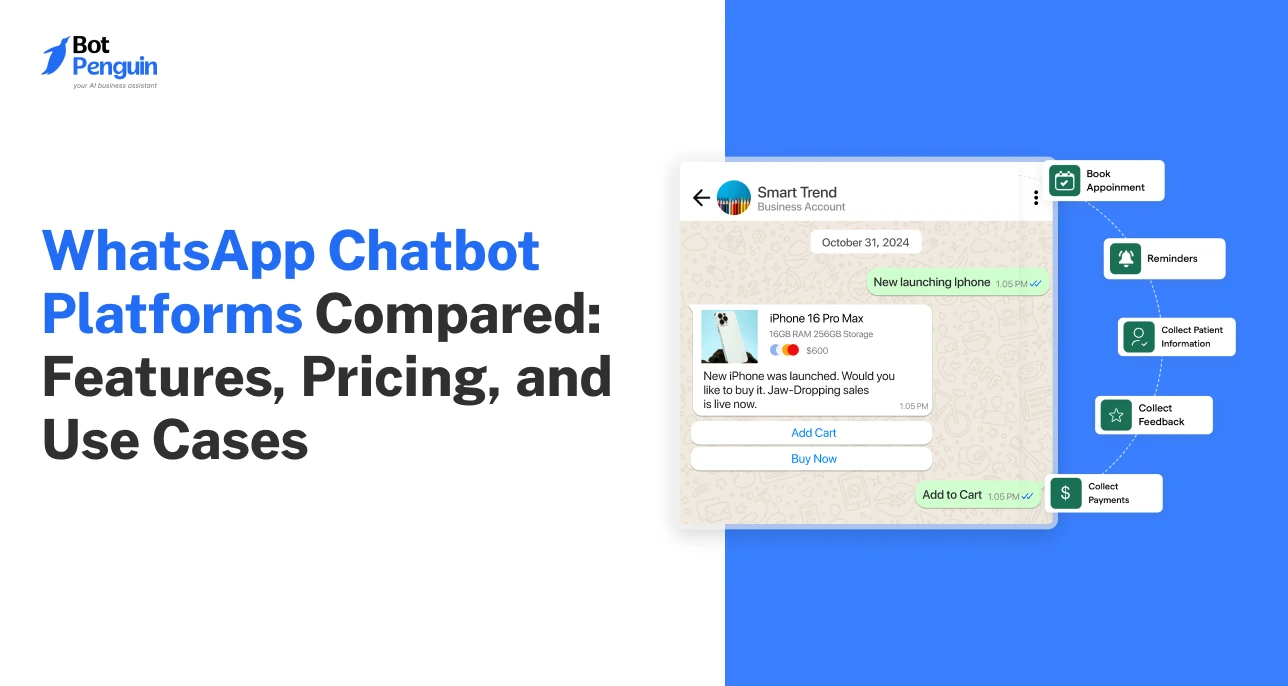
The best WhatsApp chatbot platforms in 2026 are BotPenguin for no-code AI automation, WATI for WhatsApp-first team workflows, Respond.io for omnichannel messaging, ManyChat for social marketing, and Botpress for custom AI development. The right choice depends on your automation needs, technical resources, pricing preferences, and customer communication goals.
Choosing the right WhatsApp chatbot is harder than it looks.
The market includes tools built for very different business needs. Some prioritize marketing, while others focus on support, AI, or enterprise automation.
That makes comparing the best WhatsApp chatbot platforms more important than comparing feature lists alone. If you are still exploring the basics, our WhatsApp chatbot guide explains how the technology works.
Here, we compare each platform by WhatsApp functionality, AI capabilities, automation, human handoff, integrations, usability, and pricing. We also look at real limitations, not just strengths.
By the end, you should have a clearer shortlist based on your goals, team, and technical requirements.
The best WhatsApp chatbot platforms differ in AI depth, automation, pricing, and ideal use case.
This snapshot shows where each option stands out. It also highlights the main trade-off to consider before shortlisting a platform for detailed evaluation.
Disclaimer: Pricing and feature availability were verified in August 2026. Platform fees and Meta messaging charges may change or be billed separately, so confirm current pricing before purchase.
We included WhatsApp AI chatbot platforms that can build, automate, or manage WhatsApp conversations at scale. Each option must support the WhatsApp Business Platform/API beyond basic app auto-replies.
We compared the best WhatsApp chatbot platforms using six practical criteria:
We checked API support, broadcasts, templates, rich media, and Click-to-WhatsApp ads. We also considered catalogs, commerce tools, and WhatsApp automation workflows, where available.
We assessed generative AI, contextual responses, knowledge training, and automated actions. Qualification, routing, and workflow depth also influenced our evaluation.
We looked for smooth agent takeover and shared inbox functionality. Routing, assignments, conversation context, and team collaboration also mattered.
We considered CRM, ecommerce, helpdesk, API, and webhook connections. Strong integrations should move customer data without unnecessary manual work.
We compared no-code platforms with tools requiring more technical configuration. Setup effort matters when evaluating time-to-launch.
We reviewed starting prices, usage limits, seats, contacts, and scaling costs. WhatsApp-related charges were considered separately where applicable.
Editorial disclosure: We publish this comparison at BotPenguin and include our own platform. We evaluate BotPenguin using the same criteria and disclose its relevant limitations alongside every other platform.
The best WhatsApp chatbot platforms serve different business priorities. We reviewed each option by use case, WhatsApp functionality, AI depth, pricing, strengths, and limitations.
Each review also explains who should choose the platform and when another option may fit better.
BotPenguin is a strong all-around option for growing teams. It combines WhatsApp automation, AI conversations, campaigns, and human support without requiring code.
As an official Meta Business Partner, BotPenguin also provides access to the WhatsApp Business API for compliant onboarding and automation. Its broader omnichannel setup suits businesses using multiple customer channels.
Best For: SMBs and growing teams needing one platform for WhatsApp sales, support, and marketing.
Key WhatsApp Capabilities
Its wider chatbot features also support businesses expanding beyond WhatsApp.
AI and Automation: BotPenguin supports AI-powered conversations and knowledge-based responses. Teams can combine AI with structured workflows for qualification, support, and routing.
Pros
Cons
Pricing: A Free Forever plan includes 1,000 messages and one chatbot. The Little plan starts at $29/month with 3,000 messages. See current BotPenguin pricing before comparing usage requirements.
Choose BotPenguin If...
Choose it if you want broad WhatsApp automation without heavy development. It also fits teams planning to expand across channels.
Skip BotPenguin If...
Consider a developer-first platform if you need extensive custom AI orchestration.
Verdict: BotPenguin offers a balanced mix of AI, automation, and human support. It's a strong fit for businesses that want breadth without a technical build.
WATI is built around WhatsApp-led customer communication. Its strongest areas are team inboxes, campaigns, lead capture, and structured automation.
We see it fitting teams that treat WhatsApp as their primary customer channel.
Best For: Support, sales, and marketing teams operating mainly through WhatsApp.
Key WhatsApp Capabilities
AI and Automation: WATI includes automation triggers and AI Copilot credits. More advanced chatbots are available on higher plans. Its Astra AI Agents feature adds AI agents for WhatsApp.
Pros
Cons
Pricing: Growth starts at $39/month when billed annually. It includes three users and 15,000 monthly broadcasts. Astra Pro starts at $79/month annually for WhatsApp AI agents.
Choose WATI If...
Choose WATI if WhatsApp drives most customer conversations. It works especially well for team-based campaign and support workflows.
Skip WATI If...
Look elsewhere if you need deeper omnichannel management across many messaging channels.
Verdict: WATI is a focused choice for businesses centered on WhatsApp. Its costs can increase as automation and AI requirements become more advanced.
Respond.io works best when WhatsApp is one channel among several. Its strength lies in centralized messaging, routing, automation, and team management.
It suits structured operations better than simple chatbot deployments.
Best For: Growing teams managing WhatsApp alongside other customer messaging channels.
Key WhatsApp Capabilities
AI and Automation: Starter includes AI Prompt and AI Assist. AI Agents and workflow automation begin on the Growth plan. Teams can use these features for qualification, routing, and automated responses.
Pros
Cons
Pricing: Starter costs $79/month. Growth costs $159/month and adds broadcasts, workflows, AI Agents, and developer API access.
Choose Respond.io If...
Choose it when your team manages several messaging channels. It suits businesses needing structured routing and conversation operations.
Skip Respond.io If...
Skip it if you only need straightforward WhatsApp automation at a lower entry cost.
Verdict: Respond.io is strongest as an omnichannel messaging platform. Its richer automation comes with a higher starting investment.
ManyChat is strongest when WhatsApp supports a broader social marketing strategy. Its visual automations connect WhatsApp with Instagram and Messenger workflows.
It is particularly useful for creators, marketers, and social-led businesses.
Best For: Marketing teams generating and nurturing leads through social messaging channels.
Key WhatsApp Capabilities
AI and Automation: ManyChat Pro includes advanced automations and AI-powered conversations. Teams can train AI around their business and communication style.
Pros
Cons
Pricing: Pro starts at $29/month when billed annually. It includes 2,500 active contacts and any three eligible channels. Additional active contacts incur extra charges.
Choose ManyChat If...
Choose ManyChat if social media drives your acquisition strategy. It fits marketing-led WhatsApp journeys especially well.
Skip ManyChat If...
Consider another platform for complex support operations or developer-led AI workflows.
Verdict: ManyChat remains a strong social marketing choice. Its greatest value comes from connecting WhatsApp with other social channels.
Tidio approaches WhatsApp from a customer-support perspective. It combines live conversations with its Lyro AI Agent and broader service tools.
That makes it useful for ecommerce teams already managing customer queries across channels.
Best For: Small and midsize ecommerce teams prioritizing customer service and AI-assisted support.
Key WhatsApp Capabilities
AI and Automation: Lyro uses knowledge-based responses to resolve common customer questions. It can also hand conversations to human agents when needed.
Pros
Cons
Pricing: Tidio offers a free plan. Lyro AI Agent starts at $32.50/month for 50 AI conversations. WhatsApp integration itself is available across Tidio plans.
Choose Tidio If...
Choose Tidio if incoming ecommerce support is your main priority.
Skip Tidio If...
Skip it if broadcasts, proactive campaigns, or outbound WhatsApp automation are essential.
Verdict: Tidio fits support-led ecommerce teams better than campaign-led marketers. Its inability to initiate WhatsApp conversations is an important limitation.
Chatbase focuses on building AI agents around company knowledge. Businesses can train agents using their content, then connect them to WhatsApp.
Its strongest use case is quickly answering knowledge-heavy customer questions.
Best For: Businesses wanting an AI support agent trained on existing business information.
Key WhatsApp Capabilities
AI and Automation: Chatbase centers its product around LLM-powered agents. Paid plans provide advanced models, integrations, analytics, and AI actions. Agents can use company knowledge to produce contextual answers.
Pros
Cons
Pricing: The Hobby plan starts at $40/month. It includes 700 message credits, advanced models, and integrations. Higher tiers add API access, outbound campaigns, and advanced integrations.
Choose Chatbase If...
Choose it when accurate knowledge-based answers matter most. It suits support and information-heavy conversations.
Skip Chatbase If...
Look elsewhere for deep WhatsApp commerce, broadcast, or marketing automation.
Verdict: Chatbase is strongest as an AI knowledge layer connected to WhatsApp. It is less complete as a WhatsApp marketing platform.
Botpress provides significantly more control than most no-code WhatsApp tools. Developers can build custom AI agents, connect external systems, and design complex workflows.
That flexibility also means more configuration work.
Best For: Technical teams building custom WhatsApp AI agents and business workflows.
Key WhatsApp Capabilities
AI and Automation: Botpress supports visual workflows, autonomous AI behavior, APIs, and external integrations. Teams can combine custom logic with AI models and structured actions.
Pros
Cons
Pricing: Pay-as-you-go starts at $0/month plus AI spend. It includes a $5 monthly AI credit. Plus costs $79/month annually, plus AI spend.
Choose Botpress If...
Choose Botpress when custom logic and extensibility matter more than turnkey setup.
Skip Botpress If...
Choose a simpler no-code platform if your team lacks technical resources.
Verdict: Botpress is one of the stronger developer-oriented choices. Its flexibility is valuable, but implementation requires more technical involvement.
Landbot stands out for its visual conversation builder. Teams can create structured WhatsApp journeys without building the interface from code.
It works especially well for lead capture and guided interactions.
Best For: Teams that prioritize visual flow design and structured, no-code WhatsApp experiences.
Key WhatsApp Capabilities
AI and Automation: Landbot combines visual flows with AI Assistants and AI chats. This allows teams to mix structured journeys with AI responses.
Pros
Cons
Pricing: WhatsApp Pro costs €200/month. Paying annually reduces the effective rate to €160/month. It includes one WhatsApp Business number and 500 AI chats per month.
Choose Landbot If...
Choose Landbot if visual conversation design is a major priority.
Skip Landbot If...
Consider another tool if budget or WhatsApp-first campaign depth matters more.
Verdict: Landbot offers a polished visual building experience. Its WhatsApp-specific pricing is the main tradeoff.
AiSensy is heavily focused on WhatsApp marketing and customer acquisition. Its tools cover broadcasts, campaigns, CTWA, catalogs, and chatbot automation.
This makes it particularly relevant for marketing-led WhatsApp operations.
Best For: Businesses using WhatsApp heavily for campaigns, lead capture, and customer engagement.
Key WhatsApp Capabilities
AI and Automation: AiSensy offers separate no-code chatbot and AI Agent builders. The AI Agent supports knowledge-based responses, memory, routing, and API integrations.
Pros
Cons
Pricing: The WhatsApp Chatbot Builder starts at $80/month. The AI Agent Builder starts at $99/month. Both are separate add-ons to the main AiSensy platform.
Choose AiSensy If...
Choose it if campaigns and WhatsApp lead generation drive your strategy.
Skip AiSensy If...
Consider another tool if advanced omnichannel AI matters more than WhatsApp marketing.
Verdict: AiSensy is strongest for WhatsApp-led campaigns and acquisition. Buyers should budget separately for the chatbot and AI add-on costs.
Yellow.ai targets larger businesses with complex conversational automation requirements. It combines AI agents, workflows, integrations, and multiple communication channels.
Its depth fits enterprise operations better than basic SMB use cases.
Best For: Enterprises needing large-scale AI automation across WhatsApp and other channels.
Key WhatsApp Capabilities
AI and Automation: Yellow.ai supports agentic AI across chat, voice, email, and messaging. It also offers multilingual workflows and enterprise integrations. Teams can connect agents with systems such as CRM, support, and enterprise applications.
Pros
Cons
Pricing: Yellow.ai offers a free plan with one AI agent and 500 monthly chat sessions. Enterprise pricing is customized around business requirements.
Choose Yellow.ai If...
Choose it when scale, integrations, and enterprise AI are primary requirements.
Skip Yellow.ai If...
Choose a lighter platform if you need simple WhatsApp automation and predictable SMB pricing.
Verdict: Yellow.ai is built for sophisticated enterprise deployments. Smaller businesses may find its scope and implementation requirements excessive.
Across these platforms, the strongest choice depends on what you need WhatsApp to do. AI depth, campaign tools, team workflows, pricing, and technical effort vary significantly.
Next, match those differences to your specific use case to narrow the shortlist without comparing every feature again.
The right shortlist depends on your primary WhatsApp workflow. Use these recommendations to narrow your options before comparing implementation effort and total cost.
Best fit: BotPenguin
Choose BotPenguin when you need one workflow from lead capture through qualification and handoff. ManyChat is better for social-first acquisition, while AiSensy suits broadcast-heavy campaigns.
If acquisition is your priority, our WhatsApp lead generation guide provides additional context.
Best fit: WATI
Choose WATI when WhatsApp is your team's primary support channel. BotPenguin is the stronger alternative when AI-led automation and human takeover are equally important.
Best fit: Tidio
Choose Tidio when incoming ecommerce support drives most conversations. Consider BotPenguin for broader automation, or AiSensy when campaigns matter more than support.
Best fit: Chatbase or Botpress
Choose Chatbase for knowledge-driven customer conversations. Botpress makes more sense when developers need greater control over logic and integrations.
Landbot remains suitable for teams prioritizing visual no-code flow design.
Best fit: Respond.io or Yellow.ai
Choose Respond.io when WhatsApp sits alongside several messaging channels. Yellow.ai is better suited for complex enterprise deployments that require broader AI orchestration.
Start with the workflow that matters most. Then compare setup effort, required add-ons, and actual monthly cost before deciding.
There is no universal winner among the best WhatsApp chatbot platforms. The right choice depends on your goals, workflows, team size, and technical resources.
Look beyond feature counts when making the final decision. Prioritize useful automation, easy setup, reliable handoff, integrations, and sustainable pricing. The platform should also support your needs as WhatsApp usage grows.
For businesses seeking a broad no-code option, BotPenguin WhatsApp chatbot is worth considering. It combines AI conversations, automation, campaigns, and human support into a single platform.
This makes it suitable for teams that want a simpler starting point without limiting future WhatsApp workflows as their customer communication needs expand.
The best choice depends on your use case. BotPenguin suits broad no-code automation, while other WhatsApp chatbot platforms may fit specialized needs like social marketing, custom AI development, enterprise automation, or omnichannel conversation management.
Yes. Businesses can connect an AI chatbot through the WhatsApp Business Platform/API. The chatbot can then answer questions, qualify leads, trigger workflows, and hand conversations to human agents, depending on the platform’s capabilities.
Advanced automation generally requires the WhatsApp Business Platform/API. The standard WhatsApp Business App supports basic tools like greetings and quick replies but does not provide the same automation, integrations, or scalable chatbot functionality.
Yes, some WhatsApp chatbot platforms offer free plans or limited free usage. However, businesses may still incur Meta messaging charges, usage fees, or costs for advanced features, additional contacts, AI conversations, or higher message volumes.
The total cost varies by provider and usage. Pricing may include the platform subscription, AI or message usage, team seats, contact limits, paid add-ons, and separate Meta messaging charges for eligible WhatsApp conversations.
The WhatsApp Business API provides the messaging infrastructure businesses use to communicate at scale. A chatbot platform adds the automation layer, including AI responses, workflows, routing, campaigns, integrations, and human handoff features.
Yes, if the platform supports bot-to-human handoff. The chatbot can route a conversation to an available agent, often through a shared inbox, while preserving context so the customer does not need to repeat information.
3X Your Business
Growth on WhatsApp
See how our chatbot automates replies, qualifies leads & books appointments on autopilot.
Watch Demo NowCheckout our related blogs you will love.
Updated at Sep 24, 2026
7 min to read
Updated at Sep 24, 2026
9 min to read
Updated at Aug 13, 2026
8 min to read
Updated at Jul 24, 2026
6 min to read
Updated at Oct 8, 2026
14 min to read
Updated at Oct 7, 2026
12 min to read
Table of Contents