


What is a White-Label Chatbot? Complete Guide For 2026
Updated at Oct 23, 2026
10 min to read
Every store looks the same eventually. That's why becoming a white label ecommerce reseller by selling another store builder is a losing bet. You rebrand it, launch it, and clients leave for something cheaper six months later. Nothing keeps them there.
Ecommerce automation works differently. Cart recovery, WhatsApp commerce, order tracking - these run inside a client's business every single day. They touch real revenue, not just design.
That's what smart resellers do now. They stop selling stores and start selling automation.
This guide shows you exactly what to rebrand and sell in 2026.
Most people confuse reselling with rebranding. They are not the same thing, and that difference decides how much money you actually keep from every client you sign.
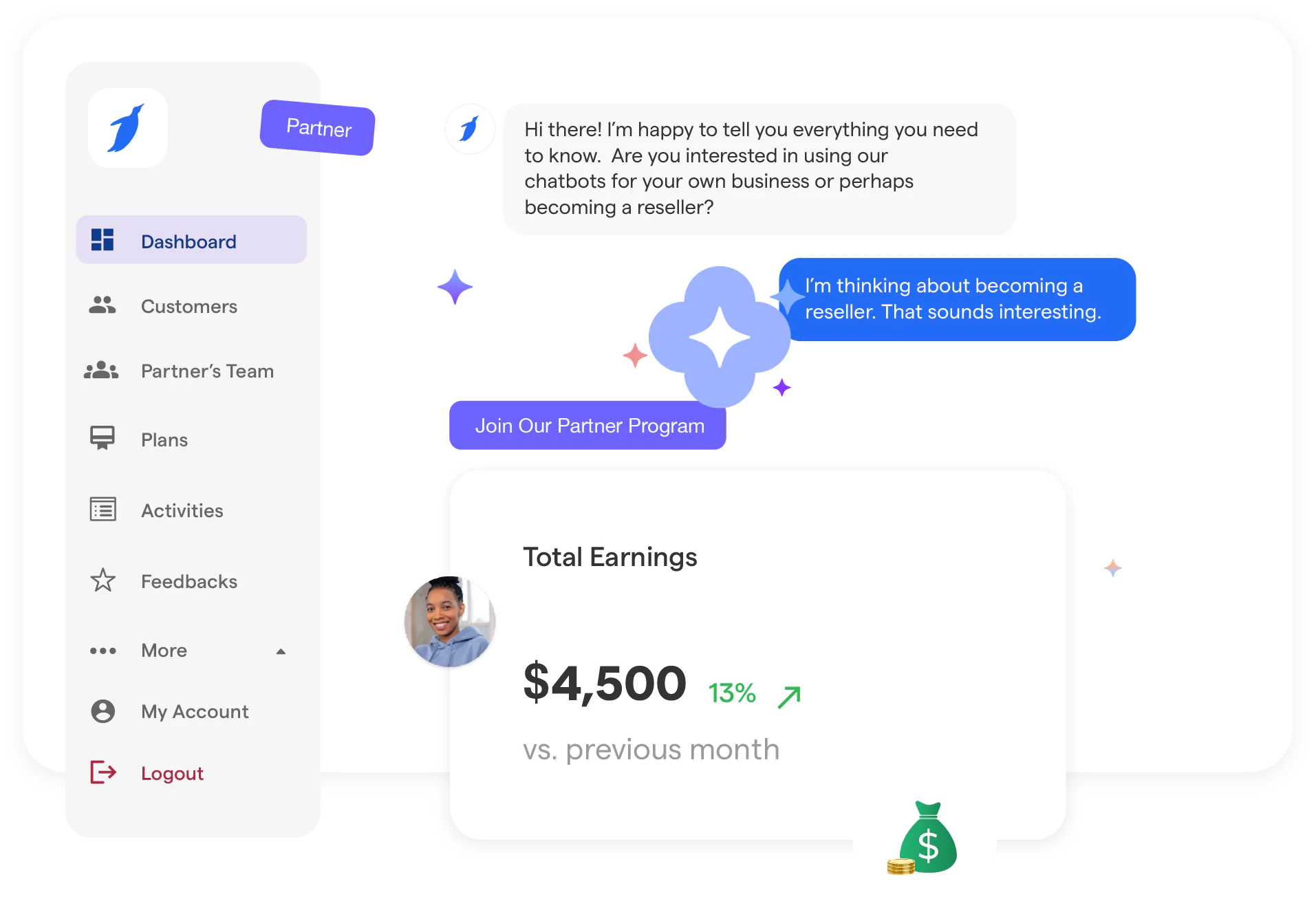
A white label ecommerce reseller is an agency, consultant, or freelancer who takes ecommerce automation built by someone else and sells it under their own name. The software is built and maintained by a vendor. You control the branding, set the pricing, and own every client relationship. Your client never sees the vendor. They see you.
This is different from commission-based reselling. In that model, you sell someone else's branded product and earn a cut. You build no asset of your own. As a white label reseller, you build a brand. You set your prices. You keep the full revenue from each client, not a percentage of it.
That ownership is what makes the model worth pursuing long-term, and it is the same reasoning behind White Label business opportunities across every vertical, not just ecommerce.
Ownership sounds good until you check what you actually own. Most white label ecommerce software still points agencies toward store builders, and that choice quietly caps income before the first client is even signed.
A store builder resale is a one-time project. You launch the store, collect payment, and move to the next client. The market is saturated with Shopify clones and WooCommerce templates, so buyers compare on price because every option looks the same. Once the site goes live, your role in that account ends.
Automation resale runs on a different timeline. It works every day, inside the client's business:
None of this is a one-time build. It is a system that touches the client's revenue continuously, and the client can measure the result directly in recovered carts and answered queries.
That measurable outcome changes the entire relationship. Automation resale earns higher margins, keeps clients on retainer longer, and makes switching to a competitor expensive for the client to justify. A store is easy to replace. A system that recovers revenue every day is not.
That daily automation is not one product. It is a full stack. Ecommerce automation is one of several types of white label SaaS agencies can rebrand, package, and sell under their own name.
With BotPenguin, agencies can resell e-commerce solutions across four channels, all rebranded under their own name.
For e-commerce clients in MENA, India, and LATAM, WhatsApp is often the primary buying channel, not a side channel. This is where reselling pays off fastest.
Agencies can resell white label WhatsApp commerce that lets shoppers browse full product catalogs inside the chat window. It supports WhatsApp product catalogs and multi-product flows that let buyers add several items before checkout. No separate app. No redirect. The sale happens inside the conversation the customer already trusts.
This is the easiest automation to sell and the easiest to renew, because the result shows up in the client's numbers every month.
Cart recovery flows reach out to shoppers who added items and left before paying, using triggers like time delay and product value. Order tracking automation handles the rest of the journey:
Clients see fewer support tickets and more completed checkouts. Both are numbers they already track, which makes renewal an easy conversation.
Product questions and order status queries pile up fast, especially outside business hours. This is where an ecommerce chatbot for agencies to resell earns its place in the stack.
These bots answer product and order questions around the clock, on the client's website, Instagram, and Facebook, all under the agency's brand. Lead capture flows run alongside them, turning store visitors who are not ready to buy into contacts the client can follow up with later. No client ever sees BotPenguin. They see their own brand, working.
For a closer look at how these bots are built and deployed, see White Label AI agents for ecommerce.
Launching this business does not take months. It takes days, and the fastest path starts with a client you already work with.
Start with one existing client who has a clear, measurable problem. Abandoned carts piling up, WhatsApp replies running slow, or an order status inbox nobody has time for. That single account becomes your first deployment and your first case study to show future clients.
Getting live is simpler than most agencies expect. Join a White Label Chatbot Partner Program, add your brand, your domain, and your pricing, and deploy your first client from a ready template in a matter of hours.
BotPenguin's white label plan starts at $1,500 per year and covers unlimited client deployments, so every client signed after the first adds pure margin. Set your own pricing in local currency, bill clients directly, and keep the full revenue.
Prove the result on that first account, turn it into a case study, then repeat the same process across your ecommerce client book. That loop, one client proven and repeated, is the entire model.
80,000+ businesses · 193 countries · 250+ white label partners ·
BotPenguin is GDPR, HIPAA, and CCPA compliant, ISO certified, SOC 2 attested, and VAPT assessed by a CERT In empanelled auditor.
The math behind this model is simple. Platform cost stays fixed at $1,500 per year regardless of how many clients you sign, so margin grows with every deployment after the first one to three clients cover that cost.
The scale of the opportunity is real too.
According to the Baymard Institute, the average documented cart abandonment rate sits at 70.22 percent across ecommerce, meaning roughly seven out of ten shoppers who add a product to their cart never complete the purchase (source: Baymard Institute). Every client an agency signs has this problem already happening inside their store. That is the gap cart recovery automation is built to close.
Exceptional Service & Tech – Highly Recommend!
I’ve had the absolute best experience working with the BotPenguin team. They are always available, incredibly responsive, and their support is second to none. Feedback is always timely, and they go above and beyond to ensure every query or request is addressed quickly and professionally.
Partner
South Africa
A white label ecommerce reseller is a business that takes ready-made ecommerce software or automation, rebrands it, and sells it to clients under its own name. The vendor builds and maintains the technology. The reseller owns the brand, the pricing, and the client relationship, while the vendor stays completely invisible. Unlike commission-based reselling, a white label reseller keeps the revenue and builds its own brand asset. In ecommerce specifically, that usually means rebranding automation such as WhatsApp commerce, cart recovery, order tracking, and support bots, rather than a store builder, because automation embeds in the client's daily operations and earns recurring revenue.
No. You do not need to build, host, or maintain an online store to become a white label ecommerce reseller. That is the difference between reselling a store builder and reselling ecommerce automation. With a platform like BotPenguin, you rebrand ready-made automation, including WhatsApp product catalogs, cart recovery flows, order tracking, and AI support bots, and deploy it onto your clients' existing stores. There is no infrastructure to manage and no code to write. Your job is branding, client relationships, and results, which is exactly what most agencies already do well.
Earnings scale with the number of clients you sign, because the platform cost is fixed while client revenue is not. BotPenguin's white label plan starts at $1,500 per year and covers unlimited client deployments, so once you have covered that fixed cost, usually within your first one to three clients, each additional client adds margin. You set your own client pricing in local currency and keep the revenue. A reseller with ten ecommerce clients on modest monthly retainers can build a healthy recurring revenue line from a single annual platform fee.
With BotPenguin, you can rebrand and resell a full stack of ecommerce automation under your own brand. That includes WhatsApp commerce and product catalogs customers browse inside the chat, cart recovery flows that re-engage shoppers who dropped off, order tracking and order management automation, AI support bots that answer product and order questions around the clock, and lead capture flows. Everything deploys across WhatsApp, website, Instagram, and Facebook from one platform, fully rebranded with your domain, logo, and pricing, so your clients only ever see your brand.
For most agencies, yes. Reselling a store builder means competing in a crowded, price-driven market where your value ends once the store is live. Reselling ecommerce automation is stickier and higher margin because it runs every day inside the client's operations, recovering carts, answering buyers, and tracking orders, producing measurable outcomes the client can see. That creates real switching costs and supports recurring retainers instead of one-off builds. Automation also ties directly to revenue, which makes it far easier to justify and renew than a website project.
No. Modern white label ecommerce platforms are built to be no code. BotPenguin's partner dashboard lets you deploy branded ecommerce automation for clients across WhatsApp, website, and social channels in hours, using ready-made templates, with no developer team and no coding required. You handle branding, pricing, and the client relationship, while the platform handles the technology and maintenance. This is what makes white label ecommerce reselling accessible to agencies, consultants, and freelancers who understand ecommerce clients but do not want to build or maintain software.
None of this required a single line of code or a new store. That is the point. A white label ecommerce reseller does not sell websites. They sell the automation that makes existing stores more profitable, every single day.
Cart recovery, WhatsApp commerce, order tracking, and AI support all run continuously and tie directly to revenue the client can measure. That is what makes automation stickier and higher margin than any store builder resale will ever be.
Become a BotPenguin partner and start reselling branded ecommerce automation, with plans starting from $1,500 per year.
Launch Your White Label E-commerce Offer, Plans from $1,500/yr
Rebrand WhatsApp commerce, cart recovery, order tracking, and AI support automation. Set your own pricing and sell everything under your brand.
Become a PartnerCheckout our related blogs you will love.
Updated at Oct 23, 2026
10 min to read
Updated at Oct 9, 2026
8 min to read

Updated at Oct 9, 2026
12 min to read
Updated at Oct 7, 2026
15 min to read
Updated at Oct 6, 2026
9 min to read
Updated at Sep 28, 2026
19 min to read
Table of Contents
