11 Best White Label AI Software Platforms in 2026

Partner

Updated On Dec 18, 2025

19 min to read

BotPenguin AI Chatbot maker

AI has never been more accessible. And that changes everything.

You no longer need a large team, deep technical skills, or months of development to launch AI-powered products. The barrier to entry has dropped fast. What matters now is how quickly you can go to market and how much control you keep.

This shift has pushed many businesses toward white label AI software. It allows agencies, SaaS founders, and consultants to offer AI solutions under their own brand without building anything from scratch. 

In this guide, we break down the best white label AI software available today, how each platform compares, and which options make the most sense if your goal is speed, scalability, and predictable revenue.

What is White Label AI Software?

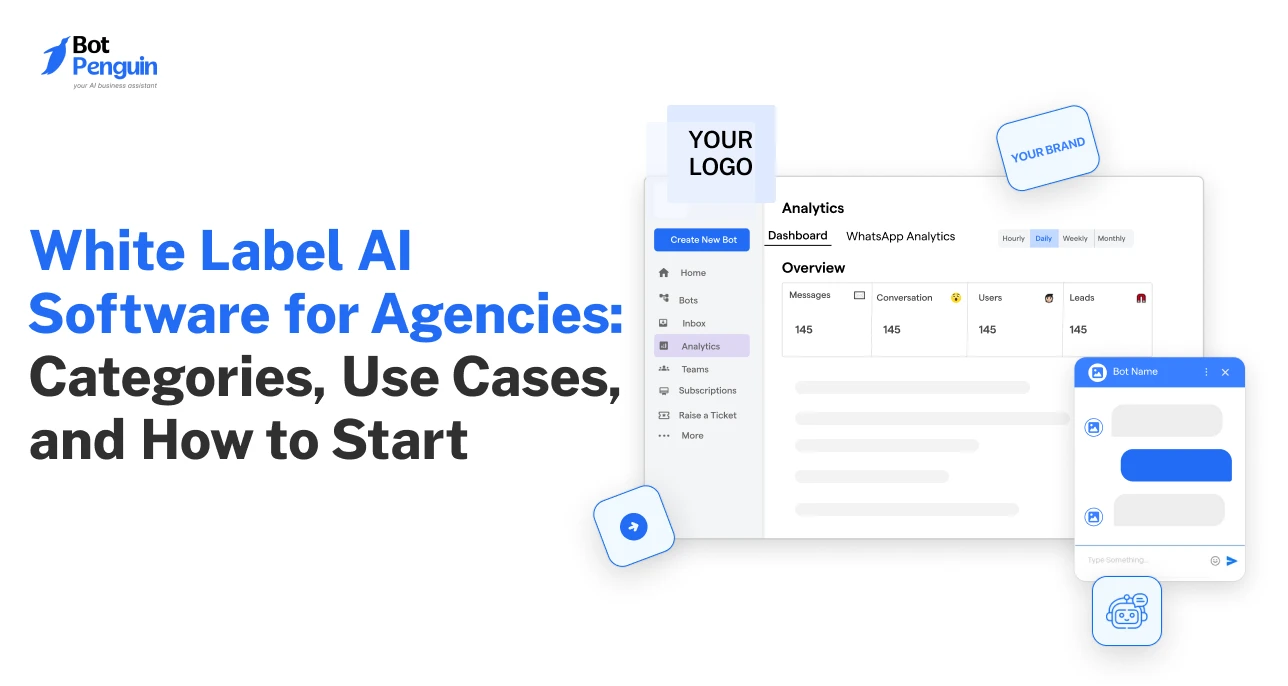
White label AI software is a prebuilt artificial intelligence platform that a business can fully rebrand and sell as its own product. 

The technology, including AI models, infrastructure, and updates, is developed and maintained by the provider, while the business using the platform controls branding, pricing, customer access, and distribution.

Who Should Use White Label AI Software?

From the previous section, one thing is clear. White label AI software works best when it fits into an existing service or product motion. 

The biggest gains come from businesses that already manage clients, platforms, or communication flows and want to add AI without increasing operational load.

Digital Agencies and Marketing-Led Businesses

Digital agencies already manage conversations at scale. Lead capture, follow-ups, support, and campaign responses are part of daily work. Adding AI improves margins, not complexity.

Agencies offering CRM services, such as Zoho partners, Bitrix24 partners, and CRM resellers, can bundle AI chat and automation as an add-on. 

A client using CRM for sales can also get AI-driven lead qualification and support inside the same workflow using white label AI for agencies.

The same applies to digital marketing agencies, WhatsApp marketing specialists, and marketing automation companies. 

For example, an agency running WhatsApp campaigns can resell AI-based response handling under its own brand. Acting as an AI reseller for agencies, revenue grows through recurring subscriptions instead of one-time campaign fees.

SaaS Founders, Platform Builders, and Product Teams

SaaS teams are under pressure to ship AI features early. Customers expect smart onboarding, instant support, and automated workflows from day one.

Founders building CRM platforms, ticketing platforms, e-commerce platforms, or communication tools can integrate white label AI for SaaS to cover these expectations. 

A ticketing platform can add AI-based issue classification. A CRM product can add AI assistants for sales reps. This creates an AI product without development cycles or long hiring timelines.

The result is faster launches, controlled costs, and the ability to test AI features before committing engineering resources.

Developers, Consultants, and IT Service Providers

Many technical service providers already design systems but depend on third-party tools to deliver intelligence. White label AI removes that dependency.

Web development agencies, WordPress developers, Shopify developers, and general tech developers can include AI chat, support, or automation as part of their builds. An ecommerce developer can ship a store with AI-powered customer support included.

IT resellers, IT solution providers, consultancy firms, and cloud communication providers such as email service providers, SMS service providers, cloud telephony, and IVR vendors can package AI as a standard layer across client solutions. 

As an AI automation reseller, services become repeatable products backed by white label AI solutions, not custom effort.

Educators, Influencers, and Training Focused Businesses

Education-driven businesses often need real tools to support their content. Trainers teaching WhatsApp automation or conversational AI can offer branded AI tools to students. Influencers and content creators can monetize reach by reselling AI platforms aligned with their audience's needs.

White label AI software fits businesses that already sell software, services, or communication outcomes. It rewards scale, repeatability, and ownership. 

The next step is understanding how to evaluate platforms that support these use cases without limiting growth or margins.

How We Evaluated the Best White Label AI Software

Not all platforms that claim to be white label are built for real resale or scale. 

This section explains the exact criteria used to identify platforms that genuinely qualify as the best white label AI software, based on business outcomes rather than marketing claims.

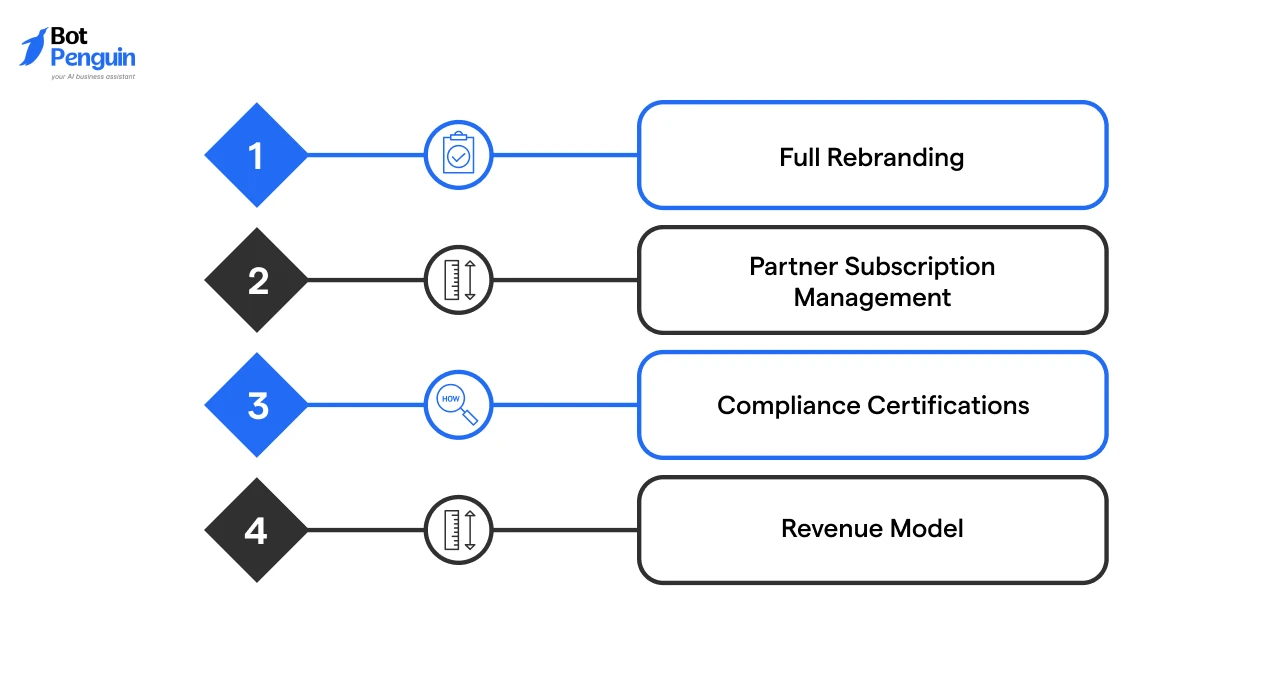
White Label Depth and Control

We assessed whether the platform allows full brand ownership. This includes branded dashboards, domains, and client-facing interfaces.

Platforms that expose the original vendor to end customers were deprioritized.

Pricing and Revenue Ownership

We reviewed who controls pricing and customer billing. Platforms that force revenue sharing or limit margin flexibility scored lower. 

Resellers must own customer relationships and monetization to scale sustainably.

Client and Account Management

We examined how platforms handle multiple customers. For example, an agency managing ten clients needs separate access, usage tracking, and permissions. 

Platforms without proper account isolation were excluded.

Integration and Deployment Readiness

We evaluated how easily the AI connects with CRM, websites, messaging channels, and internal tools. 

Platforms that require heavy custom development were ranked lower, as they slow adoption.

Scalability and Operational Fit

We looked at how platforms perform as usage grows. A solution suitable for one client but difficult to replicate across many does not support long-term growth.

How This Evaluation Helps Buyers

These criteria reflect how businesses actually choose white label AI in practice. A SaaS founder values fast feature rollout. 

An agency values repeatable client delivery. A consultant values predictable implementation. Each platform was reviewed against these real scenarios.

Transparency and Independence

No platforms paid for placement. Rankings are based solely on product capability and resale readiness. This ensures the list remains objective and useful for decision-making.

This framework removes guesswork and narrows options to platforms built for resale and scale. 

With the criteria established, the next section presents a direct comparison of the top white label AI platforms and how they perform against these benchmarks.

Quick Comparison Table of White Label AI Software

Before delving into individual tools, this table provides a high-level comparison to support quick decision-making. It is designed for readers who want clarity at a glance without reading long descriptions. 

The comparison focuses on which platforms are best suited to each use case, the level of pricing control you get as a reseller, and the depth of branding available across client-facing touchpoints.

This helps you immediately narrow down which white label AI platforms align with your business model and resale goals.

Platform

Best For

Pricing Control

Branding Depth

BotPenguin

Agencies and SaaS resellers selling chatbots at scale

Full control over plans, billing, add-ons, and margins

Complete platform-level branding

Instabot

Marketing agencies focused on lead generation bots

Partial control based on a plan

Strong widget and dashboard branding

WotNot

Agencies needing WhatsApp and enterprise chatbot use cases

Full reseller pricing control

Full domain and UI branding

Engati

Enterprise-focused agencies with global clients

Flexible enterprise pricing

Deep branding on enterprise plans

ChatCompose

Small agencies managing many simple bots

Moderate control

Widget and dashboard branding

Tidio

SMB focused support and ecommerce chat

Limited control tied to usage

Branding removal on higher plans

SendPulse

Agencies offering multi-channel marketing automation

Partial control with agency accounts

Limited platform branding

Botsify

Agencies selling AI chat and voice agents

Full reseller pricing control

Full white label dashboard and domain

Botpress

Developer-led teams building custom AI products

Fully custom pricing models

Full branding when self-hosted

Writesonic

Content and SEO agencies reselling AI writing tools

High control over enterprise plans

Full platform branding on the enterprise

CustomGPT

Agencies deploying data-trained AI assistants

Flexible pricing per client

Complete white label experience

Key Takeaway

If your goal is to build a resale business with strong ownership, platforms offering full pricing control and deep branding provide the most long-term margin and retention. 

The next section breaks down how to choose the right platform based on your business maturity and resale strategy.

List of the Best White Label AI Software Platforms

The comparison table helps narrow categories. This section goes one level deeper. Each platform type below is mapped to a specific business model. 

The goal is not to list names blindly, but to explain which type of platform fits which resale scenario, based on branding control, revenue ownership, and operational scale.

1. BotPenguin

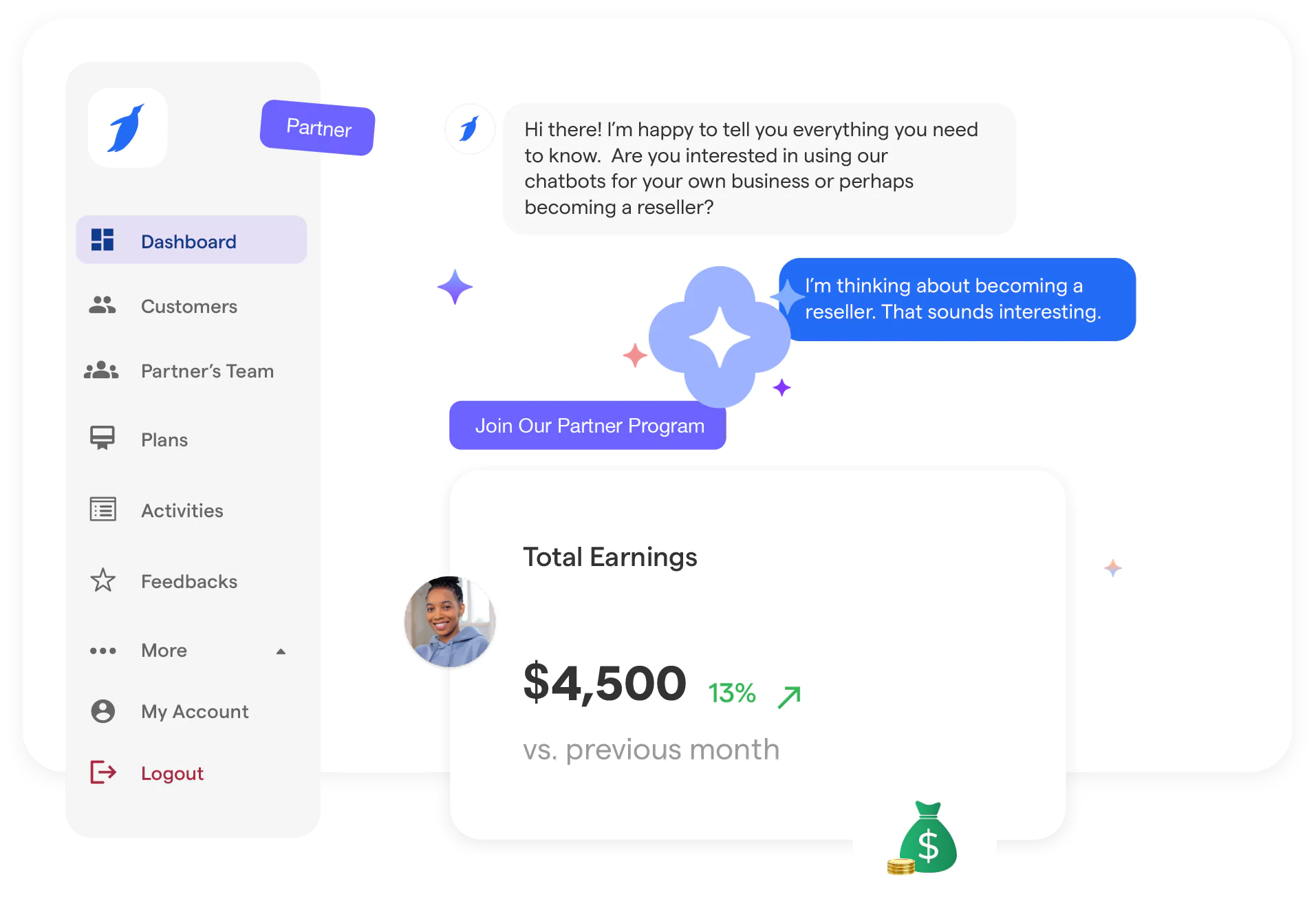
BotPenguin Whitelable Chatbot Dashboard

BotPenguin is a no code white label AI chatbot platform built for agencies, consultants, and businesses that want to sell AI chat automation under their own brand. 

It supports multiple channels including websites, WhatsApp, Instagram, Facebook, and Telegram. The platform allows partners to launch a fully branded chatbot business without building or maintaining AI infrastructure.

Features

  • Omnichannel chatbot builder: Build once and deploy across websites, WhatsApp, Instagram, Facebook, and Telegram, allowing agencies to offer consistent AI driven conversations across every customer touchpoint.
     
  • Multi AI model compatibility: Choose between OpenAI, Claude, or Gemini per bot or client, making it easy to balance response quality, cost control, and use case requirements.
     
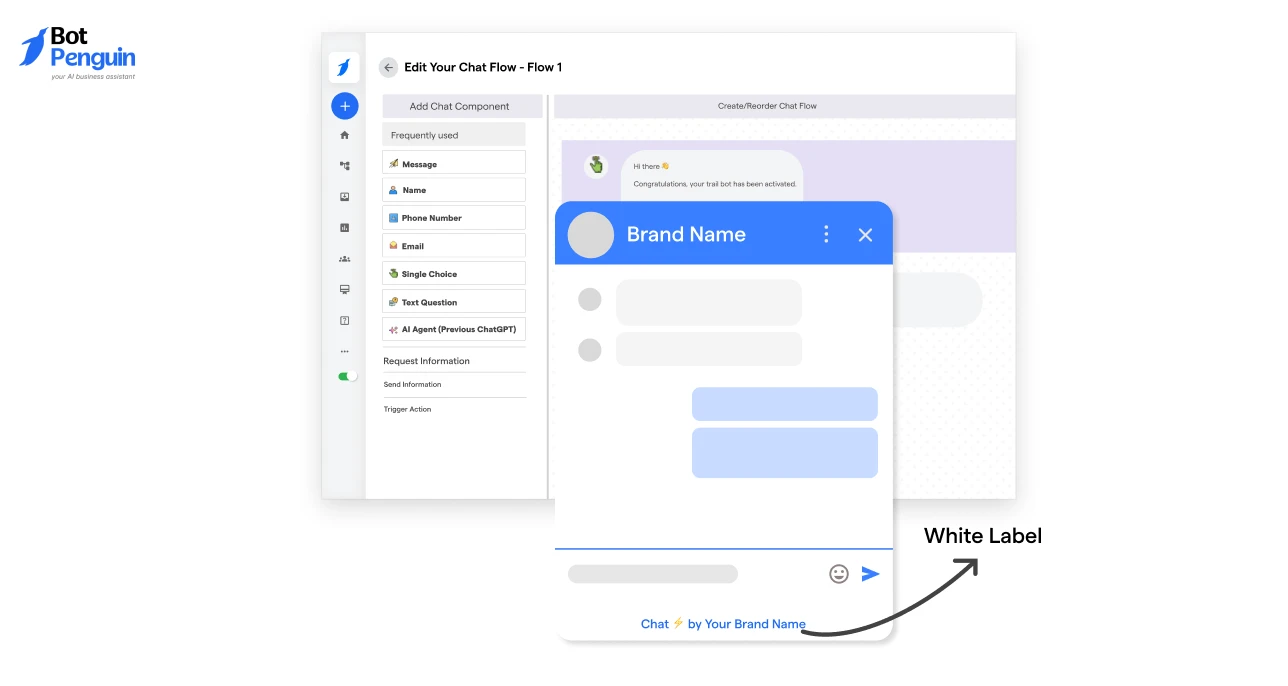
  • Complete white label control: Run the platform under your own brand with custom logo, interface, emails, and domain so clients experience it as your proprietary software.
     
  • Scalable client account management: Create and manage unlimited client workspaces with separate access roles, usage limits, and environments for clean multi client operations.
     
  • Flexible pricing and plan setup: Set custom subscription plans, usage caps, and feature access for each client, enabling predictable recurring revenue and margin control.
     
  • Business system integrations: Connect chatbots with CRM, helpdesk, calendars, and internal tools so bots can fetch data, trigger actions, and automate workflows.
     
  • Live chat with human takeover: Switch conversations to human agents instantly when needed while keeping AI active for follow ups and off hour responses.
     
  • Usage analytics and reporting: Monitor conversations, engagement, and client level usage data to optimize performance and justify ongoing client renewals.

Pros

  • Fast time to market: Agencies and consultants can start selling AI chatbots quickly without development work.
     
  • Full pricing and revenue ownership: Partners set their own pricing and billing. Clients pay the reseller directly, allowing predictable margins and recurring revenue.
     
  • Suitable for non-technical teams: The no-code setup makes it accessible for sales and marketing teams to manage chatbot delivery.
     
  • Strong support for resale use cases: The platform is designed specifically for white label partners rather than end users.

Cons

  • Advanced configurations require learning time: While basic setup is simple, advanced workflows and integrations may require time to understand.
     
  • White label access is part of paid plans: Complete branding control is available through white label plans rather than free tiers.

How It Works

After joining the white label program, partners receive access to a branded dashboard. Branding, domain, and pricing are configured first. Chatbots are then created using the builder and connected to required channels and tools. 

Client accounts are added under the partner brand. BotPenguin manages AI models, hosting, updates, and security, while the reseller focuses on selling and managing clients.

Document
Sell Your 1st Chatbot With
BotPenguin's White Label Solution

2. Instabot

Instabot is a conversational marketing chatbot platform built mainly for lead generation and customer engagement. 

Digital marketing agencies and growth teams commonly use it to capture leads, qualify prospects, and book meetings through website-based chatbots. 

Instabot offers a white label program that allows agencies to resell the chatbot builder under their own branding.

Features

  • Conversational lead capture: Instabot enables structured chat flows that collect user details, run surveys, and guide visitors toward booking meetings or submitting inquiries.
     
  • Brand customization tools: Agencies can apply their logo, colors, and styling across chatbot interfaces and dashboards to maintain brand consistency.
     
  • Multi client management: The platform allows agencies to manage multiple client chatbots from a single console with controlled access for team members and clients.
     
  • Analytics and user insights: Instabot provides dashboards to track engagement, conversion rates, and user behavior to measure chatbot performance.
     
  • AI training and intent handling: Chatbots can be trained to recognize common queries and respond using predefined logic combined with AI understanding.

Pros

  • Strong for marketing focused use cases: Instabot performs well in lead generation, landing page conversion, and appointment booking scenarios.
     
  • Easy to use interface: The chatbot builder is intuitive and suitable for marketing teams without technical expertise.
     
  • Good visual customization: Chatbot appearance can be closely aligned with brand design requirements.

Cons

  • Limited depth for complex automation: The platform focuses more on guided flows than advanced operational automation.
     
  • Full white label access depends on plan level: Complete removal of Instabot branding requires higher tier plans.

How It Works

Agencies create chatbots using a visual builder and deploy them on client websites using embed code. Branding is applied at the platform and chatbot level. 

Leads and interactions are tracked inside the dashboard. Hosting and maintenance are handled by Instabot while agencies focus on client delivery.

3. WotNot

WotNot Dashboard
Source: WotNot

WotNot is a no code chatbot platform built with white label resellers in mind. It is widely used by agencies that want to manage multiple clients and deploy chatbots across websites and messaging channels. 

The platform emphasizes scalability and operational use cases such as support, booking, and automation.

Features

  • Complete white label customization: WotNot allows partners to use custom domains, logos, colors, and interface styling across the entire platform.
     
  • Unlimited client workspaces: Agencies can create and manage unlimited client accounts with isolated data and chatbot setups.
     
  • Multi channel chatbot deployment: Chatbots can be deployed on websites and messaging platforms including WhatsApp.
     
  • Built in integrations and APIs: The platform connects with CRM and business tools and also supports API based extensions.
     
  • Subscription and pricing management: Resellers can define their own plans and manage client subscriptions inside the platform.

Pros

  • Designed for agency scale: WotNot supports large numbers of clients without platform restrictions.
     
  • Strong WhatsApp automation support: It is frequently used for WhatsApp based customer interactions and workflows.
     
  • Reliable support and uptime: Agencies report stable performance even with high chatbot volumes.

Cons

  • Advanced customization may require technical input: Some complex workflows require developer assistance or API usage.
     
  • Learning curve for deeper features: While basic setup is easy, advanced configurations take time to master.

How It Works

Agencies receive a white labeled platform instance and configure branding and domain. Client accounts are created inside the dashboard. 

Chatbots are built using templates or custom flows and deployed on client channels. WotNot manages infrastructure and updates in the background.

4. Engati

Engati is a multi channel chatbot and customer engagement platform used by mid market and enterprise businesses. 

It offers white label capabilities through enterprise level plans and is often chosen by partners serving regulated or high volume environments.

Features

  • Multi channel support: Engati supports chatbots across websites and multiple messaging platforms from a single system.
     
  • Custom partner portal: White label partners receive a branded backend portal for managing bots and clients.
     
  • Advanced analytics and reporting: Detailed dashboards provide insight into conversations, resolution rates, and performance trends.
     
  • Enterprise grade integrations: Engati connects with CRM, ecommerce, and internal systems through APIs and webhooks.
     
  • Training and partner support: Partners receive onboarding, training sessions, and priority technical assistance.

Pros

  • Strong enterprise readiness: Engati supports role based access, compliance needs, and large scale deployments.
     
  • Wide channel coverage: Useful for businesses operating across multiple customer communication platforms.
     
  • Credibility for larger clients: The platform is widely used in enterprise environments.

Cons

  • White label access requires enterprise plans: Smaller agencies may find entry costs higher.
     
  • Advanced setup can be complex: Some configurations require technical understanding or developer involvement.

How It Works

Partners receive a branded Engati platform environment. Chatbots are created using visual flows and AI logic. Bots are deployed to required channels. 

Engati manages hosting, upgrades, and core platform stability while partners manage clients and delivery.

5. ChatCompose

ChatCompose is a chatbot platform focused on simplicity and cost efficiency. It is commonly used by small agencies and consultants who want to deploy multiple chatbots quickly under their own branding. 

The platform supports rule based and AI assisted conversations.

Features

  • White label chatbot customization: Partners can apply logos, colors, and UI styling to chatbot widgets and dashboards.
     
  • Centralized chatbot management: Multiple chatbots across clients can be managed from a single dashboard.
     
  • Notifications and alerts: Email alerts notify teams when leads are generated or support requests are triggered.
     
  • Basic AI and NLP support: Chatbots can be trained using question and answer logic for common queries.
     
  • Flexible embedding options: Chatbots can be embedded on websites and landing pages using simple scripts.

Pros

  • Cost effective for small teams: Supports multiple bots without high platform costs.
     
  • Simple setup and deployment: Suitable for quick client onboarding and basic automation needs.
     
  • Strong control over chatbot appearance: Helps agencies match chatbot design with client branding.

Cons

  • Limited advanced AI capabilities: Not suitable for complex conversational intelligence needs.
     
  • Fewer native integrations: Some integrations may require custom setup or third party tools.

How It Works

Partners subscribe to a white label plan and configure branding settings. Chatbots are created using predefined flows and AI responses. 

Deployment is done through embed code on client websites. ChatCompose handles hosting and maintenance while agencies manage client relationships.

6. Botpress

Botpress is a developer focused conversational AI platform designed for teams that need deep control over chatbot behavior, infrastructure, and data. 

Unlike typical no code chatbot tools, Botpress functions more like a conversational AI framework. It can be self hosted or deployed via Botpress Cloud, making it suitable for enterprises, SaaS companies, and agencies building proprietary AI products. 

White labeling is strongest when Botpress is self hosted or licensed under higher tier plans where branding can be fully removed.

Features

  • Advanced natural language understanding: Botpress supports intent recognition, entity extraction, contextual memory, and multi turn conversations. Bots can understand user intent across complex dialogue paths rather than relying on fixed flows.
     
  • Visual flow builder with scripting: Provides a visual conversation designer combined with JavaScript based logic nodes. This allows teams to create both simple and highly complex conversational logic.
     
  • Self hosted and cloud deployment: Supports on premise or private cloud hosting, giving full control over data residency, compliance, and performance.
     
  • API first architecture: Every function is accessible through APIs, allowing Botpress to be embedded into custom applications, CRMs, or internal tools.
     
  • Role based access and collaboration: Enterprise plans support multiple users with permission controls for building, testing, and publishing bots.
     
  • Analytics and debugging tools: Includes conversation logs, fallback tracking, and testing emulators for improving bot accuracy.

Pros

  • Maximum customization and control: Ideal for teams that need non standard workflows or proprietary integrations.
     
  • Strong white label potential: When self hosted, there is no visible Botpress branding.
     
  • Enterprise readiness: Supports compliance sensitive deployments and large scale usage.

Cons

  • High technical requirement: Requires developers for setup, customization, and maintenance.
     
  • No native reseller dashboard: Managing multiple client environments requires manual processes or custom tooling.
     
  • Ongoing maintenance responsibility: Self-hosted deployments require updates, monitoring, and infrastructure management.

How It Works

Teams deploy Botpress on their own servers or cloud environment, design bots using flows and code, integrate channels via connectors, and embed branded chat interfaces into websites or applications. 

Botpress acts as the AI engine while all branding and delivery remain controlled by the operator.

7. Writesonic

Writesonic Dasboard
Source: Writesonic

Writesonic is an AI content generation platform built for producing marketing and SEO focused content at scale. It is widely used by agencies, content teams, and SaaS companies to generate blogs, landing pages, ad copy, and product descriptions. 

Writesonic offers enterprise grade white label options that allow agencies to resell AI writing tools or embed them into their own platforms under full brand control.

Features

  • AI powered content templates: Provides over 70 templates covering blogs, ads, SEO content, email copy, product descriptions, and social posts.
     
  • Brand voice customization: Allows training the AI on a specific tone, style, and vocabulary to match individual brands.
     
  • Long form content generation: Supports structured article generation with headings, outlines, and SEO optimized sections.
     
  • Multi language content creation: Generates content in more than 25 languages, useful for global campaigns.
     
  • API and white label access: Enterprise plans allow full platform rebranding, custom domains, and API integration into third party tools.
     
  • Collaboration and project management: Supports multiple users, content projects, and version control for agency teams.

Pros

  • High output efficiency: Significantly reduces time required to produce first drafts and ideation.
     
  • Wide use case coverage: One platform supports multiple content formats.
     
  • Enterprise white label availability: Agencies can provide AI writing as their own product.

Cons

  • Requires human validation: AI outputs must be reviewed for accuracy and tone.
     
  • Scaling costs: High volume or GPT 4 usage increases operational cost.
     
  • Not designed for conversational AI: Focused strictly on content generation, not chat automation.

How It Works

Agencies either use Writesonic internally or provide clients access via a branded portal or API. Users select templates, provide context, generate content, and refine outputs. 

Writesonic handles model updates and infrastructure while agencies control branding, pricing, and delivery.

8. CustomGPT

CustomGPT is a white label AI platform designed to create ChatGPT style assistants trained exclusively on proprietary business data. 

It is purpose built for agencies and enterprises that want to deploy accurate, data grounded AI assistants without building AI infrastructure from scratch. The platform focuses on reliability, security, and full white label delivery.

Features

  • Custom data training: Bots are trained using PDFs, documents, websites, and structured data provided by the client.
     
  • Source grounded responses: Answers are generated only from supplied data, reducing hallucinations and misinformation.
     
  • No code setup: Creating a chatbot requires uploading data and configuring basic settings.
     
  • Full white label deployment: Supports custom domains, branded dashboards, branded chat widgets, and branded emails.
     
  • Multi client management: Agencies can manage multiple client bots from a single admin environment.
     
  • Security and compliance readiness: Designed with enterprise security practices, including SOC 2 readiness.
     
  • API and integrations: Supports embedding AI assistants into websites, internal tools, or SaaS platforms.

Pros

  • High trust AI responses: Ideal for customer support, internal knowledge bases, and documentation driven use cases.
     
  • Strong white label positioning: Clients see only the agency or vendor brand.
     
  • Fast deployment: Bots can be live within hours once data is prepared.

Cons

  • Dependent on data quality: Bot accuracy depends entirely on the uploaded content.
  • Limited creative generation: Not suitable for marketing content or ideation tasks.
  • Usage based scaling costs: High query volumes may increase operational expenses.

How It Works

Agencies configure a branded platform, create client specific AI assistants, upload knowledge sources, and embed the chatbot into websites or applications. 

CustomGPT manages data indexing, AI responses, and infrastructure while agencies control branding, pricing, and client relationships.

9. Tidio

Tidio Dashboard
Source: Tidio

Tidio is a customer communication platform that combines live chat, AI chatbots, and basic automation into a single system. It is widely adopted by ecommerce businesses and small to mid sized companies that need real time website support with some level of automation.

While not built exclusively as a reseller platform, Tidio does offer white label capabilities on higher tier plans, making it usable for agencies that want to bundle chat support into their services rather than sell a standalone chatbot SaaS.

Features

  • Live Chat with Chatbot Automation: Tidio blends human operated live chat with AI chatbots. Bots handle initial queries such as FAQs, order status, or lead capture, and conversations can be handed off to human agents when needed.

  • Visual Chatbot Builder: Provides a no code drag and drop editor with predefined templates for ecommerce, lead generation, customer support, and cart recovery use cases.

  • Multi channel inbox: Supports website chat, Facebook Messenger, Instagram DMs, and email messages inside one dashboard, allowing businesses to manage conversations centrally.

  • Visitor context and tracking: Shows visitor location, pages viewed, device type, and visit history during chats, helping agents and bots respond with more context.

  • Marketing automation basics: Supports chatbot triggered emails, follow up messages, and simple workflows that connect chat interactions with email campaigns.

  • Analytics and reporting: Tracks chat volume, response times, chatbot engagement, and basic conversion metrics.

Pros

  • Very fast setup and deployment: Installation requires minimal technical effort using plugins or script embeds.

  • Strong hybrid support experience: Works well where bots assist but do not fully replace human agents.

  • Popular with ecommerce platforms: Deep integrations with Shopify, WordPress, Wix, and similar CMS tools.

Cons

  • White label only on expensive plans: Brand removal and advanced customization are restricted to higher tiers.

  • Limited reseller controls: No dedicated multi client billing or reseller dashboard.

  • Costs increase with traffic volume: High chat usage can significantly raise monthly fees.

How It Works

An agency or business installs the Tidio widget on a website, configures chatbot flows for common queries, and assigns agents for live chat.

Bots manage first touch conversations, while agents take over when required. Tidio handles hosting, updates, and infrastructure.

10. SendPulse

SendPulse is a multi channel marketing automation platform that combines email marketing, SMS, web push notifications, and chatbots in one system.

It is primarily a marketing tool rather than a chatbot only platform, making it suitable for agencies that want to manage cross channel communication for clients.

White labeling is partial and focused on reports, domains, and outbound communications rather than full platform rebranding.

Features

  • Multi channel automation workflows: Create automated journeys that include chatbots, emails, SMS, and push notifications triggered by user actions.

  • Chatbot builder: Supports Facebook Messenger, Telegram, and WhatsApp bots using a visual flow builder for basic automation.

  • Contact management and CRM: Stores subscriber data, interaction history, and segmentation across channels.

  • Campaign analytics: Provides performance metrics for each channel including opens, clicks, chatbot engagement, and conversions.

  • Agency account management: Allows agencies to manage multiple client projects from one account with user role controls.

Pros

  • Broad communication coverage: Reduces the need for multiple marketing tools.

  • Good fit for marketing agencies: Useful when chatbots are part of a larger automation strategy.

  • Relatively cost effective: Lower entry cost compared to enterprise marketing suites.

Cons

  • Not a full white label platform: Dashboard branding remains visible to clients.

  • Chatbot features are basic: Not suitable for advanced conversational AI use cases.

  • Interface complexity: Multiple modules can feel overwhelming initially.

How It Works

Agencies connect client channels, create automation workflows, deploy chatbots for messaging platforms, and monitor campaign performance from a single dashboard.

SendPulse manages message delivery and infrastructure.

11. Botsify

Botsify
Source: Botsify

Botsify is a chatbot and AI agent platform designed specifically for agencies and resellers. It supports both text based chatbots and AI voice bots, positioning itself as a full white label AI agent solution.

Botsify allows partners to run a fully branded chatbot platform on their own domain with control over pricing, clients, and deployment.

Features

  • Prompt based AI agents: Allows creation of AI chatbots using instructions and uploaded knowledge rather than rigid rule based flows.

  • Multi channel chatbot deployment: Supports websites, WhatsApp, Facebook Messenger, Instagram, Telegram, and SMS.

  • AI voice bots: Enables AI powered voice conversations through phone calls using telephony integrations.

  • Live chat handoff: Human agents can take over conversations when bots fail or when escalation is required.

  • White label reseller dashboard: Custom domain, branding, pricing plans, and multi client management from a central admin panel.

Pros

  • Built specifically for resellers: Clear focus on white label and agency monetization.

  • Voice and chat in one platform: Supports more use cases than chat only tools.

  • Flexible pricing control: Agencies set their own packages and margins.

Cons

  • Initial learning curve: Platform depth requires onboarding time.

  • Higher cost entry for white label: Better suited for agencies with active clients.

  • Requires AI tuning: Prompt based bots need testing to avoid inaccurate responses.

How It Works

Agencies configure a branded portal, create client accounts, build AI agents using prompts or flows, and deploy bots across chat and voice channels. Botsify maintains AI models, infrastructure, and updates.

Is Free White Label AI Software Worth It?

As businesses evaluate white label AI software, pricing related queries often surface early. Many buyers start by exploring free access before committing budget. 

Understanding the role of free options helps clarify when they are useful and when paid platforms become necessary for real growth.

How Free White Label AI Software is Commonly Used?

Most free white label software plans are designed for initial evaluation rather than long term use. They help teams understand how AI functions inside a platform.

Common use cases include

  • Testing basic AI conversations internally
  • Reviewing the platform interface and setup flow
  • Validating whether AI fits a client offering
  • Demonstrating AI capability during sales discussions

In these scenarios, free white label AI supports learning and early validation.

Why Growing Businesses Move to Paid White Label Platforms?

Once AI is positioned as a paid service or product feature, requirements change. Businesses need control, reliability, and scale.

Paid platforms are chosen because they offer

  • Full branding control across customer touchpoints
  • Ownership of pricing and revenue models
  • Reliable usage limits suitable for paying clients
  • Structured client and account management

These factors directly impact customer trust and recurring revenue.

How Buyers Use Free Access in the Decision Journey?

Free access is usually a short evaluation step. Businesses confirm platform fit, then move to a paid plan once they plan to sell AI.

Typical buyer behavior

  • Explore free access to understand capabilities
  • Validate demand with internal teams or prospects
  • Upgrade to support client delivery and revenue

This pattern is common among agencies, SaaS teams, and consultants.

Free options help you understand the category. Paid white label platforms help you build and scale a business. Buyers focused on resale and long term revenue typically transition quickly once evaluation is complete.

The next section explains how to choose the right white label AI software based on business model, scale, and monetization goals.

Common Mistakes to Avoid When Choosing White Label AI Software

After understanding pricing models and free plan limitations, the next risk comes from poor platform selection. Many businesses face churn not because AI does not work, but because the wrong white label choice creates delivery and trust issues. 

This section highlights the most common white label AI mistakes that impact revenue, scalability, and client retention.

Choosing a Platform With Limited Branding Control

A frequent mistake is assuming all white label platforms offer full brand ownership. Some platforms allow only logo changes while keeping vendor identity visible in dashboards or messages.

For example, an agency selling AI chat under its brand may later discover that clients see the original provider name during login or notifications. This weakens brand trust and makes clients question ownership.

Ignoring Pricing and Revenue Flexibility

Another common issue is selecting platforms with fixed pricing models. If the reseller cannot set plans or margins freely, profitability becomes unpredictable.

A consultant charging monthly retainers may struggle when platform pricing does not align with client contracts. These AI reseller pitfalls often surface only after onboarding paying customers.

Overlooking Client Management Needs

Some platforms work well for single use but fail when multiple clients are added. Lack of account separation, usage visibility, or role control increases operational effort.

An agency managing ten clients without proper account isolation risks data confusion and support delays. This leads to client dissatisfaction and churn.

Underestimating Integration Requirements

AI value depends on connection to business systems. Platforms that lack CRM, messaging, or workflow integrations limit real use cases.

A SaaS team adding AI support without CRM sync may still rely on manual processes. This reduces the perceived value of AI features.

Skipping Scalability and Support Evaluation

Early success can hide long term risks. Platforms that perform well at low usage may struggle as volume grows.

Businesses that do not assess support quality and scalability often face response delays during critical client issues. This directly affects retention.

Avoiding these mistakes improves long term success and protects customer relationships. Choosing the right white label AI software requires clarity on control, scale, and delivery. The next section answers common questions buyers ask before making a final decision.

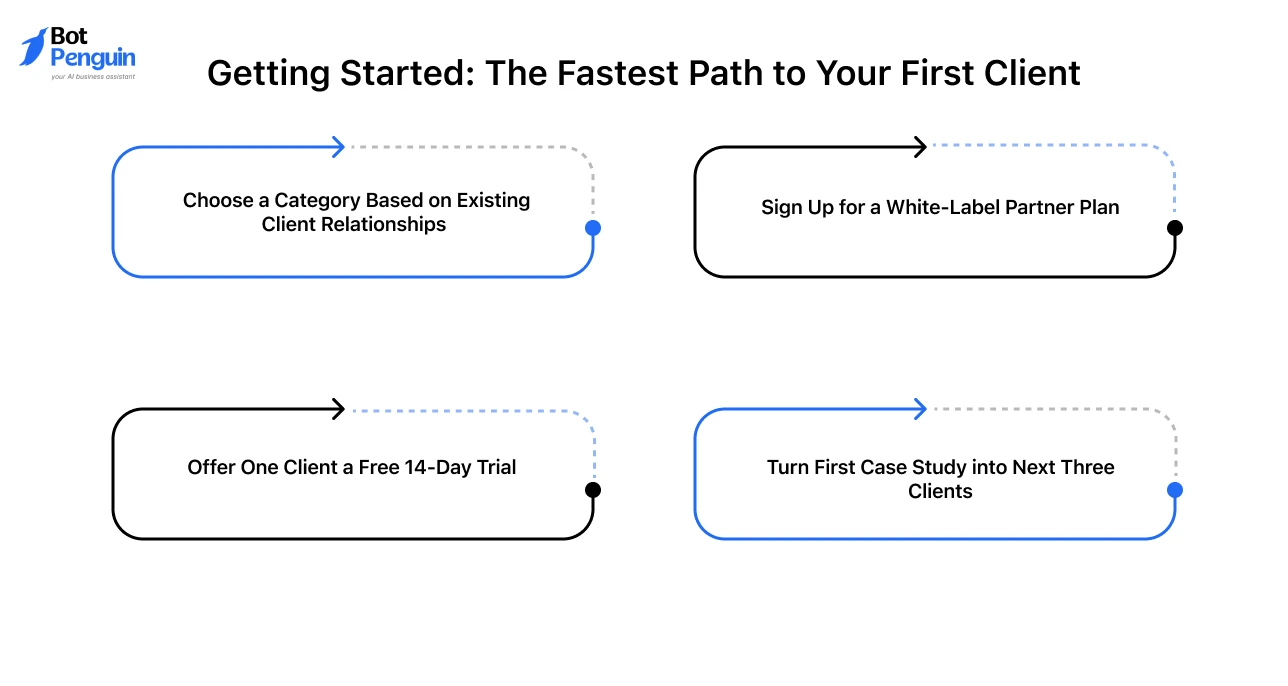
How to Get Started With White Label AI Software in the Easiest Way?

A simple setup process that lets you launch and sell white label AI under your own brand without development work.

  • Join the BotPenguin White Label Partner Program: Sign up for the white label plan to unlock branding and reseller access.
     
  • Set up your brand identity: Add your logo, brand name, and domain so the platform reflects your business.
     
  • Configure the chatbot behavior: Define responses, AI instructions, and use cases based on what you plan to sell.
     
  • Connect Required Integrations: Link CRM, helpdesk, or other tools your clients already use.
     
  • Create Client Accounts: Add each client separately with their own access and usage limits.
     
  • Set Your Pricing and Plans: Decide how you will charge clients and structure subscriptions.
     
  • Deploy the Chatbot for Clients: Launch the chatbot on websites, apps, or messaging channels as required.
     
  • Start Selling Under Your Brand: Clients interact only with your business. You manage billing and revenue.
Document
Ready to Become a Whitelabel Partner?
Try BotPenguin

Final Thoughts

At this point, the decision framework should be clear. White label AI is no longer experimental. It is a proven model for businesses that want to add AI offerings without increasing technical overhead. The advantage comes from moving fast, owning the customer relationship, and protecting margins from day one.

Choosing the best white label AI software is less  features and more  control. Agencies that resell AI chat gain recurring revenue. SaaS teams ship AI features faster. 

Consultants turn services into repeatable products. In each case, ownership of branding, pricing, and billing defines long term success.

If your goal is to expand revenue without building infrastructure, the opportunity is already validated. The only remaining step is execution. 

Platforms like BotPenguin make it practical to start reselling AI under your own brand and scale at your own pace.

Frequently Asked Questions (FAQs)

Is White Label AI Software Profitable?

Yes. White label AI software is profitable because you control pricing, retain clients, and earn recurring revenue. 

Most agencies recover their investment with one or two clients. Ongoing profits grow without added development or infrastructure costs.

Do I Need to Build White Label AI Software Myself?

No. You do not need to build anything yourself. The platform provider handles AI models, hosting, updates, and maintenance. You receive a ready to sell white label AI product that you brand and resell under your own name.

Can I Control Pricing in White Label AI Software?

Yes. You fully control pricing, subscription plans, and billing. Clients pay you directly, not the platform provider. This allows you to set margins, create custom packages, and scale revenue based on your business model.

Is White Label AI Software Good for Agencies?

Yes. White label AI software is ideal for agencies because it adds a high margin recurring revenue stream. Agencies can resell AI chatbots and automation without hiring developers or building technology from scratch.

Who Should Use White Label AI Software?

White label AI software is best for agencies, SaaS founders, consultants, and service providers. It suits businesses that want to launch AI services quickly, own the customer relationship, and scale without technical complexity.

Which is the Best White Label AI Software to Start Reselling Quickly?

BotPenguin is one of the best white label AI software platforms for fast reselling. It provides a fully branded AI chatbot platform with no development required, multi-channel deployment, custom pricing control, and full ownership of clients.

Keep Reading, Keep Growing

Checkout our related blogs you will love.

Table of Contents

BotPenguin AI Chatbot maker
  • What is White Label AI Software?
  • BotPenguin AI Chatbot maker
  • Who Should Use White Label AI Software?
  • BotPenguin AI Chatbot maker
  • How We Evaluated the Best White Label AI Software
  • BotPenguin AI Chatbot maker
  • How This Evaluation Helps Buyers
  • BotPenguin AI Chatbot maker
  • Quick Comparison Table of White Label AI Software
  • BotPenguin AI Chatbot maker
  • List of the Best White Label AI Software Platforms
  • BotPenguin AI Chatbot maker
  • Is Free White Label AI Software Worth It?
  • BotPenguin AI Chatbot maker
  • Common Mistakes to Avoid When Choosing White Label AI Software
  • How to Get Started With White Label AI Software in the Easiest Way?
  • Final Thoughts
  • BotPenguin AI Chatbot maker
  • Frequently Asked Questions (FAQs)