The Ultimate Guide to Selling on Instagram Without a Website
Updated at Oct 8, 2026
9 min to read
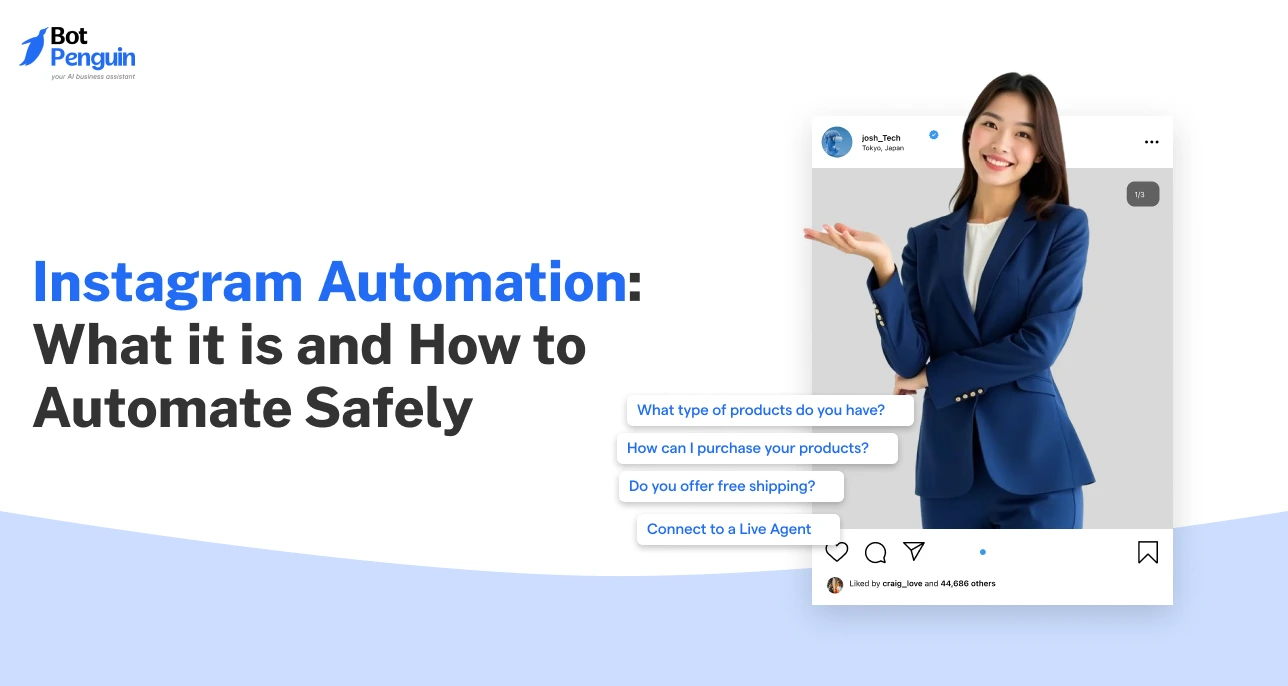
Instagram automation helps businesses manage repetitive conversations through automated DM replies, comment replies, and chatbot-driven lead capture. Instead of responding to every interaction manually, businesses can automate common customer conversations while staying focused on genuine engagement. This guide explains how Instagram automation works, where it adds value, and how to use it safely.
Instagram automation can make conversations feel more human. That sounds unexpected, but slow replies often feel less personal than fast, relevant ones.
Every missed DM, unanswered comment, or delayed story reply can cost a potential customer. Manual responses work when message volume is low, but they become difficult to manage as your audience grows.
The right automation responds to repetitive questions, starts meaningful conversations, and routes complex queries to the right person. It does not rely on spam, artificial engagement, or mass messaging.
This guide explains the three core types of Instagram automation, how they work, and how businesses can automate Instagram safely using approved tools.
Instagram automation is the process of using native Instagram features or approved third-party tools to manage repetitive conversations automatically. Instead of responding to every message or comment manually, businesses can automate routine interactions while maintaining timely and consistent communication.
Instagram automation is commonly used to:
The focus is on conversation management rather than artificial engagement. Businesses use automation to reduce manual work, improve response times, and ensure customers receive accurate responses without unnecessary delays.
Instagram automation generally falls into three categories. Each supports a different stage of the customer journey and solves a specific operational challenge.
Automatically responds to incoming messages using keywords, predefined workflows, or AI-powered conversations.
Monitors comments on posts and Reels. It can respond publicly, trigger private conversations, or guide users into a campaign workflow.
Qualifies prospects, collects customer information, answers common questions, and routes conversations to the correct sales or support team. If you want a detailed explanation of chatbot capabilities, read What an Instagram Chatbot Is?.
Many businesses confuse Instagram automation with engagement bots. These are completely different.
This guide does not cover:
Some of these activities violate Meta policies, while others belong to different search topics outside the scope of this guide.
The right solution depends on how many conversations your business manages every day.
Native Instagram features are designed for simple conversation management and include:
These features improve response speed but still require someone to manage each conversation.
As conversation volume increases, businesses often need Instagram automation software that can manage more advanced workflows.
These tools typically provide:
If your business receives only a small number of messages each day, native features may be enough. As conversations increase, dedicated automation software provides greater control, better routing, and more structured customer journeys.
Direct messages are often the first place where customers ask about products, pricing, appointments, or support.
Responding manually works when message volume is low, but delays become common as conversations increase. DM automation helps businesses respond consistently while ensuring important inquiries are not overlooked.
DM automation starts after a customer sends a message or performs a predefined action such as replying to a Story or using a specific keyword.
A typical workflow follows these steps:
Because the conversation begins with a user-initiated action, the responses remain relevant and aligned with normal customer communication.
Most businesses automate direct messages using either rule-based workflows or AI-powered conversations.
Rule-based automation follows predefined logic. It works well for predictable questions such as:
AI-powered automation can understand different ways customers ask the same question. Instead of relying only on keywords, it interprets intent and provides context-aware responses.
Businesses should use AI for conversations that vary naturally and rule-based workflows for repetitive requests.
Businesses usually automate conversations after customers perform specific actions.
Common triggers include:
Each trigger should begin a workflow that matches the user's intent rather than sending the same response to everyone.
Automation should not replace human conversations completely.
When customers ask complex questions, request personal assistance, or need account-specific support, the conversation should move to a team member. Human handoff keeps automation efficient without reducing the quality of customer service.
Imagine a customer sends the message "pricing."
The workflow might look like this:
Businesses looking for a more detailed implementation can also read Instagram Auto Reply to understand advanced DM automation strategies.
Direct messages are only one part of Instagram conversations. Customers also ask questions in comments, request pricing, join campaigns, and respond to promotional posts. Without automation, these comments can easily be missed, especially on posts that receive high engagement.
Comment automation helps businesses acknowledge these interactions quickly and move relevant users into private conversations where detailed discussions can continue.
Comment automation starts when someone comments on an Instagram post or Reel. The automation checks the comment for predefined keywords or conditions and responds based on the workflow you have created.
A typical workflow looks like this:
Because every conversation begins with a user-initiated action, the replies remain relevant and less intrusive.
Keyword triggers allow businesses to respond only when users request specific information. This makes the workflow more accurate and prevents unnecessary messages.
Common keywords include:
Imagine a business promoting an upcoming webinar. When someone comments "register," the automation can immediately send a private message containing the registration link instead of asking the customer to wait for a manual response.
Similarly, someone commenting "price" on a product post can receive product information without searching through older comments or waiting for a sales representative.
Choose keywords that clearly match customer intent. Broad or unrelated triggers often create confusing conversations and reduce user engagement.
Many conversations require more information than can comfortably fit inside a public comment section. Comment to DM automation moves those discussions into private messages while keeping the initial interaction simple.
Businesses commonly use this workflow to:
Private conversations also allow businesses to collect customer details without asking users to post personal information publicly.
If you are comparing different solutions, this guide on Best Instagram Comment Bots provides a detailed comparison of available tools:
Automation should improve conversations, not make them feel robotic.
Follow these practices to maintain a good customer experience:
Well-designed workflows respond naturally because every automated reply is connected to a specific customer action.
Consider a business promoting a live product webinar.
The workflow could look like this:
Starting with one high-intent keyword allows businesses to test the workflow before expanding automation to additional campaigns.
Comment automation begins the conversation. Chatbot-driven lead capture continues it by collecting the information businesses need to qualify prospects and route them efficiently.
Rather than treating every inquiry the same way, Instagram bot automation follows structured conversation paths based on what each customer actually needs.
The process starts after a customer sends a direct message or enters a conversation from a comment workflow.
The chatbot then follows a structured process:
This approach allows businesses to identify high-intent prospects without manually reviewing every conversation.
Only collect information that helps move the conversation forward.
Depending on the business, a chatbot may request:
Limiting data collection to what is genuinely required improves completion rates and creates a smoother customer experience.
Lead qualification becomes more useful when every answer determines the next step.
A chatbot can qualify customers based on:
Someone requesting a quotation may enter a sales workflow, while an existing customer with a technical issue can be directed immediately to customer support.
This keeps conversations relevant without forcing every customer through the same sequence.
After qualification, conversations should reach the right people without additional manual work.
Modern Instagram automation software can automatically route qualified conversations to:
Routing rules may depend on product interest, urgency, location, language, or customer type.
The goal is to shorten response times while ensuring customers reach the correct team.
Lead capture automation works particularly well for businesses that receive:
It is also useful for answering common questions before transferring complex conversations to a human agent.
If you want to understand chatbot capabilities in greater detail, read here
Businesses usually achieve better results by starting with one qualification workflow and improving it based on real customer conversations.
One of the biggest concerns businesses have is whether automation can affect their Instagram account. The answer depends less on automation itself and more on how it is implemented.
When businesses use approved tools and follow Meta's requirements, automation supports customer communication rather than manipulating engagement.
Instagram automation is generally designed to support legitimate customer conversations.
Safer automation usually:
Current API requirements and communication policies should always be verified before implementation because Meta may update them over time.
Certain activities increase the likelihood of account restrictions because they attempt to manipulate engagement or bypass official access methods.
Avoid workflows that rely on:
Businesses experiencing unusual account warnings should also review this guide
Approved integrations provide more reliable access while following Meta's permission model.
They typically offer:
Using official integrations does not guarantee that an account will never face restrictions. Businesses should still monitor workflows regularly and avoid automation that creates poor customer experiences.
Before launching automation, confirm that your workflow:
Well-designed automation should make conversations easier for customers, not simply reduce manual work.
The safest way to begin is with one clear workflow. Start by identifying the conversations that repeat most often and require consistent answers.
Review recurring direct messages, comments, campaign questions, and support requests.
Look for conversations that:
Choose one starting point:
Starting with one category makes testing easier. It also helps teams identify errors before adding more workflows.
Compare Instagram automation software based on your actual requirements.
Important selection factors include:
You can review current BotPenguin plans here
Most tools require Meta authentication and permission to access Instagram messaging features.
Exact account requirements and permissions should be confirmed before publication and implementation.
Create the main parts of the workflow:
Each response should match the action that started the conversation.
Test the workflow before launch.
Check:
Testing helps identify broken paths and unclear responses.
Track how users move through each workflow.
Review:
Use real conversation data to improve questions, routing rules, and reply accuracy.
BotPenguin for Instagram supports direct message automation, comment-triggered conversations, lead qualification, FAQ handling, conversation routing, and human support.
Businesses can begin with one workflow and expand as conversation volume grows.
Instagram automation uses native features or approved tools to manage repetitive Instagram interactions. It commonly handles direct message replies, comment replies, and lead capture. Businesses use it to respond faster, collect relevant customer details, and route conversations without managing every interaction manually.
Instagram automation is generally safer when it uses Meta official APIs and responds to user-initiated interactions. Risks increase with unofficial tools, browser access, scraping, spam, and artificial engagement. Businesses should verify current Meta policies before launching or changing any automation workflow.
The three main types are direct message automation, comment automation, and chatbot-driven lead capture. Direct message automation handles incoming messages. Comment automation responds to selected comments. Lead capture workflows ask questions, collect details, and route qualified users.
Pricing depends on the software, message volume, AI features, integrations, team access, and reporting requirements. Some tools provide limited free plans, while advanced workflows may require paid subscriptions. Businesses should compare current features, usage limits, and pricing before selecting a tool.
Account risk increases when automation uses unofficial access, mass messaging, scraping, automatic follows, artificial likes, or repetitive spam messages. Official integrations reduce some risks, but poor workflow design can still lead to warnings, account issues, or negative user feedback.
Instagram offers native features such as saved replies, quick replies, away messages, and basic inbox tools. These options support simple response management but do not provide advanced triggers, lead qualification, conditional paths, CRM routing, or detailed automation reporting.
They can support high message volumes when they include conversation queues, team routing, human handoff, CRM integrations, fallback replies, and performance monitoring. Businesses should also review message limits, response accuracy, failed conversations, and lead completion before increasing automation volume.
Instagram automation works best when it solves a clear business need. It is not one single feature.
The three main categories are direct message replies, comment replies, and chatbot-driven lead capture. Most businesses only need one or two workflows at the start.
Choose based on conversation volume, repeated customer questions, and routing requirements. Tools that use official Meta integrations are generally safer than unofficial methods.
Start with one workflow. Test it using real conversations and improve it before adding more automation.
Automate Instagram Conversations
Manage DMs, comment replies, lead capture, and human handoff from one Instagram automation workspace.
Start FreeCheckout our related blogs you will love.
Updated at Oct 8, 2026
9 min to read
Updated at Oct 8, 2026
10 min to read
.webp)
Updated at Oct 8, 2026
11 min to read
.webp)
Updated at Oct 8, 2026
19 min to read
Updated at Oct 8, 2026
8 min to read
Updated at Oct 7, 2026
7 min to read
Table of Contents