


Chatbot User Experience: How a Website Chatbot Improves UX
Updated at Oct 1, 2026
11 min to read
Will a website chatbot actually help a business like yours? The answer isn't the same for every industry.
A chatbot that drives more sales for an e-commerce store may solve an entirely different challenge for a SaaS company, real estate agency, healthcare provider, school, or consulting firm.
That's why the real question isn’t whether website chatbots work; it’s whether they work for your industry.
In this guide, we’ll break down website chatbots by industry to help you identify which businesses benefit the most, the use cases that deliver the highest value, and whether your business is a good fit.
If you're new to chatbots, start by learning what a website chatbot is before exploring the industry-specific insights.
The best website chatbot use cases vary by industry, but these six consistently see the strongest business impact:
Businesses with high website traffic, recurring customer questions, or lead generation goals benefit the most from a website chatbot.
The success of a website chatbot is truly determined by how well it fits your customers, workflows, and business goals. Here's why industry makes all the difference:
McKinsey's research found that 71% of consumers now expect a personalized experience from the businesses they interact with, reflecting why generic bots fail to convert leads.
An e-commerce brand wants more checkouts, a SaaS company wants more demos, and a hospital wants fewer no-shows.
The same chatbot can't chase all these goals with one generic setup.
Buyers, patients, students, and homeowners all expect different conversations and support.
A homebuyer wants to browse listings and book a site visit, while a patient wants a quick answer and a booked slot, not a sales pitch.
A chatbot that treats every visitor the same way ends up serving none of them well.
A shopper asks about order status, a patient asks about insurance coverage, and a student asks about application deadlines.
Each question needs a different backend workflow and a different set of integrations to resolve it well.
Some industries measure conversions, while others prioritize appointments, admissions, or customer support.
A real estate chatbot is winning if it books site visits, while a professional services chatbot is winning if it qualifies the right clients before a call is even scheduled.
The highest-performing website chatbots are designed around industry-specific workflows, not generic features.
Off-the-shelf FAQ bots rarely move the needle, but bots built around how an industry actually operates consistently do.
Therefore, a website chatbot is only as good as how well it understands the industry it's built for and the customers it's talking to.
The next sections break down how six industries (e-commerce, SaaS, real estate, healthcare, education, and professional services) use website chatbots to solve different business challenges and achieve measurable results.
Looking to add a website chatbot that understands your industry? BotPenguin lets you build chatbots around your actual business workflows, from e-commerce checkout journeys to healthcare appointment booking, rather than forcing every industry into the same template.
For e-commerce businesses, a website chatbot adds the most value when it removes the biggest friction points in the shopping journey. Here's where it makes the biggest impact:
A high-performing chatbot for e-commerce website engages shoppers at critical moments to increase conversions and improve the overall shopping experience.
The table below shows the top use cases of an e-commerce website chatbot:
Rather than waiting for a customer to ask for help, an AI-powered website chatbot engages shoppers at key moments in their buying journey.
Visitor: I'm not sure which size to order.
Chatbot: I can help. What's your usual size, and would you like to see our size guide?
Visitor: Medium.
Chatbot: Medium is currently in stock and ships within two business days. We also offer free returns if the fit isn't right. Would you like to add it to your cart?
Visitor: Yes.
A single conversation removes uncertainty, answers buying questions, and helps convert an interested visitor into a customer.
In their retail research study, McKinsey states that personalization drives a 10-15% boost in sales-conversion rates, showcasing why understanding your customers pays off.
While e-commerce chatbots focus on converting shoppers into customers, SaaS chatbots are designed to convert visitors into qualified leads. Let's see how they support the modern B2B buying journey.
A SaaS website chatbot delivers the most value by engaging high-intent visitors, answering product questions, and guiding prospects from interest to demo, trial, or paid subscription.
Here’s why companies should invest in these conversational tools:
A successful SaaS website chatbot supports the entire buying journey, from the first product question to trial onboarding and conversion.
The table below highlights its most valuable use cases.
New to the space? Explore BotPenguin's AI website chatbot solution built specifically for SaaS businesses.
Instead of waiting for prospects to contact sales, a website chatbot for SaaS proactively helps them choose the right plan and take the next step.
Visitor: I'm comparing the Free and Pro plans. Which one suits a team of 10?
Chatbot: The Pro plan includes advanced automation and CRM integrations for growing teams. What are you looking to achieve?
Visitor: We need CRM integration and workflow automation.
Chatbot: The Pro plan is the best fit. Would you like to start a free trial or book a personalized demo?
Visitor: Book a demo.
A timely conversation removes uncertainty, matches prospects with the right solution, and helps convert interest into a qualified pipeline.
The next section breaks down how real estate chatbots help capture buyer interest, recommend properties, and book site visits faster.
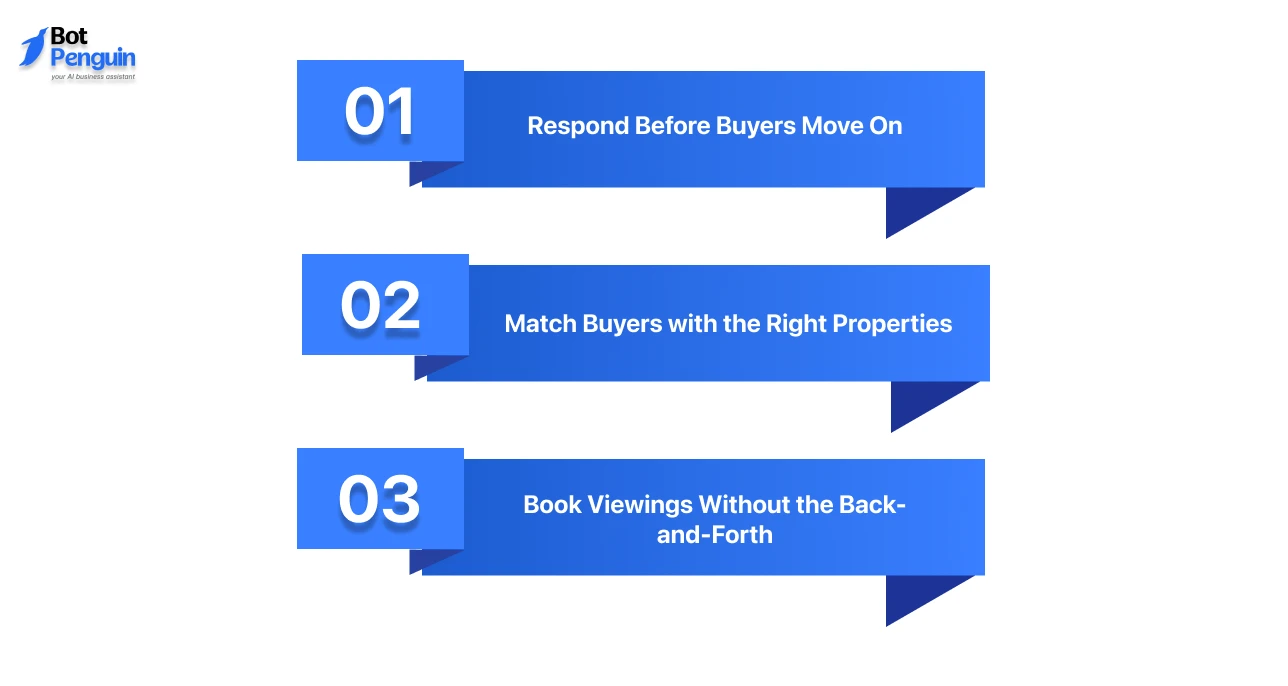
In real estate, every inquiry is a potential buyer or tenant. A website chatbot, in this case, helps capture, qualify, and convert leads, even when your agents are unavailable.
A real estate website chatbot keeps conversations moving from the first property search to the final viewing request. The table below highlights its most prominent applications:
See how BotPenguin's real estate website chatbot captures buyer inquiries and automates property viewings.
Rather than waiting for an agent to respond, a website chatbot helps buyers take the next step immediately.
Visitor: I'm interested in this three-bedroom apartment.
Chatbot: Great choice! I can answer questions or help you book a viewing. What would you like to know?
Visitor: What are the monthly maintenance charges?
Chatbot: The monthly maintenance fee is ₹4,500. Would you like me to check availability for a viewing this Saturday morning?
Visitor: Yes, please.
A timely response keeps interested buyers engaged, answers key questions, and turns property inquiries into scheduled viewings.
Every industry has its own moment of truth. For SaaS, it's choosing the right plan; for real estate, it's responding before a prospective buyer moves on. Let’s explore the latter in more detail.
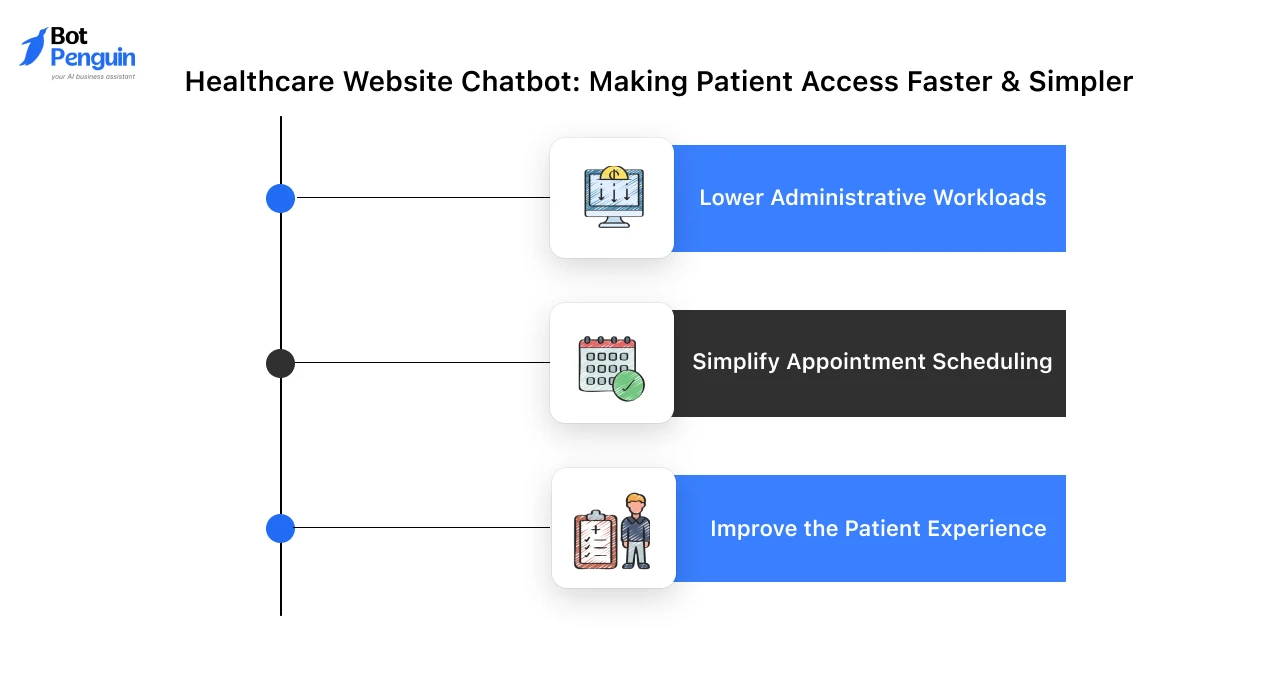
For healthcare providers, a website chatbot delivers the most value by simplifying appointment booking, answering administrative questions, and reducing the workload on front-desk staff.
From appointment scheduling to routine patient support, healthcare chatbots streamline the administrative tasks that consume the most staff time.
The most effective healthcare website chatbots decrease friction by helping patients complete routine administrative tasks without picking up the phone.
Visitor: Do you accept ABC Health Insurance?
Chatbot: Yes, ABC Health Insurance is accepted for eligible services. If you'd like, I can also help you book an appointment.
Visitor: I'd like to see a dermatologist this week.
Chatbot: We have appointments available on Thursday at 11:00 AM and Friday at 3:30 PM. Which works best for you?
Visitor: Thursday at 11:00 AM.
A simple conversation answers administrative questions, helps patients schedule appointments faster, and reduces pressure on front-desk teams, without providing medical advice.
So far, we’ve learned that healthcare chatbots make accessing care easier. Education website chatbots, on the other hand, apply the same convenience to admissions, course discovery, and student support.
An education website chatbot creates the most value by answering admission questions, guiding prospective students, and making the enrollment journey faster and more accessible.
Here’s why schools and higher education institutions invest in them:
Every student journey begins with a question. A website chatbot ensures those questions are answered quickly, accurately, and at any time of day.
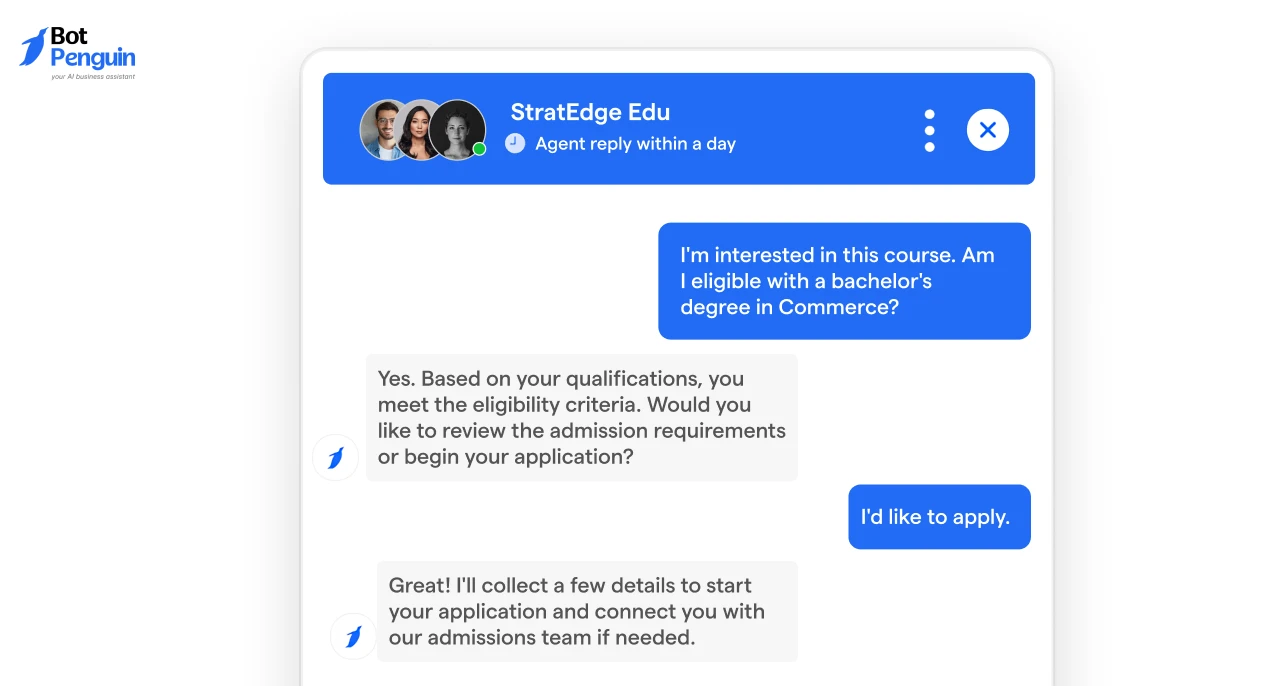
A website chatbot helps prospective students move from curiosity to action by answering questions and guiding them through the admissions process.
Visitor: I'm interested in this course. Am I eligible with a bachelor's degree in Commerce?
Chatbot: Yes. Based on your qualifications, you meet the eligibility criteria. Would you like to review the admission requirements or begin your application?
Visitor: I'd like to apply.
Chatbot: Great! I'll collect a few details to start your application and connect you with our admissions team if needed.
A single conversation removes information barriers, captures student inquiries instantly, and supports enrollment in multiple languages, regardless of office hours.
The right chatbot platform makes all the difference. With BotPenguin, educational institutions can build AI-powered website chatbots for admissions, student support, multilingual conversations, and enrollment workflows, all without writing code.
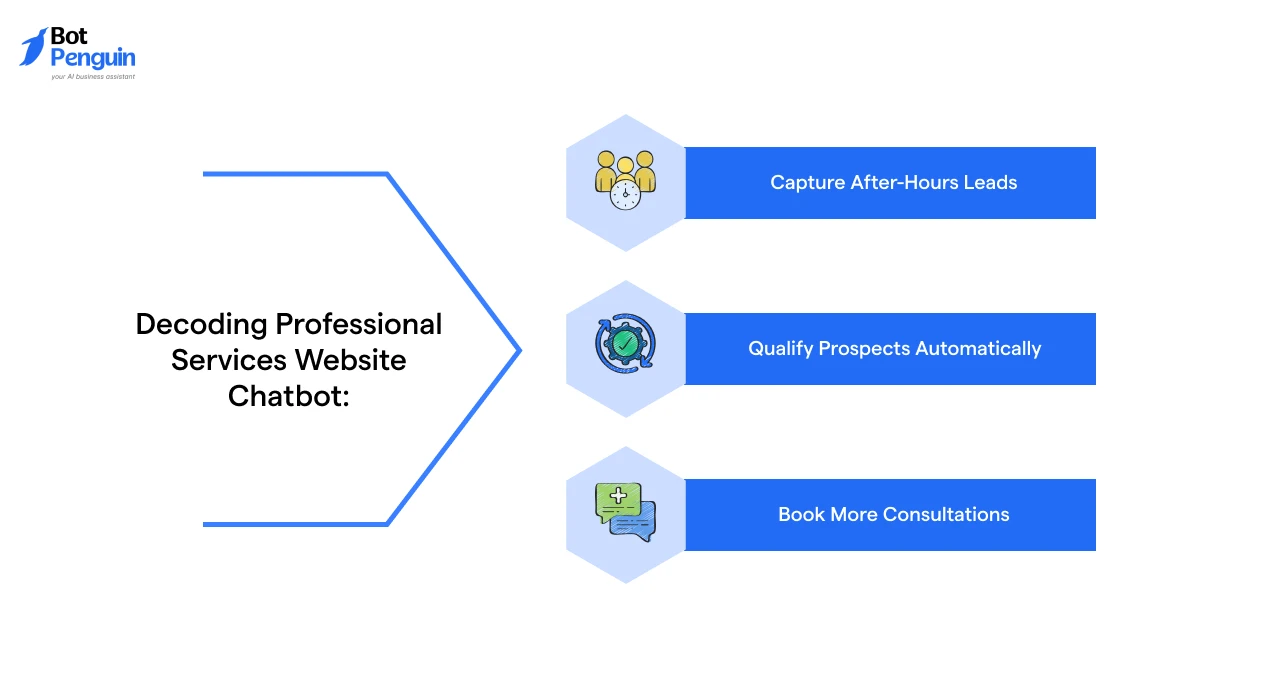
For professional services firms, a website chatbot delivers the most value by qualifying potential clients, answering initial questions, and capturing inquiries, even outside business hours.
Here’s what service businesses can achieve:
A website chatbot for a professional service business helps them respond faster while collecting the information needed for a productive consultation. Here are its most valuable use cases:
A professional services website chatbot turns passive website visits into meaningful conversations by qualifying prospects before they ever speak with your team.
Visitor: I'm looking for accounting support for my growing business.
Chatbot: I'd be happy to help. Could you tell me how many employees you have and the type of accounting support you're looking for?
Visitor: We have 20 employees and need monthly bookkeeping and tax filing.
Chatbot: Great, that's a service we provide. Would you like to book a 15-minute consultation with one of our advisors?
Visitor: Yes, please.
Thus, with a chatbot in place, a single conversation can identify high-intent leads, gather the right information upfront, and book consultations without relying on office hours or lengthy contact forms.
Deloitte's own research found that 80% of consumers prefer brands offering personalized experiences, and they spend 50% more with those brands.
See how BotPenguin's professional services website chatbot helps firms qualify leads, automate consultations, and capture inquiries around the clock.
A website chatbot becomes important when it solves a recurring business challenge. If you’re wondering which businesses need a website chatbot, use this quick checklist to decide if it's the right fit for your website.
If visitors ask the same questions repeatedly.
If you lose leads outside business hours.
If your contact forms underperform.
If your team is small but website traffic is growing.
If you sell products or accept bookings online.
If you checked two or more of these boxes, a website chatbot can likely improve customer experience, automate repetitive work, and help convert more visitors into customers.
There are a few situations where a website chatbot may add little value or create unnecessary friction.
On the whole, a website chatbot is most effective when it aligns with clear, repeatable customer needs and supports real business outcomes like lead capture, support efficiency, and conversion growth.
Website chatbots don’t work the same way for every business. Their value depends on your industry, your customers, and the problems you need to solve.
E-commerce uses them to recover carts and increase sales. SaaS uses them to qualify leads and book demos. Real estate uses them to capture buyers faster. Healthcare improves appointment booking. Education guides students to enroll. Professional services capture and qualify leads after hours.
If your visitors ask recurring questions, leave without converting, or expect quick responses, a chatbot can help.
The key is not adding a chatbot everywhere. It is using it where conversations directly impact revenue, leads, or customer experience.
E-commerce, SaaS, real estate, healthcare, education, and professional services benefit the most. Any business with repetitive questions, high traffic, or missed leads outside working hours is a strong candidate for a website chatbot.
Yes. Small businesses benefit significantly because a chatbot handles customer queries 24/7, reduces manual workload, and responds instantly to multiple visitors at once without needing extra staff or increasing operational costs.
Yes. Service businesses like consultants, agencies, accountants, and therapists use chatbots to capture leads outside office hours, qualify inquiries, and replace static contact forms with interactive conversations that improve conversion rates.
Yes. Healthcare chatbots help patients book appointments, check availability, and get answers about insurance, timings, and location, reducing front-desk workload while improving patient access and overall scheduling efficiency.
Yes. SaaS chatbots improve trial-to-paid conversions by answering product questions instantly, guiding onboarding flows, and routing high-intent users to demos or upgrades, reducing drop-offs during the evaluation and decision stage.
SaaS and e-commerce see higher ROI because their journeys are fast, structured, and conversion-driven. Chatbots can directly influence actions like purchases, demos, trials, and cart recovery, unlike slower decision cycles in some other industries.
Power Website Chatbots Built for Every Industry
From healthcare and education to real estate and e-commerce, deliver instant responses, automate lead handling, and improve customer engagement with industry-specific chatbot workflows designed for your business needs.
Explore Now!Checkout our related blogs you will love.
Updated at Oct 1, 2026
11 min to read
Updated at Sep 28, 2026
10 min to read
Updated at Sep 28, 2026
15 min to read
Updated at Aug 31, 2026
10 min to read
Updated at Aug 7, 2026
10 min to read
Updated at Jul 21, 2026
4 min to read
Table of Contents