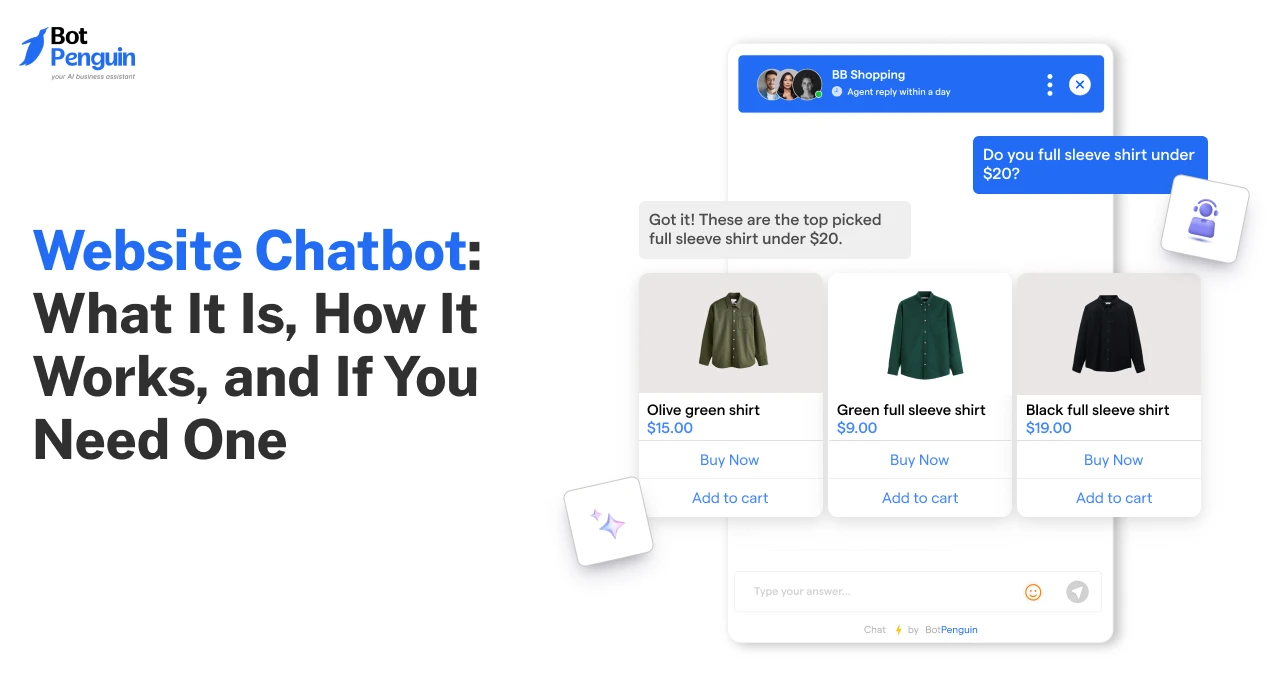
Website Chatbot: What It Is, How It Works, and If You Need One
Updated at Oct 6, 2026
12 min to read

Websites now do more than display information.
They answer questions, capture leads, and support customers. They also guide buyers when teams are unavailable.
These chatbot examples show how real brands automate conversations. Some bots answer FAQs. Others recommend products, qualify leads, and track orders.
This blog covers 17 AI chatbot examples from real websites. You will see how websites that have chatbots manage sales, support, and automation. You will also learn how websites that use chatbots reduce delays.
Across the examples, the focus stays practical. Each brand shows a clear business use. You can compare support, sales, booking, and engagement flows.
Chatbot examples are real-world cases that show how chatbots work. They show what bots say, collect, automate, or escalate. They also show how businesses use chatbots throughout the customer journey.
Some examples focus on customer support. Others support lead capture, bookings, sales, or order updates. This makes them useful for comparing practical business outcomes.
The best AI chatbot examples show more than automated replies. They show how websites with chatbots guide users, reduce delays, and route complex issues. They also help businesses understand which chatbot model fits their goals.
These examples are easier to compare when you understand how website chatbots work across simple flows, AI replies, and human handoffs.
Before reviewing the examples, let's decode the main types of chatbot.
The following chatbot examples use different chatbot models. Some follow fixed paths. Others use AI to understand user intent. Many combine both for better control and flexibility.
If you need setup guidance, check out our guide on how to add a chatbot to your website.
Rule-based chatbots follow predefined conversation flows. They use buttons, menus, and fixed answers. These bots work well for simple, repeated questions.
They are useful for FAQs, store hours, and policy answers. They also help route users to the right team. But they may struggle with open-ended questions.
AI chatbots understand natural language better. They can respond to a variety of customer questions. They can also use business data to personalize replies.
These bots are suited for customer support, product discovery, and lead qualification. They are often seen in strong AI chatbot examples. They help users move faster without rigid scripts.
Hybrid chatbots combine rules and AI. They use fixed flows for important steps. They use AI for flexible answers.
This model works well for growing businesses. It keeps key journeys controlled. It also gives customers more natural conversations.
If you are comparing tools after reviewing these types, explore our guide on the best chatbot for a website to match features with your business goals.
Next, let’s see the business tasks these chatbot types handle.
The strongest chatbot examples solve clear business problems. They help teams sell, support, qualify, book, and automate faster.
The sections below group these tasks by business outcome.
Chatbots engage buyers as soon as they land. They answer questions about pricing, products, and features. They also recommend options based on customer needs.
This reduces sales delays. It keeps interested visitors from leaving early.
Chatbots help customers get answers without waiting. They handle FAQs, order updates, and basic troubleshooting. They also route complex issues to human agents.
This improves response speed. It reduces repetitive support work.
For a deeper understanding on the angle, review our guide on how to improve your user experience with website chatbot integration.
Chatbots handle routine tasks across customer journeys. They schedule appointments, qualify leads, and track orders. They also sync data with CRM tools.
This saves team time. It keeps workflows more consistent.
Chatbots ask visitors useful qualifying questions. They collect names, emails, needs, and buying intent. They then pass better leads to sales teams.
This makes follow-up faster. It improves lead quality for growing teams.
Websites that use chatbots often automate customer updates. Bots share booking details, delivery status, and service timelines. They reduce repeated manual replies.
This keeps customers informed. It helps teams manage high-volume conversations.
For a more detailed breakdown, you can refer to our article on chatbot use cases.
Next, let’s review real brands using these chatbot flows.
Chatbots are helping brands improve sales, support, and automation. These chatbot examples show how real companies use bots across different customer journeys.
Let’s explore brand websites that use chatbots effectively. We will break down how they work, the problems they solve, and the value they bring.
1. Samsung – AI-Powered Support And Shopping Assistance
Samsung sells smartphones, TVs, appliances, and connected devices. This creates high daily customer interactions. Many customers need quick help before and after purchase.
Challenge
How The Chatbot Solved It
Samsung uses chatbot support across digital service channels. The bot helps customers troubleshoot devices and check service options. It also connects users to human support when needed.
It can support warranty checks, order tracking, and product questions. This makes the support journey faster and easier.
Key Benefit
Where To Find It
Samsung’s chatbot is available on its official support website. It also supports customers through Samsung’s digital service channels.
Samsung’s chatbot offers fast and efficient support. It also improves the overall customer experience.
2. IKEA – AI Chatbot For Customer Support And Shopping Assistance
IKEA sells furniture, home products, and store-based services. Customers often need help before buying. They also need support after delivery.
Challenge
How The Chatbot Solved It
IKEA uses Billie to answer common customer questions. The chatbot supports users across the website. It helps customers before, during, and after purchase.
It can help with product information, store support, and service queries. When needed, the chatbot can route users to a live agent.
Key Benefit
Where To Find It
Billie appears on IKEA’s website in supported regions. Users can access live chat through the website chat bubble.
3. Peloton – AI Chatbot For Customer Engagement And Support
Peloton sells fitness equipment, memberships, and digital workout access. Customers need help across purchase and membership journeys. Fast support matters after every sale.
Challenge
How The Chatbot Solved It
Peloton uses chat support to guide customers. Users can get help with orders, memberships, and product questions. They can also connect with support when needed.
The bot helps users find answers without long delays. It makes common support journeys easier to manage.
Key Benefit
Where To Find It
Peloton’s chat support is available through its support website. Users can access help through the contact support flow.
4. LG – AI Chatbot For Customer Support And Smart Assistance
LG sells appliances, electronics, and smart home products. Customers often need help after buying. Many products need guided setup and service support.
Challenge
How The Chatbot Solved It
LG uses chatbot support for product and service questions. The bot helps users find product help. It can also guide users toward repair options.
The chatbot supports troubleshooting, service tracking, and product FAQs. This reduces pressure on human support teams.
Key Benefit
Where To Find It
LG’s chatbot is available through LG’s support website. It is designed for customer assistance across product categories.
5. 1-800-Flowers – AI Chatbot For Ordering And Customer Support
1-800-Flowers sells flowers, gifts, and gourmet products online. Customers often shop for occasions and deadlines. This makes guided shopping support valuable.
Challenge
How The Chatbot Solved It
1-800-Flowers introduced GWYN as an AI gift concierge. The bot helped shoppers find suitable gifts. It used customer inputs to suggest relevant products.
The chatbot also supported ordering and shipment tracking. This made gift buying faster and more focused.
Key Benefit
Where To Find It
GWYN was introduced across 1-800-Flowers’ digital shopping channels. It remains a useful example of guided gifting and occasion-based product discovery.
6. G2 – AI Chatbot For Lead Qualification And User Assistance
G2 helps buyers compare business software. Visitors often need help finding relevant categories. This creates a strong need for guided discovery.
Challenge
How The Chatbot Solved It
G2 offers an AI Sales Agent for sales conversations. It can work on a website or a G2 profile. It helps guide buyers using marketplace and company data.
The chatbot can qualify visitors and answer product questions. It also helps route high-intent prospects.
Key Benefit
Where To Find It
G2’s AI Sales Agent can be deployed on websites. It can also support conversations on G2 product profiles.
7. HubSpot – AI Chatbot For Lead Generation And Customer Support
HubSpot provides CRM, marketing, sales, and service tools. Its website receives visitors with different business needs. Chatflows help manage these conversations more efficiently.
Challenge
How The Chatbot Solved It
HubSpot chatflows can qualify leads and book meetings. They can also create support tickets. Teams can build automated conversations using rule-based actions.
The chatbot helps route visitors based on intent. This makes both sales and support journeys smoother.
Key Benefit
Where To Find It
HubSpot chatflows are available inside HubSpot’s platform. They can be used on websites and supported messaging channels.
8. Instantly – AI Chatbot For Lead Nurturing And Customer Engagement
Instantly supports sales engagement, outreach, and lead intelligence. Many visitors need help understanding outreach workflows. Others need product or setup support.
Challenge
How The Chatbot Solved It
Instantly integrated an AI chatbot on its website to guide visitors. The chatbot answered product and workflow questions. It also supported demo bookings and lead qualification.
The bot helped users understand campaign setup faster. It also reduced repeated support questions.
Key Benefit
Where To Find It
Instantly’s chatbot is available on its website. It supports lead generation, customer support, and demo booking.
9. IndiGo – AI Chatbot For Customer Support And Booking Assistance
IndiGo serves travelers across booking and flight support. Customers often need fast travel answers. This makes chatbot support useful before flights.
Challenge
How The Chatbot Solved It
IndiGo uses 6Eskai as an AI-enabled chatbot. It helps travelers with trip questions and check-in support. It also supports travel assistance through WhatsApp.
The chatbot helps with bookings, cancellations, and flight status. It also answers common travel questions.
Key Benefit
Where To Find It
6Eskai is available through IndiGo support channels. It is also available through WhatsApp for supported travel tasks.
10. Axis Bank – AI Chatbot For Banking And Customer Support
Axis Bank serves customers across cards, loans, accounts, and payments. Banking users need quick and secure answers. This makes digital assistance useful for routine service.
Challenge
How The Chatbot Solved It
Axis Bank offers Axis AHA! as a virtual banking assistant. It uses AI and machine learning. It helps users get quick answers and online services.
The chatbot can support account, card, loan, and service queries. It also helps customers access banking information faster.
Key Benefit
Where To Find It
Axis AHA! is available through Axis Bank’s digital channels. Users can access it for supported banking queries.
11. Sephora – AI Chatbot For Product Recommendations And Beauty Support
Sephora sells skincare, makeup, fragrance, and beauty products. Customers often need help choosing the right products. This makes personalized guidance important.
Challenge
How The Chatbot Solved It
Sephora offers AI Beauty Chat for beauty guidance. It supports skincare routines, makeup suggestions, and product recommendations. It can also help with gift ideas.
The assistant helps customers narrow options faster. It makes beauty discovery more interactive.
Key Benefit
Where To Find It
Sephora’s AI Beauty Chat is available on Sephora’s website. It supports digital beauty shopping experiences.
12. H&M – AI Chatbot For Fashion Shopping Assistance
H&M serves online shoppers across clothing and accessories. Customers often need help with orders and returns. Fast support improves the shopping experience.
Challenge
How The Chatbot Solved It
H&M uses an AI Assistant chatbot for customer questions. It answers around the clock in supported regions. It helps with orders, delivery, returns, and refunds.
The assistant can also connect users to live support. This keeps routine questions moving faster.
Key Benefit
Where To Find It
H&M’s AI Assistant appears through customer service pages in supported markets. It helps customers with common shopping and post-purchase questions.
13. Bank Of America – AI Assistant For Digital Banking Support
Bank of America uses Erica as a virtual financial assistant. It supports customers in mobile banking. This makes it a strong example of banking.
Challenge
How The Chatbot Solved It
Erica helps users manage accounts and find answers. It provides proactive insights inside the mobile app. It can also connect users to financial specialists.
The assistant supports banking tasks inside the existing app. This keeps help close to the user journey.
Key Benefit
Where To Find It
Erica is available in the Bank of America Mobile Banking app.
14. KLM – AI Chatbot For Travel Support And Flight Assistance
KLM introduced BlueBot to support travel conversations. The assistant helped customers book flights in a conversational way. It showed how airlines can automate travel support.
Challenge
How The Chatbot Solved It
BlueBot helped customers book tickets through Messenger. It used artificial intelligence for conversational booking. KLM also supported updates through messaging channels.
The assistant made the flight booking more guided. It also offered another digital service path.
Key Benefit
Where To Find It
BlueBot launched through Messenger for conversational flight booking. It remains a useful airline example for automated booking and travel support.
15. Klarna – AI Assistant For Shopping And Customer Service
Klarna supports payments, shopping, orders, refunds, and returns. Customers often need help after purchase. This makes fast support critical.
Challenge
How The Chatbot Solved It
Klarna uses an AI assistant for customer support. It helps users manage payment and shopping questions. It also supports refunds, returns, and service conversations.
The assistant works as a first support layer. Customers can still access human help when needed.
Key Benefit
Where To Find It
Klarna’s AI assistant is available through Klarna support. Users can access it after signing in.
16. Expedia – AI Chatbot For Trip Planning And Travel Assistance
Expedia helps travelers search, compare, and book trips online. Customers often need help across planning, booking, and itinerary changes. This makes AI support useful across the full travel journey.
Challenge
Travelers compare many destinations and hotels.
Group trip planning can become confusing.
Travelers need updates when plans change.
How The Chatbot Solved It
Expedia introduced Romie as an AI travel assistant in 2024. It helps users plan trips, compare options, and manage itinerary updates. It can also support group travel planning through shared conversations.
The assistant helps travelers move faster from research to booking. It also keeps trip details easier to manage.
Key Benefit
Travelers get guided trip planning support.
Group planning becomes easier.
Itinerary updates become more accessible.
Travel decisions become less scattered.
Where To Find It
Romie was introduced through Expedia Group’s 2024 Spring Release. It supports Expedia’s digital travel planning experience.
17. Lyft – AI Chatbot For Driver Support And Service Resolution
Lyft serves riders and drivers across local transportation. Drivers often need fast help with account, eligibility, and service questions. Slow support can affect earnings and platform trust.
Challenge
Drivers need quick answers about requirements.
Support teams handle repeated service questions.
Complex issues still need human review.
How The Chatbot Solved It
Lyft partnered with Anthropic to use Claude for customer service. The AI assistant helps answer common driver support questions. It can also route more complex cases to human representatives.
The assistant gives drivers faster access to service information. It also reduces manual pressure on support teams.
Key Benefit
Driver support becomes faster.
Common questions get resolved more quickly.
Human agents can focus on complex cases.
Support resolution time reduced by 87%.
Where To Find It
Lyft uses the AI assistant within its customer service workflows. It supports driver service requests and common support queries.
These AI chatbot examples show a clear pattern. Strong chatbots do not only answer questions. They support real business tasks across the customer journey.
Together, these examples show why websites with chatbots perform better when the bot has a defined role. To see how businesses have applied similar solutions with BotPenguin, explore our customer case studies.
Next, let’s look at more industry-specific chatbot examples.
The examples above show broad business patterns. But each industry uses chatbots differently. Some need hiring support, while others need bookings or patient help.
The sections below connect this examples hub to focused industry and how they use websites that have chatbots.
Recruitment teams use chatbots to answer candidate questions. They also collect resumes and screen applicants. This helps hiring teams manage high-volume applications faster.
If hiring is your main focus, review our guide on best recruiting chatbots to streamline candidate screening workflows.
Education teams use chatbots for student support. They answer questions about admission, courses, fees, and campus. They also help reduce repetitive admin work.
Healthcare teams use chatbots for patient guidance. They support appointment questions, FAQs, and basic service information. They also help patients find the right next step.
Travel brands use chatbots for booking and trip support. They answer questions about flights, hotels, documents, and updates. They also help customers during time-sensitive travel moments.
Ecommerce brands use chatbots for shopping assistance. They recommend products, track orders, and answer return questions. They also reduce cart and support friction.
For a detailed understanding, you can refer to our guide on ecommerce chatbot examples.
These industry examples show how chatbot value changes by context. Next, let’s see how BotPenguin helps build chatbot flows for similar websites.
All the discussed chatbot examples show what strong automation can do. They answer questions, qualify leads, and guide customers. They also reduce repeated manual work.
BotPenguin helps businesses build similar chatbot flows without coding.
You can create a website chatbot for sales, support, lead capture, and bookings. You can also connect it with channels like WhatsApp, Facebook, and Instagram.
BotPenguin is built for businesses that want simple deployment. Teams can create chatbots without technical setup. They can also customize flows for different customer journeys.
Key capabilities include:
If you are still deciding what your bot should include, review our article on how to choose the perfect features for your website chatbot before finalizing the workflow.
First, sign up on the BotPenguin platform for free. You can start in seconds without technical setup.
Then, choose your chatbot type. It can support sales, customer service, bookings, or lead generation.
Next, customize the chatbot for your business needs. Set up automated responses, workflows, and triggers. Keep each flow tied to a clear customer action.
Once the flow is ready, connect it to your website and other daily business tools. You can also add it to platforms like WhatsApp, Facebook, and Instagram.
Test the experience before launch. Then improve it using real customer conversations.
If your business wants faster replies and better conversion paths, BotPenguin can help you start with a website chatbot.
Amazon, Sephora, H&M, HubSpot, and Indigo Airlines use chatbots on their websites. They use them for support, product recommendations, bookings, and lead capture.
Ecommerce, SaaS, healthcare, real estate, and financial services rely heavily on chatbots. Any high-traffic site with repeated visitor questions can benefit.
Yes. No-code chatbot platforms like BotPenguin make chatbot deployment accessible for small businesses. Setup can take under 30 minutes.
Websites use chatbots for lead capture, customer support, appointment booking, cart recovery, FAQ deflection, and product recommendations.
Chatbots are effective when they are configured around clear user goals. G2 reports that 82% of customers prefer chatbots over waiting for a representative, showing their value for faster first responses and routine website support.
Build A Website Chatbot
Automate support, capture leads, and guide visitors like the brands in these examples with BotPenguin’s website chatbot.
Start For FreeCheckout our related blogs you will love.
Updated at Oct 6, 2026
12 min to read
Updated at Oct 5, 2026
8 min to read
Updated at Jul 14, 2026
8 min to read
Updated at Jul 10, 2026
11 min to read
.webp)
Updated at Oct 6, 2026
15 min to read
Updated at Oct 6, 2026
15 min to read
Table of Contents