





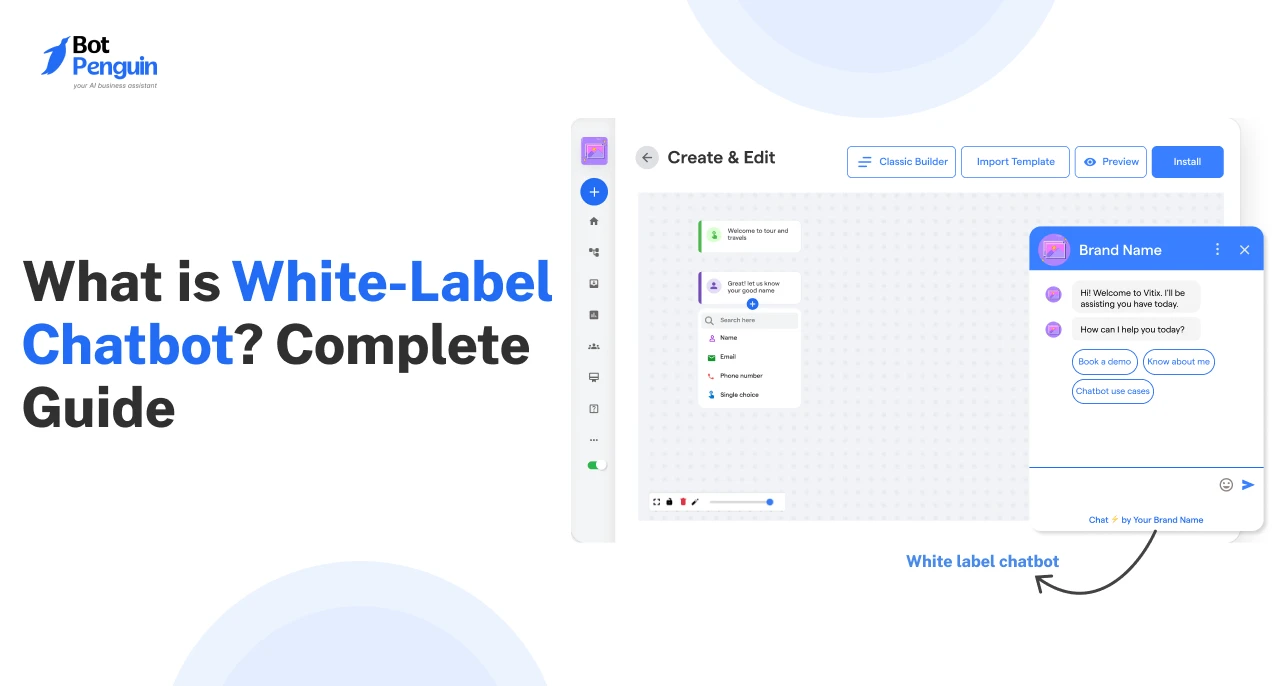
What is a White-Label Chatbot? Complete Guide For 2026
Updated at Oct 19, 2026
10 min to read
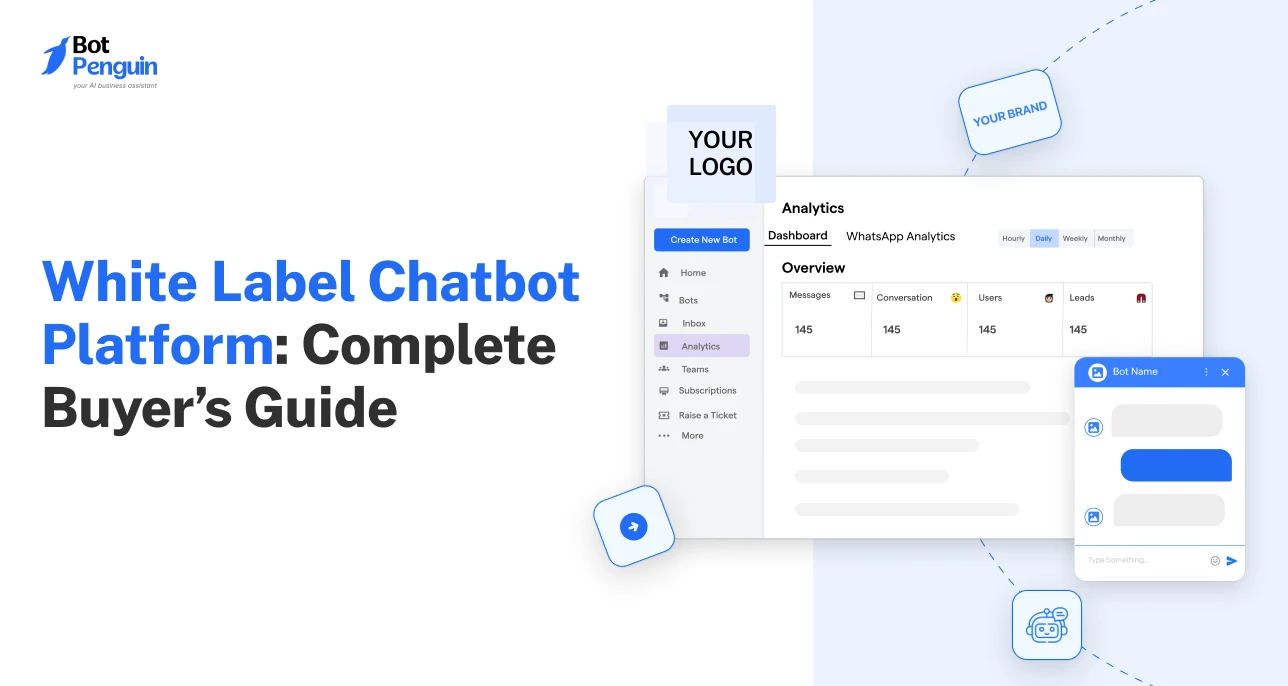
Most popular chatbot tools offer branding removal rather than a complete reseller setup. The same criteria apply to a white label AI chatbot platform; the AI layer changes what you resell, not who owns the domain, billing, and clients. A true white-label chatbot platform should support custom branding, pricing control, client account management, and branded delivery. This comparison shows which tools provide full resale, partial white-labelling, or no reseller model.
Comparing white-label chatbot tools is harder than checking a feature list.
Many platforms offer AI replies, integrations, and basic branding controls. However, only some support full resale, custom domains, multi-client management, and independent pricing.
That distinction matters as the chatbot market continues expanding.
Grand View Research estimates the global chatbot market at $9.6 billion in 2025 and projects it to reach $41.2 billion by 2033.
As more tools enter the market, agencies must distinguish basic branding features from those of platforms built for complete resale.
This white-label chatbot comparison reviews reseller-ready platforms and popular tools, including ManyChat, Chatbase, Chatfuel, Intercom, and Landbot. It explains which tools support genuine white-labelling, which only remove visible branding, and which are better suited to direct business use.
For a broader look at reseller models, platform types, and white-label opportunities, explore our white-label partner resources.
A white label chatbot platform lets businesses sell chatbot services under their own brand without building the software from scratch. For a simpler explanation, read our guide to white-label chatbots.
For this comparison, a platform must support more than basic logo changes. It should help teams brand, deploy, manage, and resell chatbot services across client accounts.
A complete white-label chatbot platform usually includes:
Some tools in this list are built for full chatbot resale. Others fit custom AI builds, direct customer support, or AI service packaging.
That difference matters before comparing features, pricing, and buyer fit.
A platform is only as white label as its weakest client-facing surface. Before comparing prices or features, check these ten criteria to choose the right white-label Chatbot platform for your needs.. They help distinguish basic rebranding from a platform you can genuinely operate under your own identity.
1. Custom domain: Check whether clients can access the platform through a domain or subdomain controlled by your business rather than a vendor URL.
2. Branded emails: Confirm whether client-facing notifications and transactional emails can use your branding and sender identity.
3. Invoices and billing ownership: Verify whether invoices, subscriptions, and client payments can operate under your own business rather than the platform provider.
4. Client login and dashboard: Check whether each client receives access to a branded workspace without being routed through a vendor-facing dashboard.
5. Mobile apps: If mobile access matters, confirm whether branded iOS or Android apps are available rather than vendor-branded applications.
6. WhatsApp account ownership: Verify whether each client can connect and retain control of their own WhatsApp Business account and associated number.
7. Brand visibility: Check the dashboard, URLs, emails, chatbot widgets, documentation, and apps to determine whether the vendor's name appears anywhere client-facing.
8. Per-client custom plans: Confirm whether you can create your own packages, feature limits, and prices for different clients.
9. Dashboard languages: Check whether the client-facing dashboard supports the languages required by the markets you intend to serve.
10. Currencies: Verify whether you can charge clients using the currencies required across your target regions.
For a platform-level example of how these criteria are applied, review BotPenguin's white label depth checklist.
If GoHighLevel is one of the platforms you are considering, our GoHighLevel white-label chatbot guide examines how its branding and white-label controls compare.
With these criteria established, the next step is to compare how the five shortlisted platforms handle white-label delivery in practice.
A strong white-label chatbot comparison should look beyond feature lists and assess how each platform supports resale, branding, client delivery, channels, and operational control. The commercial opportunity also depends on how effectively partners package AI services.
A Sage-commissioned IDC study of 2,009 software resellers found that 87% of high-performing partners operated a dedicated AI practice.
This suggests that successful partners combine suitable technology with focused AI expertise, implementation services, and a clear resale model.
The table below gives a quick view before the individual platform breakdowns. They are grouped by their strongest use case rather than an overall ranking.
Based on the five platforms reviewed, three provide a reseller-oriented combination of branded delivery, client management, and independent pricing control: BotPenguin, BotSailor, and Stammer AI.
Botpress is better suited to developer-led custom implementations, while Tidio primarily supports direct business use with limited branding controls.
This means 60% of the shortlisted platforms meet the comparison’s core reseller-readiness standard, while the remaining 40% serve adjacent use cases rather than complete white-label resale.
(Methodology: This editorial finding is based on publicly available product, pricing, partner, and documentation pages reviewed in September 2026. A platform was counted as reseller-ready only when it supported branded delivery, client management, and reseller-controlled pricing.)
The sections below explain where each platform fits best, what setup model it supports, what it offers, and what to check before shortlisting it.
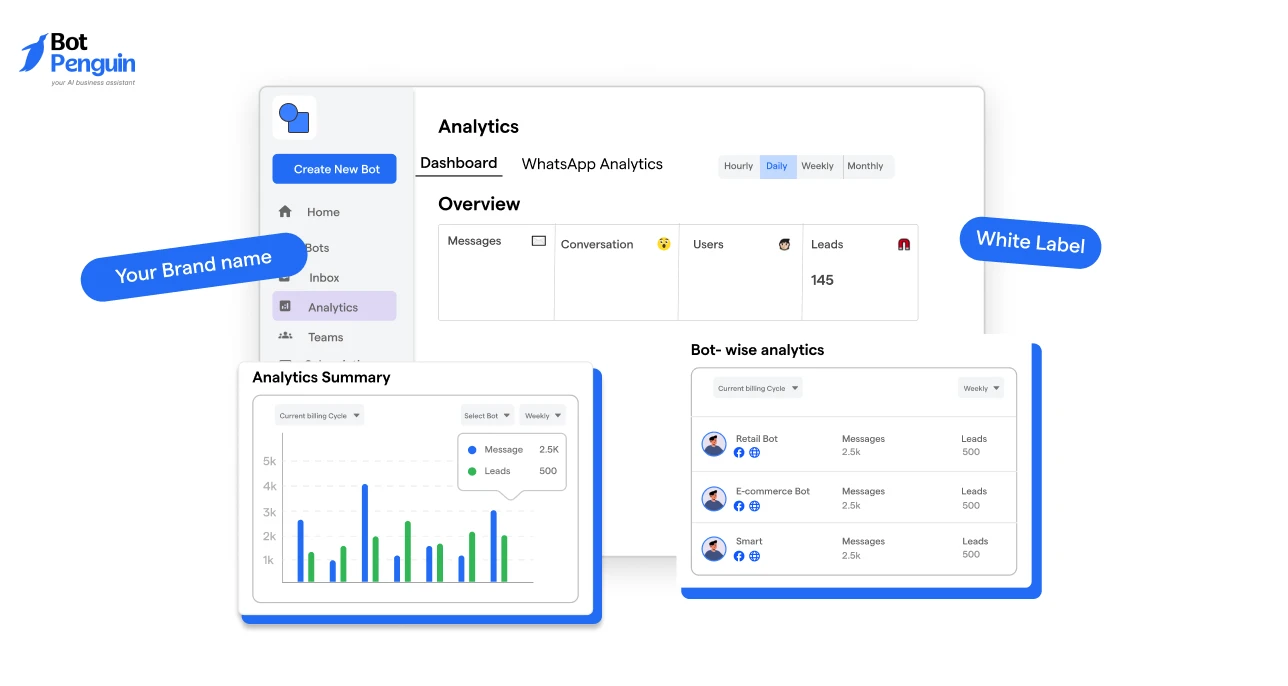
BotPenguin is a strong choice for teams wanting a fully branded AI chatbot setup without building the platform themselves. Its broader white-label ecosystem extends beyond chatbots to WhatsApp, Instagram, AI agents, automation, and AI voice. Advanced AI-agent and voice capabilities vary by partner tier. Partners also receive brand control, custom domain setup, pricing freedom, and no-code deployment support.
BotPenguin’s broader partner ecosystem includes 250+ active partners worldwide. The platform also allows partners to keep 100% of their revenue and go live within 12 hours.
Plans start at $1,500 per year, with additional white-label chatbot pricing plans available based on usage and features.
✓ PROS
Strong brand control across logo, domain, colors, help docs, and marketing assets
Partners can set their own pricing and keep 100% of revenue
Strong WhatsApp, website, and omnichannel automation fit
Includes partner portal, support, training, and marketing assistance
× CONS
Annual partner pricing may not suit very small resellers testing demand
Best suited for teams ready to sell chatbot services actively
Less developer-customizable than platforms like Botpress
To see the partner model in practice, review how a BotPenguin white-label partner in South Africa launched branded chatbot services.
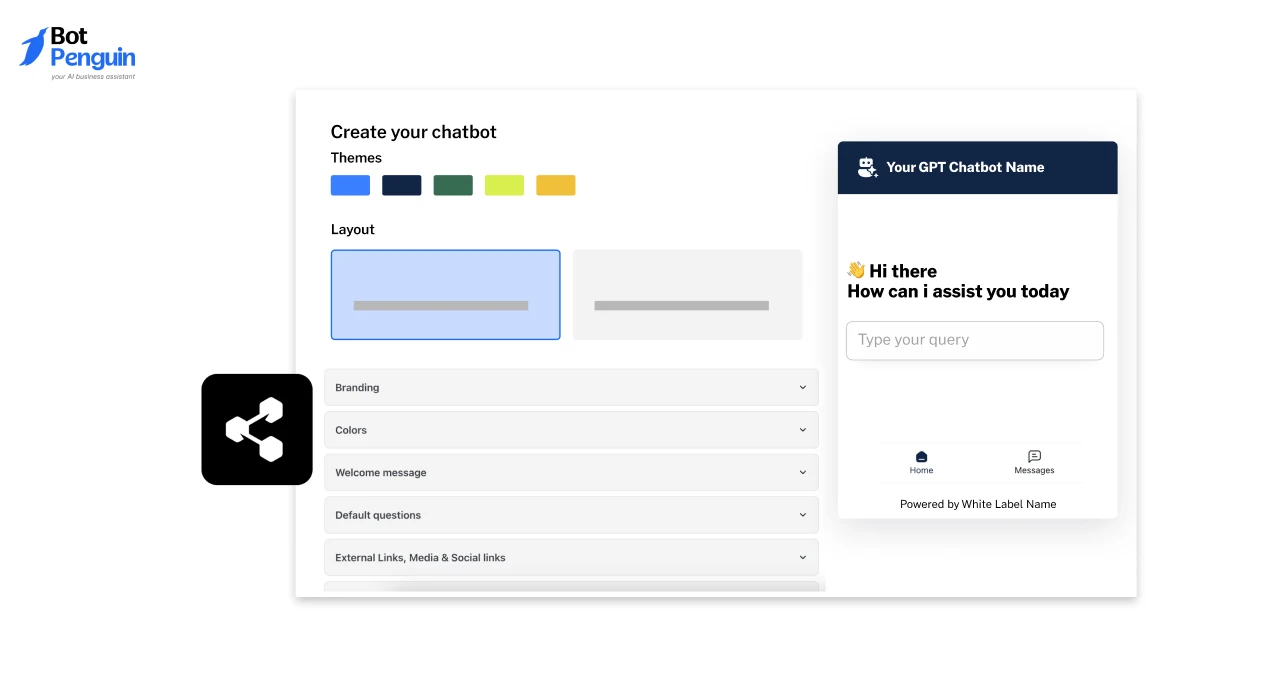
Botpress is best for technical teams looking to build advanced, custom chatbot workflows for clients. Its partner program supports affiliates, implementation partners, and certified experts, but it is not a full white-label SaaS resale platform.
The platform works better for custom AI development than for agencies that need ready-made domain-level rebranding.
Botpress does not publish one standard partner price. Affiliate partners can earn 30% commission on referred customer spending for 12 months, while implementation and certified partner arrangements use separate commercial terms.
✓ PROS
Strong customization and developer control
Good for complex AI workflows
Partner and implementation opportunities
× CONS
Not a full white-label reseller platform
Requires technical expertise
Less suitable for quick reseller setup
BotSailor is best for teams looking to launch a branded chatbot SaaS business focused on WhatsApp, Messenger, Instagram, Telegram, and web chat automation.
Service providers can create client accounts, manage multiple businesses from a single platform, and package chatbot services as their own recurring offering. It also gives resellers the flexibility to set their own pricing structure.
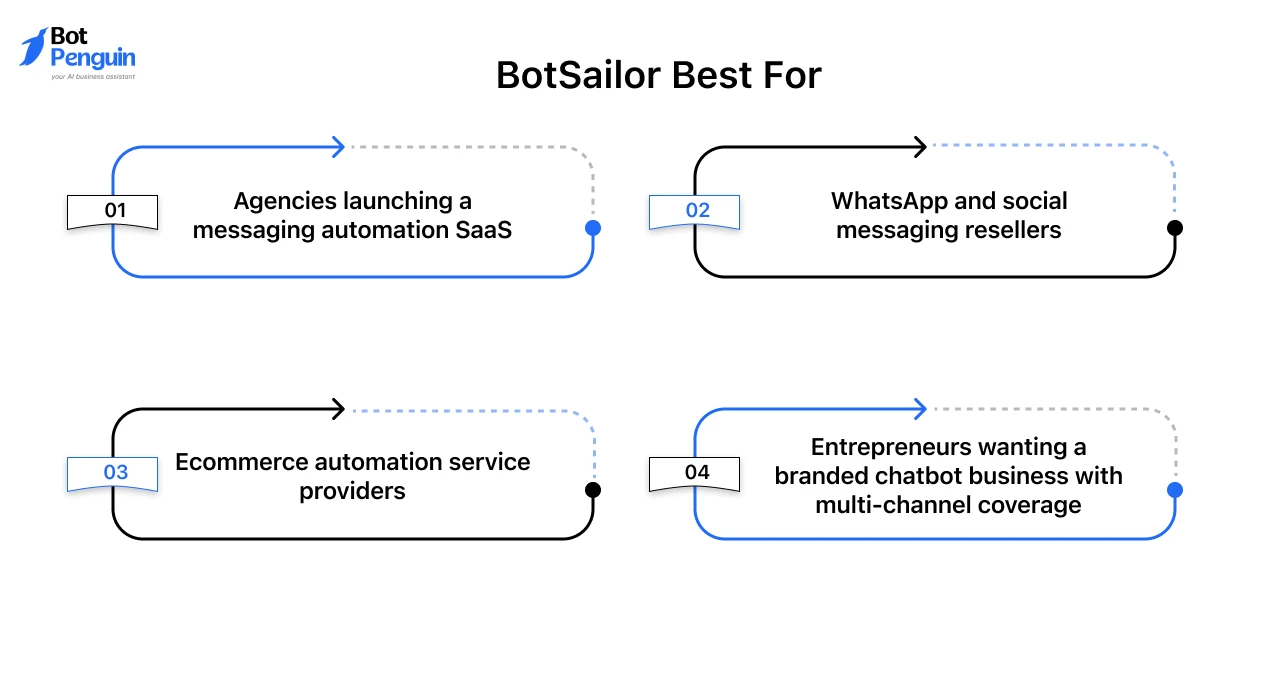
BotSailor's white-label Agency plans currently start at $130.99/month, with higher tiers increasing based on subscriber and client-account capacity.
✓ PROS
Strong white-label SaaS positioning with domain, logo, colors, menus, and landing page branding
Covers WhatsApp, Facebook, Instagram, Telegram, and web chat
Includes ecommerce and payment integrations
Good fit for messaging-first reseller businesses
× CONS
Pricing and limits vary significantly by package
Some platform pages mention channels that may still be under construction
May need setup effort for DNS, SSL, app approvals, and payment configuration
Less suited for highly custom developer-led AI agent projects
Tidio is a strong live chat and AI support platform, but it is not a full white-label reseller solution. It offers widget customization and limited branding removal, mainly for direct business use.
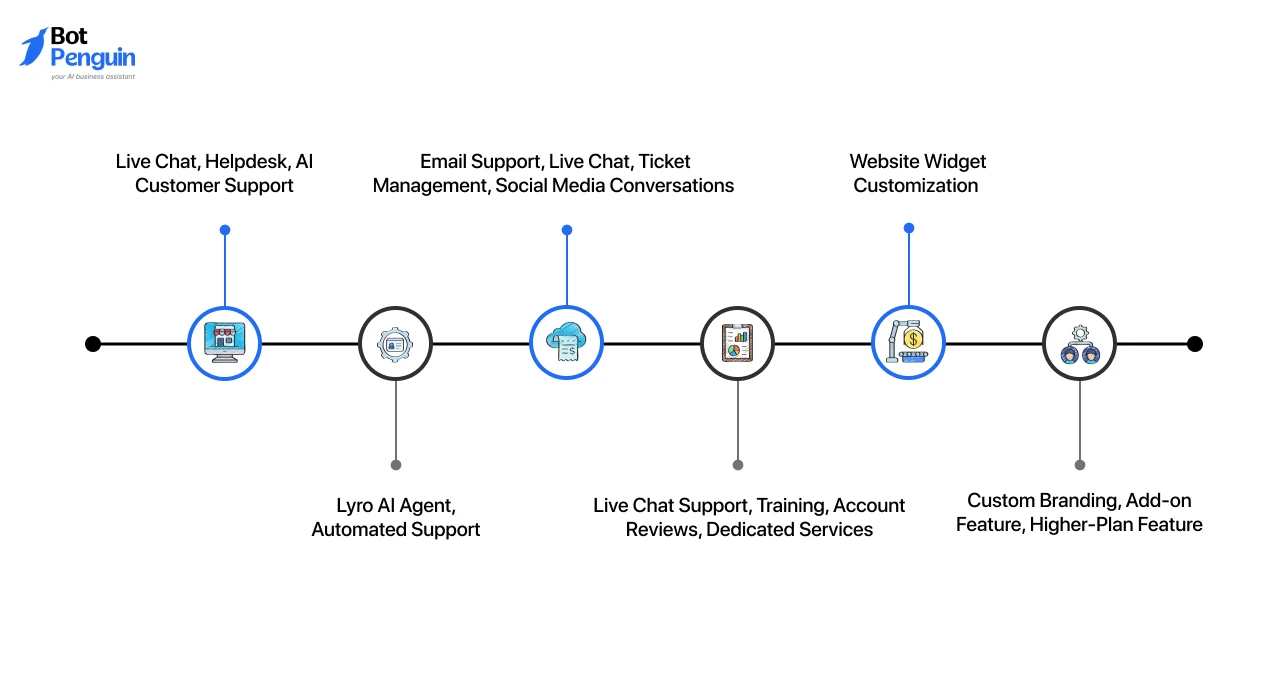
Tidio offers free and paid retail pricing options. It supports widget branding on higher plans but isn't a true reseller platform.
✓ PROS
Easy to set up
Offers live chat and AI support tools
Basic widget customization is available
× CONS
Not a true white-label reseller platform
No full reseller dashboard or client-management model for service providers
Full branding control is limited
Stammer AI is best for businesses looking to launch a branded AI SaaS focused on AI chatbots and client-managed AI tools. It gives teams the ability to operate under their own brand with custom domains, branded dashboards, client management tools, and flexible pricing control.
The platform is designed to help businesses package AI services as recurring revenue offerings while maintaining ownership of the customer experience.
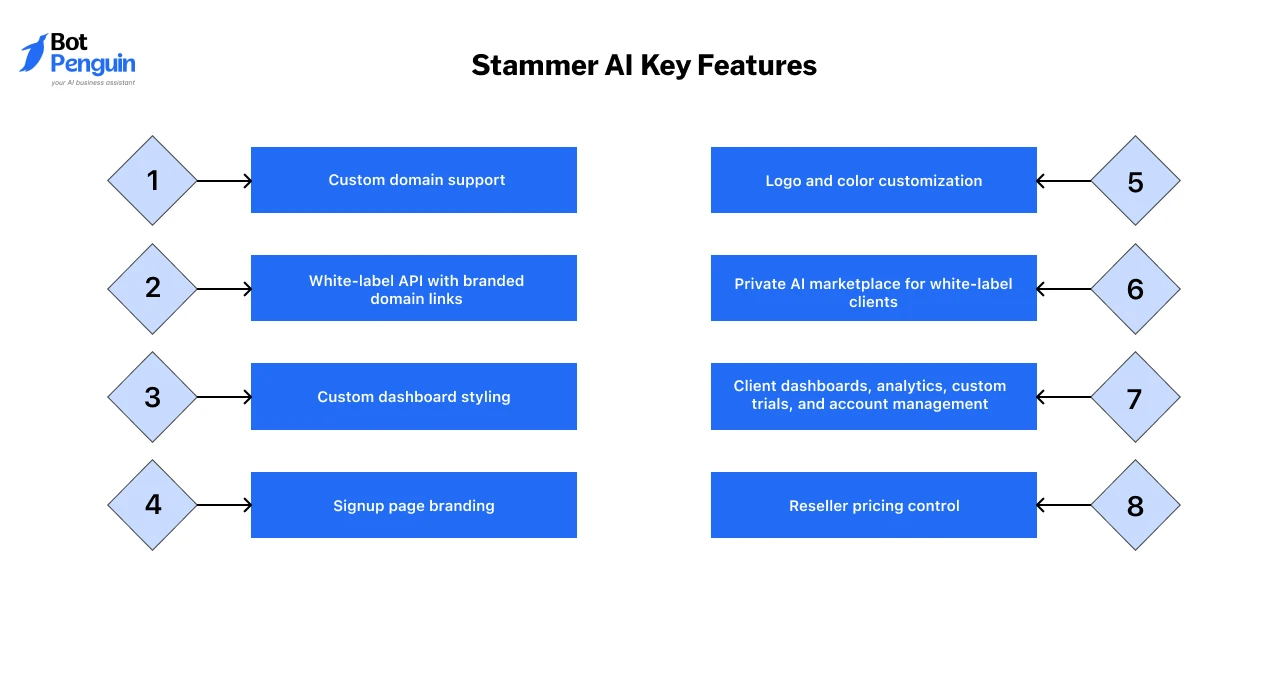
Stammer AI positions its white-label SaaS as an agency product. Its agency plan starts from $197 per month.
✓ PROS
Strong white-label features, including custom domain, dashboard, API, and client management
Allows service providers to set their own pricing and keep markup
Includes AI chat and AI voice options
Private AI marketplace can support productized resale
× CONS
May require more AI product knowledge than simpler chatbot tools
Usage, API, and plan limits should be reviewed carefully
Better suited for AI-focused teams than basic support chatbot resellers
Less suitable for teams wanting only simple website chat
Dedicated white-label platforms are only part of the picture. Agencies also need to know whether widely used chatbot tools can be rebranded and resold.
Popular chatbot tools differ significantly in what they call white-labeling. Some only remove vendor branding, while others provide custom domains, client workspaces, independent pricing, and tools for transferring or managing client deployments.
The table distinguishes full white-label resale from branding controls, multibrand features, and developer-led partner models.
The sections below explain what each platform officially supports and where its white-label limitations begin.
ManyChat does not provide a native white-label reseller platform with a custom domain and fully branded client dashboard. It is primarily designed for businesses and agencies that manage automation within ManyChat’s own environment.
Read the full breakdown of ManyChat’s white-label limitations.
Chatbase supports partial white-labeling for branded AI agent deployments. Its Enterprise plan includes broader white-label controls. The Chatbase pricing page lists these features directly.
Brand removal also costs $1,188 yearly as an add-on. Public plans omit reseller billing and branded client subscriptions.
Chatbase therefore supports branding, not complete SaaS resale.
Chatfuel supports managed automation across WhatsApp, Instagram, and Messenger. Its plans emphasize inboxes, flows, contacts, and broadcasts. The Chatfuel pricing page outlines these platform capabilities.
Public plans show no custom domain or reseller portal. They also omit independent subscriptions and partner-controlled billing.
Chatfuel suits managed automation, not white-label software resale.
Intercom provides multibrand management rather than a complete white-label resale model.
Its official documentation confirms that businesses can manage multiple brands within a single workspace and customize the Messenger, email, Help Center, and Fin AI Agent experience for each brand. This is useful for organizations operating several customer-facing brands, but it does not create an independently branded reseller platform.
Intercom does not publicly provide the complete combination of a vendor-free reseller portal, reseller-controlled subscriptions, independent client billing, and product resale under a separate software identity.
It is therefore better suited to multibrand customer support than complete white-label chatbot resale.
Landbot provides custom branding for eligible website chatbot plans. This branding applies only to web-based chatbot deployments. The Landbot pricing page confirms this limitation.
Its public plans omit independent reseller billing controls. They also lack a fully rebranded multi-client SaaS portal.
Landbot supports client projects, not complete white-label resale.
Engati provides a dedicated white-label partner option. Its portal supports branding, master-account access, and multiple customers.
The Engati pricing page lists these partner capabilities.
It does not list fixed package prices, but its current reseller program provides an indicative platform fee range of $6,000–$15,000 per year. Final pricing and commercial terms depend on the partnership arrangement.
Partners can define their own pricing and terms. Training, onboarding, sales support, and account management are included.
Tidio provides widget customization and may allow branding removal on selected plans or add-ons. However, it does not offer client sub-accounts, partner pricing, or a reseller dashboard, as expected from a complete white-label SaaS platform.
Review the complete guide to Tidio white-label options.
Botpress gives technical teams strong control over AI agents, workflows, APIs, and deployment. However, it is not structured as a ready-made white-label SaaS platform for non-technical resellers managing multiple branded client accounts.
See the detailed Botpress white-label comparison.
Yes. WotNot offers a dedicated white-label partnership rather than only chatbot branding removal.
Partners can run the platform under their own branding, use a custom domain, create multiple customer accounts, and define their own client pricing.
Its white-label plan also offers managed hosting and access to ongoing platform updates. However, white-label partnership pricing is not publicly listed, so commercial terms require direct consultation.
Voiceflow provides dedicated white-label tools for agencies and partners. These include multi-client workspaces and client handoff capabilities.
The Voiceflow pricing page confirms these features. Its model also includes usage billing and deployment management.
Voiceflow supports white-label delivery for technical service providers. However, it focuses on custom agent development rather than turnkey software resale.
Comparing these alternatives with a complete reseller model? Review BotPenguin’s branded delivery, client management, pricing control, and partner capabilities. Explore BotPenguin’s white-label chatbot offering.
The comparison shows that branding removal and true white-label resale are not the same. Some platforms support direct business customization, while others provide the domains, client accounts, and pricing control required for resale.
Comparing the two resale models side by side makes that distinction clearer.
Many people searching for a chatbot reseller program enter a standard reseller agreement without realizing how different the models are.
A standard reseller sells the vendor’s chatbot, with the vendor’s brand remaining visible. The vendor usually controls pricing, owns the client relationship, and pays a fixed commission. This route is easier to start, which makes vendor-branded reselling suitable for referrals or lower-risk market entry.
A white label reseller licenses the technology under its own brand. Clients see your domain, logo, packages, and pricing. You own the customer relationship and control the margin. The trade-off is more setup, including domain configuration, brand assets, onboarding, and pricing.
However, each new client builds equity in your business. Standard reselling generates income. White labeling builds a business asset.
If your goal is a chatbot business under your own name with recurring revenue and client ownership, white label is the model. See how BotPenguin’s white-label partnership works.
Before setting client-facing prices, confirm three numbers with your platform provider.
Once these three figures are clear, calculate your minimum cost per client. This becomes your pricing floor. Build every package above it and include room for onboarding, support, reporting, and profit.
Three pricing models are common. A per-client monthly subscription is the most predictable because recurring revenue compounds as the client base grows. This should be the default for most resellers.
Tiered packaging creates two or three plans with clear differences in features. Lower tiers may include only website chat, while higher tiers can add WhatsApp, Messenger, AI responses, reporting, integrations, and priority support. This creates a natural upsell path.
Usage-based pricing can work for high-volume ecommerce or messaging clients, but revenue becomes less predictable. Start with a per-client subscription supported by tiered packages.
Illustrative pricing only. Adjust these packages using your actual platform, usage, onboarding, and support costs.
Your Starter tier price should cover your full platform subscription on its own. If one client at your lowest tier does not break even on your platform cost, reprice before you launch. Never discount below your cost base to win a client — a client signed at a loss does not become profitable later.
Use this formula: Estimated gross margin = Client revenue − platform costs − usage costs − delivery and support costs
For example, assume a reseller charges one client $300 per month:
In this example, the reseller earns an estimated gross margin of $210 per client per month, or 70%, before sales, marketing, taxes, and general business overhead.
High message volumes, custom integrations, or intensive support can reduce this margin. Calculate each package based on realistic client usage rather than the platform’s entry price alone.
White-label chatbot platforms use different pricing structures, account limits, and reseller terms. This table compares each platform’s starting cost, reseller model, and client account limits.
(Disclaimer: Pricing, plan limits, partner terms, and white-label features were reviewed in September 2026 and may change without notice. Always verify the latest details directly with each provider before making a purchase decision.)
Use the listed prices as an initial comparison only. Before choosing a provider, confirm account limits, usage charges, branding costs, channel fees, support responsibilities, and the minimum client price needed to protect your target margin.
You can also compare BotPenguin's cost base, branding controls, and client-account structure through our white-label chatbot partnership page.
Next, let’s identify which platforms best fit different business models and buyer types.
The best white label chatbot depends on your delivery and revenue model. Some teams need reseller controls, while others prioritize development flexibility or rapid deployment.
Use the filter below to narrow the shortlist.
The best white label chatbot for branded service providers is the one that supports branding, client management, WhatsApp deployment, onboarding, and pricing control.
Strong options include:
For agencies, the priority should be recurring revenue support, not just chatbot creation.
The best white label chatbot builder for SaaS teams should support product embedding, workflow control, integrations, and flexible deployment.
Good options include:
For SaaS teams, the platform should align with the product roadmap, not just the sales offering.
The best chatbot platform for service providers, consultants, and IT resellers should balance setup speed, branding control, support, and client pricing flexibility.
Practical choices include:
The right platform should match the service model you can deliver consistently. Choosing a platform that aligns with your strengths will make scaling and client retention much easier.
Choosing a chatbot tool requires more than checking whether its logo can be removed.
Some platforms support only widget customization, while others provide custom domains, client accounts, independent pricing, and complete branded delivery.
Start by deciding whether you need a chatbot for your own business, a technical platform for custom builds, or software you can resell under your brand. Then compare channel coverage, client controls, pricing structure, and margin potential.
For a reseller-ready option, explore BotPenguin’s white-label chatbot offering and compare its branding, client-management, pricing, and revenue model against your shortlist.
True white-label resale typically requires custom branding, client sub-accounts, pricing control, and branded delivery. BotPenguin, BotSailor, and Stammer AI provide reseller-oriented capabilities, while tools such as Tidio and ManyChat mainly support direct business use or limited branding.
White-label chatbot software pricing varies widely depending on branding controls, client limits, channels, and support. Some platforms offer plans starting from monthly subscriptions, while others use annual partner programs or custom pricing. Beyond the platform cost, businesses should also consider scalability, usage limits, and long-term profitability.
Yes. White-label chatbot platforms are specifically designed for resale. They allow businesses to offer chatbot services under their own brand, set custom pricing, manage multiple client accounts, and provide implementation or support services. This makes them a popular option for consultants, SaaS resellers, and service providers.
ManyChat, Chatbase, and Intercom do not provide the same complete reseller model. ManyChat focuses on managed automation, Chatbase offers partial white-labeling, and Intercom provides multibrand support rather than vendor-free software resale.
White-label chatbot platforms commonly support websites and major messaging channels such as WhatsApp, Instagram, and Facebook Messenger. Some also support Telegram, SMS, email, Slack, or live chat, depending on the provider and plan. Channel coverage should therefore be matched against the communication platforms your clients use most frequently to avoid deployment limitations later.
Setup time depends on branding requirements, domain configuration, integrations, and onboarding processes. Some platforms allow partners to launch within a few hours, while others require consultation, training, or technical setup. The timeline generally becomes longer when custom workflows, channels, or client-specific integrations are involved.
A white label chatbot builder provides ready-made software that can be rebranded and resold quickly. A custom-built chatbot is developed from scratch and offers greater flexibility, but requires significantly more time, technical resources, and maintenance. White-label solutions are usually faster and more cost-effective for most businesses.
Subscribe to Our Newsletter
Get the latest business insights straight into your inbox.
Checkout our related blogs you will love.
Updated at Oct 19, 2026
10 min to read
Updated at Oct 9, 2026
8 min to read

Updated at Oct 9, 2026
12 min to read
Updated at Oct 6, 2026
9 min to read
Updated at Oct 1, 2026
11 min to read
Updated at Sep 28, 2026
19 min to read
Table of Contents
