


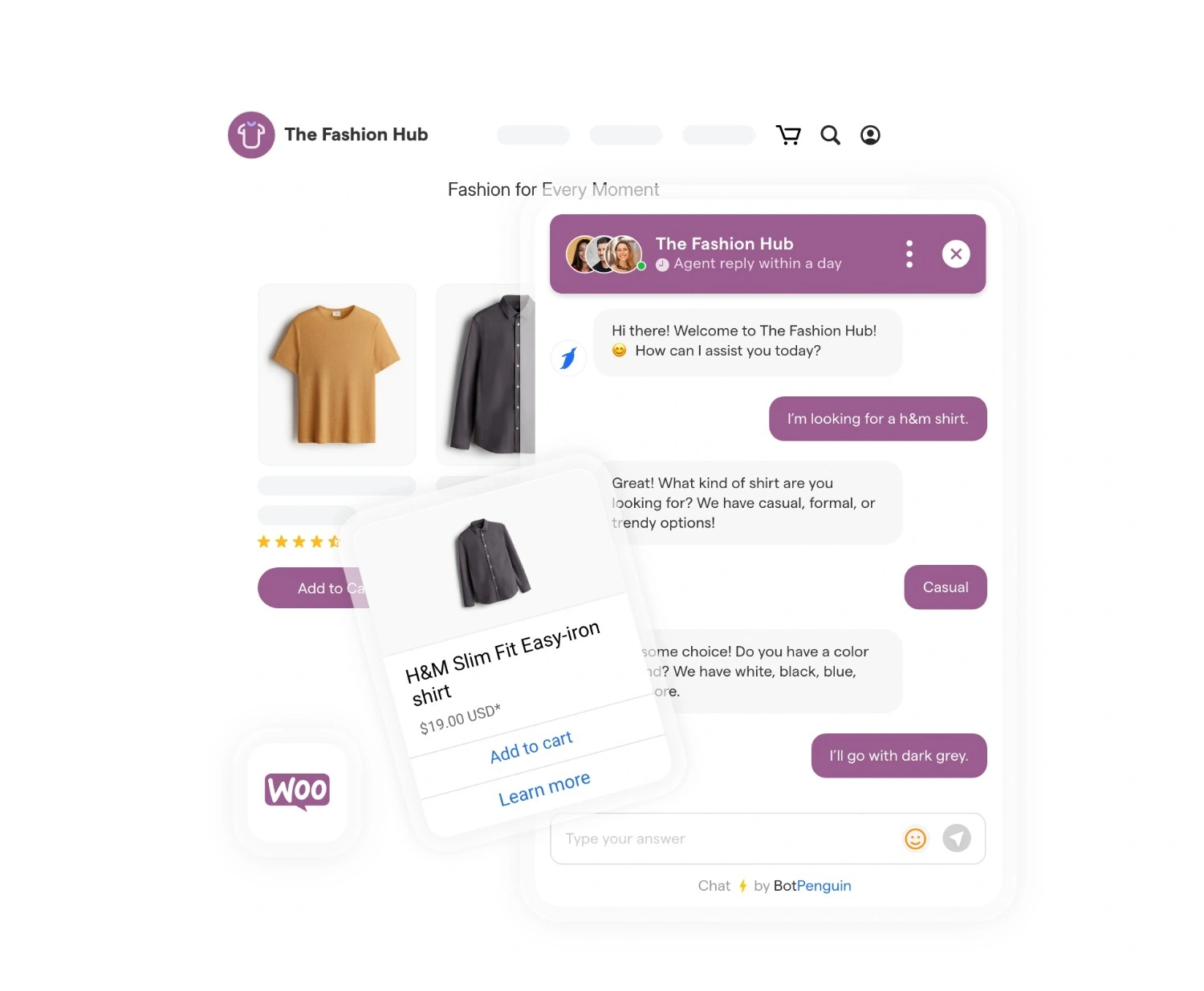
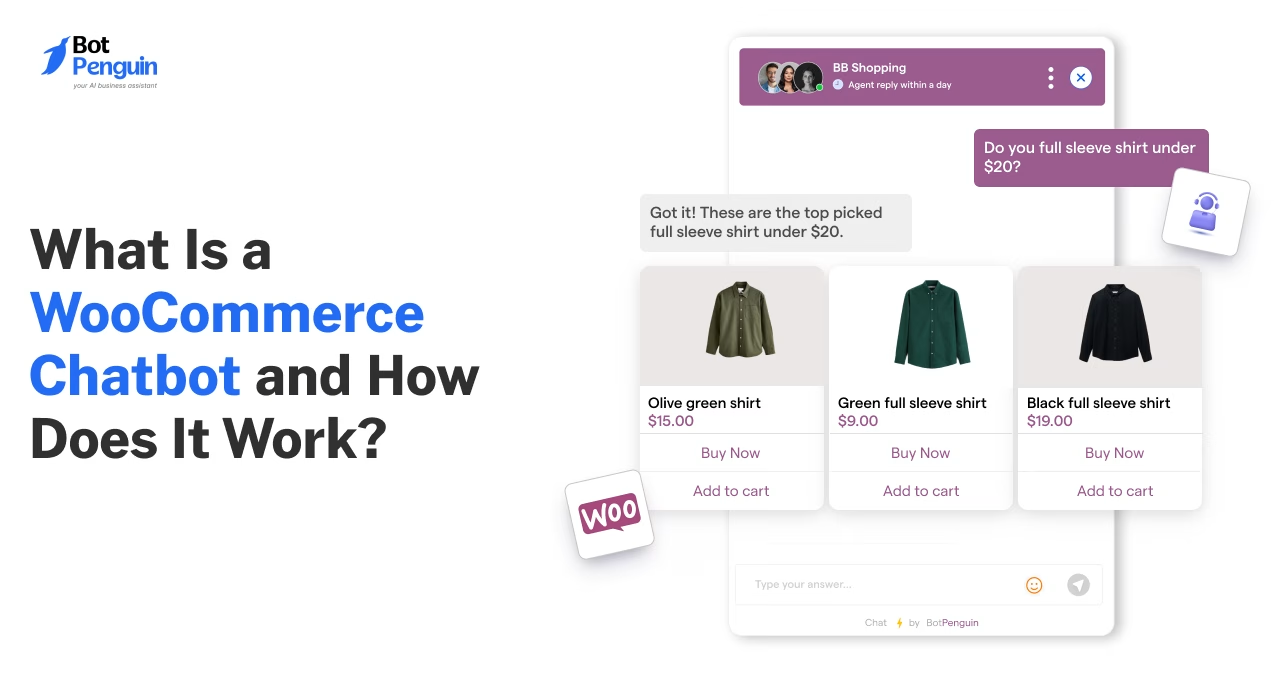
What Is a WooCommerce Chatbot and How Does It Work?
Updated at Oct 16, 2026
12 min to read
Struggling with recurring WooCommerce support requests? This guide explains how a customer service chatbot handles order tracking, returns, refunds, warranties, multilingual questions, and complex handoffs. It shows where automation fits, what data connections matter, and when human support is still required.
Your next sale might be one answer away…
Customers don’t always leave your WooCommerce store because of price or a better competitor. Sometimes it’s a simple question about delivery, product specs, or an order status left unanswered.
A WooCommerce customer service chatbot closes that gap. It answers common questions, shares order updates, and handles after-sales requests, so your store never goes quiet when it matters most.
This guide explains where a WooCommerce chatbot for after-sales support fits, how it works, and when human support is still needed.
For the broader concept, start with what a WooCommerce chatbot is and how it works across a store.
As a WooCommerce store grows, support requests often increase faster than the team handling them. Simple questions begin to consume time that could be spent on more complex customer issues.
A Gartner survey of over 5,700 customers found that just 14% of service issues are fully resolved through self-service, even for “very simple” cases.
Understanding where these problems come from makes it easier to see where a WooCommerce customer service chatbot adds value:
These recurring support gaps show where a WooCommerce chatbot can minimize pressure without weakening service quality.
This is where platforms like BotPenguin fit naturally, combining AI, WooCommerce integrations, and automated workflows to help you automate your WooCommerce support while routing complex cases to your team.
A WooCommerce order tracking chatbot works through a structured data-retrieval process, not a preset shipping message.
Forrester found 55% of online shoppers want more visibility into their order status than they currently get.
The chatbot requests the order number and billing email to confirm identity before any private information appears.
Logged-in customers can be verified through their WooCommerce account instead, skipping repeat entry.
Once verified, the chatbot pulls data from the connected WooCommerce order database: order status, payment confirmation, fulfillment progress, shipping method, tracking number, and dispatch date, then converts it into a clear answer.
If a shipping extension has added carrier data, the chatbot returns the tracking URL directly in the conversation.
This matters because WooCommerce may mark an order “Completed” before the carrier confirms delivery, since store status and courier status aren't always the same.
Some orders ship from multiple warehouses.
A useful chatbot checks for multiple tracking numbers before replying, explaining which items have shipped and which are pending, so a partial shipment doesn't look fully delayed.
The chatbot hands off failed deliveries, missing scans, or address changes to the team, along with the order number, tracking record, and conversation history, cutting repeat questions while keeping edge cases with support.
A WooCommerce order tracking chatbot thus simplifies delivery updates, improves order visibility, and routes complex shipping issues to human support when needed.
When connected with systems like WooCommerce, CRM software, shipping carriers, and helpdesk platforms, a chatbot can access order information and guide customers through common after-sales tasks.
Here’s how a WooCommerce customer service chatbot handles each request, where automation stops, and when an agent steps in.
Let’s study each of these after-sales WooCommerce chatbot tasks in detail:
Customers often want to know whether an item is eligible for return, how long they have, where to ship it, or what happens next.
A chatbot can walk them through your return policy, collect the required details, and direct them to the correct return workflow.
Example: A customer types, “I received the wrong size”. The chatbot checks the order, confirms it falls within the return window, and shares the next steps for an exchange.
A WooCommerce order tracking chatbot can answer one of the most common support questions without agent involvement.
By connecting with shipping providers, it can retrieve the latest tracking status, expected delivery date, or notify customers about delays.
Customers often have questions weeks or months after their purchase. They may ask whether a product is still under warranty, how to claim it, or where to find setup instructions.
A chatbot can verify warranty eligibility, surface relevant documentation, and guide users to the appropriate process.
Once a return has been approved, customers naturally want to know when the refund will arrive.
Rather than checking each request manually, the chatbot can share the current refund status, estimated processing timeline, and explain each stage of the process.
Customers occasionally need to update a delivery address, modify contact details, download invoices, or access previous orders.
Where store policies allow, the chatbot can guide them through these requests or collect the required information before passing it to an agent.
A chatbot for after-sales support can send a follow-up message after delivery or after a support case is closed, asking whether everything met expectations.
If a customer reports a problem, the conversation can be routed to the right team before frustration grows.
Billing disputes, damaged products, or unusual requests often require human judgment.
A WooCommerce AI chatbot can collect the customer's order details, summarise the issue, and transfer the conversation to a support agent with all the context already available.
This avoids customers having to explain the same problem multiple times.
Together, these workflows keep post-purchase support moving while ensuring complex cases reach the right agent.
Beyond order-specific requests, a WooCommerce customer service chatbot also picks up the smaller, high-frequency questions that don't need a ticket but still pull attention away from the support team.
These capabilities extend chatbot support beyond order-related issues and into everyday store assistance.
BotPenguin helps bring these capabilities together in a single WooCommerce chatbot, empowering businesses to manage everyday customer questions, automate routine support, and deliver a more connected customer experience across channels.
Good support doesn't end at checkout; it just changes shape. As your WooCommerce store scales, questions about orders, returns, refunds, warranties, and deliveries become a steady part of the business.
One-by-one handling wears thin fast, especially when the same few queries resurface across customers.
A WooCommerce customer service chatbot resolves routine questions, walks customers through common after-sales tasks, and passes complex issues to your team when they need a person.
Before you pick a solution, confirm it connects with your store, shipping tools, and support systems to keep every answer accurate across the customer journey.
A WooCommerce chatbot can connect with your store’s order data, identify the customer, retrieve the latest status, and share tracking details automatically. It can also guide returns, refund inquiries, warranty questions, and other routine post-purchase requests.
A chatbot answers routine post-purchase questions at any hour, shortens response times, and keeps simple requests out of the agent queue. Support teams can then focus on damaged items, billing disputes, delivery exceptions, and other cases requiring judgment.
Yes. A WooCommerce chatbot can explain the return policy, confirm whether an order meets basic eligibility rules, collect required details, and direct the customer to the correct workflow. Policy exceptions or unclear cases can be transferred to an agent.
When connected to WooCommerce and carrier data, the chatbot can return the customer’s actual order status, tracking number, and shipment link. Without those integrations, it can only provide general guidance, so reply quality depends on connected data.
Yes. A WooCommerce chatbot can detect the customer’s language or present a language selector, then reply using configured multilingual content. Stores should still review translated policies, product instructions, and legal wording before relying on automated responses across markets.
A chatbot can show the recorded refund status, explain the current processing stage, and share the expected timeline when payment data is available. Final settlement times may still depend on the payment gateway, card issuer, bank, or store policy.
The chatbot should escalate requests involving missing deliveries, damaged products, unusual warranty claims, billing disputes, failed identity checks, or policy exceptions. It can pass the order details and conversation history forward, so the customer does not repeat the issue.
Improve WooCommerce Customer Support With AI Chatbots
Handle order tracking, returns, refunds, warranty questions, and after-sales inquiries in one place. Deliver timely assistance while giving your support team more time for complex customer issues.
Get Started NowCheckout our related blogs you will love.
Updated at Oct 16, 2026
12 min to read
Updated at Oct 12, 2026
12 min to read
Updated at Oct 9, 2026
11 min to read
Updated at Oct 7, 2026
8 min to read
Updated at Oct 6, 2026
6 min to read
Updated at Sep 10, 2026
11 min to read
Table of Contents