Customer Service Automation: Benefits, Use Cases & Best Practices in 2026
Updated at Oct 5, 2026
8 min to read
Most businesses believe their customer service is adequate. A contact form, an email inbox, maybe a phone line. That is the situation most digital businesses are still operating in today.
The problem is your customers are not waiting anymore. When someone messages you on WhatsApp at 9 PM about a delayed order, they expect a reply, not a business hours notice. That silence is where trust breaks permanently.
According to Salesforce, 73% of customers expect companies to understand their needs, yet most support is built around the business's convenience, not the customer's. Digital customer service closes that gap.
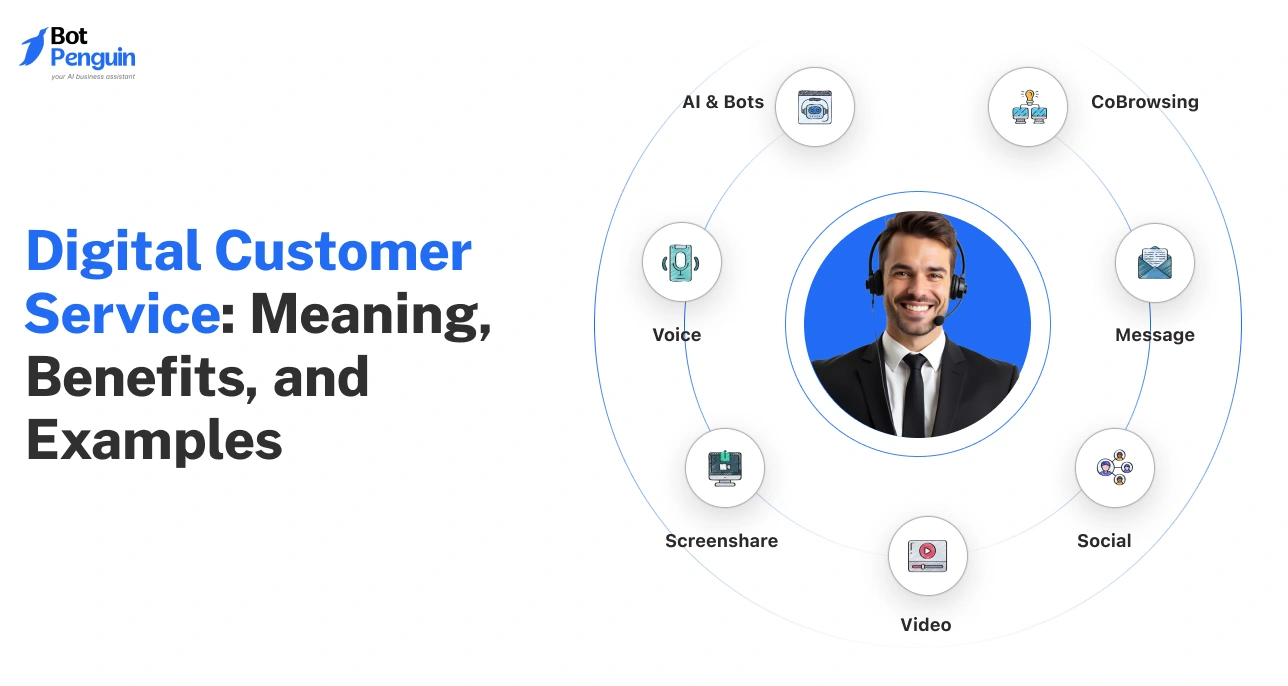
Digital customer service is the support a business provides through online channels including live chat, WhatsApp, AI chatbots, email, social media, and self-service portals. It combines automation, AI, and human assistance to respond faster, handle more volume, and stay consistent across every interaction.
It means meeting customers on the channels they already use, the moment they reach out. In practice, that looks like this:
Digital customer service does not replace human agents. It redirects them. Automating high-volume, repeatable queries such as order tracking, FAQs, and booking confirmations frees your team to focus on interactions that genuinely need a person: complaints, complex decisions, and situations where empathy matters more than speed.
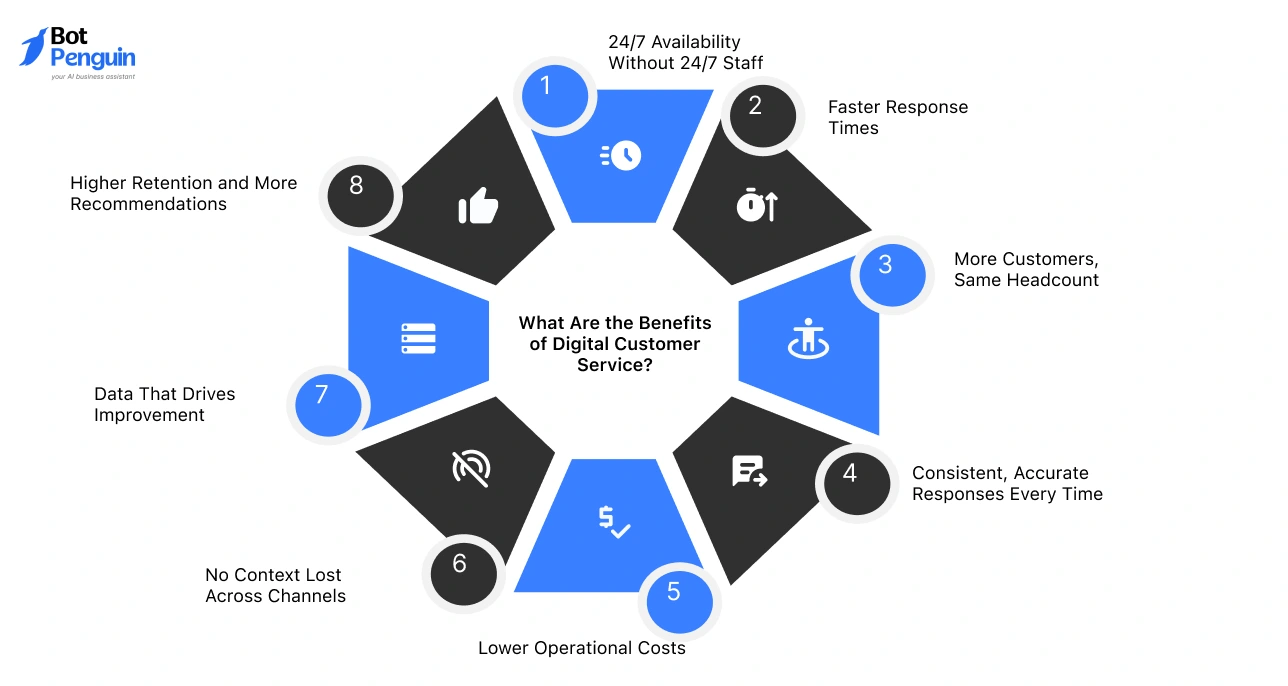
Businesses that embrace digital customer service consistently outperform those that do not. Here is why.
AI chatbots respond at 3 AM the same way they do at 3 PM. For e-commerce businesses, this eliminates abandoned carts from unanswered overnight queries. For WhatsApp-first businesses, it means zero missed leads. Automation closes the time gap between when customers need help and when your team is available.
A customer messaging on WhatsApp gets an instant automated reply, not a 20-minute hold queue. Digital channels collapse first response time from hours to seconds, which is often the difference between a completed purchase and a lost one.
A human agent handles one phone call at a time. With digital chat tools, the same agent handles multiple conversations simultaneously. AI chatbots remove this ceiling entirely by handling unlimited concurrent queries without fatigue or error.
Human agents have bad days, forget policy details, and occasionally give contradictory answers. A well-configured chatbot delivers the same accurate response every time, protecting brand consistency at scale.
Automating repetitive queries — FAQs, order status, pricing, booking confirmations — removes the largest share of inbound support volume. Most businesses see a significant reduction in ticket volume within the first 90 days of deployment, with cost savings that compound over time.
Customers contact you on WhatsApp, follow up on Instagram, and check your website chat. A unified platform consolidates all these conversations so no context is lost, no customer is forgotten, and no message falls through the cracks because it arrived on an unmanned channel.
Every digital interaction generates insight. You can see which queries are most common, where conversations fail, which agents perform best, and how satisfaction trends over time. Phone-only support cannot offer this visibility.
Customers who feel heard and served quickly come back. They also tell others. Reducing friction in the support experience is one of the most direct levers a business has for both retention and word-of-mouth growth..
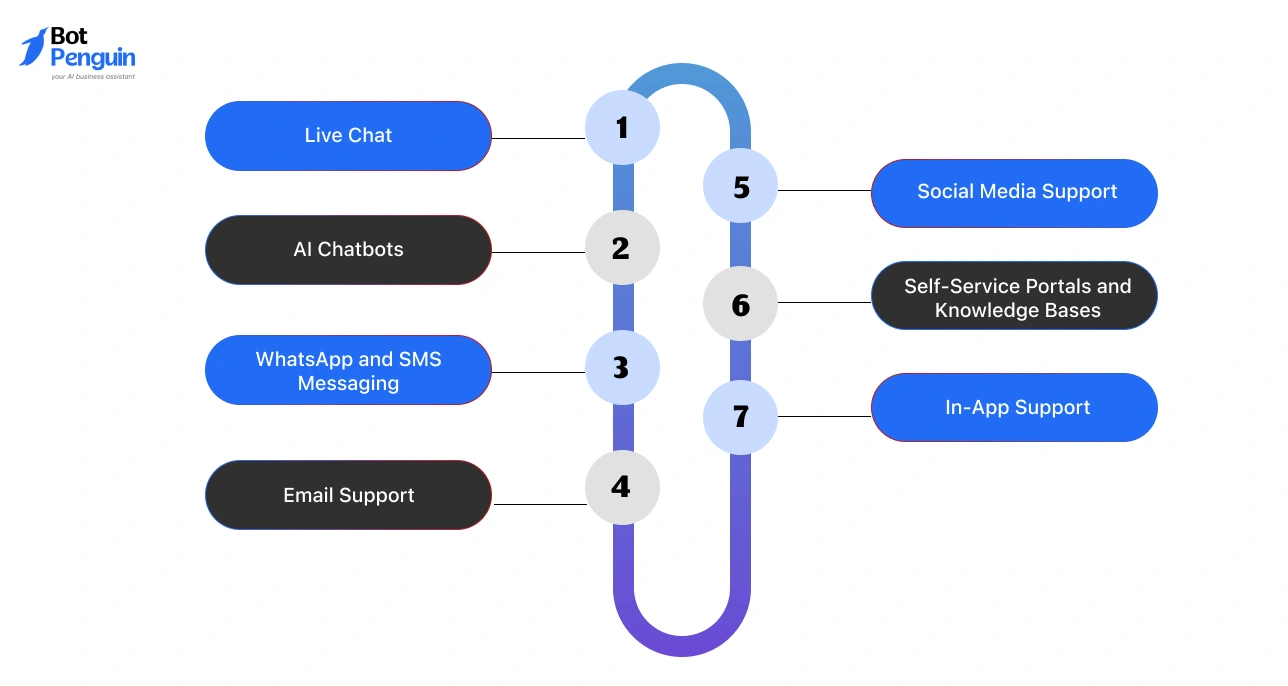
Digital customer service is not a single channel. It is an ecosystem where each channel serves a different purpose in your overall support strategy.
A real-time messaging widget on your website or app. Customers get instant answers without leaving the page. Best for resolving purchase-intent questions, handling objections, and reducing cart abandonment. Platforms like BotPenguin support both AI-automated and human agent modes, switching seamlessly based on query complexity.
Automated conversation flows powered by natural language AI. Modern chatbots understand informal phrasing, pull data from your systems in real time, process orders, book appointments, and capture leads without human involvement. They handle unlimited simultaneous conversations and escalate to a human agent when the query genuinely needs one.
WhatsApp is the dominant messaging channel across South Asia, Southeast Asia, Latin America, and Africa, and increasingly the preferred channel for customer communication worldwide. Businesses using the official WhatsApp Business API can automate replies, send proactive updates, run broadcast campaigns, and manage multi-agent conversations from a single inbox.
Still essential for formal communications, detailed issue resolution, and B2B correspondence. Email works best when paired with automation: auto-responses, ticket routing, and templated replies that reduce manual workload. Less suited for real-time queries but critical for documentation and complex cases.
Facebook, Instagram, and X have become frontline customer service channels. Customers post questions, complaints, and feedback publicly. A unified inbox that monitors and routes all social messages from one place protects brand reputation and keeps response times consistent across channels.
FAQ pages, help centres, and knowledge bases let customers find answers independently with zero agent cost per resolution. This is the most scalable form of digital customer service and is increasingly preferred by customers who would rather search than wait.
For SaaS businesses and mobile apps, in-app chat or support widgets provide contextual help exactly where users need it without making them leave the product. This reduces friction and directly improves adoption and retention.
One of the fastest-growing components of digital customer service is the AI chatbot. Understanding what it does and how it works is essential before choosing a platform.
A customer service bot is an AI-powered tool that automatically handles customer queries through conversation on your website, WhatsApp, social media, or messaging apps. It interprets messages using natural language processing, retrieves the relevant answer from your knowledge base, and responds instantly at any volume, without human involvement for routine queries.
Consider a business receiving 500 queries a day. The majority are routine: order status, pricing questions, booking confirmations, return policies. A well-configured chatbot resolves these automatically, leaving your team to handle only the queries that genuinely require a human decision.
The result is that your team's effective capacity increases significantly without a single additional hire. The chatbot handles the WhatsApp spike at midnight, the website surge during a sale, and the social media DM queue simultaneously.
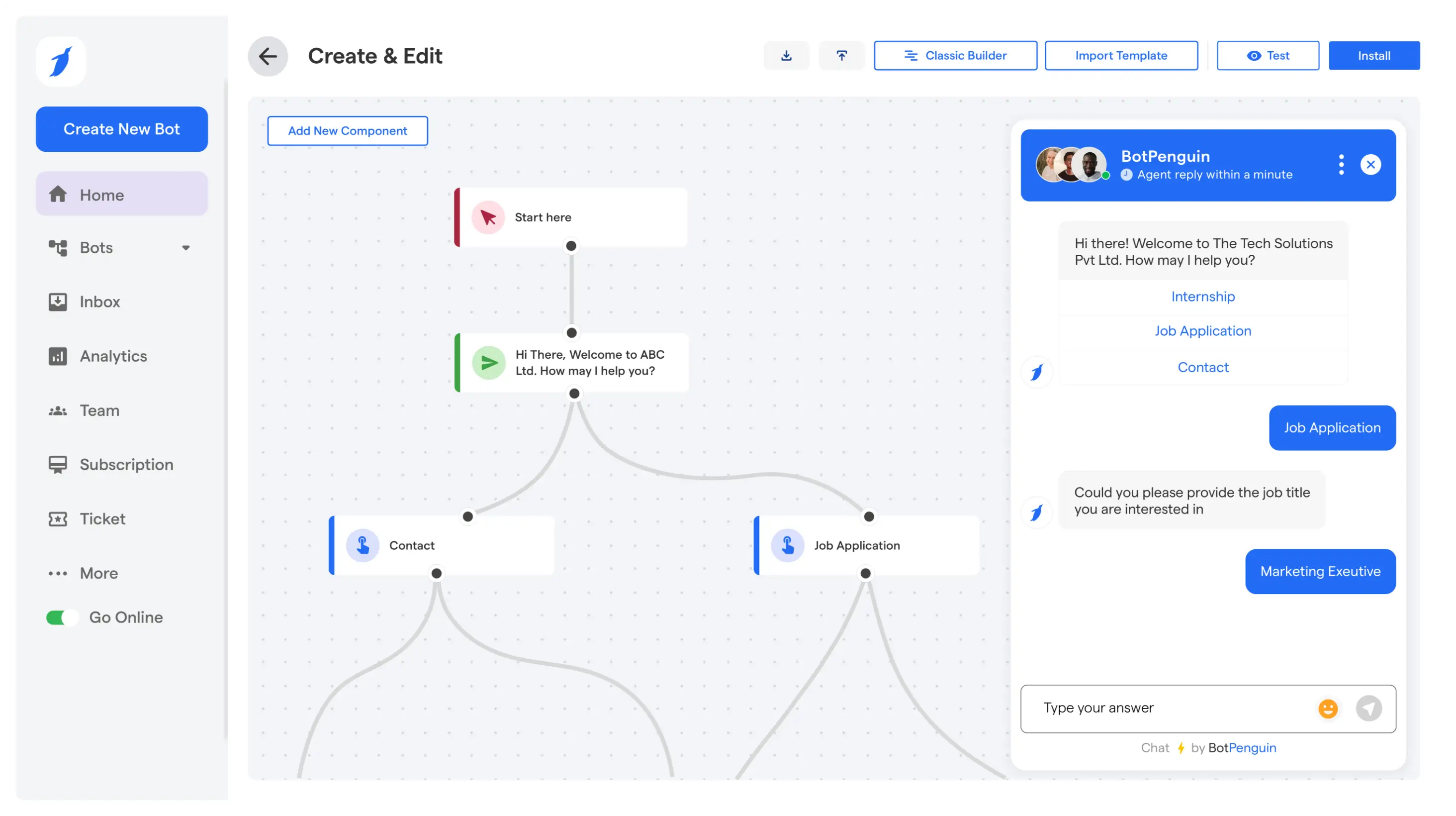
Platforms like BotPenguin are built for businesses that need a customer service bot deployable quickly, without developers or enterprise pricing. It covers WhatsApp, website, Shopify, Facebook, Instagram, and Telegram from one dashboard, with pre-built templates for the most common support use cases and integrations with tools like HubSpot, Salesforce, and Zapier.
With dozens of platforms competing in this space, choosing the right tool for your business type and budget matters enormously. Here is how the leading platforms compare.
Not all platforms are built for the same use cases. The right choice depends on your channels, integrations, and team capabilities.
Before evaluating tools, define:
Once this is clear, evaluate platforms using the criteria below.
Start with the channels where your customers are most active.
Ensure the platform:
Choosing the wrong channel fit will limit adoption, no matter how strong the platform is.
Not all automation is equal. There is a significant difference between basic rule-based bots and advanced AI systems.
Look for:
This determines how much of your support can actually be automated.
Integrations should improve context, not just add connections.
Focus on:
A smaller number of strong integrations is more valuable than many shallow ones.
Pricing models can impact scalability more than expected.
Watch for:
Prefer pricing that scales predictably with your business growth.
Different business sizes require different priorities. Use the breakdown below to narrow your options.
Small teams should prioritise simplicity and speed of setup.
Focus on:
Platforms like BotPenguin and Freshdesk are commonly used in this category.
Growing businesses need more structure and integration.
Focus on:
This stage requires balancing automation with team collaboration.
Enterprises require depth, control, and scalability.
Focus on:
Platforms like Zendesk and Salesforce Service Cloud are typically used here, though they require higher investment and longer implementation timelines.
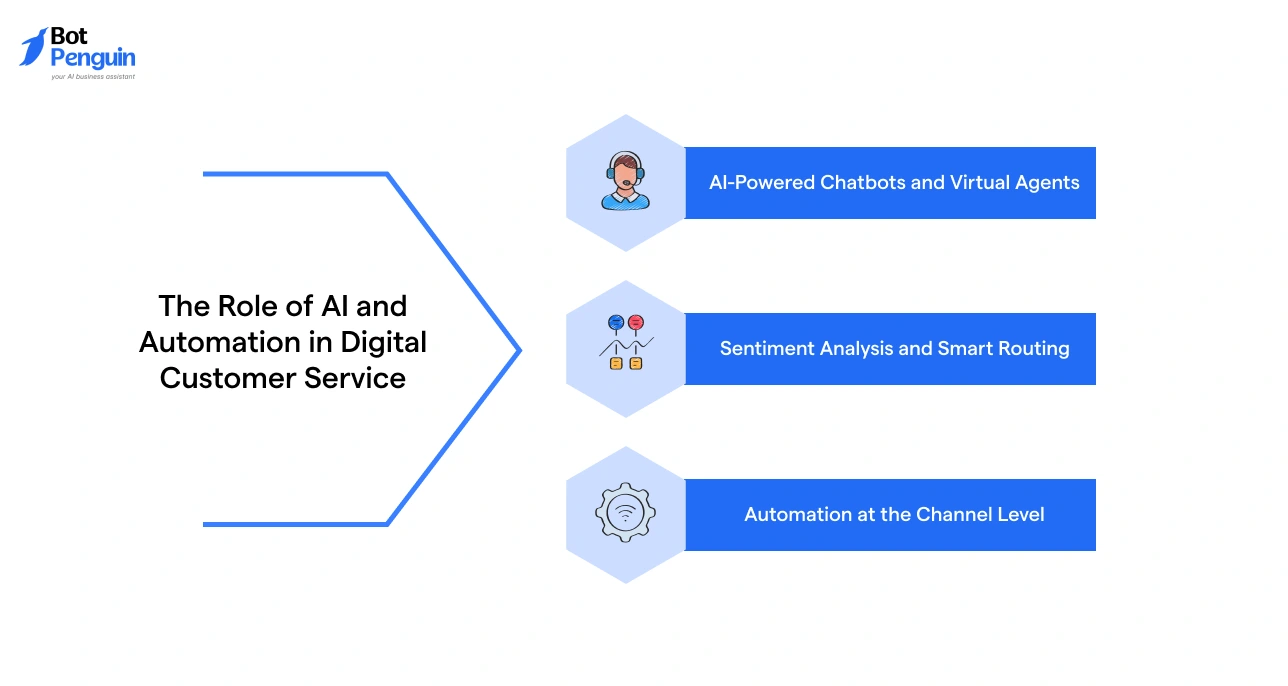
AI and automation are what make digital customer service scalable. Without them, every additional query requires additional human time. With them, volume stops being a constraint.
Modern AI chatbots use natural language processing to understand customers even with informal phrasing, spelling errors, or regional language variations.
They handle FAQs, process transactions, check order status, book appointments, and capture leads — all without human involvement. The result is support that runs continuously and improves response quality, not just speed.
AI does not just read words. It reads tone.
Sentiment analysis detects when a customer is frustrated or at risk of leaving and escalates automatically to a human agent before things deteriorate. Smart routing then uses query type, customer history, and sentiment together to direct each conversation to the right place, cutting misroutes and resolution time.
The most impactful automation happens where your customers already are.
Platforms like BotPenguin manage all three from a single dashboard, removing the need for separate tools per channel.
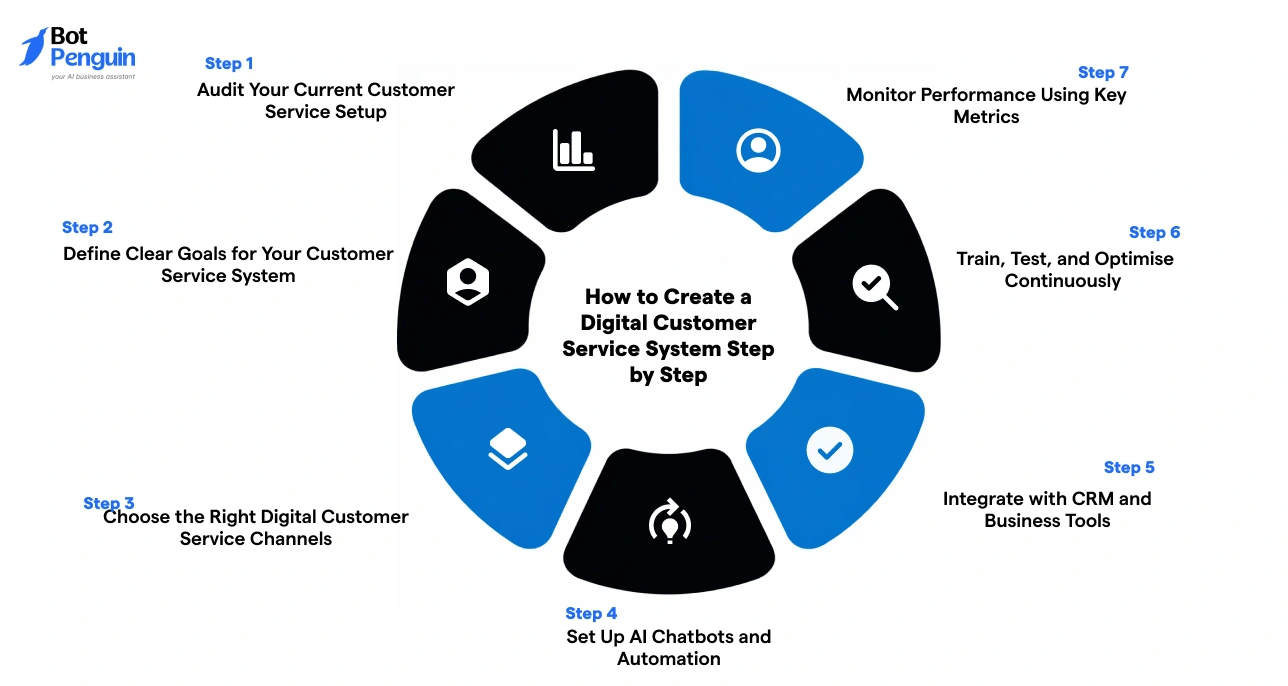
Creating a digital customer service system involves setting up the right channels, automating high-volume queries, and continuously improving performance using data.
Follow these steps to build a scalable and efficient system.
Start by analysing how your current support system performs across channels.
Focus on:
This helps identify gaps and prioritise areas for automation.
Set measurable outcomes before implementing any tools.
Define goals such as:
Clear goals ensure your system delivers business impact.
Select channels based on where your customers are most active.
Typically:
Start with one or two channels and expand gradually.
Implement AI chatbots to handle routine and high-volume queries.
Configure your system to:
This creates immediate efficiency and faster response times.
Connect your customer service system with your existing tools.
Key integrations include:
This ensures personalised and context-driven interactions.
Your system improves through regular testing and refinement.
Track and optimise:
Use these insights to improve chatbot accuracy and workflows.
Measure the success of your system using core KPIs.
Focus on:
These metrics help you evaluate both efficiency and business impact.
Each business type operates on different channels, faces unique challenges, and requires a tailored support approach. Here is how digital customer service works in practice across key business models.
E-commerce businesses deal with constant spikes in support queries, especially during sales and peak seasons. Most of these queries revolve around order status, delivery timelines, returns, and product-related questions.
The biggest challenge is managing this volume without increasing support costs or delaying responses.
To solve this:
Businesses using AI-driven customer service in e-commerce report up to a 67% reduction in cost per resolution along with improved repeat purchases.
For B2B businesses, the website is both a support channel and a lead generation engine. However, many struggle with high bounce rates and low visitor engagement.
The core issue is that potential customers leave without interacting or sharing their details.
A structured digital customer service setup can fix this:
B2B companies using conversational AI report a 38% increase in lead qualification rates and shorter sales cycles.
Source:
For local and service-based businesses, WhatsApp has become the primary communication channel. However, manual replies create delays, inconsistency, and missed opportunities.
The challenge is maintaining speed and consistency while managing high message volume.
A WhatsApp automation setup enables:
Using the official WhatsApp Business API ensures scalability, reliability, and compliance while avoiding risks associated with unofficial tools.
You cannot improve what you do not measure. The right metrics help you understand performance, identify gaps, and continuously optimise your support strategy.
Customer service leaders consistently prioritise metrics like CSAT, response time, and resolution rate as the most critical indicators of success.
Modern customer service is shifting rapidly toward digital channels. More than 40% of customer interactions are expected to move to digital channels in the coming years, making these metrics critical for scaling support operations.
At the same time, AI is transforming performance benchmarks.
This makes tracking the right KPIs essential to stay competitive.
In the early stages, avoid tracking everything at once. Focus on the three metrics that give the clearest signal of performance:
These metrics provide a fast and reliable indicator of whether your digital customer service setup is working.
With dozens of platforms available, choosing the right one depends on your business model, preferred channels, required integrations, and growth stage.
Instead of comparing features blindly, use this seven-point evaluation framework to make a practical, high-impact decision.
Start with where your customers are.
If most of your enquiries come through WhatsApp, a platform without native WhatsApp Business API support is immediately a poor fit, regardless of its other features.
Map your top channels first, then shortlist platforms that support them natively.
Complex tools slow down adoption, especially for lean teams.
Evaluate:
A platform should enable your team, not create dependency on technical resources.
Your customer service platform must work seamlessly with your existing tools.
Look for integrations with:
Most importantly, ensure two-way data sync so customer context flows both ways, not just into the system.
Not all chatbots are equal.
Some platforms offer simple rule-based flows, while others provide NLP-powered AI that understands natural language and context.
Choose based on your current needs, but also consider scalability. A system that works today should not limit you tomorrow.
Without data, optimisation is guesswork.
A strong platform should provide visibility into:
These insights are critical for improving both automation and human support over time.
Pricing models vary widely and can impact long-term costs significantly.
Be cautious of:
Prefer flat or tiered pricing models that scale predictably as your business grows.
The platform’s own support matters more than most businesses expect.
When issues arise, fast and effective vendor support can save hours or even days of downtime.
Before committing:
A reliable vendor becomes a long-term partner, not just a software provider.
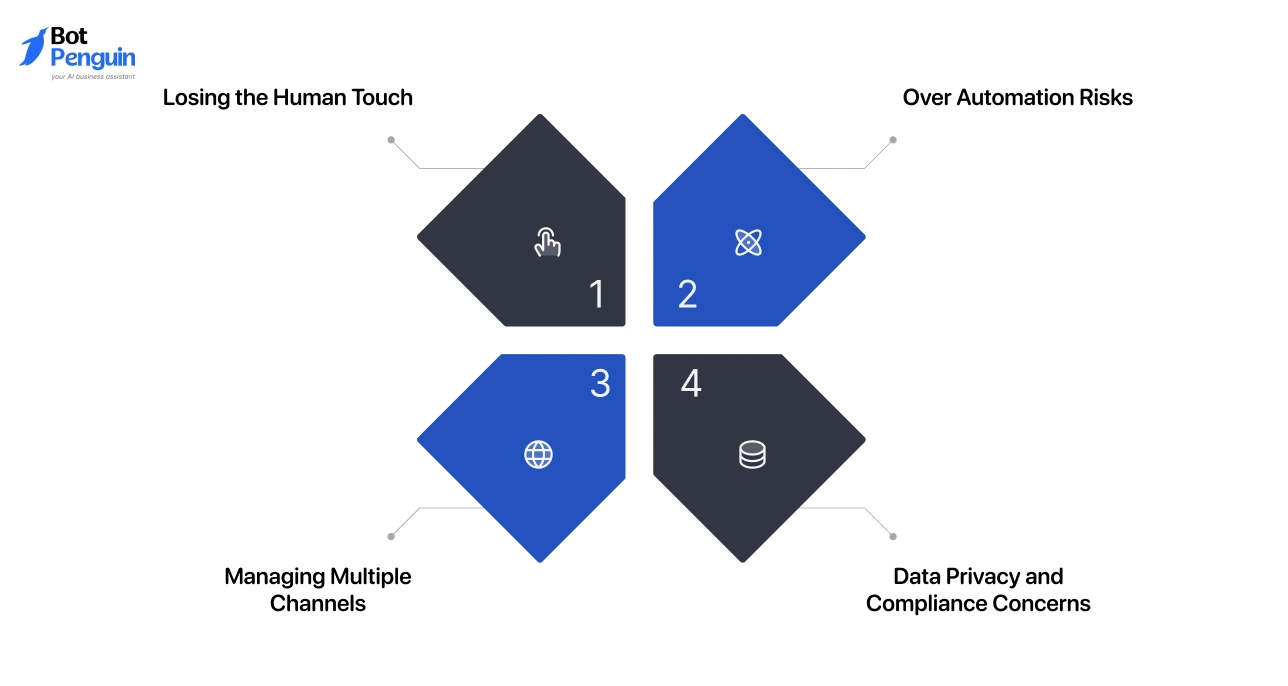
Even with the right tools in place, businesses often face operational and strategic challenges when scaling digital customer service.
Here are the most common issues and how to solve them effectively.
Support teams spend a large portion of their time answering the same questions repeatedly, such as order status, pricing, or booking details.
Solution: Deploy an AI chatbot trained on your top query types and configure it to resolve these automatically without human involvement.
Most businesses achieve 60% to 80% automated resolution within the first 60 days, allowing agents to focus on complex and high-value interactions.
Customers often switch between channels like WhatsApp, website chat, and social media. Without shared context, they are forced to repeat their issue multiple times.
In fact, 56% of consumers have had to repeat their issue to multiple agents due to lack of context continuity.
Source:
Solution: Use a unified inbox with full conversation history across all channels. This ensures every agent has complete context, reducing frustration and improving resolution speed.
Different agents may provide different answers to the same query, leading to confusion and reduced trust.
Solution: Centralise communication using a shared knowledge base and unified inbox. When both agents and chatbots pull responses from the same source, consistency improves significantly.
Many visitors leave without interacting, especially when they cannot find answers quickly.
Solution: Implement proactive chatbot engagement that triggers within seconds of user activity. By qualifying intent and offering relevant help, businesses can convert passive visitors into active conversations.
B2B businesses often see lead capture rates double within 30 days of implementing proactive chat.
Customers expect instant responses, but most teams operate within fixed hours. Missed messages often translate directly into lost opportunities.
Solution: Use automation to handle after-hours queries.
A chatbot can:
This ensures no query goes unanswered, even outside working hours.
As customer interactions move to digital channels, businesses handle more personal and sensitive data. This increases legal and compliance responsibilities.
Solution: Choose platforms that offer:
Avoid unofficial integrations, as they can lead to account bans, data exposure, and compliance risks.
Seeing digital customer service in action makes it easier to understand its real impact. Below are real-world implementations across different business types.
A Shopify-based fashion retailer was receiving over 300 WhatsApp queries per day during peak sale periods. Most questions were repetitive, focused on order status, delivery timelines, and return policies.
After implementing a Shopify-integrated WhatsApp chatbot using BotPenguin:
This allowed the business to scale support operations without increasing costs or compromising on response speed.
A B2B software company had strong website traffic but struggled with low conversions. Their contact form generated fewer than 10 leads per week, with a conversion rate below 1.5%.
After deploying a lead generation chatbot powered by BotPenguin on high-intent pages:
This transformed the website from a passive touchpoint into a consistent lead generation channel.
A digital-first customer service model does not eliminate human interaction. It restructures support by making automation the primary layer and human agents the escalation layer.
The goal is to deliver faster responses, handle higher volumes, and maintain consistency across every interaction.
Every customer touchpoint, including website chat, WhatsApp, and social media, should be covered by automation first.
This ensures:
AI chatbots should resolve routine, high-frequency queries end-to-end.
This typically includes:
Most businesses achieve 60% to 80% automation coverage, reducing both response time and support load.
Not all interactions should be automated. Queries that require empathy, judgement, or decision-making should be handled by human agents.
This approach ensures:
Agents should always receive:
A digital-first model improves continuously through data.
Track:
Use these insights to:
Many customers prefer solving problems on their own instead of waiting for support.
A well-structured knowledge base helps:
A digital-first approach is not about adding more tools. It is about building a system that delivers measurable results.
This includes:
While still ensuring human support is available when it truly matters.
Customer expectations have changed faster than most support systems. Speed, availability, and consistency are no longer advantages, they are baseline requirements.
Digital customer service bridges this gap by combining automation, AI, and human support into one scalable system. Businesses that adopt it early reduce response times, handle higher volumes, and improve both retention and revenue without increasing costs.
The shift is not about replacing teams. It is about enabling them to focus on what truly matters while automation handles the rest.
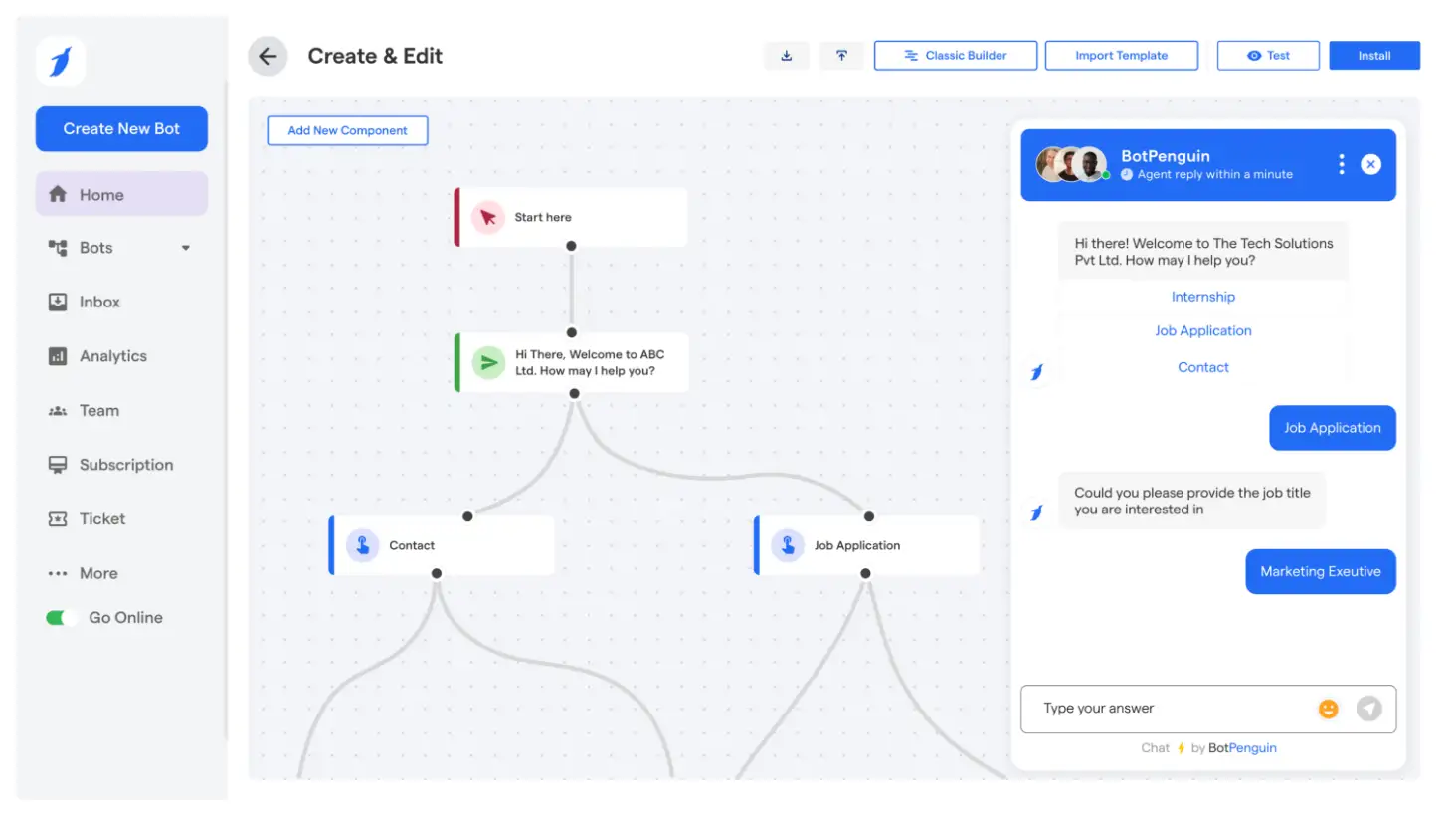
Transform how you engage, support, and convert your customers with AI driven automation.
👉 Start building your digital customer service system today
Get Started with BotPenguin
A common example of digital customer service is a WhatsApp chatbot that instantly responds to customer queries such as order status, pricing, or booking details.
Other examples include website chatbots for lead qualification, automated email responses for support tickets, and AI-driven systems managing queries across multiple channels.
Digital customer service improves customer experience by reducing response time, enabling 24/7 availability, and maintaining consistent communication across channels.
Customers receive instant answers without waiting, which reduces friction and increases overall satisfaction.
Small businesses can benefit significantly from digital customer service automation by handling high volumes of queries without increasing team size.
Automation enables faster responses, better organisation of conversations, and improved customer engagement across channels.
In digital customer service, a chatbot is an automated system that responds instantly using AI or predefined logic, while live chat involves human agents handling conversations in real time.
Most modern systems combine both, where chatbots manage initial queries and escalate complex issues to human agents when required.
AI chatbots handle complex queries by analysing intent and context within customer messages.
When a query exceeds their capability, they automatically escalate it to a human agent with full conversation history, ensuring a seamless and efficient resolution.
WhatsApp is important for digital customer service because it enables real-time communication with high engagement and open rates.
Businesses use it to handle support queries, send updates, manage bookings, and run customer communication workflows within a single channel.
Related BotPenguin Resources
Ready to Transform Your Customer Service?
BotPenguin helps e-commerce stores, B2B websites, and WhatsApp businesses deploy AI chatbots that work 24/7, handle high volumes, and capture leads automatically. Free plan available. No coding required.
Start Free Today →Checkout our related blogs you will love.
Updated at Oct 5, 2026
8 min to read

Updated at Oct 1, 2026
10 min to read
Updated at Jul 14, 2026
14 min to read
Updated at Jun 22, 2026
10 min to read
Updated at Jun 22, 2026
10 min to read
Updated at Jun 3, 2026
15 min to read
Table of Contents