


How to Choose the Right Whitelabel ChatGPT Platform?
Updated at Apr 30, 2026
8 min to read


The best white-label ChatGPT platforms help agencies sell GPT-powered chatbots under their own brand. BotPenguin, Botpress, Voiceflow, Stammer.ai, CustomGPT.ai, and Botsify offer different levels of branding, channel support, and reseller control, making each suitable for different agency needs.
GPT-powered platforms have earned trust by making AI more accessible. They help teams automate conversations, answer questions, and support customers without needing a development team.
For agencies, that opens a real opportunity: selling AI solutions under your own brand. But not every platform gives you that freedom.
Some lock down branding, channels, or reseller options. Others demand technical skills or charge extra for essential features.
This guide explores the top white label ChatGPT platforms, compared on features, pricing, and reseller terms. You'll also see which one fits your agency best.
GPT technology has changed how businesses use conversational AI.
Its ability to understand context, interpret natural language, and generate relevant responses makes chatbots more capable of handling customer queries, guiding purchases, and assisting with everyday business tasks.
McKinsey's 2025 State of AI report found that 88% of surveyed respondents reported AI use in at least one business function within their organizations.
This growing adoption is one reason white label GPT platforms are attracting attention. Other factors include:
To understand which platforms deliver these benefits, we first need to look at the criteria that matter most when evaluating them.
We judged each platform the way an agency would: can you build on it, put your name on it, and profit from selling it? Five factors guided our comparison:
First, who owns the brand? We checked for custom branding, your own domain, and client dashboards. We also noted whether you can set your own prices and resell, or whether you only get logo removal.
Next, the AI itself. We looked at OpenAI GPT support, other model options, knowledge-base training, and how far you can shape chatbot behavior for different clients.
Then, where the bots can live. We checked deployment across websites, WhatsApp, social messaging apps, and voice, plus how well each one connects to the tools clients already use.
Money matters on both sides of the sale. We compared entry costs, subscription structures, usage-based charges, and reseller billing to show the financial commitment agencies take on.
Finally, the day-to-day effort. We assessed no-code capabilities, technical requirements, multi-client management, and the tools for maintaining AI agents after launch.
Every finding draws on public product documentation, pricing pages, and white-label terms from official platform websites.
With these criteria established, let's compare the leading white label ChatGPT platforms and how they measure up.
Compare the six platforms by their white-label capabilities, supported channels, and starting prices.
*Note: Pricing may vary by plan, billing cycle, region, and usage. Supported channels may also depend on the selected plan and integrations. Check official websites for the latest details.
Now, let's examine each platform in detail to understand its key offerings, strengths, and suitability for different agency needs.
White labels mean different things on different platforms. On one, it gives you your own domain, pricing, and client revenue. On another, it gives you a logo-free chat widget.
The reviews below show where each platform draws that line. You’ll see how each one handles branding, channels, AI models, and pricing, plus the type of agency it suits best.
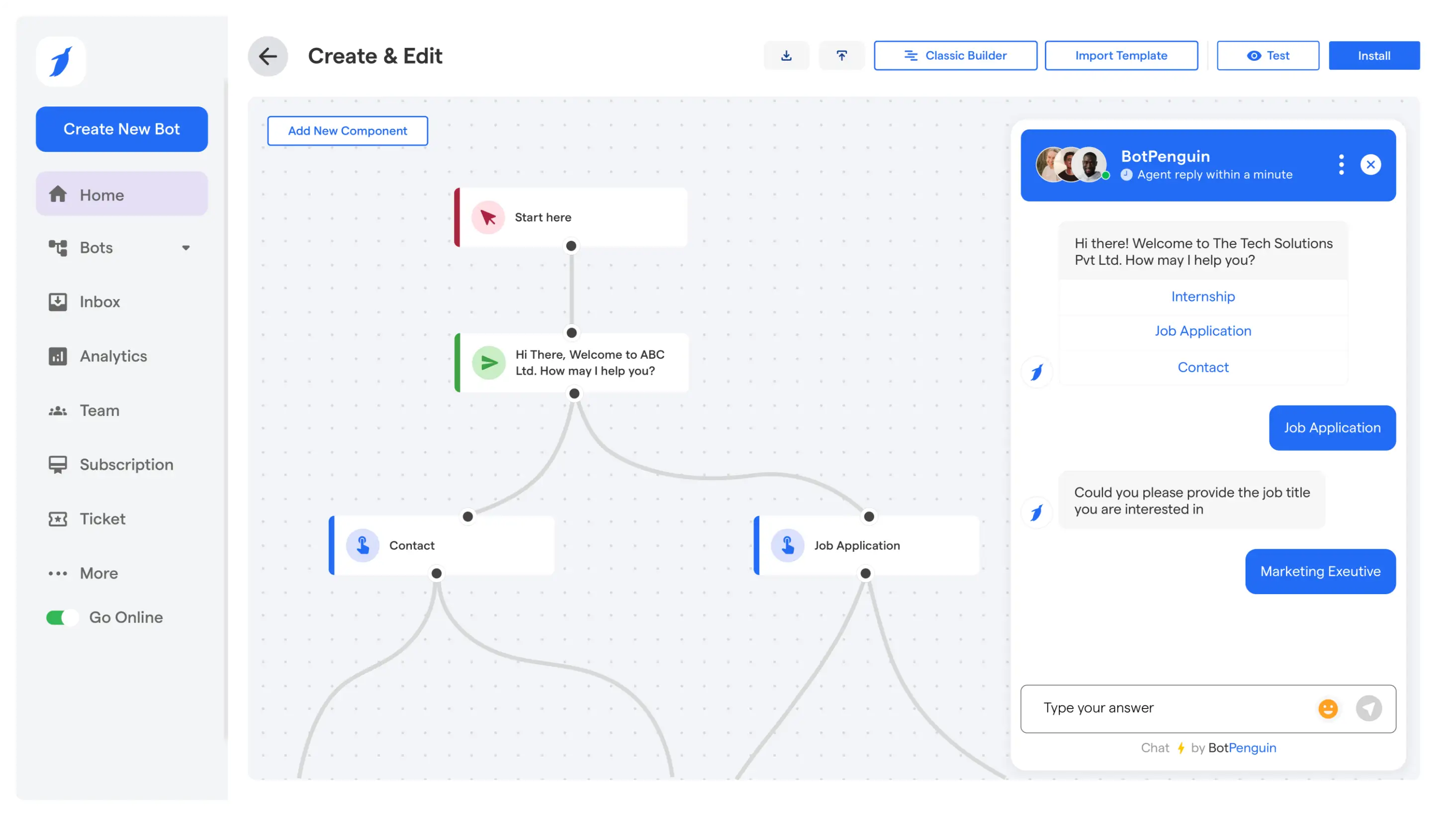
BotPenguin has built its presence in the conversational AI space by bringing chatbots, AI agents, and voice automation together in one no-code platform.
Today, it serves over 80,000 businesses across 193 countries, helping them manage customer interactions without complex development.
For agencies, the bigger advantage lies in its white label ChatGPT platform. Rather than simply reselling chatbot subscriptions, partners can run a fully branded SaaS business with their own domain and pricing, retain 100% of client revenue, and remain anonymous behind the brand.
Key Offerings
BotPenguin is GDPR, HIPAA, and CCPA compliant, ISO certified, SOC 2 attested, and VAPT-assessed by a CERT-In empanelled auditor.
Best For: Agencies looking to launch and scale a branded, multichannel AI chatbot business
Pricing: BotPenguin’s Pebble plan starts at $600/year. View pricing for other plans.
Built for teams that want greater control over AI development, Botpress combines a visual chatbot builder with advanced developer tools. Its platform supports GPT-powered agents for customer support, lead generation, and automated business workflows.
Unlike fully branded reseller platforms, Botpress focuses on white-labeling the chatbot experience. Agencies can remove Botpress branding from webchat widgets through its Plus plan and customize the interface to match their clients' branding.
Key Offerings
Best For: Developer-focused agencies building customized AI chatbots with branded webchat interfaces.
Pricing: White-label webchat is available with the Plus plan, starting at $150/month, billed annually. Additional conversation usage charges apply.
Voiceflow takes a design-first approach to conversational AI. Its visual workspace helps teams plan conversations, test responses, and develop AI agents powered by OpenAI's GPT models and other LLMs.
For agencies, Voiceflow offers white-labeling and client handoff tools alongside multi-client workspace management.
This makes it useful for teams delivering customized chat and voice agents while managing client deployments from one platform.
Key Offerings
Best For: Agencies building customized GPT-powered chat and voice agents with collaborative design and client management tools.
Pricing: Voiceflow offers a free trial. Paid plans combine subscription fees with usage-based billing, while agency white-label pricing is not publicly specified.
Stammer.ai is built around a straightforward idea: helping agencies sell AI services without developing the technology themselves.
The platform brings GPT-powered chatbots and AI voice agents together, allowing businesses to automate customer conversations, lead generation, and appointment scheduling.
Stammer.ai's agency-focused white-label model lets partners use their own domain and branding, manage client accounts, and set their own pricing. This helps agencies build recurring revenue through AI services.
Key Offerings
Best For: Marketing and automation agencies managing multiple client accounts with separate dashboards, usage tracking, and billing controls
Pricing: The Pro White Label plan starts at $99/month, with additional usage charges. Enterprise pricing is custom.
CustomGPT.ai focuses on making business knowledge more useful through AI. Instead of building chatbots around fixed conversation flows, it uses GPT-powered AI and retrieval-augmented generation (RAG) to answer questions from company documents, websites, and other approved content.
For agencies, CustomGPT.ai offers a way to deliver branded, knowledge-based assistants without developing the underlying AI infrastructure.
Its Premium plan allows users to remove CustomGPT.ai branding, although commercial resale rights depend on a separate partner agreement.
Key Offerings
Best For: Agencies developing document-heavy AI assistants for knowledge bases, internal support, and specialized information retrieval.
Pricing: White-label branding is available on the Premium plan, starting at $449/month billed annually or $499/month billed monthly. Enterprise pricing is custom.
Botsify puts AI agent development and client management under one roof, with a strong focus on agencies selling AI services. Its no-code platform supports OpenAI GPT models and other LLMs to build assistants for customer support, lead qualification, and business automation.
Its white-label offering goes beyond a branded chatbot widget.
Agencies can operate under their own domain and logo, provide clients with branded dashboards, and manage billing independently. Botsify handles the underlying technology while partners manage their client relationships.
Key Offerings
Best For: Agencies that want to package industry-specific AI agents and manage subscription, token, and integration-based client billing
Pricing: White-label access is offered through Botsify's Agency Plan, with pricing available on request.
These six platforms offer different levels of branding, customization, and reseller control. While some support complete SaaS ownership, others focus on specific AI capabilities.
The right choice depends on your agency's technical expertise, client needs, and long-term business goals.
The right platform depends less on the number of features and more on how your agency plans to deliver AI services. Here's how the options compare for different business needs.
Choose BotPenguin, Stammer.ai, or Botsify if building recurring revenue through branded AI services is your priority. Agencies choosing BotPenguin can also join its white-label chatbot partner program.
Choose Botpress or Voiceflow based on how your team prefers to develop and deliver AI agents.
Choose CustomGPT.ai when accuracy and source transparency matter more than complex conversational workflows. Its RAG-based approach suits document-heavy use cases where users need answers supported by identifiable sources.
However, agencies planning to resell these assistants should confirm commercial resale rights before committing.
Ultimately, choose the platform that supports your agency's delivery model without introducing unnecessary technical or operational complexity.
Choosing among the best white label ChatGPT platforms comes down to what your agency wants to offer and how much control you need.
Some platforms are better suited for custom AI development, while others focus on branding, client management, and recurring revenue.
Before committing, look beyond the feature list. Check reseller rights, supported channels, usage costs, and how easily the platform can support new clients.
Also, consider the time and effort needed to maintain each solution as your agency grows.
Ultimately, the right platform should fit your business model, meet your clients' expectations, and make delivering AI services simpler over time.
You cannot rebrand or resell ChatGPT itself as your own product. However, you can build branded AI applications using OpenAI's API or authorized white-label platforms, subject to licensing and branding requirements.
BotPenguin suits agencies seeking fully branded, multichannel AI services. Botpress offers greater developer control, while Stammer.ai and Botsify focus on reseller operations. The best choice depends on your agency's business model.
White-label ChatGPT platform pricing varies by provider, branding rights, and usage. Entry plans may cost hundreds of dollars annually, while advanced plans add subscription fees, AI usage charges, and reseller features.
Yes, selling GPT-powered chatbots under your brand is generally legal when you follow applicable laws, platform licenses, and OpenAI's terms. Confirm commercial resale permissions and avoid implying an official OpenAI partnership.
Yes, platforms like BotPenguin and Stammer.ai offer no-code tools for building branded GPT-powered chatbots. However, complex integrations, custom workflows, or advanced deployment requirements may still need technical expertise or developer assistance.
The ChatGPT API is commonly used to refer to OpenAI's API, which developers integrate into applications. White-label platforms add branding, chatbot builders, client management, and deployment tools around supported AI models.
Agencies should verify branding rights, reseller permissions, supported channels, AI usage limits, and data security. They should also assess client management, ongoing maintenance costs, and whether the platform supports independent billing.
Launch Your Own White Label AI Chatbot Platform
Build and resell GPT-powered chatbots under your brand. Set your pricing, manage clients, and keep 100% of client revenue.
Build Your BrandCheckout our related blogs you will love.
Updated at Apr 30, 2026
8 min to read
Updated at Nov 5, 2026
10 min to read
Updated at Oct 30, 2026
11 min to read
Updated at Oct 22, 2026
10 min to read
Updated at Oct 16, 2026
9 min to read
Updated at Sep 26, 2026
10 min to read
Table of Contents