


Building Voice-First UX: Strategies for Voicebot Development
Updated at Oct 16, 2026
9 min to read
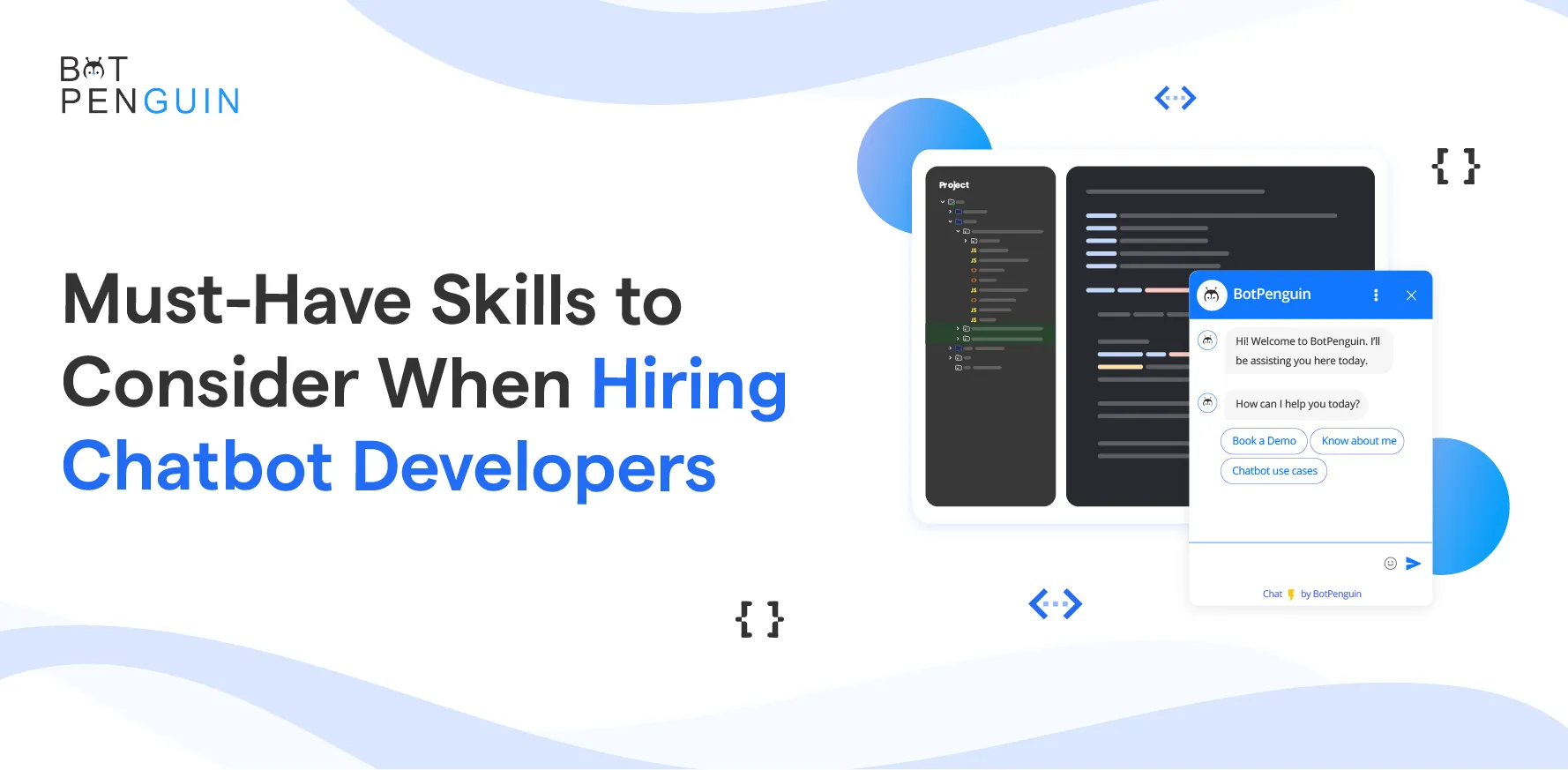
The most important chatbot developer skills include NLP, machine learning, programming, conversational design, and deployment. Strong developers should also understand business requirements, integrations, scalability, security, and cross-channel user experience. Evaluating these skills helps businesses choose candidates who can build reliable and effective chatbot solutions.
Hiring the right chatbot developer directly affects your chatbot’s performance and reliability. Strong resumes alone don't show how well candidates solve problems.
You need to evaluate both technical skills and practical judgment.
A capable developer should understand NLP, programming, integrations, design, and deployment. They should also translate business needs into workable chatbot solutions.
This makes the right skill set important during candidate evaluation.
This guide covers the essential chatbot developer skills businesses should assess before hiring. It also explains how to define requirements and evaluate developers effectively.
These steps help you choose candidates who match your project needs.
Clear requirements make it easier to evaluate the right chatbot developer. They also prevent unclear expectations from affecting project scope or delivery.
Before reviewing candidates, clearly define these four areas.
Start by deciding what the chatbot should achieve for your business. Focus on outcomes instead of creating a long feature list.
Common goals include:
Clear goals help developers recommend suitable features and technical approaches.
Define who will use the chatbot and what they need. Consider their common questions, language preferences, and expected support level.
This information shapes the chatbot’s tone, responses, and conversation structure.
Map the main requests users should complete through the chatbot. Identify required questions, actions, decision points, and human handoffs.
You do not need a complete conversation script. A basic flow gives developers enough context for project planning.
Decide where customers should access the chatbot. This could include your website, WhatsApp, Instagram, or Facebook Messenger.
Also identify required CRM, scheduling, payment, or support integrations. These connections can significantly affect project complexity and developer requirements.
A clear brief gives every candidate the same project context. You can then assess how well they understand and translate those requirements.
Once your requirements are clear, focus on the skills behind delivery. The right developer should combine technical ability with practical project understanding.
The following chatbot developer skills help you evaluate candidates more consistently. Each skill shows how well a developer can handle real project demands.
A skilled chatbot developer should understand your goals before suggesting technical solutions. They should connect business needs with clear chatbot requirements.
Look for developers who can assess these areas effectively:
The developer should understand your audience, workflows, and customer pain points. They should also identify the tasks your chatbot must handle.
This helps them design conversations around real business needs.
A strong developer should evaluate whether your requirements are technically practical. They should also identify budget, integration, or scalability constraints early.
This prevents unrealistic recommendations and unexpected development issues.
Experienced developers should spot potential problems before implementation begins. These may include integration gaps, unclear data sources, or complex user flows.
They should also suggest practical alternatives when requirements create unnecessary complexity.
The goal isn't just to understand your brief. The developer should turn it into a workable chatbot plan.
Natural Language Processing helps chatbots understand how people actually communicate. A capable developer should know how to apply NLP effectively.
NLP helps chatbots interpret intent, context, entities, and varied phrasing. It plays a vital role in chatbot development.
This allows chatbots to understand requests beyond exact keyword matches. Better language understanding also improves response relevance and conversation quality.
Look for experience with techniques commonly used in chatbot development, including:
Developers should know when each technique adds practical value. They should not add unnecessary complexity to simple chatbot workflows.
Developers should understand frameworks such as spaCy, NLTK, and TensorFlow. Python experience is also useful for many NLP-based chatbot projects.
The right framework depends on your chatbot’s scope and architecture. Strong developers should explain why their chosen approach fits your requirements.
NLP expertise becomes especially important when adding LLM-powered conversational capabilities. Developers must connect language models without sacrificing control or business context.
For teams needing this expertise, BotPenguin supports custom chatbot development using NLP and LLM technologies. Its developers can help align language capabilities with specific business requirements.
Machine learning helps chatbots recognize patterns and improve responses over time. Developers should understand where ML adds value within chatbot workflows.
Machine learning enables systems to learn patterns from existing data. Chatbots can use these patterns to classify inputs and predict outcomes.
Common applications include:
Developers should know which use cases genuinely require machine learning.
A capable developer should understand common machine learning approaches. These may include decision trees, neural networks, and classification algorithms.
They should also explain why a specific approach fits your chatbot. Complex models should not replace simpler solutions without clear benefits.
Developers may work with TensorFlow, PyTorch, or scikit-learn for ML tasks. Their framework choice should match the project’s scale and technical requirements.
Look beyond familiarity with individual tools when evaluating candidates. Strong developers should understand model performance, data requirements, and implementation tradeoffs.
This knowledge helps them build chatbot features that remain practical and scalable.
Chatbot developers should understand platforms that simplify conversational application development. Their experience should extend beyond familiarity with one specific tool.
Platforms like Dialogflow provide tools for building conversational experiences. They support common tasks like intent detection and conversation management.
Developers should understand how these capabilities fit within broader chatbot architecture.
Look for practical experience with features such as:
Hands-on experience matters more than listing platforms on a resume.
The right platform depends on your chatbot’s goals and technical requirements. Developers should consider integrations, scalability, customization, and deployment needs.
They should also explain why one platform better suits your project. Strong developers avoid forcing every project into their preferred technology.
This flexibility helps them build solutions around requirements rather than platform limitations.
Modern chatbot development increasingly relies on large language models and generative AI. Developers should understand how these technologies improve conversational capabilities.
LLMs help chatbots generate flexible responses across varied user requests. They can also improve contextual understanding and natural conversation quality.
However, developers should know where LLMs add practical value.
A skilled chatbot developer should understand areas such as:
These skills help reduce irrelevant or inaccurate chatbot responses.
Not every chatbot requires the same model or architecture. Developers should compare accuracy, speed, cost, and integration requirements.
They should also know when rules or structured flows work better. Strong developers combine AI with controlled workflows when projects require reliability.
This knowledge helps developers build flexible chatbots without losing business control.
Programming skills remain essential for building, integrating, and maintaining chatbot systems. Developers should know languages that match the project’s technical requirements.
Common languages used in chatbot development include:
Python is widely used for AI and machine learning projects. JavaScript and Node.js work well for web-based chatbot applications.
Java and C# are also common in enterprise environments.
Look beyond the languages listed on a candidate’s resume. Recruiters should verify relevant hard skills on a candidate's resume during evaluation.
Developers should understand:
These fundamentals matter when chatbots connect with external business systems.
The best language depends on integrations, performance, scale, and architecture. Developers should explain why their chosen stack fits those requirements.
Language choice can also affect integration speed and development effort. Netcorp notes that framework and API compatibility can influence project timelines.
Strong developers should choose technologies based on project needs, not personal preference.
Strong chatbot design makes conversations easier to follow and complete. Developers should understand both interface design and conversational structure.
A chatbot should be simple, clear, and easy to navigate. Developers should design interfaces that match the brand experience.
They should also reduce friction during common user journeys.
A clear conversational flow helps users reach their goals faster. Developers should structure paths around common intents and next actions.
Strong flows should include:
These elements help keep conversations focused and efficient.
Developers should understand how wording affects chatbot usability. Responses should stay concise, relevant, and easy to understand.
The chatbot’s tone should also match the brand and audience.
Good chatbot design should feel natural without pretending to be human. Developers should maintain context and respond consistently throughout conversations.
They should also avoid unnecessary complexity or overly scripted responses.
Strong design skills help create chatbot experiences that feel clear and intuitive.
A chatbot is only useful when it performs reliably after launch. Developers should understand hosting, infrastructure, scalability, and deployment security.
Deployment moves the chatbot from development into a live environment. Developers should know how to configure hosting and supporting infrastructure.
They should also plan for availability, monitoring, and future updates.
Cloud platforms can support scalability, uptime, and flexible resource management. Developers may work with AWS, Google Cloud, or Microsoft Azure.
Their cloud experience should match your project’s expected traffic and complexity.
Common deployment tools include:
Developers should choose tools based on scale, maintenance needs, and budget. They should avoid adding infrastructure that creates unnecessary complexity.
Chatbots may process user data or connect with sensitive systems. Developers should understand secure authentication, access controls, and data protection.
They should also identify deployment risks before launch. Strong security practices help protect both users and connected business systems.
A capable developer should balance reliability, scalability, and security throughout deployment.
Once your requirements are clear, the next step is finding suitable candidates. A structured process helps you compare developers on relevant skills and project fit.
You can find chatbot developers through several channels:
Each source signals different levels of technical depth and experience. GitHub can reveal coding activity, while referrals provide proven working history.
Your job description should reflect the project, not generic technical requirements. Include the chatbot’s purpose, channels, integrations, and expected capabilities.
Also define:
Clear expectations help attract candidates who actually match your needs.
Use interviews to test practical problem-solving, not memorized technical answers. Ask how candidates would handle integrations, fallback logic, scaling, and testing.
Soft skills matter as well. Developers should explain technical decisions clearly and communicate risks early.
Look for projects with similar complexity or business use cases. Ask what the developer personally handled during each project.
Strong portfolios should show more than polished interfaces. They should demonstrate technical ownership, problem-solving, and measurable outcomes.
Agree on deliverables, milestones, integrations, testing, and acceptance criteria before development starts. Also clarify responsibilities for data, API access, and approvals.
Your hiring model will also affect cost and project management. Compare hiring a freelancer, agency, or dedicated developer before choosing the right approach.
The best option depends on your budget, required expertise, and support needs. A clear evaluation process helps you choose based on project fit.
Hiring the right chatbot developer requires more than checking technical qualifications. You need someone who understands your goals, users, integrations, and project constraints.
Evaluate candidates across NLP, machine learning, programming, conversational design, and deployment. Then compare their experience, communication skills, portfolios, and approach to project planning.
If you prefer platform-backed expertise, BotPenguin can support custom chatbot development for specific business requirements. Our team works across AI, NLP, integrations, and deployment needs.
This gives businesses another option beyond managing the entire hiring process independently.
Key chatbot developer skills include programming, NLP, machine learning, integrations, and deployment. Developers should also understand conversational design, APIs, security, and LLM-based chatbot development. The exact skill mix depends on your project requirements, technical environment, planned capabilities, and business goals.
Look for clear communication, problem-solving, adaptability, and strong collaboration skills. Developers should explain technical decisions without unnecessary complexity, identify risks early, manage feedback constructively, and work effectively with stakeholders when project requirements, timelines, priorities, or technical constraints change during development.
NLP helps chatbots understand user intent, context, entities, and varied phrasing. Developers with NLP experience can design more accurate conversational interactions, choose suitable language-processing techniques, and decide when simple rules work better than complex models for specific chatbot use cases.
Developers should choose architecture based on traffic, integrations, and performance requirements. Cloud infrastructure can support scaling when demand increases. Efficient code, secure APIs, monitoring, caching, and suitable deployment tools also help maintain reliable chatbot performance as usage grows over time.
Developers may monitor performance, fix technical issues, and improve conversation flows after launch. They can also update integrations, address security needs, and support changing business requirements. Ongoing responsibilities, maintenance scope, response times, and ownership should be defined before development begins.
Hiring costs depend on project complexity, required expertise, and development scope. Custom AI features, integrations, multiple channels, advanced security, and testing can increase effort. The hiring model, developer experience, project timeline, support needs, and maintenance expectations also affect total costs.
Development timelines depend on chatbot complexity, integrations, channels, and approval requirements. Projects with simple flows usually require less work than custom AI solutions. Clear requirements, available APIs, prepared data, timely feedback, defined milestones, and faster approvals can reduce deployment delays.
Hire Chatbot Developers
Evaluate proven chatbot developers with the right technical skills, project experience, and development support for your business needs today.
Get In TouchCheckout our related blogs you will love.
Updated at Oct 16, 2026
9 min to read
Updated at Sep 26, 2026
10 min to read
Updated at Sep 26, 2026
7 min to read
Updated at Sep 25, 2026
11 min to read
Updated at Sep 18, 2026
12 min to read
Updated at Jul 29, 2026
9 min to read
Table of Contents