10 Best AI Voice Agents for Customer Service and Support
Updated at Aug 7, 2026
20 min to read
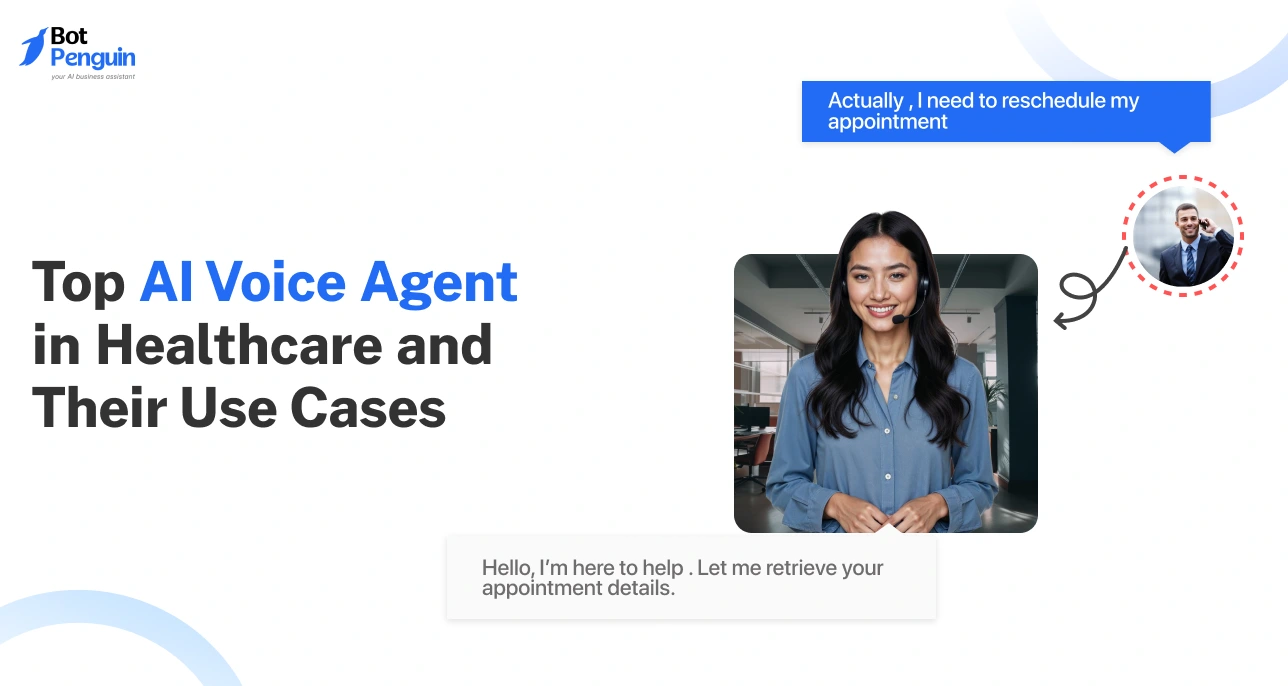
An AI voice agent for healthcare handles inbound and outbound patient calls through natural spoken conversations. It can schedule appointments, send reminders, manage rescheduling, collect intake details, answer routine questions, and route calls. When a request needs staff or clinical judgment, it escalates the conversation to the right person.
Healthcare phone lines can become bottlenecks long before the waiting room fills. High call volumes, repeated scheduling requests, and missed calls can quickly overwhelm front-desk teams.
An AI voice agent for healthcare offers another way to handle these routine conversations. It can respond to patients, manage common requests, and route calls when human support is needed.
This helps reduce hold times without forcing patients through rigid phone menus.
In this guide, you will learn how healthcare AI voice agents work, where they fit in patient communication, their common use cases, key benefits, and the security considerations healthcare organizations should understand before using them.
An AI voice agent is software designed for spoken patient conversations over the phone. It can answer incoming calls or place outgoing calls for predefined communication needs.
Unlike basic phone automation, patients can speak in their own words. They do not need to press numbers or follow rigid menu paths. The voice agent interprets the request and responds within the conversation.
At its core, a healthcare voice agent combines three capabilities:
Voice interaction: Patients communicate naturally by speaking instead of typing or selecting menu options.
Intent understanding: The system identifies what the patient is trying to accomplish.
Action-oriented communication: The conversation can move toward an appropriate predefined outcome.
Healthcare organizations can use voice agents for both inbound and outbound communication. Inbound interactions begin when a patient calls the organization. Outbound interactions begin when the voice agent contacts a patient for an approved purpose.
The defining feature is the communication channel. These agents are built specifically for real-time phone conversations.
They differ from text-based chatbots and traditional menu-driven IVR systems. Those distinctions become clearer once we look at what actually happens during a voice AI conversation.
In practice, voice AI for healthcare follows a simple conversational process. The patient speaks, the system identifies the request, and the conversation progresses accordingly.
The goal is not to make patients learn another phone menu. The interaction should feel closer to speaking with front-desk staff.
The conversation starts with the patient explaining what they need. They can use normal language instead of choosing numbered options.
For example: “I need to move my appointment from Tuesday.”
The voice agent identifies the main intent behind that request. It can also recognize relevant details already provided during the conversation.
If information is missing, the agent can ask for it. This keeps the patient from restarting the request each time.
Once the agent understands the request, it continues the conversation. It asks only the follow-up questions needed to move forward.
For example, it may clarify a preferred date or time. If the patient changes their preference, the conversation can adjust without restarting.
Context is important here. Each response should build on what the patient already said.
This makes the experience different from rigid phone trees. Those systems often force callers through predefined menu branches.
Some requests require information beyond the phone conversation itself. The voice agent may need access to connected healthcare systems.
Depending on the workflow, these can include:
Scheduling systems
Practice management systems
Electronic health record systems
CRM or patient databases
These connections provide the information required for an approved task. They can also record completed actions in the appropriate system.
The exact capabilities depend on the integration and its permissions. Access to a system does not automatically mean it supports every action.
Once the agent has the required information, it can complete routine, predefined steps. The conversation then ends with a clear outcome or next step.
Not every request should be automated. Complex, sensitive, or clinical situations may require staff involvement.
In those cases, the voice agent should route the conversation appropriately. Relevant context should also move with the call where supported.
Consider a patient calling to move an existing appointment.
1. Patient states the request: “I need to move my Tuesday appointment.”
2. The voice agent identifies the intent: It recognizes that the patient wants to reschedule.
3. Required details are confirmed: The agent gathers the information needed for the approved workflow.
4. Available slots are checked: It accesses the connected scheduling system and presents suitable alternatives.
5. The appointment is updated: The agent confirms the selected slot when the integration allows it.
6. Exceptions are escalated: Unsupported, sensitive, or clinical requests are transferred to appropriate staff.
The sequence is straightforward: understand the request, clarify details, check the relevant system, complete the task, or escalate when needed.
This end-to-end workflow shows how a routine call can move from request to resolution. The next question is which healthcare conversations best fit that process.
An AI voice agent for healthcare can support many repetitive patient communication workflows. The strongest use cases involve clear requests and defined next steps.
These applications reduce routine phone work without removing staff from complex conversations.
Scheduling calls often follow predictable steps. Patients ask for available times, choose a slot, or change an existing booking.
A voice agent can support:
New appointment requests
Available slot checks
Appointment rescheduling
Appointment cancellations
The conversation can stay focused on completing the scheduling request. Patients can state preferences naturally instead of navigating multiple menu options.
For rescheduling, the agent can collect the preferred date or time. It can then continue the workflow based on available options.
Outbound reminders help patients confirm whether they still plan to attend. Voice agents can make these calls before scheduled appointments.
Missed appointments also carry a high operational cost.
A 2024 longitudinal study estimates that missed visits cost the U.S. healthcare system $50 billion annually.
The workflow can handle several common responses:
Confirm the existing appointment
Record that the patient cannot attend
Offer another available appointment
Capture a request for staff assistance
This makes reminders more interactive than recorded calls. A patient who declines can move directly toward another appointment.
The goal is to close the communication loop during the same call.
Some patient calls require information before staff can respond appropriately. Voice agents can collect that information through structured questions.
They may ask about:
The reason for calling
Basic patient details
Relevant administrative information
The type of assistance required
Responses can then be routed according to predefined rules. For example, certain answers may trigger escalation to appropriate staff.
The voice agent supports intake and routing, not independent diagnosis. Clinical assessment and medical decisions must remain with qualified healthcare professionals.
Front desks often answer the same administrative questions throughout the day. Many of these requests do not require individual staff judgment.
A voice agent can respond to approved questions about:
Clinic hours
Location and directions
Appointment preparation
Provider availability
Administrative policies
Approved insurance-related information
Answers should come from information the healthcare organization approves. This keeps the voice agent within clearly defined communication boundaries.
When a question falls outside that information, the call can move to staff.
Patient calls do not always arrive during office hours. Without another option, routine requests may go to voicemail until staff return.
Voice agents can provide immediate assistance for supported after-hours requests. They may answer administrative questions, collect information, or identify the purpose of the call.
However, after-hours automation needs clear limits. Sensitive, urgent, or unsupported situations should follow predefined escalation procedures.
The goal is not to automate every after-hours conversation. It is to prevent routine requests from waiting unnecessarily.
Healthcare organizations also manage many outbound follow-up conversations. These calls can be repetitive but still important for patient communication.
Voice agents may support workflows involving:
Referral status follow-ups
Patient recall campaigns
Approved follow-up outreach
Preventive-care reminders
Missed appointment follow-ups
Each workflow should have a defined purpose and response path. If the patient raises an unrelated or sensitive concern, staff can take over.
Together, these use cases show where conversational voice automation can fit daily healthcare communication. They also raise an important distinction: how does this differ from traditional IVR or a healthcare chatbot?
AI voice agents, IVR systems, and healthcare chatbots can all automate patient communication. However, they differ in how patients interact and what each channel supports.
Traditional IVR relies mainly on menus and keypad inputs. Healthcare chatbots use written conversations across websites or messaging channels. AI voice agents focus on natural spoken conversations over the phone.
Traditional IVR works well for predictable routing. A caller may press one for appointments or two for billing.
The limitation appears when a request does not fit the menu. Patients may need several selections before reaching the right destination.
AI voice agents reduce that menu dependency. Patients can state their request directly using spoken language.
The biggest difference is the communication channel. Healthcare chatbots serve patients through written digital conversations.
AI voice agents serve patients who prefer or need phone communication. Both can support conversational automation, but they meet patients in different environments.
Neither format replaces the other in every situation. The right choice depends on where patients already communicate with the organization.
Understanding these differences also makes the value of voice automation easier to assess. The next section looks at the specific benefits healthcare organizations can gain from using it.
Voice automation adds value by changing how teams handle daily calls. Its benefits are strongest when repetitive conversations follow clear workflows.
Patients often call with requests that don't require staff judgment.
Voice agents can help with:
Scheduling questions
Appointment confirmations
Basic administrative requests
Common informational queries
Patients can get help without waiting for front-desk availability. This shortens the path from request to resolution.
Front-desk teams handle many similar calls throughout the day. These calls also interrupt other responsibilities.
Voice agents can take on repeatable tasks such as:
Scheduling requests
Appointment confirmations
Routine FAQs
Basic call routing
Staff can then focus on conversations needing judgment or personal attention.
Call demand often rises at predictable times. Monday mornings and opening hours can create heavy phone queues.
Voice automation helps by:
Handling several supported calls at once
Reducing pressure on a single staff queue
Giving routine callers another path to resolution
Limiting unnecessary wait times during peak periods
This is especially useful when call volume exceeds available front-desk capacity.
Routine patient needs do not always fit office hours.
Voice agents can keep supported phone assistance available for:
Administrative questions
Scheduling requests
Appointment confirmations
Other predefined routine needs
Patients may complete these tasks without waiting for the next business day.
Traditional phone menus require patients to follow fixed options. That can create friction when a request does not fit neatly.
Voice agents allow patients to:
Explain requests in their own words
Avoid long menu trees
Clarify preferences during the call
Move through routine requests conversationally
This makes phone self-service more flexible and easier to use.
Routine calls often follow defined procedures. Voice agents can apply those steps consistently.
This helps ensure:
Required information is collected
Standard workflows are followed
Important steps are not skipped
Similar requests receive similar handling
Consistency does not mean every conversation sounds identical. It means the underlying process stays reliable.
Organizations evaluating these outcomes can also review relevant customer case studies for documented automation results.
These operational benefits explain why voice automation can improve routine communication. However, healthcare use also introduces stricter responsibilities around data, compliance, and patient safety.
Healthcare voice automation can involve sensitive patient information. Security and clinical boundaries must therefore be designed into every workflow.
Organizations should assess compliance, data handling, call permissions, and escalation before deployment.
A voice AI product should not be labeled “HIPAA compliant” without context. Compliance depends on how the technology is configured and used.
Healthcare organizations should evaluate:
Whether protected health information enters the voice workflow
How patient information moves between connected systems
Which parties can access or process that information
Whether required contractual safeguards are in place
Whether the vendor will sign an applicable Business Associate Agreement (BAA)
The organization’s own processes also remain part of the compliance picture. A compliant vendor alone does not make every deployment compliant.
Organizations evaluating broader autonomous healthcare workflows can review our guide on HIPAA-compliant AI agents separately.
Voice interactions can create additional forms of patient data. These may include recordings, transcripts, call metadata, and collected patient details.
Before using them, organizations should define:
Recording: Whether calls are recorded and for what purpose
Transcripts: Whether conversations are converted into stored text
PHI handling: Where protected information is processed and stored
Access controls: Which staff members can access call information
Encryption: How sensitive data is protected in transit and storage
Retention: How long recordings and transcripts remain available
Do not collect data simply because the technology permits it. Each stored element should have a defined operational purpose.
Teams should also review the provider’s security and trust documentation before sharing sensitive patient information.
Outbound voice automation requires more than scheduling a call. Healthcare organizations must consider the rules applying to automated communications.
Important considerations include:
The purpose of the call
Whether appropriate consent is required
Which number is being contacted
What information may be disclosed
How patients can manage communication preferences
Requirements can vary by call type and applicable law. Organizations should review their specific obligations before automating outbound patient communication.
Voice AI should operate within clearly defined limits. Routine administrative communication is different from clinical judgment.
Workflows should establish when the system must involve staff, including:
Requests requiring clinical assessment
Complex or unusual patient situations
Sensitive conversations
Unsupported questions
Situations matching predefined escalation rules
A voice agent may collect structured information or route a call. It should not be presented as independently diagnosing conditions or replacing qualified medical professionals.
These safeguards determine where voice AI can be used responsibly. With those boundaries established, the next step is understanding where it fits across the patient journey.
Voice AI can support patient communication at several points, not just scheduling. Its role changes as patients move from initial contact to ongoing care.
The table below shows where phone-based automation can fit operationally.
The role of voice AI should remain specific at each stage.
A pre-booking conversation may only require information and routing. A scheduling interaction may require access to available appointment slots.
Later stages can involve different communication goals. Before a visit, the focus may shift toward intake. Afterward, it may support approved follow-ups or reminders.
This journey-based view also prevents over-automation. Not every patient interaction needs the same level of voice support.
The more useful question is where phone demand creates enough friction to justify automation. That helps determine when a healthcare organization should consider using AI voice agents.
An AI voice agent for healthcare is most useful when phone demand creates recurring operational pressure. The strongest fit appears when routine calls consume staff time or delay patient responses.
Voice AI may be worth considering when an organization experiences:
High inbound call volume: Staff cannot answer every routine call quickly.
Frequent scheduling calls: Booking and rescheduling dominate phone traffic.
Long hold times: Patients regularly wait before reaching staff.
Repetitive administrative questions: Teams repeatedly answer similar non-clinical requests.
Missed calls: Calls go unanswered during busy periods.
Heavy reminder workloads: Staff spend significant time confirming appointments.
After-hours inquiries: Patients call when front-desk teams are unavailable.
Repeated outbound calls: Follow-ups and reminders require regular staff effort.
The pattern matters more than any single issue. Voice AI becomes more relevant when several of these problems occur together.
It may matter less when most patient communication already happens digitally. The same applies when most calls require clinical judgment.
Healthcare teams should therefore evaluate their actual call mix first. The key question is whether enough calls are repetitive and rule-based.
For teams already exploring conversational automation, BotPenguin features can provide broader product context alongside this evaluation. Reviewing BotPenguin reviews can help teams understand how its automation ecosystem fits different business workflows.
An AI voice agent for healthcare is software that handles spoken patient conversations by phone. It can answer or place calls, understand patient requests, and support predefined administrative workflows. Common applications include scheduling, reminders, intake, routine questions, and call routing, with staff involvement when needed.
AI voice agents listen to spoken patient requests and identify the intended action. They respond conversationally, ask necessary follow-up questions, and retain context during the call. When connected systems are required, they can use approved data to support the workflow or transfer the conversation to staff.
Healthcare organizations commonly use voice agents for repetitive patient communication. Typical uses include appointment booking, rescheduling, reminders, confirmations, administrative FAQs, intake, referral follow-ups, and after-hours calls. They work best when conversations follow clear rules and do not require independent clinical judgment.
Not automatically. HIPAA compliance depends on the vendor, deployment, data flows, security controls, and contractual arrangements. Healthcare organizations should evaluate how PHI is handled, whether recordings or transcripts are stored, and whether the required Business Associate Agreement and other safeguards are in place.
Yes, when the voice agent is connected to an appropriate scheduling system. It can collect patient preferences, check available slots, and support booking or rescheduling workflows. The exact actions available depend on the connected system, permissions, and how the healthcare organization configures the workflow.
Traditional IVR usually asks callers to press numbers and follow predefined menus. AI voice agents allow patients to explain requests using natural speech. They can interpret open-ended requests and continue the conversation based on context, making them better suited to more flexible phone interactions.
A voice agent handles spoken conversations over phone calls. A healthcare chatbot handles written conversations through websites or messaging channels. Both can support routine patient communication, but they serve different communication preferences. Organizations may use one or both depending on how patients typically contact them.
Healthcare organizations handle many patient calls every day. Yet not every conversation requires human judgment or clinical expertise.
The real value of an AI voice agent for healthcare lies in handling repeatable, rule-based conversations. Scheduling requests, reminders, and routine questions can move faster. Meanwhile, sensitive or clinical situations should still reach qualified staff.
The goal is not to replace healthcare teams. It is to reserve their time for conversations that genuinely need them.
Teams exploring broader conversational automation can also review BotPenguin to understand how AI-driven communication can support routine business workflows.
Subscribe to Our Newsletter
Get the latest business insights straight into your inbox.
Checkout our related blogs you will love.
Updated at Aug 7, 2026
20 min to read
Updated at Jun 5, 2026
11 min to read
Updated at Jun 2, 2026
14 min to read
Updated at Sep 25, 2026
14 min to read
.webp)
Updated at Sep 24, 2026
10 min to read

Updated at Sep 21, 2026
17 min to read
Table of Contents