
Drift Chatbot Explained: What It Was and What Happened to It
Updated at Oct 6, 2026
9 min to read
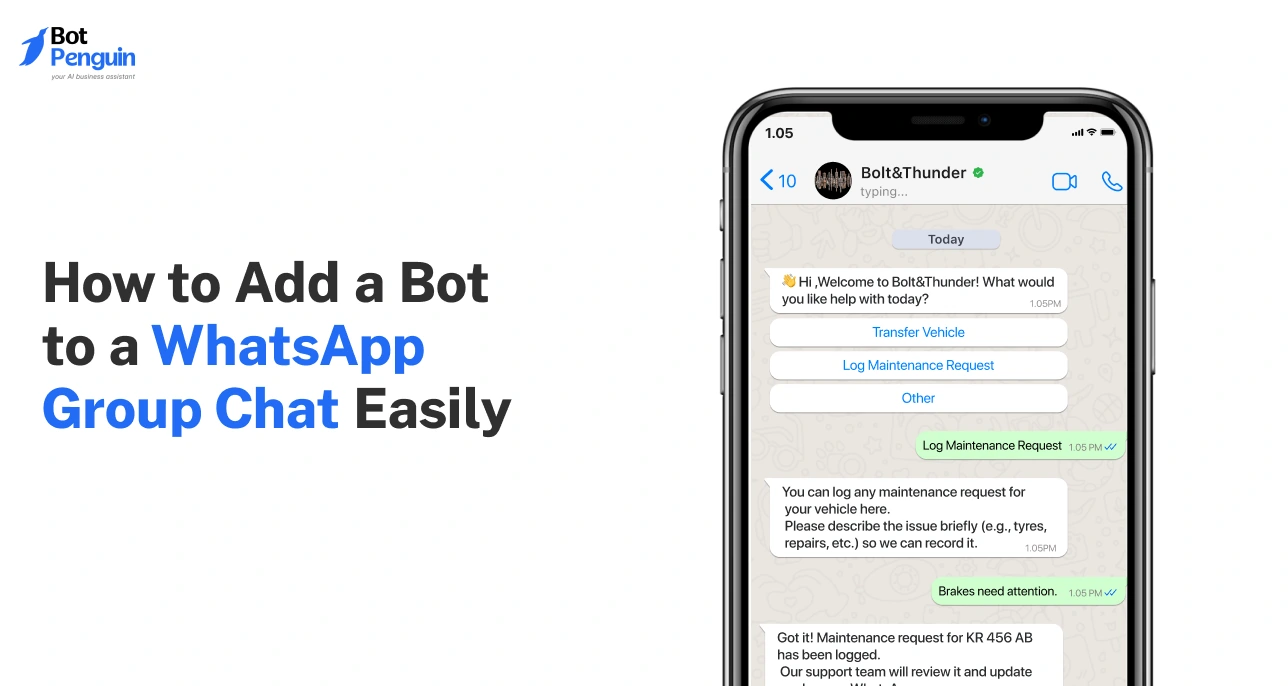
WhatsApp now supports limited group automation through its Groups API for eligible businesses, but you still cannot simply add a bot to any existing WhatsApp group. Businesses can also use the WhatsApp Business API with platforms like BotPenguin for broadcasts, automated 1:1 conversations, auto-replies, and wa.me links that move members into automated bot flows.
You've searched for how to add a WhatsApp bot to a group, and you deserve a straight answer, not a runaround.
The short answer is that WhatsApp now supports limited group automation through its Groups API, but you cannot simply add a bot to any existing group chat.
With the right setup using the WhatsApp Business API and a platform like BotPenguin, you can automate group scale communication, send broadcasts, handle FAQs, and respond to hundreds of users instantly.
This guide covers everything: what works, what does not, and exactly how to set it up today.
A WhatsApp chatbot for groups is an automated messaging system that handles conversations on WhatsApp without any human typing each reply manually.
Now here is the part most guides skip. The term "WhatsApp group bot" can be misleading because standard WhatsApp bots cannot simply be added to existing group chats, although eligible businesses can use Meta's Groups API for API-created groups.
What they do is power group scale communication through the WhatsApp Business API, by auto-responding to individuals, sending broadcasts to thousands of opted-in contacts, and triggering conversation flows based on user actions.
Think of it less as a bot inside a group and more as a bot that replaces what a group was trying to do, but faster, smarter, and at scale.
This is one of the most common points of confusion, so let us clear it up before you get started.
For WhatsApp group automation, the API is the only path that actually works. And with BotPenguin handling the entire API connection on your behalf, the technical barrier is effectively zero.
As of 2026, WhatsApp supports group messaging through its official Groups API for eligible businesses.
However, this does not mean you can add a bot to any existing WhatsApp group. The API works with groups created programmatically through the WhatsApp Cloud API, with participants joining through invite links.
This restriction is not a technical oversight. WhatsApp was built around private, trusted communication, and allowing automated accounts to freely participate in group conversations would fundamentally challenge that trust model.
However, the Groups API still has important limitations:
Here is something important that most articles miss, though. The reason people want a WhatsApp group bot is rarely about the group itself.
It is about reaching many people at once, automating responses, and reducing manual work. All of that is completely achievable through the WhatsApp Business API without needing a bot inside a group at all.
The most reliable workaround is a no-code WhatsApp chatbot connected to the official WhatsApp Business API, which replicates group-scale communication through individual and broadcast messaging.
So while you cannot simply add a bot to an existing WhatsApp group, eligible businesses now have limited Groups API support alongside 1:1 and broadcast automation.
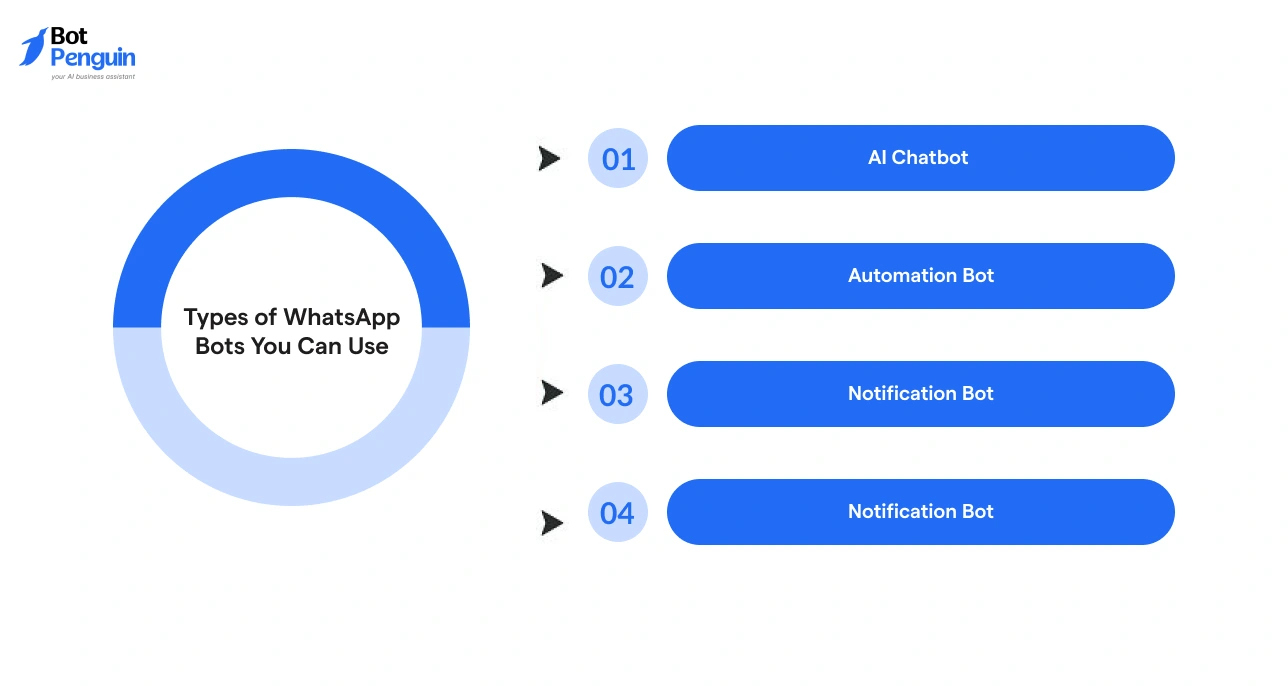
Before jumping into the setup, it helps to know which type of bot actually fits what you are trying to do.
Most people search for a WhatsApp group bot, but what they really need is one of these four types.
This type understands natural language. It can read what a user types, understand the intent behind it, and reply conversationally.
It is ideal for customer support, lead qualification, and FAQs. BotPenguin's WhatsApp chatbot is built on this model.
See how a WhatsApp chatbot compares with an AI agent when choosing the right automation approach.
This type does not need to understand language. It sends scheduled messages, triggers broadcasts, and delivers updates at set times.
If you want to send weekly offers, order confirmations, or event reminders to a large contact list, this is what you need.
This type listens for a trigger from another system, like a payment confirmation, a shipping update, or a form submission, and instantly sends a WhatsApp message to the right person.
It is less about conversation and more about real-time alerts.
Unofficial moderation bots may monitor group activity, filter spam, welcome new members, and enforce rules automatically.
It is the closest thing to a true group bot, but it works through unofficial libraries, which carry a real risk of account bans. We do not recommend this path for any business.
For most businesses, the answer is a combination of the first two. An AI chatbot that can hold a conversation, paired with automation tools that proactively reach out to users. Together, they cover many of the common use cases businesses associate with WhatsApp group bots.
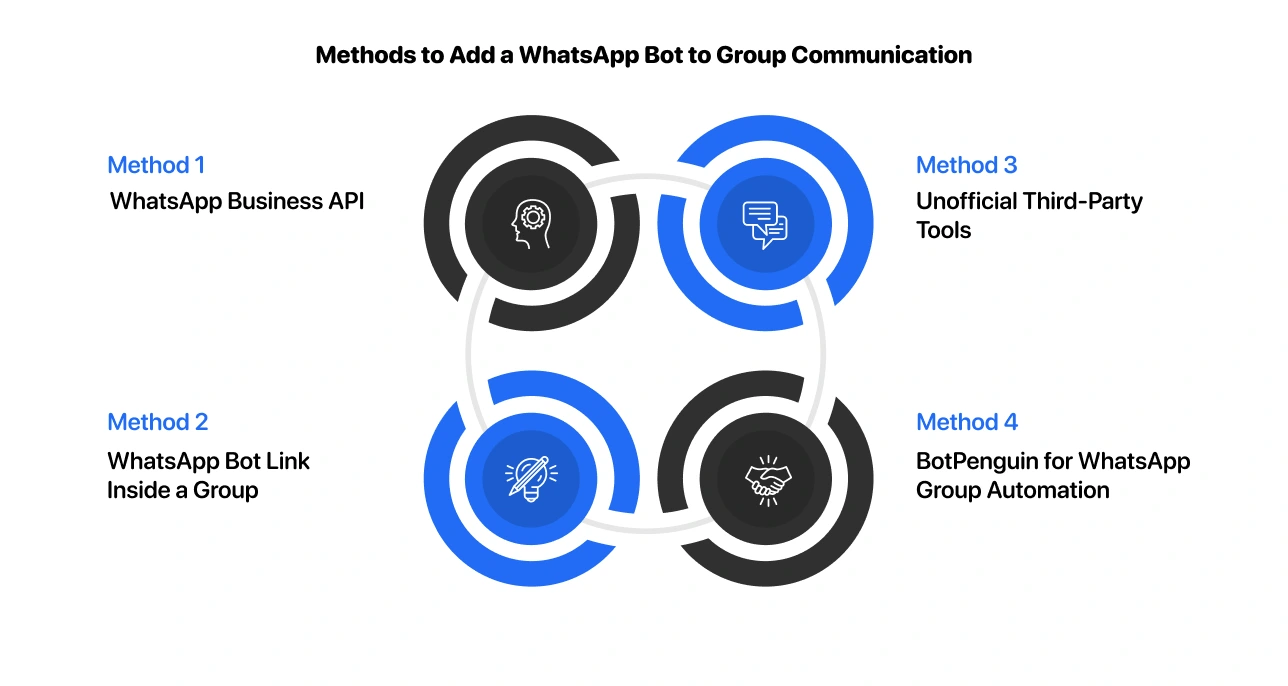
Depending on your account eligibility and group setup, there are several ways to automate WhatsApp group communication.
This is the official, Meta-approved method and the only one we recommend for any serious business use.
With the WhatsApp Business API, you can:
This is not a workaround. It is how WhatsApp intended businesses to use automation at scale.
The only requirement is that you connect through an official WhatsApp Business API provider, such as a Meta Business Partner like BotPenguin, which supports API access, message template submission, and compliance-related setup.
Note: Eligible businesses can also use Meta's Groups API to create and automate API-managed groups directly through the WhatsApp Cloud API
This method works within WhatsApp's rules and is genuinely effective for community and group scenarios.
You set up your bot, generate a wa.me chat link, and post that link inside your WhatsApp group. When group members tap the link, they are taken into a one-to-one conversation with your bot instantly.
This works especially well for:
The bot does not live inside the group, but it handles every conversation that flows out of it, which is ultimately what matters.
Several tools claim to inject bots directly into WhatsApp groups by exploiting WhatsApp Web or using unofficial libraries. We want to be straightforward about this.
Using these tools means you risk:
No legitimate business should build on an unstable, policy-violating foundation. If you have seen guides recommending these tools, they are prioritizing a shortcut over your account safety.
BotPenguin is an official Meta Business Partner, which means it sits at the intersection of everything covered in the methods above.
It gives businesses the cleanest path from zero to a fully working WhatsApp automation setup without needing a developer or any technical knowledge.
With BotPenguin, you get:
BotPenguin supports API onboarding, message template submission, and compliance-related setup.
So instead of spending weeks on setup and approvals, you can have a working WhatsApp bot live within hours and start automating the group-scale communication your business actually needs.
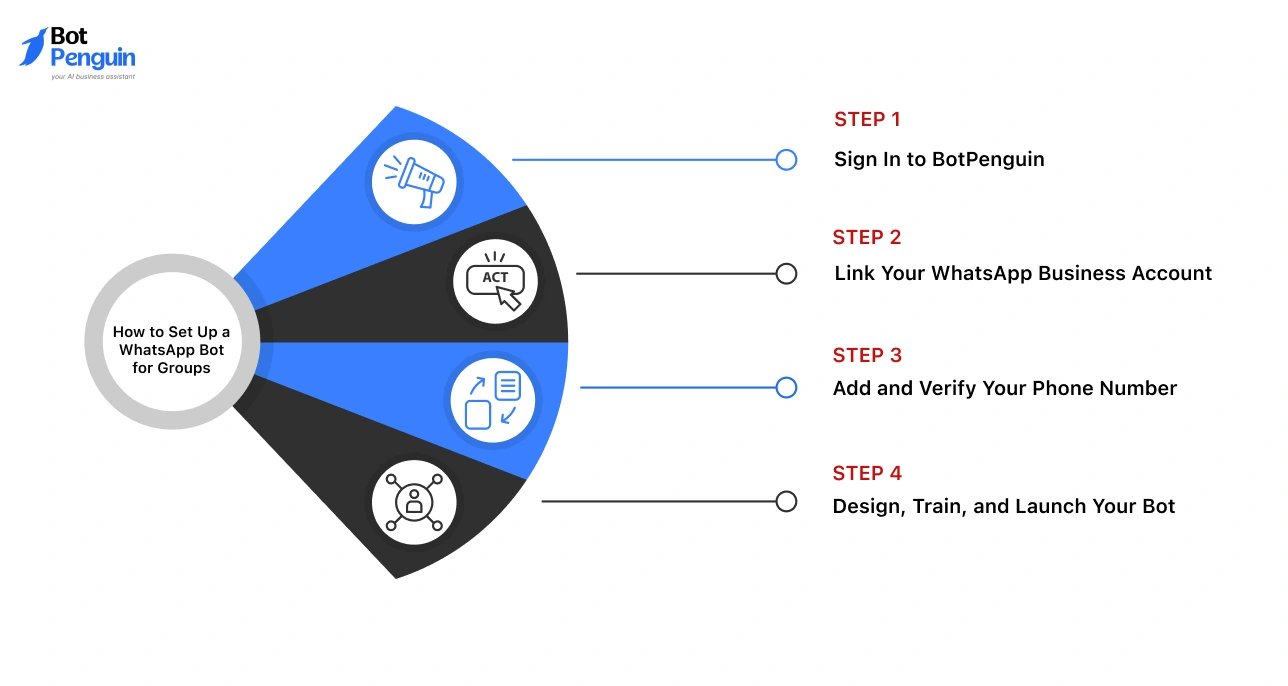
Getting your WhatsApp bot live is simpler than most guides make it sound. Here is the entire process in four steps.
Start by logging into your BotPenguin account and creating a new chatbot. When prompted to select a platform, choose WhatsApp.
The whole setup takes under two minutes, and no coding skills are required at any stage. BotPenguin's entire setup is visual and no-code from start to finish.
Log in to your WhatsApp Business account via Meta and provide the necessary business information to establish the connection. BotPenguin guides you through every step, so there is no guesswork involved.
Enter a phone number that is not already registered with WhatsApp. Follow these steps to verify it. This is the number your bot will use to send and receive messages on WhatsApp.
Build your conversation flows using BotPenguin's no-code builder, train your chatbot with your own content like FAQs, product details, or support scripts, and deploy it. Your bot is now live on WhatsApp and ready to interact with users instantly.
Once live, share your wa.me bot link inside your WhatsApp group. Every member who taps it enters a one-to-one conversation with your bot immediately, giving you group-scale reach without needing a bot inside the group at all.
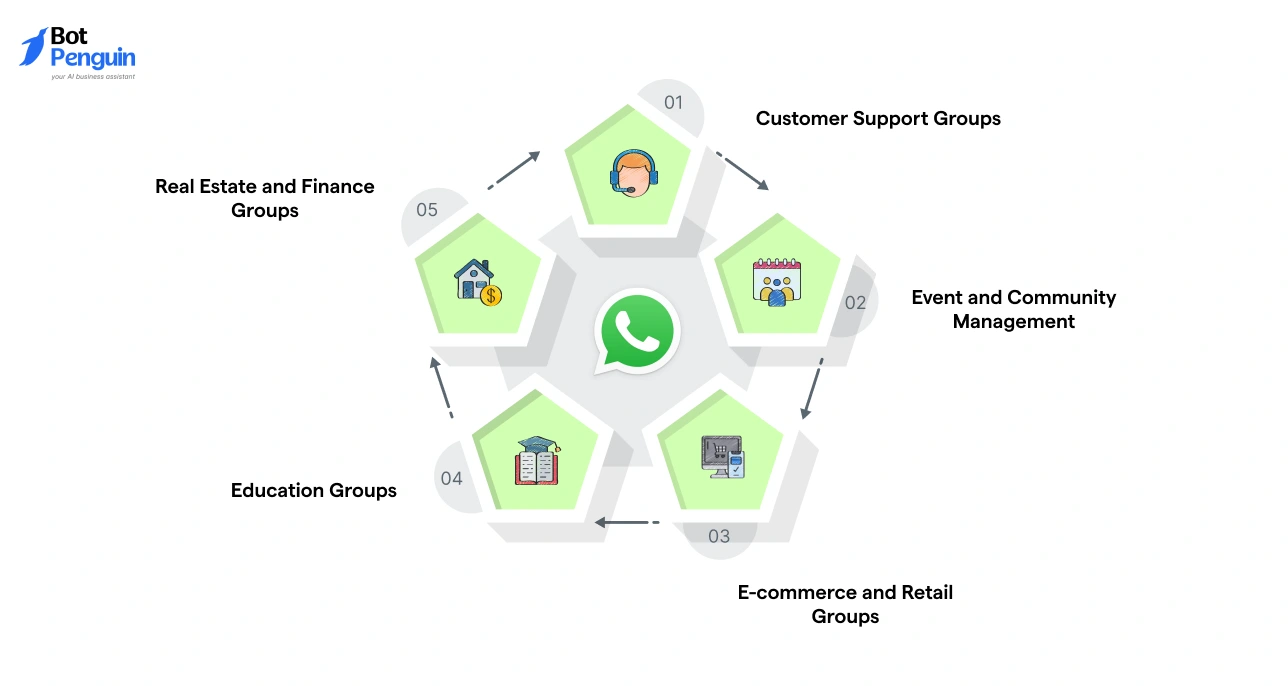
A WhatsApp bot does not just answer questions. When set up correctly, it becomes the primary communication layer between your business and your audience.
Here are the most impactful ways businesses are using it today.
Instead of managing a chaotic support group where messages get buried, businesses share a bot link that instantly handles the most common queries.
Order status, return requests, billing questions, and FAQs get resolved in seconds without a single human agent getting involved. Your team only steps in when the conversation genuinely needs them.
Post your bot link in any event or community WhatsApp group and let it do the heavy lifting. Attendees tap the link to confirm attendance, get event schedules, receive reminders, or ask questions.
Everything is handled automatically, and every response is instant, regardless of how many people message at the same time.
Broadcast order confirmations, shipping updates, delivery notifications, and flash sale alerts to your entire opted-in customer list at once.
Each message is personalized and delivered directly to the individual, giving you the reach of a group broadcast with the feel of a personal conversation.
Automate homework reminders, exam schedules, fee payment alerts, and admission updates. Students or parents tap a bot link from their class WhatsApp group and instantly get the specific information they need without the group getting flooded with repetitive questions.
Send property listings, price drop alerts, or investment updates to interested leads the moment something changes.
Prospects reply directly to the bot to book a viewing, request a callback, or get more details without waiting for an agent to become available.
Every one of these use cases comes down to the same core idea. People are already in WhatsApp groups. Instead of fighting that behavior or trying to manage it manually, a WhatsApp bot meets them exactly where they are and handles the communication automatically, instantly, and at any scale.
Setting up a WhatsApp bot is straightforward, but a few common issues can trip you up. Here is what to look out for and how to fix each one quickly.
This is the most common issue, and it almost always comes down to one of two things.
Either your WhatsApp Business number is not fully verified in your WhatsApp Business API provider's dashboard, or your webhook URL has gone inactive.
If your bot is sending outbound messages outside the 24-hour customer service window, you generally need an approved message template to continue the conversation.
Outside the customer service window, businesses generally need an approved message template to initiate or continue messaging.
Double-check your wa.me link format. It should follow this structure exactly: wa.me/countrycode followed by the phone number with no spaces, brackets, or dashes.
A single formatting error is enough to break the link entirely.
This usually means one of two things. Either a high number of users reported your messages as spam, or you used an unofficial tool at some point.
Make sure every contact on your broadcast list has explicitly opted in and that you are only using the official WhatsApp Business API through a Meta Business Partner.
If your bot is missing the intent behind what users are typing, your training data needs more variety. Go into your BotPenguin bot builder and add more example phrases for each intent.
The more variations you feed it, the better it gets at recognizing what users actually mean, even when they phrase things differently.
Most of these issues take under ten minutes to fix once you know what to look for.
The key is to always stay within official WhatsApp guidelines, keep your contact list opted in, and use a Meta Business Partner that handles the compliance layer for you automatically.
WhatsApp now supports limited group automation through its Groups API, but access and use cases remain more restricted than standard 1:1 Business API messaging.
With the WhatsApp Business API, you can reach thousands of people at once, automate every repetitive conversation, and deliver instant personalized responses around the clock. Everything a WhatsApp group bot was supposed to do, done better and at an unlimited scale.
BotPenguin is the easiest way to make that happen. As an official Meta Business Partner, it gives you direct access to the WhatsApp Business API, a no-code builder, AI-powered responses, and broadcast tools all in one place. It is free to start and takes under a day to go live.
Start building compliant WhatsApp automation with BotPenguin today.
Eligible businesses can use WhatsApp's Groups API for API-created groups, but you cannot simply add a bot to any existing WhatsApp group. For existing groups, businesses can still use bot links and 1:1 automation.
Connect your number to the WhatsApp Business API through an official WhatsApp Business API provider, build your AI bot, and share its chat link inside your group for members to interact with.
WhatsApp Business Platform pricing is based on delivered messages and varies by market and message category. Service messages are free, while additional platform or provider fees depend on the WhatsApp solution you use.
There is no single best option for every business. BotPenguin is a strong fit for teams that want no-code setup, AI-powered conversations, broadcasts, and group-scale communication in one platform. Businesses with highly custom requirements may still prefer a more developer-led solution.
Yes. AI-powered WhatsApp bots can detect and respond in multiple languages automatically, making them effective for diverse international group audiences without any manual switching.
No. Members simply tap the shared wa.me link and the conversation opens instantly without needing to save any number to their contacts first.
Yes. WhatsApp Business API supports rich media, including images, PDFs, videos, and audio files, making bot conversations far more engaging than plain text alone.
3X Your Business
Growth on WhatsApp
See how our chatbot automates replies, qualifies leads & books appointments on autopilot.
Watch Demo NowCheckout our related blogs you will love.
Updated at Oct 6, 2026
9 min to read
Updated at Oct 6, 2026
5 min to read
Updated at Oct 5, 2026
17 min to read
Updated at Oct 5, 2026
15 min to read
Updated at Oct 5, 2026
13 min to read
Table of Contents