TL;DR
|
AI automation is projected to surpass $20 billion by 2029, and agencies are racing to deliver intelligent solutions without building complex systems from scratch.
A white-label AI chatbot allows businesses to rebrand and resell a fully developed chatbot platform under their own name, eliminating development costs while enabling recurring revenue.
BotPenguin powers agencies and resellers globally with a scalable white-label chatbot platform that supports GPT integration, omnichannel deployment, and full branding control.
This guide explains how it works, what to look for, and how to build a profitable chatbot reselling business.
What are White Label Chatbots?

White-label chatbots are turnkey automation systems built by a tech provider and licensed for resale under another company’s brand.
Rather than developing their own AI infrastructure, resellers brand and price existing chatbot software and sell it to clients as their own.
The provider handles backend systems, hosting, security, and updates, while the reseller focuses on sales, onboarding, and customer growth—separating product development from market execution.
Building from Scratch vs Using a White Label Chatbot Platform
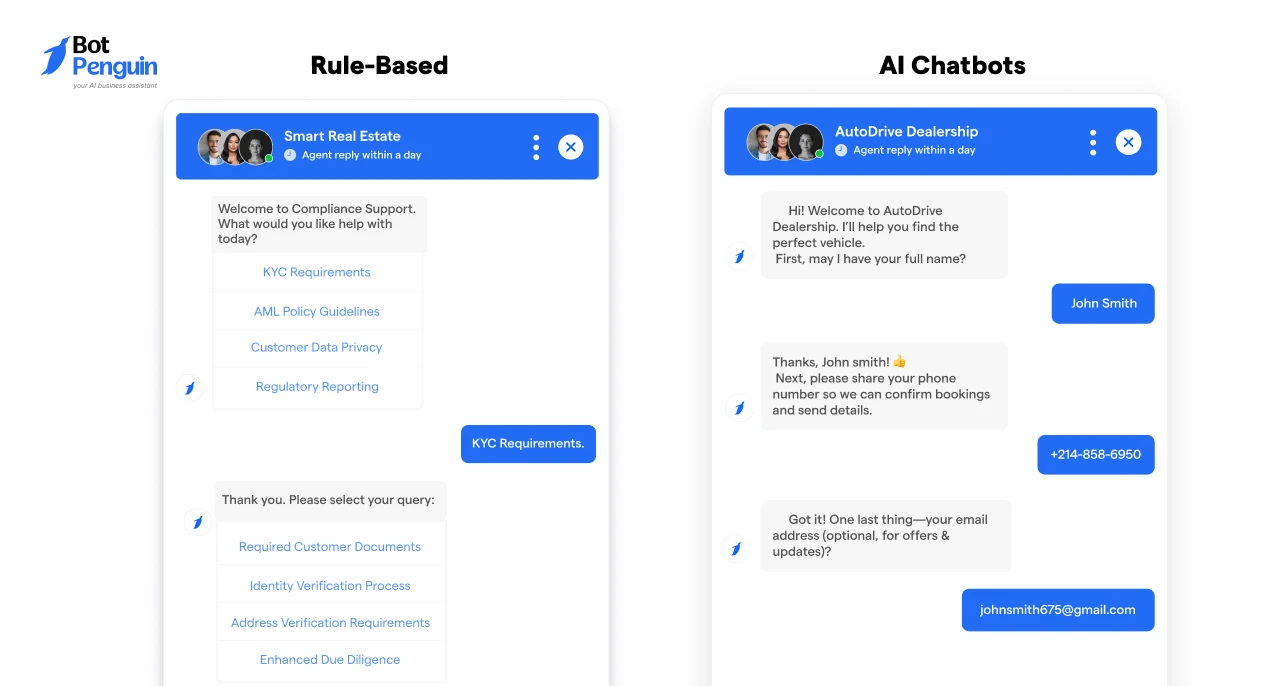
Before choosing a path, it is important to compare operational impact, cost exposure, and scalability requirements.
For most agencies, the difference is strategic. Building internally prioritizes product ownership but increases capital and operational burden.
Using a white-label chatbot platform prioritizes speed, scalability, and revenue focus.
What are White Label Models?

White-label chatbot platforms operate under structured commercial arrangements. The model selected affects branding authority, margin control, and growth flexibility.
Platform Access Model
The reseller receives access to a centralized dashboard to create and manage chatbots for multiple clients. Branding is applied at the account or client level.
This model is common for agencies integrating automation into broader service offerings.
Full Brand Control Model
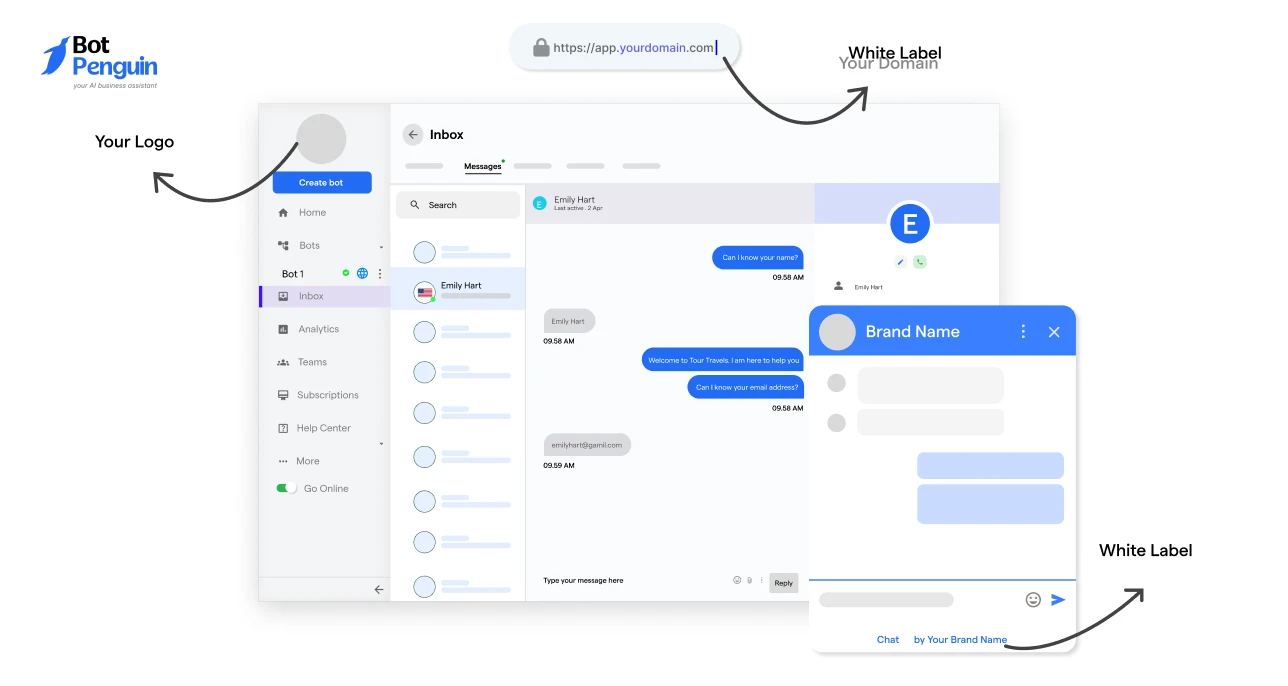
The reseller operates under a custom domain with branded interface elements and client visibility under its own identity. The provider remains operationally invisible.
This model strengthens brand positioning and perceived product ownership.
Revenue Share Model
The reseller enters with lower upfront fees and shares a portion of recurring client revenue with the platform provider.
This reduces initial capital commitment but limits long-term margin expansion.
Wholesale Licensing Model
The reseller pays fixed wholesale pricing and retains full control over client pricing. Margins are predictable, and revenue growth depends directly on sales performance.
This model is typically used by agencies building a dedicated chatbot reseller program.
Selecting the appropriate structure depends on growth objectives, capital availability, and desired brand ownership.
Understanding these distinctions ensures the decision aligns with long-term business strategy rather than short-term convenience.
Top 6 Best White Label AI Chatbots
Selecting the best white-label AI chatbot requires evaluating branding control, AI capability, integrations, and reseller scalability.
Not every platform supports a true AI chatbot reseller platform model.
Below is a structured comparison of six leading tools to help agencies choose the right white-label chatbot platform.
Feature Comparison Matrix
Key Observations
- BotPenguin operates as a structured, leading white-label chatbot platform with built-in reseller readiness.
- Some tools are strong in marketing automation but lack a full white-label AI chatbot platform with custom domain capability.
- Enterprise infrastructure tools require technical resources and are less suited for no-code AI chatbot reseller operations.
- Branding flexibility and margin control vary significantly across platforms.
For agencies and SaaS providers looking to build a scalable white-label automation business with predictable recurring revenue, choosing a platform with full reseller architecture is critical.
We now know the major one. Let's look at them in detail.
1. BotPenguin White Label AI Chatbot

BotPenguin is a purpose-built white-label AI chatbot platform designed specifically for agencies and automation resellers.
Unlike generic chatbot tools, it is structured as a full AI chatbot reseller platform with account-level branding, multi-client management, and margin control.
The platform supports GPT and advanced language model integration, enabling contextual conversations instead of scripted flows.
Agencies can deploy bots across websites, WhatsApp, Instagram, and other channels from a centralized dashboard.
Custom domain configuration allows partners to operate a white-label AI chatbot platform with custom domain access under their own brand identity.
Key Features

- GPT white-label chatbot integration
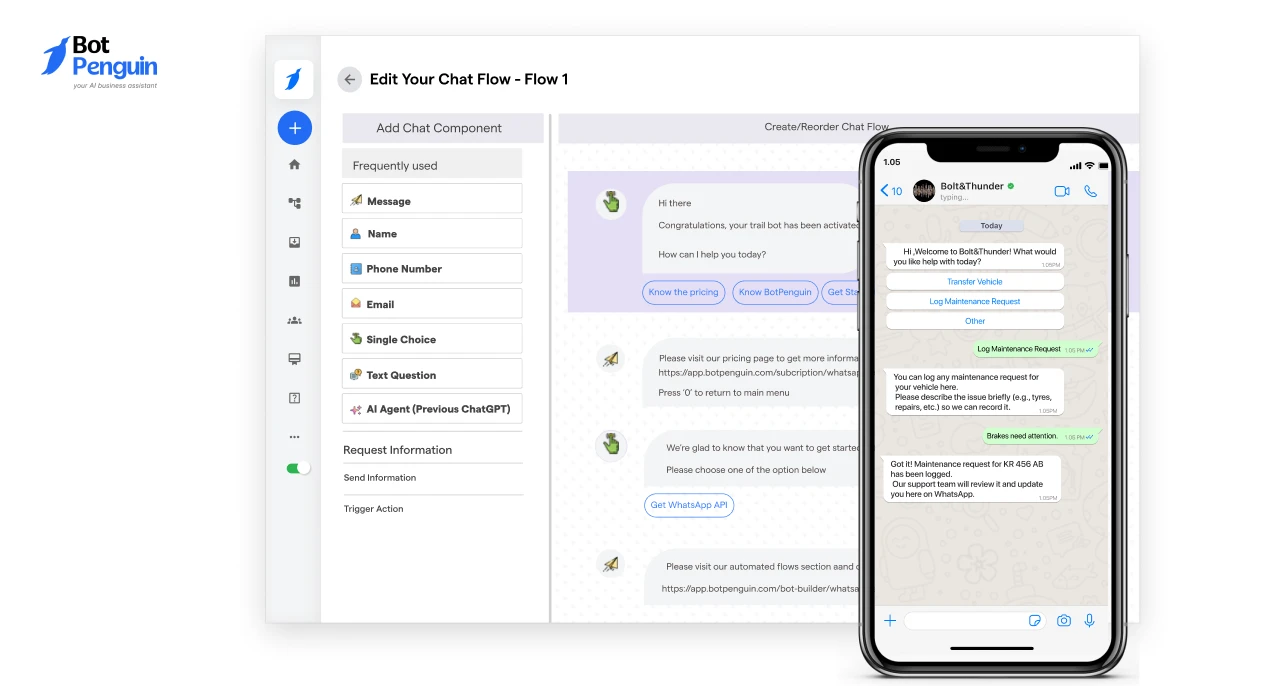
- No code chatbot builder
- Multi-client dashboard
- CRM and API integrations
- Omnichannel deployment
- Analytics and reporting
Pros
- Designed for scalable reseller operations
- Strong branding and domain control
- Structured partner model
Cons
- Advanced configurations may require onboarding support.
Reviews
Agencies highlight recurring revenue scalability and operational control as key advantages when building an AI chatbot reselling business.
2. ManyChat White Label AI Chatbot
ManyChat is a widely recognized chatbot builder primarily focused on social messaging automation.
While not originally developed as a complete white-label chatbot platform, agencies sometimes use it in limited reseller structures for small business automation services.
The platform specializes in Instagram and Messenger automation, offering visual workflow builders and broadcast messaging tools.
GPT functionality can be integrated, but it is not positioned as a full generative AI chatbot reseller system.
Branding flexibility exists, but does not match the depth required for a fully invisible private label chatbot solution.
Key Features
- Visual no-code builder
- Instagram and Messenger automation
- Broadcast campaigns
- Ecommerce triggers
Pros
- User-friendly interface
- Strong social automation tools
- Established market presence
Cons
- Limited full white label branding
- Not structured as a dedicated AI chatbot reseller platform
- Restricted margin control
Reviews
Frequently recommended for social media marketing automation, though less suited for agencies building a structured white-label chatbot for a reseller's program.
3. Tidio White Label AI Chatbot
Tidio combines live chat and AI automation, with strong positioning in ecommerce environments.
It supports an AI chatbot for business use cases such as product recommendations, order tracking, and customer support automation.
While Tidio offers chatbot customization, it is not inherently built as a wholesale white-label SaaS chatbot solution.
Agencies can manage multiple clients, but custom domain-level white labeling is limited compared to platforms built specifically for reseller scalability.
The system includes automation templates and ecommerce integrations that simplify onboarding for online stores.
GPT-style AI capabilities are available, enabling improved contextual responses.
Key Features

- AI-driven chat automation
- Ecommerce platform integrations
- Live chat escalation
- Workflow automation
Pros
- Strong ecommerce orientation
- Quick deployment
- Reliable support infrastructure
Cons
- Limited reseller branding flexibility
- Not optimized as a full AI chatbot reseller platform
Reviews
Highly rated by ecommerce businesses seeking automation, but less aligned with agencies wanting a comprehensive white-label chatbot solution for digital agencies.
4. Chatfuel White Label AI Chatbot
Chatfuel is one of the early players in social chatbot automation. It primarily focuses on Messenger and website-based conversational experiences.
While agencies use it to deploy automation, it is not positioned as a full white-label chatbot builder for large-scale reseller programs.
Chatfuel operates largely on rule-based workflows with optional AI enhancements.
Branding customization exists, but does not fully support a white-label chatbot with a custom domain model at scale.
For small agencies testing automation services, it can function as a lightweight entry solution.
However, advanced GPT white-label chatbot capabilities and enterprise integrations may require external extensions.
Key Features
- Rule-based chatbot automation
- Messenger and website integration
- Basic AI enhancements
- Template library
Pros
- Simple setup
- Suitable for small projects
- Accessible pricing tiers
Cons
- Limited generative AI depth
- Restricted reseller branding structure
- Not optimized for long-term AI chatbot reselling business growth
Reviews
Often used for marketing automation projects rather than full-scale white-label chatbot platform deployments.
5. Landbot White Label AI Chatbot

Landbot specializes in conversational landing pages and interactive website flows.
It provides a visual builder that enables marketing teams to create conversational forms and qualification funnels.
While it supports automation and integrations, Landbot is not structured primarily as a white-label AI chatbot platform.
Branding can be customized, but it is less focused on enabling agencies to sell chatbots under their own brand with full reseller margin control.
Its strength lies in lead generation workflows and interactive web experiences rather than omnichannel AI chatbot reseller platform capabilities.
Key Features
- Drag and drop visual builder.
- Web-based conversational flows
- CRM integrations
- Lead qualification templates
Pros
- Strong for lead capture
- Clean visual interface
- Effective for marketing funnels
Cons
- Limited omnichannel depth
- Not positioned as a full white-label SaaS chatbot
- AI capability is not as advanced as GPT-focused systems
Reviews
Frequently praised for marketing use cases, though less suitable for agencies building structured white-label chatbot reseller programs.
6. Gupshup White Label AI Chatbot
Gupshup operates as an enterprise messaging infrastructure platform supporting large-scale communication automation.
It provides API driven solutions for WhatsApp, SMS, and messaging channels. Unlike no-code platforms, Gupshup requires deeper technical configuration.
While it can be adapted into a reseller model, it is more infrastructure-focused than a ready-made white-label chatbot solution.
Its strength lies in enterprise messaging scale rather than providing a turnkey white-label chatbot builder for agencies.
Organizations with technical teams may benefit from its flexibility, but non-technical resellers may find onboarding more complex.
Key Features
- Messaging API infrastructure
- Multi-channel communication
- Enterprise-grade scalability
- Integration flexibility
Pros
- Strong enterprise reliability
- Broad messaging support
- High scalability
Cons
- Technical setup required
- Not inherently a no-code AI chatbot reseller platform
- Branding structure depends on the agreement
Reviews
Well regarded in enterprise environments but better suited for technically equipped teams rather than agencies seeking a ready-to-deploy white-label AI chatbot platform.
Each platform serves different needs, from social automation to enterprise messaging.
Agencies building a scalable AI chatbot reselling business should prioritize full branding control, GPT integration, and multi-client management.
The right white-label chatbot platform determines long-term revenue stability and operational growth.
How White Label AI Chatbots Work
The operating model follows a clear four-step structure. The sequence is straightforward: choose the platform, apply your brand, deploy for clients, and generate recurring revenue. This clarity is what makes the model commercially scalable.
Choose Platform → Apply Branding → Deploy to Clients → Monetize Monthly
Step 1: Choose a White Label Chatbot Platform
Start by selecting a platform that supports multi-client management and scalable deployment.
Evaluate the following:
- Does it function as a true custom chatbot platform with account-level control
- Can you manage multiple clients from a single dashboard
- Are CRM, messaging, and API integrations already available
- Is uptime consistent and documented
- Is partner pricing structured for margin control
The goal at this stage is not feature overload. It is operational reliability and scalability.
A strong chatbot reseller solution should allow you to onboard clients without technical bottlenecks.
Step 2: Rebrand with Custom Domain and Branding
Once access is secured, apply your identity to the system.
Branding setup should include:
- Your company name and logo
- Custom domain configuration
- Branded client dashboard access
- Controlled user permissions
Clients should interact with your brand at every touchpoint. The technology provider remains in the background.
This structure enables you to sell chatbots under your own brand while maintaining full market ownership of the client relationship.
Step 3: Deploy Across Channels
After branding, move into client deployment.
Standard deployment typically includes:
- Website chatbot installation
- Messaging platform integration
- Lead capture workflows
- Support automation flows
- Live agent routing setup
Deployment should be repeatable. You should not be rebuilding systems from scratch for each client.
Omnichannel capability ensures consistent automation across all communication touchpoints.
Step 4: Monetize with Recurring Revenue
The final step converts deployment into predictable income.
Common revenue components include:
- Monthly subscription fees
- One-time setup charges
- Custom workflow configuration
- Ongoing optimization services
Most resellers tier pricing based on usage, features, or number of bots.
Because infrastructure and AI updates are managed by the provider, revenue scales without increasing engineering overhead.
Key Benefits of a White Label AI Chatbot Platform
For agencies and SaaS companies, the value of this model is measured in operational efficiency and revenue scalability.
The following white-label chatbot benefits explain why many businesses adopt this structure instead of building internally.
Lower Upfront Investment
A white-label SaaS chatbot eliminates the need for internal engineering, infrastructure setup, and AI model development.
The platform is already built and maintained by the provider.
Business Outcome: Capital expenditure is significantly reduced, financial risk is controlled, and resources can be allocated toward sales, marketing, and growth initiatives.
No Code AI Chatbot Builder
Most platforms include a visual builder that allows workflows, responses, and automations to be configured without writing code.
Business Outcome: Teams can deploy and modify chatbots quickly, reduce dependency on technical staff, and support multiple clients efficiently.
Custom Branding and Domain Control
White-label platforms allow full brand application, including logo placement, custom domain configuration, and branded dashboards.
Business Outcome: Agencies maintain brand authority, strengthen client trust, and position the automation offering as their own proprietary solution.
Omnichannel Deployment
An omnichannel white-label chatbot can operate across websites, messaging platforms, and integrated systems from a centralized environment.
Business Outcome: Clients receive consistent automation across all communication touchpoints, improving engagement and increasing perceived service value.
GPT and LLM Integration
Modern platforms integrate GPT and advanced language models to handle contextual conversations and dynamic responses.
Business Outcome: Higher quality interactions improve lead qualification, support resolution rates, and overall client satisfaction.
Recurring Revenue Model
A chatbot reseller program is typically structured around subscription-based pricing with optional setup and management services.
Business Outcome: Agencies build predictable recurring revenue and improve lifetime client value without proportional increases in operational cost.
Built-in Analytics and Reporting
Most platforms provide reporting dashboards that track conversation volume, engagement metrics, and conversion activity.
Business Outcome: Clear performance data supports renewal conversations, upselling opportunities, and continuous optimization.
Faster Client Acquisition
Reusable templates and standardized deployment workflows reduce onboarding time for new clients.
Business Outcome: Shorter implementation cycles increase deal velocity and enable agencies to scale more efficiently.
These advantages demonstrate how a white-label chatbot platform combines operational simplicity with commercial scalability, making it a structured growth channel for agencies and SaaS providers.
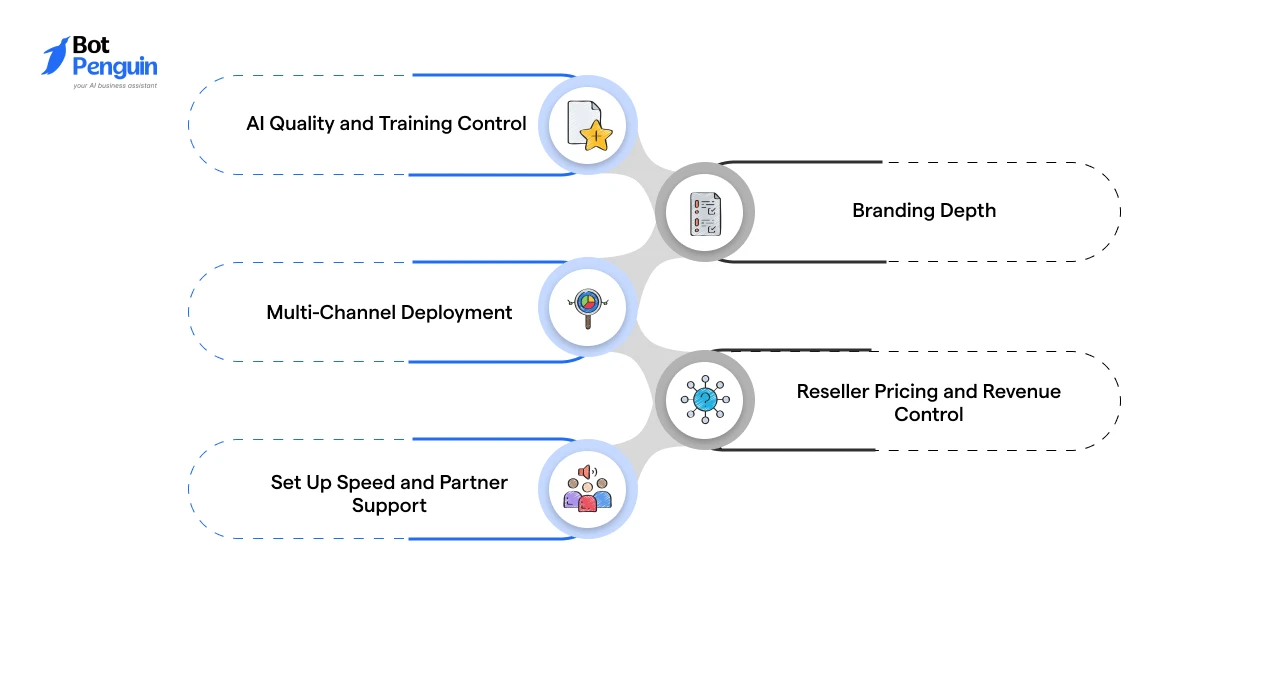
What to Look for in the Best White Label Chatbot Platform?

Selecting a white-label chatbot platform is a strategic decision that affects scalability, margins, and long-term positioning. Not all systems are built for reseller growth.
The evaluation should focus on technical depth, operational control, and commercial flexibility rather than surface-level features.
Use the checklist below to assess whether a platform qualifies as the best chatbot platform for resellers in a competitive market.
Advanced NLP and GPT Integration

A modern white-label AI chatbot platform should support advanced natural language processing and GPT-based capabilities.
This ensures the chatbot can interpret intent accurately, handle contextual queries, and respond dynamically rather than relying only on fixed scripts.
Confirm whether the platform supports:
- Context-aware conversations
- Continuous AI model improvements
- Configurable knowledge base integration
- Multilingual processing
Strong AI capability directly impacts conversation quality and client retention.
No Code Builder and Custom Workflows
A scalable white-label chatbot builder must allow teams to configure bots without engineering involvement.
Visual workflow design, reusable templates, and modular logic blocks are essential.
Evaluate whether the platform provides:
- Drag and drop conversation design
- Conditional logic and branching
- Workflow cloning for multiple clients
- User role management for internal teams
Ease of configuration determines how efficiently you can deploy across accounts.
Multi-Channel Support

The platform should support deployment across all primary communication touchpoints from a centralized interface.
Look for:
- Website chatbot deployment
- Messaging platform integration
- Consistent logic across channels
- Centralized conversation management
An omnichannel approach reduces fragmentation and increases the value of the solution delivered to clients.
API and CRM Integrations
Integration depth is critical for automation to deliver a measurable business impact.
Confirm whether the platform supports:
- CRM synchronization
- Calendar and booking integrations
- Ecommerce and payment connections
- API access for custom integrations
A strong integration layer allows the chatbot to move beyond simple responses and connect directly to business processes.
Security and Compliance
Data handling standards must be clearly defined. Since client conversations often include sensitive information, the platform must demonstrate strong security practices.
Review:
- Data encryption standards
- Access control systems
- Hosting reliability
- Compliance documentation
- Backup and recovery policies
Security transparency protects both the reseller and end clients.
Reporting Dashboard and Insights
Performance visibility is essential for demonstrating ROI.
The platform should provide:
- Conversation volume tracking
- Lead capture metrics
- Engagement and resolution statistics
- Channel-level performance reports
Clear reporting enables data-driven optimization and supports renewal discussions.
A structured evaluation based on these criteria ensures that the selected white-label chatbot platform supports both operational scalability and commercial growth.
For a comparative breakdown of leading solutions, refer to the detailed platform comparison section.
How to Become a Chatbot Reseller?

Becoming a reseller does not require technical expertise or product development.
With the right white-label partner, the process is straightforward and structured around three clear steps.
Step 1: Get Access to the White Label Platform
Start by partnering with a provider that offers a complete chatbot reseller solution. With BotPenguin, you receive access to an already-built white-label AI chatbot platform.
There is no coding, no infrastructure setup, and no AI development required. The system is already built and production-ready.
Step 2: Apply Your Brand and Set Your Pricing
Once onboarded, configure your branding. Add your logo, set up your custom domain, and define your pricing plans.
The platform runs in the background while you position it as your own product. This is where you sell chatbots under your own brand without technical ownership.
Step 3: Start Selling and Scale Recurring Revenue
Begin onboarding clients using standardized templates and workflows. Deploy bots, connect required integrations, and charge a monthly subscription.
As you add more clients, revenue grows without increasing development costs.
This three-step structure is the simplest path to launching a white-label chatbot business with minimal risk and predictable margins.
Why Use a White Label Chatbot for Business?
A white-label chatbot for business becomes valuable when it drives measurable operational and revenue outcomes.
Across industries, AI-driven automation has improved response speed, reduced manual workload, and increased conversion performance.
Below are real examples of how businesses have implemented structured automation.
Ecommerce Automation
Ecommerce brands use AI chatbots for business workflows to automate order management, lead capture, and messaging-based sales.
Case Example:
TTRacing implemented automation to manage high-volume customer interactions.
Within months, qualified leads increased three times while response time dropped by 80 percent. Similarly, BVK Biryani automated over 2,000 WhatsApp orders with full payment visibility, reducing manual order handling errors.
Outcome: Faster responses, higher conversion rates, and improved operational clarity.
Healthcare Appointment and Engagement Automation
Healthcare providers rely on consistent communication and follow-ups to maintain treatment adherence and patient engagement.
Case Example:

Cipla automated over 10,000 drip campaigns and reduced missed medication doses by 40 percent using structured conversational automation.
This demonstrates how automation can move beyond support and directly impact health outcomes.
Outcome: Improved compliance, reduced manual outreach, measurable engagement improvement.
Lead Qualification
Companies use automation to filter, qualify, and route prospects before sales intervention.
Case Example:

BreakBag achieved three times more qualified leads and reduced response time by 60 percent after deploying AI-powered automation.
Galaxy Toyota automated over 800 leads and accelerated service bookings by 35 percent using structured workflows.
Outcome: Higher quality pipelines and improved sales efficiency.
Education and Enrollment Automation
Educational institutions manage large volumes of repetitive queries related to admissions and programs.
Case Example:
DVET Maharashtra automated over 50,000 student queries using a bilingual chatbot. The system provided 24/7 support and reduced dependency on administrative teams.
Outcome: Immediate response delivery, multilingual support, and large-scale query handling.
Travel and Logistics Automation

Travel and logistics operations require real-time coordination and booking updates.
Case Example:
Benbau reduced driver assignment time by 70 percent and centralized fleet operations across two countries through automation.
This shows how conversational systems can improve coordination efficiency beyond customer support.
Outcome: Operational speed improvement and centralized workflow management.
Across industries, a structured white-label chatbot implementation has delivered measurable improvements in lead generation, operational efficiency, and customer response time.
The common pattern is not experimentation but repeatable automation tied to defined business outcomes.
AI Capabilities That Modern White Label Chatbots Must Have
A white-label platform is no longer evaluated only on branding and deployment. AI depth now determines conversion rates, automation coverage, and client retention.
A serious generative AI chatbot reseller must ensure the platform includes advanced capabilities that directly impact measurable business performance.
Below are the AI functions that define a competitive GPT white-label chatbot in 2026.
GPT and Generative AI Integration
A modern ChatGPT white-label solution should support contextual understanding rather than scripted responses.
GPT integration allows the chatbot to interpret user intent, handle complex queries, and generate adaptive replies.
ROI Impact
Higher response accuracy improves lead qualification and reduces live agent dependency.
Businesses often see increased conversion rates on demo requests and reduced support backlog when conversations are handled intelligently instead of through fixed menus.
Sentiment Analysis
An LLM-powered white-label bot should be able to detect tone and urgency within conversations.
Identifying frustration, purchase intent, or confusion enables dynamic routing and response prioritization.
ROI Impact
Escalating high-intent or dissatisfied users in real time protects revenue and reduces churn.
Early intervention in negative interactions improves customer retention and brand perception.
Multilingual Support
Global businesses require automation that can respond in multiple languages without building separate bots.
Language model support enables consistent communication across regions.
ROI Impact
Expanding language coverage increases market reach without increasing staffing costs. This directly supports international scaling and higher customer engagement rates.
Live Chat Escalation
Automation should not replace human agents entirely. It should filter and route conversations intelligently.
A strong GPT white-label chatbot includes a seamless transition from AI handling to human support when complexity increases.
ROI Impact
Live escalation ensures high-value prospects are not lost while routine queries remain automated. This balances efficiency with revenue protection.
Workflow Automation
AI should connect conversations to actions. A robust platform must trigger CRM updates, appointment scheduling, order tracking, and internal notifications automatically.
ROI Impact:
Automated workflows reduce manual processing time and accelerate sales cycles.
Faster response execution improves operational efficiency and measurable business outcomes.
For agencies building a generative AI chatbot reseller offering, these capabilities are not optional enhancements.
They define whether the platform can deliver measurable value to clients and sustain recurring revenue growth.
White Label Chatbot Pricing and ROI Overview
When evaluating how much a white-label chatbot costs, the more strategic question is how quickly the investment converts into recurring revenue.
A white-label model is structured so that infrastructure remains controlled while client-based income scales.
The example below illustrates how revenue grows as you onboard more clients and price your service effectively.
Revenue Scaling Example
Assumption: Average client subscription price = $100 per month
This model shows that even at $100 per client per month, onboarding 30 clients generates $36,000 annually.
At 50 clients, revenue reaches $60,000 annually without proportional infrastructure growth.
Revenue Multiplier Illustration
If pricing increases or additional services are bundled, revenue scales further.
Example with tiered pricing:
Because white-label chatbot pricing typically involves a structured platform investment rather than variable development cost, each additional client increases profit potential rather than increasing technical overhead.
What This Means for ROI
- Revenue grows directly with client acquisition.
- Pricing flexibility increases margin control.
- Infrastructure does not need to expand linearly with revenue.
- Subscription-based billing improves financial predictability.
This structure is why many agencies treat white-label automation as a recurring revenue engine rather than a one-time service offering.
Why Choose BotPenguin as Your White Label Partner?

Choosing a platform is not only about software access. It determines what you can confidently sell in the market and what value your clients can deliver to their own customers.
A strong white-label partner expands your commercial capability while keeping operational complexity low.
Below is a structured view of what you can offer as a BotPenguin white-label partner and what your clients can offer to their end users.
What You Get as a White Label Partner
What Your Clients Will Be Able to Offer Their Customers
Strategic Advantage
As a white-label partner, you position yourself as a technology provider without building the technology.
Your clients position themselves as digitally advanced businesses without expanding internal support teams.
This layered value structure is what makes the model commercially strong.
You build recurring revenue, and your clients improve operational efficiency and customer experience at the same time.
Conclusion
The white-label AI chatbot model has evolved into a structured growth channel for agencies and SaaS providers seeking recurring revenue without technical overhead.
Instead of building infrastructure from scratch, businesses can focus on branding, client acquisition, and scalable automation services.
With GPT integration, omnichannel deployment, and reseller-ready architecture, this model supports predictable margins and operational efficiency.
Platforms built specifically for reseller scalability, such as BotPenguin, provide the combination of branding control, AI capability, and multi-client management required to operate confidently in competitive markets.
The right white-label chatbot platform is not just a software choice. It is the foundation of a long-term automation business strategy.
Frequently Asked Questions (FAQs)
How much does a white-label chatbot typically cost?
White-label chatbot pricing varies by platform tier, message volume, AI capabilities, and branding depth. Most providers offer structured subscription plans with scalable usage limits. Total cost depends on how many clients you manage and the level of automation features required.
How long does it take to set up a white-label AI chatbot?
Setup time typically ranges from a few hours to several days. Branding configuration, custom domain setup, and workflow customization determine deployment speed. No-code platforms significantly reduce implementation time compared to building automation internally.
Can i fully customize branding on a private-label chatbot solution?
Yes. Most private-label chatbot solutions offer logo placement, domain mapping, branded dashboards, and client-level account control. Customization depth depends on the platform’s white-label architecture and reseller agreement.
Which platforms support a white-label chatbot model?
Several automation platforms support white-label functionality. The best options provide multi-client management, GPT integration, CRM connectivity, and custom domain control designed specifically for reseller scalability.
Does a white-label chatbot support ChatGPT integration?
Many modern platforms offer ChatGPT white-label solution capabilities. This allows contextual responses, dynamic conversation handling, and AI-driven lead qualification rather than relying only on predefined scripts.
Is technical experience required to run a no-code AI chatbot reseller program?
No. A no-code AI chatbot reseller model allows configuration through visual builders. Infrastructure, hosting, and AI model updates are managed by the platform provider, reducing technical dependency.
What kind of support is available for chatbot resellers?
Support typically includes onboarding assistance, documentation, troubleshooting help, and technical escalation options. The level of partner support varies by plan and provider structure.
Can I deploy a white-label chatbot across multiple channels?
Yes. Most platforms support omnichannel deployment, including website integration and messaging platforms. Centralized management ensures consistent automation logic across communication channels.
How does GPT integration improve chatbot performance?
GPT integration enhances intent detection, contextual understanding, and natural response generation. This improves lead-qualification accuracy, reduces the support backlog, and increases engagement quality.
What should i evaluate before choosing a white-label chatbot platform?
Evaluate AI depth, branding control, integration capability, scalability, pricing flexibility, and reseller support. The platform should support long-term recurring revenue growth without increasing technical overhead.