


White-Label AI Agents for IT Consultancies and MSPs: The Fastest Path to Offering AI for MSP (2026)
Updated at Sep 12, 2026
8 min to read
Updated On Aug 19, 2026
14 min to read
Agencies that keep trading time for money will always hit a growth ceiling. White label AI agents break that pattern.
A white label AI agent is an AI-powered automation tool you resell under your own brand without building anything from scratch. You configure it, brand it, and deploy it for clients. The technology is already built.
In 2026, agencies using white label AI agents are winning clients that budget-constrained competitors simply cannot serve.
This guide covers everything: the model, the platforms, the use cases, and how to launch fast.
Before comparing platforms or pricing models, it helps to be precise about what you are actually selling.
Before choosing a solution, compare AI agents, AI assistants, and AI chatbots to understand how they differ in autonomy, task execution, and business use cases.
A white label AI agent is an AI-powered automation system that agencies deploy for clients under their own brand name. The underlying platform is provided by a vendor; the agency applies custom branding, pricing, and domain. Clients interact only with the agency's branded interface, and the vendor stays completely invisible.
The term white label comes from physical product manufacturing, where a producer makes a product and a retailer sells it under their own brand. In AI, the product is a fully functional automation platform. You rebrand it, price it, and deliver it as your own service.
Many agency owners use these terms interchangeably, but the business model behind each is very different.
A reseller earns commission by selling the vendor's product under the vendor's brand. The vendor owns the client relationship. A white label AI agency sells the same product under their own brand, on their own domain, at their own price point, and keeps 100% of client revenue.
For agencies with existing client relationships, this distinction matters. Reselling builds a commission stream. White labeling builds a brand asset.
Understanding the economics here is what separates agencies that move forward from those that stay on the fence.
Most agency service lines have a cost problem: more clients mean more hours, more hires, and more overhead. The white label AI agent model is structured differently. There is one fixed cost, the platform subscription, and revenue that scales with every client added without a proportional increase in what you spend.
Once you pay the platform fee, every client you add generates revenue across three layers.
The setup fee is billed once at the start. The monthly subscription is recurring.
Add-on services stack on top. A single client at mid-range rates generates $300 in setup revenue and $400 per month ongoing.
At 10 clients, that is $4,000 in monthly recurring revenue before any add-ons are billed.
Most SaaS tools charge per seat or per usage, so costs rise as your client count rises. A white label AI agent platform charges a flat annual fee. The 20th client costs the same in platform fees as the first.
That is the margin expansion point most agency owners miss when they first look at this model. Your cost base stays fixed. Your revenue compounds.
Agencies need control over how they bill clients. BotPenguin's partner program lets you create your own pricing plans, gate features by tier, offer free trials to prospects, add paid add-ons, and bill clients in local currencies through local payment gateways.
For agencies operating in markets like India, MENA, and LATAM, local currency billing matters. International card billing in these regions consistently underperforms on conversion. Local gateway support removes that friction entirely.
Agencies that want to scale beyond direct client work can appoint their own resellers under their brand. Your partners sell the service, clients interact with your brand, and revenue flows through your pricing structure.
This converts your agency from a service business into a platform business. Revenue grows without headcount growing at the same rate.
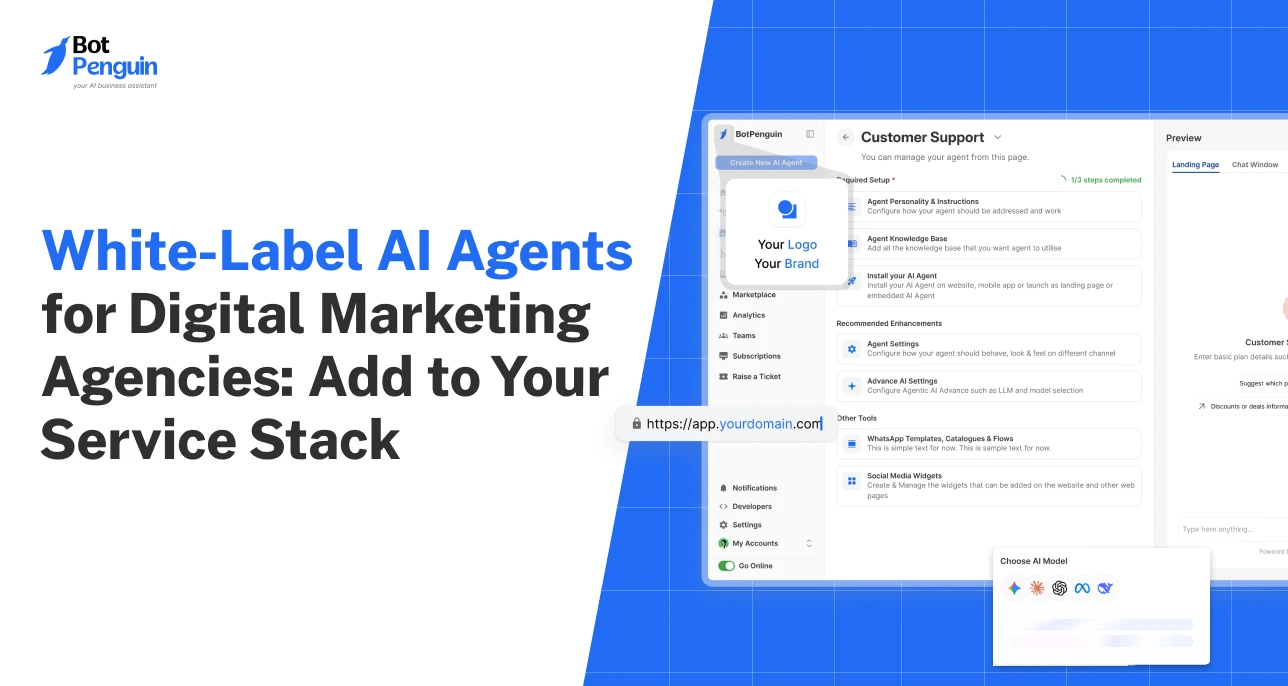
Digital marketing firms can explore white-label AI agents for agencies to learn how to package these solutions alongside SEO, paid advertising, social media, CRM, and customer support services.
Now that the business model is clear, the next question is where these agents actually get deployed and what they do for your clients.
The revenue model makes sense on paper. What makes it work in practice is channel coverage. A platform that deploys across multiple channels from a single trained agent gives your clients more reach and gives you a stronger service to sell.
WhatsApp is the primary business communication channel across the UAE, Saudi Arabia, India, Brazil, Mexico, and most of Southeast Asia. For agencies serving clients in these regions, this is the first channel to deploy on.
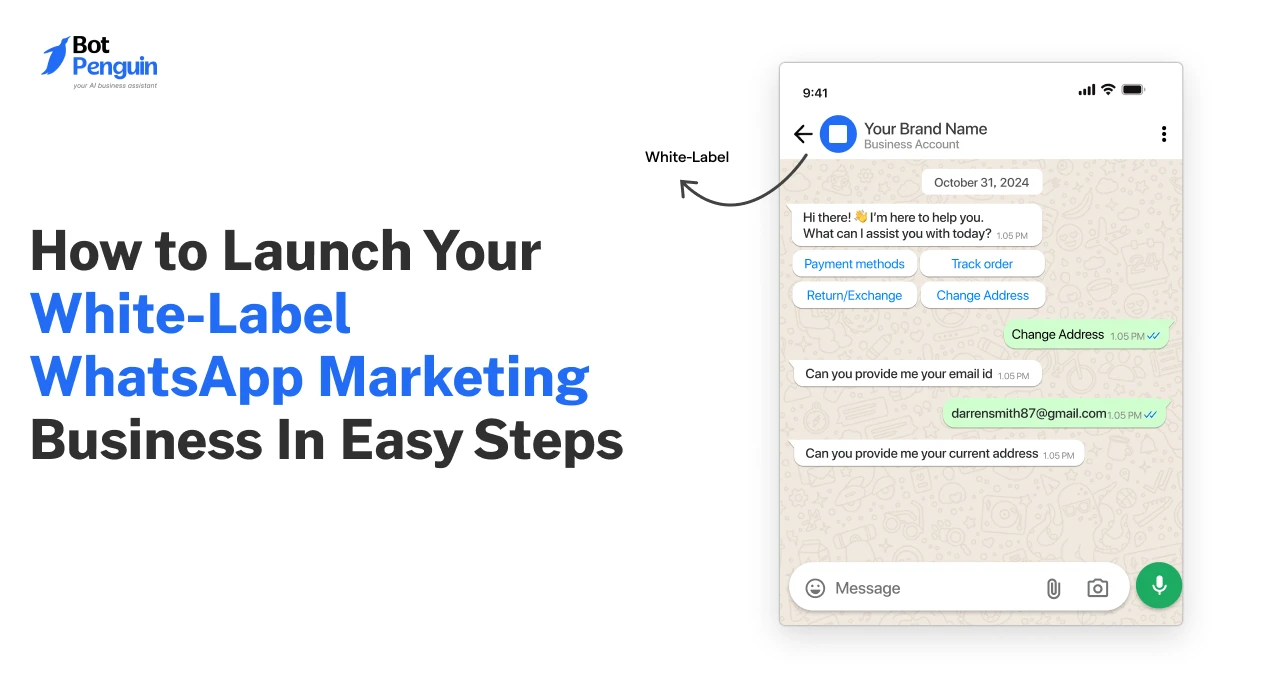
For a full breakdown, see our dedicated guide to white label AI agents for WhatsApp.
Website chat is where most deployments start because results are immediate and measurable. The agent runs on the client's site around the clock under their own branding with no third party name visible anywhere.
Instagram DMs are a frontline sales channel for ecommerce, fashion, beauty, and food service clients. The agent operates entirely within the Instagram interface with no redirects.
Different client audiences live on different platforms. All channels below are managed from one dashboard with shared AI training across every deployment.
For ecommerce clients, the agent connects to the store's live data and operates without manual updates or sync delays.
For a full breakdown, see our dedicated guide to white label AI agents for ecommerce.
Agencies already managing CRMs for clients can connect the AI agent directly to existing pipelines. Every interaction syncs automatically without manual data entry.
See our guides on HubSpot-compatible AI agents and white label AI agents for GoHighLevel agencies for specifics.
With channel coverage clear, the next question is which use cases produce the strongest returns for your clients.
Knowing which channels to deploy on is only half the picture. What the agent actually does on those channels determines the value your clients see and how long they stay.
Four use cases generate the most consistent, measurable ROI across agency client portfolios.
The most broadly applicable use case across real estate, financial services, healthcare, education, B2B services, and ecommerce.
Up to 3× more qualified leads.
Any client with an inbound sales process and a defined qualification criteria.
For a detailed deployment guide, see our guide to AI agents for lead generation.
The agent handles the top 30 to 40 most common queries automatically around the clock and escalates complex or sensitive cases to a human agent.
Reduction in support volume within a few months
Any client receiving high volumes of repetitive inbound queries.
For a full breakdown, see our guide to AI customer service agents for agencies.
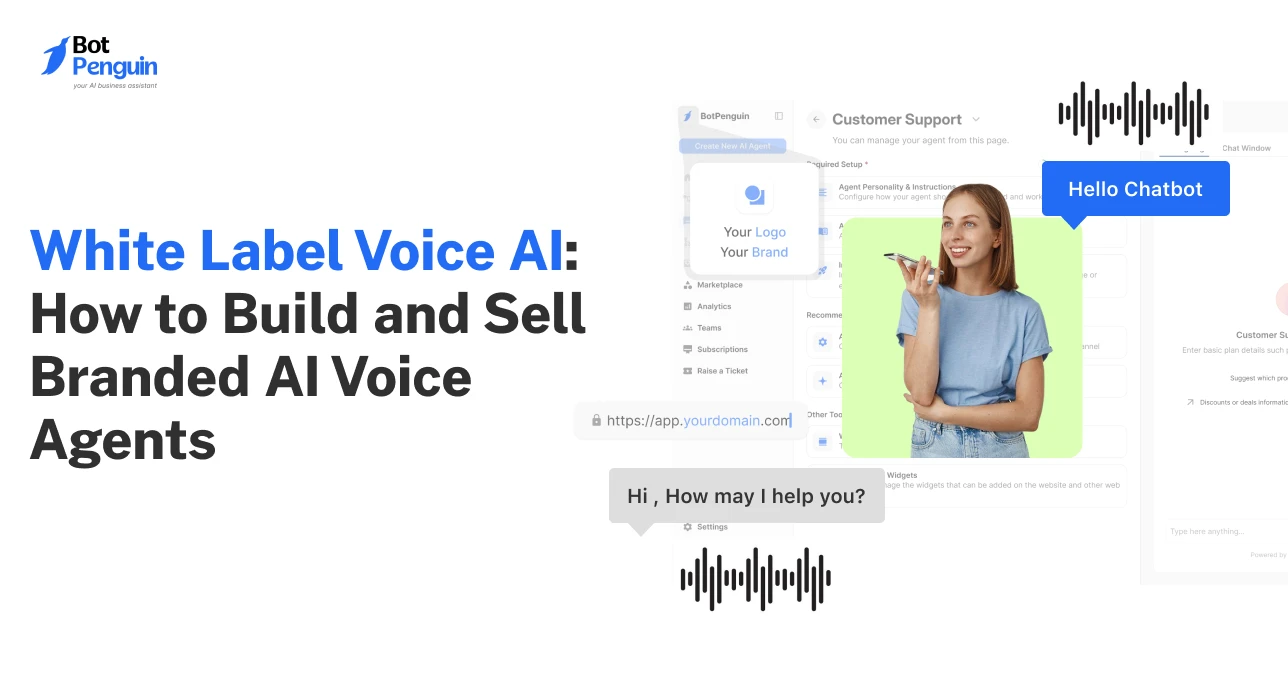
Built for service businesses that still rely on phone-based booking. Alongside WhatsApp and website chat, agencies can deploy voice agents to answer inbound calls, confirm appointments, handle rescheduling, and run outbound reminder calls under their own brand.
40–70% reduction in routine call/booking workload.
Dental clinics, physiotherapy, salons, legal consultancies, financial advisors, and repair services. Healthcare providers can explore white-label AI agents for healthcare clinics to see how agencies can automate patient inquiries, appointment booking, reminders, and routine administrative workflows.
For a full breakdown, see our guide to white label AI agents for appointment booking.
For retail and ecommerce clients, the agent targets three workflows that directly affect revenue recovery and repeat purchase rates.
WhatsApp cart recovery open rates 3–5× higher than email, making it the highest ROI recovery channel in WhatsApp primary markets.
Retail and ecommerce clients on Shopify or WooCommerce with high cart abandonment rates.
For a full breakdown, see our guide to white label AI agents for ecommerce.
With the use cases clear, the next step is knowing how to evaluate which platform is actually worth building your business on.
Choosing the wrong platform at the start costs more than just money. It costs client relationships. Here are the eight criteria that separate a complete platform from a partial one
Your domain, your logo across all client-facing screens and mobile apps, your name in help documentation. A logo placed on the vendor's shared domain is not white label. Confirm that the platform removes every visible trace of the vendor before committing.
What to check: Custom domain support, branded mobile app, white-labeled help docs.
Managing separate tools per channel is not viable at 10 or more clients. The platform should deploy WhatsApp, website chat, Instagram, Facebook, Telegram, and ecommerce integrations from one training set and one dashboard.
What to check: Single agent training that applies across all connected channels simultaneously.
Without built-in subscription management, billing becomes a manual problem. The platform should let you create your own pricing plans, gate features per tier, offer free trials, add paid add-ons, and bill clients in local currencies through local payment gateways.
What to check: Local currency billing support, especially for MENA, India, and LATAM markets where international card billing underperforms.
Revenue sharing models compress your margin with every client you add. The correct model is a flat annual platform fee with 100 percent revenue retention on your end.
What to check: Run the numbers at 5, 10, and 20 clients before signing. The difference between flat fee and revenue share compounds significantly at scale.
Enterprise clients and regulated industries require compliance documentation before procurement approval. GDPR, HIPAA, CCPA, and ISO certifications need to be available in writing, not just mentioned on a website.
What to check: Certifications that cover healthcare, finance, and insurance use cases specifically.
Zapier-based connectivity adds per-task costs that grow with usage volume. Native integrations with HubSpot, Zoho, Salesforce, GoHighLevel, and regional CRMs keep costs predictable and data sync reliable.
What to check: Whether integrations are native or Zapier-dependent, and what the cost difference is at scale.
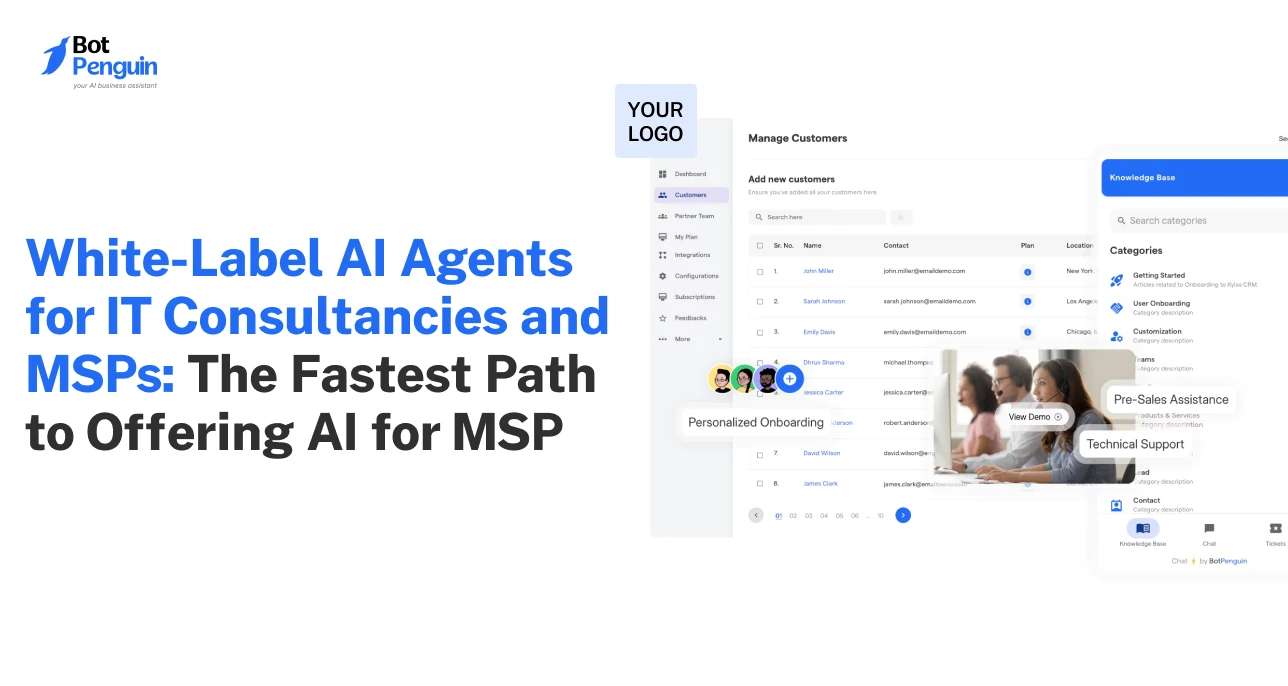
IT service providers can explore our guide to white-label AI agents for IT consultancies to learn how to package CRM integrations, implementation, compliance, and ongoing management as a scalable client service.
Global platforms are built for global markets. Agencies serving clients in MENA, India, and LATAM need support for local payment gateways, regional CRMs, and market specific integrations that standard platforms do not cover natively.
What to check: Whether the platform has a custom development offering and what the turnaround and cost structure looks like.
When a client deployment goes live, and something breaks at 11 pm, the vendor's response time becomes your client's experience. Generic support queues are not acceptable at the partner tier.
What to check: Dedicated partner support channel, response time guarantees, and escalation process for live deployment issues.
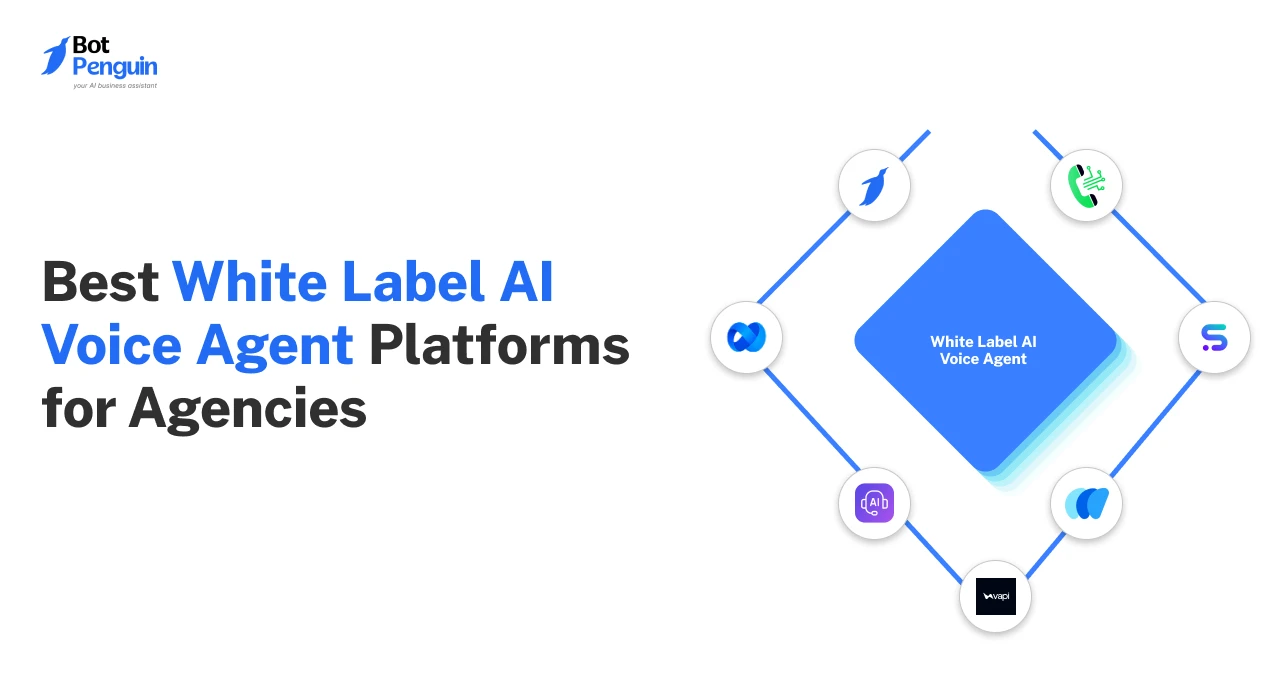
For a full head-to-head comparison across platforms, see our best white-label AI agent platforms guide.
With the evaluation criteria clear, the next section covers what agencies actually earn and how the numbers build over time.
The platform evaluation matters. But what ultimately drives the decision is the revenue picture. Here's an illustrative model of how recurring revenue compounds against a flat annual platform fee.
These numbers are indicative and will vary based on your pricing, market, and client mix.
Every new client also generates a one-time setup fee for initial deployment. This covers workspace configuration, AI training on the client's products and FAQs, CRM integration, and channel setup.
Setup fee range: $500 to $1,500 per new client.
At 10 new clients in year one, that adds $5,000 to $15,000 in non-recurring revenue on top of the $42,000 in annual retainers.
Agencies that appoint their own resellers under their white label brand multiply revenue without adding direct client work. Each reseller drives their own client base. The parent agency takes a share of that revenue while the reseller handles the client relationships.
This is what converts a white label AI agency from a service business into a scalable platform business. The revenue multiplies. The overhead does not.
With the earnings picture clear, the next step is understanding exactly how to get your first client live under your brand in under 12 hours.
Platforms vary widely on rebranding depth, channel coverage, billing infrastructure, and compliance. A logo swap on a shared domain isn't the same as full white-labeling with a custom domain and branded mobile apps. Billing support for local currencies matters if you're serving MENA, India, or LATAM markets.
For a full side-by-side comparison across the best platforms — with pricing, strengths, and honest limitations for each — see our best white-label AI agent platforms guide.
With the platform comparison in place, the final step is the actual launch process and how to get your first client live in under 12 hours.
Once you've chosen a platform, the launch sequence is straightforward:
Set up your branded workspace under your own domain and logo
Pick a first client from an existing relationship, since trust converts faster than a cold prospect
Run a short free trial while the agent handles real conversations
Review results, then convert the trial to a monthly retainer
Repeat with each new client. Subsequent launches go live faster using a repeatable template
Most agencies complete this cycle in 14 to 30 days from signup to a paying client.
For the full breakdown, including legal structure, pricing calculators, client contracts, and scaling past 10 clients, see our complete guide to starting an AI agent business.
White label AI agents are one of the clearest revenue opportunities in the current agency market. Low startup cost, high client retention, flat platform fees, and revenue that grows with every client added.
The agencies building their first deployments now, while the market is still early, are the ones that will own this category in their markets over the next several years.
BotPenguin's partner program gives you the branded platform, omnichannel deployment, compliance certifications, local billing infrastructure, and dedicated partner support to start immediately.
The technology is ready. The clients are asking. The only variable is when you start.
Start Your White Label AI Agency With BotPenguin Today
A white label AI agent is an AI-powered automation system built by a vendor and deployed by an agency under their own brand name. The agency applies their own domain, logo, and pricing. Clients interact only with the agency's branded interface and have no visibility into the underlying vendor or platform.
Platform costs vary by vendor. BotPenguin's white label partner program starts at $1,500 per year as a flat annual fee. That fee covers unlimited client deployments, meaning the platform cost does not increase as you add clients. Revenue from client subscriptions, setup fees, and add-on services is retained entirely by the agency.
A full white label AI agent platform supports deployment across WhatsApp, website chat, Instagram DMs, Facebook Messenger, Telegram, WordPress, Microsoft Teams, Squarespace, Shopify, and WooCommerce. All channels are managed from one dashboard using a single trained agent. Platforms that only support website chat or limited channels are not suitable for agencies serving clients across multiple markets.
Yes. BotPenguin's partner program allows agencies to appoint their own resellers who sell the service under the agency's brand. Each reseller drives their own client base, and the parent agency takes a share of that revenue. This converts the agency from a direct service business into a platform business where revenue grows without proportional overhead increase.
A white label chatbot program follows a fixed decision tree. It responds based on predefined rules and cannot handle inputs it was not explicitly programmed for. A white label AI agent uses large language model technology to understand context, handle varied inputs, qualify leads, manage multi-turn conversations, and integrate with CRMs and external systems in real time. The practical difference is that an AI agent handles a far broader range of client interactions without manual scripting for every scenario.
The branded platform goes live on the same day you complete onboarding with BotPenguin. Your first client deployment, including AI training on their FAQs, CRM connection, and channel setup, takes 2 to 4 hours. Subsequent client deployments using the same template workspace typically go live in under an hour. From signing up to having a paying client on a monthly retainer, most agencies complete the cycle within 14 to 30 days.
If you have questions specific to your market, client base, or technical setup, the BotPenguin partner team is available to walk you through the options before you commit or you can check out. our white-label library
Subscribe to Our Newsletter
Get the latest business insights straight into your inbox.
Checkout our related blogs you will love.
Updated at Sep 12, 2026
8 min to read
Updated at Aug 3, 2026
10 min to read
Updated at Oct 9, 2026
10 min to read
Updated at Oct 8, 2026
11 min to read
Updated at Sep 30, 2026
17 min to read
Updated at Sep 29, 2026
9 min to read
Table of Contents
