



API and White Label Solutions: Meaning, Differences & Which to Choose
Updated at Sep 17, 2026
14 min to read
Most agencies are building on the wrong foundation.
They pick a chatbot platform, slap their logo on it, and call it white-label. Then they wonder why clients churn. The problem isn't the branding; it's the platform. A chatbot alone doesn't cut it anymore. Clients want chat, autonomous AI agents, and voice. All three. Under your brand.
That's exactly what separates a real platform from a rebranded widget. This guide compares five platforms on the criteria that actually matter — so you choose right the first time.
Not all platforms fail the same way. They fail on different criteria.
Before running a platform comparison like this one, you need a fixed evaluation framework. If you are still defining the service model, read our guide to white-label AI agents for agencies.
Here are the criterias that determine whether a platform will work for an agency business model at scale.
Surface-level branding is not white-labeling.
Real white-labeling means zero vendor footprint visible to end clients. Check for:
Platforms that offer only a logo swap on a shared subdomain will expose your vendor the moment a client inspects a URL.
Agencies serving SMB clients need one platform covering all channels their clients use.
That means WhatsApp, website chat, Instagram DMs, Facebook Messenger, and Telegram from a single bot training set. Also check for:
The moment you need separate tools per channel, your operational overhead multiplies with every client you add.
Voice is no longer optional for agencies positioning as full-service conversational AI providers.
Evaluate these specifically:
Platforms that added voice as an afterthought typically have higher latency and limited call flow customization. The quality gap between platforms is significant.
Most platforms leave billing entirely to you. That is a spreadsheet problem at 10+ clients.
Look for platforms that offer:
Without built-in billing infrastructure, every new client adds manual overhead to your operations.
Do the unit economics before you commit to any platform.
The two common models are:
Run the numbers at 5 clients, 10 clients, and 20 clients. The platform that looks affordable at 3 clients can become your biggest cost center at 15.
Enterprise clients and regulated-industry clients will ask for compliance documentation before procurement approval.
At minimum, verify:
Platforms that are self-managed on compliance put that burden on you and your clients.
Zapier-based integrations add per-task costs that compound at scale.
Prioritize platforms with native integrations for:
Also check for regional CRM support if your clients operate outside North America. The difference between a native integration and a Zapier workaround becomes significant when you are managing 20+ client deployments simultaneously.
When a client deployment goes live and something breaks, your reputation is on the line — not the platform's.
Ask before you commit:
Support quality is the criteria that only reveals itself after you have signed the contract. Check references from existing partners before committing.
These criterias form the evaluation framework used throughout this comparison. Every platform reviewed below is scored against all these — not just the ones where it performs well.
Ready to see how BotPenguin stacks up? Explore BotPenguin's white-label partner program.
Agencies can evaluate BotPenguin as a white label AI agents platform for deploying chatbots, autonomous AI agents, and voice AI under one brand.
The table below covers every criterion from the evaluation framework above. Use it to shortlist before reading the full platform reviews.
Pricing verified as of July 2026. Rates may change, please confirm current pricing on each provider's site before purchase.
Key takeaway: BotPenguin is the only platform in this comparison that carries native support across chatbot, AI agents, and voice together with full white-labeling, and built-in partner billing under one plan.
The table gives you the overview. This section gives you the specifics — capabilities, honest limitations, and which agency profile each platform actually fits.
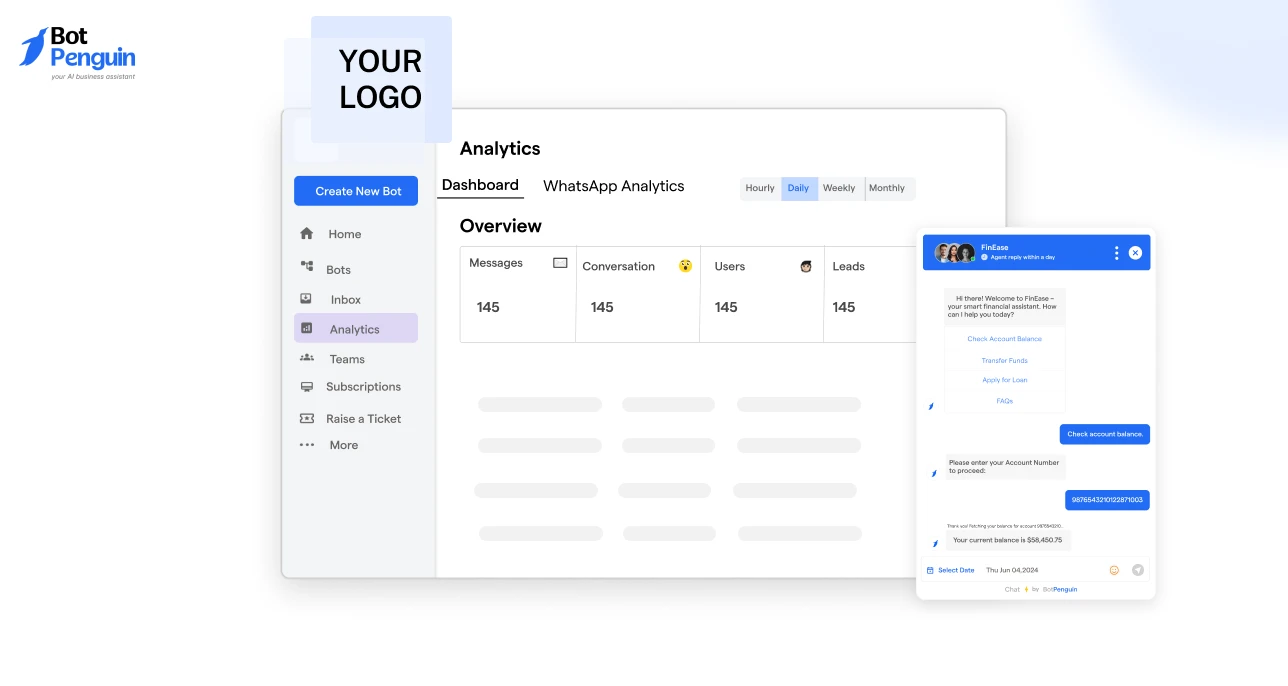
BotPenguin is the only platform in this comparison that covers chatbot, AI agents, and voice under a fully white-labeled brand with built-in partner billing
Overview: Most agencies piece together three tools to cover chat, agents, and voice. BotPenguin does all three from one dashboard, one knowledge base, and one partner plan. It supports 250+ white-label partners; the product is used in 193 countries, and agencies can go live in 12 hours.
One South African IT services and digital marketing agency used this exact model to go live in 10 days and scale to 58 clients and $94,400 in partner revenue — see how they built it.
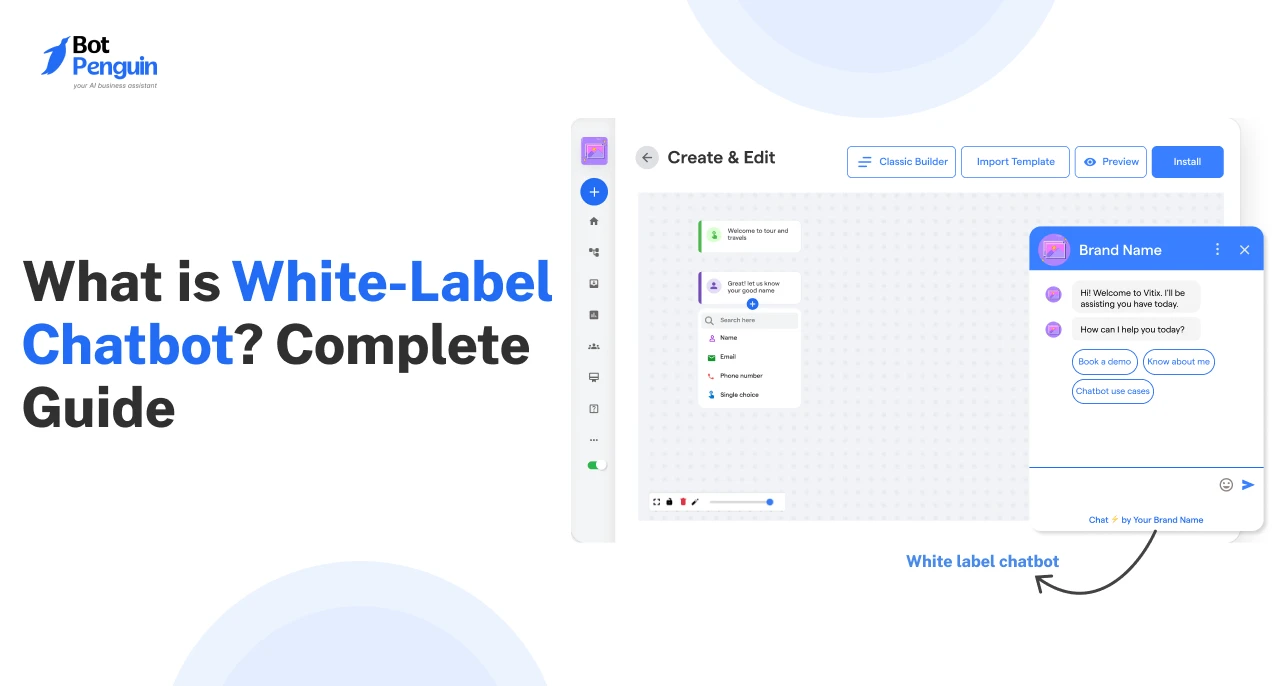
Agencies focused specifically on chatbot resale can also explore BotPenguin's white label chatbot platform for branded, multi-channel chatbot deployments.
Agency Limitation Not suited for enterprise contact centers requiring multi-agent orchestration across 100+ simultaneous seats or deep ITSM integrations with platforms like ServiceNow or Jira.
Explore BotPenguin's white-label partner program
Stammer AI is purpose-built for the reseller model with full white-labeling across dashboard, domain, and API.
Overview Stammer AI started as a chatbot platform and added voice capability. It is one of the few platforms explicitly designed for agencies who want to build, brand, and sell conversational AI without developing core technology from scratch.
Agency Limitation: Voice is not native infrastructure — it is an add-on and lags behind voice-specialist platforms on quality and latency. No HIPAA compliance, ruling it out for healthcare clients. Message-based pricing becomes unpredictable at high volume.
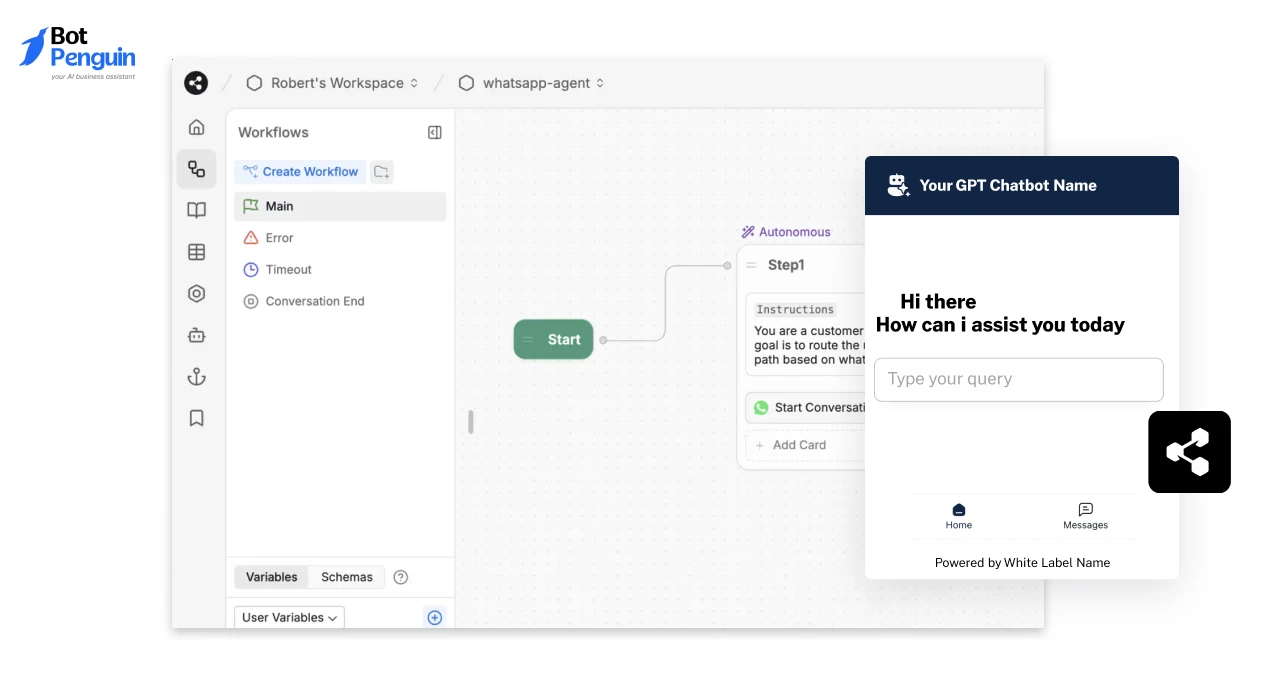
Botpress is open-source and free to self-host. It is the strongest developer-first platform in this comparison.
Overview Botpress gives developer-led agencies complete control over the codebase, infrastructure, and customization depth. It stays current with the latest LLMs and is ready to use for most conversational AI use cases without heavy configuration.
Agency Limitation No commercial white-label partner program. No built-in partner billing. No native voice AI. WhatsApp requires separate API configuration and developer work. Running self-hosted infrastructure across 10+ clients creates significant operational overhead. White-labeling requires developer effort and is not available out of the box.
Synthflow is a voice-native platform purpose-built for agencies deploying AI phone agents at scale.
Overview Synthflow owns its voice infrastructure end to end. No third-party voice provider dependency, no cascading failures from upstream outages. For agencies where voice quality and compliance are the primary requirements, Synthflow is a specialist option in this comparison.
Agency Limitation No chatbot. No AI agents. No WhatsApp or messaging channel support. Voice only means agencies cannot offer a full conversational AI stack under one brand. Starting price of $1,400/mo is the highest in this comparison. Not suitable for agencies whose clients need omnichannel messaging coverage alongside voice.
NoForm AI is a white-label AI sales chatbot platform built for agencies that want to offer AI-powered lead qualification under their own brand. It engages website visitors, answers sales questions, and automatically captures and qualifies leads from existing website traffic.
Overview: NoForm AI enables agencies to launch branded AI chatbots without building or maintaining AI infrastructure. The platform includes AI auto-training from a client's website, customizable chat behavior, CRM integrations, automated lead qualification, and centralized management for multiple client deployments.
Agency Limitation: NoForm AI is optimized for website-based lead qualification rather than omnichannel messaging or AI voice agents. Agencies looking for WhatsApp-first automation, outbound voice calling, or enterprise contact center capabilities may require additional tools.
The right platform is not the one with the most features. It is the one that fits your agency's service model, client base, and growth stage.
For most agencies — especially those adding AI services to existing client retainers — BotPenguin covers every criterion on this list under one plan. For everyone else, the table above points to the right fit.
Want to explore beyond these five? Visit our white-label partner hub for the full category breakdown.
Use the recommendation table to match your agency profile to the right platform. Not the one with the most impressive marketing.
For most agencies — digital marketing agencies, freelancers building AI service businesses, and partners scaling omnichannel AI services — BotPenguin scores highest across the criteria that matter most: full rebranding, omnichannel coverage, and partner billing at a flat annual cost with 100% revenue retention. 250+ agency partners; product used in 193 countries.
BotPenguin is the best white-label AI agent platform for agencies that need omnichannel deployment across chat, AI agents, and voice, with built-in partner subscription management and local payment gateway support. For developer-led agencies, Botpress offers more customization. For voice-first deployments, Synthflow is a specialist option.
A chatbot responds to messages based on rules or predefined scripts. An AI agent acts autonomously. It executes multi-step workflows, integrates with business systems, makes decisions, and completes tasks without human input at each step. White-label versions of both can be deployed under an agency's own brand, but AI agents handle significantly more complex workflows.
Only BotPenguin includes built-in partner subscription management. That covers creating your own pricing plans, gating features per client tier, offering free trials, and billing clients in local currencies through local payment gateways. Every other platform in this comparison requires manual billing through Stripe or separate tools, which adds operational overhead as client count grows.
Voiceflow's white-label options are limited. No custom domain, no partner branding at full depth. Botpress is open-source and technically white-labelable with developer work, but has no commercial white-label partner program with built-in branding controls and billing management. Both are strong for building AI products. Neither is built for reselling to multiple clients as a managed service.
Ready to launch with BotPenguin?
The partner program includes everything in this comparison.
Get Started NowCheckout our related blogs you will love.
Updated at Sep 17, 2026
14 min to read
Updated at Sep 9, 2026
17 min to read
Updated at Sep 4, 2026
10 min to read
Updated at Aug 7, 2026
14 min to read
Updated at Oct 19, 2026
10 min to read
Updated at Oct 19, 2026
11 min to read
Table of Contents
