


White-Label AI Agents for IT Consultancies and MSPs: The Fastest Path to Offering AI for MSP (2026)
Updated at Sep 12, 2026
8 min to read
Updated On Aug 3, 2026
10 min to read
If you run a digital marketing agency in 2026, adding AI agent services can help you expand your offering without building the technology internally.
Your clients already see AI receptionists, lead qualification bots, WhatsApp automation, and customer support agents in action. They now expect your agency to help them adopt these tools.
You already understand their challenges in lead generation, booking, support, and marketing. The practical question is how to add AI agents without rebuilding your service model.
This guide explains how agencies can package, price, and deliver white-label AI agent services to existing clients.
You can also explore more white-label partner resources for agencies in our white-label partner hub.
Agencies are adding AI agents because client demand, platform reliability, and recurring-service potential are beginning to align. These shifts make AI automation easier to package as a practical agency service rather than an experimental add-on.
Agencies unfamiliar with the broader model can first review our guide to what white-label AI agents are.
Clients already see AI agents handling instant replies, lead qualification, booking support, WhatsApp conversations, and common support requests.
They may not use terms such as “agentic AI.” They usually ask for faster responses, fewer missed leads, lower support workloads, and better conversion from the traffic your agency already generates.
This creates a natural opportunity for agencies to package AI automation alongside existing marketing, website, CRM, or support services.
Earlier AI agent tools often required extensive technical configuration, ongoing troubleshooting, and manual workflow repair.
Current platforms are more practical for client deployment because agencies can configure lead qualification, CRM updates, follow-ups, bookings, and human handovers within a single system.
Agencies can now deploy AI agents that qualify leads, update CRMs, trigger follow-ups, book appointments, and escalate complex requests to human teams.
AI agent services suit the agency model because one platform can support multiple client deployments.
Agencies can charge an initial setup fee, a recurring management fee, and additional usage-based costs where applicable. Reusable templates can also reduce the delivery time for later clients.
For example, managing 10 clients at $350 per month would produce $42,000 in annual client revenue. Actual margin depends on platform fees, usage costs, implementation time, and support requirements. (Note: This is an illustrative revenue example, not a guaranteed earning outcome. Actual revenue and margins vary by pricing, client count, platform costs, usage, and service scope.)
A BotPenguin partner case study reports that a Colombian digital marketing agency served 35 clients and generated $43,580 in white-label revenue.
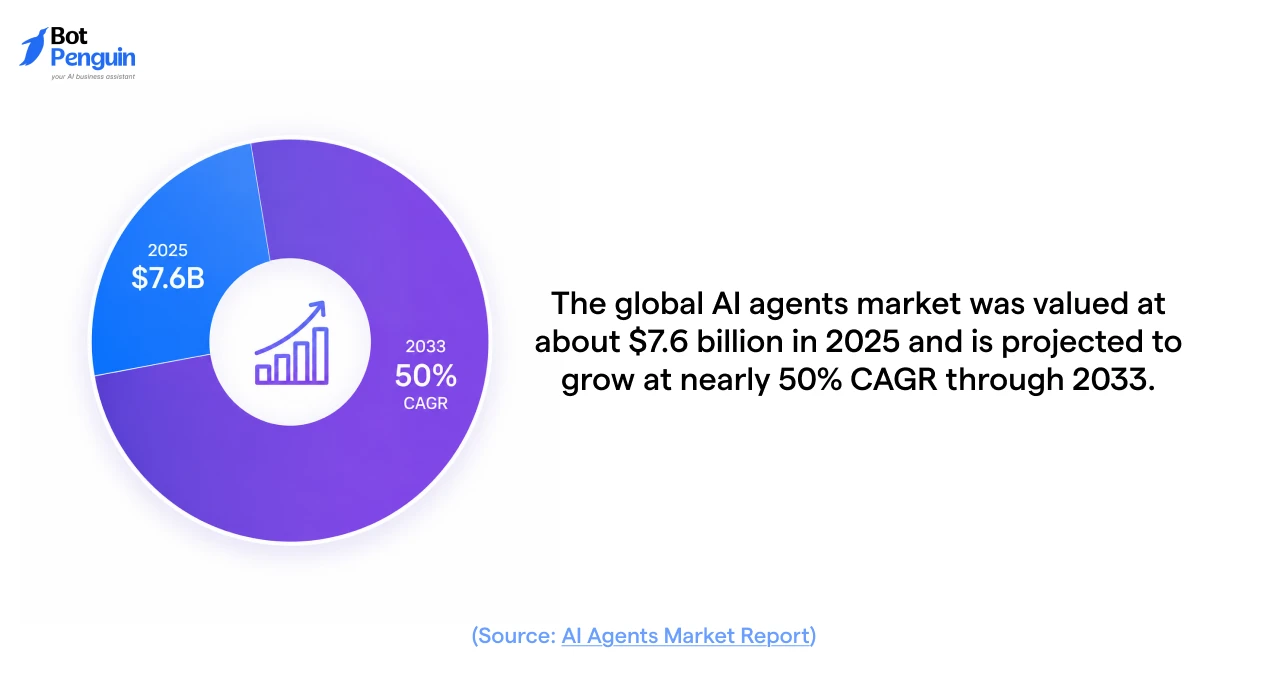
The global AI agents market was valued at about $10.9 billion in 2026 and is projected to grow at nearly 49.6% CAGR through 2033. (Source: Grand View Research AI Agents Market Size Report)
Agencies that start early can build case studies, refine pricing, and position themselves before AI agent services become standard in agency proposals.
For those starting from scratch, our complete guide on how to start an AI agent business covers the full setup process before adding the white-label layer.
Now that the reasons for adoption are clear, the next step is understanding how AI agents fit into the agency model you already run.
Agencies can join a white-label partner program, apply their branding, and deploy AI agents for clients under their own business identity.
The platform provider supplies the underlying technology, while the agency controls packaging, pricing, onboarding, client communication, and ongoing optimization.
AI agent services should sit alongside your existing retainers rather than replace them.
AI agents should strengthen the services your agency already sells.
If you manage paid media, a lead qualification agent can respond to campaign inquiries and route qualified prospects to sales.
If you manage social media, an AI agent can handle selected Instagram or Facebook Messenger conversations.
If you provide SEO, a website agent can engage organic visitors outside business hours.
Your existing service creates demand. The AI agent helps the client capture, qualify, or support that demand more effectively.
This makes the agency’s overall service package more measurable and harder to replace.
Next, let’s address the real question: which clients on your current roster should get them first?
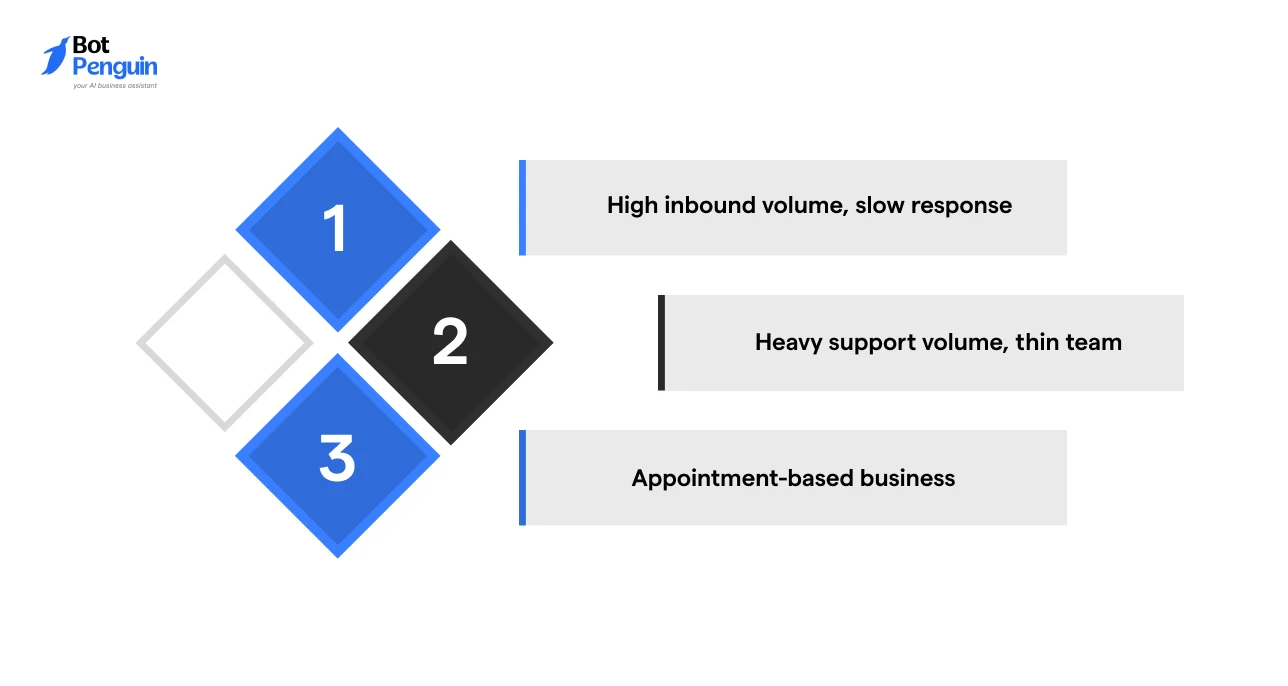
As an agency, start with clients for whom AI agents can deliver a visible ROI quickly.
The three profiles below help you scan your current client list and identify the easiest first deployments.
Channel selection should reflect how each client already communicates with customers. In WhatsApp-first markets, agencies may need a dedicated WhatsApp package rather than adding WhatsApp language throughout every service.
For a channel-specific comparison, review white-label AI agents for WhatsApp.
Once you know which clients to start with, the next step is to turn those deployments into service packages with clear pricing. Let's see how.
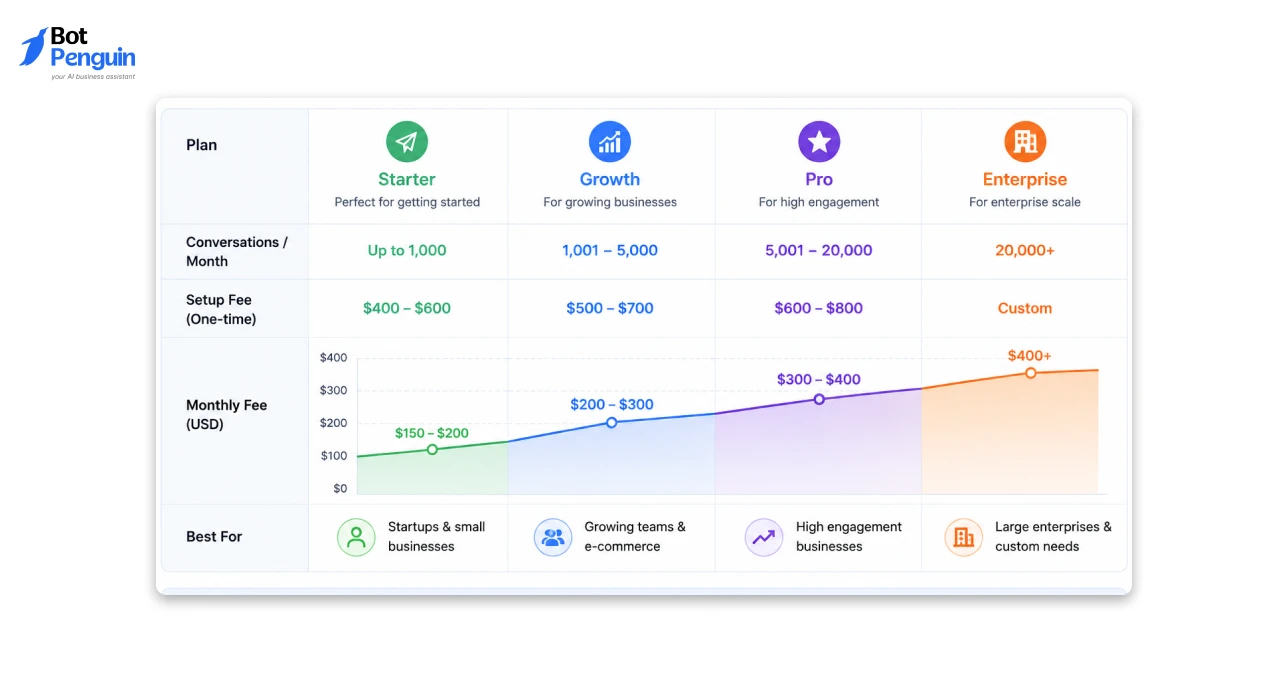
AI agent services should be priced as clear add-ons or managed retainers, not vague “automation support.” The three packages below give agencies a practical starting point for packaging, pricing, and positioning the service.
(Pricing note: The figures below are illustrative agency pricing ranges. Actual fees should reflect client volume, workflow complexity, integrations, support requirements, channel costs, and local market conditions.)
Offer this as an add-on to paid media, SEO, website, or CRM retainers.
Illustrative pricing: $400–$1,000 setup fee plus $200–$600 per month.
Pricing should reflect the number of channels, workflow complexity, CRM requirements, lead volume, and reporting scope.
The service helps clients capture and qualify more of the demand your campaigns already generate.
For deeper use-case guidance, review AI agents for lead generation.
Position this as a managed add-on to websites, social media, CRM, or customer service retainers.
Illustrative pricing: $400–$1,000 setup fee plus $200–$600 per month.
Pricing should account for support volume, knowledge-base size, escalation rules, reporting, and ongoing optimization.
The service can reduce repetitive support work while giving the client a record of handled conversations.
For the dedicated support use case, review AI customer service agents for agencies.
Offer this only when WhatsApp is already the client's primary customer channel.
The package may include approved broadcasts, drip sequences, lead qualification, and automated replies.
Pricing should reflect messaging volume, Meta charges, automation depth, template requirements, and campaign management.
Review the dedicated white-label AI agents for WhatsApp guide for channel-specific implementation.
Offer this as a premium service for appointment-based businesses, local service providers, clinics, property teams, and high-inquiry sales operations.
Pricing should reflect call volume, voice usage, workflow complexity, integrations, and human handover requirements.
For voice-heavy clients, white-label AI voice agents add premium call automation.
Once the service offering is clear, choose a pricing model that aligns with the client’s volume, risk, and budget predictability. The table below compares the most common service packaging models agencies use to structure pricing and client engagements.
Once the packages and pricing are clear, the next step is understanding what BotPenguin provides behind the scenes to help agencies deliver them under their own brand.
BotPenguin supports more than 250 partners globally, including digital marketing agencies.
Here is what the partner program includes for agencies delivering branded AI agent services.
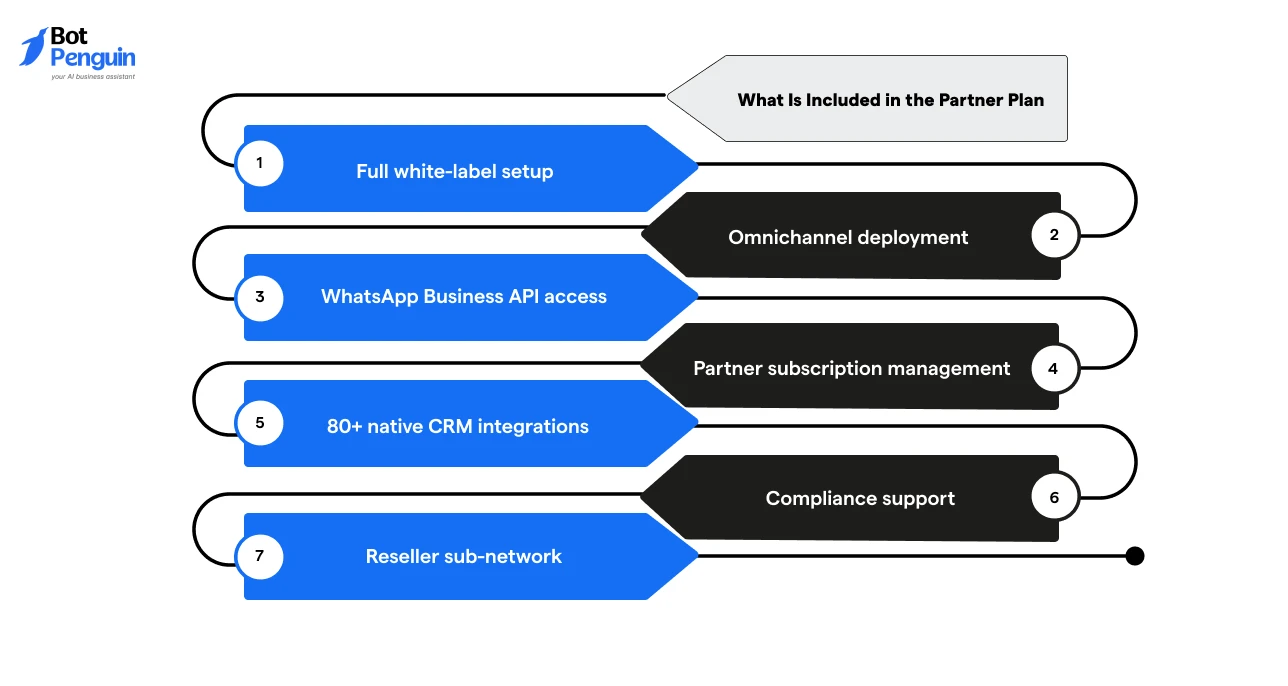
BotPenguin’s Baby plan starts from $1,500/year. Platform setup and the branded dashboard can go live within 12 hours. However, agencies that need AI agents, advanced white-label capabilities, and voice coverage should review the advanced King plan.
If the agency is still comparing options, this is where a best white-label AI agent platforms compared guide helps evaluate platform fit before committing.
For agencies in the UAE, Saudi Arabia, India, Brazil, Mexico, and much of Southeast Asia, WhatsApp is not just another channel. It is often the main customer communication layer.
That changes how agencies should package AI agent services.
Clients in these regions need AI agents that can respond to, qualify, follow up with, and support customers directly on WhatsApp.
BotPenguin is an official Meta Business Partner, enabling agencies to onboard clients to the WhatsApp Business API with compliant access without requiring each client to apply to Meta separately.
The partner subscription system also supports local payment gateways and currencies, including AED, SAR, INR, and BRL. This reduces billing friction for agencies serving local and regional clients.
Now, let's get down to the practical, real questions agencies ask before joining.
Most agency owners ask the same questions before adding a new service line.
The answers below come directly from common partner conversations and focus on the operational realities agencies care about.
The $1,500/year price refers to BotPenguin’s Baby plan. Agencies that want AI agents, advanced white-label capabilities, and voice coverage should review the King plan.
Additional costs may depend on the channels used. WhatsApp conversations are billed by Meta, and agencies usually pass those costs to clients.
For high-volume WhatsApp clients, agencies can either include estimated conversation costs in the monthly package or add them as usage-based charges.
Website chat, Instagram, and Facebook do not carry the same Meta conversation charges.
Clients rarely need to interact with the platform itself.
They interact with the AI agent through channels they already use, such as WhatsApp, website chat, Instagram, or Facebook Messenger.
Your agency manages the backend. The client sees only the branded conversation experience.
This risk is managed through escalation rules and ongoing optimization.
You can configure the AI agent to hand conversations to a human based on topics, sentiment, customer type, or direct requests.
During the first few weeks, agencies should review conversation logs regularly and retrain the AI agent on missed or inaccurate responses. Most deployments stabilize quickly once real customer interactions are incorporated into the workflow.
Define the cancellation and offboarding process before deployment.
The agreement should cover notice periods, final billing, data export, channel disconnection, integration removal, workflow ownership, and access termination.
Clear offboarding terms protect both the agency and the client.
With the common objections addressed, the final question is whether adding a white-label AI agent offering makes sense for your current client base and growth goals.
If so, choose a platform that simplifies launch and client management.
Agencies choose a suitable white-label partner plan, apply their branding, configure the client’s workflow, connect relevant channels and systems, test the deployment, and manage ongoing optimization. Setup time varies by use case, integrations, and channel complexity.
No — AI agents augment, not replace, existing agency services. An agency running SEO and paid ads for a client adds AI lead qualification — the agent captures and qualifies more inbound leads, making the paid ads ROI more visible to the client. AI agents make existing services stickier, not redundant.
Agencies typically charge a $400–$1,000 setup fee and a $200–$600 monthly retainer per client. The final price depends on channels, conversation volume, integrations, and whether the package includes voice, WhatsApp, support, or lead qualification.
2–4 hours for first deployment: workspace creation, AI training on the client's FAQs and products, CRM integration, and channel setup on WhatsApp or website chat. Subsequent clients reuse a template workspace and typically go live in under 1 hour.
No. BotPenguin's white-label program covers your domain, logo, mobile apps, and support documentation. Clients interact only with your agency's branding across every touchpoint. BotPenguin's name is never visible.
Yes. BotPenguin is an official Meta Business Partner. Every client your agency onboardes gets compliant WhatsApp Business API access through your white-labeled platform, without having to apply to Meta separately. This is a significant advantage in markets like the UAE, Saudi Arabia, India, and Brazil, where WhatsApp is the primary business channel.
Agencies do not need to rebuild their business to add AI agent services.
They can package AI automation alongside existing lead generation, website, CRM, social media, booking, and support retainers.
The strongest approach is to start with a client that has a clear operational problem, define a measurable workflow, and price the service around setup, management, usage, and reporting.
A suitable white-label partner platform supplies the technology. Your agency remains responsible for client strategy, implementation, communication, and ongoing value.
Explore the white label AI agent platform to review BotPenguin’s partner capabilities.
Add AI Agent Revenue
Offer AI agent services under your brand and turn existing client relationships into recurring revenue with the BotPenguin white-label program.
Join White Label ProgramCheckout our related blogs you will love.
Updated at Sep 12, 2026
8 min to read
Updated at Aug 19, 2026
14 min to read
Updated at Oct 9, 2026
10 min to read
Updated at Oct 8, 2026
11 min to read
Updated at Sep 30, 2026
17 min to read
Updated at Sep 29, 2026
9 min to read
Table of Contents
