
How to Start an AI Agency: Business Models, Costs, and Steps
Updated at Oct 12, 2026
13 min to read
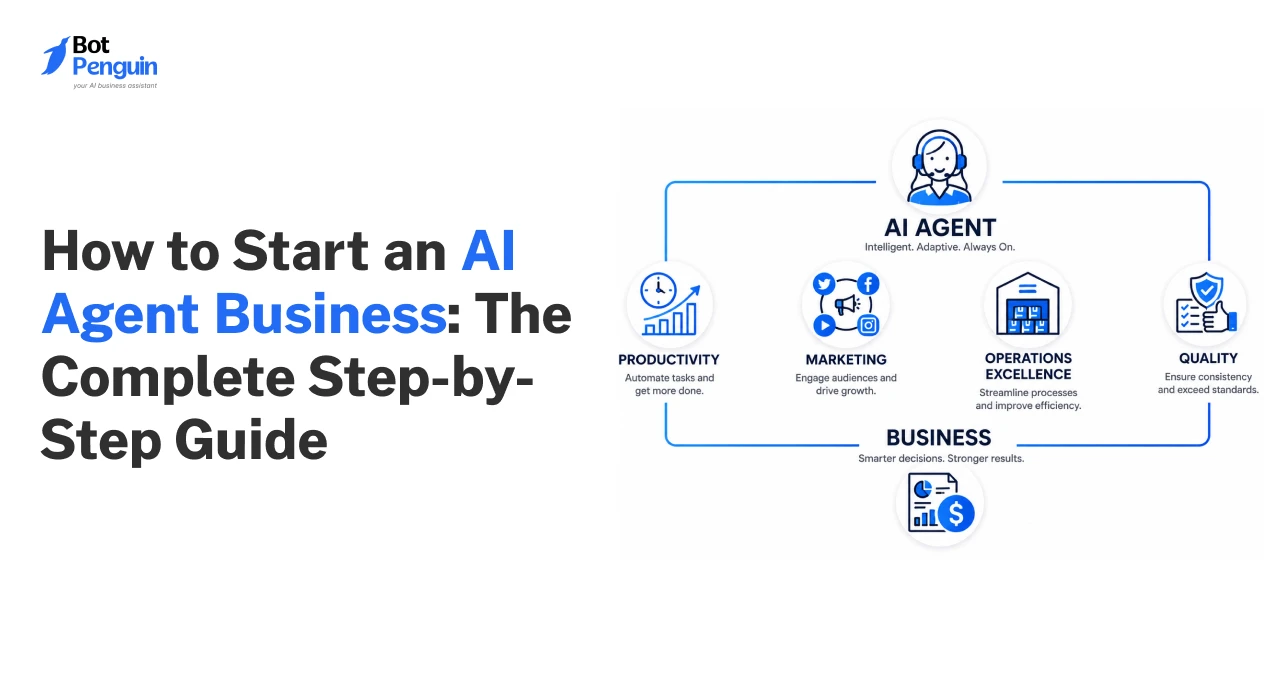
Contributor Note: This article shares insights from a BotPenguin partner’s experience, with editorial input from the BotPenguin team.
What’s a sure-shot way to earn money from AI? Build an AI or sell it. Right?
The chicken-and-egg problem is that building AI takes serious time, money, and technical expertise. And selling it means finding a problem businesses will pay to solve.
Agentic evolution is gaining momentum. In fact, Gartner predicts that 33% of enterprise software applications will include agentic AI by 2028. So, the opportunity is clearly growing.
That’s also when I realized there was a smarter way in. Think of a model where you use existing platforms to solve business problems and sell those solutions as services.
In this guide, I’ll share how to start an AI agent business following this approach, from choosing your niche to finding clients and planning for growth.
The appeal is practical. Businesses simply want lower costs, faster operations, and fewer manual bottlenecks… And AI agents can help deliver all three.
Recently, Deloitte reported that 74% of leaders expect AI agents to reshape nearly half of their business processes within four years. That’s a telling number for where business adoption is headed, and here’s what’s driving that shift:
Put together, these pressures are making AI agents less of an experiment and more of a practical business priority.
Up next, I’ll share how you can start an AI agent business and walk you through the route I chose.
Once you have the “why,” the “how” usually comes down to five steps. Here’s what you need to get right before you start selling, delivering, and scaling your AI agent services:
The first thing I learned was not to start with the AI agent itself. Start with the roadblock a business is already paying good money to fix.
Look for repetitive tasks, missed leads, slow responses, or manual work that creates visible friction: the kind teams complain about in every meeting.
Before choosing a problem, I'd check three things:
Clients rarely want an AI agent for its own sake. They want more leads, lower costs, faster support, or fewer hours lost to manual work. Once the problem is clear, the next step is shaping it into an offer.
Once I knew the problem, I had to turn it into something businesses could actually buy.
Instead of offering "AI agents" broadly, I'd define the offer around one clear outcome. For example:
The clearer the outcome, the easier it is to explain the value. I'd also keep the first offer narrow.
You can always expand later, but starting with one use case makes the service easier to build, price, and sell.
When your offer is clear, decide how you’re going to build and deliver it. Broadly, you have three routes:
I chose the third route with BotPenguin. For me, it made more sense to focus on solving client problems, selling the service, and managing delivery instead of building the underlying technology myself.
I also took time to understand how the platform worked before selling anything. I built test agents, explored how customization worked, and learned what the client setup and delivery process would actually involve.
Whichever route you choose, look at what you actually need to deliver: channels, integrations, AI models, knowledge sources, analytics, and ongoing support.
And if you have trouble deciding, remember: the best setup is not necessarily the most advanced one; it’s the one that lets you deliver your offer reliably.
Before trying to scale, I'd make sure the offer works with a real client.
You can start with a focused demo or pilot and define what success should look like. That could mean more booked calls, faster response times, fewer missed leads, or less manual work.
Some tips to begin:
The goal here is simple: prove that the agent creates value, not just that it works. That first result also gives you something far more useful than a polished pitch: proof you can show the next client.
Once you have a result that works, don’t rebuild everything from scratch for every new client.
Document the setup, onboarding, delivery process, and what produced the outcome. Then reuse what makes sense across similar clients.
That could mean:
This is where the business starts becoming easier to manage and scale.
And when the process starts repeating, the next question is simple: what does it actually cost to run this business? Let’s clear that up in the next section.
Straightforward answer? Your budget depends largely on the route you choose, whether you build from scratch, use no-code tools, or go with a white-label platform.
Each comes with a different mix of upfront investment and ongoing costs:
*Methodology: These 2026 ranges are rounded from public AI platform pricing and development-cost guides reviewed in September 2026. Actual costs vary by usage, integrations, customization, hosting, support, and add-ons.
You're paying for development time, and timelines vary widely by complexity. A focused agent may take weeks, while complex enterprise builds can take several months.
Every fix or feature request can also add to your ongoing maintenance costs.
Costs scale with usage, so a busy month can spike your bill fast. You're also dependent on the platform's roadmap for features you can't build yourself.
With white label AI agents, you skip most of the underlying development and can potentially start onboarding clients much faster. Your margins depend on the partner's pricing tiers, so it pays to model this before setting client rates.
Understanding these costs also makes it easier to decide how you want to price your offering.
When I started looking at pricing, one thing became clear: charging only for the time spent building the agent leaves a lot of value on the table.
McKinsey found that 40% of AI-native companies use activity consumption pricing, compared with 35% using flat-fee models.
So, I’d price based on what you’re delivering and the value it creates. Common pricing models include:
For most new businesses, it’s best to keep it simple: a setup fee plus a recurring monthly charge. It gives the client a predictable cost while giving you recurring revenue.
Whatever model you choose, leave enough margin for platform costs, usage, support, and the time you’ll spend maintaining the service.
After your pricing models are clear, you can start mapping what the business could look like as your client base grows.
There’s no fixed income ceiling here. What you make depends on your pricing, number of clients, recurring revenue, and how consistently you can deliver results.
I find it more useful to think in milestones than big revenue promises:
Note: These are illustrative revenue ranges, not guarantees. Actual results depend on your pricing, niche, service offering, client retention, and acquisition efforts.
The first client proves someone will pay. The next few prove whether you can repeat the process.
From there, recurring clients are what start turning the service into a more predictable business.
When I first thought about starting an AI agent business, I did what most people would do: searched the World Wide Web to see what options were out there.
That’s when I came across BotPenguin’s white-label AI agent platform. A few things immediately caught my attention. The platform offers:
In other words, I could run the customer-facing business under my own brand, and that flexibility made it feel less like reselling someone else's product and more like building my own.
What made that more convincing was seeing that the revenue potential had already been proven by other partners.
For example, one of BotPenguin’s AI Automation partners generated $60,650 in revenue and achieved a 14x return on its BotPenguin investment!
That alone showed me the model could work commercially, not just technically.
Curious how it works? Learn how to start AI automation agency under a white label program today.
Signing up was the easy part. Before I could confidently sell anything, I needed to understand what I was actually offering.
I spent time building test agents, exploring customization, learning how client onboarding worked, and understanding where the platform ended and my responsibility as a partner began.
What helped was the support BotPenguin provides during that learning phase, including:
This was probably the most important lesson: a white-label platform gives you the infrastructure, not the business itself.
Beyond the tech, I still had to:
That distinction matters. BotPenguin made the technology and delivery side easier for me, but building the business around it was still my job.
Overall, this experience gave me a much clearer view of what it actually takes to build an AI agent business, so I could share the practical side of the journey, not just the platform side.
Starting an AI agent business is less about having the most advanced tech and more about solving the right problem.
There is a clear trajectory you follow when launching an AI agent business. Pick one clear use case, choose a delivery model that fits, test it with a real client, and build from there.
For me, the white-label route made sense because it let me focus on clients instead of infrastructure. But the real work still came down to the offer, pricing, delivery, and results.
That’s the part worth getting right if you want to build something that lasts.
An AI agent business sells AI-powered solutions for tasks like lead capture, support, booking, follow-ups, or workflows, usually through setup fees and recurring service plans.
Start by choosing one business problem, defining a clear offer, selecting how you’ll build the agent, testing it with a client, and repeating what works.
Yes. A white label AI agent business lets you sell AI solutions under your own brand without building the core technology yourself, while you handle clients and delivery.
Costs vary by route. Custom builds can require thousands upfront, while no-code and white-label options usually shift more spending into subscriptions, usage, and delivery.
It can be. Profitability depends on solving valuable problems, pricing with enough margin, controlling platform and usage costs, and retaining clients through recurring services.
Start with one niche and one clear use case. Build a focused demo, offer a pilot, collect proof, then use that result in outreach, referrals, and case studies.
Subscribe to Our Newsletter
Get the latest business insights straight into your inbox.
Checkout our related blogs you will love.
Updated at Oct 12, 2026
13 min to read
Updated at Oct 12, 2026
15 min to read
Updated at Jul 10, 2026
18 min to read
Updated at Jun 5, 2026
25 min to read
Updated at Oct 14, 2026
6 min to read
Table of Contents