


White Label AI Agents: The Complete Guide (2026)
Updated at Aug 19, 2026
14 min to read
Updated On Sep 12, 2026
8 min to read
More clients are asking IT consultancies and MSPs about AI automation.
The opportunity is no longer deciding whether AI is relevant; it's determining how to deliver AI agent solutions profitably and at scale.
The challenge then becomes finding AI solutions that solve real client problems, fit your delivery model, and create recurring revenue opportunities. This is where white-label AI agent platforms can help.
This guide explores how MSPs and IT consultancies can add white-label AI agents to their offerings. You’ll learn the business model, client use cases driving demand, implementation considerations, and how AI agents can create both project-based and recurring revenue streams.
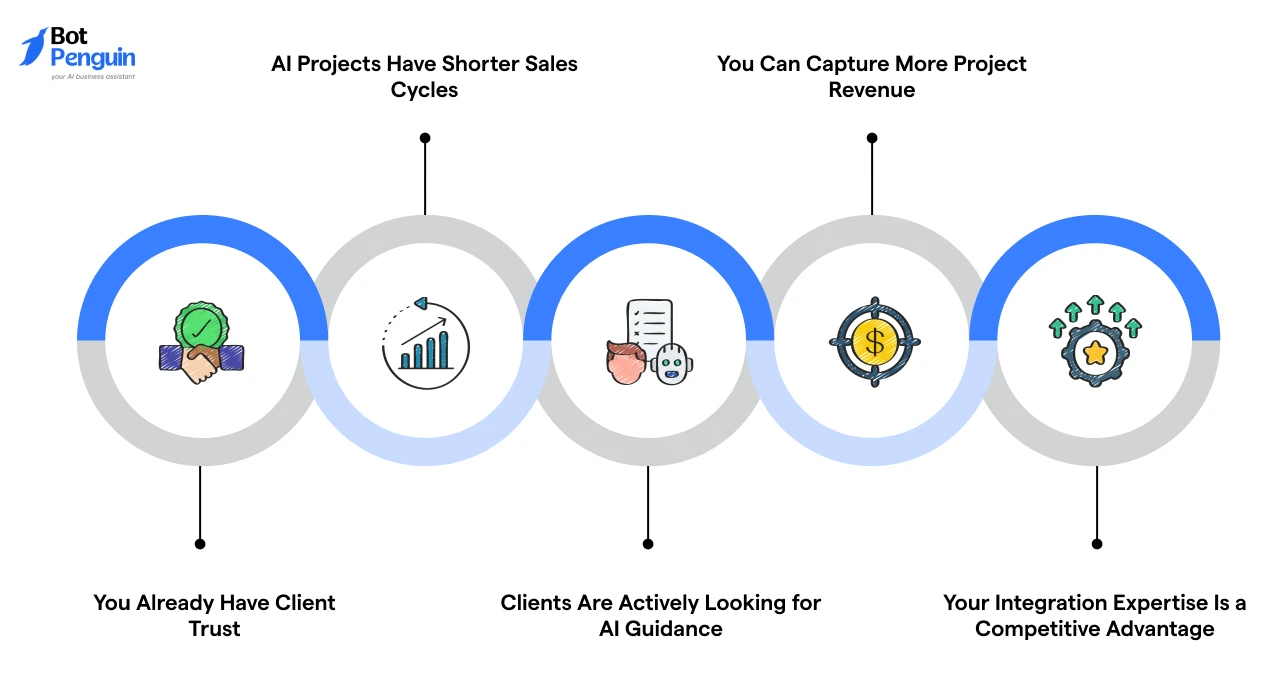
As IT consultancies and MSPs, you have a unique advantage in the AI market. Since you already advise clients on technology decisions, AI agent implementation becomes a natural extension of the existing services.
92% of MSPs already see AI as the defining factor in who wins and who loses clients by 2026, which makes now the right time to build that practice.
The opportunity is compelling because:
Most IT consultancies are sitting on an untapped AI revenue opportunity. The clients, trust, and demand already exist; what's missing is the infrastructure to deliver it, and that's exactly what white-label AI agents provide.
White-label AI agents allow IT consultancies and MSPs to offer AI implementation services under their own brand without building or maintaining the underlying technology.
The delivery model is similar to a CRM implementation or cloud migration project. The consultancy remains responsible for client-facing activities, while the white-label provider supplies the AI infrastructure.
This structure allows consultancies to focus on delivering business outcomes while the AI infrastructure is taken care of by a white-label partner platform.
The commercial model varies slightly between provider types:
If you’re looking for a way to add AI agent delivery to your service stack without the R&D overhead, BotPenguin's white-label AI agent platform gives you the infrastructure, the branding, and the partner support to get started fast.
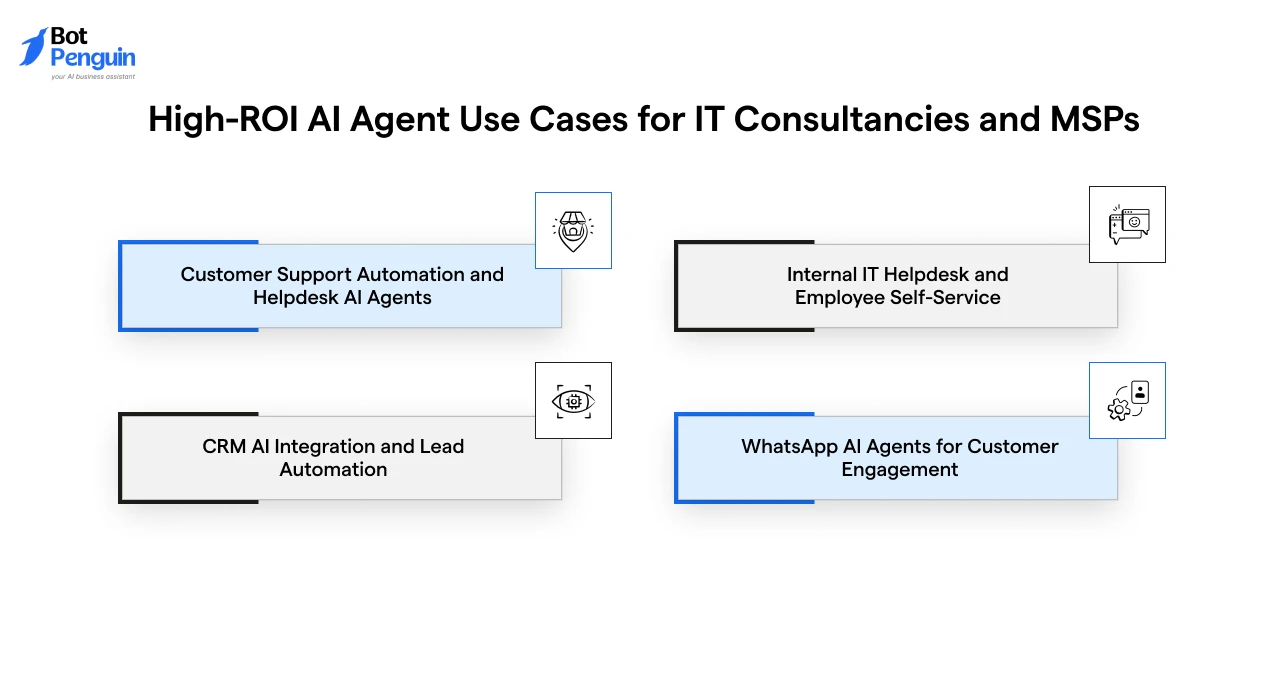
The most successful AI implementation services for IT consultancies are built around AI agent use cases connected to systems they already manage, such as CRMs, helpdesks, and communication platforms.
Partnering with white-label AI agent providers makes it possible to deliver these use cases under your own brand:
AI agents can handle repetitive customer queries using information from FAQs, knowledge bases, and support documentation while integrating with platforms such as Zoho Desk, Freshdesk, and ServiceNow.
The impact shows up early. Even entry-level AI implementations have delivered 37% faster first responses and resolution times that are 50% shorter.
For consultancies already managing helpdesk or CRM environments, this creates a natural upsell opportunity with measurable improvements in response times, ticket resolution, and ongoing support retainers.
For MSPs, internal IT support is one of the most practical managed service provider AI agents use cases.
AI agents can answer policy questions, process access requests, handle password resets, and support employees through Microsoft Teams, Slack, or internal portals.
MSPs can improve operational efficiency, increase team capacity, and create recurring revenue through managed AI services.
CRM AI integration consultancy services are a natural extension of existing Zoho, Salesforce, and HubSpot projects.
AI agents can qualify inbound leads, capture customer information, update CRM records, and trigger sales workflows automatically.
This allows consultancies to expand their AI automation IT consulting offerings while creating additional implementation projects and long-term AI management retainers.
For a deeper breakdown of this use case, see our guide on AI agents for lead generation.
For businesses that rely heavily on WhatsApp communication, AI agents can automate lead qualification, customer support, appointment scheduling, and follow-up conversations.
These deployments integrate with existing CRM and customer support systems, making them a strong fit for both IT consultancies and MSPs.
Because the business impact is highly visible, WhatsApp AI projects often lead to broader automation engagements and ongoing managed AI services.
For IT consultancies and MSPs evaluating white-label AI agents, platform selection often comes down to two questions:
Both are critical when delivering AI implementation services at scale.
Native integrations lower deployment time and support common AI automation IT consulting projects without requiring extensive custom development. Here’s what to consider:
Native API connections handle primary CRM and helpdesk integrations without requiring third-party middleware.
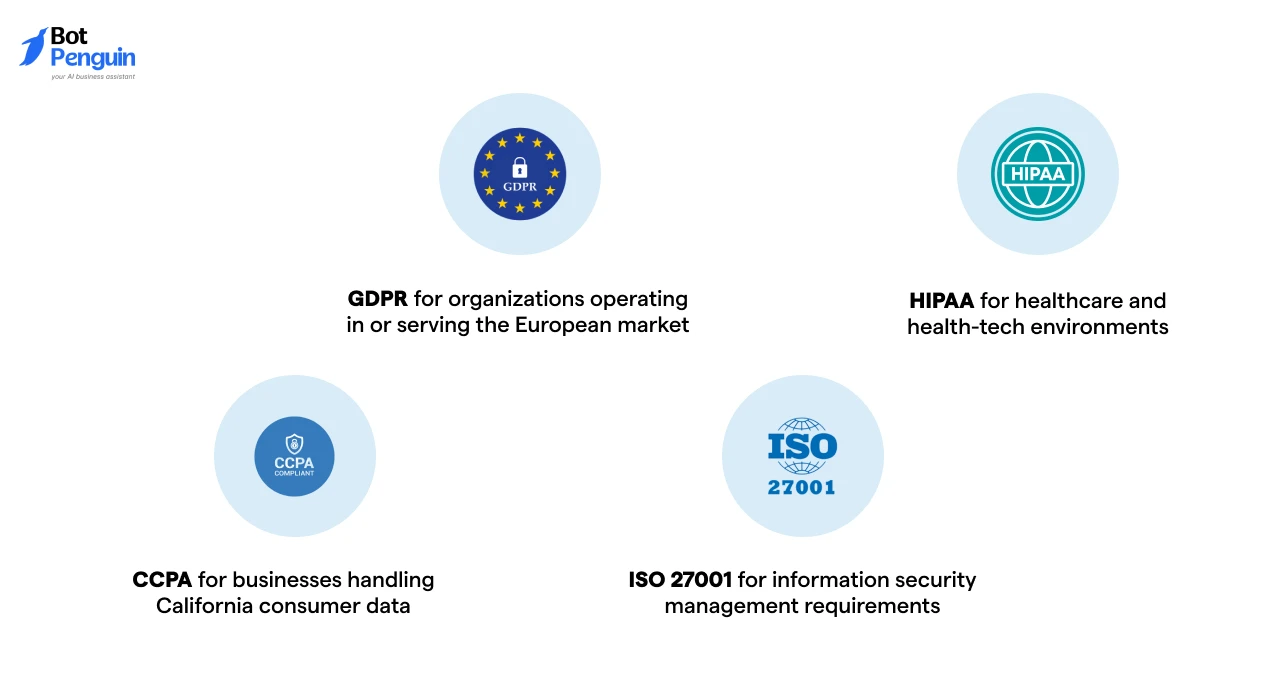
When recommending white-label AI agents to enterprise or regulated-industry clients, compliance certifications are often a prerequisite for approval.
Key compliance standards include:
Integration coverage and compliance readiness separate platforms built for enterprise delivery from those built for demos. For IT consultancies, both should be non-negotiable from day one.
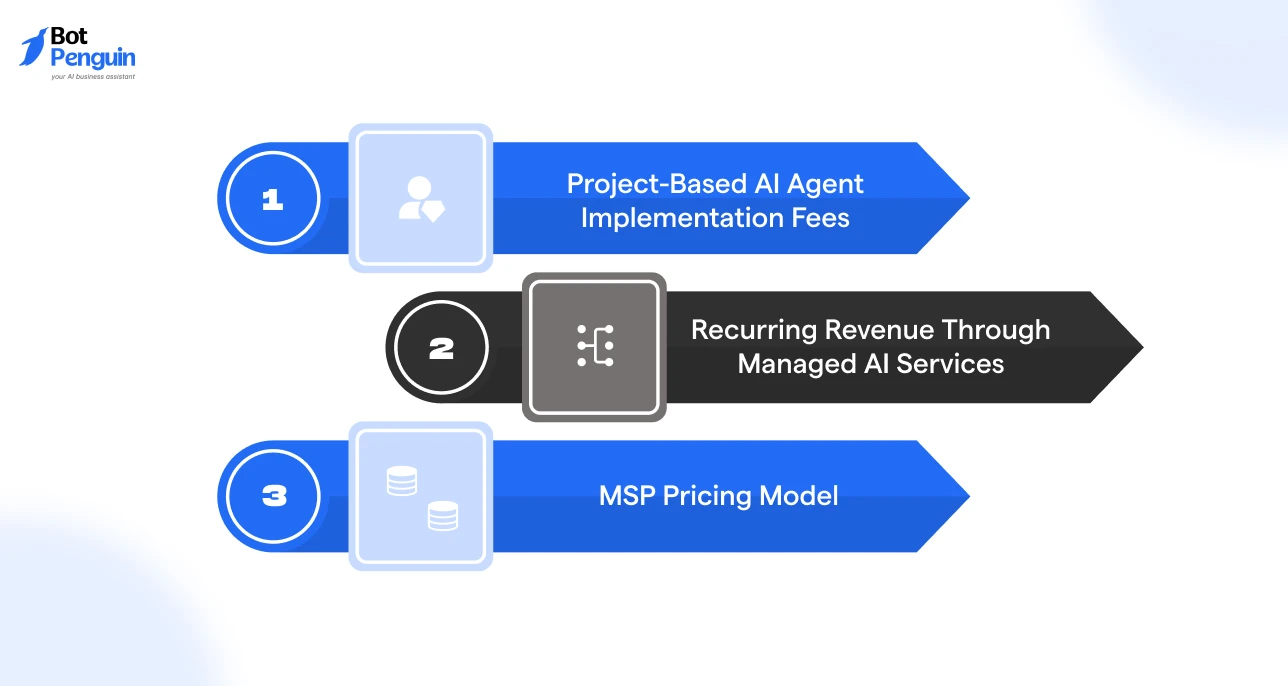
One reason white-label AI agents are attractive to IT consultancies and MSPs is that they fit naturally into existing project and managed service pricing models.
Most providers generate revenue from a combination of implementation fees and recurring support retainers.
For IT consultancies, AI agent deployments are typically sold as implementation projects. The fee usually covers discovery, AI agent configuration, CRM integration, workflow setup, testing, and client handover.
*The exact pricing depends on factors such as integration complexity, number of communication channels, workflow requirements, and customization needs.
After deployment, consultancies can offer ongoing AI management services that include:
This creates predictable recurring revenue alongside traditional implementation projects.
Managed service provider AI agents are often packaged as an add-on to existing support contracts rather than as standalone projects.
Typical pricing ranges from $150-400 per month per client, covering AI agent monitoring, optimization, and support alongside the client's broader IT environment.
Because white-label AI platforms operate on a fixed partner cost, each additional AI deployment increases recurring revenue without requiring additional infrastructure investment.
For consultancies already offering CRM administration, managed services, helpdesk support, or AI automation IT consulting, white-label AI agents can become a natural extension of existing service offerings.
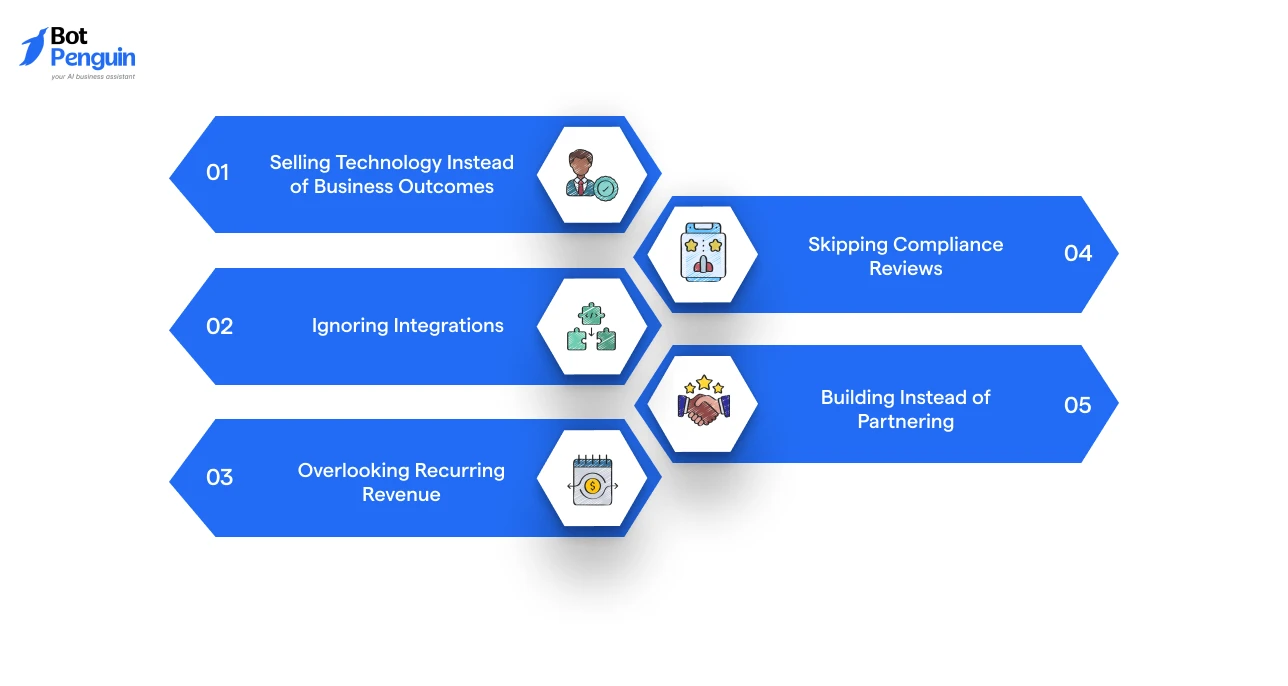
Adding AI agents to your service portfolio can create significant project and recurring revenue opportunities.
However, many IT consultancies and MSPs make avoidable mistakes that slow adoption and reduce client outcomes.
Clients care about solving problems, not deploying AI. This weakens the value proposition.
Position AI agents around outcomes such as customer support automation, lead qualification, employee self-service, or faster response times.
AI agents deliver the most value when connected to platforms such as Salesforce, HubSpot, Zoho CRM, Freshdesk, ServiceNow, and WhatsApp.
Poor integrations often limit adoption and ROI.
Many consultancies focus only on implementation fees. This limits long-term profitability.
Ongoing optimization, retraining, reporting, and support can create long-term managed service revenue.
For healthcare, financial services, and enterprise clients, certifications such as GDPR, HIPAA, CCPA, and ISO 27001 are often essential during vendor evaluation.
Without them, deals may stall.
Developing an AI platform from scratch can be costly and time-consuming.
White-label AI agents allow consultancies to focus on implementation, integrations, and client management while leveraging proven infrastructure.
Most of these mistakes trace back to the same root cause: the wrong platform choice. A white-label AI agent provider like BotPenguin handles the infrastructure, compliance, and integrations, so your team can stay focused on client delivery and revenue growth.
IT consultancies and MSPs are in a strong position to capitalize on the growing demand for AI. The client’s trust, technical expertise, and implementation experience are already there.
The real opportunity is turning AI agents into a structured service offering that creates both project-based revenue and recurring managed service income.
White-label AI agents make that easier. Rather than investing in platform development, you can focus on delivering client outcomes while leveraging proven infrastructure behind the scenes.
The demand is already here. The next step is turning it into a scalable service line.
IT consultancies can add white-label AI agents by partnering with an AI platform provider and offering implementation, integration, and ongoing management services under their own brand. This creates new project revenue and recurring managed service opportunities.
For IT consultancies and MSPs, AI agents should integrate with Zoho CRM, Salesforce, HubSpot, Microsoft Dynamics, Freshdesk, Zoho Desk, Zendesk, and ServiceNow to support lead management, customer support, and workflow automation.
Yes. Leading white-label AI agent platforms like BotPenguin support enterprise compliance requirements through certifications such as GDPR, HIPAA, CCPA, and ISO 27001. These certifications are especially important for IT consultancies serving clients in healthcare, financial services, legal, and other regulated industries.
Yes. MSPs can package white-label AI agents as an add-on to existing managed service contracts. Common use cases include customer support automation, employee self-service, helpdesk assistance, and lead qualification, creating additional recurring revenue.
Most white-label AI agent deployments can be completed within a few hours to a few days, depending on integration requirements, communication channels, workflow complexity, and the amount of training data involved.
Most IT consultancies combine one-time implementation fees with recurring support retainers. Revenue comes from AI agent deployment, CRM integrations, optimization, monitoring, and ongoing management, creating both project-based and recurring income streams.
Generate More Qualified Leads With AI Lead Generation Agents
Engage prospects instantly across WhatsApp, website chat, and social channels. Qualify leads automatically, sync them to your CRM, and help clients convert more of their existing traffic without increasing ad spend.
Get Started NowCheckout our related blogs you will love.
Updated at Aug 19, 2026
14 min to read
Updated at Aug 3, 2026
10 min to read
Updated at Oct 9, 2026
10 min to read
Updated at Oct 8, 2026
11 min to read
Updated at Sep 30, 2026
17 min to read
Updated at Sep 29, 2026
9 min to read
Table of Contents
