


How to Build and Sell Branded AI Voice Agents Under Your Own Name (2026 Guide)
Updated at Oct 9, 2026
10 min to read
Updated On Sep 30, 2026
17 min to read
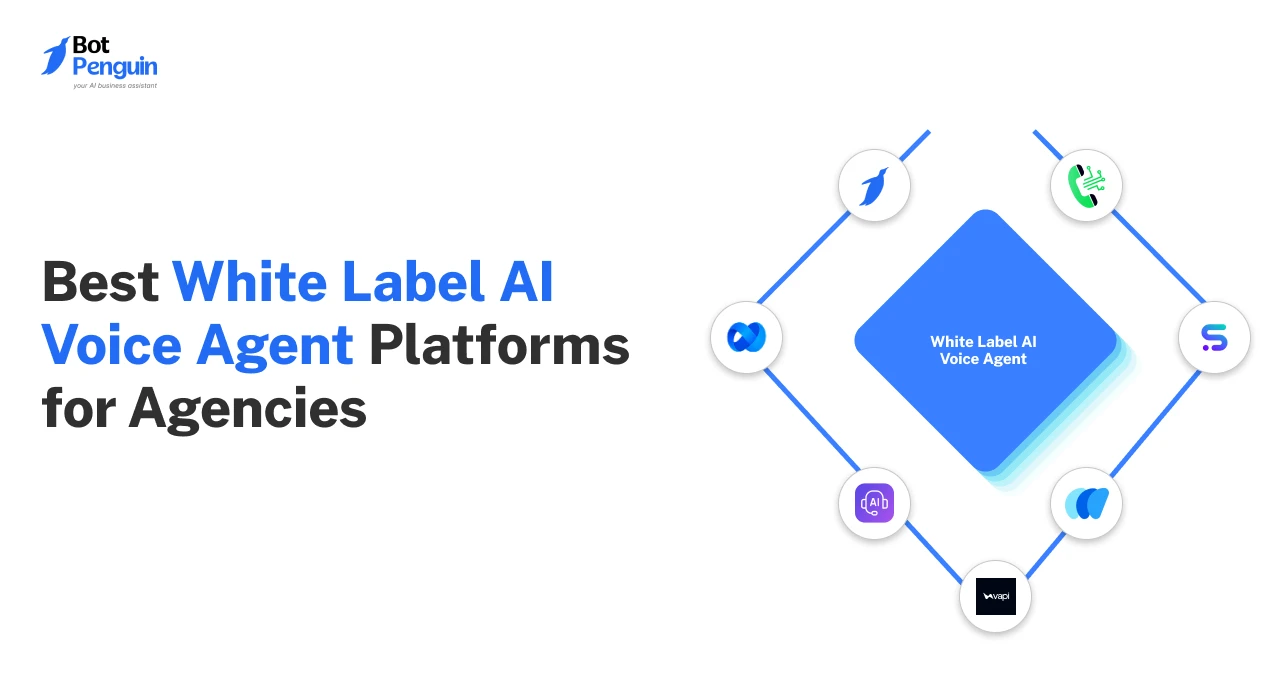
Your competitor just launched voice AI. They didn't build it. They white-labeled it.
This happens every single day. Agencies rebrand platforms, mark up pricing, and call it theirs. But picking the wrong white label AI voice platform will cost you real money. Very fast.
The margin difference is brutal. Just $0.05 per minute versus $0.15. That's your entire profit margin gone.
This guide reviews the 7 best white label AI voice agent platforms specifically built for agencies in 2026. We analyzed pricing, features, real margins, and use cases to help you understand which platform matches your agency's growth trajectory.
By the end, you'll know exactly which platform fits your agency best.
Comparing white label AI voice platforms without a framework will leave money on the table. Most reviews focus on flashy features.
They miss what actually determines if you'll make 40% margins or 10% margins. We evaluated every platform across eight specific criteria. These eight factors separate profitable agencies from those stuck competing on price.
Platform Comparison Matrix: The 8 Criteria
Your client logs in. Do they see your logo, your domain, your colors? Or do they see the platform vendor's branding hiding in the footer?
True brand control means your domain, dashboard, emails, and mobile apps show only your identity.
Clients should never know which white label AI voice agent platform powers the system. Partial white label solutions leave the vendor's branding visible somewhere. This creates trust issues and limits your positioning power.
Voice agents are powerful, but clients want options. Can the platform handle voice plus WhatsApp and chat from one system?
Single channel platforms keep costs low but limit what you can sell to clients. Omnichannel platforms cost more but let you bundle services. This directly impacts your pricing power and contract value per client.
This matters more than most people realize. A native platform builds the entire stack itself. A wrapper sits on top of another company's voice engine.
Native platforms give you control and better margins. Wrapper platforms get you to market faster but create vendor dependency. Your tech stack either belongs to you or to someone else. This choice ripples through every decision you make.
Flat fee, per-seat, per-minute, or hybrid? Read past the headline price.
Add-ons appear after you commit. Setup fees, overage charges, compliance add-ons, and integration costs compound. Calculate the real cost per minute across different call volumes.
A platform that costs $0.05 per minute becomes $0.15 after fees for some agencies. Others stay at $0.07. The difference is your entire margin.
As you add 10 clients, does your cost per client drop? Or does it stay flat regardless of volume?
Platforms with per-client pricing scale poorly. Platforms with volume discounts reward growth. Some charge monthly fees that never decrease. Others allocate minutes per client and let you keep unused minutes. Your margin structure either compounds as you grow or erodes.
Healthcare and finance clients require specific certifications. Without them, entire verticals are off limits.
Check if compliance is included or costs extra. Some platforms include SOC 2 as standard. Others charge thousands per year for certification. If you can't serve regulated industries, your addressable market shrinks.
Can your clients in India, Europe, or Brazil actually pay you?
Global payment support matters if you're international. Limited payment gateways force clients to use workarounds. Multi-currency billing reduces friction and increases collection rates. This isn't optional if your clients aren't all in the US.
When a client call breaks at 9pm on Friday, who do you call?
Platforms with ticketing systems for enterprise clients provide faster resolution. Platforms with community forums only leave you waiting. Partner support channels separate agencies that win from those that lose deals due to poor support response times.
Most reviews score the first four criteria. Brand control, channels, architecture, and pricing are visible. Margin structure, compliance, billing reach, and support are invisible until you need them. That's where agency profit actually lives. That's where client retention either happens or fails.
Score every platform on all eight before you commit to anything. Ready to see how BotPenguin compares on these exact metrics?
Agencies interested in starting a white label voice AI business should evaluate platform costs, channel coverage, compliance, and margin structure before committing.
Now that you know what separates profitable platforms from mediocre ones, let's compare the actual options. The table below shows platform fees, per-minute costs, channel capabilities, and architecture type.
Platform Comparison: Fees, Pricing, Channels & Architecture
Prices are current as of July 2026 and subject to change per each platform's own pricing page please verify directly with the provider before committing.
BotPenguin scores highest on criteria that compound as you grow. It's native, fully rebranded across domain, dashboard, emails, login, and iOS and Android apps. BotPenguin is GDPR, HIPAA, and CCPA compliant, ISO certified, SOC 2 attested, and VAPT-assessed by a CERT-In empanelled auditor.
BotPenguin uses custom, quote-based pricing across its King and Emperor tiers, with unlimited clients and no per-seat charges. Your cost stays predictable as you add clients. This matters. You get consistent margins whether you have 5 clients or 50.
Channels: Voice sits inside a complete suite with chat, WhatsApp, Instagram, and 80 plus integrations. You sell one branded omnichannel product instead of bolting voice onto a chat platform.
Billing Reach: BotPenguin supports local payment gateways and multi-currency support. This is critical if your clients are in MENA, India, or LATAM, where card billing converts poorly. Your clients pay in their local currency through local payment rails.
Key Features:
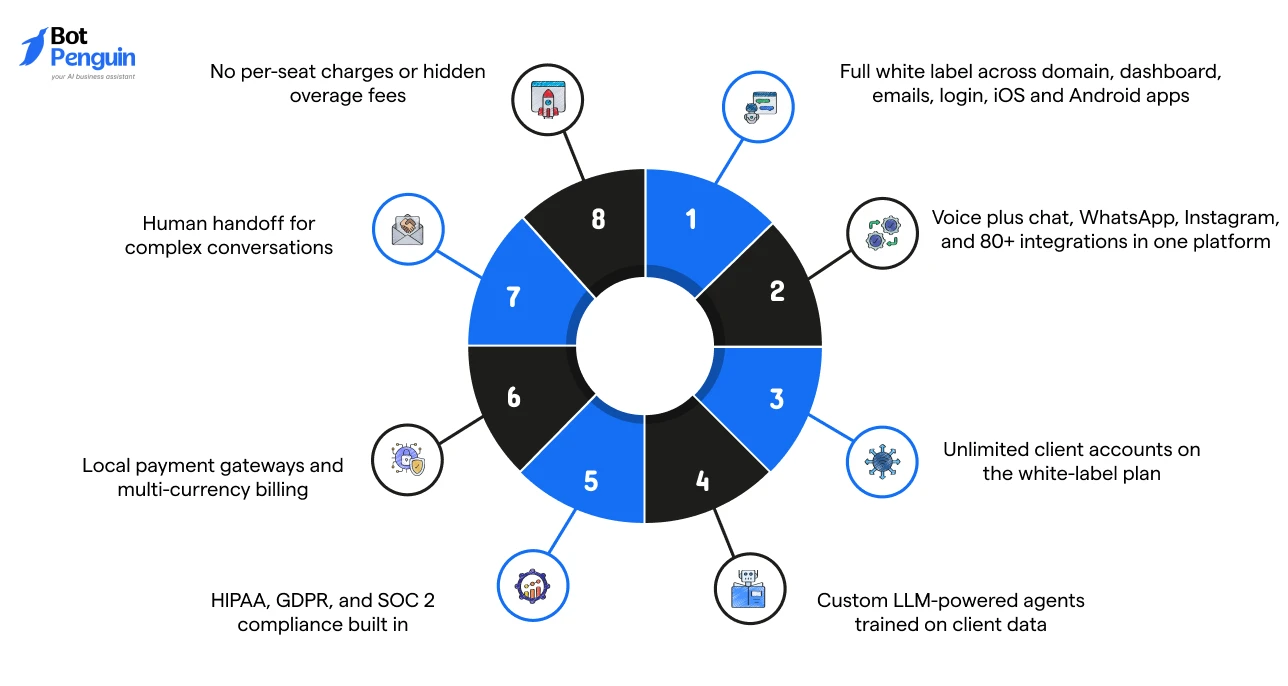
Full white label across domain, dashboard, emails, login, iOS and Android apps
Voice plus chat, WhatsApp, Instagram, and 80+ integrations in one platform
Unlimited client accounts on the white-label plan
Custom LLM-powered agents trained on client data
GDPR, HIPAA, and CCPA compliant, ISO certified, SOC 2 attested, and VAPT-assessed by a CERT-In empanelled auditor
Local payment gateways and multi-currency billing
Human handoff for complex conversations
No per-seat charges or hidden overage fees
The trade-off is voice depth. Voice specialists build features BotPenguin doesn't prioritize. If your agency's competitive edge is voice-only innovation, read the specialists below. If your edge is owning the entire client relationship under one brand with predictable margins, see how BotPenguin compares.
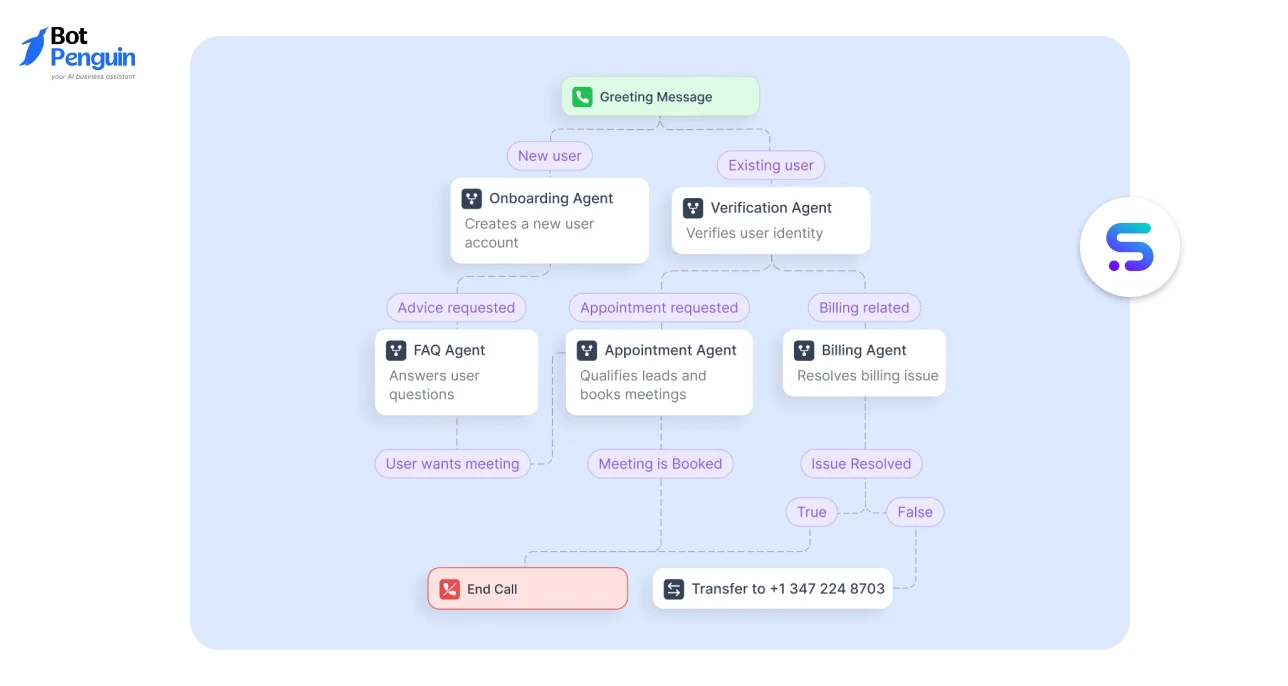
If your clients demand premium voice quality and you're willing to pay for it, Synthflow delivers.
It's one of the most feature-complete native voice platforms with a no-code flow builder, ElevenLabs voices, and strong GoHighLevel integration. For agencies with high-value clients, it earns its place in the stack.
• No-code drag-and-drop voice agent builder (setup in under 20 minutes)
• ElevenLabs voice integration for superior voice quality
• Native GoHighLevel and HubSpot integrations
• 30+ languages with regional accent support
• White-label agency dashboard with sub-accounts and rebilling
• Automated billing and minute allocation per client
• SOC 2, HIPAA, and GDPR compliance
• Outbound and inbound call handling with voicemail detection
• Voice only, so WhatsApp and chat need separate tools
• Flow builder follows rigid paths and struggles with longer off-script conversations
• Per-minute costs add up quickly at higher volumes
• Expensive entry point compared to omnichannel alternatives
Synthflow works best for premium voice-only work where margin isn't tight and clients pay top dollar for call quality. For agencies building omnichannel platforms on tight margins, the cost structure makes it harder to compete.
Ready to explore options that fit your margin targets? Learn how to build a white label voice AI business with architecture that protects your margins.
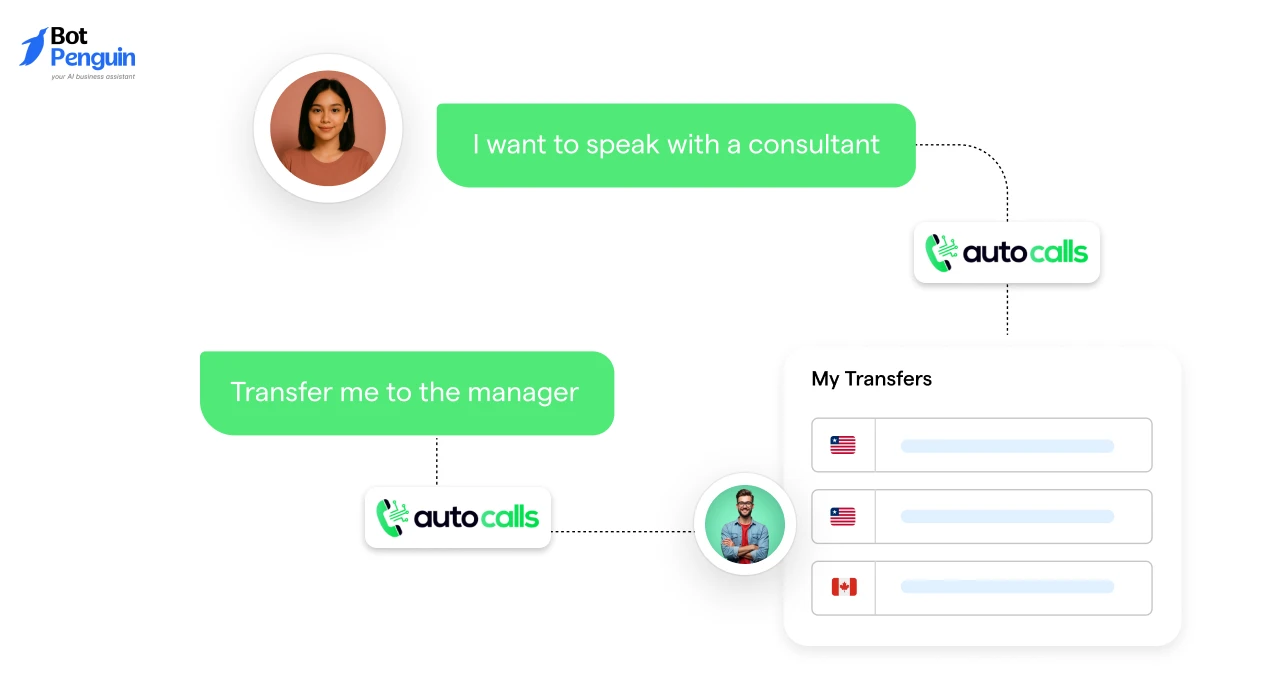
BotPenguin and Synthflow cover two extremes: omnichannel on custom, quote-based pricing, or premium voice-only depth.
Autocalls sits in the middle with omnichannel features, all-inclusive pricing, and the fastest launch timeline. It's the closest direct competitor to BotPenguin on channel breadth and cost structure.
Autocalls covers voice, WhatsApp, and web chat from one dashboard. The pricing is $0.09 per minute all-inclusive, meaning LLM, voice, and telephony costs are bundled. You don't bring your own API keys or manage separate vendor bills. Everything flows through one invoice.
• Voice, WhatsApp, and web chat from one platform
• All-inclusive $0.09 per minute pricing with no separate vendor bills
• White-label agency plan at $419 per month
• Unlimited sub-accounts with no per-account fees
• Stripe rebilling for automatic client invoicing
• White-labeled documentation and sales materials included
• Dedicated partner manager via Slack or WhatsApp
• Phone numbers in 150+ countries
• 100+ languages with voice cloning capabilities
• Monthly fee structure versus BotPenguin's custom annual subscription.
• Stripe-only billing, no local payment gateways or multi-currency support
• Newer to market with limited public reviews
• Less suitable for agencies serving MENA, India, or LATAM markets
Autocalls works best for US and European agencies wanting omnichannel capability without the complexity of managing multiple API keys. The 24-hour launch time matters if you need to close deals quickly. The trade-off is emerging market support, which BotPenguin handles better through local payment gateways.
If margin is your obsession and voice is your focus, Trillet delivers the most aggressive economics in the voice-only category.
It posts $299 per month for unlimited sub-accounts at a flat $0.09 per minute, with HIPAA, SOC 2, and GDPR included at no extra cost. For a voice-first agency, this changes the equation.
Most voice platforms lock you into rigid flow builders. Trillet uses dynamic conversation architecture with Crews multi-agent handoffs that handle complex calls better than linear decision trees. Website scraping spins up a trained agent in minutes without manual prompt engineering.
• $299 per month flat fee for unlimited sub-accounts
• $0.09 per minute all-inclusive pricing with no add-ons
• HIPAA, SOC 2, and GDPR compliance included at no extra cost
• Dynamic conversation architecture for complex multi-turn calls
• Crews multi-agent handoffs for specialized routing
• Website scraping to auto-train agents on client data
• No-code agent builder with fast deployment
• Natural conversation flow without rigid decision trees
• Voice-led only, not omnichannel
• WhatsApp and chat need separate platforms
• Smaller vendor with less market presence than all-in-one suites
• Limited brand control compared to full white-label solutions
Trillet works best for voice-first agencies chasing the best per-minute margin and compliance coverage in one package. You sacrifice omnichannel breadth but gain economics that let you undercut competitors while maintaining healthy margins.
Ready to calculate your real margins? Understand how white label voice AI software pricing models impact your profitability across different architectures and compliance tiers.
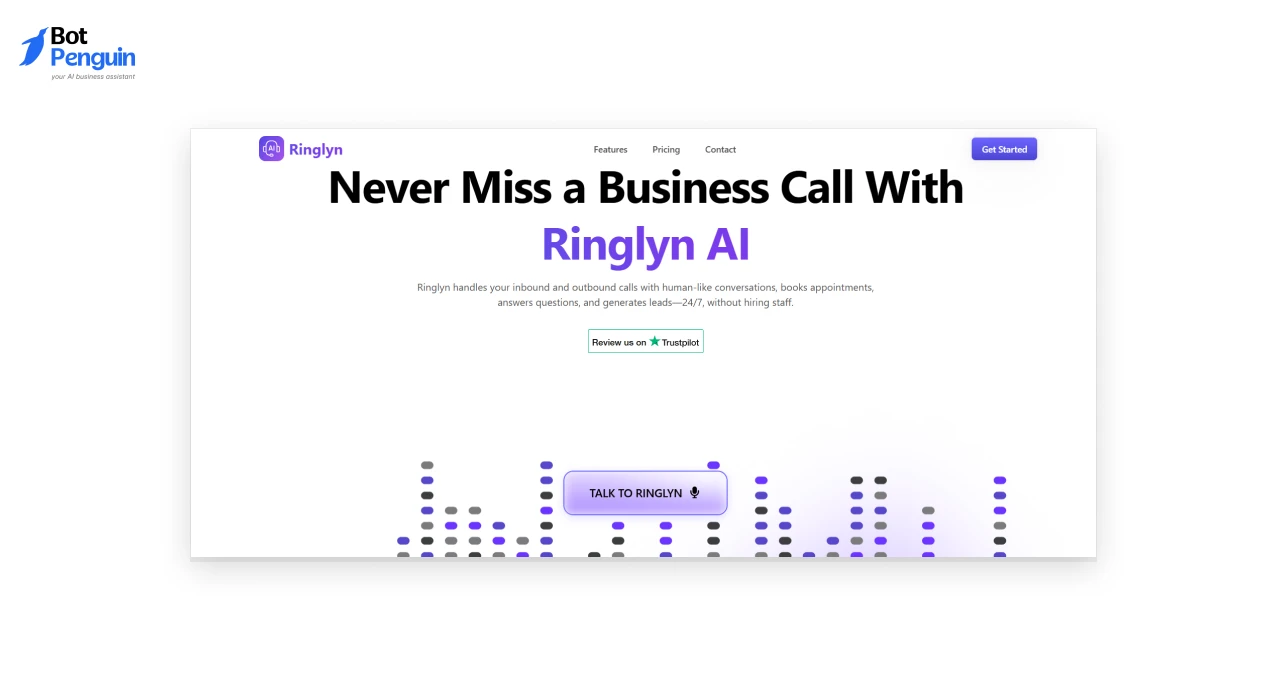
Trillet targets lean agencies chasing margin per call. Ringlyn targets established agencies running high client volume that can absorb premium fixed costs.
Ringlyn markets a complete agency white-label program with branded client dashboards, multi-client management, and a flexible billing engine built for scaling.
The fixed cost is the highest on this list at roughly $2,497 per month for unlimited sub-accounts. This suits agencies already running 20+ active clients that can spread the fee across their base.
For a newer agency with 3 to 5 clients, the break-even math gets steep compared with Trillet at $299 monthly or BotPenguin's quote-based tiers.
• Complete white-label agency program with full branding
• Multi-client dashboard with granular permission controls
• Flexible billing engine supporting multiple pricing models
• Unlimited sub-accounts with no per-account overages
• Enterprise-grade compliance and security
• Dedicated account management for premium partners
• API access for custom integrations
• Call recording and quality monitoring included
• Highest monthly fee at $2,497 requires high client volume to justify
• Break-even client count is steep for newer agencies
• Premium pricing limits margin flexibility on smaller deals
• Best-fit for agencies with established revenue base
Ringlyn works best for agencies already operating at scale with 15+ paying clients and revenue to support the premium fee structure. The fixed cost becomes irrelevant when spread across high volume. The trade-off is that newer agencies need to grow faster to justify this investment.
Understand the full cost equation. Compare how fixed fees, per-minute costs, and break-even client counts reshape your agency's white label voice AI platform economics.
Ringlyn works for agencies at scale. Wrapper platforms work for solo operators testing the market on a shoestring.
These platforms add a white-label dashboard on top of Vapi or Retell and start around $299 to $399 per month. The entry price is attractive and some offer multi-provider flexibility.
But the risk is structural and you need to understand it upfront. When the upstream provider has an outage, your clients' agents go down and you cannot fix it. You're paying for the white-label layer but not the infrastructure underneath. Your clients blame you for problems you don't control.
• Add white-label branding on top of Vapi, Retell, or ElevenLabs
• You connect your existing provider accounts
• Wrapper syncs agents, phone numbers, and knowledge bases
• Clients see your branding and domain only
• Billing flows through your system to clients
• Low entry cost at $299 to $399 per month
• No infrastructure risk you personally own
• Multi-provider flexibility on some platforms
• Fast to deploy with existing provider accounts
• Good for testing product-market fit before scaling
• Upstream outages become your customer support problem
• No control over voice quality or latency
• Dependent on provider stability and pricing changes
• Weak foundation for scaling an agency
• Clients contact you when infrastructure fails
Wrapper platforms are defensible for a solo operator validating whether clients will pay for voice agents. They're weak as the foundation for an agency you plan to scale beyond 10 clients. The moment you have paying customers, infrastructure ownership matters.
Your clients don't care that Vapi had an outage. They care that their agents stopped working and you're responsible. That liability compounds as your client base grows.
Ready to scale sustainably? Understand native vs wrapper voice AI architecture and why infrastructure ownership decides your agency's future.
Wrapper platforms sit on top of Vapi and Retell. These two are the engines that power most other platforms you've read so far. They offer low per-minute rates at $0.07 to $0.10 and deep control over every component of your voice stack. But they are developer tools, not no-code agency white-label products.
Vapi lets you mix-and-match speech-to-text providers, LLMs, and text-to-speech engines. Retell builds phone-first with proprietary turn-taking and sub-600ms latency. Both are phenomenal at what they do. Both require engineers.
If you need a branded client dashboard, billing system, and multi-account management, neither platform gives you that out of the box. You'd build it yourself or pair them with a wrapper. This adds 3 to 6 months to your launch timeline and engineering complexity.
• $0.05 per minute platform fee with mix-and-match providers
• Full control over STT, LLM, and TTS choices
• Flow Studio for visual conversation building
• Comprehensive API and CLI tooling
• Bring Your Own Telephony support
• $0.07 per minute usage-based pricing
• Proprietary turn-taking model built on real conversation data
• Sub-600ms latency for natural interactions
• Visual drag-and-drop flow builder
• Built-in testing and QA simulation tools
• HIPAA, SOC 2, and GDPR compliance included
• No white-label client portal built in
• No multi-account or sub-account management
• No billing or rebilling system
• No branded documentation or support tools
• Requires custom development to launch as a product
Pick Vapi or Retell only if you have engineers on staff and want to build your own platform on top. Most non-technical agencies should resell a finished white-label product instead. The cost of building white-label infrastructure yourself erases any savings from lower per-minute rates.
Your decision comes down to this: Do you want to build or buy? Infrastructure platforms like Vapi and Retell make you a builder. White-label suites like BotPenguin and Synthflow let you start selling immediately.
Know your resources before choosing. Understand the full picture of white label voice AI platform comparison across cost, control, and time-to-market.
You've seen the platform breakdown. Now you need to understand the architecture decision that sits underneath. A native platform owns its AI, telephony, and infrastructure.
A wrapper rents an engine like Vapi or Retell and adds a dashboard on top. This difference reaches your clients in ways that matter.
Native vs Wrapper Comparison
When Vapi has an outage, every wrapper using Vapi goes down with it. Your clients' agents stop working. Your support inbox fills up.
You contact Vapi's support. Vapi doesn't prioritize your ticket because you're not their direct customer. You wait. Your clients wait. Your reputation takes the hit.
When BotPenguin has an outage, you call BotPenguin directly. You're the customer. You get priority support. The issue gets fixed faster.
For a business you put your name on, control of the stack protects your reputation. You can't control Vapi's infrastructure. You can control BotPenguin's because you own it directly. When your clients experience downtime, they blame you regardless of who caused it.
Wrappers make financial sense when you're testing product-market fit with 1 to 3 clients. They make no sense when you're scaling to 20+ clients and your name is on the line.
If reliability sells your service, weigh infrastructure ownership before the entry price. The cheapest platform becomes the most expensive when it costs you clients.
Ready to choose? Understand how native vs wrapper voice AI architecture affects your client retention, support burden, and long-term margins.
Architecture determines control. Channel breadth determines revenue. A voice-only platform answers phone calls and stops there.
Your clients in 2026 expect one provider to cover phone, WhatsApp, and website chat together. Sell voice alone and you cap your invoice. You leave the rest of the client's automation to a competitor.
An omnichannel white-label platform lets you bundle voice with chat and messaging under one brand, charge for the suite, and make your service far harder to replace. This is the clearest line between profitable agencies and those stuck competing on price.
A client pays you $500 per month for voice-only. They still need a chat platform at $300 per month elsewhere. Your competitor gets the chat revenue.
Same client on an omnichannel platform pays you $700 per month for voice plus chat. You keep all the revenue. Your competitor gets nothing.
Scale this across 20 clients and the difference is $4,000 per month in recurring revenue you either capture or leave on the table.
Voice-only clients can switch to a competitor. They only lose phone functionality.
Omnichannel clients switching to a competitor lose phone, chat, WhatsApp, and integrations. The friction cost is much higher. They stay longer.
Synthflow and Trillet lead on voice depth but stay voice-led. BotPenguin and Autocalls cover the full channel set, with BotPenguin reaching widest through 80 plus integrations and local-currency billing support.
If your edge is voice quality alone, voice-only works. If your edge is owning the entire client communication stack under one brand, omnichannel is non-negotiable.
For a deeper look at how inbound and outbound fit into that stack, see how agencies resell white label AI receptionists and white label AI calling agents, or learn how to sell AI voice agent
The margin difference between voice-only and omnichannel isn't $0.02 per minute. It's $200 to $400 per client per month in revenue you capture or lose.
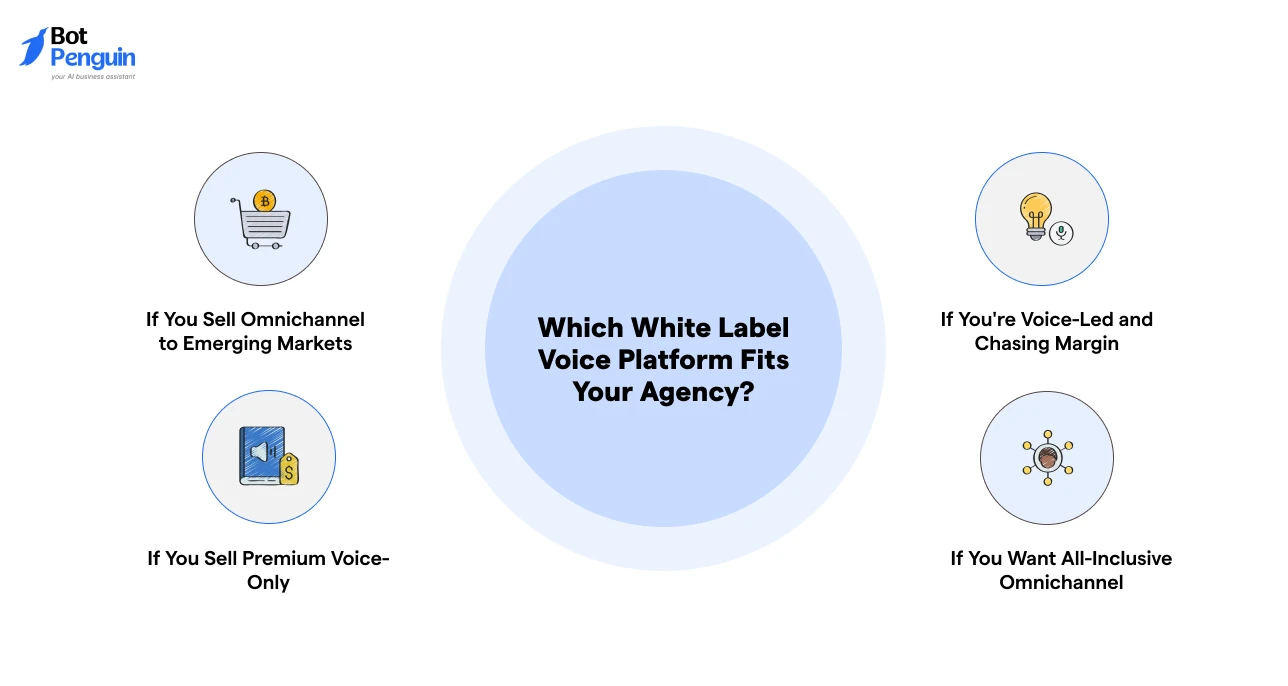
You now understand the eight criteria, the architecture differences, and the channel implications. The question is which platform actually fits your specific situation.
The answer depends on three things: your target market, your service model, and your cost tolerance. Match the platform to your agency, not the other way around.
Choose BotPenguin. You want a branded suite covering voice, chat, WhatsApp, and integrations under one contract.
Your clients are in MENA, India, or LATAM where card billing converts poorly. BotPenguin's quote-based pricing keeps your fixed cost predictable. Local payment gateways and multi-currency support matter more than per-minute savings.
Weigh Synthflow. Your clients pay top dollar for call quality. You're not price-sensitive on per-minute costs. You want the best voice depth and ElevenLabs integration.
The $1,400 monthly Agency plan fits if your average client contract exceeds $1,000 per month. Your edge is voice polish, not omnichannel breadth.
Look at Trillet. You want the best per-minute economics at $0.09 flat with HIPAA, SOC 2, and GDPR included. Your clients are in the US or Europe.
You don't need WhatsApp or chat. The $299 monthly fee makes sense if you're scaling 20+ clients on voice alone.
Autocalls fits for US and European agencies. You want voice, WhatsApp, and chat bundled at $0.09 per minute all-inclusive.
No bring-your-own-keys complexity. $419 per month white-label with Stripe rebilling and unlimited sub-accounts. The 24-hour launch time matters if you close deals fast.
Avoid wrappers as a scaling foundation. They work for solo operators. They fail when you have 20+ paying clients and one upstream outage takes down your entire business.
Skip the raw infrastructure tools unless you have engineers. Vapi and Retell are powerful. They also require 3 to 6 months of custom development to launch as a white-label product.
Score your shortlist on all eight criteria with your real client mix before you sign anything. Don't optimize for entry price. Optimize for the criteria that compound as you grow: brand control, margin structure, compliance, and billing reach.
Pull your actual client pipeline. Calculate break-even. Test each platform's free tier. Score them against the eight criteria you learned earlier. Choose based on data, not hype.
Ready to move forward? Compare your specific client mix and market against the white label AI voice platform options that actually fit your agency's growth path.
The best white label AI voice agent platform scores well on all eight criteria for your client mix, not the cheapest headline.
Voice-only specialists win on voice depth. Wrappers win on entry price and lose on reliability. For agencies wanting to own the whole client relationship under one brand, sell across voice, chat, and WhatsApp, and bill clients in their own currency, BotPenguin scores highest.
Native architecture. Unlimited clients. 80+ integrations. Local payment gateways. GDPR, HIPAA, and CCPA compliant, ISO certified, SOC 2 attested, and VAPT-assessed by a CERT-In empanelled auditor.
Compare BotPenguin against your shortlist. Run the numbers on all eight criteria. Test the free tier. Then start building under your own brand.
Ready to launch your white label voice agency? Explore BotPenguin's white label program today.
It depends on your stack. BotPenguin fits agencies wanting an omnichannel suite (voice, chat, WhatsApp) under one brand with predictable, quote-based pricing and local-currency billing. Synthflow and Trillet suit voice-only agencies that want maximum voice depth and accept higher monthly fees.
Platform fees range widely.BotPenguin uses custom, quote-based pricing. Trillet runs $299 per month, Autocalls $419 per month, Synthflow about $1,400 per month plus bring-your-own-key costs, and Ringlyn $2,497 per month. Most charge per call minute on top, so model your client mix before choosing.
A native platform owns its AI, telephony, and infrastructure. A wrapper adds a branded dashboard over a third-party engine like Vapi or Retell. Native platforms give single-vendor accountability and steadier pricing. Wrappers cost less to start but inherit upstream outages they cannot fix.
Omnichannel, in most cases. Clients in 2026 expect one provider to handle phone calls, WhatsApp, and website chat. A voice-only tool limits what you can charge and is easy to replace. A platform like BotPenguin that covers all channels lets you sell a larger, stickier service.
Margins come from a low fixed fee, no per-seat charges, and a manageable per-minute rate. BotPenguin's quote-based subscription with unlimited clients keeps fixed costs predictable. Trillet's $0.09 per minute is among the best per-minute rates. Avoid per-line pricing that forces upgrades as clients grow.
Coverage varies. Most are US and Stripe-centric. BotPenguin supports local payment gateways and multi-currency billing, which matters for agencies serving MENA, India, and LATAM, where international card billing converts poorly. Confirm telephony coverage for your client regions before committing.
Compare BotPenguin White Label Program
Compare features, pricing, branding options, and support to see why agencies choose BotPenguin’s white label program and become successful partners.
Become a PartnerCheckout our related blogs you will love.
Updated at Oct 9, 2026
10 min to read
Updated at Sep 18, 2026
11 min to read
Updated at Sep 18, 2026
10 min to read
Updated at Sep 17, 2026
12 min to read
Updated at Oct 21, 2026
12 min to read
Updated at Oct 8, 2026
11 min to read
Table of Contents
