


How to Build and Sell Branded AI Voice Agents Under Your Own Name (2026 Guide)
Updated at Oct 9, 2026
10 min to read
Updated On Sep 18, 2026
11 min to read
A missed call is a booked appointment that walked to a competitor instead.
That's the problem a white label AI voice receptionist solves, and most businesses don't even know they have it. It just shows up as a slow month.
Agencies that sell "AI" struggle to close deals, because owners don't buy technology. They buy fixed problems.
That's why this is the easiest voice product in your stack to sell: you're not pitching AI, you're pitching a phone that finally gets answered, branded as your own, billed every month.
A white-label AI voice receptionist is an AI agent that answers a business's inbound calls 24/7 under your agency's brand — greeting callers, answering routine questions, and booking appointments directly into the calendar.
Agencies resell it to clients as their own service, with the underlying platform invisible, keeping the recurring margin.
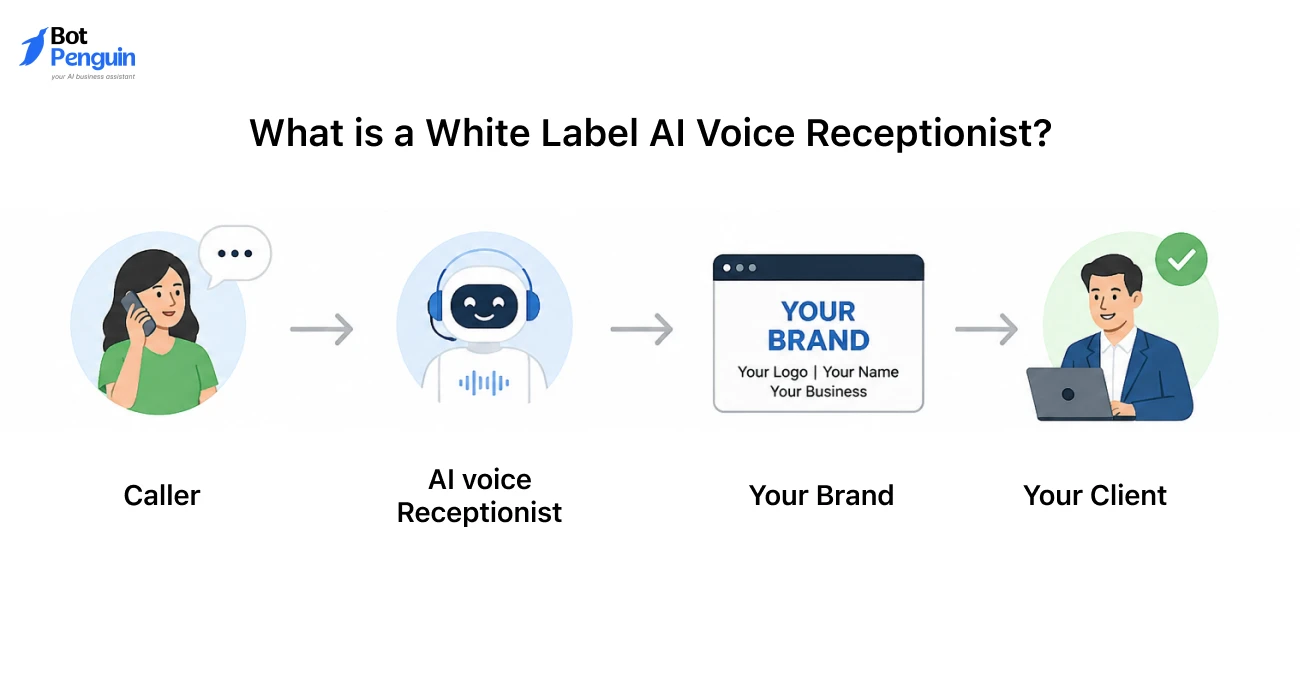
Your client sees your dashboard and your invoice. The platform doing the work behind it stays invisible to them.
You configure the receptionist using no-code tools. No developer, no telephony contract, no custom build. You add your logo, your colors, your domain, and it becomes yours.
The platform manages three layers you would otherwise build separately:
Building this from scratch means sourcing a speech-to-text provider, a language model, a text-to-speech voice, and a telephony connection, then wiring all four together and keeping them running.
A white-label AI receptionist platform replaces all four with one login.
That is the actual gap between launching a branded reception service this week and spending months on infrastructure a client will never ask about.
This setup is what makes reselling an ai voice receptionist for agencies realistic without an engineering team. You are not maintaining uptime on four separate APIs. You are configuring a product that someone else keeps running on a white label AI voice agent platform.
The same backend works whether your client is a dental clinic booking cleanings or a real estate office fielding listing calls. An ai receptionist for clinics and salons runs on the same infrastructure as one built for a law firm.
Only the script and calendar connections change.
That is what makes it possible to resell ai receptionist services across verticals without rebuilding your stack each time, and to position it as the kind of AI receptionist white label clients renew every month — a true white label ai phone answering service they never have to think about.
If reception is your first service, this is also the starting point to build a white label voice AI business that covers a client's entire phone line over time.
Agencies interested in starting a white label voice AI business can use our complete guide to understand the platform, pricing model, and recurring revenue opportunities.
A voice agent only ever does one of two jobs. Knowing which one you are selling changes how you price it and which client problem it actually solves.
A receptionist answers calls coming into the business. It picks up when a client's phone rings and handles the caller right there. This is the white label ai receptionist side of the product.
It captures revenue that was already leaking out through missed calls, calls that came in after hours, and calls nobody picked up during a busy shift. That revenue existed before you got involved. The receptionist just stops it from disappearing.
A calling agent places calls out from the business. It sends reminders, follows up on old leads, and re-engages contacts sitting in a CRM doing nothing.
This side does not recover lost revenue. It creates new contact with people who were never going to call in on their own.
Sold separately, each one covers half a client's phone line. Sold together under one branded plan, you cover the whole thing, inbound and outbound, on a single invoice.
That is also a stronger retention position. A client paying for one service can drop it. A client running both inbound and outbound through your brand has restructured their entire call handling around you.
This page stays focused on the inbound side. For the outbound build, pricing, and script approach, see how to offer a white label AI calling agent.
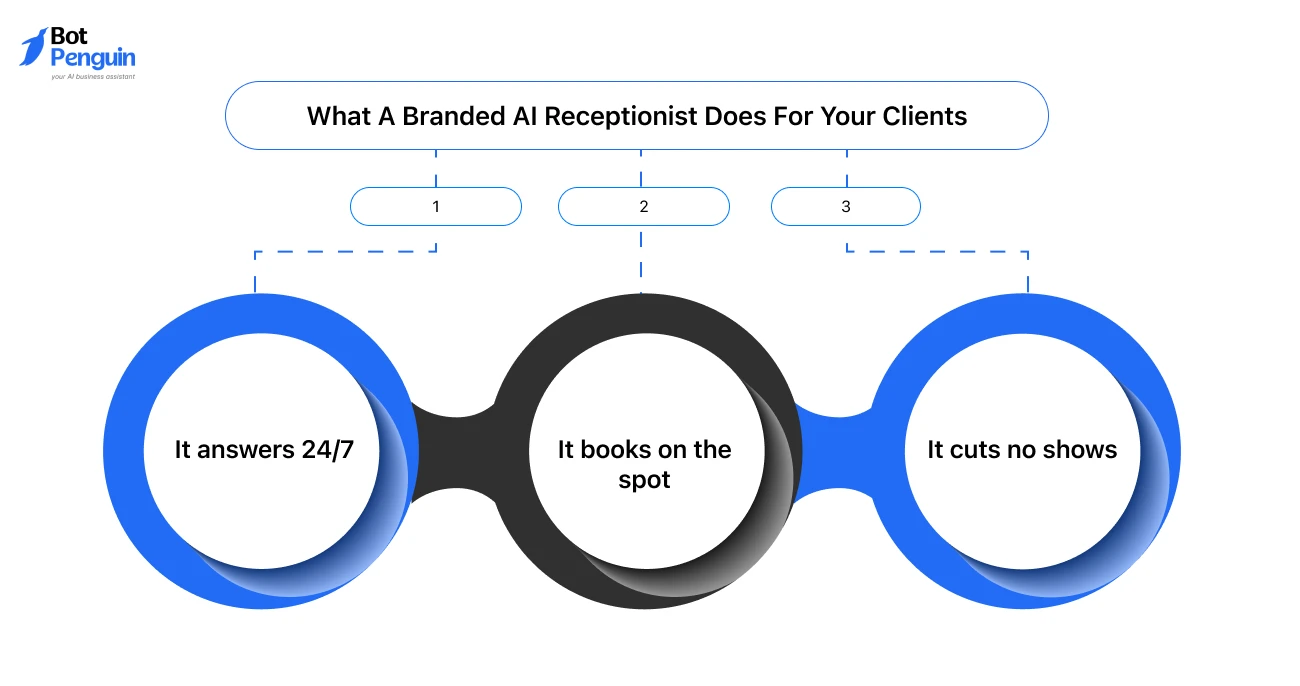
A client does not pay you for AI. They pay you for results they already track: calls answered, appointments booked, no shows down.
The receptionist earns its fee by turning calls that would have gone to voicemail into revenue on the books. Each capability below maps to a number the client is already watching.
A receptionist is only as good as what it does once the phone actually rings. Three things happen on every call that decide whether the client renews you next month.
It answers 24/7: Calls outside office hours stop going to voicemail. A clinic closed for the night, a salon between appointments, a law firm after 6pm, none of them lose that caller anymore.
It books on the spot: Appointments go straight into the client's calendar during the call itself. No callback, no missed window, no lead going cold while waiting on a return call. It also qualifies the caller and routes anything urgent straight to a person.
It cuts no shows: Pair the receptionist with reminder calls and no-shows drop, since the same system that booked the appointment can also confirm it before the slot arrives.
Not every business feels a missed call the same way. Some industries lose real money the moment the phone goes unanswered, and that is where this sells itself.
All five run on appointments. All five lose money the moment a call goes unanswered. That makes an AI receptionist for clinics, dental practices, and salons one of the easiest verticals to start with, since the value, a booked appointment that would otherwise have walked, is obvious without explaining how the AI works.
Pick one vertical first. Build a script template tuned to its calls, its calendar setup, and its common questions. Once that template books appointments reliably for one client, reuse it across every similar client you bring on.
That is how you scale a white-label AI voice agent platform without rebuilding the setup each time. Explore our white label partner solutions to see how the full partner program works.
Most agency services need a pitch deck. This one needs a sentence. Every owner already knows the problem you are about to solve, which is what makes both the sale and the retention work in your favor.
Reception sells on a problem every owner already recognizes: we miss calls and lose business. You do not have to explain AI, language models, or how the system works under the hood.
You show one thing instead. The phone gets answered. Appointments get booked. That is the entire pitch.
This makes the sale short and the value visible from the first week, since the client can check their own calendar and see new bookings that would not have existed otherwise.
A service that sells fast still needs to retain, and reception does that on its own once it is running.
Once a client's phone line runs on your branded receptionist, switching providers means disrupting their bookings, their greeting, and their calendar setup. Most clients will not risk that disruption over a small price difference, so they stay.
You pay one flat white-label license. You set your own client price on top of it. As you add clients, your platform cost does not climb with them, which is what keeps the margin intact instead of shrinking as you grow.
This is also the model behind every other branded service you might resell ai receptionist plans alongside, since the same fixed cost structure holds regardless of how many verticals you serve. For the full numbers across pricing tiers and client counts, read the white label voice AI business guide.
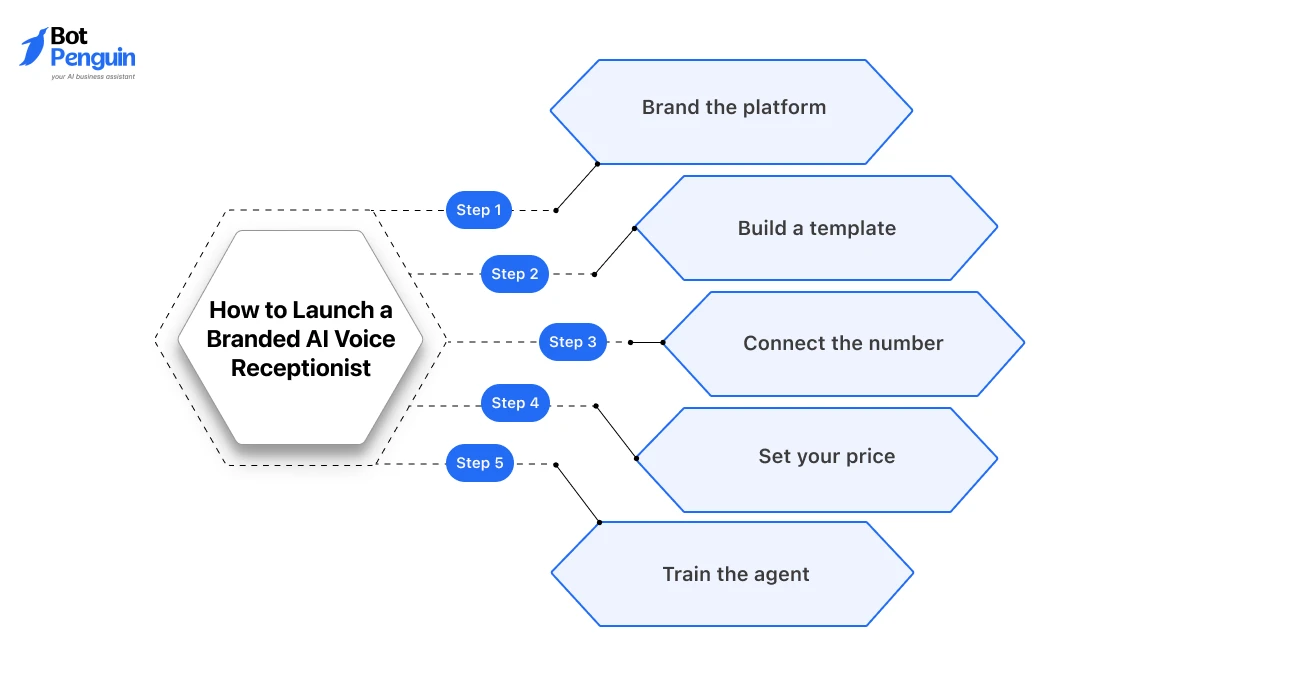
Knowing why reception sells does not tell you how to get one live. The actual launch is shorter than most agency owners expect, and it follows the same five steps regardless of which vertical you start with.
None of these steps need a developer or a telephony contract. The platform handling the white label ai receptionist backend already owns the carrier relationship, the phone numbers, and the speech infrastructure. Your work is configuration, not engineering.
Start with a client who already loses calls. An after-hours clinic or a busy salon works well, since the missed call problem is visible to them before you even pitch.
Show the booked appointments from week one. That result, not a feature list, is what sells the next client. A founder who can see new bookings appearing on their own calendar does not need convincing that the service works.
For partner program pricing and the full setup details, see the white label AI voice agent platform.
The launch sequence gets the receptionist live. Configuration is what determines whether callers can tell it apart from a real front desk.
Greeting: Write it in the client's voice, not a generic script. The greeting is the first thing every caller hears, so it sets the tone for the entire call.
Question handling: Set the questions the agent should answer directly: hours, pricing, services, location. Anything outside that list should route out, not improvise.
Calendar connection: Connect the client's calendar so the agent can book in real time during the call, not after it ends.
Routing rules: Define exactly when the agent hands a caller to a person. Urgent cases, complaints, and anything outside its training should never stay with the AI.
The script is where a receptionist feels professional or sounds robotic, so this is the one part of setup worth spending real time on. For a head start on wording it correctly, use our AI voice receptionist prompt guide, then adapt it to each client's vertical and tone.
You already know the difference between answering calls and making them. What matters now is which one to sell first, and whether you should sell just one at all.
A white-label AI voice receptionist sits on the inbound side. It answers calls coming into a business, books appointments, and handles routine questions the moment the phone rings.
An AI calling agent sits on the outbound side. It places calls out, running reminders, follow-ups, and lead re-engagement against a list the client already has.
A receptionist fixes half a client's phone problem. A calling agent fixes the other half. Most appointment-driven businesses have both problems at once: missed calls on one side, a stale lead list on the other.
Selling both under one branded plan covers a client's entire phone line, inbound and outbound, on a single invoice. The price you can charge goes up. The delivery cost barely moves, since both run on the same platform.
Start with the receptionist if you're choosing one. The missed call problem is easier to prove in week one, since booked appointments show up on the client's calendar right away.
Once that's working, outbound calling becomes an upsell to a client who already trusts you, not a second pitch from zero.
Not every white label platform handles both inbound and outbound well under one plan. Before you commit to one, see how to compare white label voice platforms on that exact requirement.
Reception is the easiest voice service to sell, because every owner already understands what a missed call costs them. You are not introducing a new problem. You are solving one they have lived with for years.
A white label AI voice receptionist turns those calls into booked appointments around the clock, billed every month under your brand, while the platform runs the calls and the telephony behind it.
Voice is built into a full omnichannel suite, so reception is not a standalone tool you bolt on. It is one part of a system you sell as your own, alongside chat and other channels under the same brand.
Start your white label AI receptionist business and launch under your brand. Offer a Branded AI Receptionist to Your Clients or explore our white label partner solutions to see how the full partner program works.
A branded AI agent that answers your clients' inbound calls 24/7, greets callers, answers questions, and books appointments — essentially a white label AI answering service sold under your own name, with the platform staying invisible. Your client gets a receptionist that never sleeps, and you keep the recurring margin.
It answers every call, day or night, so no lead goes to voicemail. It handles common questions, books appointments straight into the calendar, routes complex calls to a human, and cuts no-shows with reminders. For appointment-driven businesses, it turns missed calls into booked revenue.
Appointment-driven local businesses: dental and medical clinics, salons and aesthetics, real estate offices, law firms, and home services companies. They lose money on missed and after-hours calls, and they value a front desk that never closes, which makes them easy clients for an agency to sell.
A receptionist handles inbound calls that come to the business. A calling agent makes outbound calls: follow-ups, reminders, lead re-engagement. Most agencies sell both as one branded service so they cover a client's entire phone line, inbound and outbound, under a single plan.
Agencies commonly price a managed AI receptionist as a monthly retainer per client, often a few hundred dollars, scaled by call volume. With a flat fee white label platform, the cost stays fixed as you add clients, so most of the retainer becomes margin after the first few accounts.
No. The white label platform handles telephony and number provisioning. You configure the greeting, routing, and calendar with no-code tools, connect the client's number, and launch under your brand. For help writing the agent's script, see our AI voice receptionist prompt guide.
Checkout our related blogs you will love.
Updated at Oct 9, 2026
10 min to read
Updated at Sep 30, 2026
17 min to read
Updated at Sep 18, 2026
10 min to read
Updated at Sep 17, 2026
12 min to read
Updated at Oct 21, 2026
12 min to read
Updated at Oct 8, 2026
11 min to read
Table of Contents
