


HubSpot AI Agent: How It Works, Use Cases & Integrations
Updated at Oct 6, 2026
9 min to read
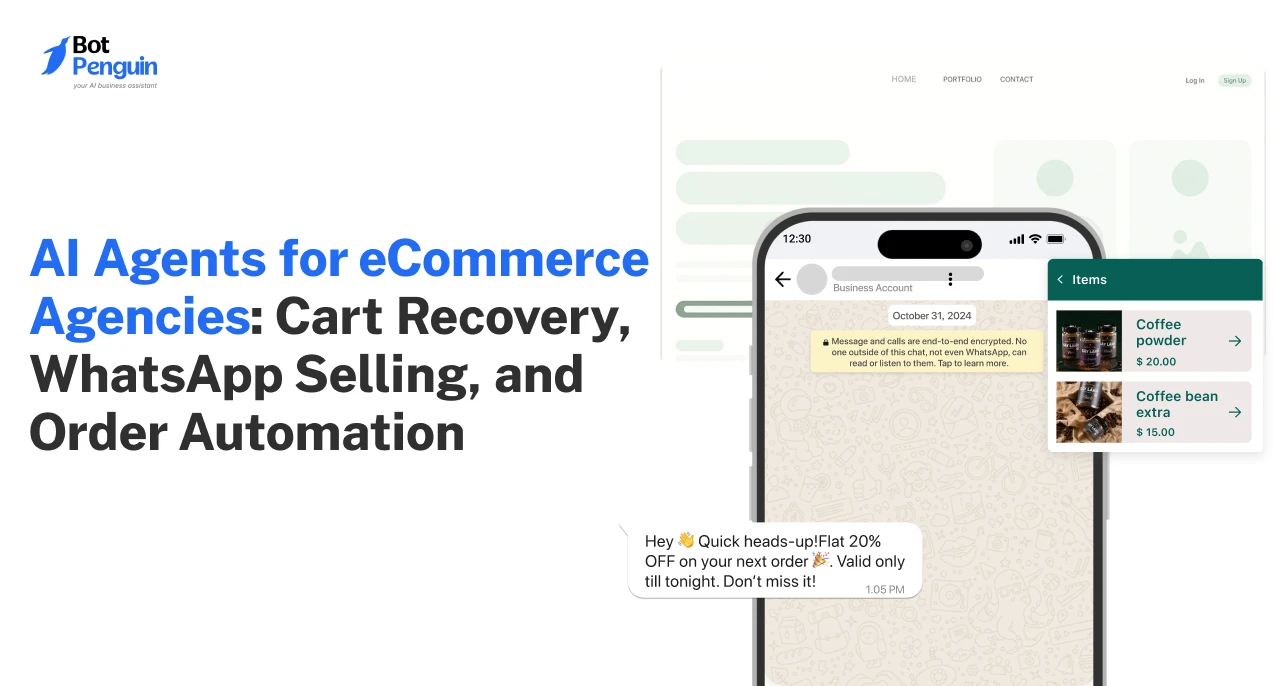
An AI agent for ecommerce helps shoppers find products, get order updates, and complete common service tasks using connected store data. Under a white-label model, agencies can offer that capability under their own brand and manage it for clients.
E-commerce gains from showmanship. The better the pitch, the more the sales.
But online stores cannot have a skilled salesperson guiding every shopper through every product, question, and hesitation. That is where sales quietly slip away.
An AI agent for ecommerce steps in like a digital sales assistant, helping shoppers discover products, compare options, get answers, and move closer to checkout.
For agencies and brands, a white label AI agent for ecommerce takes this further, powering branded shopping experiences across multiple stores without building an AI system from scratch.
In this guide, you'll learn how white-label AI agents work for e-commerce, what goes into building one, and how agencies and brands can offer them under their own name.
If you're comparing customer-facing tools for a store, see the best ecommerce chatbots instead.
Buying a ready-made AI agent means renting someone else's brand every time a client asks who built it. White-labeling lets agencies own the product, the pricing, and the client relationship from day one.
In 2026, 31% of U.S. marketing agencies said they plan to monetize agentic AI within the next 24 months. (Source: Forrester, 2026)
For e-commerce agencies, white-labeling offers one way to turn that AI capability into a branded client service. Here’s why agencies are choosing this model:
Off-the-shelf agents carry someone else's logo, someone else's name, and someone else's footer link.
Clients see the vendor before they see the agency. Every touchpoint becomes a missed chance to build the agency's own reputation.
Reselling a third-party tool means paying retail and marking it up just enough to stay competitive.
White-labeling flips this. Agencies pay wholesale or subscription rates and set their own client pricing, keeping more margin per account.
Bought agents come with fixed workflows built for a generic buyer, not a specific store.
Product catalogs, tone of voice, and checkout flows often can't be adjusted deeply enough to match a client's actual shopper journey.
When a client's chatbot lives on a vendor's platform, the agency has little control if pricing changes, features get pulled, or the vendor pivots.
White-label ownership keeps the agency in control of the relationship, not the vendor.
Together, these factors make white-labeling a practical way for e-commerce agencies to sell AI while keeping control of their brand, margins, and client relationships.
For agencies looking to offer branded AI agents without building the technology in-house, BotPenguin provides a white-label AI agent platform that can be tailored to client needs. Agencies can brand the experience as their own while creating AI agents for product discovery, customer queries, lead qualification, and other ecommerce workflows.
An AI agent for ecommerce is software that can understand a shopper's intent, pull connected product and order data, and take action, not just answer questions.
Unlike a scripted chatbot, it reasons through a query, decides what information it needs, and responds like a sales rep who actually knows the catalog.
Under a white-label program, the agency gets the same underlying agent, rebranded with its own identity, and deployed separately for each client store.
White-labeling is already common among agencies, with 73% using white-label services to expand their offerings. (Source: Amra & Elma, 2025)
Here’s how that white-label setup typically moves from initial configuration to ongoing client management:
Each of these steps has been explained below.
The agency sets up the agent through the provider's backend.
This includes selecting the AI model, defining default behaviors, and establishing the core configuration for the client deployment.
The provider's name, logo, and default styling get replaced with the agency's own.
Domain, color palette, tone of voice, and even the agent's name shift to match each client's storefront identity, not the platform's.
The agent links to the client's product catalog, CRM, and checkout system through available integrations.
This step determines what the agent actually knows and can act on, from stock levels to order status.
The branded agent goes live on the client's store, fully invisible to the platform behind it.
Shoppers interact with what looks like a native store feature, not a third-party tool wearing a costume.
The agency takes over monitoring, performance tuning, and client reporting from here.
This is where the agency builds long-term value, adjusting responses and catching issues before clients notice or raise them.
Once the agent is configured, branded, connected, and live, the agency's job shifts from building to backing it up.
Support responsibility splits by layer, so agencies aren't stuck debugging infrastructure they don't own. A typical partnership includes:
Uptime and platform reliability commitments from the provider, so agencies can confidently support client deployments
Dedicated onboarding support during the first few client deployments, often through a support executive or designated support channel
Escalation paths for LLM or integration failures, so agencies aren't debugging model behavior or API errors on their own
White-labeled documentation and training material agencies can hand to their own support staff or clients directly.
With the provider handling the infrastructure, agencies can stay focused on managing clients, refining performance, and growing their white-label AI offering.
A white-label AI agent is only as useful as the ecommerce systems it can safely access and act across.
The goal is not to connect every tool available. It is to connect the systems that give the agent enough context to answer accurately, act safely, and create measurable value for each ecommerce client.
If the client needs broader scheduled workflows beyond conversational AI, see how ecommerce automation connects the wider ecommerce stack.
White-labeling an AI agent involves more than branding and deployment.
Agencies are taking on legal, technical, and operational responsibility for every client store the agent touches, so a few key questions need answers before signing on with a provider.
Every conversation captures customer data, so agencies need clarity on consent, retention periods, and processing roles under GDPR or CCPA before deployment.
A Cloudera survey of 1,500+ IT leaders found 53% rank data privacy as their top AI agent concern. (Cloudera, 2025)
Contracts should specify who controls that data, since the agency, the client, and the provider each play a different legal role.
Agents can be given access to orders, refunds, inventory, and CRM records, but broader access means broader risk if something goes wrong.
Agencies should scope permissions tightly per client, granting only what the agent needs to complete its intended tasks.
No agent is immune to hallucination, especially around pricing, policies, or order specifics that shift often.
Clear rules should define which actions require approval and which conversations must escalate to a human before anything gets confirmed or promised.
Prompts, workflows, configurations, and branded assets built during a client engagement need clear ownership terms from the start, not after a dispute.
Agencies should also define what happens to customer data and configurations if a client chooses to leave.
Relying on a single provider or model creates risk if pricing changes, outages happen, or the provider pivots direction entirely.
Agencies should ask about portability, API dependence, and contingency plans before committing a client's entire experience to one platform.
Getting these details right upfront helps agencies build white-label ecommerce AI experiences that are safer to deploy, easier to manage, and more sustainable for both the agency and its clients.
Ecommerce agencies are applying white-label AI agents across both shopper-facing journeys and internal client operations.
These use cases show how the same white-label model can support revenue, service efficiency, and multi-client management.
Agencies deploy branded agents that guide shoppers through catalogs based on preferences, budget, and past behavior, replacing static filters with a conversational discovery layer.
This works especially well for stores with large or complex catalogs where shoppers often abandon search out of decision fatigue.
Agents pull live order status, shipping updates, and return eligibility directly from the client's systems, cutting down repetitive support tickets.
For agencies managing multiple client stores, this use case scales easily since the underlying logic barely changes between brands.
Branded agents step in when shoppers hesitate at checkout, answering last-minute questions about shipping, sizing, or payment options before they abandon the cart.
Around 7 in 10 online shopping carts are abandoned before purchase, based on Baymard Institute’s aggregated research. (Source: Baymard Institute, 2026)
Agencies often position this as a direct revenue-recovery service, making it an easy upsell to existing clients.
Agents suggest complementary products or upgrades based on what's already in the cart, mimicking the judgment call a good in-store salesperson makes naturally.
Agencies can tune these suggestions per client brand, keeping recommendations relevant instead of generic.
Agencies running agents across several client stores use a single backend to manage configurations, monitor performance, and roll out updates, while each storefront stays visually distinct.
This use case is often the strongest pitch for agencies scaling beyond one or two clients.
Choosing a white-label provider is where the considerations above turn into a real decision.
Here's how BotPenguin's program is structured for agencies working across ecommerce clients:
BotPenguin’s white-label model lets agencies set their own client pricing and retain the revenue they generate.
Ecommerce agencies can package AI agents with setup, optimization, and managed services instead of reselling a fixed third-party subscription with limited commercial control over client accounts.
The partner dashboard centralizes client accounts, subscriptions, usage, billing, and payments in one place.
As an agency adds more ecommerce stores, that shared backend reduces administrative friction while keeping each client deployment, pricing structure, and account relationship clearly separate over time.
Each ecommerce client can receive an agent configured around its catalog, policies, and customer journey.
Agencies can position agents for product recommendations, order status, returns, and cart recovery while keeping the shopper-facing experience aligned with each retailer’s brand and service expectations.
Agencies can work with multiple AI models, including GPT-4, Claude, Gemini, DeepSeek, and OpenRouter, while training agents on client-specific knowledge sources.
That flexibility helps match model behavior, tone, and information access to the requirements of different ecommerce accounts and use cases.
BotPenguin combines data isolation, access controls, audit logs, encrypted APIs, and regional hosting options for agencies managing multiple ecommerce client deployments.
BotPenguin is GDPR, HIPAA, and CCPA compliant, ISO certified, SOC 2 attested, and VAPT-assessed by a CERT-In empanelled auditor.
Partners receive self-serve documentation, setup resources, product training, and rebranded help materials for client-facing support.
A dedicated partner support executive is also available as an add-on, giving agencies an escalation route when platform issues or more complex deployment questions arise.
Together, these pieces cover the ownership, flexibility, and compliance ground agencies need before putting their name on an ecommerce client's storefront, without asking them to build any of it from scratch.
Explore BotPenguin’s Security and Trust, review the full feature list, and see what users say in BotPenguin reviews. You can also see how agencies and partners have applied similar models in BotPenguin case studies.
White-labeling gives ecommerce agencies a way to sell AI without building the core technology themselves. The value comes from control. Agencies can shape the brand, pricing, client setup, and service while the provider handles the underlying infrastructure.
An AI agent for ecommerce can support product discovery, order updates, cart recovery, and customer support across connected systems. The advantage is not just automation. It is the ability to package that capability as your own service.
If your agency already serves ecommerce clients, white-label AI can become an extension of what you sell. Start with one use case and scale from there.
A white-label AI agent for ecommerce is an AI assistant agencies can brand as their own and deploy for client stores. It can support product discovery, order updates, support, and sales using connected store data.
Ecommerce agencies use white-label AI agents to offer branded AI services without building the underlying technology. They can control client pricing, branding, deployment, and support while using the provider’s infrastructure to serve multiple stores.
Yes. Agencies can deploy white-label AI agents for Shopify, WooCommerce, and other ecommerce stores under their own branding while managing client configurations, pricing, support, and ongoing optimization through the underlying provider.
A white-label AI agent uses the provider’s technology while appearing under the agency’s brand. Agencies configure the agent, connect client systems, apply branding, deploy it, and manage performance for each ecommerce account.
White-label ecommerce AI agents can support product discovery, order tracking, returns, cart recovery, upselling, customer support, and lead capture. Exact capabilities depend on the data, integrations, permissions, and workflows configured.
They can be, when the underlying platform provides strong security controls. Agencies should check encryption, access controls, data isolation, audit logs, regional hosting options, and compliance requirements such as GDPR or CCPA.
Agencies can typically control branding, client pricing, domains, dashboards, and service packaging. The exact level of control depends on the provider, so billing, data ownership, revenue rights, and exit terms should be reviewed.
Useful connections include product catalogs, order systems, CRMs, helpdesks, checkout tools, and analytics platforms. These integrations give the agent enough context to answer accurately, act safely, and support client workflows.
Subscribe to Our Newsletter
Get the latest business insights straight into your inbox.
Checkout our related blogs you will love.
Updated at Oct 6, 2026
9 min to read
Updated at Sep 28, 2026
12 min to read
Updated at Sep 21, 2026
11 min to read
Updated at Aug 21, 2026
9 min to read
Table of Contents

