8 Best Ecommerce Automation Software for Small Businesses
Updated at Sep 14, 2026
12 min to read
Over 70 percent of retail tasks are still handled manually, even though most can be automated today.
That gap is where delays, errors, and missed revenue quietly build up.
When daily retail work relies on people checking systems, responding to queries, and moving information by hand, speed declines.
Customers wait longer. Teams get stretched. Small issues turn into repeated problems.
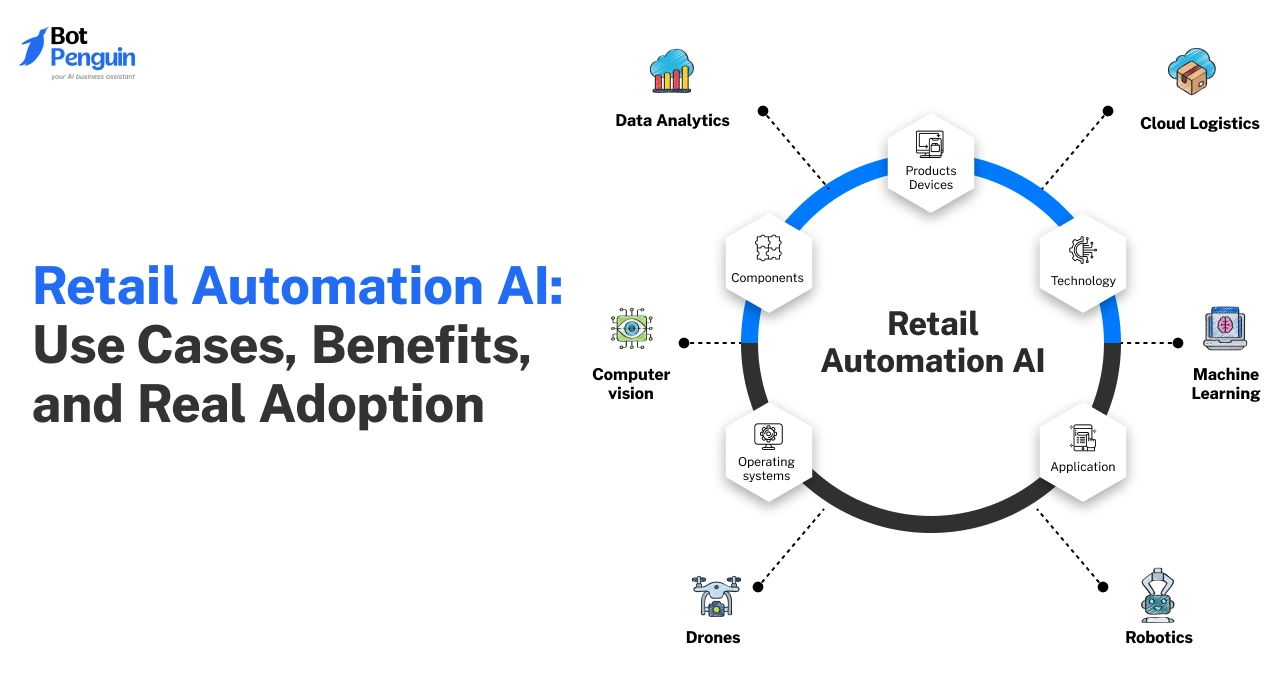
This is why retailers are turning to retail automation AI. Not to replace teams, but to remove manual effort from high-volume work across support, sales, and operations.
This guide explains how retailers are using AI automation in practice, the results they are seeing, and the platforms and approaches that make this automation possible today.
Manual work is the real bottleneck in retail today. Not a lack of tools, not a lack of people.
Too much work still moves through inboxes, spreadsheets, and handoffs, slowing everything down.
This is where retail automation AI shows its value.
It focuses on automating everyday actions that happen across sales, support, and operations.
Think about answering recurring customer questions, updating order status, routing leads, or flagging stock issues before they escalate.
These are small tasks on their own, but together they shape how fast a retail business can move.
In modern retail, speed and consistency matter more than perfect execution.
AI automation helps teams respond in real time, across channels, without adding more people or complexity. The Ahmed Al Maghribi Perfumes case study shows how automation can help retail brands manage customer conversations faster and improve engagement across the buyer journey.
It works quietly in the background, handling volume while teams focus on decisions that need human judgment.
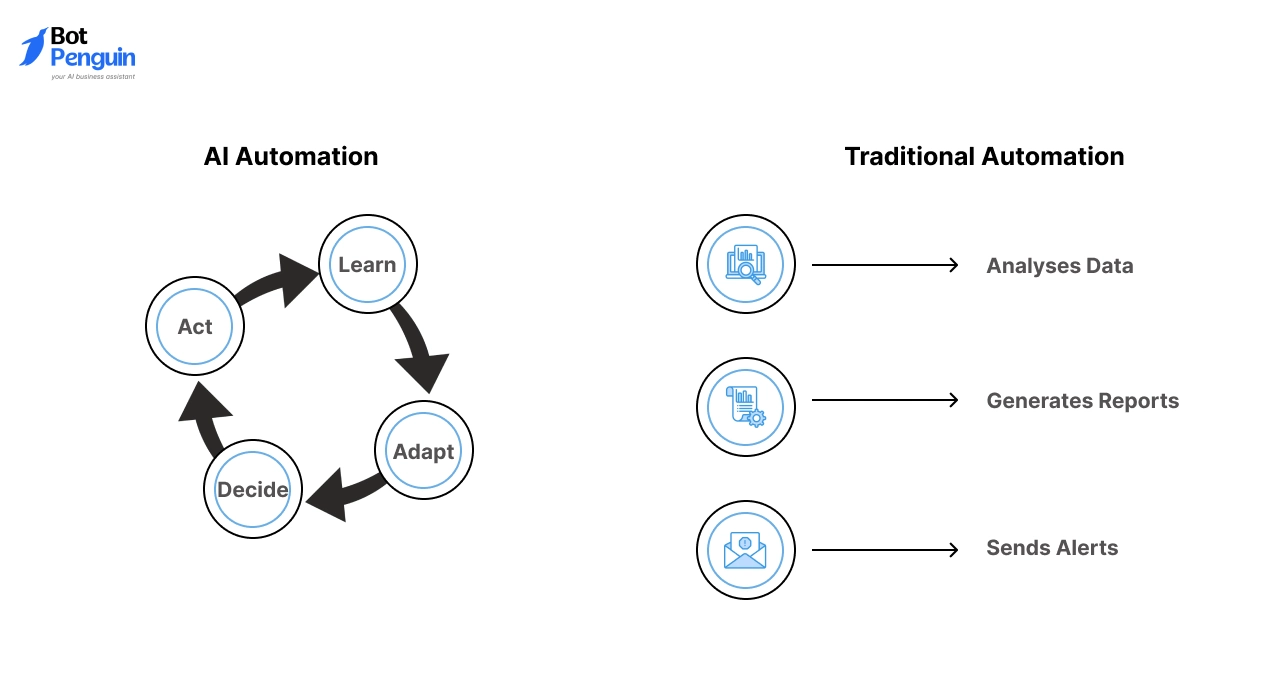
Traditional automation follows rules. If a customer clicks a button, the system responds in a fixed way.
This works until real behavior breaks the flow. Customers ask unexpected questions, change intent mid-conversation, or jump between channels.
Retail AI automation adapts to these moments. It understands context, learns from past interactions, and responds based on intent rather than prewritten paths.
For example, if a shopper asks about delivery and then requests a return, the AI adjusts without restarting the conversation.
This flexibility matters in retail because customer behavior is rarely predictable.
AI handles variation without constant manual updates, making automation more reliable as volume grows.
Retail has become faster and more fragmented. Customers expect instant replies on chat, messaging apps, and in-store touchpoints.
They do not care which system holds their data or which team owns the request.
Manual workflows and basic tools cannot keep up with this demand. Teams get overloaded, response times slip, and errors increase.
This is why AI automation in retail is moving from a nice-to-have to a necessity.
Retailers use AI to manage scale without losing control. It helps handle peaks, reduce repetitive work, and maintain consistent experiences across every channel.
As automation takes hold, the focus shifts from why AI matters to where it fits best.
That naturally brings attention to the specific retail processes now being automated first.
Where does AI automation in retail actually help first? The answer is simple. Start where work repeats, volume is high, and delays are visible to customers.
This is how retail automation AI is integrated into daily operations, not as a single system, but as targeted automation layered into existing workflows.
It quietly handles time-consuming tasks, while teams stay focused on exceptions and decisions.
Retailers rarely automate everything at once. They begin with processes that most often touch customers.
Then they expand into operations that keep orders moving and shelves stocked.
These are the areas where AI delivers value quickly and consistently.
Customer Support is usually the first place retailers apply AI automation. This is because the support volume is constant, and questions recur.
Customers ask about order status, delivery timelines, returns, refunds, and store policies.
These questions arrive through chat, messaging apps, email, and voice. Handling them manually creates backlogs and delays.
AI steps in to answer instantly. A customer checks the delivery status and gets a real-time update.
Another asks about a return and receives step-by-step guidance. If an issue becomes complex, the conversation moves to a human agent with full context.
This reduces pressure on support teams. Agents spend less time on repetitive queries and more time resolving real problems.
Response times improve without hiring more staff. Service quality stays consistent even during sales or peak seasons.
Over time, AI learns from past conversations. Answers improve. Escalations drop. Support becomes faster without feeling automated.
Sales conversations in retail rarely follow a straight path. Shoppers browse, compare, hesitate, and change their minds.
This is where retail AI automation supports the buying journey without forcing outcomes.
AI assists shoppers during product discovery. A customer asks for a recommendation based on budget or use case.
AI responds with relevant options and explains differences in simple terms. When questions shift to availability or delivery, the conversation adapts.
During checkout, AI helps remove friction. It answers last-minute doubts, confirms shipping details, and nudges customers who hesitate.
The goal is not to push sales, but to guide decisions.
This kind of assistance feels natural. Shoppers get help when they need it, without waiting. Sales teams see higher completion rates and fewer abandoned carts.
Behind the scenes, AI plays a critical role in keeping operations aligned. Inventory and fulfillment require ongoing updates and cross-system coordination.
With retail automation AI, stock levels are monitored continuously. When inventory runs low, alerts trigger early.
Orders update automatically as they move through fulfillment. Customers receive timely delivery notifications without manual follow-ups.
If delays occur, AI communicates changes before customers ask. This prevents support tickets and frustration.
Teams no longer chase updates across dashboards or spreadsheets.
Errors drop because data flows consistently between systems. Fulfillment becomes predictable, even as order volume grows.
Operations teams gain visibility without extra effort. Customers stay informed without waiting.
Retail no longer lives on a single channel. Customers move between online stores, messaging apps, and physical locations.
AI automation in retail helps connect these touchpoints.
In-store kiosks answer product questions. QR codes trigger personalized support. Online conversations continue seamlessly on messaging apps.
AI recognizes returning customers and adapts responses based on past interactions.
This creates a unified experience. Customers do not repeat themselves. Context travels with them.
For retailers, this reduces fragmentation. Every interaction feels connected, even when systems differ.
As these processes come together, the impact becomes visible beyond daily tasks. Efficiency improves. Customers respond better. Costs stabilize.
That leads to a closer look at the business outcomes AI automation delivers across retail operations.
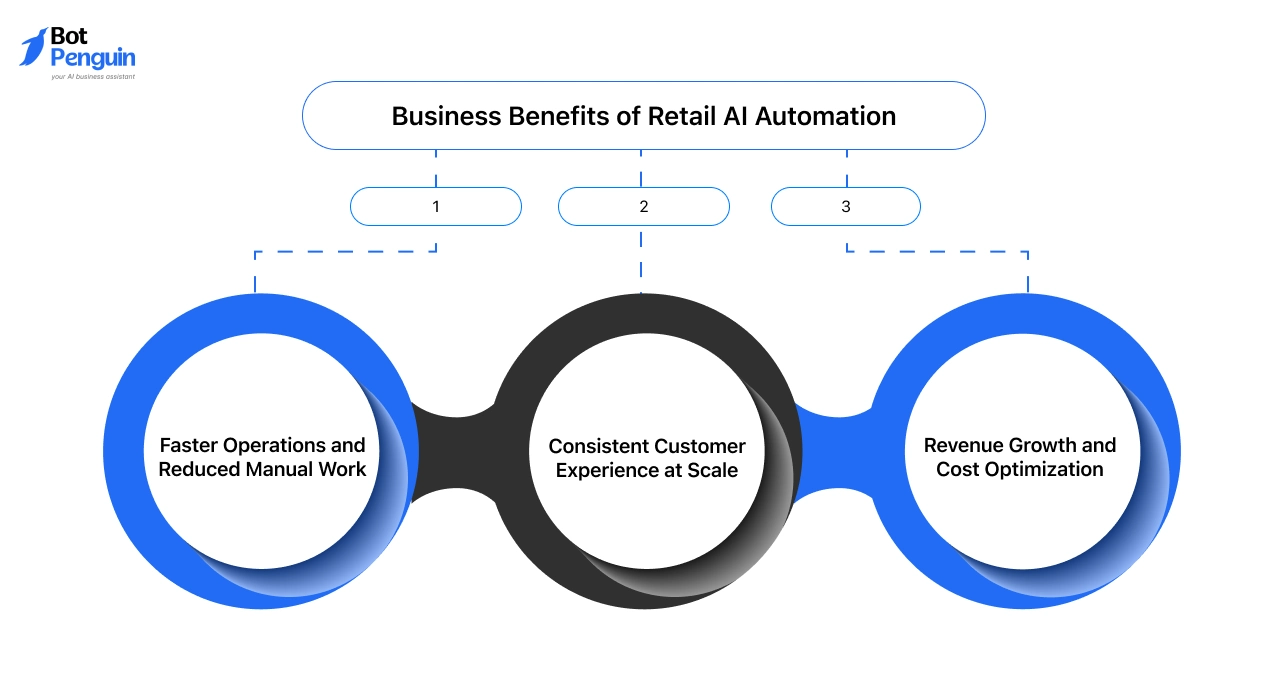
Once AI becomes part of daily retail workflows, its impact becomes evident quickly. Not in abstract metrics, but in how smoothly work moves from one step to the next.
Fewer handoffs. Fewer delays. Fewer moments where teams scramble to keep up. This is where retail AI automation proves its value.
It does not create new processes. It strengthens the ones retailers already rely on.
The benefits are practical. They show up in daily stand-ups, support queues, and sales dashboards. Over time, they compound across the business.
Manual work slows retail more than most teams realize. Small tasks add up. Checking order status. Routing tickets.
Updating systems and following up on the same questions repeatedly.
With retail automation AI, these tasks run automatically. A support request is categorized and answered. An order update triggers a message.
A lead is routed without manual review.
Teams stop reacting and start planning. Work moves forward without waiting for approvals or handoffs. This reduces burnout and errors.
Operations become predictable. Even during high-volume periods, workflows do not break. Speed improves without adding more tools or people.
Consistency is hard when volume increases. During sales or festive seasons, response quality often drops.
Customers receive different answers depending on the time or channel.
This is where AI automation in retail makes a difference. AI delivers the same accurate response every time. Policies stay consistent. Updates go out on time.
A customer asking about a return on chat receives the same guidance as someone asking on messaging. Context carries across channels. No one starts over.
This builds trust. Customers know what to expect. Teams stay confident that service quality will not slip when demand rises.
Revenue impact often follows operational stability. When customers get help quickly, they move forward. When delays drop, abandonment drops too.
Retail AI automation supports this by keeping shoppers engaged. Product questions get answered. Checkout doubts are resolved. Follow-ups happen on time.
At the same time, costs stay controlled. Fewer agents are needed for repetitive work. Teams focus on high-value conversations.
Resources shift where they matter most.
Margins improve not through pressure, but through efficiency.
As these benefits take shape, retailers begin to look beyond outcomes and toward execution.
The next step is to understand how teams move from intent to implementation and how AI automation is deployed in real retail environments.
Retailers are not switching everything at once. They are adding automation where it fits naturally and expanding only after seeing results.
This is how retail automation AI is showing up in real retail environments. It is integrated into existing systems, tested incrementally, and refined over time.
Most successful rollouts follow a pattern. Start small. Prove value. Then build on what works.
Most retailers do not begin with complex workflows. They start where impact is visible, and risk is low.
Customer-facing automation fits naturally here because it reduces workload quickly without changing internal processes. Common starting points include:
These use cases are easy to monitor. Response times improve. Support tickets are reduced. Customer experience remains consistent.
Because the scope stays limited, teams can test, adjust, and refine quickly.
This makes customer-facing automation a practical, low-risk first step before expanding AI automation across retail operations.
Once trust builds, retailers expand automation beyond support.
Sales teams use AI to assist shoppers during browsing and checkout. Operations teams rely on AI for order updates and internal alerts.
This is where retail AI automation begins to connect departments.
A customer conversation informs inventory checks. A delayed order triggers both a customer message and an internal task.
Over time, retention use cases appear. AI sends proactive updates, follow-ups, or reminders based on behavior, not as campaigns, but as timely support.
Each expansion builds on existing data and workflows. Nothing feels disconnected. Teams stay in control and can pause or adjust when needed.
As automation spreads across teams, attention naturally shifts to the tools behind it.
The focus shifts from what to automate to how to select systems that support long-term growth and flexibility.
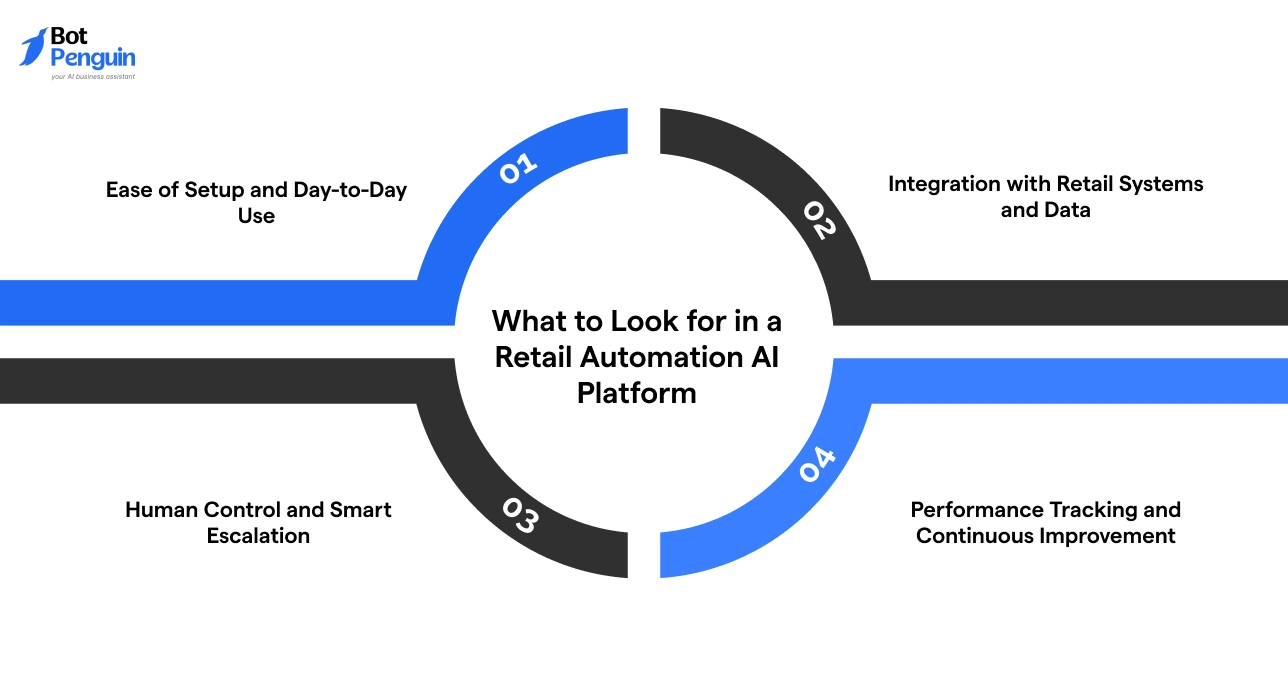
The right retail automation AI platform should feel practical from day one. It should support how retail teams already work, connect easily with existing systems, and scale without adding friction.
The goal is not more features, but fewer obstacles.
Platforms that succeed in retail are the ones teams trust to run quietly in the background while staying easy to control.
Retail teams do not have time for lengthy setup or complex configuration. If launching a basic workflow takes weeks, adoption slows immediately.
A reliable retail automation AI platform allows teams to get started quickly. Common use cases, such as FAQs, order updates, and customer routing, should be simple to configure.
Changes should not depend on developers or external support.
Day-to-day management matters just as much. Teams should be able to review conversations, refine responses, and monitor automation from a single, clear dashboard.
When tools are easy to use, automation remains active and useful rather than being ignored.
Automation only works when it has access to live data. Without integration, AI responses become generic and unreliable.
With AI automation in retail, platforms must connect smoothly with CRM systems, order management tools, inventory data, and POS systems.
When a customer asks about an order, AI should retrieve real-time information. When stock changes, responses should adjust automatically.
Strong integration removes the need for manual updates. Data stays consistent across teams. Customers receive accurate answers without delay.
Automation should never feel out of control. Retail teams need clear boundaries between AI and human involvement.
With retail AI automation, teams should determine when AI should handle a request and when it should escalate.
Complaints, edge cases, or sensitive issues should move to agents without friction.
Escalation must carry context. Agents should see the full conversation and customer history so nothing needs to be repeated.
This keeps service smooth and builds trust internally.
Effective automation improves over time. That only happens when teams can see what is working.
A strong retail automation AI platform provides clear visibility into response times, resolution rates, and customer behavior.
These insights help teams refine flows, identify gaps, and expand automation where it makes sense.
Patterns emerge naturally. Automation becomes sharper, not heavier.
When platforms support ease, integration, control, and insight, automation feels reliable.
That clarity also helps address doubts and concerns that often surface when AI enters retail workflows, which, in turn, lead to misconceptions many teams still hold.
After evaluating platforms and capabilities, many retailers realize that the biggest barriers to AI automation in retail are not technical.
They are mental models shaped by earlier tools and incomplete information.
These misconceptions often delay progress. Addressing them clearly helps teams move forward with confidence.
One common belief is that AI automation is expensive and only suited for large enterprises. In reality, many retailers start small.
They automate a single workflow, like order updates or FAQs. Costs stay controlled because automation replaces manual effort rather than adding layers.
Another concern is complexity. Teams fear long setup cycles or heavy technical dependency. Modern AI tools are built for speed.
Retail teams configure common use cases without developers. Adjustments happen in hours, not weeks.
There is also fear of losing control. Some worry AI will act on its own or make wrong decisions. In practice, retailers define boundaries.
AI handles routine work. Humans step in for exceptions. Escalation rules stay clear and visible.
A common concern is that AI will harm the customer experience. The opposite is often true. Customers prefer instant answers.
When AI responds clearly and hands off when needed, trust improves.
Finally, some believe automation removes the human element. What it actually removes is repetition.
Teams spend less time answering the same questions and more time solving real problems.
When these myths are set aside, AI automation in retail becomes easier to evaluate on its real merits.
It is a tool that supports teams, scales operations, and improves consistency when used with intent and clarity.
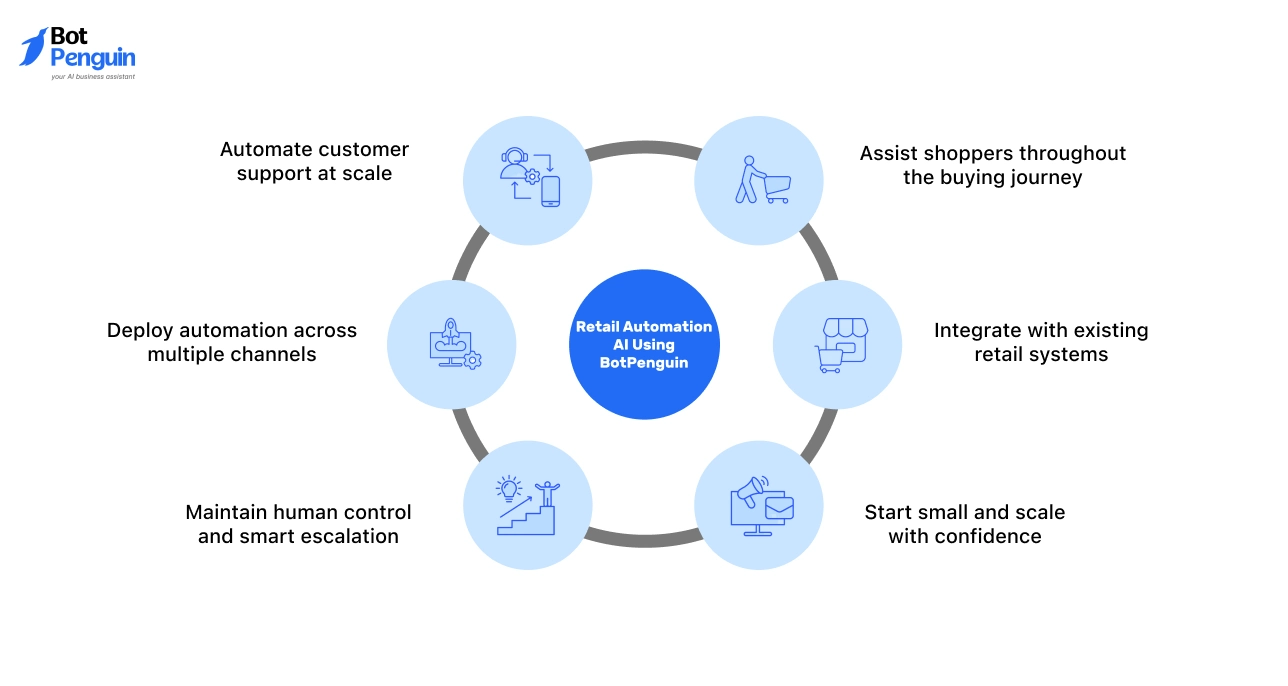
Retail automation works best when the platform stays simple, flexible, and grounded in real retail workflows.
BotPenguin is designed to help retailers move from intent to execution without overcomplicating adoption.
Here is what BotPenguin enables for retail teams:
BotPenguin makes retail automation AI practical and manageable.
It helps retailers remove friction from daily operations while keeping teams in control and customers engaged.
So, don’t delay any further and start with AI automation for your retail business today!
Most retailers can launch basic AI automation in retail within a few hours. Use cases like FAQs or order updates require minimal setup, especially when using no-code automation platforms such as BotPenguin.
Small and mid-sized retailers often benefit the most. Retail automation AI helps lean teams handle higher volumes without increasing staff or operational complexity.
Retailers control how data is accessed and used. Most AI automation on retail platforms adheres to standard security and compliance practices to protect customer information.
Yes. AI automation tools in retail, such as BotPenguin, support multiple languages, helping retailers serve diverse customer groups consistently across regions.
Success is measured through response time, ticket reduction, conversion rates, and customer satisfaction. These metrics clearly show the impact of retail AI automation.
Subscribe to Our Newsletter
Get the latest business insights straight into your inbox.
Checkout our related blogs you will love.
Updated at Sep 14, 2026
12 min to read
Updated at Sep 11, 2026
11 min to read
Table of Contents