


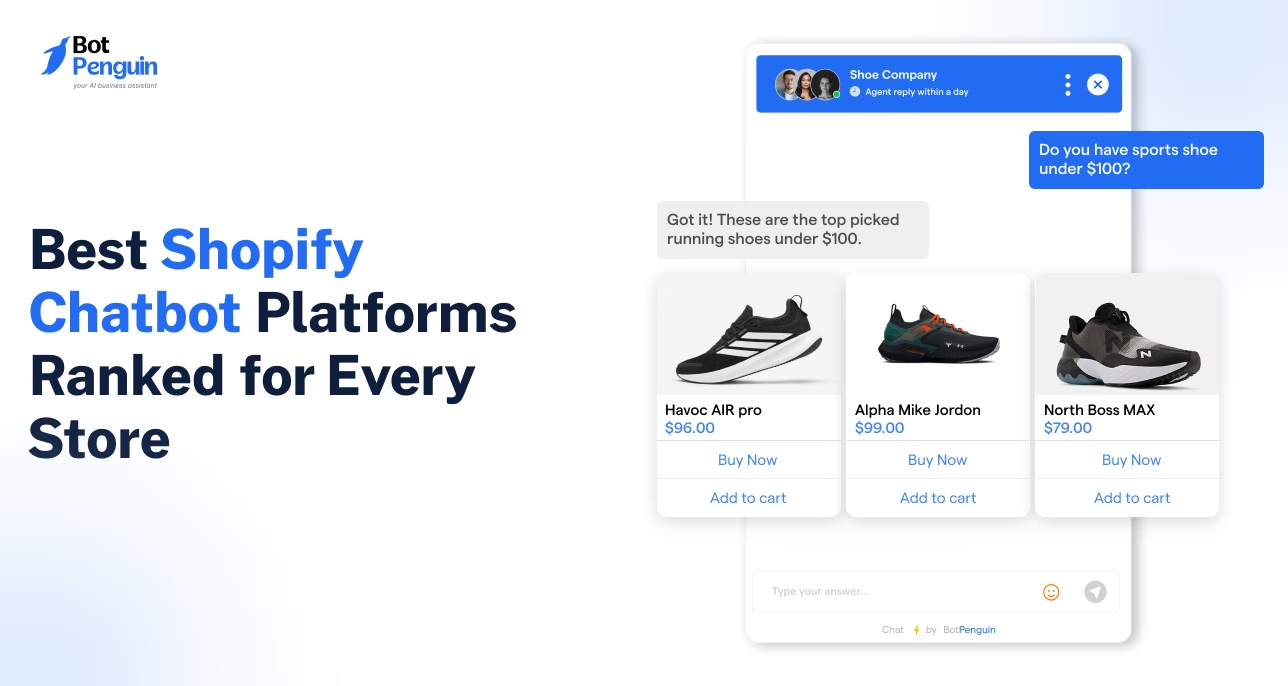
Best Shopify Chatbot Platforms Ranked for Every Store
Updated at Oct 13, 2026
9 min to read
An AI chatbot increases Shopify sales by acting at the moments that decide a purchase.
It suggests one relevant add-on after a product goes into the cart, follows up on abandoned checkouts by solving the reason the shopper left, qualifies serious buyers before a human joins, and answers product questions before hesitation turns into a lost sale.
Most Shopify stores don't have a traffic problem. They have a conversion problem: shoppers who were ready to buy leave with a question unanswered, a cart left behind, or a doubt nobody addressed.
A chatbot helps only when every message has a job and a trigger. Sending more messages doesn't help. This guide covers the tactics that move revenue (upsells, cart recovery, and lead qualification), when to trigger each one, and how to prove the return so the investment is easy to defend.
If you want the basics first, see what a Shopify chatbot does.
A chatbot should be evaluated as a revenue investment, not only a support expense. It influences shoppers during moments that directly affect conversion.
Revenue comes from how those conversations affect purchase decisions. The clearest signals are recovered carts, accepted recommendations, faster answers and completed purchases.
A chatbot can influence revenue at several points before checkout. Its value extends beyond reducing support workload.
A Shopify chatbot should therefore be judged against sales outcomes, not only ticket reduction.
Cost savings remain useful, but revenue metrics show whether conversations create or preserve commercial value.
Chatbot value appears at specific decision points. The table connects each shopper moment with its likely commercial outcome.
Fast answers keep the buying process moving when shoppers need reassurance before committing.
Merchants can compare the revenue impact of BotPenguin's Shopify chatbot against their current store performance.
A chatbot generates revenue through three connected levers: cart recovery, higher order value and lower purchase hesitation. Each lever affects a different buying stage, so merchants should measure them separately.
Faster responses matter when shoppers need reassurance before checkout. Delayed answers can create hesitation and send buyers elsewhere.
A chatbot can support conversion by answering:
These answers are most valuable during product selection and checkout. At these stages, speed can protect active purchase intent.
Track response time and chatbot-assisted conversion rate together. This connects faster service with completed purchases.
Product recommendations work when they respond to a clear customer action. A shopper who adds an item has shown buying intent.
That action gives the chatbot useful context. It can recommend something relevant without interrupting the customer's decision.
The chatbot should wait until a product enters the cart. Recommending items during the first visit can feel premature.
Use the selected product to decide what appears next. The recommendation should support the original purchase instead of competing with it.
See how chatbot product recommendations work for more detail on matching offers to shopper intent.
A customer buying a phone may need a case or screen protector. Showing another phone may create confusion and slow the decision.
Set the trigger to activate once after cart addition. Repeating the same offer during checkout can frustrate customers.
A complementary product should make the original purchase more useful. It should also be easy to add.
Suppose a customer adds running shoes to the cart. The chatbot can recommend running socks before checkout.
The message should explain the connection clearly. It could mention comfort, fit or suitability for running.
Send a product card or link so the customer can add the socks in one step.
This approach can increase order value while keeping the buying process simple.
For more automated marketing flows, see chatbot ideas for Shopify marketing automation.
Show one or two relevant options. Too many choices can delay checkout and reduce the value of the recommendation.
Remove unrelated products from the flow. Limit repeated messages during the same session.
Review acceptance data to identify which offers customers actually add. Remove suggestions that receive little engagement.
A focused chatbot for Shopify should help customers complete their purchase with less effort.
According to the Baymard Institute, the average documented online shopping cart abandonment rate is 70.22% (Source: Baymard Institute, 2026).
A cart reminder has little value when it ignores why the customer left.
Effective recovery depends on timing, product context, and the issue blocking the purchase. The message should help the shopper continue.
A recovery flow begins when a customer leaves checkout without completing payment.
The chatbot should record the cart contents and prepare a relevant follow-up message.
Send the first message soon after abandonment while the selected product remains relevant.
Do not use the same timing for every later message. Adjust follow-ups based on customer responses and campaign performance.
Stop the recovery flow after a purchase, direct rejection or support handoff. This prevents unnecessary messages.
The first message should offer help. It should not create false urgency or pressure.
A generic reminder gives the customer little reason to return.
Weak message:
"You left something in your cart."
Stronger message:
"You left the black running shoes in your cart. Do you need help with sizing or delivery?"
The stronger message reflects the customer's previous action. It also addresses two possible purchase concerns.
Product details can make recovery messages more useful. These details may include name, size, color or quantity.
Only include information available through the store and chatbot integration.
Customers abandon carts for different reasons.
Common barriers include shipping costs, delivery timing, sizing questions, payment problems and unclear return policies.
The chatbot should identify the concern before suggesting an incentive.
A short question can direct the conversation
"What stopped you from completing your order?"
The reply can trigger the correct response.
Shipping questions should receive delivery details. Payment issues should receive supported payment options.
Product concerns should receive accurate sizing, material, compatibility, or availability information.
This approach addresses the actual problem instead of assuming price caused the abandonment.
A discount should not be the first recovery tactic. Many customers only need clarification or reassurance.
A later message may include an incentive when the purchase remains incomplete.
The offer should follow clear rules. These rules may consider cart value, product margin, customer segment or purchase history.
Frequent coupons can teach shoppers to abandon carts and wait for discounts.
A structured discount policy also protects margins. It prevents agents and automated flows from offering unnecessary incentives.
For a full setup, follow our Shopify abandoned cart automation guide.
Not every shopper needs immediate human support.
Some customers need a simple product answer. Others are ready for a detailed sales conversation.
A chatbot can collect essential details first. It can then route each customer based on intent and buying needs.
Start with one question that identifies the customer's purpose.
Then ask only what is needed for the next step.
Useful questions include:
Keep the flow short. Two or three relevant questions are usually enough.
A long sequence can feel like a form. It may cause the customer to leave before completing the conversation.
Only collect information that affects the recommendation, routing decision or sales response.
A practical flow should begin by identifying customer intent.
The chatbot can then ask relevant questions and record each answer.
Next, it should determine whether human help is required.
Simple requests can remain automated. Complex questions should move to the correct team member.
Strong buying signals may include a clear budget, urgent timeline, bulk order or detailed product requirement.
Each step needs a clear purpose. Avoid collecting details that will not affect the final response.
A useful flow follows this sequence:
The chatbot should classify requests before assigning them.
Product recommendations can stay within the guided shopping flow.
Bulk purchase requests should go to sales. Order questions should reach customer support.
Return requests should follow the store's return process. Technical concerns should reach the correct specialist.
General questions may remain automated when accurate information is available.
Clear routing reduces waiting and prevents conversations from reaching the wrong team.
A human agent should receive the customer's details, discussed products, answers and previous messages.
The handoff should also include the stated concern or buying intent.
This context prevents repeated questions. It helps the agent continue the conversation from the correct point.
The agent should know why the conversation was transferred. They should also see what the chatbot already explained.
This creates a smoother transition and reduces the time needed to understand the request.
The same chatbot message can help or annoy a customer depending on when it appears.
Timing should match the shopper's current action and buying stage. A useful trigger responds to clear customer behavior.
Product page activity can show that a shopper needs more information before buying.
A chatbot can respond when a shopper asks a product question or asks to compare items.
It can offer product comparisons, size guidance, availability information or relevant alternatives.
The message should support the current decision. It should not interrupt a visitor who has just opened the page.
A customer viewing two similar products may need a comparison. A customer checking several sizes may need fit guidance.
Trigger the message only when the customer's activity suggests uncertainty or interest.
Adding a product to the cart shows stronger buying intent than viewing a page.
The shopper has selected an item and moved closer to checkout.
This is the right stage to suggest one complementary product.
The recommendation should connect directly to the cart item. It should also remain easy to add.
Show the offer once after cart addition. Avoid repeating it across every checkout step.
Stop showing the recommendation when the customer removes the related product.
A recovery flow should begin after the system detects an incomplete checkout.
The first message should mention the abandoned product and offer practical help.
Send it while the cart remains active and relevant. The exact schedule should reflect store data and customer response.
Later messages should be spaced carefully. Stop the sequence after a purchase, rejection or support request.
Repeated messages can frustrate customers and reduce trust.
Chatbot conversations do not prove revenue impact.
A busy inbox can still produce weak sales results. Shopify merchants should measure every sales tactic separately.
This shows which messages, triggers, and flows influence customer actions.
Upsell acceptance rate shows whether customers find product recommendations relevant.
Track the number of offers shown, accepted offers, and extra revenue from those purchases.
Use this calculation:
Accepted upsells ÷ total upsell offers × 100
Review results by product, recommendation, and placement.
A strong offer for one product may perform poorly for another.
Also review the additional revenue generated. A high acceptance rate may still produce limited value on low-priced items.
Cart recovery rate measures whether reminders bring shoppers back to complete purchases.
Track abandoned carts contacted, recovered carts, recovered revenue and revenue linked to each message.
Use this calculation:
Recovered carts ÷ contacted abandoned carts × 100
Compare individual recovery messages. This helps identify which wording and timing produce better results.
Also track unsubscribe requests and support escalations. These signals can reveal whether the sequence sends too many messages.
Lead qualification should be measured beyond the number of conversations transferred to sales.
Track how many visitors enter the flow, complete the questions, reach an agent and become customers.
This shows whether the questions identify real buying intent.
A high handoff rate does not always indicate success. The flow may transfer too many low-intent conversations.
Compare qualification answers with final sales outcomes. Remove questions that do not improve routing or conversion.
Compare purchases from customers who interacted with the chatbot against purchases from customers who did not.
This comparison can reveal a relationship between chatbot use and conversion.
However, an assisted sale should not be credited entirely to the chatbot without clear attribution rules.
Customers may also interact with email, advertisements, search results or sales agents.
Define how long a chatbot interaction remains part of the conversion journey. Apply the same attribution rule consistently.
A strong result from one store does not predict the same outcome elsewhere.
Performance depends on traffic quality, average order value, offer relevance and flow design.
Published results should serve as reference points, not fixed benchmarks. The most reliable comparison comes from each store's own pre-launch data and flow-level reporting.
This keeps ROI expectations realistic and prevents isolated success stories from becoming misleading promises.
Revenue results will differ across Shopify stores. A Shopify chatbot performs within each store's traffic, product mix, offer quality and conversion process.
Performance depends on store conditions, while reliable ROI depends on clear attribution and store-level benchmarks.
The same chatbot flow can produce different results across stores because the conditions are different.
A high-traffic store with weak offers may underperform. A smaller store with focused flows may generate stronger returns per conversation.
Conversion attribution must use a consistent reporting window. Merchants should compare results against pre-launch baselines and control periods where possible.
Executive approval becomes easier when the proposal starts with current store performance rather than broad claims about automation.
A credible proposal starts with a baseline, connects each flow to a commercial outcome and proves value through a limited rollout. Here's how.
Before proposing new investment, document how the store performs today. This gives decision-makers a credible comparison point.
Record current cart recovery, conversion rate, average order value, response time and support cost per conversation. These figures reveal where revenue is being lost and where automation may create measurable value.
A clear baseline also prevents later results from being attributed to the chatbot without evidence.
Every chatbot flow should support a defined business result. Cart reminders should connect to recovered revenue. Product recommendations should connect to upsell acceptance and order value.
Present revenue gains separately from support savings. Recovered sales and higher order values show growth. Lower response times and support costs show operational efficiency.
The most useful reporting metrics include:
This structure helps executives see which outcomes justify continued investment.
Start with one or two high-impact flows instead of automating every customer interaction at once. Cart recovery and product recommendations are practical starting points because their outcomes are easier to isolate.
Set a defined test period and report results by individual flow. Compare each result with the pre-launch baseline and explain any changes in traffic or offers.
A limited rollout reduces risk while producing evidence that can support wider adoption.
Once leadership can see where revenue is created, approval becomes a decision grounded in performance rather than expectation.
BotPenguin connects to your Shopify store, so your WhatsApp and website chatbots can work with live store data. Once connected, the chatbot can help shoppers browse products, check order status, recover abandoned carts, and confirm cash-on-delivery orders. Store events such as abandoned carts, new orders, fulfilled or canceled orders, and return requests can automatically trigger WhatsApp messages.
To start, open your bot in BotPenguin, go to Integrations, choose Shopify, enter your store name, and approve the BotPenguin app in Shopify. Then add the chat widget to your store. Our guide shows how to connect your chatbot to Shopify step by step.
Start with one flow, such as cart recovery on WhatsApp, measure it against your baseline for a few weeks, and only then add the next one. The Shopify integration is included from the Little plan ($29/month), and paid plans come with a 7-day free trial, no credit card needed.
Revenue depends on store traffic, average order value, and chatbot flow quality. Most gains come from cart recovery, relevant upsells, and faster answers. Results are strongest when merchants track recovered revenue and assisted conversions against their existing store performance.
A strong moment is usually after a customer adds a relevant product to the cart. That action shows clearer purchase intent than a simple page visit. The suggested item should directly support the original purchase and remain easy to add.
Chatbot recovery can respond to customer actions and reference specific cart details such as product name, size, or quantity. It can also ask what stopped the purchase. Email recovery often follows a scheduled sequence, while chatbot recovery can support a more interactive response.
Yes. A chatbot can ask about budget, product interest, purchase timing, and specific needs before routing the conversation. It can then send the answers and chat history to the right team member. This helps sales agents begin with useful context instead of repeating basic questions.
Payback time varies with traffic, subscription costs, order value, and flow performance. Stores with steady purchase activity may recover costs within a few months. The result becomes clearer when revenue gains and support savings are compared with the total cost of ownership.
The Shopify integration is included from the Little plan at $29 per month and on the King plan at $99 per month, as well as BotPenguin's WhatsApp-only plans. It is not part of the Free plan. Paid plans have a 7-day free trial with no credit card, so you can connect your store and test a flow first.
A chatbot adds revenue when it acts at the right moment with the right message: one relevant add-on after a cart addition, a helpful follow-up after an abandoned checkout and a short qualification before a serious buyer reaches your team.
Start with the flow closest to your biggest leak, record your baseline and track the result separately from support savings. When the numbers hold, add the next flow. If you're ready to test it on your own store, try BotPenguin's Shopify chatbot.
Subscribe to Our Newsletter
Get the latest business insights straight into your inbox.
Checkout our related blogs you will love.
Updated at Oct 13, 2026
9 min to read
Updated at Oct 13, 2026
8 min to read
Updated at Oct 13, 2026
8 min to read
Updated at Sep 26, 2026
10 min to read
Updated at Sep 10, 2026
10 min to read
Updated at Sep 10, 2026
15 min to read
Table of Contents