What Is an Omnichannel Customer Experience?
Updated at Sep 25, 2026
14 min to read
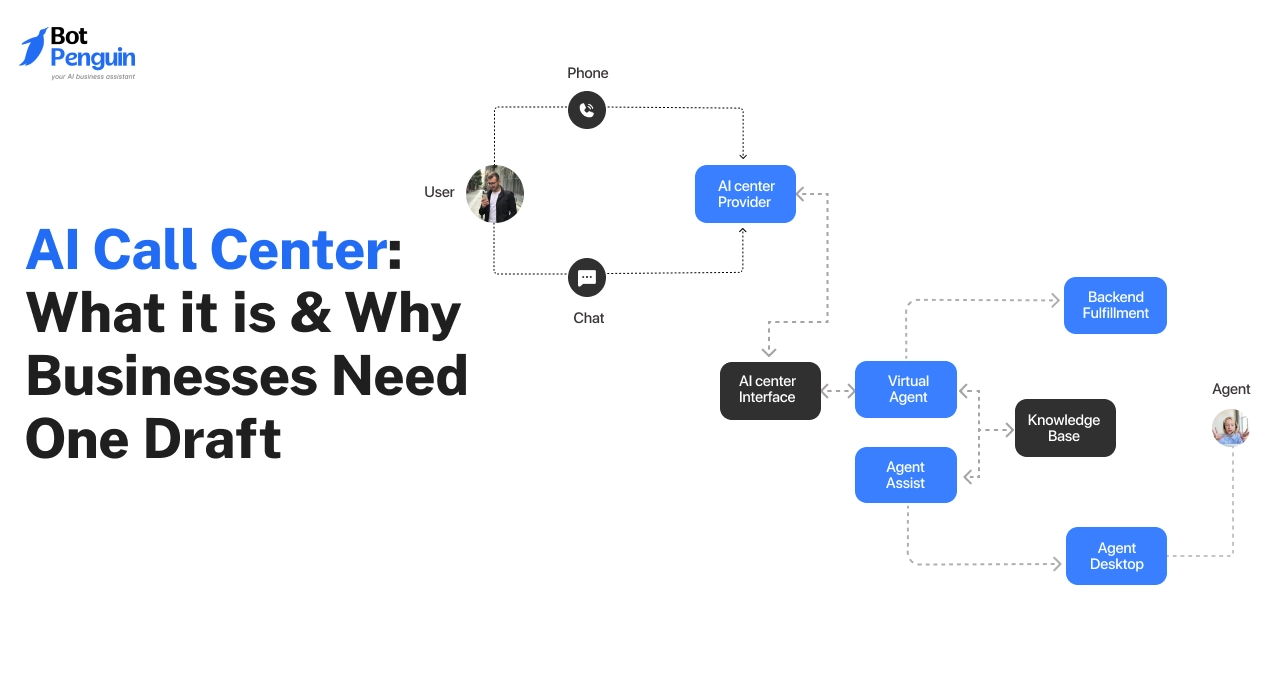
Most customer calls today never need a human. AI is quietly taking over the first “Hello” in call centers worldwide.
Businesses that once relied on large teams now use AI call centers to handle questions, route calls, and solve problems faster and cheaper. Customers get instant responses and companies save hours every day.
This shift isn’t about replacing people. It’s about building smarter, always-on systems that make human work easier and customers happier.
In this guide, you’ll learn what an AI call center really is, how it works, and why it’s becoming essential for modern businesses.
An AI call center represents the evolution of customer communication. It uses artificial intelligence to manage calls, understand customer intent, and deliver accurate responses without human intervention for routine tasks.
Instead of relying only on manual input, it blends automation, data, and language understanding to create faster and more efficient service experiences.
A traditional call center depends on human agents for every query. This leads to longer wait times, limited operating hours, and higher costs.
In contrast, an AI call center operates 24x7, handles thousands of interactions simultaneously, and learns from each conversation to improve future responses.
For instance, a retail brand using AI for call center operations can automatically identify a returning customer, detect intent, and respond instantly about order status or return policies.
The agent only intervenes if the system flags a complex issue. This balance keeps response times low while maintaining service quality.
In short, an AI call center combines intelligence, automation, and data learning to enhance both customer and agent performance. With the foundation clear, the next step is to understand how this system actually works and what powers its intelligence.
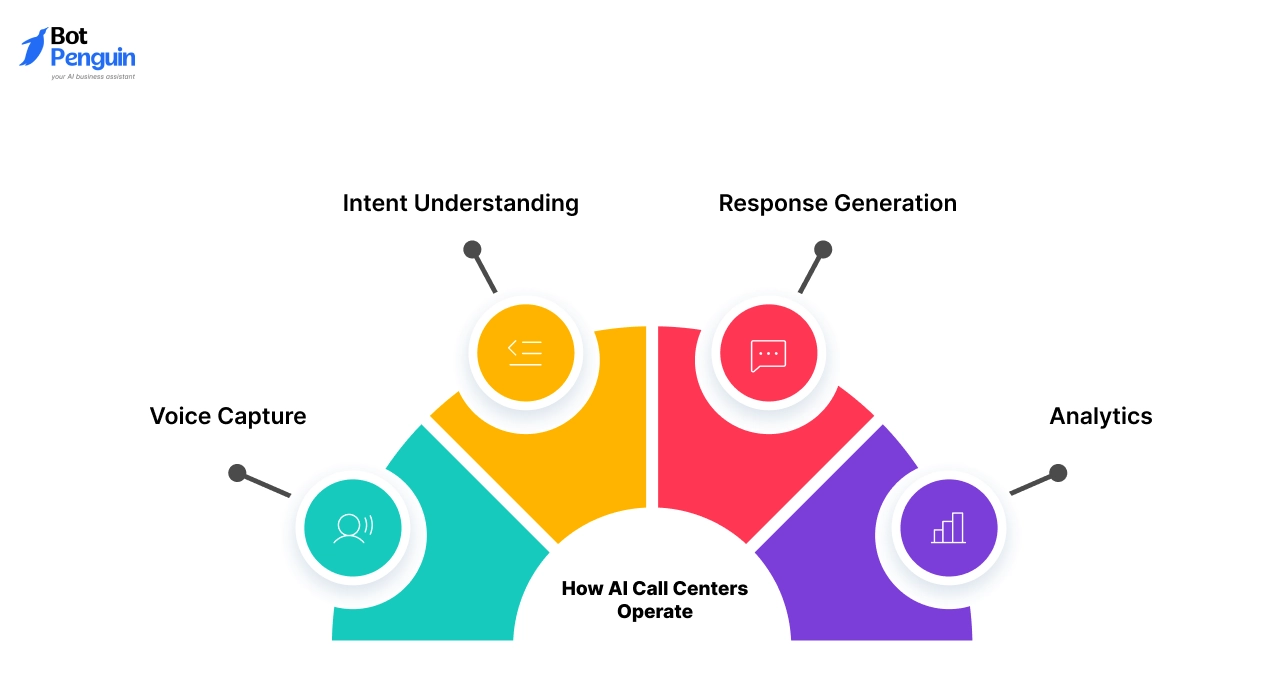
An AI call center operates through a connected workflow that combines speech recognition, natural language processing, automation, and analytics.
The system converts live voice interactions into structured data, interprets intent, retrieves relevant information, and delivers accurate responses within seconds.
This architecture allows organizations to manage high call volumes, minimize errors, and gain real-time visibility into performance through AI call center technology.
The process begins when the customer speaks to the system.
Once the text is ready, natural language processing models analyze its meaning and context.
After intent classification, the AI system produces the appropriate response.
Every interaction generates measurable data that fuels continuous improvement.
Voice Capture → Intent Understanding → Response Generation → Analytics
Each stage converts unstructured speech into structured intelligence. The system continuously learns from data, strengthens prediction accuracy, and delivers consistent service quality regardless of call volume.
By understanding how these steps interact, it becomes clear why AI call center technology is redefining customer communication. The next section will examine the core components that enable this intelligent workflow to operate efficiently and at enterprise scale.
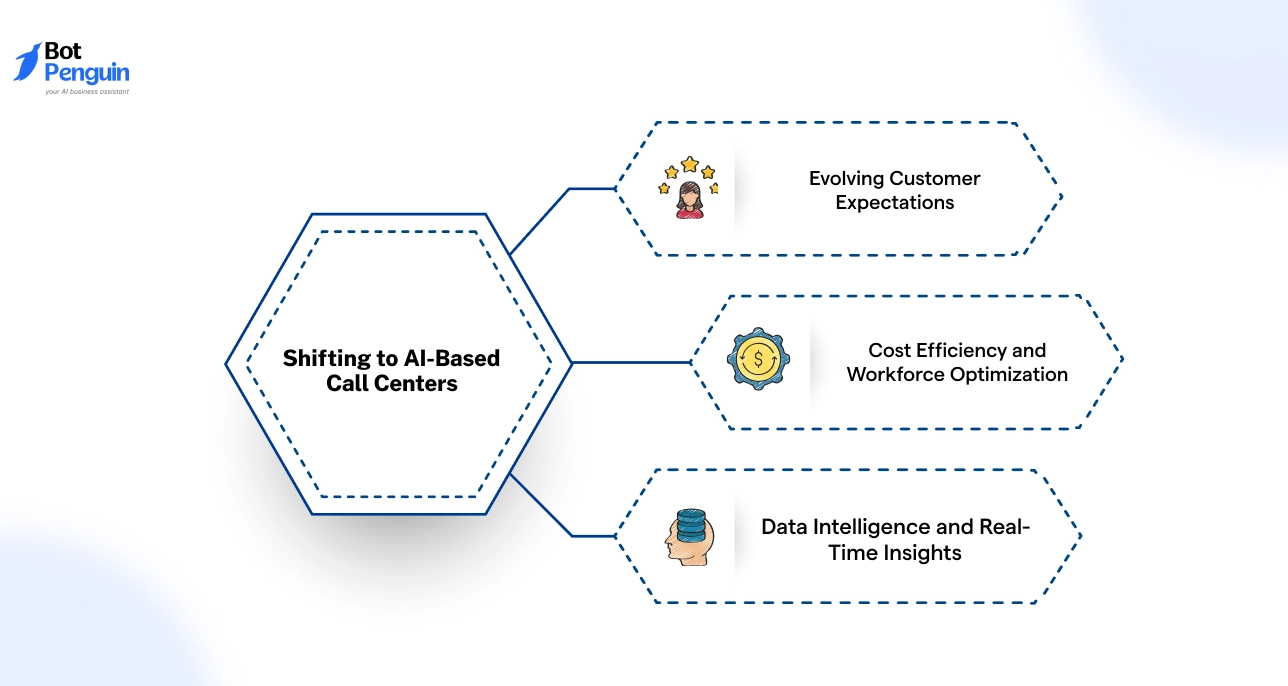
Customer service is undergoing a major transformation. The rise in customer expectations, operational costs, and the demand for instant support are driving organizations toward automation.
The AI based call center market is projected to exceed 10 billion USD by 2028, reflecting a global shift in how businesses approach communication and service delivery.
By adopting an AI powered call center, organizations are reducing manual dependency, increasing responsiveness, and improving overall service consistency. The transition is driven by measurable business outcomes and not just technology adoption.
Customers expect immediate, accurate, and personalized responses across every communication channel.
Businesses use AI to meet rising customer expectations for speed, accuracy, and personalization.
Reducing costs while maintaining service quality is a top operational priority for modern organizations.
AI optimizes resources, reduces costs, and strengthens operational scalability.
Every customer interaction produces valuable operational data that often goes unused in traditional systems.
AI transforms raw customer interactions into actionable intelligence that drives continuous improvement.

A mid-sized eCommerce company adopted a call center with AI to manage high order volumes during festive sales.
AI enables scalability and service consistency without increasing operational load.
The adoption of AI powered call center systems reflects a data-driven shift toward intelligent, scalable, and customer-focused operations.
With the motivations for adoption established, the next section explores the specific benefits of AI in call centers and the measurable results businesses achieve after implementation.
The integration of AI in call centers has moved from experimentation to proven business strategy. Companies now adopt AI to optimize performance, cut costs, and enhance customer engagement.
With call center AI, support functions become more efficient, data-driven, and scalable — aligning operational goals directly with measurable outcomes.
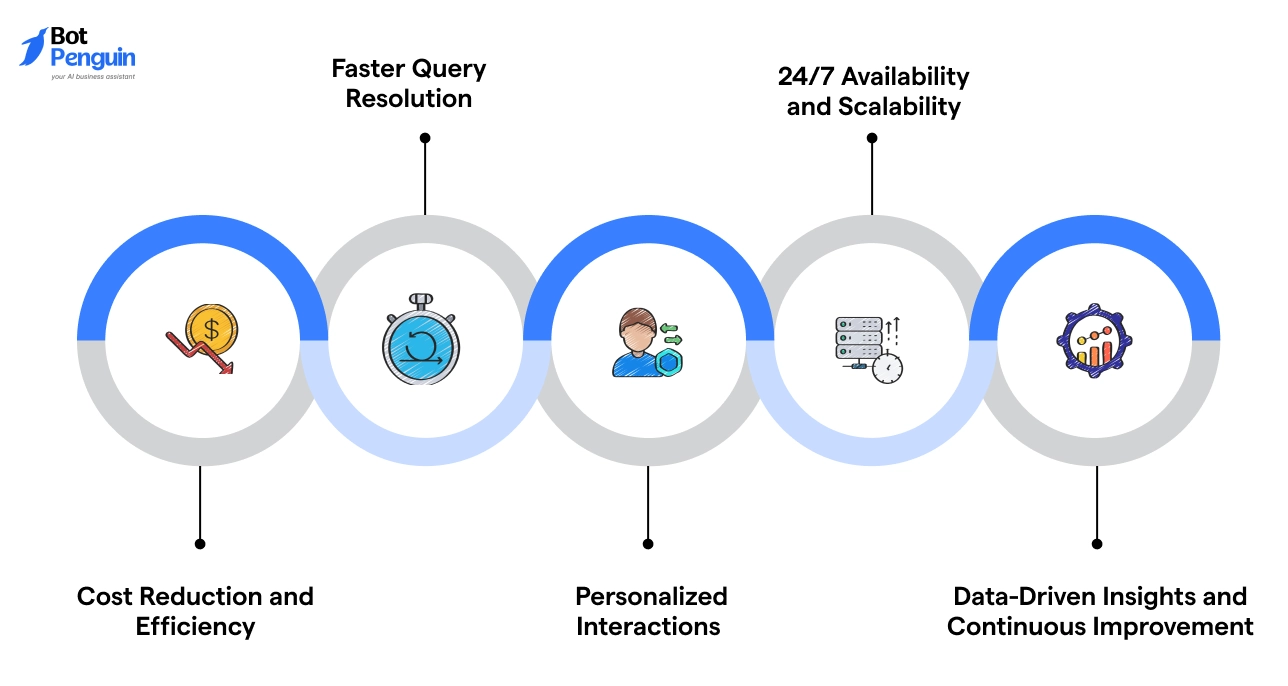
Below are five core benefits organizations consistently experience when implementing AI for call centers.
Running a traditional call center involves heavy expenses in staffing, training, and infrastructure maintenance. AI for call centers automates repetitive tasks such as order tracking, account verification, and information retrieval, reducing human dependency.
This automation minimizes labor costs and operational delays while improving task accuracy. Agents can focus on higher-value cases instead of routine calls.
On average, businesses using AI in call centers achieve a 30 to 40 percent reduction in operational expenses and greater overall efficiency.
Business Impact: Companies report substantial cost savings and optimized workforce utilization with minimal compromise on service quality.
Response time is critical for customer satisfaction. Call center AI improves speed by instantly identifying intent, analyzing context, and generating accurate responses from internal systems.
For example, in telecom or banking, AI can instantly verify customer details, share billing updates, or process simple transactions without queue delays. This leads to shorter call durations, reduced hold times, and faster first-contact resolutions.
Business Impact: Organizations achieve up to 40 percent faster resolutions and stronger customer satisfaction through intelligent routing and real-time automation.
Personalization enhances both experience and loyalty. AI in call centers uses customer data — including past conversations, purchase history, and sentiment — to adapt interactions dynamically.
When a returning customer reaches out, the AI references prior issues and preferences to tailor responses. This creates a more human-like interaction while maintaining consistency and accuracy. Businesses also use these insights to identify upselling and cross-selling opportunities.
Business Impact: Personalized engagement leads to higher customer satisfaction and measurable increases in retention and revenue growth.
Customer expectations now extend beyond standard business hours. AI for call centers provides continuous support across time zones and channels, ensuring customers always receive assistance.
During demand surges, call center AI scales instantly to manage increased call volumes without affecting response quality. The system prioritizes urgent queries and distributes workload evenly, maintaining consistent service delivery.
Business Impact: Enterprises achieve uninterrupted service and scalable support capacity without additional infrastructure or staffing costs.
Every customer interaction contains valuable operational data. AI in call centers captures and analyzes this data to uncover patterns, identify inefficiencies, and predict customer behavior.
Supervisors gain real-time visibility through analytics dashboards tracking performance metrics, call reasons, and satisfaction trends. The AI continuously retrains itself using this data, improving accuracy and decision-making over time.
Business Impact: Businesses convert interaction data into actionable insights, driving continuous optimization and higher service reliability.
The adoption of AI in call centers delivers measurable returns across efficiency, speed, personalization, scalability, and intelligence.
By transforming service operations into data-driven ecosystems, AI enables companies to achieve sustainable performance improvements and stronger customer relationships.
The next section will highlight real-world examples showing how these outcomes translate into practical business success.
With businesses prioritizing efficiency and customer satisfaction, the use of artificial intelligence for call centers is expanding across industries.
Companies are applying AI to automate interactions, streamline processes, and derive insights that improve decision-making. The following examples highlight how organizations in different sectors are using AI call centers to solve real operational challenges and deliver measurable outcomes.
Each scenario demonstrates a clear transformation: from manual inefficiency to automated intelligence powered by AI for call center systems.
Problem: Retail brands deal with high call volumes related to order tracking, returns, and stock availability. Manual handling led to long waiting times and inconsistent responses during peak sales periods.
AI Solution: The retailer implemented an AI call center integrated with its CRM and inventory systems. The AI automatically recognized customer intent, retrieved order information, and resolved repetitive questions without agent involvement.
Measurable Outcome: Within two months, over 70 percent of repetitive queries were automated. Average handling time dropped by 40 percent, and customer satisfaction improved by 28 percent during seasonal demand spikes.
Problem: A financial service provider faced growing pressure to provide instant account assistance while ensuring transaction security. Manual verification processes delayed issue resolution and increased support costs.
AI Solution: The company deployed artificial intelligence for call centers to authenticate users through voice recognition and detect anomalies using real-time behavioral analytics. The AI handled routine balance inquiries and card status updates while flagging potential fraud cases for human review.
Measurable Outcome: Response time decreased by 45 percent, while fraud detection accuracy improved by 30 percent. The company reduced agent workload and maintained compliance across all service channels.
Problem: Healthcare centers struggled to manage appointment scheduling, prescription refills, and patient record requests efficiently. Human agents were unable to handle large daily call volumes, leading to delays and missed follow-ups.
AI Solution: Hospitals implemented AI for call center platforms integrated with patient databases and electronic health record systems. The AI scheduled appointments, sent reminders, and provided automated updates about reports and consultations.
Measurable Outcome: Appointment scheduling accuracy increased by 35 percent, and patient waiting time was reduced by 40 percent. Staff productivity improved as administrative workloads decreased, enabling teams to focus on patient care.
Across industries, AI call centers are addressing real business challenges with quantifiable results. From retail efficiency to fintech security and healthcare reliability, AI-driven systems are transforming how organizations manage communication and service quality.
The rise of AI in call centers marks a major shift in how organizations manage communication, efficiency, and customer satisfaction. Rather than replacing human agents, AI strengthens customer service teams by handling repetitive tasks and providing accurate, data-backed responses.
This allows human representatives to focus on complex, value-driven conversations. The result is faster query handling, better personalization, and round-the-clock availability that enhances the customer experience.
An AI powered call center enables scalability and consistency across operations without increasing staff or infrastructure costs. Businesses using AI for call center operations gain measurable benefits such as reduced costs, higher service accuracy, and actionable insights from every interaction.
AI is not a substitute for human empathy but a technology that extends its reach through automation and intelligence.
It automates repetitive customer interactions, optimizes call routing, and provides real-time assistance to agents, improving speed and consistency.
Yes, most call centers AI solutions connect with tools like Salesforce, HubSpot, and Microsoft Dynamics to unify customer data and reporting.
Call center voice AI enables systems to recognize speech, analyze tone, and respond naturally to customer queries, enhancing interaction quality.
Voice AI call center platforms follow global security standards such as GDPR and SOC 2, using encryption and restricted access to protect customer information.
Performance is tracked through key metrics like resolution time, agent productivity, customer satisfaction, and operational cost savings.
BotPenguin provides a ready-to-deploy AI call center solution with voice automation, CRM integration, and analytics tools, enabling quick setup and measurable ROI.
Boost Sales with Automated Calling & Lead Qualification
Automate calls, engage prospects instantly, and route only qualified leads to your team for smoother conversions.
Explore Now!Checkout our related blogs you will love.
Updated at Sep 25, 2026
14 min to read

Updated at Aug 14, 2026
8 min to read
Updated at Aug 8, 2026
7 min to read
Updated at Jul 29, 2026
9 min to read
Updated at Jun 22, 2026
8 min to read

Updated at Jun 22, 2026
10 min to read
Table of Contents