Best Free AI Agent Builder (No-Code Tools to Build AI Agents)
Updated at Sep 30, 2026
18 min to read
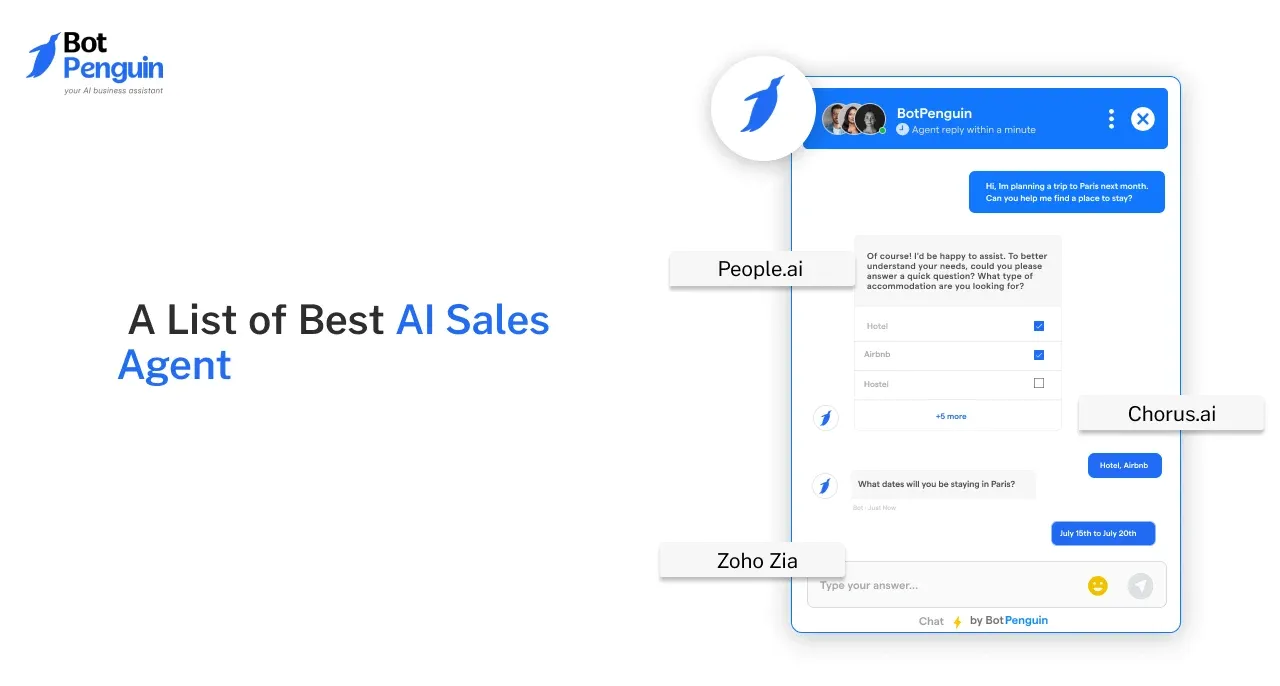
An AI sales agent is software that autonomously qualifies leads, answers questions, follows up, books meetings, and syncs activity with your CRM across sales channels. Some focus on outbound prospecting, others on inbound qualification or CRM assistance. The best choice depends on your sales motion, channels, integrations, and how quickly you need to deploy.
A prospect can show interest when your sales team is offline. If nobody responds quickly, that opportunity can disappear. The buyer may move to a competitor before your team replies.
An AI sales agent closes that response gap. It can reply instantly, ask qualification questions, handle routine conversations, follow up, and route high-intent prospects.
An AI powered sales agent can work across messaging channels and keep CRM data updated.
This guide explains how these agents work and what they automate. It compares agent types and the ten best options for 2026. You will also learn how to choose an AI agent for sales based on channels, integrations, and deployment needs.
An AI sales agent is software built to handle sales conversations and tasks. It combines artificial intelligence, large language models, business data, and connected tools inside defined sales workflows.
It can handle tasks that previously required human involvement, including:
This makes it different from a traditional scripted chatbot. Rule-based bots follow predefined paths and rely on fixed instructions. An AI sales agent can understand context, choose the next action, and interact with connected systems.
Businesses can deploy these capabilities through an AI sales agent platform.
You may also see terms such as AI salesperson, AI sales rep, or AI sales representative. Some vendors use AI sales bot or AI sales assistant for similar capabilities.
These names may emphasize different interfaces or sales tasks. However, they generally describe AI handling part of the sales process.
The important question is how the agent understands context, accesses business data, and takes action. That workflow becomes clearer when you look at how AI sales agents actually work.
An AI sales agent connects customer conversations with business data, tools, and CRM systems. The workflow usually follows this path:
Customer channel → AI agent → business knowledge/tools → CRM/action → response
A typical interaction works like this:
1. A prospect starts a conversation on a supported channel.
2. The agent interprets the prospect’s intent and context.
3. It retrieves information from approved business sources.
4. It generates a response based on that information.
5. It calls a connected tool when action is required.
6. It may read or update information inside the CRM.
7. It determines the next appropriate step.
8. It continues the conversation or escalates to a human.
The agent may check availability or retrieve product information. It can also qualify prospects, create CRM records, schedule meetings, or route leads.
Its answers should come from approved company knowledge. Sources may include website pages, documentation, FAQs, and product information. This keeps responses aligned with the business.
Autonomous agents handle repeatable sales workflows with limited human involvement. They can manage qualification, follow-up, scheduling, and high-volume inbound conversations. Some can also support structured outbound workflows.
Assistive agents work alongside human salespeople. They can draft replies, summarize conversations, suggest next steps, and prepare CRM information. They are especially useful when sales conversations require more judgment.
The choice is not simply AI versus humans. Teams can automate repeatable work while keeping people involved where judgment matters.
Understanding this difference makes the next comparison clearer.
The terms AI powered sales agent, AI SDR, and AI sales bot often overlap, but they describe different sales roles. The clearest way to separate them is by the job each handles.
An AI sales agent is the broader category. It can support inbound qualification, outbound engagement, follow-up, CRM actions, and scheduling. It may operate autonomously or assist human reps.
An AI SDR is more specialized. It focuses on prospecting, outreach, pipeline generation, and other top-of-funnel work.
An AI sales chatbot is mainly the conversational interface. It engages website visitors and messaging inquiries in real time. It can answer product questions, qualify prospects, and route conversations.
The right category depends on the sales job you need handled. Start by asking whether you need outbound prospecting, inbound qualification, or both.
That decision also shapes which sales tasks an agent should automate next.
The biggest advantages are speed and coverage. These systems can engage prospects when salespeople are unavailable. They also handle repetitive sales interactions at greater volume.
The agent can capture leads and ask relevant qualification questions. It can apply predefined criteria and identify higher-intent prospects. Qualified leads can then move to the right salesperson.
Other prospects can continue receiving appropriate follow-up. Conversation context stays available as those interactions continue.
Businesses using a lead generation chatbot can extend that workflow into qualification, routing, and follow-up.
Prospects often need information before taking the next step. The agent can retrieve approved product details, FAQs, pricing information, or availability data.
Responses can draw from connected business knowledge sources. This gives prospects useful information without having to wait for a salesperson.
Once a prospect is ready, the agent can support scheduling. It can check available meeting slots and help book appointments.
It can also route qualified prospects to the appropriate salesperson. Human reps then enter the conversation when their involvement creates more value.
Sales conversations generate the information teams need later. The agent can create or update CRM records during those interactions.
It can preserve qualification details and conversation context. This reduces manual data entry and gives salespeople better information before follow-up.
Prospects may contact a business through WhatsApp, Instagram, Facebook, Telegram, or website chat. The agent can support qualification and engagement across these touchpoints.
An AI sales agent for WhatsApp can handle conversations that often begin as messaging-based sales interactions. The same workflow can extend across other supported channels.
Context should remain connected as conversations progress. When human judgment becomes necessary, the interaction can move to a salesperson.
These capabilities vary significantly between platforms. That makes the next question more important: which options offer the right combination for your sales motion?
Not every AI sales assistant platform solves the same sales problem. Some focus on inbound conversations, while others prioritize outbound prospecting.
The AI sales agent software market includes several distinct categories. These range from no-code omnichannel platforms to CRM-native and workflow tools.
Here’s where each platform fits best and the sales workflow it is built to support.
BotPenguin suits teams that generate leads through messaging and website conversations.
Artisan’s Ava focuses on automating outbound sales development workflows.
AiSDR is designed for outbound prospecting built around research and personalization.
Clay is strongest when prospect data drives the sales workflow.
SalesCloser AI focuses further down the funnel than typical prospecting tools.
Salesforce Agentforce brings AI-driven sales workflows into the Salesforce ecosystem.
HubSpot Breeze supports prospecting and sales assistance within HubSpot’s existing environment.
Apollo combines prospecting data with tools for structured outbound engagement.
Gumloop is designed for teams that need flexible AI-powered workflow automation.
Salesloft and 1mind focus on connecting conversational engagement with broader revenue workflows.
The shortlist becomes easier once you identify the sales bottleneck.
Features alone should not decide the winner. The right platform must fit your channels, CRM, workflow, and deployment requirements. Those criteria provide the foundation for choosing the right option.
The right choice of AI agent for sales depends on your sales motion, systems, and deployment needs. Start with the job you actually need automated.
Define the primary use case before comparing platforms. Do you need inbound qualification, outbound prospecting, or both?
This immediately narrows the shortlist. A strong inbound platform may not suit outbound-heavy teams.
Look at where sales conversations actually begin. That may include your website, WhatsApp, social messaging, or outbound email.
Choose a platform that supports those channels naturally. The tool should fit your existing sales motion.
Do not stop at checking whether an integration exists. Review what the connection can actually do.
Check whether the AI sales agent software can read records, create leads, update statuses, sync conversation context, trigger workflows, and support qualified-lead handoff.
Compare the setup required before the agent becomes useful. Consider configuration, engineering involvement, and expected time to value.
No-code platforms are especially useful when teams need faster deployment. More customized workflows may require additional setup.
Vendor demos rarely reflect every real buyer interaction. Test shortlisted platforms with actual questions, qualification criteria, product information, and edge cases.
Also test human handoff scenarios. The strongest option is the one that performs reliably inside your real sales environment.
The final decision should come from a real-world trial, not from feature lists or polished demos alone.
An AI sales agent is AI-based software that supports sales conversations and workflows. It can qualify prospects, answer product questions, follow up, schedule meetings, update CRM records, and escalate conversations when human judgment or involvement is required.
Pricing varies by platform and usage. Some providers offer free entry plans, while others charge per seat, conversation, or usage. Costs can also depend on supported channels, automation depth, CRM integrations, and other connected sales capabilities.
No. An AI sales rep can handle qualification, initial responses, routine follow-up, and scheduling. Human salespeople remain essential for relationship building, complex objections, negotiation, and closing conversations that require judgment, trust, or deeper commercial understanding.
Yes. Many AI sales agents connect with CRMs to read customer records, create leads, update fields, and sync conversation context. Deeper integrations can also trigger sales workflows and give human reps useful context before they continue qualified conversations.
An AI SDR specializes in top-of-funnel work, especially prospecting and outbound outreach. An AI sales agent is the broader category. It can support outbound sales, inbound qualification, follow-up, scheduling, CRM actions, and other sales workflows.
Yes. No-code platforms such as BotPenguin let teams configure an AI sales bot using business knowledge, connected channels, qualification rules, CRM integrations, and human handoff settings. This allows sales teams to deploy automation without building custom software.
There is no universally best AI sales agent for every team. The right choice depends on your sales motion and workflow priorities.
Choose an autonomous SDR when outbound pipeline generation is the main gap. Choose CRM-native AI when Salesforce or HubSpot drives daily sales activity. Choose a no-code omnichannel agent to handle inbound conversations across messaging channels.
BotPenguin fits the third route. It supports qualification and follow-up across website and messaging channels. Teams can connect CRM workflows without building custom software. Its no-code setup also helps businesses deploy faster.
If messaging-led sales are central to your pipeline, explore BotPenguin’s AI sales agent platform and evaluate it against your real sales workflow.
Automate Sales With BotPenguin
Qualify leads, follow up instantly, and route high-intent prospects across messaging channels with a no-code AI sales agent platform.
Build Your AI Sales AgentCheckout our related blogs you will love.
Updated at Sep 30, 2026
18 min to read
Updated at Sep 26, 2026
13 min to read
Updated at Sep 25, 2026
15 min to read
Updated at Sep 25, 2026
13 min to read

Updated at Sep 12, 2026
17 min to read
Table of Contents