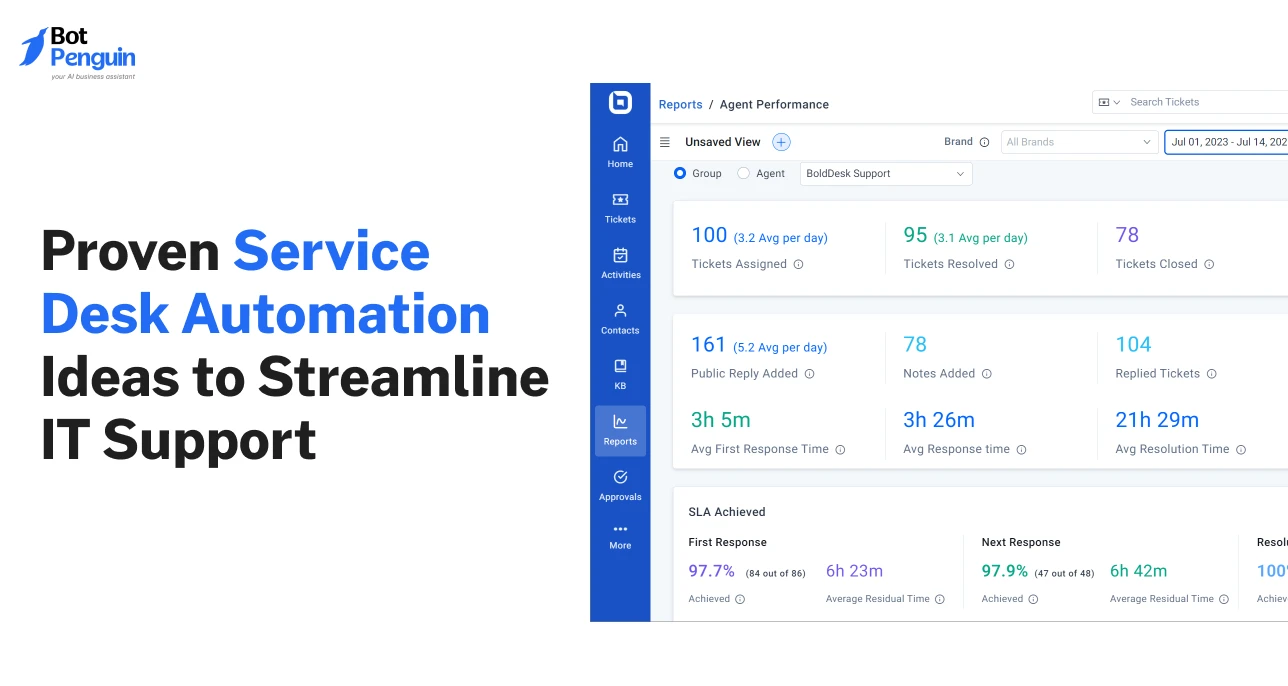
11 Proven Service Desk Automation Ideas to Streamline IT Support
Updated at Oct 10, 2026
24 min to read
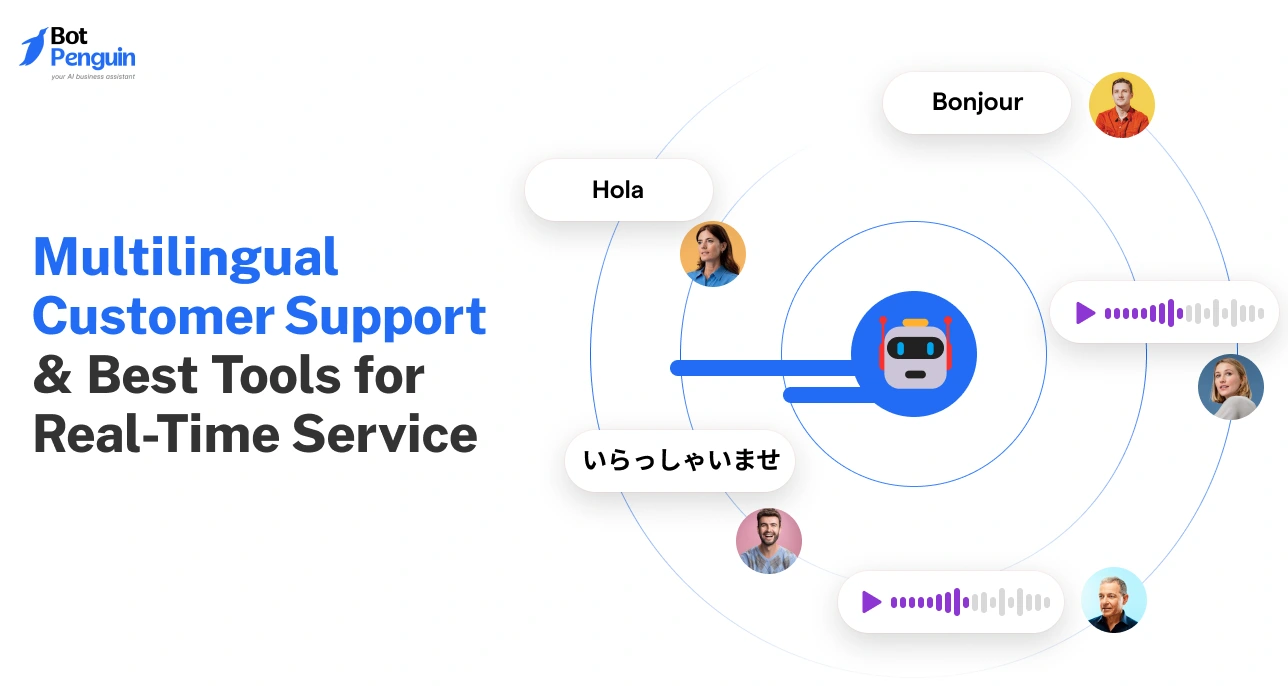
• A multilingual AI chatbot handles customer queries in 50+ languages, 24/7, without needing a human agent or a developer to set it up.
• Businesses lose customers when support isn't in their native language; multilingual chatbots directly improve satisfaction, retention, and global reach.
• AI-powered NLP detects the user's language automatically and responds in kind, no manual switching, no extra configuration per language.
• Multilingual AI support is no longer a luxury for enterprises; it's an accessible, affordable growth tool for businesses of any size.
• BotPenguin makes it effortless to build and deploy a multilingual customer support chatbot with a no-code setup, ready-made templates, and seamless live chat fallback, all in minutes.
Multilingual customer support is not a nice-to-have. For most businesses, it is a revenue problem they have not traced back to its source yet.
When a customer reaches out in Spanish and gets a response in English, they do not stay to figure it out. They leave. And they do not come back.
Most businesses simply do not know where to start the tools exist, but the path from problem to deployment is not obvious. A multilingual AI chatbot fixes this by detecting your customer's language automatically and responding in kind, no human intervention, no manual routing, no delay.
This guide covers how to build a multilingual chatbot, why it directly impacts your bottom line, and which practices separate the ones that work from the ones that frustrate customers.
76% of consumers prefer to buy from websites in their native language, and 40% will never buy from websites in other languages." — CSA Research, "Can't Read, Won't Buy – B2C" (csa-research.com)
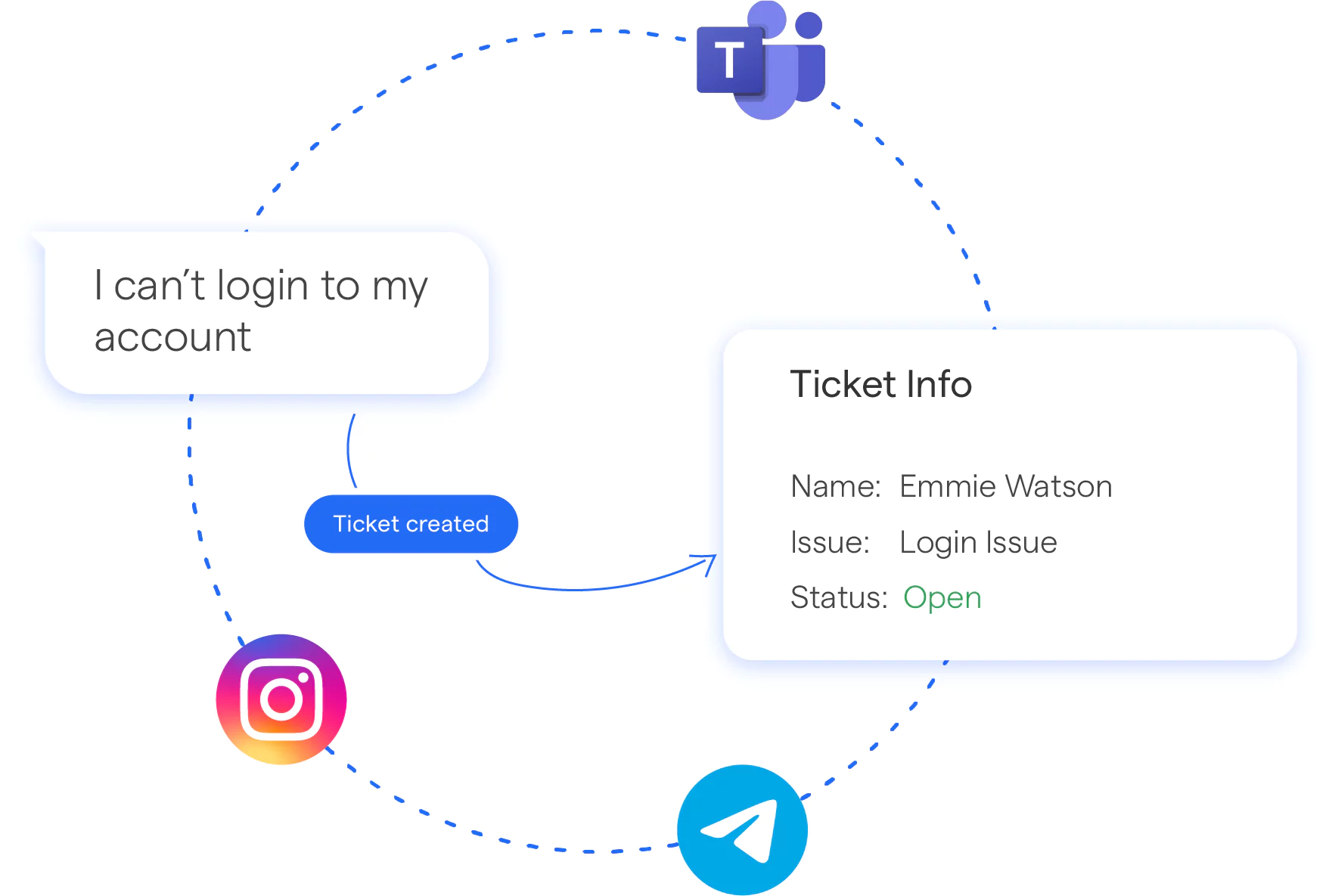
A multilingual AI chatbot is software that detects the language a customer is using and responds in that same language, automatically, in real time, without switching tools.
That is the difference between this and a translation bot. A translation bot takes your English response and converts it word-for-word. A multilingual chatbot understands what the customer means in their language and responds with that same intent intact. The output feels natural because it is — it is not a conversion, it is a native response.
Businesses across e-commerce, healthcare, travel, and SaaS use this to handle customer queries across markets without building separate support teams for each region. One setup. Every language. Consistent quality throughout.
"The global chatbot market is expected to reach $27.3 billion by 2030." — Grand View Research (grandviewresearch.com)
Language is no longer a barrier you can afford to ignore. It is a business decision. CSA Research found that 40% of consumers will never buy from websites in other languages. That is not a preference, it is a buying condition. The businesses winning in global markets right now are the ones that made multilingual customer support a priority early.
Most teams track cart abandonment. Very few track how many customers left because they could not understand the support experience.
A customer in Mexico reaches out about a delayed order. The chatbot responds in English. The customer does not follow up, not because the problem was unsolvable, but because the response was un navigable. Multiply that across thousands of interactions monthly and the number becomes significant.
Abandoned carts, low CSAT scores, and poor retention in non-English markets often trace back to this single point of friction. The revenue loss is real, it just does not show up in the report labelled "language barrier."
WhatsApp alone has over 2 billion users, with the heaviest concentration in India, Brazil, Mexico, and the Middle East, markets where English is rarely the first language.
If a competitor deploys a chatbot on WhatsApp that handles queries in Hindi, Portuguese, or Arabic, and you do not, the comparison is not close. Customers do not weigh features when they are confused.
They go with whoever is easier to talk to. Multilingual customer support chat is increasingly a baseline expectation in these markets, not a differentiator.
Hiring one fluent Spanish-speaking support agent is a start. Hiring agents fluent in Spanish, Hindi, Arabic, French, and Portuguese is a payroll decision most growing businesses cannot make.
A multilingual chatbot covers all of those languages from day one, at a flat monthly cost, without shift scheduling or language training.
As you expand into more markets, the cost per interaction stays flat. With a human team, it scales linearly and expensively.
"Chatbots can reduce customer service costs by up to 30%." — IBM (ibm.com)
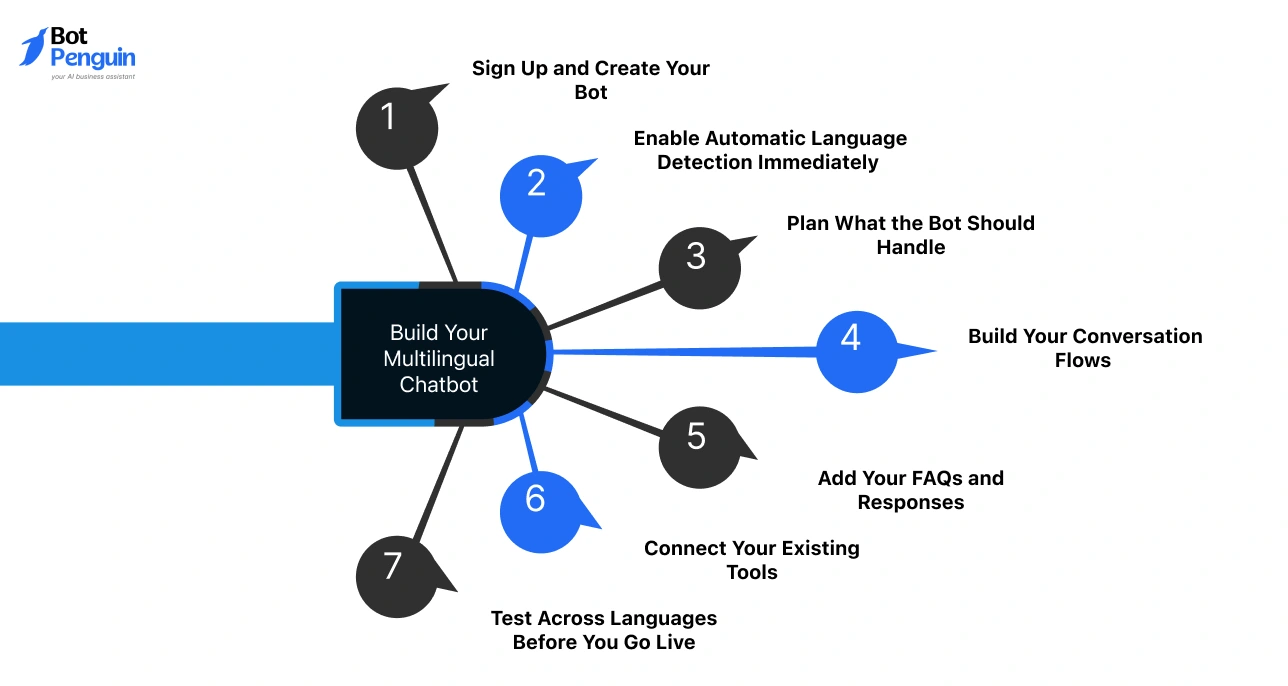
Building a multilingual chatbot does not require a developer. It requires a clear setup process and the right platform. Here is how to do it.
Go to BotPenguin, create a new chatbot, and choose your deployment channel: Website, WhatsApp, or Facebook Messenger.
Why this matters: Your channel choice determines which language markets you can reach immediately. WhatsApp covers India, Brazil, and the Middle East by default.
Before building any flows, switch on language detection. BotPenguin reads the customer's first message, identifies the language, and routes the response automatically.
Why this matters: This is the entire value of a multilingual chatbot. Enabling it early means every flow you build is automatically multilingual from the first message.
Define the core use cases before writing a single response, customer support, FAQ handling, order tracking, lead capture. This shapes your flow structure.
Why this matters: A clear scope prevents over-building. One well-scoped chatbot in five languages outperforms a complex one that breaks under edge cases.
Write flows in your primary language using short, simple sentences. The simpler the language, the more accurately it translates across other languages downstream.
Why this matters: Complex sentence structures break down across languages faster than simple ones. Clarity in your primary language produces natural outputs in every other.
Load in common questions and answers. The more comprehensive this is, the more accurately the bot responds across languages.
Why this matters: Thoroughness here pays off in every language simultaneously; each addition to your knowledge base improves all supported languages at once.
Link your CRM, e-commerce platform, or email system. When a customer asks "where is my order?" in French, the bot pulls live data and responds in French.
Why this matters: The integration closes the loop, a multilingual chatbot that cannot access your data is just a multilingual FAQ. The combination is what makes it genuinely useful.
Get native speakers to test in each core language you are targeting. Look for responses that feel off, miss intent, or lose context in translation.
Why this matters: A bad multilingual answer does more damage than no answer. Testing with native speakers catches cultural and tone issues that automated checks miss entirely.
BotPenguin detects language automatically, you build once, it serves in 50+ languages without separate flows per language.
Shopify store owners in international markets deal with this daily, traffic from multiple countries, one support setup built for English. Here is the fix:
The chatbot then handles incoming queries in each visitor's language automatically.
A French-speaking customer asking about shipping times gets the answer in French.
A German customer asking about returns gets it in German.
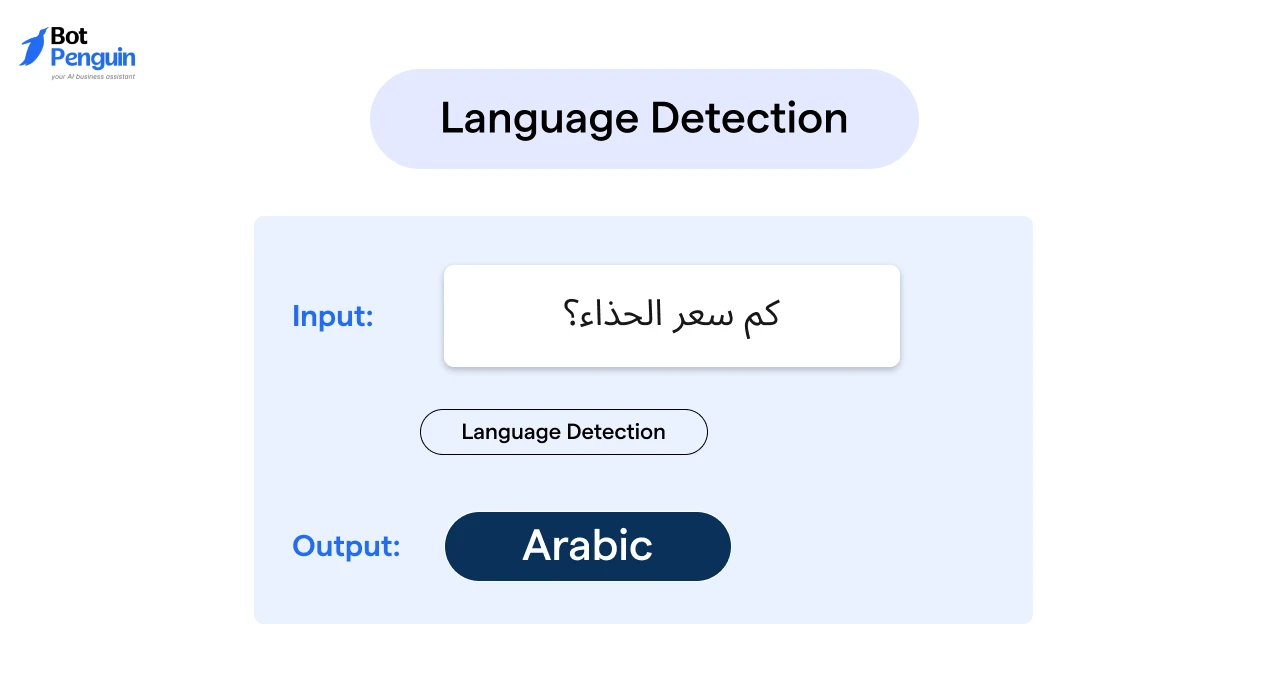
Every incoming message passes through a language identification model before anything else happens.
This model, trained on billions of text samples across hundreds of languages, reads the linguistic patterns in your customer's message and assigns it a language label with a confidence score.
High confidence means the response engine fires immediately in the detected language. The whole detection step takes milliseconds.
Short messages are the hardest case. A message that says "help me" is ambiguous, it reads identically in English regardless of where the user is. In these cases, the system looks at session history, browser locale data, and previous exchanges to resolve the ambiguity before responding.
Code-switched text adds another layer of complexity. Hinglish, the Hindi-English mix dominant in Indian markets or Spanglish in US-Latin communities, is real and common.
BotPenguin handles this through models trained specifically on mixed-language datasets, identifying the dominant language rather than defaulting to English whenever it sees English words.
When the confidence score falls below a set threshold, triggered by an extremely short message or no prior context, the bot escalates to a live agent rather than guessing.
This fallback is what protects the customer experience in lower-resource languages and edge cases. A confident wrong answer damages trust faster than a short delay before a human response.
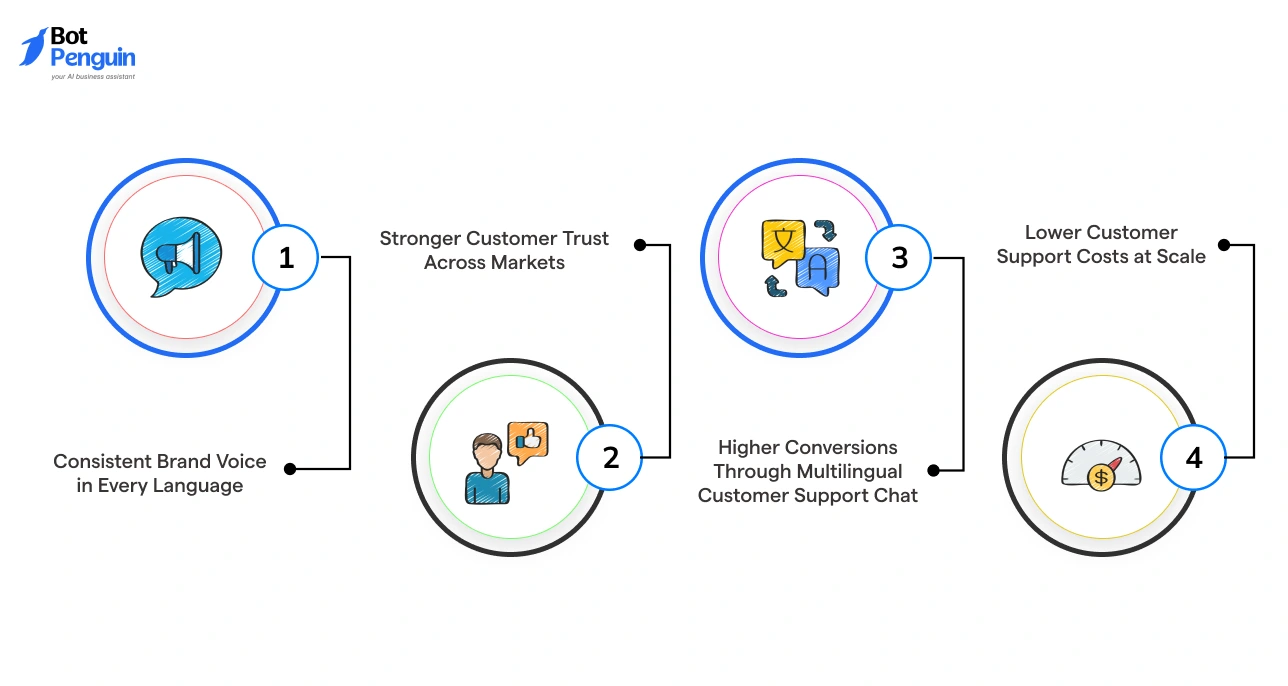
The business case for multilingual support is straightforward. More customers can engage with you. More engagement leads to more conversions. Better support leads to better retention. Here is where the impact shows up specifically:
Human agents vary. Their tone shifts based on workload, mood, and training quality. The result is uneven customer experiences, especially across different regional teams.
A chatbot delivers the same approved, on-brand responses every time, in every language. A customer in Germany and a customer in Indonesia get the same quality of answer.
The brand voice stays intact whether someone is reading the response in Spanish or Arabic. In markets where you have no local team, this consistency is the only quality control you have. It is also the strongest argument for deploying multilingual support before you have regional staff, not after.
Trust is built in the first interaction. When a customer reaches out in their language and gets a clear, accurate response in that same language, it signals that the business takes them seriously.
CSA Research found that 76% of consumers prefer native-language content when making purchase decisions. That preference does not stop at product pages; it extends through the entire support experience.
Brands that meet this expectation build stronger retention in non-English markets than those offering generic English-only support.
Language friction at checkout is one of the quieter causes of lost revenue. A shopper in Brazil who cannot get a clear answer about shipping costs in Portuguese is more likely to abandon than push through in a language they are not comfortable with.
Multilingual customer support chat, specifically on messaging channels like WhatsApp and Messenger, closes this gap at the exact moment the customer is making a decision. These are the channels where non-English speakers are most active.
Businesses that invest in multilingual support see up to 1.5x higher conversion rates in non-English markets, according to Common Sense Advisory. The chatbot that handles the language barrier at the decision point directly improves that number.
Forrester Research puts the average cost of a single customer service call at $8.01. A chatbot handles the equivalent interaction across any supported language at a fraction of that cost. As volume grows, the cost per interaction with a chatbot stays flat.
Scaling a multilingual support team manually means new hires, training, and management overhead for every new market. A chatbot covers all of that from a single platform deployment.

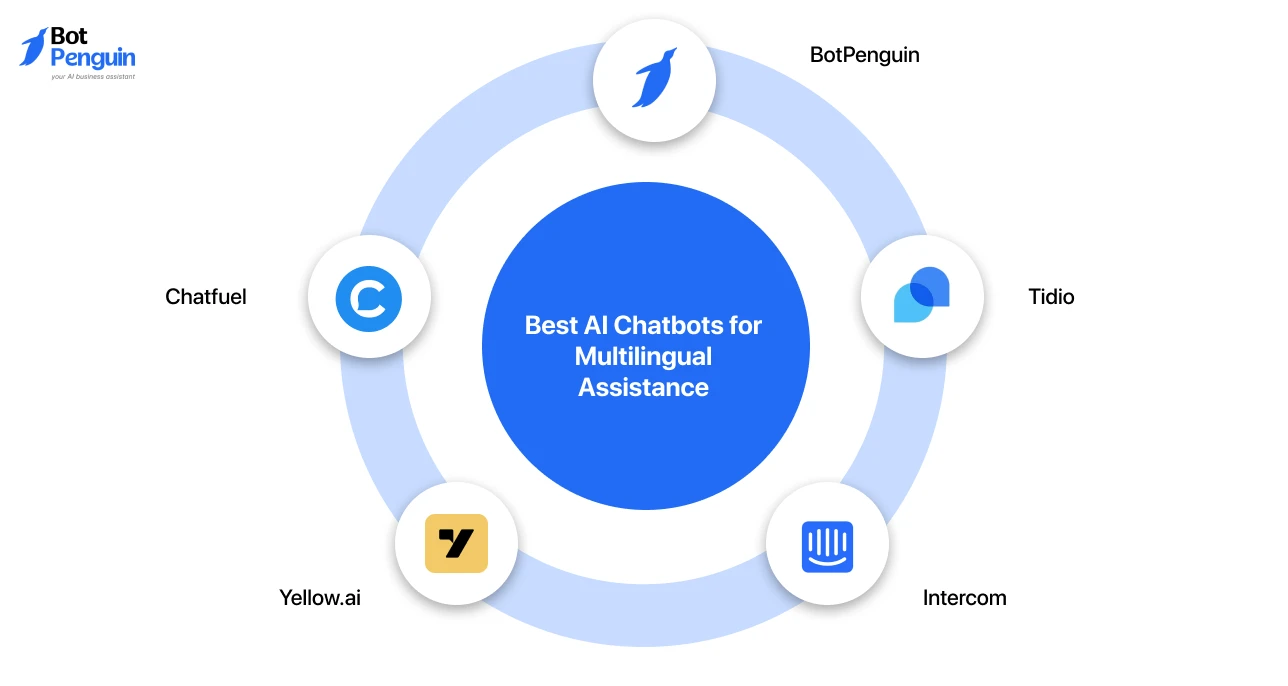
Choosing the right platform comes down to four things: how many languages it supports, whether it requires a developer, which channels it works on, and what it costs as you scale. Here is how the main platforms compare:
BotPenguin stands out for businesses that need WhatsApp coverage alongside a website chatbot, without a development team to set it up. WhatsApp is the dominant messaging channel in Latin America, India, and the Middle East. No-code setup means you are live in hours, not weeks, and the free tier lets you test before committing to a paid plan.
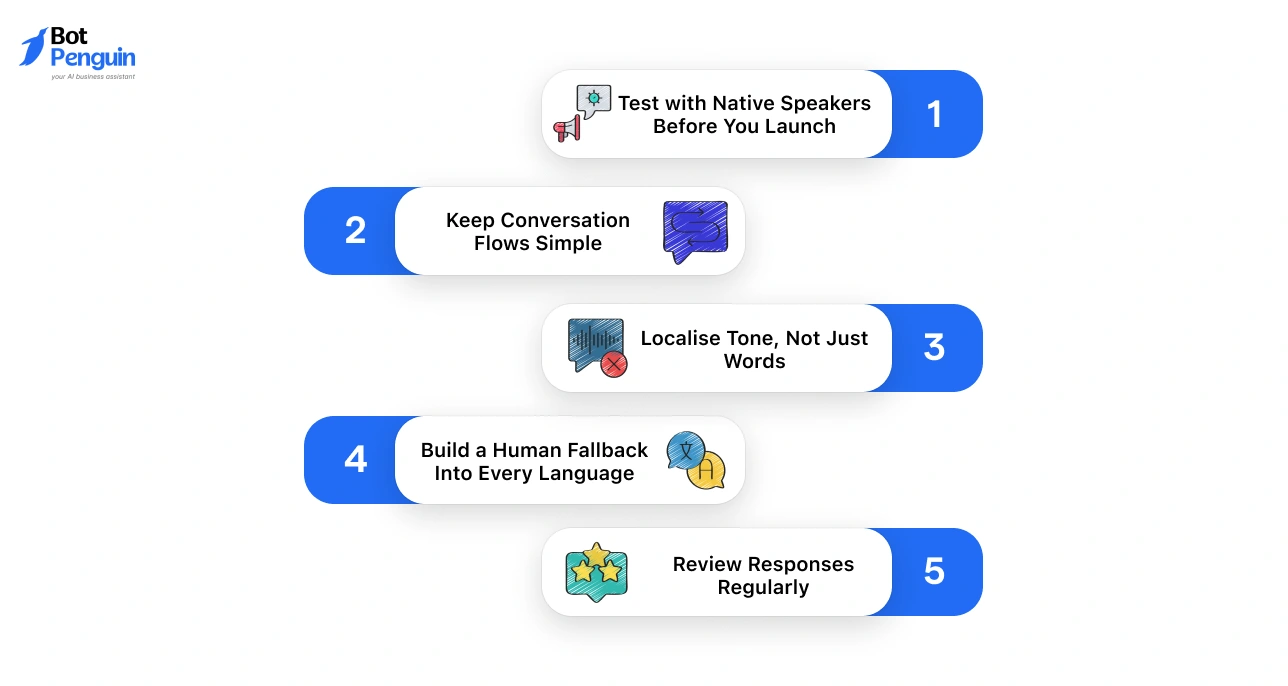
A multilingual chatbot that is poorly configured creates more frustration than it solves. These practices keep it working the way it should:
A response that reads correctly in machine translation can still feel awkward or culturally off when a native speaker reads it. Run every key language through someone who actually speaks it before launch. Look for tone mismatches, not just grammar errors.
This step catches the issues that automated testing misses entirely, the responses that are technically correct but register as rude, robotic, or confusing in a specific cultural context.
Complex sentence structures break down across languages faster than simple ones. Short, clear sentences in your primary language produce more accurate and natural responses in other languages. Simplicity scales better.
If a sentence needs three clauses to make its point in English, it will likely confuse the language model in the target language. Rewrite it as two sentences. This single habit improves output quality across every language simultaneously.
German customers expect formal language. Brazilian Portuguese speakers expect warmth. Japanese business conversations follow specific courtesy structures. The words can be right while the tone is completely wrong.
Build a short tone guide for each major market you serve, even just five bullet points covering formality level, how to handle complaints, and how to close a conversation politely. Review tone alongside accuracy in every language test.
There are languages and edge cases where the bot will underperform. Set a clear escalation path, when the bot's confidence is low, it should hand off to a live agent rather than give a poor response.
A bad multilingual answer damages trust faster than a delayed human response. The fallback is not a failure state, it is a feature that protects your brand in every language you serve.
Language evolves. Slang changes. Product details update. Schedule monthly reviews of your bot's responses across all active languages to keep content accurate and current. A response that was perfect at launch can become outdated within months in fast-moving markets.
This is especially important in markets like India, Brazil, and the Middle East, where colloquial language and cultural references shift quickly. A quarterly audit across your top five languages takes an afternoon and prevents months of quietly degraded customer experience.
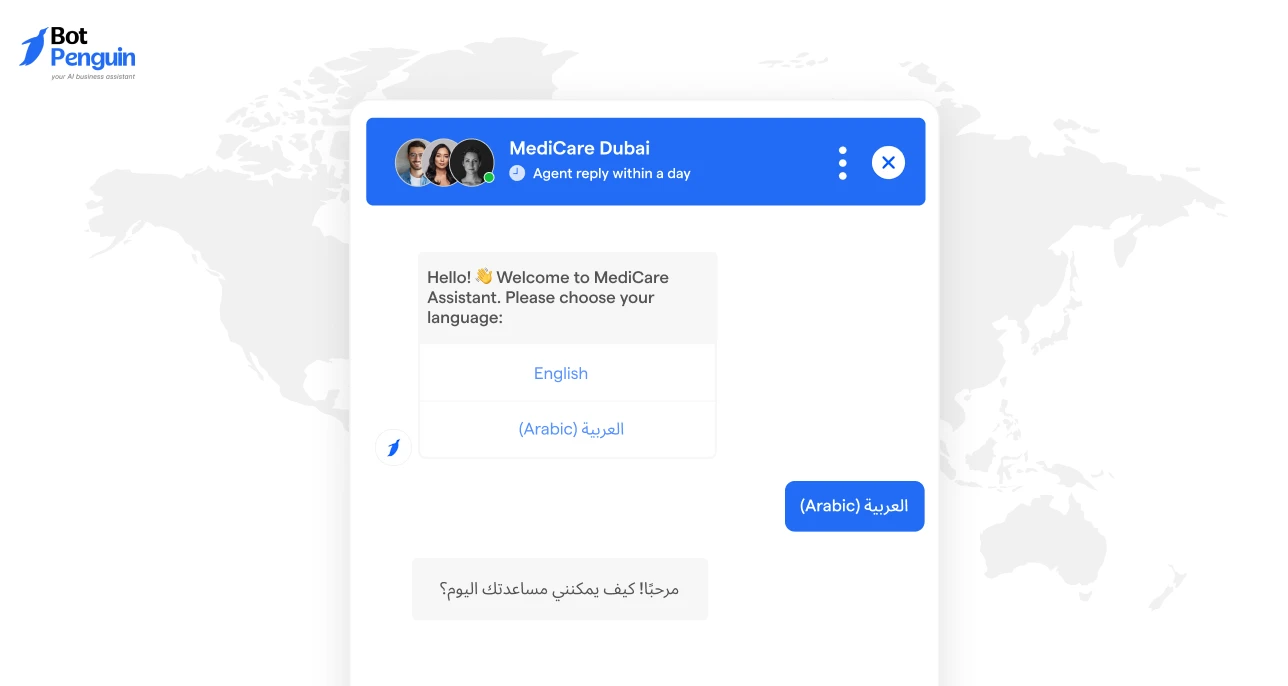
Not all chatbot platforms handle multilingual automation equally. The key criteria: Does it detect language automatically without separate flows per language? Does it support the channels your non-English customers actually use, particularly WhatsApp? Does it scale across 10+ languages without developer involvement?
BotPenguin supports multilingual chatbot automation across websites, WhatsApp, Facebook Messenger, and Telegram. Language detection is automatic, configuration is no-code, and the platform handles 50+ languages from a single flow. For businesses moving into non-English markets without a technical team, this is the clearest path to deployment.
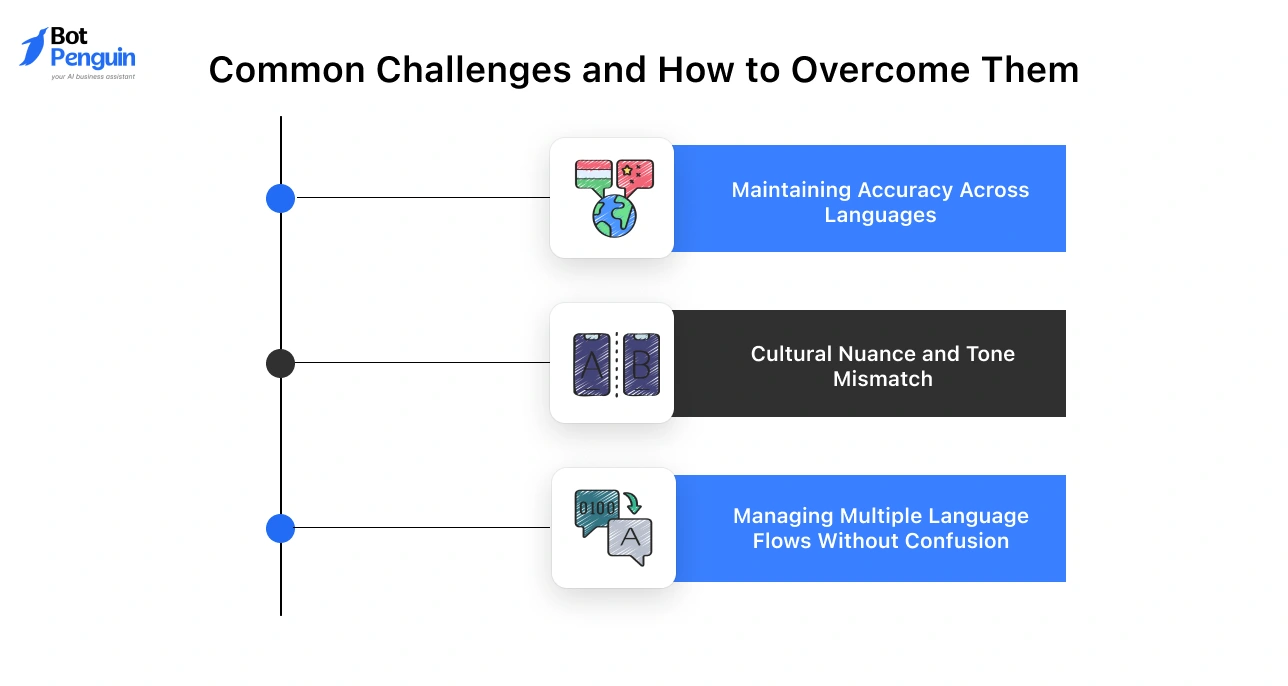
Problem: High-resource languages like Spanish, French, and German get excellent AI support. Low-resource languages like Swahili, Bengali, or Tagalog have less training data, which means the bot's accuracy drops noticeably in these markets.
Solution: Audit your bot's performance in every language you have enabled, not just the main ones. For lower-resource languages, keep conversation flows shorter and simpler; less complexity means fewer opportunities for the AI to misinterpret intent. Set up monthly accuracy reviews for any language below 10% of your total support volume.
Problem: A response that is perfectly accurate in English can land as cold, rude, or confusing in another cultural context. In Japanese business culture, a direct answer to "what is your refund policy?" without an opening acknowledgement of the customer's inconvenience reads as dismissive, even if the information is correct. In Arabic, informal contractions that work in English chat can come across as disrespectful in customer service.
Solution: Work with native speakers in your target markets to review tone specifically, not grammar. Build a short cultural style guide for each language you serve. Even three to five notes per language covering formality level, how to open a complaint response, and how to close a conversation significantly improves the customer experience.
Problem: Teams assume that adding languages means multiplying their workload. A company serving customers in eight languages imagines maintaining eight separate bots, eight separate flow diagrams, and eight separate QA processes running in parallel.
Solution: The right platform eliminates this concern entirely. BotPenguin uses one flow with automatic language routing built in. You maintain one set of responses, and the system handles language distribution. A retail business serving customers in English, Spanish, French, and German operates from a single BotPenguin flow with zero duplication. Nothing multiplies, nothing splits.
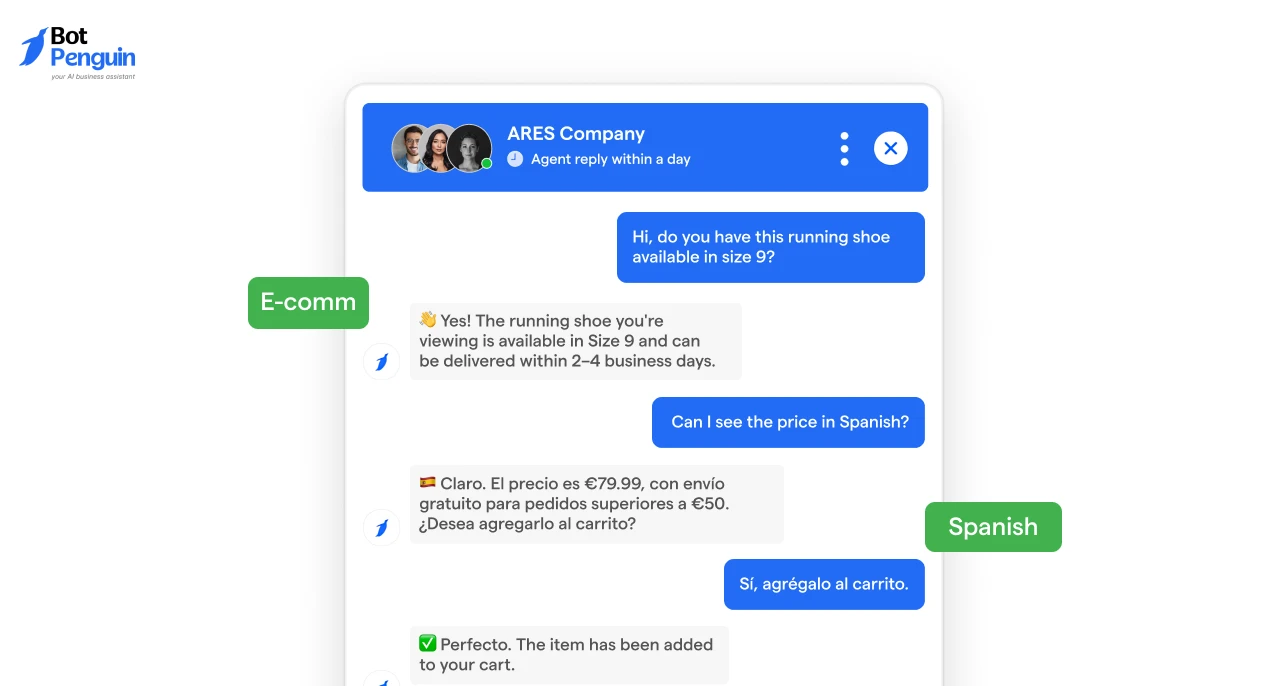
(Anonymised client — fashion retail, EU and LATAM markets)
A mid-size fashion brand expanding into Spain and Brazil deployed BotPenguin to handle product queries and cart recovery in Spanish and Portuguese. Before deployment, customers in those markets abandoned carts at a measurably higher rate than English-speaking markets. The support experience was English-only, and checkout queries were going unanswered.
Within six weeks of launch, cart abandonment in Spain and Brazil dropped by 20%. The single change was making the support conversation happen in the customer's language at the moment they needed it.
(Anonymised client — telehealth provider, South Asia and Middle East)
A telehealth provider serving patients across India and the Middle East deployed a multilingual chatbot to handle appointment bookings, pre-consultation FAQs, and insurance queries in Hindi, Arabic, and English. Before deployment, patients describing symptoms in English when it was not their first language consistently provided incomplete information, extending consultation times.
Within 60 days of launch, patient satisfaction scores increased measurably, and first-call resolution improved. Patients communicating in their native language provided more complete symptom descriptions, reducing the back-and-forth before each consultation.
(Anonymised client — online travel agency, 12-country market)
A travel company managing bookings from 12 countries ran into constant escalation issues — queries from non-English speakers that the English-only bot could not resolve kept reaching human agents for basic questions. After deploying BotPenguin with multilingual detection, the bot resolved over 70% of multilingual queries without escalation within the first 30 days.
Human agents shifted their time to complex itinerary changes and genuine exceptions, rather than spending the day on basic booking confirmations.
(Anonymised client — online learning platform, Southeast Asia and Middle East)
A platform serving students from Southeast Asia and the Middle East found that a significant portion of early drop-offs happened during account setup and course selection, not because the product was confusing, but because the support experience was English-only. Students needing help in Bahasa Indonesia, Arabic, or Tamil were not getting it.
After deploying a multilingual chatbot covering those three languages alongside English, onboarding completion rates increased, and early dropouts in those segments fell within 45 days of launch.
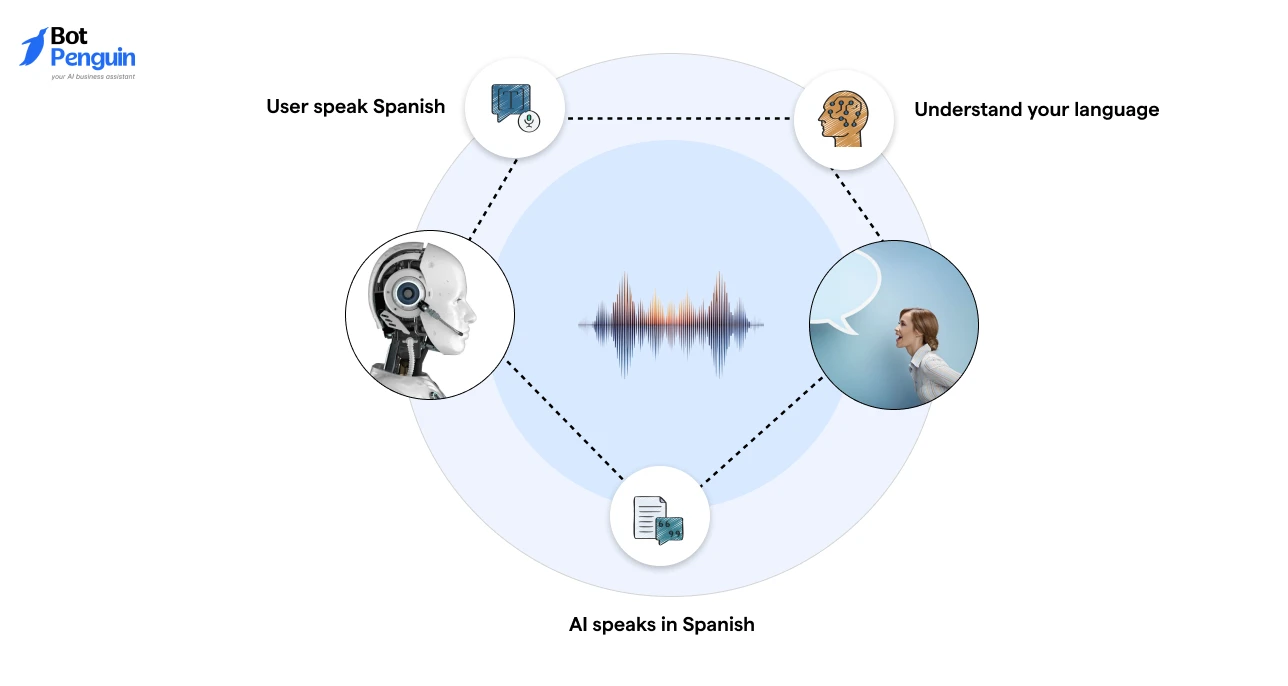
AI language models are improving faster than most teams realise. Languages that had limited AI support two years ago, such as regional dialects, minority languages, and mixed-code languages like Hinglish, are being covered with increasing accuracy as training data grows and models become more sophisticated.
Voice is the next layer. Text-based multilingual support is the current standard, but voice-based multilingual chatbots are moving from enterprise-only territory into mainstream accessibility. A customer will speak in their language, and the chatbot will respond in that same language via voice. The friction of typing in a second language disappears entirely.
Businesses that build multilingual infrastructure now are not just solving a current problem; they are building an asset. Every interaction in a new language adds data. That data improves the model's accuracy in that language over time. The businesses that start now will have a performance advantage over those who start in two years that compounds continuously.
Building a multilingual chatbot used to require a development team, a significant budget, and months of setup. That is no longer the case.
The tools exist today to deploy multilingual customer support across WhatsApp, your website, and social channels, in 50+ languages, without writing a single line of code. The business case is straightforward: customers engage more, convert better, and stay longer when support speaks their language.
The businesses moving on this now are building an advantage that compounds over time. The ones waiting are losing ground in markets they do not even realise they are competing in.
Build your multilingual chatbot on BotPenguin, free to start, no developer needed.
You build a multilingual chatbot by choosing a platform with built-in language detection, setting up your conversation flows in one language, and enabling multilingual support. BotPenguin detects the customer's language automatically from the first message, you build once, and the bot serves customers in 50+ languages without creating separate flows per language. The setup is no-code and takes hours, not weeks.
To make a chatbot multilingual, you need a platform that uses NLP-based language detection rather than manual translation. Once your content is live, the AI reads the user's first message, identifies the language, and responds accordingly. No separate bot per language is required. Platforms like BotPenguin handle this automatically across 50+ languages from a single configuration.
Sign up on BotPenguin, select Shopify as your platform, and install the BotPenguin widget from the Shopify App Store. Enable automatic language detection in the dashboard. The chatbot then detects each visitor's language and responds in it, whether they are browsing in French, Spanish, Arabic, or English without any per-language manual setup.
BotPenguin supports multilingual chatbot automation across websites, WhatsApp, Facebook Messenger, and Telegram. Language detection is automatic with no per-language manual configuration needed. The platform covers 50+ languages from a single flow, making it the clearest option for businesses serving non-English markets without a technical team to manage the setup.
A translation bot converts text word-for-word from one language to another. A multilingual chatbot understands intent, context, and tone in multiple languages natively, so responses feel natural and accurate, not mechanically converted. The difference shows up most clearly with idiomatic expressions, complaints, and nuanced requests where word-for-word translation loses the customer's actual meaning.
Yes. A multilingual AI chatbot operates continuously across all supported languages, regardless of time zone. Customers in different countries get responses in their language at any hour without a human agent being online. This is one of the most significant cost advantages for global businesses; one deployment covers every time zone and every supported language simultaneously around the clock.
Give support to your customers in the language they speak
Manage multilingual conversations across channels from a single platform without hiring language specific agents.
Go Global with BotPenguinCheckout our related blogs you will love.
Updated at Oct 10, 2026
24 min to read
Updated at Oct 5, 2026
8 min to read
Updated at Oct 1, 2026
10 min to read
Updated at Jun 22, 2026
10 min to read
Updated at Jun 22, 2026
10 min to read
Updated at Jun 3, 2026
15 min to read
Table of Contents