10 Best Dental Chatbots & AI Receptionists in 2026
Updated at Sep 28, 2026
11 min to read
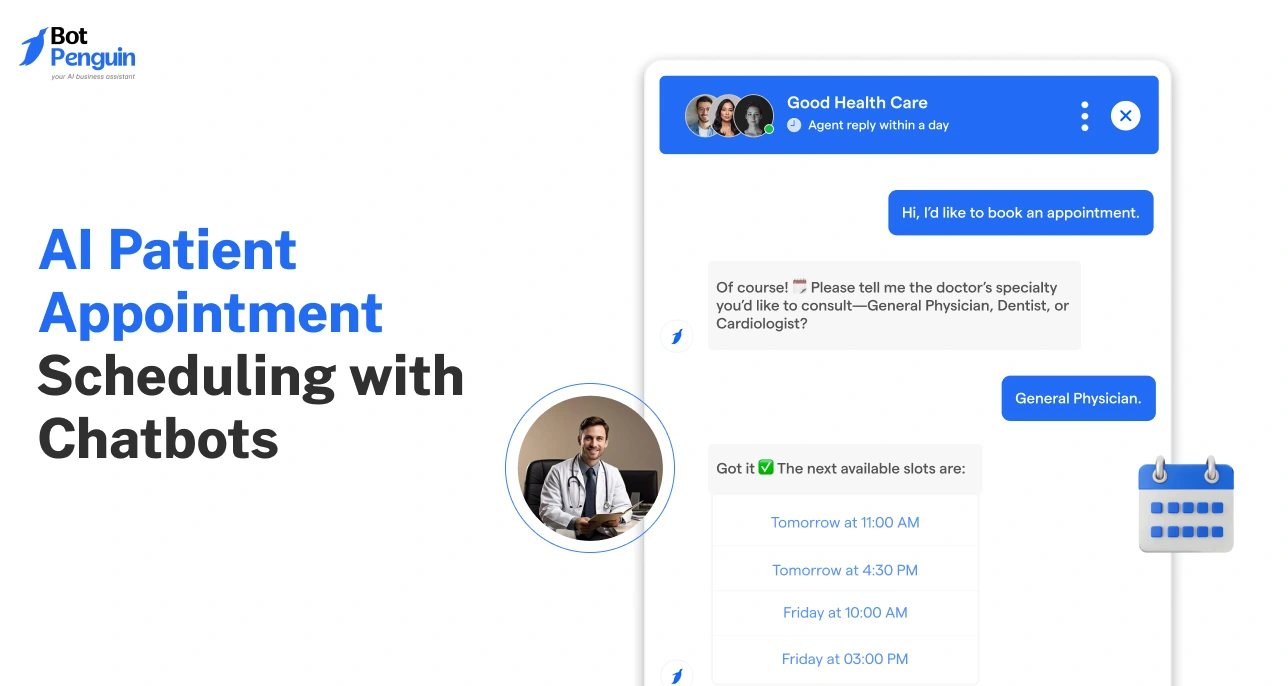
AI patient appointment scheduling uses chatbots and connected automation to help patients book, reschedule, or cancel appointments in real time. The system can check provider availability, send confirmations and reminders, collect basic booking information, and escalate complex requests to staff without relying entirely on front-desk calls.
Most appointments are lost before they’re ever booked.
Clinics still rely on slow, manual scheduling that can’t keep up with demand. However, today’s patients expect instant access. They book flights, food, and hotel rooms in seconds. Why should a doctor’s appointment be any different?
This gap is exactly where AI patient appointment scheduling changes the game. It uses chatbots to handle booking, rescheduling, and reminders in real time, helping clinics run more efficiently without adding more staff.
In this guide, you’ll learn how AI scheduling chatbots work, where they fit in your workflow, and how to implement them to reduce no-shows and improve access.
AI patient appointment scheduling uses chatbots and automation to manage the entire booking process. Patients can book, reschedule, or cancel instantly. Clinics can match demand with available slots more efficiently.
The goal is simple: faster access for patients and less manual work for staff.
For example, a patient can message a clinic’s WhatsApp chatbot at 11 PM, answer a few quick questions, and walk away with a confirmed appointment, without a call or staff involved.
Traditional tools only show available slots. AI chatbot scheduling for clinics goes further.
It understands patient intent, asks the right questions, and guides users to the correct appointment type. It can also suggest providers, handle follow-ups, and automate reminders.
This turns scheduling into a smart, interactive process, not just a calendar function.
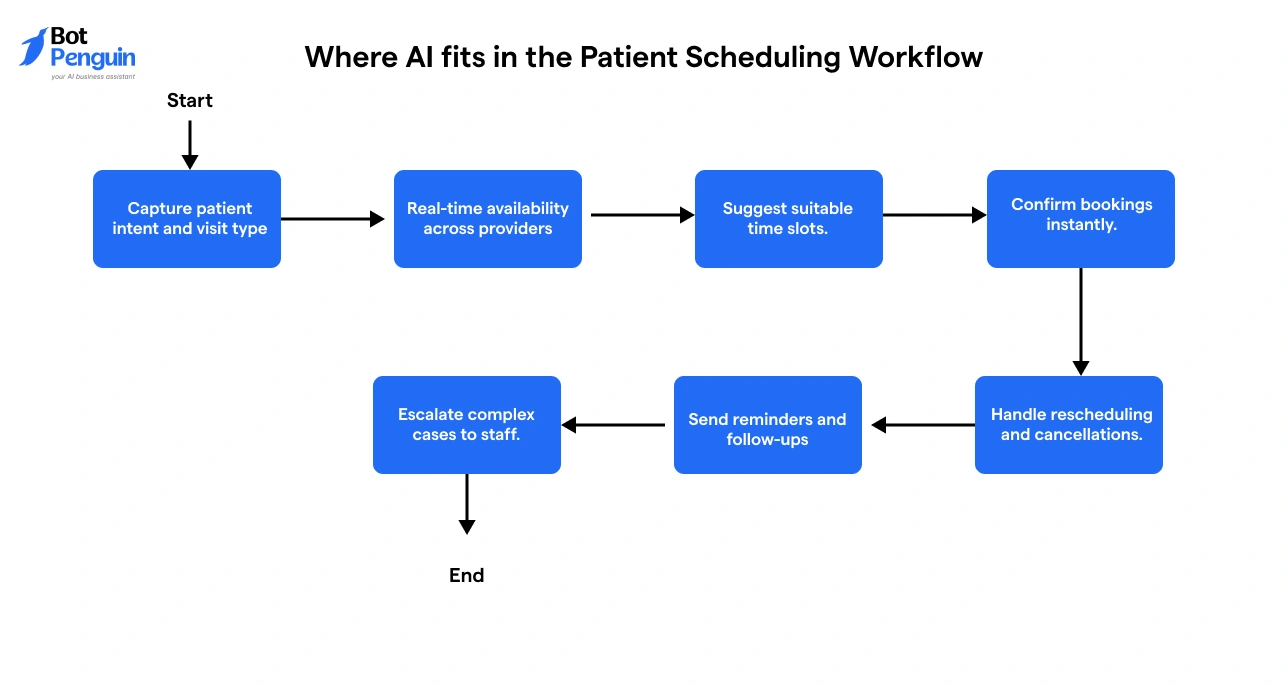
AI tools manage key steps without manual effort, while still allowing human support when needed. They:
Thus, the front desk shifts from managing bookings to focusing on in-clinic patient care, where human attention actually matters.
If you’re looking to bring this kind of scheduling into your own workflow, platforms like BotPenguin make it easier to deploy AI chatbots across channels like WhatsApp, web, and voice for faster booking, reduced no-shows, and improved patient access.
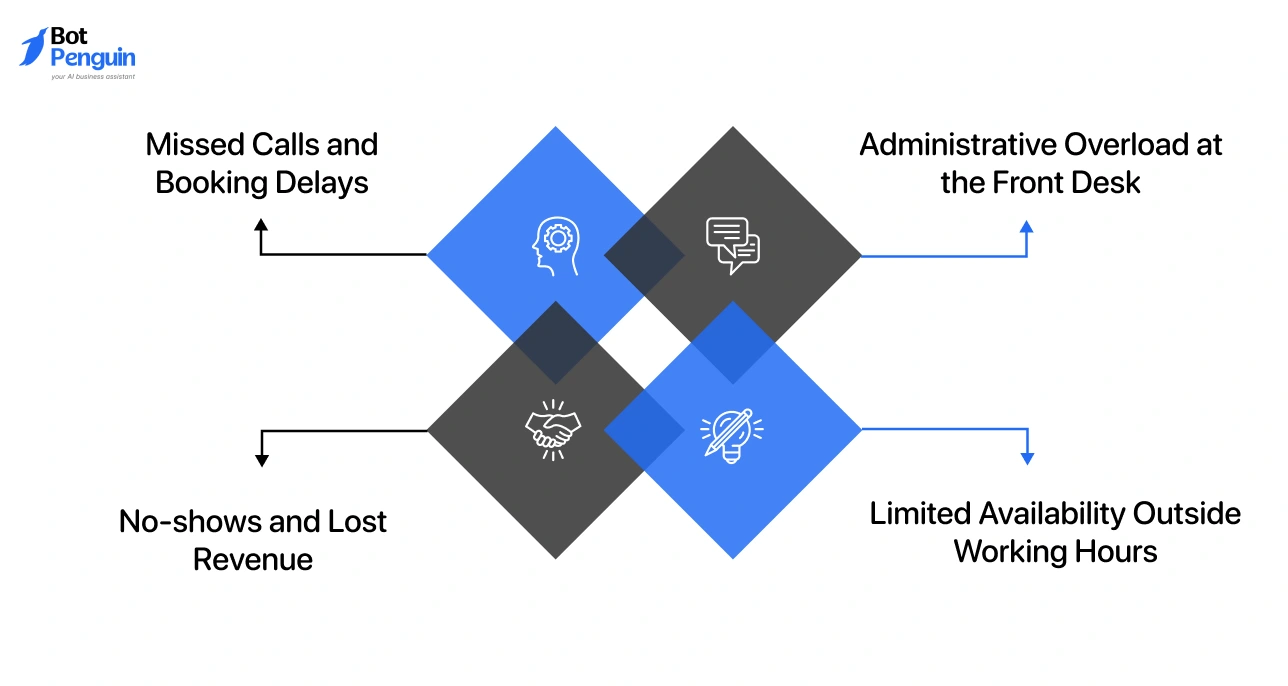
Traditional scheduling breaks in simple, everyday ways. It slows patients down and puts pressure on staff. The following gaps are easy to spot:
No-shows remain a current operational problem. An August 2026 MGMA poll found that 32% of responding medical groups reported higher patient no-show rates year to date compared with 2025.
These are daily friction points that cost clinics patients, revenue, and staff morale. Manual scheduling was never built for today’s volume or expectations.
That’s where AI appointment booking bots come in, reflecting the rapid shift toward automated, patient-first access in healthcare.
As per Grand View Research, the AI patient scheduling market is set to grow nearly 9x by 2033, reaching $555M at a 27.6% CAGR.
In the next section, we’ll explore how AI handles repetitive work for hospitals and clinics, enhancing efficiencies and patient experience.
AI patient appointment scheduling is not just about booking a slot. It is a real-time system that captures intent, matches providers, and manages availability without manual intervention.
Here's a step-by-step breakdown of how the process works in practice:
This system turns appointment scheduling from a manual task into a continuous, automated workflow that improves patient access and minimizes front desk dependency.
Here are some key points to remember:
For example, Epic Systems introduced a conversational AI tool that lets patients book appointments via SMS. It guides the interaction, suggests slots, confirms bookings, and shares follow-up links, without requiring portal logins or calls.
While some believe scheduling involves just picking a time slot, AI patient appointment scheduling with chatbots is a fully connected workflow that guides patients from first contact to post-visit follow-up.
This is what that journey looks like in practice:
The result is a scheduling experience that feels less like admin and more like care.
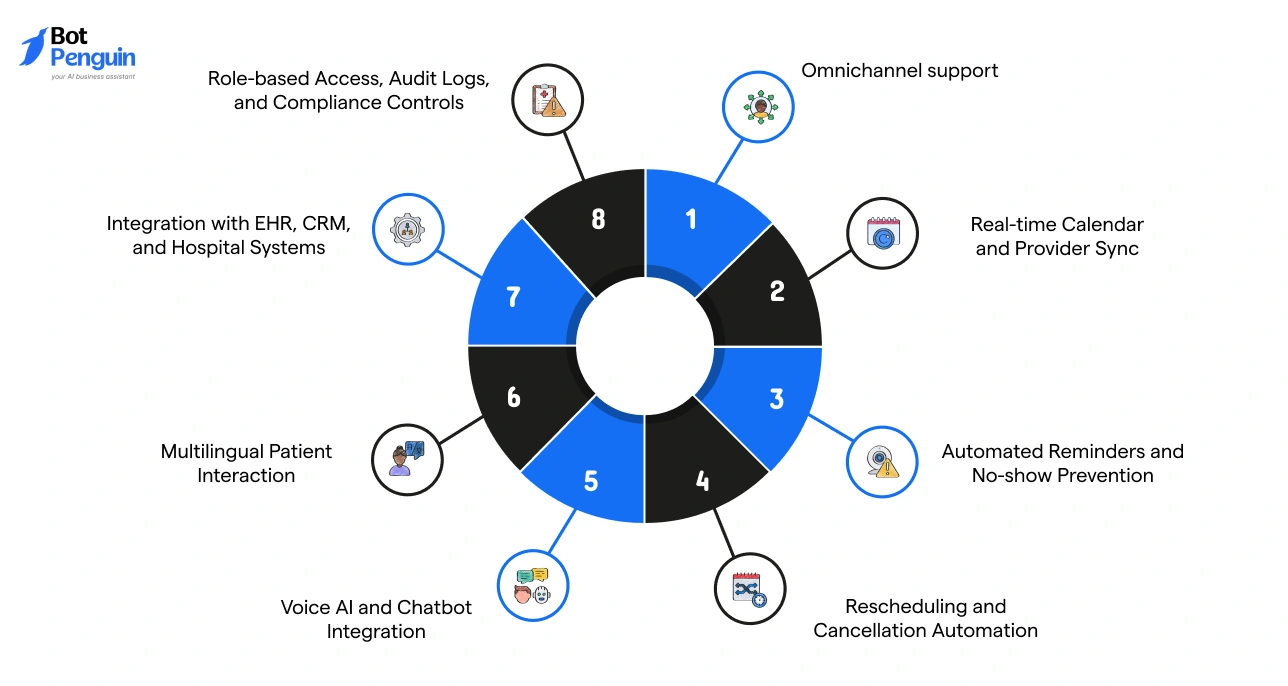
The right chatbot does more than just book appointments. The features it carries will directly determine how much work it takes off your team, and how smooth the experience feels for your patients.
It’s important to look for features that support both patient experience and operational efficiency:
Get these features right, and scheduling stops being a problem your clinic manages; it becomes something that runs itself.
AI chatbots handle scheduling through direct patient interactions. They guide users step by step, understand requests in real time, and complete bookings without manual effort.
Each use case below reflects how chatbots actively manage conversations to drive faster, accurate scheduling.
These use cases show the real strength of chatbots. They don’t just assist; they act. By handling conversations end-to-end, they remove delays, improve access, and keep scheduling active at all times.
For scheduling chatbots to work smoothly, they must connect with core hospital systems.
For example, if your chatbot books an appointment but isn’t synced with the provider’s live calendar, you’ll end up with double bookings, confused patients, and frustrated staff.
Importantly, these integrations ensure accurate data flow, lower conflicts, and support an easy booking experience across care settings.
The chatbot connects with patient record systems to access history, demographics, and visit details.
This helps ensure accurate bookings and avoids duplicate or incomplete entries. It's critical for maintaining compliance with HIPAA for healthcare providers in the US.
The system syncs with doctor schedules to reflect real-time availability. This prevents double bookings and keeps time slots consistent across all touchpoints.
The AI booking bot supports clinics operating across multiple branches by routing patients to the most suitable location based on proximity and availability.
Consider: A patient in the south of the city getting routed to the nearest branch with an open slot, not the headquarters across town.
The chatbot enables direct booking of virtual consultations and automatically shares session links and relevant details with patients.
If a patient books a virtual visit, the chatbot instantly sends a confirmed Zoom or Teams link; no manual coordination, no back-and-forth emails.
The system captures insurance information and basic intake details during booking, lowering manual effort and speeding up the check-in process.
The deeper your integrations, the less your team has to manually fill in the gaps, and the more your patients experience a process that just works.
AI scheduling systems interact with highly confidential patient information, making data protection and regulatory alignment non-negotiable.
These platforms must adhere to strict standards such as HIPAA and GDPR to safeguard patient records, ensure secure communication, and maintain reliability across every interaction.
Reliable scheduling in healthcare is not just about speed or automation. It depends on secure data handling, clear governance, and controlled AI behavior.
When these safeguards are in place, AI scheduling chatbots can operate confidently within healthcare environments, balancing efficiency with responsibility.
AI scheduling chatbots create a measurable impact across access, efficiency, and revenue. To understand true value, focus on a few high-signal metrics that reflect both performance and outcomes.
Tracking these metrics gives a clear view of impact. They show how well the system improves access and drives better use of available capacity.
For healthcare providers, meeting these benchmarks would mean lower administrative costs and a patient experience that keeps people coming back.
Adopting AI chatbots for patient scheduling improves efficiency, but it also comes with practical challenges. Addressing these challenges early helps ensure smoother deployment and better outcomes:
Challenge: Connecting the chatbot with EHRs, calendars, and other systems can be time-consuming and error-prone. If your records and chatbot aren’t properly synced, a patient could book a slot that simply doesn’t exist.
Solution: Use APIs and phased integration to ensure stable, secure data exchange
Challenge: Inconsistent or outdated data can lead to double bookings or incorrect slot availability. This directly erodes patient trust.
Solution: Enable real-time sync and validation checks across all scheduling systems
Challenge: Front desk teams may resist change or struggle with new workflows.
Imagine a new front desk worker joining mid-rollout with no proper training and unclear handoff rules. He would be constantly second-guessing the system and creating exactly the kind of chaos the chatbot was meant to prevent.
Solution: Provide simple interfaces, training, and clear escalation paths for confidence.
Challenge: Patients may expect human-like understanding in all scenarios. Whether it’s a nuanced symptom or an emotional concern, a chatbot has limits.
Solution: Set clear boundaries and ensure smooth handoff to staff when needed
Challenge: Not all requests fit predefined flows, especially urgent or multi-step cases. In emergency situations, a rigid chatbot can cost critical minutes.
Solution: Design fallback logic and enable quick human intervention.
Challenge: Handling sensitive patient information raises security and regulatory risks, particularly around HIPAA in the US and equivalent regulations elsewhere.
Solution: Implement strict access controls, encryption, and compliance-ready workflows
None of these challenges is a deal-breaker, but ignoring them early almost always makes them harder to fix later.
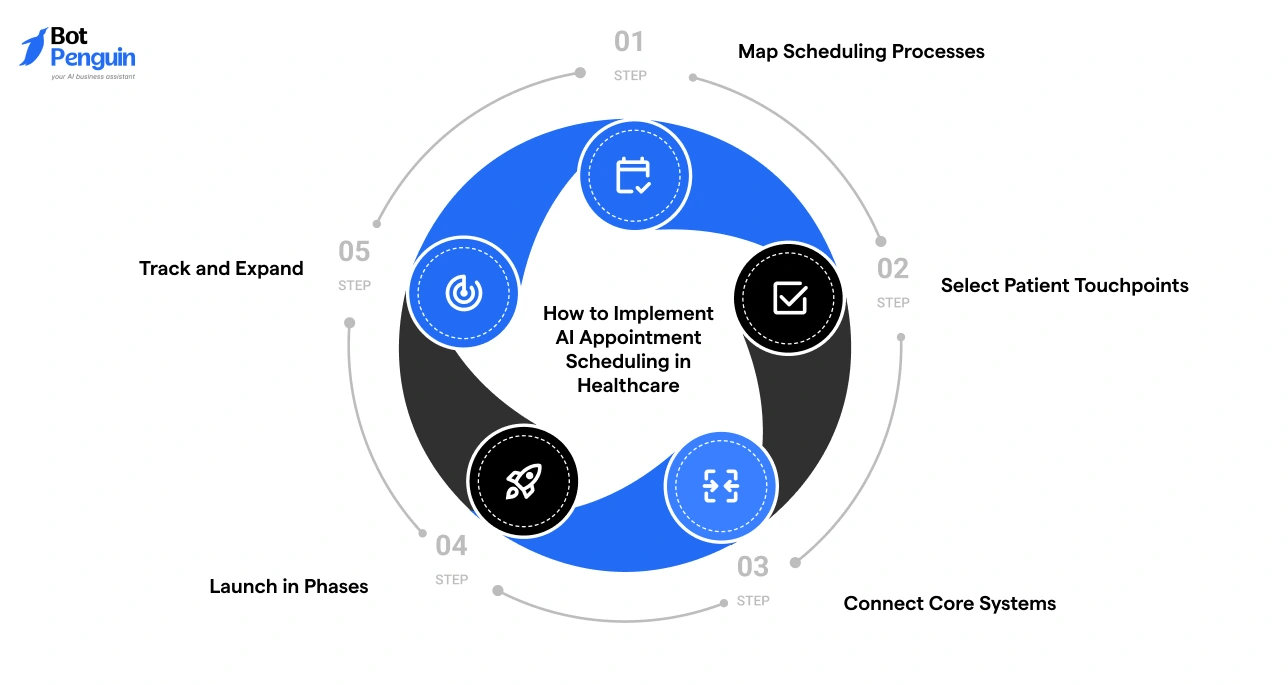
Switching to AI-powered scheduling doesn’t have to be overwhelming. The key is to start with clarity: know your current process, identify the gaps, and build from there.
Here's how to do it step by step:
Start by outlining how appointments are currently handled, including booking, rescheduling, and follow-ups. This helps identify gaps and define what the AI system should automate.
Decide where patients will interact with the system, such as website chat, WhatsApp, or voice assistants.
Choose channels based on patient behavior and accessibility.
Want your scheduling system to work across every patient touchpoint? Platforms like BotPenguin help deploy an omnichannel healthcare chatbot with a unified inbox for managing conversations, bookings, and follow-ups across channels from one place.
Integrate the chatbot with essential platforms like EHR, calendars, and hospital systems to enable real-time availability and seamless data flow.
Begin with a small rollout, such as one department or use case. This allows testing, feedback collection, and quick adjustments.
For example, start with after-hours booking for general consultations before rolling out across specialties.
Measure performance using key metrics like booking rate and no-shows. Use insights to refine workflows and scale across teams or locations.
Done right, implementation is less of a technical project and more of a gradual shift; one that gets easier and more impactful with every step forward.
Choosing the right solution is not just about features. It requires evaluating how well the system fits your workflows, integrates with your infrastructure, and supports long-term growth.
Focus on these key evaluation areas:
If the answers to these questions are clear and aligned with your operational needs, you are not just selecting a chatbot; you are building a more efficient, responsive, and patient-centric scheduling system.
AI patient appointment scheduling is no longer a nice-to-have. It’s becoming essential for clinics that want to keep up with patient expectations. Chatbots remove delays, reduce workload, and keep scheduling active at all times.
More importantly, they turn a fragmented process into a smooth, guided experience. Patients get faster access. Staff focuses on care, not calls.
The real value comes from how well the system fits your workflows and integrates with your tools. Start small, measure impact, and scale from there.
Done right, scheduling stops being a bottleneck and becomes a growth driver for your practice.
AI patient appointment scheduling uses chatbots to automate booking, rescheduling, and reminders by understanding patient requests and matching them with available providers in real time.
Scheduling chatbots ask simple questions, identify patient needs, check real-time availability, suggest slots, confirm bookings, and send reminders, all within a single conversation.
Yes, AI chatbots send automated reminders and follow-ups across channels, helping reduce no-shows by keeping patients informed and making rescheduling easy.
AI scheduling chatbots can be HIPAA compliant if they follow strict data security practices, including encryption, access controls, and secure handling of patient information.
AI scheduling improves booking speed, reduces administrative workload, increases slot utilization, minimizes missed appointments, and enhances patient access without adding staff.
Yes, chatbots enable 24/7 appointment booking, allowing patients to schedule visits anytime without waiting for clinic hours or staff availability.
Healthcare chatbots integrate with EHRs, calendars, and communication tools using APIs, ensuring real-time data sync, accurate scheduling, and seamless patient interactions across systems.
Subscribe to Our Newsletter
Get the latest business insights straight into your inbox.
Checkout our related blogs you will love.
Updated at Sep 28, 2026
11 min to read
Updated at Sep 25, 2026
12 min to read
Updated at Sep 24, 2026
11 min to read
Updated at Sep 24, 2026
14 min to read
Updated at Sep 18, 2026
8 min to read
Updated at Sep 18, 2026
8 min to read
Table of Contents