


How to Build and Sell Branded AI Voice Agents Under Your Own Name (2026 Guide)
Updated at Oct 9, 2026
10 min to read
Updated On Oct 8, 2026
11 min to read
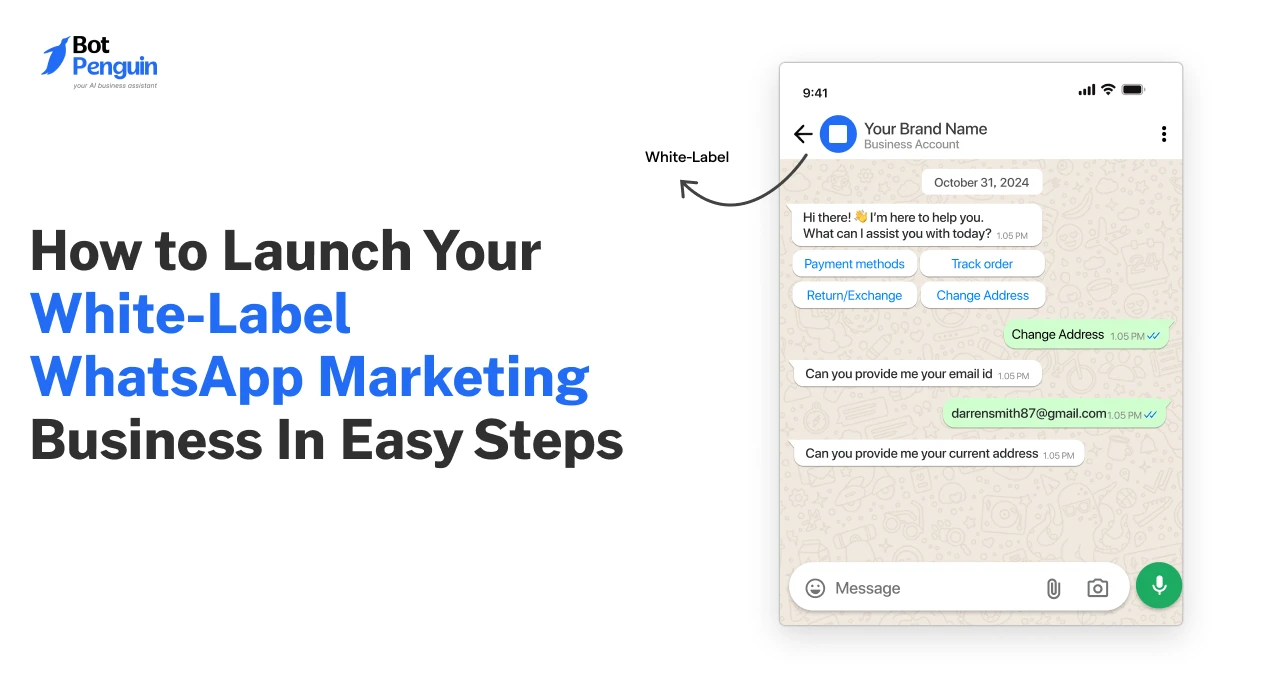
Starting a white label WhatsApp business means using an existing platform to sell branded WhatsApp services without building the technology yourself. Choose a reliable provider, define your offer and pricing, brand the experience, onboard clients, and manage delivery as you scale.
The next wave of digital marketing isn’t happening in inboxes; it’s happening on WhatsApp.
As businesses race to engage customers on WhatsApp, demand for WhatsApp marketing services is growing faster than many agencies can keep up with. That creates a compelling opportunity for agencies, consultants, and entrepreneurs.
One of the fastest ways to capitalize on this surging demand is by using a white label WhatsApp platform that lets you start your own branded WhatsApp marketing business without building the tech in-house.
In this guide, you'll learn how to start a white label WhatsApp business, how to choose the right provider, how to win clients, and how to earn recurring revenue.
Before we get into the steps, let’s understand why businesses are rapidly shifting customer communication to WhatsApp, especially in high-growth markets.
One thing is clear: demand is on the rise. Yet most companies don’t want to build, manage, or optimize WhatsApp systems on their own. That gap is exactly where agencies come in.
Launching now isn’t just about offering WhatsApp services; it’s about positioning your agency inside a channel that is still expanding.
These market trends explain why more agencies are choosing white label WhatsApp platforms instead of building WhatsApp infrastructure themselves.
If your goal is to build a branded WhatsApp marketing business rather than simply resell software, a white label partnership gives you the infrastructure to launch under your own brand while retaining pricing flexibility and client ownership.
A white-label WhatsApp partnership allows you to launch and grow a branded WhatsApp marketing business without building your own software.
You focus on branding, client acquisition, pricing, and service delivery, while your technology partner manages the platform, infrastructure, hosting, compliance, and official WhatsApp Business API access.
More than 200 million people use the WhatsApp Business app worldwide, showing the scale of business communication already happening on WhatsApp.
Thus, the white-label approach allows you to launch faster and focus on what matters most: winning clients and delivering results.
Wondering how the white-label WhatsApp API works? Read our guide to understand its setup and API model.
Although the two models are often grouped together, they work differently.
The key difference is simple: a reseller sells someone else's product, while a white-label business lets you build your own brand on top of proven technology.
For agencies and entrepreneurs looking to create a long-term WhatsApp marketing business, that added control can be a significant advantage.
Starting your own WhatsApp marketing business is less about building technology and more about choosing the right WhatsApp technology provider and structuring your offering.
Once the foundation is in place, you can move from setup to selling in a very short time. Here’s how to start a white label WhatsApp business through the white-label route:
Now, let’s look at each of these steps in detail.
Your foundation is the platform you choose. Look for a provider that offers official WhatsApp Business API access, along with strong compliance, stable messaging delivery, and reliable system performance.
This decision directly impacts your onboarding experience, platform reliability, and long-term scalability.
If you're evaluating a WhatsApp white label provider, also consider onboarding support, compliance assistance, scalability, and ongoing platform maintenance.
Once your platform is ready, you transform it into your own business identity. This includes:
At this stage, your clients should experience the platform as if it were built entirely by your agency.
This is where you define your business model and margins. You decide how to structure your offerings through monthly, quarterly, or annual plans, including tiered plans based on client needs and usage.
Meta bills the client directly for messaging at its published rates. You earn from software subscriptions, setup, add-ons, and managed services rather than marking up messaging costs.
You can set your margins across software plans, automation, and AI-driven features, and include add-ons such as campaign setup or chatbot flow creation.
With your system ready, you can start selling and onboarding clients. Using your admin panel, you:
This is where your offering becomes a real, revenue-generating service.
All client operations are managed from a single unified dashboard.
From here, you can track conversations, campaigns, and engagement for each client, assign roles and access to team members, and monitor message usage along with overall performance.
This centralized setup makes it easy to scale operations without adding operational complexity.
These 5 steps are all it takes to go from an idea to a fully branded WhatsApp marketing business, ready to onboard your first paying client.
Before you start setting up the platform, make sure the basic business groundwork is ready:
With these basics in place, you’ll be better prepared to move from setup to client onboarding without unnecessary friction.
Next, we’ll break down the different revenue models and how you can actually monetize this setup.
In a white label WhatsApp marketing business, your income doesn’t come from a fixed commission. Instead, you control pricing and build your own layered revenue model on top of the platform.
Your profit is the difference between your platform cost and what you charge clients, but more importantly, it comes from multiple recurring and one-time revenue streams.
Note: Meta bills your client directly for messaging, while you earn from software subscriptions, setup, add-ons, and managed services.
Your primary income comes from monthly, quarterly, or annual plans that you sell for access to WhatsApp marketing tools and features. This forms your base recurring revenue.
You can charge a one-time fee for onboarding clients, configuring WhatsApp numbers, setting up templates, and launching initial campaigns. This improves early cash flow.
You don’t mark up Meta’s message charges. Instead, structure your software plans in usage tiers, so clients move to higher plans as their messaging needs grow.
For example, as a client's messaging volume increases, they may move to a higher plan with more capacity and features, increasing your recurring software revenue.
You can upsell services like chatbot flows, AI automation, campaign creation, and lead nurturing sequences. These are high-margin upgrades that increase per-client value.
For clients who want done-for-you execution, you can offer full campaign management, strategy, and optimization as a premium service layer.
A single client can easily contribute multiple revenue streams at once, which means your earnings are not dependent on a single fee but a stacked, compounding model.
If you're comparing different WhatsApp solution providers, our WATI white label guide explains whether WATI offers a true white-label model and how it compares with a fully white-label partnership.
Together, these layers create a scalable revenue system where you earn from setup, subscriptions, higher plan tiers, and services. This is what makes the white label WhatsApp model predictable and scalable over time.
Starting a branded WhatsApp marketing business can be profitable, but avoidable mistakes can slow down growth early. Here are the most common ones:
Many agencies pick platforms without checking WhatsApp API access, compliance, or scalability, which can create problems later.
How to Avoid It: Choose a reliable white-label WhatsApp technology provider with stable infrastructure, proper API access, and proven scalability.
New businesses often try to win clients by being the cheapest, which decreases margins and makes the model unsustainable.
How to Avoid It: Position your service around outcomes like leads, automation, and engagement, not just messaging costs.
Some beginners rely too heavily on referrals or platforms, limiting long-term control over clients and revenue.
How to Avoid It: Onboard clients under your own brand and manage communication directly to retain ownership of the relationship.
Many agencies simply resell WhatsApp software instead of packaging it as a complete marketing solution.
How to Avoid It: Build clear service offerings around campaigns, automation flows, and lead nurturing so clients see value beyond the platform.
Handling multiple clients manually, chasing template approvals, and keeping up with API updates can quickly slow operations down.
How to Avoid It: Choose a white-label provider with a unified dashboard, compliance support, and backend maintenance.
Most of these mistakes come down to rushing the foundation to get to revenue faster. Focus on platform choice, positioning, and ownership before scaling.
Reliable white label partners like BotPenguin can handle the infrastructure, compliance support, and scalability side, so you can put that energy into building a service clients actually stick around for.
A white label WhatsApp platform gives agencies and entrepreneurs a faster path to starting their own WhatsApp marketing business without investing in software development.
Your brand, your pricing, your clients, and your recurring revenue all sit on top of existing WhatsApp infrastructure that handles the technical side.
The process is simple: choose the right provider, set up your brand, define your offers, and start onboarding clients.
With the right setup, you can launch quickly and build a scalable WhatsApp marketing business under your own name.
Start by choosing a white-label platform with official WhatsApp Business API access. Then brand the platform, set your pricing and services, and onboard clients. From there, you can manage client accounts, campaigns, automation, and reporting from one dashboard.
The cost depends mainly on your white-label platform plan, branding, and business setup. You avoid building the software yourself, while Meta bills clients separately for WhatsApp messaging at its published rates.
No advanced technical skills are required. Your provider handles the platform infrastructure, hosting, API connectivity, and backend maintenance. Your focus stays on branding, pricing, client acquisition, onboarding, and service delivery.
Launch time depends on your provider, branding, Meta onboarding, and business setup. Since the underlying platform is already built, you can generally start much faster than developing a WhatsApp solution from scratch.
Revenue can come from software subscriptions, setup and onboarding fees, higher plan tiers, add-on services, and managed campaigns. Meta messaging charges are billed separately, so your revenue does not depend on marking up message costs.
It can be profitable when pricing, client acquisition, and service delivery are managed effectively. Recurring subscriptions can be combined with setup fees, add-on services, and managed campaigns to create multiple revenue streams per client.
A reseller sells another company’s product, often within the vendor’s existing structure. A white-label model lets you operate under your own brand, set your pricing, and manage the client relationship while the provider handles the backend technology.
Agencies, consultants, freelancers, resellers, and entrepreneurs can start one. It is particularly suited to businesses that want to offer WhatsApp marketing, automation, or managed services without developing and maintaining the underlying software themselves.
Build Your White-Label WhatsApp Marketing Business
Launch and sell WhatsApp marketing services under your own brand without building technology. Manage clients, set pricing, and grow recurring revenue with a ready WhatsApp platform.
Get Started NowCheckout our related blogs you will love.
Updated at Oct 9, 2026
10 min to read
Updated at Sep 30, 2026
17 min to read
Updated at Sep 29, 2026
9 min to read
Updated at Sep 18, 2026
11 min to read
Updated at Sep 18, 2026
10 min to read
Updated at Sep 17, 2026
12 min to read
Table of Contents
