

Most apology letters don’t work.
Not because the situation is beyond repair, but because the message doesn’t say what the other person needs to hear.
People want clarity, responsibility, and a simple plan to fix things. When those parts are missing, even a small issue can escalate. But when they’re done right, a written apology can calm tension, restore trust, and show professionalism within minutes.
This guide gives you a clear structure, quick examples, and ready-to-copy templates so you can write an effective apology letter in any situation.
What is an Apology Letter and When Should You Use One
An apology letter is a written message that acknowledges an issue, accepts responsibility, and explains the corrective steps. It is used when the details matter, and the recipient needs a precise explanation.
For example, if a customer received incorrect billing information, a written apology confirms the error and outlines the corrected amount.
It is also appropriate for internal situations. If a project update was delayed and several teams relied on the information, a written apology ensures that every team member receives the same clarification without variation.
A written apology is recommended when the matter is sensitive or when documentation is expected.
For instance, if a service disruption affected multiple clients, the written format creates transparency and avoids any confusion about the sequence of events and the corrective measures taken.
What Should an Apology Letter Include
Many situations escalate because the message avoids specifics or uses unclear language.
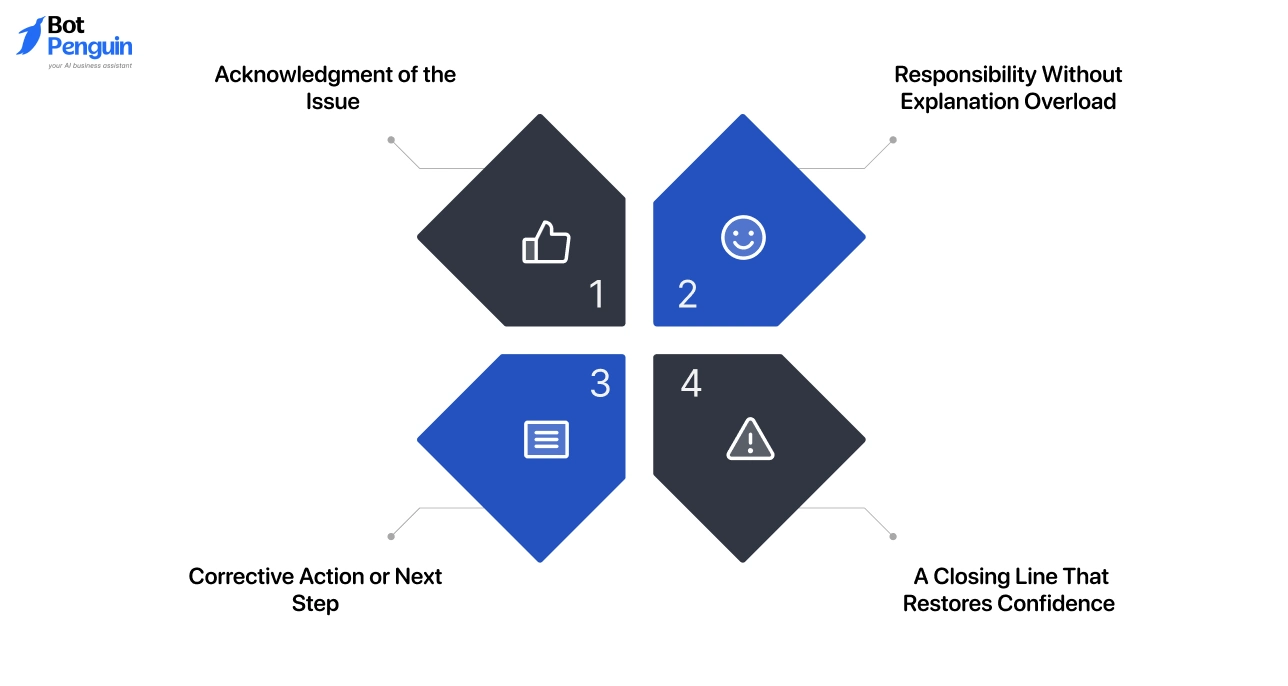
The four components below form the foundation of an effective apology in customer communication, workplace issues, and personal cases. When applied correctly, they reduce confusion and rebuild confidence.
1. Acknowledgment of the Issue
State exactly what occurred.
Example: If an update reached a customer later than expected, begin by acknowledging the delay.
Readers looking for formal apology letter guidance expect this level of clarity. It removes uncertainty and confirms that you recognize the exact concern.
2. Responsibility Without Explanation Overload
Provide a direct statement that accepts the error.
Example: If your team missed a response deadline, clearly state that the reply did not go out on time.
This avoids defensive language and positions the communication as accountable and solution oriented.
3. Corrective Action or Next Step
Explain the action taken to resolve the issue.
Example: If a payment confirmation did not trigger, confirm that the workflow has been updated and the confirmation has now been processed.
This reduces follow up questions and demonstrates improvement.
4. A Closing Line That Restores Confidence
End with a simple message that provides closure.
Example: Thank the reader for their patience or confirm availability for further clarification. This reinforces reliability and completes the communication.
These four elements create a consistent structure across all apology scenarios. The next section explains how to apply this process step by step so the message remains clear and effective in any situation.
How to Write an Apology Letter Step by Step
Once you understand what an apology letter is and when it should be used, the next requirement is a clear process for writing it.
A structured method prevents vague or incomplete communication. It also ensures that the message matches the expectations of the recipient.
Many readers searching for a professional apology letter want a reliable sequence that works across customer situations, workplace communication, and service resolutions.
The steps below keep the process simple and consistent.
1. Start with a Direct Apology
Begin with a clear statement that addresses the issue.
For example, if an order update reached the customer later than expected, open by acknowledging the delay without adding interpretation.
2. State the Specific Issue
Identify the exact event or action. If a document was sent with incorrect numbers, mention that the earlier file included an incorrect figure.
This avoids confusion and ensures the reader knows what the apology refers to.
3. Accept Responsibility
Provide a straightforward acceptance of the error. If the delay or mistake occurred within your process, confirm that the oversight was internal.
This keeps the tone accountable and reduces the chance of defensive messaging.
4. Offer a Brief and Factual Explanation
Include context only if it helps clarify the issue.
For example, if the earlier confirmation failed due to a processing delay, mention that the system did not update on time. Keep this section factual and concise.
5. Describe the Corrective Action
Explain what has already been done to resolve the issue. If a new update or corrected file has been shared, state that clearly.
This step assures the reader that the situation has been addressed.
6. Mention Measures to Prevent Recurrence
Share one specific change that lowers the chance of a repeated issue.
For example, state that the account settings or workflow have been updated to ensure timely communication. Readers appreciate knowing that the improvement is already in motion.
7. Invite Follow-up if Needed
A short line confirming availability for questions signals professionalism. This is especially useful in customer communication, where clarity supports better outcomes.
8. End with a Concise and Polite Closing
Close with a clear thank you or confirmation of support. The tone should remain neutral and consistent with the rest of the message.
These steps help create a message that is structured, factual, and easy to understand.
Whatsapp Apology Messages for Fast Replies
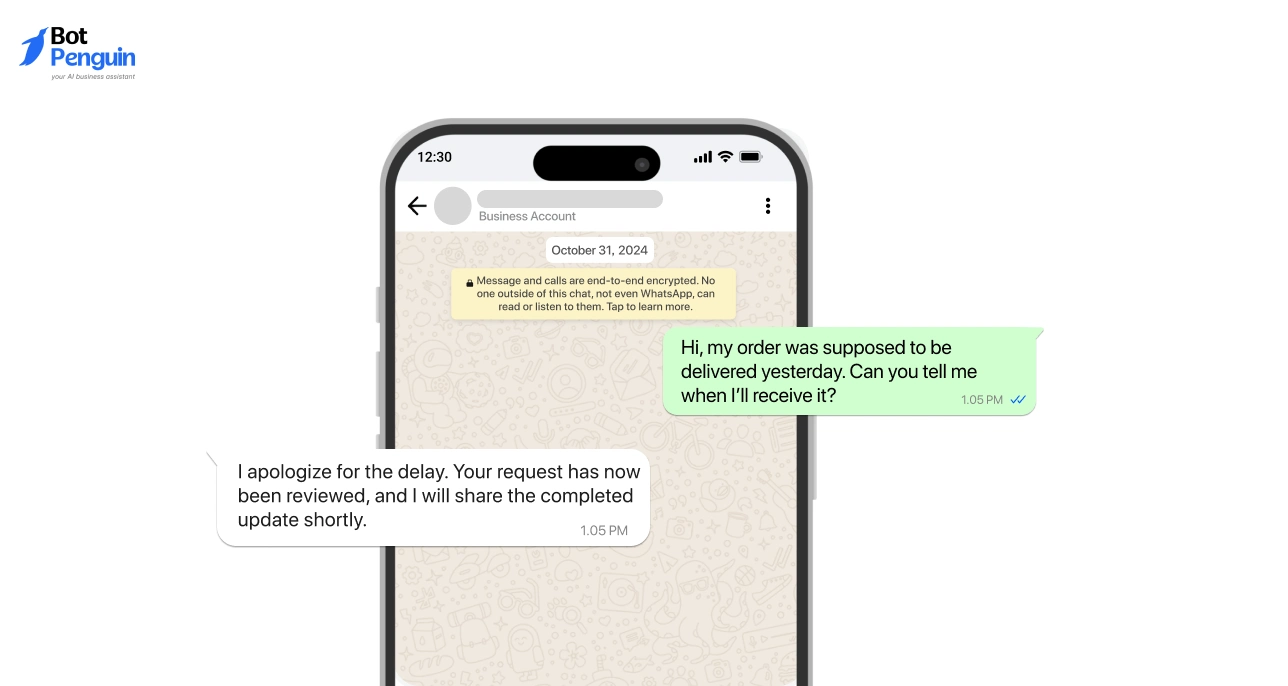
WhatsApp is often used when the situation requires quick acknowledgment rather than a complete apology letter.
These messages provide immediate clarity, confirm responsibility, and keep communication efficient.
Below are detailed, practical messages for inconvenience, delay, mistakes, and customer concerns, each written with a professional tone and selective emoticons where appropriate.
Inconvenience
- I acknowledge the inconvenience caused and have forwarded your concern to the relevant team. I will share the confirmed resolution once the review is completed.
- Thank you for informing me. I understand the disruption this created and the correction is already in progress. I will update you shortly 🙂
- Your experience matters. I apologize for the inconvenience and have initiated the required action to prevent further impact.
- I understand your concern. The issue has been validated and the next step is currently being processed. I will keep you updated.
- Thank you for your patience. I recognize the inconvenience and will share the final confirmation once the verification is complete.
Delay
- I apologize for the delay. Your request has now been reviewed, and I will share the completed update shortly.
- Thank you for waiting. The delay occurred during internal checks, but the pending step is now active. A final update will follow soon.
- I acknowledge the delayed response. The required information has been verified, and I will send the outcome shortly.
- Your message was delayed in our review cycle. The task is now in progress, and the next update will reach you soon.
- I apologize for the delayed communication. Your request is currently prioritized, and I will confirm the status shortly 🙂
Mistake
- I acknowledge the earlier mistake. The correct information has been verified, and the updated details will be shared with you in a moment.
- Thank you for pointing out the error. The data has been reviewed and the corrected version is now prepared for you.
- The previous update contained an incorrect entry. It has now been corrected and I will send the revised information shortly.
- I apologize for the mistake. The accurate details are ready, and I will share them for your confirmation.
- The earlier file included a mistake. The correction is complete and I appreciate your patience during the revision 🙂
Customer Issues
- I understand your concern and have shared it with the support team for immediate review. I will update you once the corrective step is completed.
- Your issue has been reviewed, and I will share the confirmed resolution once the team completes the final check.
- I apologize for the inconvenience. Your request is now prioritized, and the corrective action is already underway.
- Your feedback is valuable. The issue has been assigned for faster resolution and I will keep you informed throughout the process 🙂
- Thank you for reporting the concern. I have initiated the internal review and will update you as soon as the outcome is ready.
Apology Letter Templates {{Copy+Paste}}
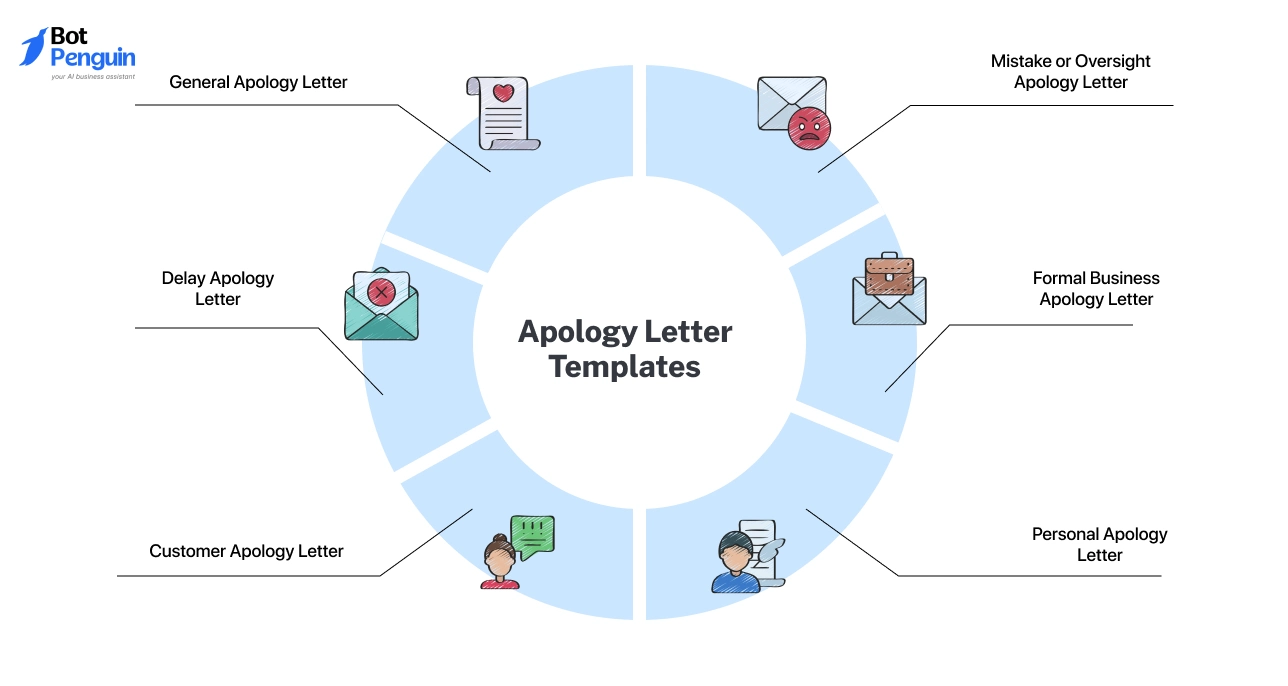
Certain situations require a complete written message rather than a short acknowledgment. A structured email is appropriate when the recipient needs clarity, documentation, or formal communication.
The following templates reflect the standards expected in a professional apology letter, with clear sections for acknowledgment, responsibility, corrective action, and next steps.
Each template includes editable fields so it can be adapted to customer communication, internal correspondence, or personal situations.
1. General Apology Letter
Subject
Update regarding your recent concern
Hello {{Name}},
Thank you for informing me about the matter related to {{issue}}. You should have received accurate information earlier, and I understand the inconvenience this caused. I reviewed the details and confirmed that the issue occurred during {{brief explanation}}.
The correction has now been completed and the updated information is accurate. I have communicated this to the team to ensure greater consistency in future communication.
Thank you for your patience while this was being resolved. If you require clarification or a summary of the changes, I am available to assist.
Regards,
{{Your Name}}
2. Customer Apology Letter
Subject
Correction applied to your account request
Hello {{Customer Name}},
Thank you for bringing this to our attention. You rely on accurate communication, and the earlier update did not reflect the correct status of your request.
I apologize for this error. I have reviewed the matter and applied the corrected information to your account. The related process has also been evaluated to strengthen accuracy in future updates.
Your satisfaction is important, and I appreciate your patience while this was addressed. If you need additional assistance or clarification, I will support you immediately.
Regards,
{{Your Name}}
{{Team or Department}}
3. Delay Apology Letter
Subject
Response delay regarding {{topic}}
Hello {{Name}},
I acknowledge the delay in responding to your message concerning {{issue}}. You should have received the update sooner, and I understand how this may have affected your plans.
The review required additional validation, which extended the response time. The verification is now complete, and the pending action has been processed.
I have communicated this internally so we can maintain more consistent timelines in future communication.
Thank you for your patience. If you require further information or an update on the next step, I am available to assist.
Regards,
{{Your Name}}
4. Mistake or Oversight Apology Letter
Subject
Correction to the earlier information
Hello {{Name}},
Thank you for identifying the error in the previous update. I understand the importance of accurate information and how this oversight may have affected your decision-making.
I reviewed the details and confirmed the correct information for {{specific item}}. The internal process that caused the issue has been addressed with the team, and the revised information is now confirmed.
If you need the corrected document or a detailed summary of the changes, I will provide it promptly.
Regards,
{{Your Name}}
5. Formal Business Apology Letter
Subject
Acknowledgment and correction of {{formal issue}}
Hello {{Recipient Name}},
I am writing to acknowledge the issue identified in our recent correspondence regarding {{topic}}. The information previously shared was incorrect, and I take responsibility for the lapse.
The matter has been reviewed with the appropriate department, and the correction has been completed. Additional verification steps have been introduced to improve accuracy in future communication.
Thank you for your cooperation throughout this process. If you require an updated document or formal confirmation of the correction, I will provide it immediately.
Regards,
{{Your Name}}
{{Position}}
{{Organization}}
6. Personal Apology Letter
Subject
Clarification regarding our earlier conversation
Hi {{Name}},
I would like to acknowledge the misunderstanding that occurred earlier. I understand that the situation may have caused confusion, and I take responsibility for my part in it. I reviewed the details and have corrected the information on my end. I appreciate your patience while I addressed the matter.
If you would like to discuss this further or need clarification on any point, I am available at your convenience.
Regards,
{{Your Name}}
These templates provide structured and customizable formats suited for customer communication, internal updates, and personal matters.
Each one maintains a clear explanation, a responsible tone, and confirmed corrective action. The following section provides concise scenario-based examples to refine tone and phrasing when a full email is not required.
Try BotPenguin

Scenario-Based Apology Examples: Short Variations
Short responses are often sufficient when the issue does not require a full email. These variations help you address the situation promptly while maintaining professionalism, clarity, and responsibility.
Each example is written in a “we” voice and includes a greeting, a concise body, a closing note, and a sign-off placeholder. This format works well across email, chat, and WhatsApp.
If You Caused Inconvenience
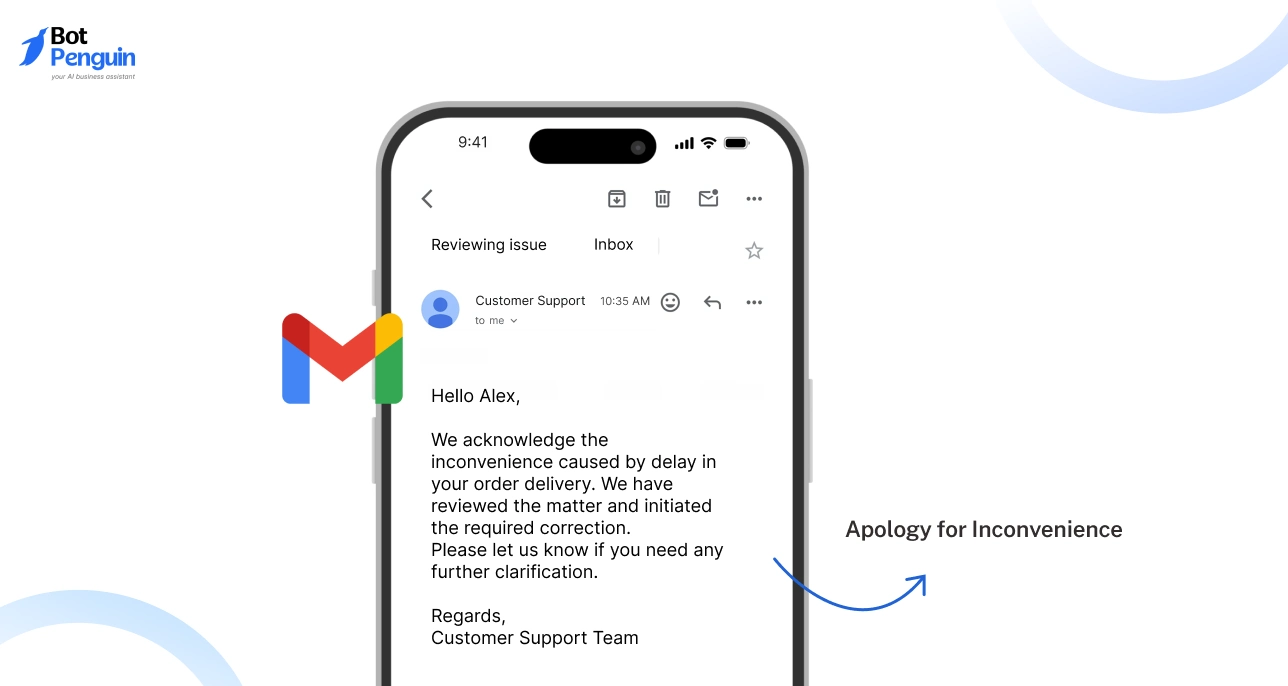
Example 1
Hello {{Name}},
We acknowledge the inconvenience caused by {{issue}}. We have reviewed the matter and initiated the required correction.
Please let us know if you need any further clarification.
Regards,
{{Team or Organization Name}}
Example 2
Hello {{Name}},
Thank you for informing us about {{issue}}. We understand the inconvenience, and the correction is now in progress.
If you require an update, we are available.
Regards,
{{Team or Organization Name}}
If You Delayed a Response or Delivery
Example 1
Hello {{Name}},
We apologize for the delay in responding to your request about {{topic}}. The review is now complete and the update is ready.
If you need the next step or any additional detail, we can share it.
Regards,
{{Team or Organization Name}}
Example 2
Hello {{Name}},
Thank you for your patience. The delay occurred during the verification of {{specific item}}, and the pending action has now been processed.
If you need a summary of the timeline, we can provide it.
Regards,
{{Team or Organization Name}}
If There Was Miscommunication
Example 1
Hello {{Name}},
We understand that the earlier message created confusion regarding {{topic}}. We have reviewed the details and confirmed the correct information.
If you need further clarification, we are available.
Regards,
{{Team or Organization Name}}
Example 2
Hello {{Name}},
There was a misunderstanding in the previous update about {{issue}}. We have corrected the information so you have the accurate version.
Please let us know if you need confirmation of any specific point.
Regards,
{{Team or Organization Name}}
If a Customer is Upset
Example 1
Hello {{Name}},
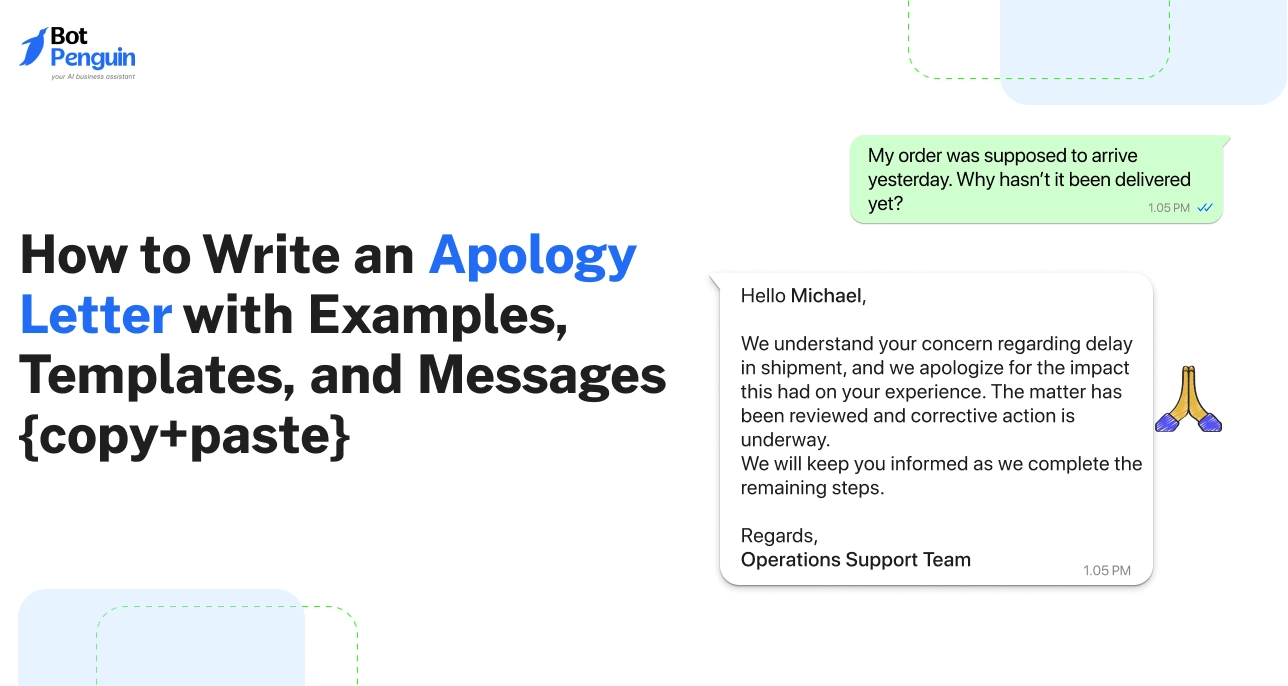
We understand your concern regarding {{issue}}, and we apologize for the impact this had on your experience. The matter has been reviewed and corrective action is underway.
We will keep you informed as we complete the remaining steps.
Regards,
{{Team or Organization Name}}
Example 2
Hello {{Name}},
Thank you for sharing your feedback. We understand why this situation was frustrating. Your concern has been escalated and our team is addressing it.
If you need immediate support, we are available.
Regards,
{{Team or Organization Name}}
If You Need to Apologize to Your Boss or Colleague
Example 1
Hello {{Name}},
We want to acknowledge the issue related to {{task or project}}. The oversight has been corrected and the cause has been reviewed.
If you need additional details, we can provide them.
Regards,
{{Your Team or Department}}
Example 2
Hello {{Name}},
We understand how this affected the workflow. We take responsibility for the error concerning {{specific item}}, and the correction is complete.
Please let us know if you need a summary of the update.
Regards,
{{Your Team or Department}}
If You Need a Public Apology
Example 1
Hello everyone,
We acknowledge the issue related to {{topic}} and understand its impact. The matter has been reviewed and the corrective action has been completed.
Thank you for your understanding as we work to maintain accuracy.
Regards,
{{Organization Name}}
Example 2
Hello everyone,
We recognize the concern raised regarding {{issue}}. We take responsibility for the error and have updated the information accordingly.
We appreciate your patience while this was resolved.
Regards,
{{Organization Name}}
These customizable responses help you address common situations quickly and professionally while maintaining a consistent and accountable tone.
They also prepare readers for the next section, which focuses on selecting the most appropriate tone for different types of apology messages.
What Tone Should You Use in an Apology Letter
Tone determines how your apology is interpreted. The previous section addressed situation-based replies, and the next requirement is selecting a tone that matches the recipient and the context.
A well-written professional apology letter should communicate responsibility and clarity, but the tone must adjust based on the level of formality expected.
1. Formal Tone
A formal tone is appropriate for senior stakeholders, corporate documentation, compliance matters, legal communication, or situations where the apology becomes part of an official record.
It avoids conversational language and focuses on accuracy, responsibility, and verification. This tone demonstrates respect for processes and emphasizes the seriousness of the issue.
Expanded Example
Hello {{Name}},
We acknowledge the issue identified in your recent correspondence regarding {{topic}}. Our team has reviewed the matter in detail and completed the required correction.
We understand the importance of accuracy in formal communication, and we regret that this oversight occurred. The updated information has been verified, and the relevant stakeholders have been informed.
If you require an updated document or an official confirmation note, we will prepare it promptly.
Regards,
{{Organization Name}}
2. Professional Friendly Tone
This tone fits most business communication, including customers, colleagues, and external partners. It is respectful and structured but more conversational than formal writing.
This tone is used when the issue has an impact but does not require legal or high-level documentation. It helps maintain a positive relationship while still addressing the concern directly.
Expanded Example
Hello {{Name}},
Thank you for bringing this to our attention. We understand your concern regarding {{issue}}, and we apologize for the inconvenience.
We have reviewed the matter and completed the correction. The updated information is now accurate and active in our system. We appreciate your patience while we resolved this.
If you need more details or support related to this update, we are available to assist.
Regards,
{{Team or Department}}
3. Casual Tone
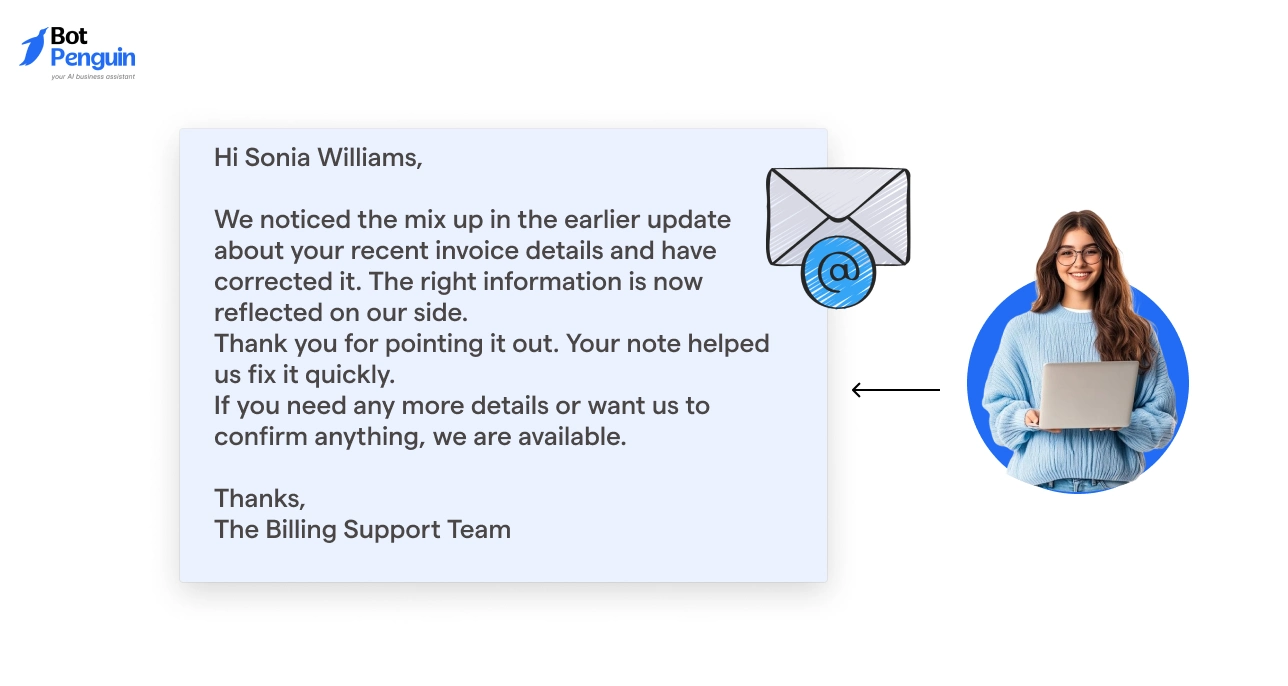
A casual tone is suitable for internal communication, familiar colleagues, or situations where the issue is minor and the relationship does not require formal structure.
It keeps the message simple and straightforward while still acknowledging responsibility.
Expanded Example
Hi {{Name}},
We noticed the mix up in the earlier update about {{topic}} and have corrected it. The right information is now reflected on our side.
Thank you for pointing it out. Your note helped us fix it quickly.
If you need any more details or want us to confirm anything, we are available.
Thanks,
{{Your Name or Team}}
Selecting the appropriate tone ensures that the message aligns with the expectations of the recipient and the sensitivity of the situation.
Formal tone supports official communication, a professional, friendly tone suits most customer and colleague interactions, and a casual tone keeps internal updates efficient.
Mistakes to Avoid in an Apology Letter
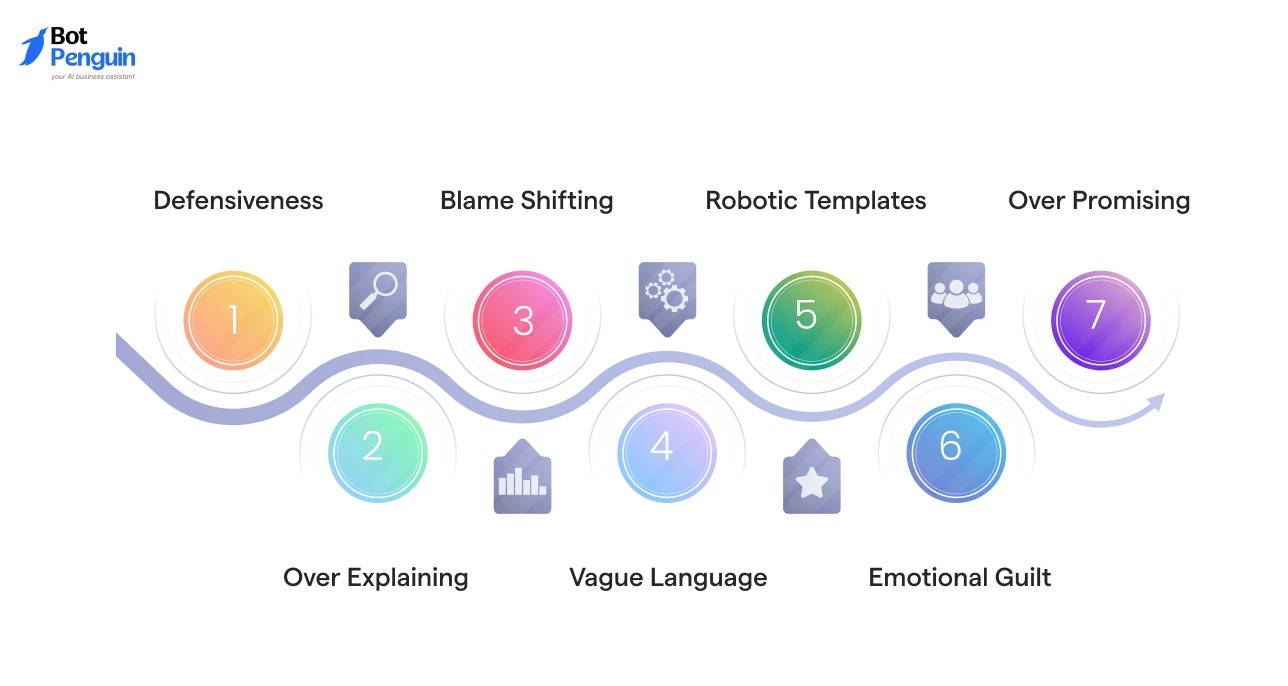
Writing a clear apology is not only about what you include but also about what you avoid. Even a well-meaning message can lose its impact if the tone sounds defensive or if the explanation becomes unclear.
Readers of a professional apology letter expect responsibility, accuracy, and a direct explanation without unnecessary language.
This section outlines common mistakes that weaken an apology and provides practical examples so you can maintain clarity and credibility in every message.
Defensiveness
Defensiveness makes the apology appear insincere. For example, writing “We only made this mistake because the customer entered the wrong information” shifts attention away from responsibility.
The recipient should not feel blamed for the issue. The message should remain centered on what the team can control.
Over Explaining
Over-explaining creates confusion and reduces the effectiveness of the apology. A detailed timeline of internal steps or technical processes does not help the reader.
For instance, long explanations about system updates or internal approvals are unnecessary unless they directly affect the resolution.
Blame Shifting
Redirecting the responsibility to another department, partner, or customer reduces trust.
For example, statements such as “The delay happened because the operations team did not review it on time” create internal friction and appear unprofessional externally. The focus should stay on the corrective action.
Vague Language
Vague phrases such as “something went wrong” or “there was an issue” do not provide clarity. Readers need to know what part of the process failed in order to trust the correction.
Structured apologies address the specific point without disclosing unnecessary details.
Robotic Templates
Templates that sound generic or automated undermine sincerity. For example, repeating the same one-line message across multiple concerns makes the communication appear scripted.
Customization is essential for a professional apology letter, even when using a standard structure.
Emotional Guilt
Excessively emotional language such as “We feel terrible about this” or “We are extremely distressed,” distracts from the corrective action.
Apologies should remain factual and centered on what is being done to resolve the matter.
Over Promising
Statements such as “This will never happen again” or “We guarantee no future issues” can create unrealistic expectations. It is more effective to describe the corrective actions taken and the processes updated rather than making absolute commitments.
Avoiding these mistakes ensures that every apology remains clear, responsible, and aligned with professional communication standards.
With these points in mind, the next section explains how to choose the most appropriate format for your message, whether it is an email, written letter, or short acknowledgment.
Email vs Letter vs Short Message: Which Format Should You Use
The effectiveness of an apology depends not only on the clarity of the message but also on the format you choose. Each format carries a different level of formality, documentation, and expectation.
A professional apology letter is appropriate in certain contexts, but an email or short message may be more suitable in others.
The goal is to select the format that aligns with the seriousness of the issue, the relationship with the recipient, and the information they require to move forward.
Below is detailed guidance for each format along with practical scenarios.
When to Use Email
Use email when the issue requires documented communication, a clear explanation, or a structured response.
Email is appropriate for operational issues, customer complaints, internal updates, or any situation where the recipient may refer back to the message later.
Example scenarios
- A customer received an incorrect invoice and needs a clear explanation of what changed and why.
- A colleague requires a written update on a delay that affected project timelines.
- A partner needs a recorded clarification for an error in a shared file or deliverable.
Email provides written proof of acknowledgment, corrective action, and follow-up details.
When a Letter is Required
Use a formal letter when the matter involves compliance, contracts, legal documentation, or high-level organizational communication.
A letter provides a more formal tone, a physical or official record, and a stronger acknowledgment of responsibility.
Example scenarios
- A compliance-related error affected contractual terms and requires an official written apology.
- A senior stakeholder expects a formal communication about an oversight in a critical report.
- An external authority needs documented confirmation that the issue was addressed and corrected.
A letter is also appropriate when the apology may be archived, reviewed by multiple teams, or included in formal records.
When a Short Message is Enough
Use a short message when the issue is minor, time sensitive, or does not require full documentation. This format is ideal for quick acknowledgment and immediate clarity.
It is often used through WhatsApp, chat, or internal messaging tools.
Example scenarios
- A reminder was sent late, and the recipient simply needs confirmation that the correct information is now updated.
- A small operational delay affected a meeting schedule, and the correction is already complete.
- A brief misunderstanding occurred, and only a short clarification is necessary.
Short messages work when speed and immediate reassurance matter more than full detail.
When a Public Apology is Needed
Use a public apology when the issue affects multiple users, a broad audience, or a customer base.
Public apologies address collective concerns, provide transparency, and ensure consistent communication across all affected individuals.
Example scenarios
- A service outage affected a large group of customers, and they require a unified, accurate update.
- A published document contained incorrect information and needs an open correction to maintain trust.
- A community or user group was impacted by an operational issue and needs a clear acknowledgment in a shared space.
A public apology ensures everyone receives the same information and understands the corrective steps taken.
Each format serves a different purpose. Email supports clarity and documentation, letters provide formal acknowledgment, short messages offer immediate responses, and public statements address broader audiences.
Understanding these distinctions ensures that every apology aligns with the recipient's expectations and the seriousness of the situation. The next section explains how automation can help teams manage these communications consistently and efficiently.
How BotPenguin Helps You Send Perfect Apology Messages Automatically
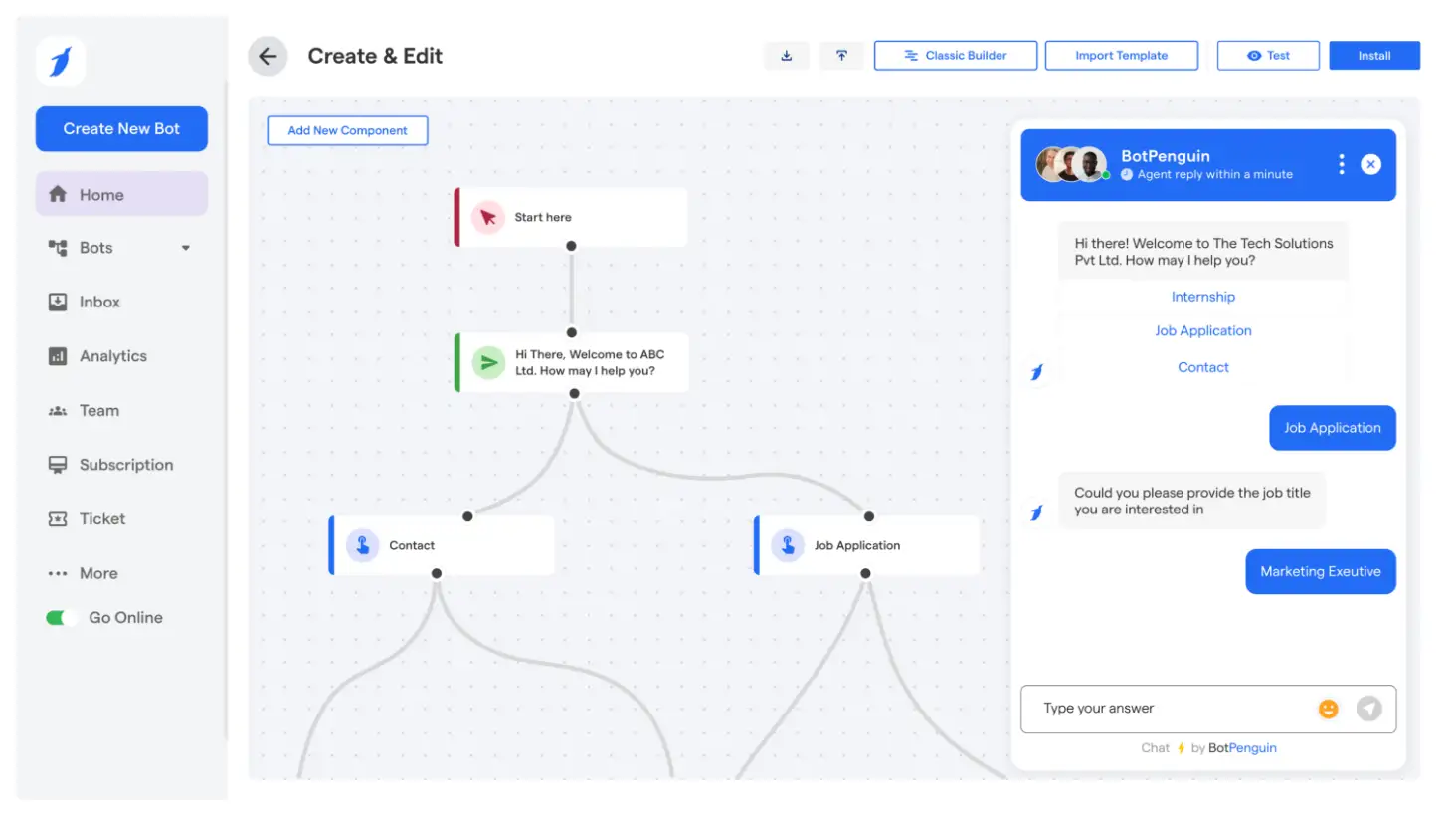
As the number of customer interactions increases, maintaining consistent and timely apology communication becomes difficult. Errors, delays, and service issues require immediate and accurate responses.
BotPenguin addresses these challenges by automating message creation, delivery, and tracking, which improves response quality across support, operations, and service teams.
Smart Pre-built Apology Templates
BotPenguin includes templates for delays, incorrect information, service concerns, missed responses, and complaint handling.
These templates follow a clear structure and best practices, allowing teams to provide fast, accurate, and responsible communication without drafting messages from scratch.
Automated Customer Messaging Across Channels
The platform delivers apology messages across WhatsApp, Telegram, chat, Instagram, and other communication channels.
This ensures that customers receive the update on the channel they prefer, which improves clarity and response time during operational or service-related issues.
Personalized Tone and Message Generation
BotPenguin automatically adapts its tone based on customer profile, previous interactions, and communication history.
The AI generates formal, professional, friendly, or neutral messages, ensuring that each apology matches the required tone of the situation.
CRM Synced Conversations
All messages are logged within your CRM, including the apology, follow-up updates, and status confirmations.
This prevents missed follow-ups, supports accurate record keeping, and helps teams track issue resolution without manually linking messages.
Ideal for Support, Operations, and Service Teams
Teams that handle large volumes of inquiries or operational updates benefit from automated apologies for delays, corrections, and service disruptions.
It enables consistent communication even during peak workloads or time-sensitive issues.
Try BotPenguin to Automate Customer Communication and Send Accurate Apology Messages Instantly.
BotPenguin strengthens apology communication by providing templates, automation, tone control, and integrated tracking. With these capabilities in place, teams can maintain clarity and consistency across all customer interactions.
Explore Now
Final Thoughts
A clear apology depends on structure, tone, and timely communication. You now have the frameworks, examples, and templates to address any situation with accuracy and confidence.
Whether the issue involves a delay, incorrect information, or a service related concern, the steps in this guide ensure your message remains responsible and easy to understand.
Use these resources whenever you need quick phrasing, full email formats, or guidance on tone. Bookmark this guide so you always have the right words available when an apology is required.
Frequently Asked Questions (FAQs)
What are some common mistakes to avoid when writing an apology letter?
Avoid generic language, over-explaining, blaming others, or sounding insincere. Keep it specific, empathetic, and action-driven to rebuild trust effectively.
Is “We Apologize for the Inconvenience” appropriate for serious customer complaints?
It’s too vague for serious issues. Use clearer, more empathetic phrases that acknowledge the problem and outline steps to resolve it.
Can I use an apology amenity card instead of writing a full apology letter?
Amenity cards are fine for minor service issues, but a formal apology letter is better for serious concerns or repeated mistakes.
When does saying “I Apologize for the Inconvenience” come across as dismissive—and what should you say instead?
It sounds dismissive if overused or emotionless. Try: “We understand your frustration and are actively working to resolve this issue.
How formal should a letter to apologize be in different business situations?
Match the tone to the context. Use formal language for clients or higher-ups; keep it clear and respectful even in internal messages.