WhatsApp Chatbot for Ecommerce: Use Cases, Examples, and Setup
Updated at Oct 7, 2026
12 min to read
Your shoppers don't wait.
They want answers at discovery, at checkout, and after the purchase lands. If they don't get them quickly, they move on to a competitor who responds faster. Scaling a support team to match that demand isn't realistic for most ecommerce businesses.
That's exactly where conversational AI for ecommerce comes in.
It handles customer conversations across the entire shopping journey: instantly, personally, and without adding headcount.
This guide breaks down how conversational AI in ecommerce works, where it drives results, and how to add it to your store.
Conversational AI in ecommerce is the use of AI-driven systems in online retail to understand shopper intent, hold real-time conversations, and deliver personalized responses that guide purchase decisions, support shoppers, and drive engagement.
It works across your entire store: on your website, app, WhatsApp, Instagram, or any channel your customers use.
Unlike static forms or basic automation, it holds real conversations. It remembers context, pulls live data from your store, and personalizes every response based on what the shopper actually needs at that moment.
The result:
The numbers reflect the shift. The global conversational AI market is expected to grow up to $57.5 billion by 2030 (MarketsandMarkets), with ecommerce among the fastest-growing adoption sectors.
Three components power every conversational AI interaction:
Together, these make every customer interaction feel less like a form submission and more like talking to someone who knows your store inside out.
Now that you know what it is, it’s time to see how it differs from a traditional chatbot.
Traditional chatbots follow a script. Conversational AI follows the conversation. It also operates at a broader level, powering smart assistants, voice bots, and IVRs, with chatbots as just one component.
That single difference changes everything about how your store handles customer interactions, at scale, across channels, and at every stage of the buying journey.
Here's how they compare across the factors that matter most to your store:
The gap shows up most in high-intent moments (when a shopper is mid-checkout and needs a quick answer, or when they're comparing two products and need a nudge).
A scripted bot stalls. Conversational AI moves them forward.
69% of consumers say they prefer chatbots for quick communication with brands (Salesforce). But that preference drops sharply when the bot can't handle their actual question. That's the gap conversational AI closes.
Not every store needs conversational AI right now.
If your store has a small product catalog, low monthly query volume, and straightforward FAQs, a rule-based chatbot handles the job without the added complexity.
The upgrade makes sense when your query volume grows, your customer questions become more varied, or your current bot is visibly costing you conversions.
Start with what fits your current scale. Upgrade when the gaps become expensive.
The real question, however, isn't which tool is better; it's where in your ecommerce store conversational AI drives the most measurable impact.
Conversational AI works across every stage of your customer's journey, from the first product search to long after the order is delivered.
Here’s a breakdown of the top use cases of ecommerce conversational AI:
Most shoppers don't know exactly what they want. A search bar doesn't solve that.
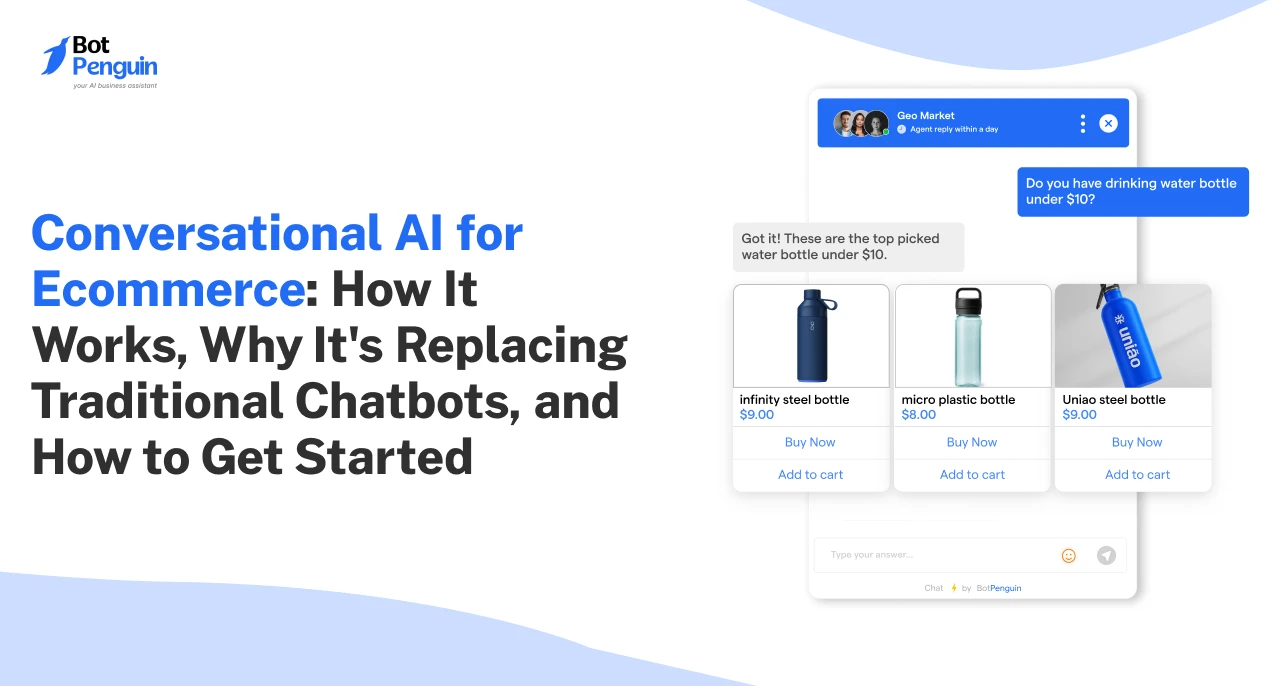
Conversational AI replaces dead-end search with guided, intent-aware discovery. Shoppers describe their needs in natural language. The AI asks follow-up questions, narrows options, and surfaces the right products instantly.
For example, Amazon’s Alexa-enabled shopping lets users search for and reorder products with voice commands, with the AI understanding intent and suggesting relevant items based on past behavior and preferences.
Businesses using AI-driven personalization report 10–15% revenue uplift, according to McKinsey.
70.19% of online shopping carts are abandoned before checkout (Baymard Institute).
Most of those abandonments happen because a question went unanswered at the wrong moment, not because the shopper changed their mind.
Conversational AI detects hesitation signals and intervenes before the shopper leaves:
Brands using AI-driven cart recovery report up to a 25% reduction in abandonment rates (Tidio).
The sale doesn't end at checkout. Post-purchase is where support tickets pile up, and where customer loyalty is won or lost.
Conversational AI handles the high-volume, repetitive interactions automatically:
AI chatbots can handle up to 80% of routine customer queries, according to IBM, freeing your team to focus on complex, high-value cases.
The journey use cases are clear. But the tools that deliver them have evolved beyond chat interfaces, with AI agents now executing tasks rather than just responding to queries.
If you’re looking to scale your ecommerce sales, BotPenguin powers conversational AI chatbots that engage users in real time, automate support and sales workflows, and turn everyday interactions into measurable conversions and revenue growth.
Most conversational AI answers questions. AI agents act on them.
An AI agent doesn't wait for your shopper to ask. It monitors behavior, detects intent, and takes action autonomously, without a human trigger.
That's a meaningful operational shift for ecommerce stores.
Here's the difference between conversational AI chatbots and AI agents in practice:
What AI agents handle autonomously in ecommerce:
In 2026, it's estimated that 20% of customer service interactions in ecommerce will be handled entirely by autonomous AI agents (Gartner), with zero human involvement from query to resolution.
For ecommerce operators, this isn't a future consideration. It's a current competitive advantage.
Knowing what AI agents can do is one thing; choosing the right platform to deploy them is another.
Most ecommerce teams pick a platform the wrong way; they book demos first and define requirements second.
That's how you end up with a tool that looks impressive but doesn't fit your stack, your team, or your customers.
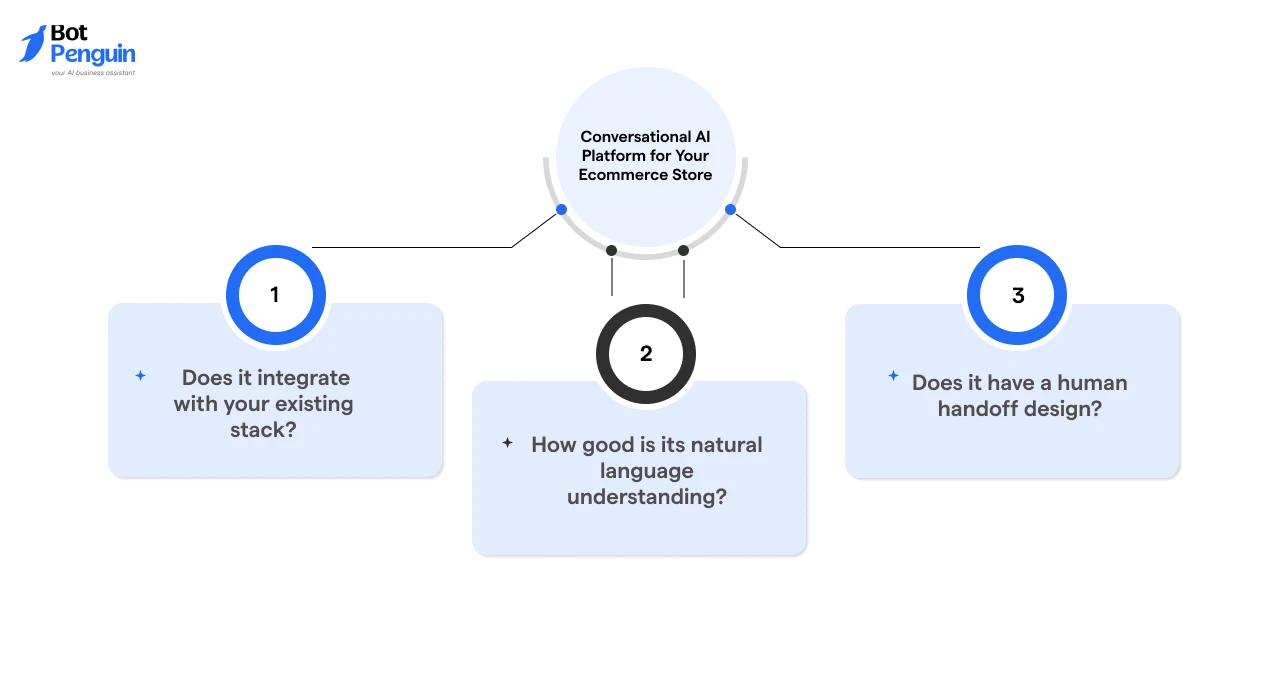
Start with three questions. They'll eliminate most wrong choices before you evaluate a single platform.
The conversational AI platform needs to connect natively with your ecommerce platform, CRM, and order management system, not through workarounds.
If you're on Shopify or WooCommerce, verify that the native integration is available before proceeding.
A platform that requires custom development to connect to your catalog isn't plug-and-play; it's a project.
Not all NLU engines are equal. Test it with messy, real-world inputs: typos, slang, multi-part questions. A reliable benchmark is 85–90%+ intent recognition accuracy on real queries.
If it fails on the inputs your actual shoppers would send, it'll fail in production.
No AI handles every conversation perfectly. The question is what happens when it can't.
A well-designed platform seamlessly escalates to a human agent, passing along full conversation context. A poorly designed one makes the shopper start over.
That single feature separates good implementations from frustrating ones.
Choosing the right conversational AI platform depends on your store size, query volume, and integration needs.
Here are commonly used tools categorized by real-world ecommerce use cases.
The table above helps you map your store size to the platform that best fits your current needs.
For most ecommerce operators, especially those on Shopify or WooCommerce, the right platform often falls in the mid-market, where fast deployment and core capabilities matter most.
Tools like BotPenguin fit this category, covering essential use cases such as product queries, post-purchase support, and human handoff without heavy setup.
Before you set it up, though, there are a few deployment mistakes that consistently kill ROI before the platform even gets a fair chance. In the next section, we cover such mistakes.
Getting the platform right is only half the job. How you deploy it determines whether it drives results or collects dust.
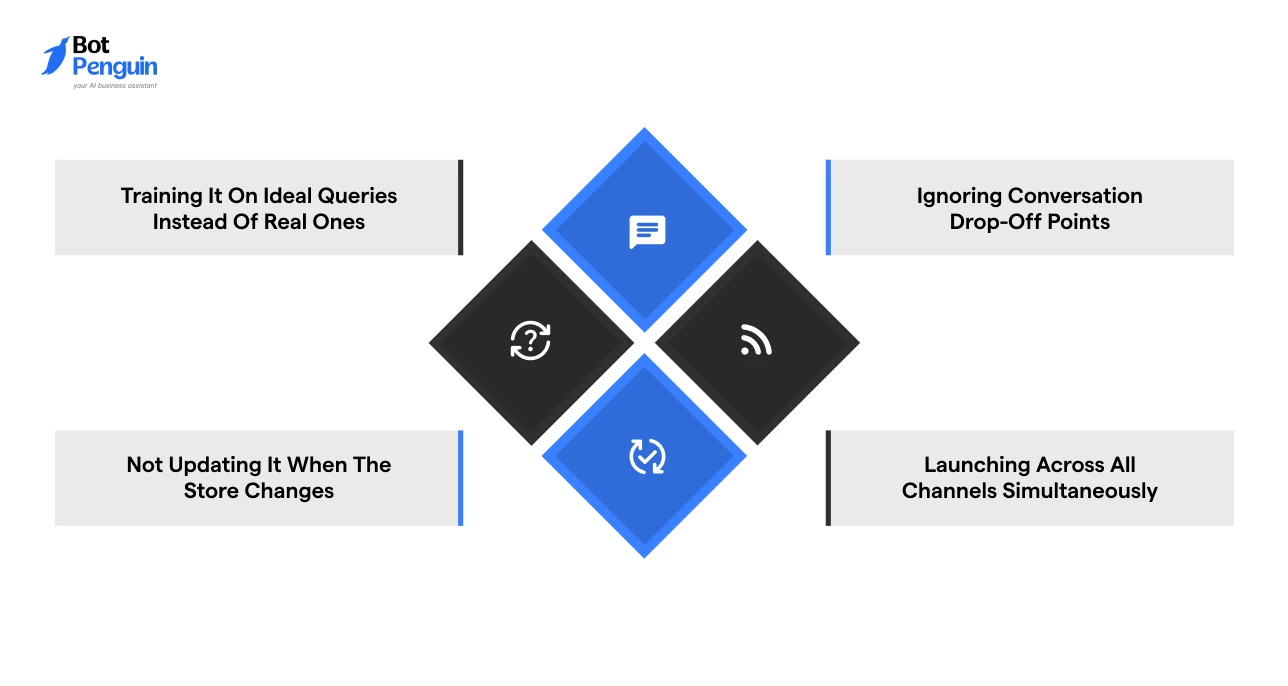
These are the 4 mistakes that consistently kill ROI, and how to avoid them.
Teams train the AI on polished FAQs. Real shoppers are vague, inconsistent, and unpredictable. The AI fails on the queries that matter most.
The Right Approach: Pull your last 3 months of actual support tickets and chat logs. Train on what shoppers genuinely ask, not what you wish they'd ask.
The AI is live, but no one is reviewing where conversations break down. Drop-off points quietly accumulate: unresolved queries, dead ends, frustrated shoppers.
The Right Approach: Review conversation logs weekly in the first 90 days. Fix failing flows before they compound into a pattern.
New products launch. Policies update. Promotions go live. The AI keeps answering based on outdated information.
The Right Approach: Every time something changes in your store, update your AI's knowledge base. Treat it like your storefront, not a one-time setup.
Teams go live on the website, WhatsApp, Instagram, and email at the same time. Each channel has different conversation patterns and customer expectations. The AI performs poorly across all of them.
The Right Approach: Launch on your highest-traffic channel first. Optimize performance there before expanding to additional channels.
With the common pitfalls mapped, here's how to get your conversational AI live and working correctly from day one.
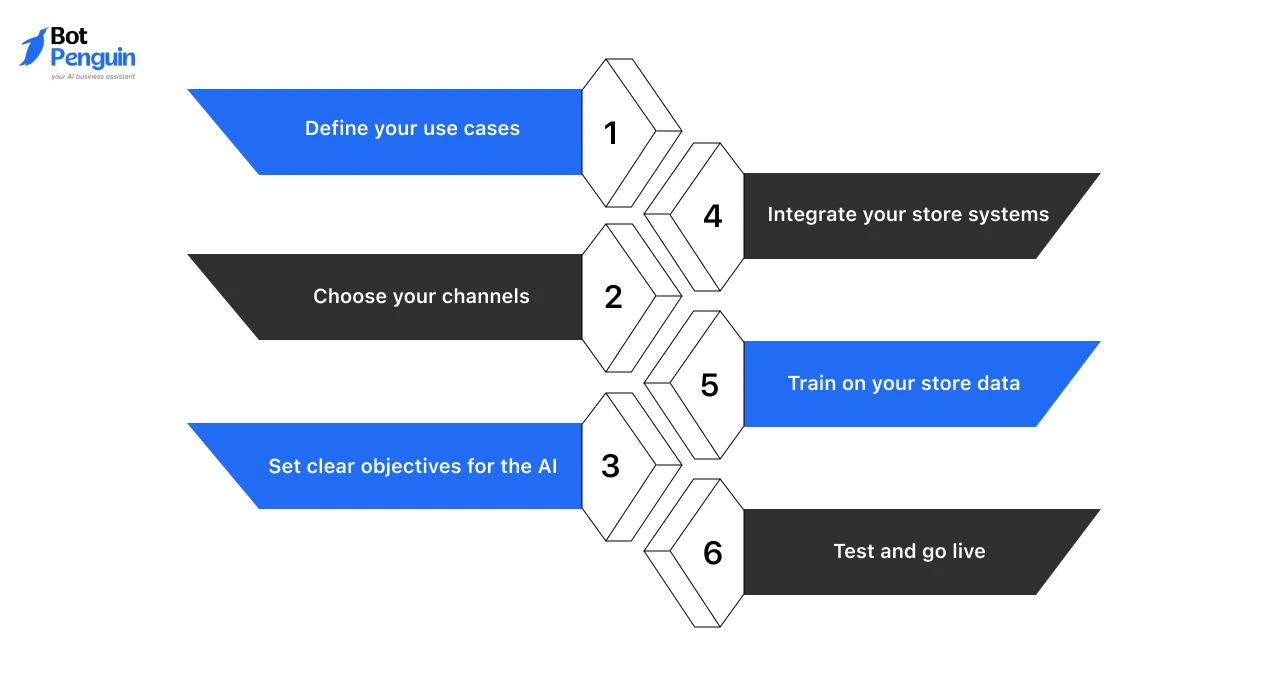
Setting up conversational AI on your ecommerce store doesn’t require heavy technical effort. Most modern platforms offer no-code or low-code deployment with pre-built integrations.
Here’s a typical implementation flow followed across platforms:
Identify where conversational AI will add value: product discovery, cart recovery, order tracking, or customer support.
Decide where your shoppers interact most: website, WhatsApp, Instagram, or mobile app. Start with one high-traffic channel.
Define what the AI should do: guide product selection, answer FAQs, handle returns, or assist during checkout.
Connect your ecommerce platform, CRM, and order management system so the AI can access real-time product and order data.
Upload product catalogs, FAQs, shipping policies, and past support queries to make responses accurate and context-aware.
Run real-world scenarios such as product comparisons or delivery queries. Optimize responses before full deployment.
Looking to deploy your own conversational AI in ecommerce? Platforms like BotPenguin simplify the process with 80+ pre-built integrations and no-code setup, enabling faster deployment across ecommerce channels.
Conversational AI in ecommerce is moving beyond reactive support toward proactive, autonomous engagement.
AI chatbots will continue to handle high-volume conversations, while AI agents take on decision-making and task execution across the shopping journey.
Instead of waiting for shoppers to ask, these systems will predict intent, initiate interactions, and act in real time.
This shift turns conversational AI from a support layer into a revenue-driving system.
Platforms that combine chatbots with agent capabilities, such as BotPenguin, are already enabling businesses to scale personalized, end-to-end customer interactions more efficiently.
If you're looking to implement this shift, explore how BotPenguin can help you deploy conversational AI for your ecommerce store.
Traditional chatbots follow fixed scripts, while conversational AI understands intent, retains context, and dynamically adapts responses to complex, unpredictable customer queries.
Key use cases include product discovery, guided selling, cart recovery, checkout support, order tracking, returns handling, and post-purchase engagement across the entire customer journey.
AI-powered personalization and conversational support can increase conversions by guiding shoppers in real time, reducing friction during decision-making, and improving the overall shopping experience.
When unable to resolve a query, conversational AI escalates to a human agent with full conversation context, ensuring faster resolution without requiring the customer to repeat information.
Most no-code conversational AI platforms allow setup within a few hours, including integration, training on store data, and deployment across key customer interaction channels.
Conversational AI helps small ecommerce stores automate support, handle product queries, and improve conversions, reducing manual workload while maintaining consistent customer engagement at scale.
Subscribe to Our Newsletter
Get the latest business insights straight into your inbox.
Checkout our related blogs you will love.
Updated at Oct 7, 2026
12 min to read
Updated at Sep 30, 2026
11 min to read
Updated at Sep 25, 2026
13 min to read
Updated at May 29, 2026
11 min to read
Updated at May 20, 2026
8 min to read
Updated at May 20, 2026
9 min to read
Table of Contents