





Best AI Chatbot Platform for Telecom Customer Service: 10 Tools Compared
Updated at Oct 9, 2026
10 min to read
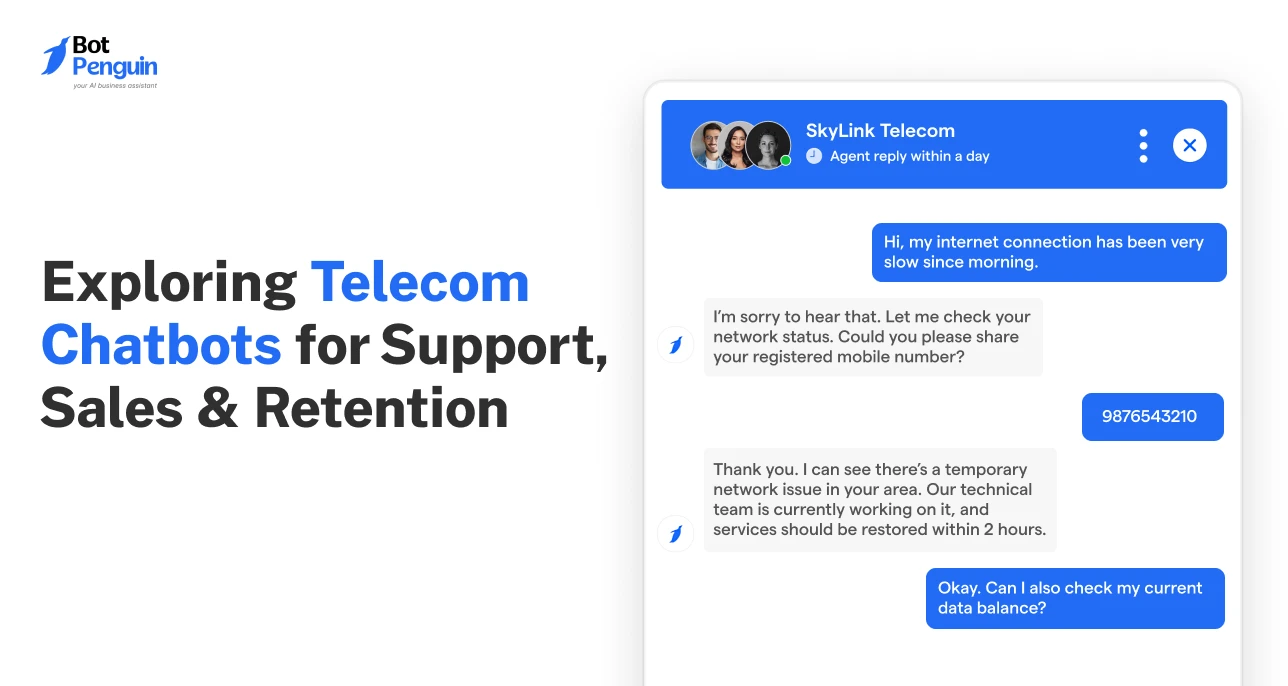
Telecom customer support is among the busiest service environments.
They are expected to handle massive volumes of billing questions, recharge requests, plan changes, and network issues… That too at the speed users demand. However, long wait times and overloaded support teams still frustrate users, leading to surging churn.
This is where telecom chatbots step in.
From AI-powered support and plan recommendations to proactive retention workflows, these chatbots help providers automate conversations without losing speed.
In this guide, you’ll learn what telecom chatbots are, how they work, their top use cases, benefits, customer retention strategies, and how telecom companies use them to improve support & sales.
A telecom chatbot is a rule-based or AI-powered virtual assistant that helps telecom companies automate customer support, sales, billing, recharge assistance, and service-related conversations.
A prominent example is Bharti Airtel's Thanks app, which deploys six AI agents (Data, Buy, Build, Pay, Serve, and Channels) to handle billing, payments, and support for over 380 million users. (Source: Business Standard)
But its working is not as simple as its process looks on the outside.
A typical chatbot for telecom companies follows a simple but powerful workflow:
The result? Faster resolutions, fewer support tickets, and a smoother experience, without adding headcount.
The core distinction between a traditional and AI-driven telecom chatbot comes down to how they understand and respond to customers.
Here’s how to visualize that difference in practice:
For telecom companies handling millions of daily interactions, AI chatbots aren't just an upgrade; they're a necessity. The more complex your customer journeys, the stronger the case for AI over rule-based flows.
Platforms like BotPenguin make this transition straightforward, offering telecom-ready AI chatbot solutions that work across websites, WhatsApp, and voice channels without heavy development overhead.
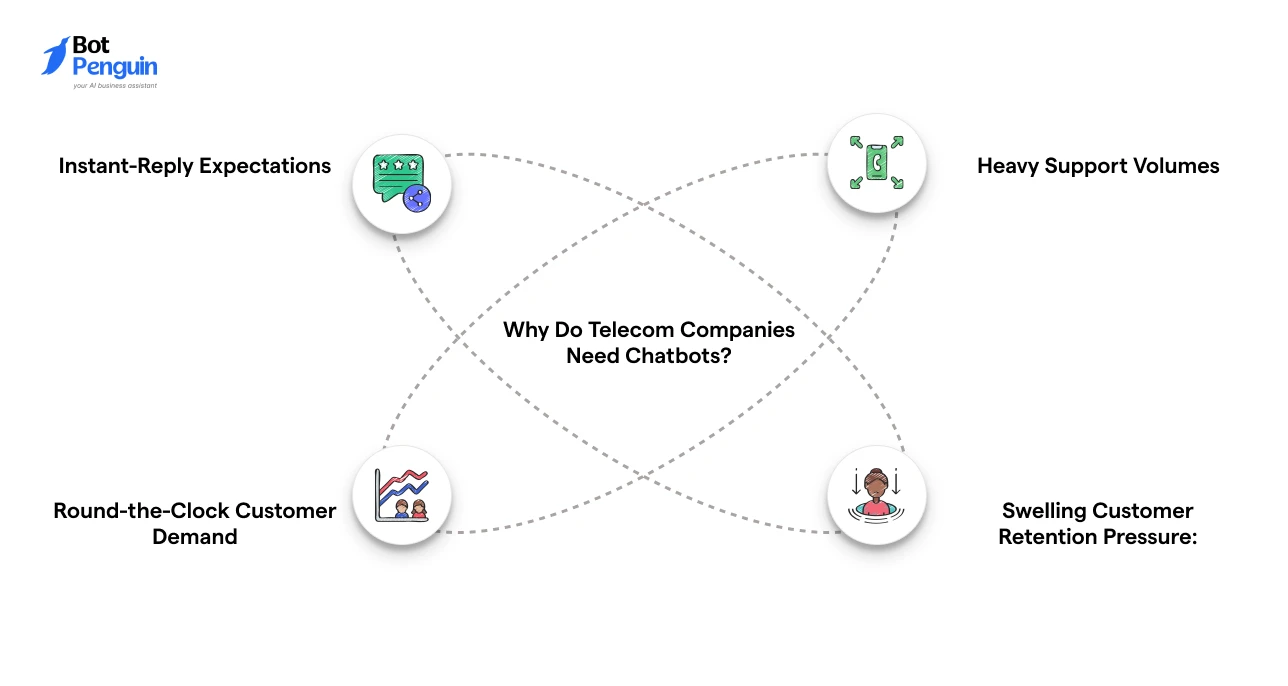
What makes the task of telecom companies complex is not the queries themselves, but volume… And AI chatbots help them handle this pressure more efficiently.
Backing their relevance, IBM Institute for Business Value reports that AI chatbots can resolve up to 80% of routine and repetitive customer queries.
Here are the reasons driving the rapid adoption of these AI-assisted tools:
Telecom chatbots help providers deliver quicker support, decrease operational pressure, and improve customer experience without continuously increasing support expenses.
Telecom chatbots now support key subscriber journeys across account management, engagement, issue resolution, and revenue growth.
The table below provides a quick overview of key chatbot use cases for telecom companies:
Each of these use cases has been explained further below:
Telecom chatbots manage routine subscriber requests like balance checks, SIM activation, account updates, and service inquiries without agent involvement.
A strong example is seen in Jio's HelloJio, an AI-powered multilingual virtual assistant that handles balance checks, recharge tracking, plan exploration, and real-time issue resolution. (Source: Jio.com)
Customers can check invoices, payment history, due dates, failed transactions, and billing breakdowns directly within the conversation.
This helps lower inbound billing calls significantly, one of the highest-volume query types in any telecom support center.
Chatbots streamline prepaid recharge and renewal workflows with reminders, quick payment options, and recommended plans.
Think: Emergency situations where a customer's data runs out at midnight, and there's no agent available - the chatbot handles the recharge instantly, on any channel.
AI-powered telecom chatbots suggest relevant plans, data packs, OTT bundles, and upgrades based on customer usage patterns.
Chatbots collect subscriber requirements, location details, and plan preferences before routing high-intent leads to telecom sales teams.
Telecom chatbots share real-time outage alerts, maintenance updates, and expected service restoration timelines.
Chatbots guide customers through internet setup, SIM issues, device configuration, and connectivity troubleshooting steps.
A great example is Deutsche Telekom, whose AI chatbot independently handles 50% of service desk inquiries, reducing human agent dependency by 30%.
Subscribers can check roaming charges, activate international packs, and understand usage limits through conversational support.
Telecom chatbots gather customer ratings, feedback, and post-resolution opinions immediately after interactions.
This helps telecom companies spot service gaps in real time, instead of waiting for monthly surveys that most customers never complete.
AI telecom chatbots identify dissatisfied customers, trigger retention offers, and automate win-back communication workflows.
From first contact to post-resolution feedback, telecom chatbots now cover the entire customer journey. The use cases above aren't isolated features; they work together to reduce costs, improve experience, and protect revenue at every touchpoint.
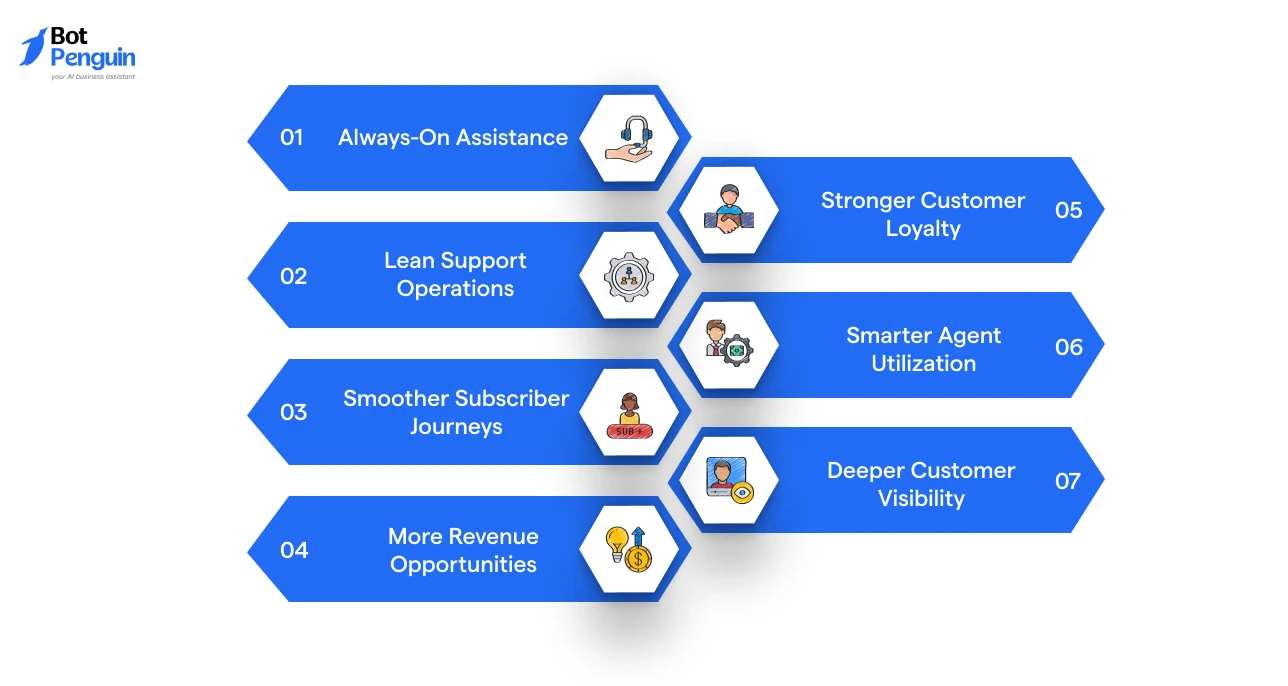
Chatbots for telecom directly impact revenue, retention, and operational efficiency.
Here are the top advantages that these solutions provide to telecom operators and providers:
As telecom competition continues to grow, chatbots are becoming an important tool for improving both operational effectiveness and subscriber experience.
Want a real example? See how Breakbag used BotPenguin for a live chatbot deployment →
Different customer support tools solve different telecom communication needs.
Understanding how telecom chatbots, IVR chatbots, and live chat differ helps providers choose the right support experience.
An IVR chatbot is a voice-based automated assistant that interacts with telecom customers through phone calls using voice commands, speech recognition, or keypad inputs.
Example: When you call your mobile provider and hear "Press 1 for billing, Press 2 for recharge" - that’s an IVR system!
While all three handle customer queries, they differ significantly in channel, capability, and the type of customer problem they solve best.
Here’s a breakdown of the main differences between these types:
Despite these differences, the right choice isn't always one over the other. In fact, most telecom providers benefit from running all three in parallel, each handling the support channel it does best.
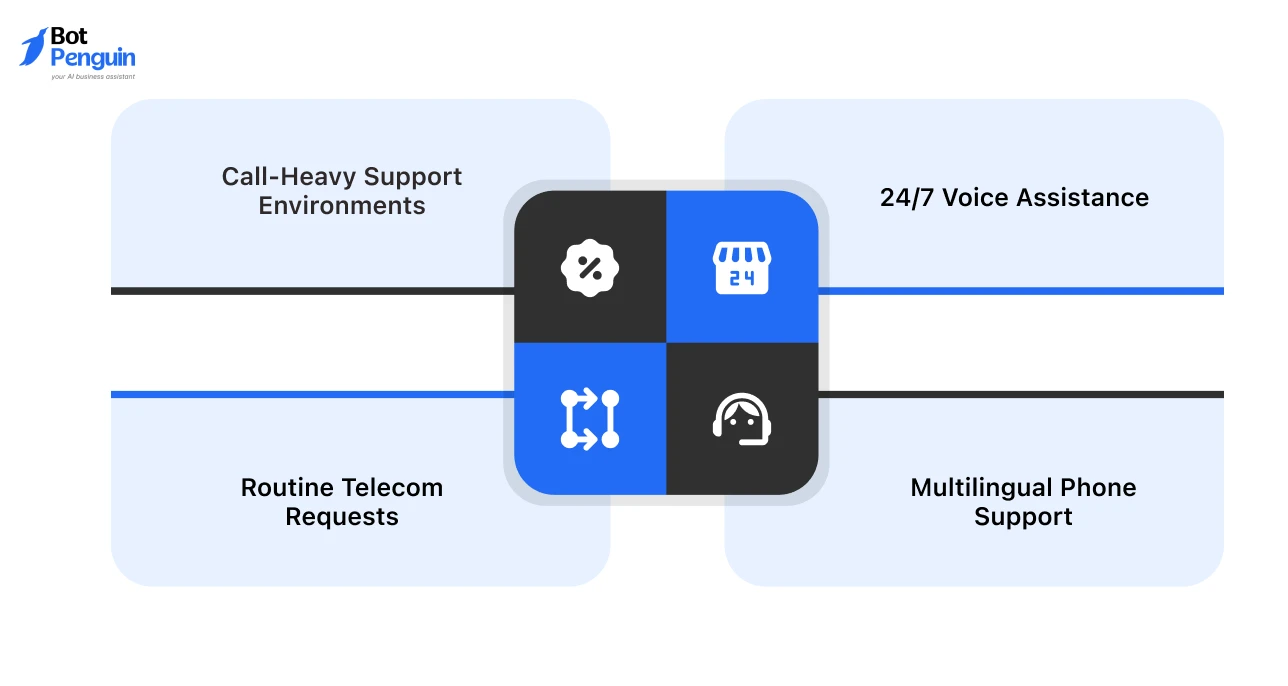
IVR chatbots are the right fit when your customers are still picking up the phone, and that's a larger segment than most telecom providers expect.
Here’s what to consider:
Using IVR chatbots alongside digital telecom chatbots creates a more connected and accessible customer support journey.
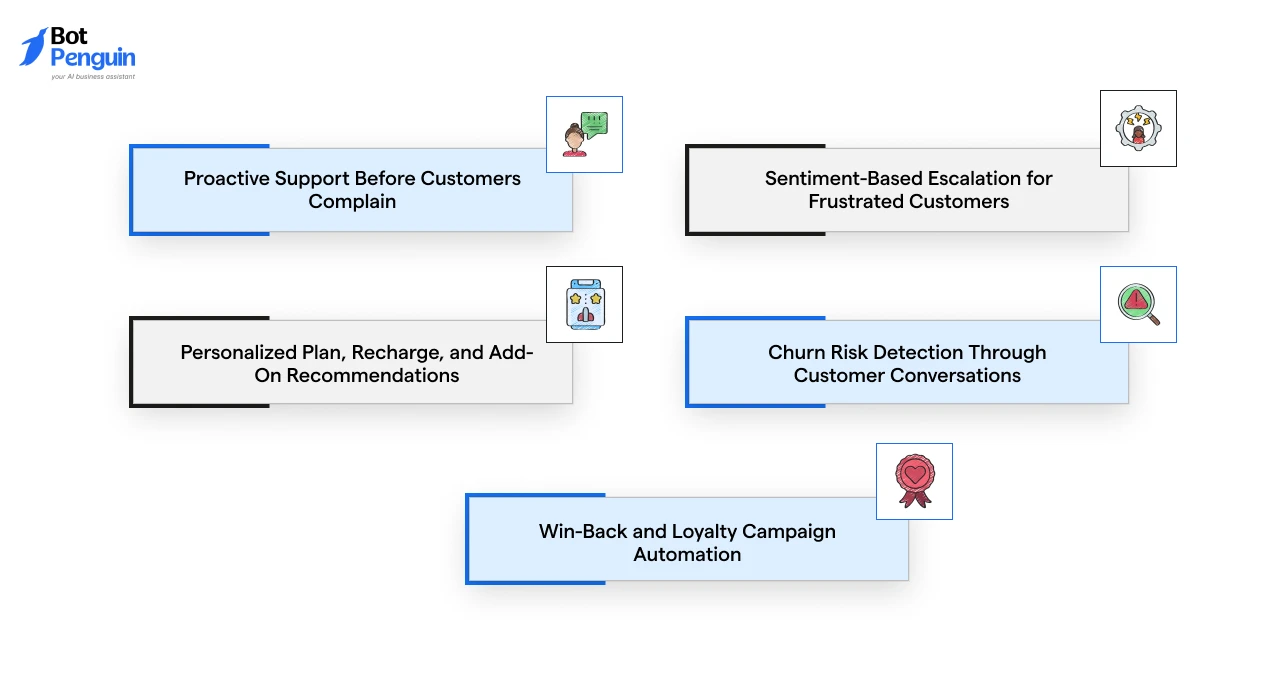
Keeping subscribers loyal requires more than solving tickets.
Modern conversational AI in telecom and telecom chatbots help providers identify dissatisfaction early, enhance engagement quality, and strengthen long-term subscriber relationships.
Here are some strategies that telecom companies can deploy to build lasting subscriber loyalty:
Telecom chatbots can notify subscribers about outages, expiring plans, unusual usage spikes, or delayed payments before frustration builds.
AI-driven telecom chatbots can detect angry language, repeated complaints, or negative tone patterns and quickly transfer conversations to senior representatives.
This helps retain subscribers at their most vulnerable moment - before they decide to leave.
Instead of showing generic offers, chatbots can recommend data packs, roaming options, entertainment bundles, or recharge plans based on subscriber behavior.
Repeated service complaints, pricing concerns, and cancellation-related questions often signal churn intent.
Telecom chatbots help flag these high-risk interactions early.
Telecom providers can automate renewal reminders, exclusive loyalty offers, upgrade campaigns, and re-engagement messages for inactive subscribers across multiple communication channels.
Retention-focused telecom chatbots help providers maintain stronger subscriber relationships while reducing revenue loss from preventable churn.
Building an effective telecom chatbot requires more than adding automated replies.
The chatbot should align with subscriber needs, telecom workflows, and communication channels from the beginning. Here’s a step-by-step approach to building chatbots for telecom:
Before launching a telecom chatbot, providers should also focus on conversation clarity, multilingual support, and accurate telecom information.
These help ensure the chatbot delivers accurate, frustration-free experiences from day one - not after months of costly fixes.
Tracking the right telecom chatbot metrics helps providers measure conversation quality, operational efficiency, and business impact more accurately.
Each of these metrics is followed by acceptable standards for telecom chatbot benchmarking in brackets:
Strong telecom chatbot performance usually comes from continuous optimization, accurate telecom data, and well-designed escalation workflows.
Platforms like BotPenguin can surface these metrics natively, along with built-in data privacy controls and GDPR-compliant conversation handling, so telecom providers can optimize performance without compromising subscriber trust.
Today’s providers are deploying chatbots across every channel subscribers already use. This ensures they’re meeting customers where they are, not where it's convenient.
The right channel mix depends on your subscriber demographics and support volume. Most telecom providers see the best results running websites, WhatsApp, and IVR chatbots together as a core stack.
At this stage, it’s worth looking at some common challenges that must be addressed while using telecom chatbots.
Even advanced telecom chatbots can fail if they are poorly designed, disconnected from telecom systems, or unable to handle real subscriber expectations.
Here are some challenges to look out for:
Telecom conversations are highly specific. Meaning, they'll relate mainly to plans, recharges, network issues, billing cycles, and subscriber accounts.
The Fix: Use telecom-focused workflows, industry terminology, and subscriber scenarios instead of generic support scripts.
Without backend integrations, chatbots cannot access invoices, plan details, recharge history, or subscriber information accurately.
The Fix: Connect your chatbot to CRM, billing, and ticketing systems before launch, not as an afterthought.
Subscribers should not get trapped in endless automated flows, which create frustration faster than a long hold queue ever could.
The Fix: Set clear escalation paths for unresolved or high-priority interactions.
Many telecom subscribers still prefer phone-based communication.
The Fix: Combine digital chatbots with IVR and voice automation for broader accessibility.
Outdated recharge plans, offers, or pricing information can quickly damage subscriber trust and create confusion.
The Fix: Schedule regular data syncs between your chatbot and live plan, pricing, and offer databases.
Billing disputes, cancellation requests, and frustrated subscribers often require empathy and human involvement rather than full automation.
The Fix: Define which conversation types always route to a human, and never automate your way past them.
The most effective telecom chatbots balance automation, customization, system integration, and timely human assistance.
Customer expectations in telecom are changing quickly. People want fast answers, simple interactions, and support that works across every channel without long waiting times.
This is why chatbots in the telecom industry are becoming more important. They help telecom companies handle everyday conversations more efficiently while improving subscriber experience, retention, and engagement.
But a good telecom chatbot is not just about automation. It should understand customer needs, connect with telecom systems, and know when human support is needed.
As telecom services become more digital, chatbots will continue to play a bigger role in how telecom companies retain customers.
A telecom chatbot is a rule-based or AI-powered virtual assistant that helps telecom companies manage subscriber conversations across support, billing, recharge, and sales workflows.
Chatbots in the telecom industry use AI, predefined workflows, and telecom system integrations to answer subscriber questions, automate tasks, and route complex issues to agents.
Telecom chatbots are commonly used for billing support, recharge assistance, outage updates, technical troubleshooting, plan recommendations, and customer retention workflows.
Yes. Telecom chatbots automate repetitive subscriber queries, reduce support workload, improve response speed, and help telecom companies lower operational service costs.
An IVR chatbot is a voice-based automated system that handles customer calls using speech or keypad inputs to guide users through telecom support options.
An IVR chatbot works through voice calls, while telecom chatbots can operate across websites, apps, WhatsApp, SMS, and other digital communication channels.
Yes. Telecom chatbots help reduce churn through proactive reminders, personalized offers, faster issue handling, and loyalty or win-back communication campaigns.
No. Telecom chatbots handle routine subscriber interactions, while human agents manage sensitive, complex, or high-priority customer conversations requiring personal assistance.
Boost Telecom Support & Sales With AI Chatbots
Handle billing queries, recharge requests, plan upgrades, and customer support instantly. Reduce wait times, improve conversions, and increase retention with intelligent telecom automation workflows.
Explore Now!Checkout our related blogs you will love.
Updated at Oct 9, 2026
10 min to read
Updated at Oct 19, 2026
11 min to read

Updated at Oct 14, 2026
11 min to read
Updated at Oct 14, 2026
10 min to read
Updated at Oct 14, 2026
10 min to read
Updated at Oct 13, 2026
11 min to read
Table of Contents

