AI in Finance: Use Cases, Benefits & Future Trends
Updated at Oct 7, 2026
9 min to read
Most financial institutions don’t face issues in adopting AI. They face them when AI operates outside compliance boundaries.
AI chatbots are now central to customer communication in banking and fintech. They automate queries and improve efficiency, but they also introduce risks related to data privacy, security, and regulatory compliance.
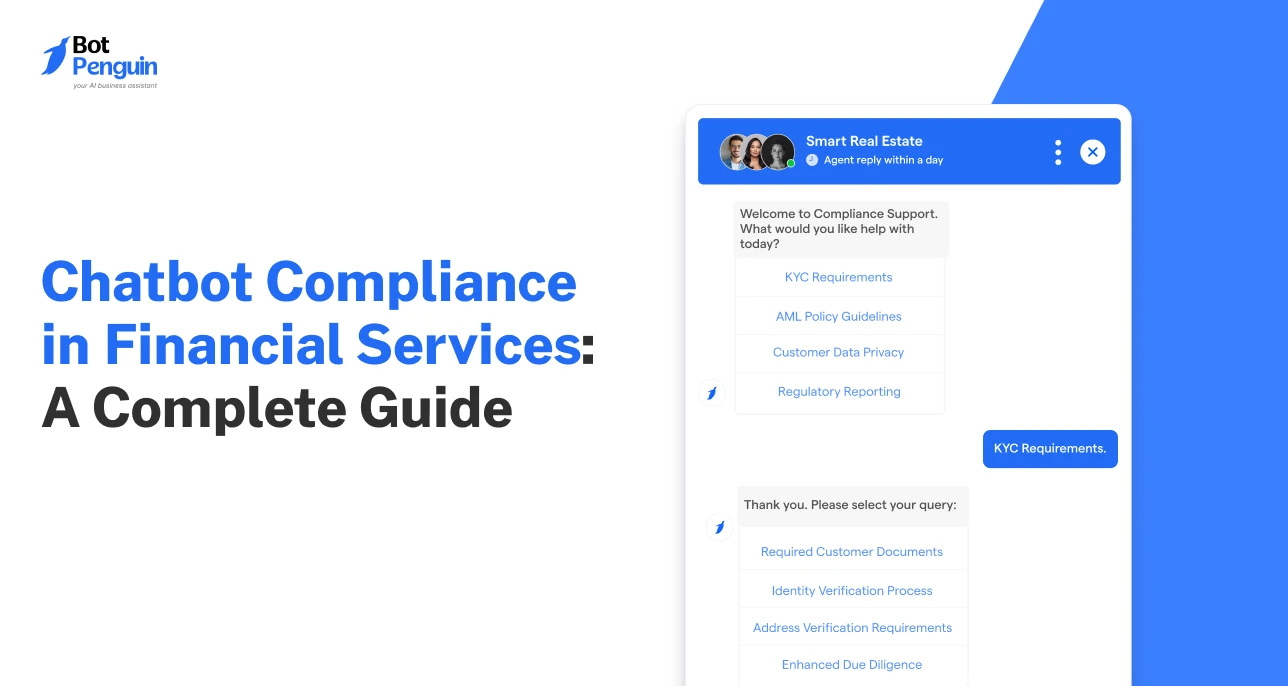
In financial services, chatbots must comply with requirements and frameworks such as GDPR, KYC, AML, PCI DSS, SOC 2, ISO 27001, and CCPA. These frameworks define how data is collected, processed, and protected.
This guide explains the risks, regulatory requirements, and best practices for chatbot compliance in financial services so institutions can scale automation without exposing their business to regulatory penalties.
Financial institutions operate in one of the most heavily regulated environments.
When chatbots in financial services handle customer interactions, compliance becomes just as important as automation. One inaccurate response can create regulatory, legal, and reputational risks.
The consequences of non-compliance can also be significant, with GDPR Article 83 allowing administrative fines of up to €20 million or 4% of total worldwide annual turnover, whichever is higher.
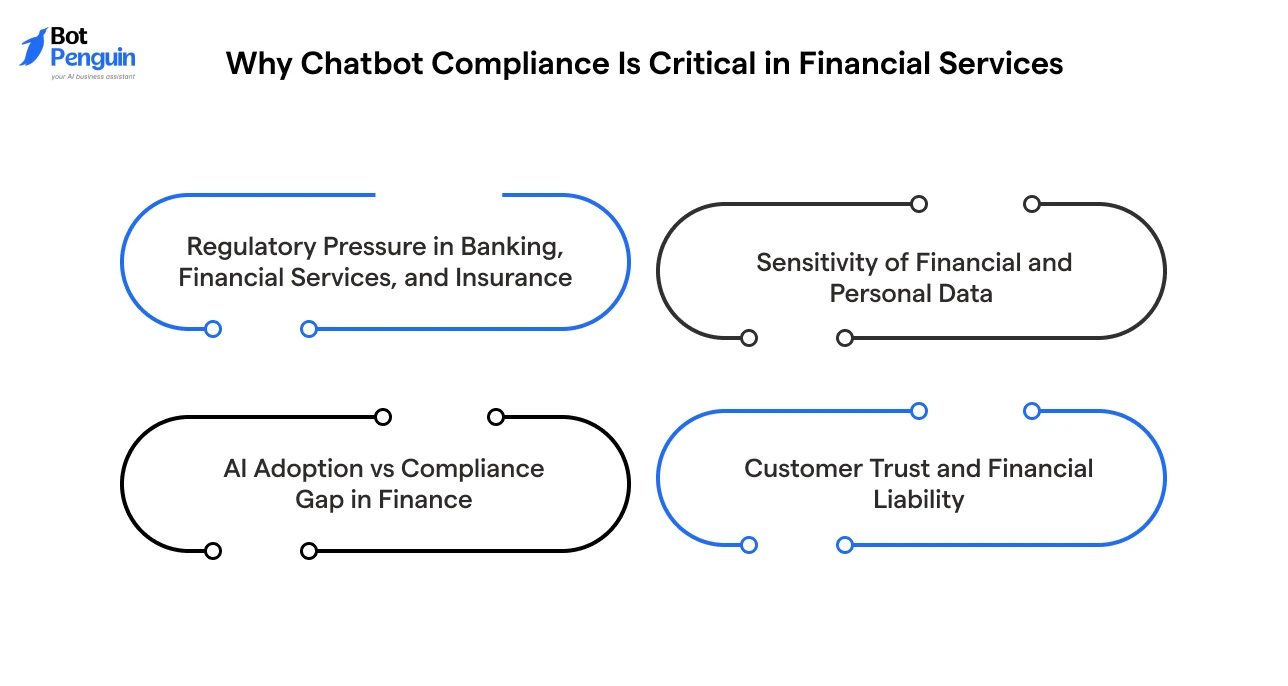
Here’s why financial chatbot compliance is crucial:
In finance, every customer interaction, including chatbot conversations, must be traceable and compliant.
For BFSI businesses that manage regulated customer data, transactions, policy information, and financial queries, a compliant financial chatbot is no longer optional. Regulators expect clear audit trails, data handling policies, and communication controls across all digital channels.
Financial chatbots often handle highly sensitive information, including account details, transaction queries, payment data, and personal identifiers.
This information is subject to strict privacy, security, and data governance requirements under frameworks such as GDPR, CCPA, SOC 2, and ISO 27001. A single lapse in chatbot compliance can result in data breaches, regulatory penalties, and loss of customer trust.
AI chatbots in financial services are being deployed faster than compliance systems can adapt.
Many teams focus on the benefits of automation but overlook AI chatbot risks such as uncontrolled responses, data exposure, and inadequate monitoring. This gap creates serious vulnerabilities.
In financial services, customers expect every digital interaction to be accurate, secure, and compliant.
A chatbot error can lead to more than dissatisfaction. It can expose customers to incorrect information, create financial losses, and increase institutional liability.
Strong chatbot compliance helps protect customer trust while reducing legal and financial risk.
Compliance failures can have significant business consequences.
When chatbot compliance is treated as an afterthought, financial institutions face greater exposure to regulatory fines, legal liability, reputational damage, and loss of customer trust.
If you’re looking to deploy AI chatbots without compromising compliance, platforms like BotPenguin help financial businesses reduce these risks with secure chatbot deployment, controlled AI responses, and compliance-ready workflows.
At the same time, understanding these risks in the financial context is the first step toward building a secure and compliant chatbot system. Let’s explore them in detail in the next section.
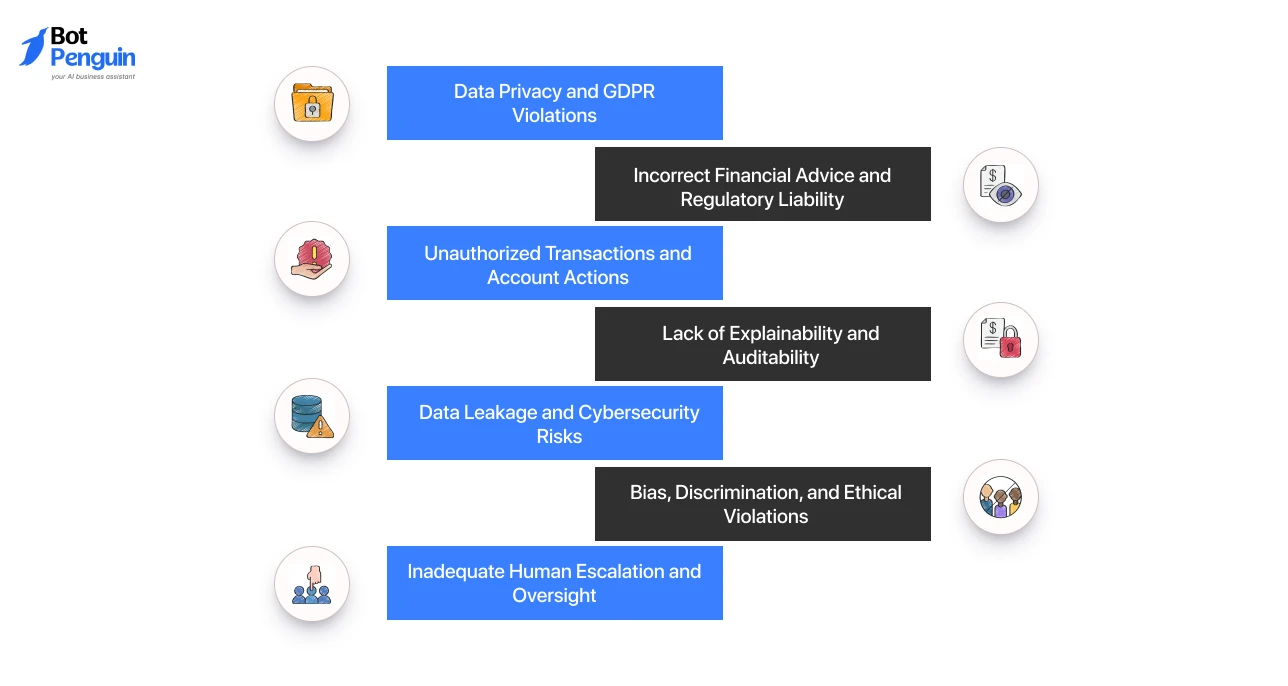
While financial chatbots can improve customer service and operational efficiency, they also introduce unique regulatory, privacy, and governance challenges.
For a broader overview of how these systems work, see our guide on AI chatbots in financial services.
Here’s a breakdown of the key risks involved:
When a financial chatbot captures data without clear consent or stores it without a lawful basis, it can violate chatbot GDPR compliance requirements.
GDPR applies not only to organizations operating in the EU but also to non-EU businesses that offer services to or monitor individuals in the EU/EEA.
These violations often occur through poorly designed input fields, excessive data collection, or conversation logs that store sensitive information by default. A common case is bots saving full conversation histories, including account details, without user awareness.
For a deeper breakdown, read our guide on GDPR compliant chatbots.
Financial chatbots are not licensed financial advisors. Yet, without controls, they can generate responses that sound like financial guidance.
This creates serious risks of AI chatbots in regulated environments like finance. If a chatbot suggests investment options or misinterprets user intent, it can lead to non-compliant advisory behavior.
In financial services, even one misleading response can trigger liability. This is why financial chatbot responses need strict boundaries, compliance checks, and human oversight.
Chatbots that support account-related actions must not execute transfers, payments, profile changes, or fund movements without strong authentication and authorization.
In regulated markets, authorities such as the SEC, FINRA, and CFTC expect financial firms to maintain appropriate controls, preserve communications, and supervise digital channels.
If a chatbot triggers an unauthorized account action or fails to properly record the interaction, it can create compliance, fraud, and liability risks.
Regulators expect every decision to be traceable. AI models do not naturally provide that clarity.
Many chatbots operate as black boxes. They generate responses without showing how or why a decision was made. This creates a gap in chatbot compliance.
Without audit logs, teams cannot prove what the bot said, why it said it, or how data was processed. This becomes a major issue during audits or investigations.
Chatbots rely on APIs, integrations, and third-party tools. Each connection increases exposure.
Sensitive data can leak through unsecured endpoints or poorly configured integrations. This is one of the most overlooked risks of AI chatbots in finance.
A typical scenario involves bots connected to CRMs or payment systems without proper encryption or access control. This opens the door to unauthorized data access.
AI models learn from data. If the underlying data is biased, the chatbot may reflect those biases. This leads to unfair or discriminatory responses, which can violate ethical standards and regulations.
In financial services, bias can affect credit recommendations, eligibility decisions, or support quality.
Chatbots can create compliance risk when they continue handling conversations that require human review.
In financial services, queries involving complaints, suspicious activity, failed verification, financial advice, or account actions should be escalated to trained teams. Without clear escalation paths, the chatbot may give incomplete responses, miss risk signals, or mishandle regulated customer interactions.
These issues go beyond technical errors. They directly affect compliance, customer trust, and brand reputation.
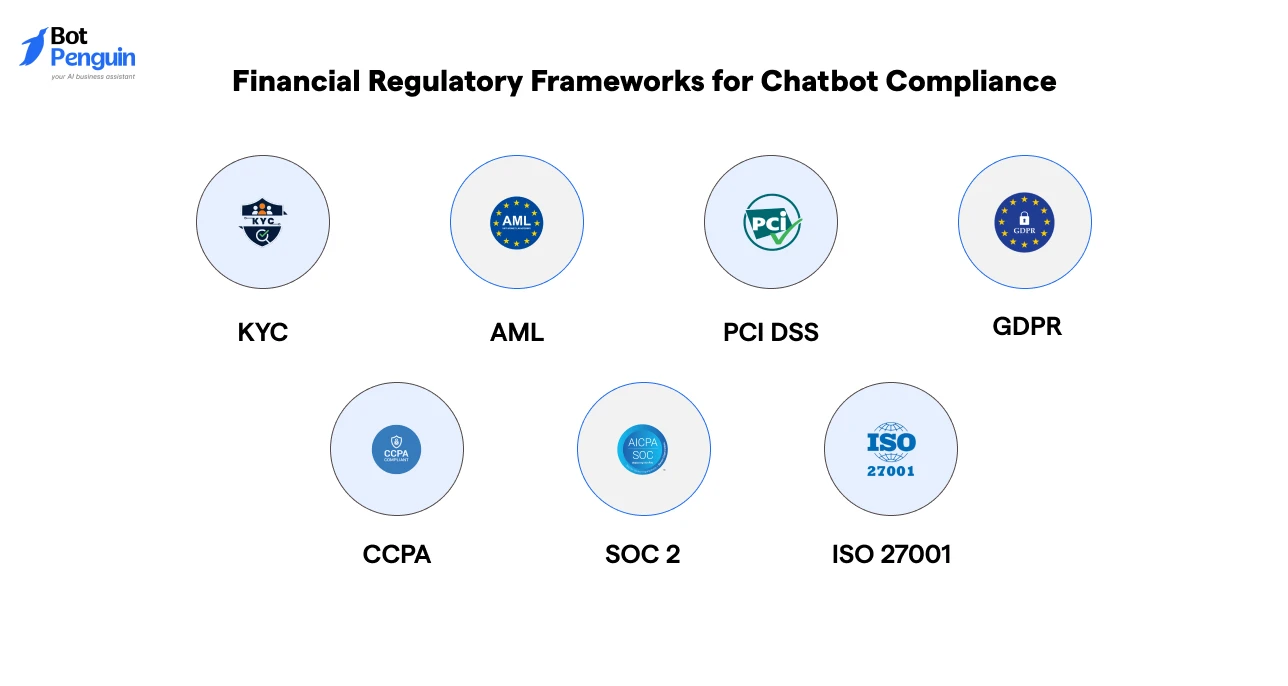
Financial chatbot compliance must cover more than general privacy. A compliant chatbot must support secure data handling, identity verification, payment protection, auditability, and regulatory reporting.
Below, we’ve listed the primary regulatory frameworks governing chatbot use in financial services:
KYC requires financial institutions to verify customer identities before offering regulated services.
Chatbots can support KYC by collecting user inputs, guiding document submission, and routing verification steps, but they should not independently approve customer identities.
AML regulations require financial institutions to detect and prevent suspicious activity, fraud, and money laundering.
Chatbots handling financial queries should flag unusual requests, avoid bypassing compliance checks, and escalate high-risk conversations for review.
PCI DSS applies when systems process, transmit, or store payment card data.
Financial chatbots must avoid storing sensitive card information, use secure payment flows, and ensure card-related interactions are handled through PCI-compliant systems.
GDPR governs how personal data of EU/EEA users is collected, processed, stored, and deleted.
Financial chatbots must collect clear consent, limit unnecessary data collection, protect user information, and support access, correction, and deletion requests.
CCPA protects the personal data rights of California residents.
Financial chatbots must disclose what customer data is collected, explain how it is used, and provide users with control over data access, deletion, and opt-out requests.
SOC 2 evaluates how service providers manage customer data across security, availability, confidentiality, processing integrity, and privacy.
For fintech and banking chatbots, it supports secure access controls, monitoring, encryption, and operational accountability.
ISO 27001 provides a framework for managing information security risks.
Financial chatbots aligned with ISO 27001 follow structured controls for data protection, access management, risk assessment, vendor security, and incident response.
Together, these frameworks help financial institutions build chatbots that support secure customer interactions, regulatory compliance, auditability, and responsible data handling.
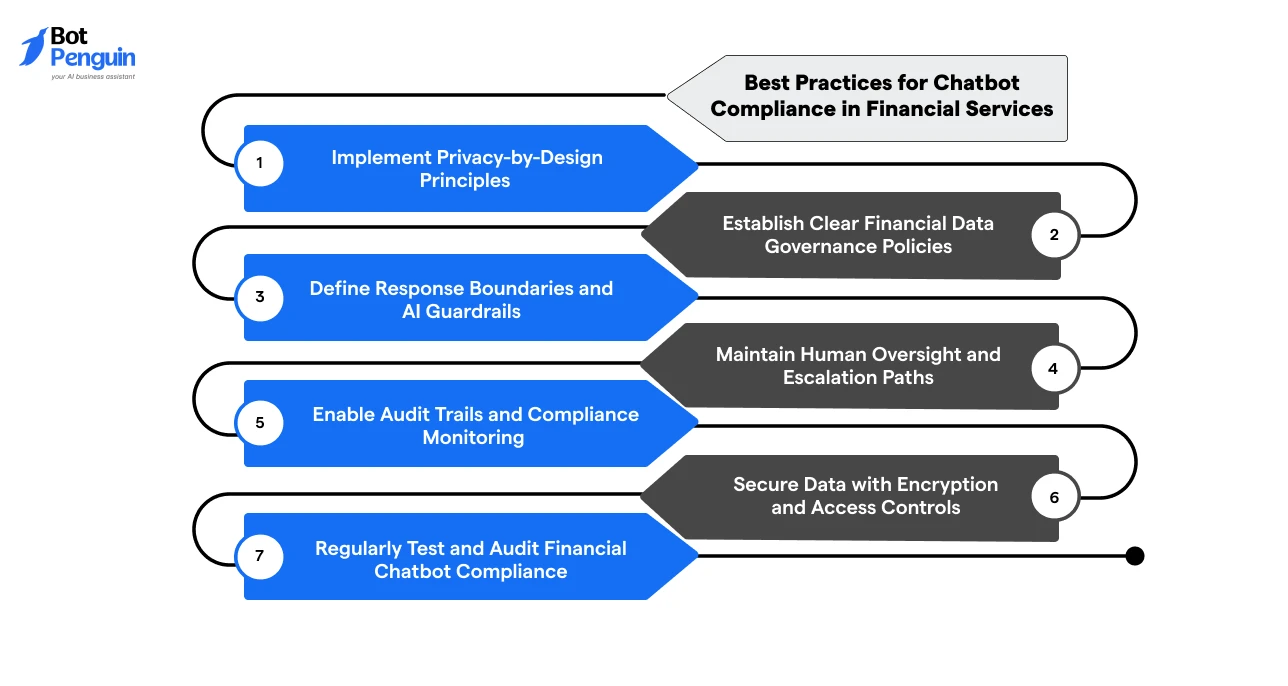
Understanding the risks and regulatory requirements is only part of chatbot compliance.
Financial institutions must also implement the right controls and governance practices to reduce risk and support regulatory obligations.
Compliance should be built into the chatbot workflow from the start.
Financial chatbots should collect only necessary data, show clear consent notices, support user rights, and avoid storing sensitive information unless required.
A compliant chatbot should define how customer data, transaction details, identity documents, payment information, and conversation logs are collected, classified, stored, accessed, and deleted.
Strong governance helps lower privacy violations and keeps chatbot data aligned with financial compliance requirements.
It’s crucial to set strict limits on what the chatbot can say or do.
Financial chatbots should avoid unverified advice, product recommendations, eligibility decisions, or transaction-related actions unless approved workflows and compliance controls are in place.
High-risk conversations should move to a human agent.
This includes complaints, investment-related queries, suspicious activity, failed authentication, KYC issues, or requests involving sensitive financial decisions.
Every chatbot interaction should be traceable.
It’s important to maintain logs of user consent, bot responses, escalation events, data access, and system actions so compliance teams can review activity during audits or investigations.
Use encryption for data in transit and at rest.
Internal access should be restricted through role-based permissions, multi-factor authentication, and secure API integrations to prevent unauthorized exposure of financial or personal data.
Review chatbot responses, data flows, consent mechanisms, integrations, and escalation rules on a regular basis. Ongoing testing helps detect compliance gaps before they turn into regulatory, legal, or reputational risks.
Most compliance gaps come from small misses, not major failures. This checklist helps ensure your chatbot compliance is aligned with regulatory expectations from day one.
These best practices and checklist items provide a practical foundation for building secure, auditable, and compliant financial chatbot experiences.
A compliant financial services chatbot is built on technical and governance layers that control data, decisions, access, monitoring, and integrations. Here’s what that includes:
This layer identifies whether the chatbot is handling personal data, financial data, payment information, identity documents, or general queries.
It helps route each data type through the right storage, access, retention, and compliance controls.
This system records user consent, communication preferences, data-sharing permissions, and withdrawal requests.
It helps ensure that customer data is collected and used only within approved privacy and regulatory boundaries.
The policy engine defines what the chatbot can say, block, recommend, or escalate.
It keeps responses aligned with internal policies, financial regulations, product rules, and approved communication guidelines.
This framework routes high-risk conversations to human teams when the chatbot detects complaints, sensitive financial queries, failed verification, suspicious activity, or advisory intent.
It prevents automated systems from handling decisions that require review.
Audit logs capture chatbot responses, user actions, consent records, escalation events, and system decisions.
Monitoring infrastructure helps compliance teams detect policy violations, unusual behavior, and gaps before they become audit issues.
Identity and access controls ensure that users are authenticated before accessing account-related information or initiating sensitive actions.
They also restrict internal access so only authorized teams can view or manage regulated data.
This layer protects connections between the chatbot and financial systems such as CRMs, payment gateways, KYC tools, core banking systems, and support platforms.
Secure APIs help prevent data leakage, unauthorized access, and integration-level compliance failures.
Thus, a compliant financial chatbot relies on multiple layers working together to manage data, access, decisions, monitoring, and regulatory requirements throughout the customer journey.
Next, we’ll examine the key factors to consider when selecting a compliance-ready financial chatbot platform.
A compliance-ready financial chatbot platform should offer more than automation.
It should help teams control data, restrict AI responses, secure integrations, and maintain audit-ready records.
Does the platform support GDPR, CCPA, SOC 2, ISO 27001, KYC, AML, and PCI DSS requirements?
How does it manage consent, data retention, and user data rights?
Can it restrict financial advice, product recommendations, and high-risk responses?
Are audit logs, escalation records, and conversation histories available for compliance review?
How are APIs, payment flows, and third-party integrations secured?
No clear compliance documentation or certifications
No audit logging or conversation traceability
Weak access controls for sensitive customer data
No AI response guardrails or human escalation options
Unclear data storage, retention, or deletion policies
Rather than building compliance controls from scratch, organizations can use platforms like BotPenguin that support GDPR, CCPA, and SOC 2 requirements while offering the governance, security, and monitoring capabilities needed for regulated environments.
In financial services, chatbot compliance directly affects customer trust, regulatory exposure, and operational risk.
A compliance-ready financial chatbot must protect sensitive data, avoid unauthorized advice or transactions, support auditability, and follow frameworks such as GDPR, KYC, AML, PCI DSS, SOC 2, and ISO 27001.
As financial institutions expand AI-driven customer interactions, compliance must be treated as a design requirement rather than a post-deployment checklist.
When these controls are built into the chatbot system, financial institutions can automate customer conversations without weakening governance, security, or regulatory accountability.
The biggest risks of AI chatbots include data privacy violations, incorrect financial responses, a lack of auditability, and security gaps. These risks can lead to regulatory penalties, especially when chatbots handle sensitive financial or personal data.
To achieve chatbot GDPR compliance, you need clear user consent, limited data collection, secure data storage, and user control over their data. The chatbot must also support data access, correction, and deletion requests.
No. Chatbots can provide general financial information, but personalized recommendations may require regulatory oversight. Financial advisor chatbot compliance focuses on ensuring chatbot responses remain within approved regulatory boundaries.
Best practices include privacy-by-design, data governance, AI guardrails, human escalation, audit logging, encryption, access controls, and regular compliance testing.
Key frameworks include GDPR, CCPA, SOC 2, ISO 27001, KYC, AML, and PCI DSS, depending on data type, region, and use case.
Scale Financial AI Conversations with Confidence
Deploy a secure, audit-ready chatbot built for financial services and strict data regulations.
Get Started NowCheckout our related blogs you will love.
Updated at Oct 7, 2026
9 min to read
Updated at Oct 6, 2026
9 min to read
Updated at Jun 8, 2026
11 min to read

Updated at Oct 14, 2026
11 min to read

Updated at Oct 14, 2026
10 min to read

Updated at Oct 14, 2026
10 min to read
Table of Contents