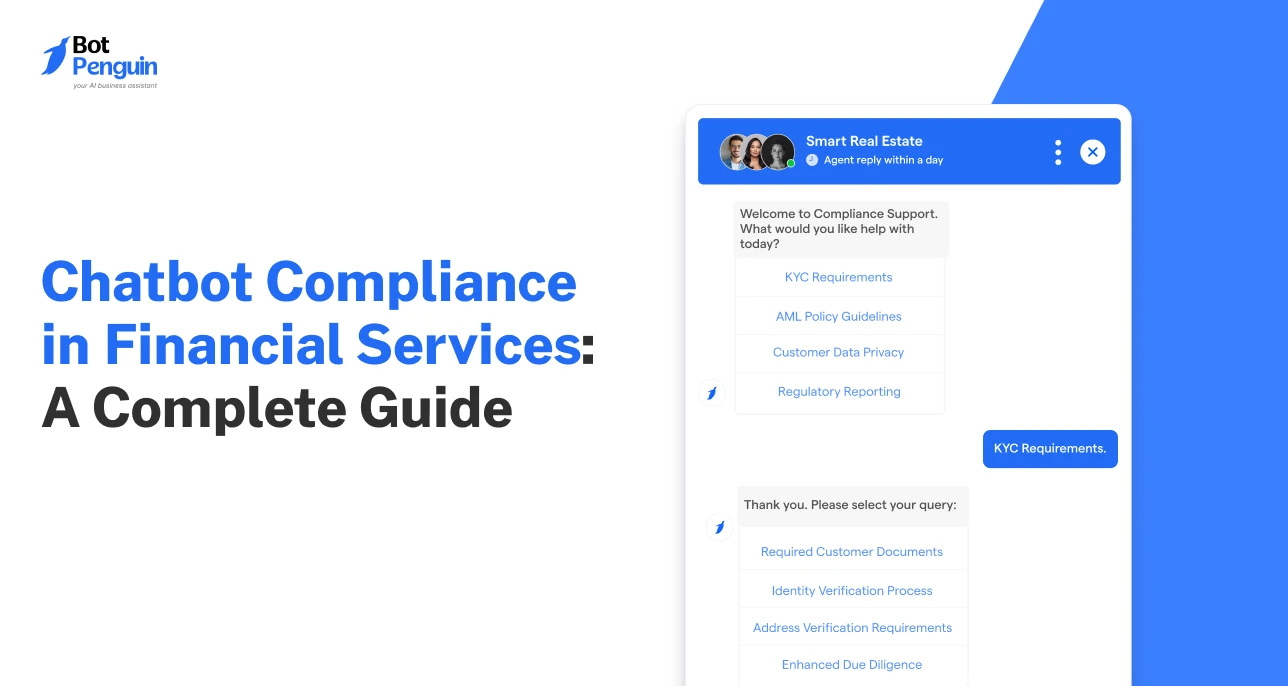
Chatbot Compliance in Financial Services: A Complete Guide
Updated at Oct 19, 2026
11 min to read

A financial services chatbot is an AI assistant that automates customer conversations for fintechs, lenders, insurers and advisory teams, handling KYC collection, onboarding, balance or status queries, fraud alerts and support while routing transactions, advice and approvals to secure systems and human agents.
Financial institutions are under pressure from two sides.
Fraud is rising, and compliance requirements are becoming stricter. At the same time, customers expect instant, seamless service across every touchpoint.
Traditional systems struggle to keep up with this demand.
This is why chatbots in financial services are making a measurable impact.
From automating KYC and detecting suspicious activity to simplifying onboarding and support, AI chatbots in finance are evolving into core operational systems.
This blog explores what AI chatbots for finance are, how they work, where they add value, and what businesses should consider before adopting them.
A finance AI chatbot is an intelligent system that understands financial queries, processes user data, and performs actions such as onboarding, account support, and transaction handling in real time.
Unlike rule-based bots, an AI chatbot for finance can interpret intent, adapt to different inputs, and interact with backend systems to complete tasks.
Every request follows a structured flow to maintain accuracy and compliance. Here’s how a financial chatbot works:
Using this workflow, AI chatbots in financial services can securely handle login issues, verify identity, and resolve the request within seconds.
A chatbot for financial services relies on core technologies to function effectively across different use cases.
Here’s a quick overview of the tech stack:
These technologies allow a financial services chatbot to interact with systems, process data securely, and deliver accurate responses in real time.
Financial organizations like fintech and insurance companies operate in high-risk, high-volume environments.
Managing fraud, compliance, and customer experience manually slows growth and increases operational risk. Here’s why finance AI chatbots are important:
Fraud is rising in digital payments and insurance claims. Delayed detection leads to financial loss and trust issues.
AI chatbots in finance help detect unusual behavior during transactions or claim submissions by analyzing user activity, transaction patterns, input inconsistencies, and behavioral anomalies in real time.
A fintech app can flag suspicious payment activity, while an insurance chatbot can identify inconsistent claim data before processing.
Financial platforms must follow strict KYC, AML, and documentation requirements. Manual checks often cause delays and errors.
A chatbot for financial services can collect user data, verify documents, and maintain records.
In fintech, this speeds up account verification. In insurance, it simplifies policy onboarding and claim validation.
Users expect quick account setup and fast claim processing. Delays increase drop-offs and dissatisfaction.
Chatbots in financial services provide real-time support during onboarding and claims.
A fintech platform can activate user accounts within minutes, while an insurance chatbot can guide users through claim submission step by step.
Fintech apps and insurance providers handle large volumes of queries daily. Scaling support teams increases costs.
A financial services chatbot can manage multiple conversations simultaneously.
It can handle onboarding queries, payment issues, or claim status requests without adding operational overhead.
Financial institutions don't need to build these workflows from scratch.
No-code chatbot platforms like BotPenguin allow fintech and insurance teams to automate onboarding, compliance checks, customer support, and fraud-prevention workflows while integrating with existing systems and maintaining audit-ready processes.
Conversational AI in financial services uses natural language processing, machine learning, and connected business systems to understand customer requests and respond through natural conversations. It can power a financial services chatbot for tasks such as KYC, onboarding, account support, fraud alerts, claims, and transaction queries.
Unlike basic rule-based bots, conversational AI can interpret intent and context when customers phrase the same request differently. Conversational AI for financial customer interactions can therefore automate routine conversations while routing sensitive, complex, or exception-based requests to human teams.
Conversational AI can shorten customer wait times by handling routine requests as soon as they arrive. Customers can check application status, understand account processes, find general policy information, or get help with common service questions without waiting for an available support representative.
It also gives financial institutions a way to provide informational support outside normal business hours. A chatbot can answer approved questions 24/7 while keeping sensitive transactions, account changes, and regulated decisions within secure workflows.
For requests involving personalized financial advice, conversational AI should support rather than replace qualified professionals. It can identify the customer’s intent, collect relevant context, and route the conversation to a licensed advisor when professional advice or approval is required.
This division of work also reduces repetitive tasks for customer-service teams. Agents can spend less time answering routine questions and more time handling exceptions, complex cases, and conversations requiring human judgment.
Understanding what a finance chatbot is also helps distinguish the customer-facing chatbot from the broader conversational AI systems, integrations, and workflows operating behind it.
Most financial platforms start with simple automation, but quickly face limitations.
The choice between AI chatbots and rule-based chatbots determines how effectively systems handle compliance, fraud detection, and user interactions.
How Decision-Making Differs in Real Finance Scenarios
AI chatbots for finance understand intent and adapt to varied customer queries, while rule-based systems follow fixed conversational paths.
AI finance chatbots can detect suspicious behavior patterns dynamically, while rule-based finance systems rely only on predefined triggers.
AI chatbots make compliance workflows more flexible by adapting validation steps based on user inputs.
AI chatbots personalize financial interactions using customer history, behavior, and preferences.
In short, rule-based financial chatbots are suitable for simple, repetitive queries.
As complexity increases, AI becomes necessary for handling real-world financial operations.
Financial workflows involve verification, decision-making, and continuous monitoring.
Chatbots in financial services handle these processes in a structured and automated way.
Here are the top financial chatbot use cases at a glance:
Each of these use cases has been discussed below:
Compliance requires accurate data collection and traceability.
A chatbot for financial services collects KYC details, verifies identity documents, and ensures required inputs are complete before submission.
It also maintains audit logs automatically, which simplifies compliance tracking and reduces manual errors.
For example, a fintech chatbot can ask users to upload identity documents, verify mandatory details, and flag incomplete KYC submissions before account activation.
AI chatbots in finance monitor transaction patterns and user behavior in real time.
They can flag suspicious logins, abnormal transactions, or inconsistent claim data before processing, reducing financial risk.
For instance, if a user suddenly attempts multiple high-value transactions from a new device or unusual location, the chatbot can flag the activity and trigger additional verification before processing the payment.
Onboarding processes often cause drop-offs due to delays and complexity.
A financial services chatbot guides users through registration, document submission, and verification in a structured flow.
This reduces friction and improves completion rates across fintech and insurance platforms.
These onboarding workflows are also common across fintech chatbots used for account setup and customer verification.
Financial queries require quick and accurate responses.
A chatbot in financial services can handle account queries, payment updates, and policy information instantly.
It also sends transaction alerts, reminders, and status updates, keeping users informed without delays.
This demand is already visible in banking: Deloitte reported in 2025 that 60% of surveyed banking customers used chatbots for technical support, making it the most common chatbot use case in its study.
Financial services depend on matching users with the right products.
A finance AI chatbot captures user intent through conversation and recommends relevant products.
This helps fintech platforms suggest credit or investment options and allows insurance providers to guide users toward suitable policies.
Likewise, a chatbot can recommend a suitable credit card or investment plan because you previously searched for travel rewards, savings goals, or low-risk investment options.
A real-world example is Home Loan Whiz, which used BotPenguin to qualify mortgage leads 40% faster while reducing consultant workload by 60%. See the mortgage lead qualification case study for the complete workflow and results.
Together, these use cases streamline operations while improving compliance, security, and customer satisfaction.
Adopting chatbots in financial services improves efficiency, but it also introduces risks that fintech and insurance companies must manage carefully.
Here are the top challenges to consider:
A chatbot in financial services handles personal details, transaction data, and documents. Any security gap can lead to data breaches.
Fintech apps must ensure encryption and secure access, while insurance platforms must protect claim and policy data during interactions.
Keeping chatbot workflows aligned with changing regulations is a constant challenge.
In fintech, missing a verification step can lead to compliance issues. In insurance, incorrect claim validation can create legal risks.
Therefore, a chatbot for financial services must follow KYC, AML, and data protection rules to maintain compliance, reduce operational risk, and ensure secure customer interactions.
For a deeper breakdown, see our guide to chatbot compliance in financial services.
Integrating a financial services chatbot with core systems such as payment gateways or policy databases can be complex.
Fintech platforms may face API limitations, while insurance providers may deal with fragmented systems that slow down implementation.
A phased integration approach with secure APIs and middleware can help financial institutions connect chatbots with legacy systems more efficiently.
An AI chatbot for finance may struggle with complex or ambiguous queries. In fintech, this can affect transaction-related requests.
In insurance, unusual claim scenarios may require human intervention.
Without proper escalation, this can impact user experience.
This is why most chatbots for financial services should be designed with controlled workflows and human fallback options to handle edge cases effectively.
On the whole, financial institutions can reduce these challenges by combining secure infrastructure, compliance-focused workflows, reliable integrations, and human oversight within their chatbot strategy.
At the same time, choosing the right chatbot platform matters significantly when it comes to deploying a safe & compliant tool.
Selecting a chatbot for financial services requires evaluating how well it fits real operational needs in fintech and insurance.
The focus should be on compliance, system connectivity, and handling complex workflows reliably.
A chatbot for financial services must support KYC, AML, and data protection requirements.
It should further validate user inputs, ensure all required data is collected, and maintain secure records.
The right chatbot should connect with CRM systems, payment platforms, and internal databases.
This allows real-time access to user information and transactions.
Users interact across websites, mobile apps, and messaging platforms. Chatbots in financial services should provide a consistent experience across all channels.
A fintech user may switch devices during onboarding, while an insurance customer may check updates through chat.
Every interaction needs to be recorded for compliance and monitoring. A chatbot should maintain logs of user actions, validations, and responses.
This supports audits and ensures traceability, which is critical in regulated financial environments.
Automation cannot handle every scenario. An AI chatbot for finance should transfer complex queries to human agents when needed.
In fintech, this is required for transaction issues. In insurance, it is necessary to handle complex claims or disputes.
Choosing the right chatbot depends on how effectively it supports compliance, integrates with systems, and handles real user scenarios without failure.
Comparing the best financial chatbot platforms can help teams evaluate these capabilities before choosing a solution.
Platforms like BotPenguin simplify deployment with no-code automation, secure integrations, GDPR-aligned workflows, and SOC 2-ready compliance features for financial chatbots.
The real challenge is building finance chatbots that can handle compliance, data validation, and system execution reliably.
BotPenguin helps by acting as a workflow layer between customer interactions and core financial systems.
BotPenguin is built for regulated workflows that involve KYC checks, document validation, and structured data handling.
The platform ensures data is collected correctly, validated in real time, and processed only when all conditions are met.
This improves onboarding accuracy in fintech and reduces errors in insurance workflows.
BotPenguin integrates with CRM systems, APIs, and internal databases.
This allows chatbots to fetch live data, update records, and complete tasks such as onboarding or claim processing within the same interaction.
Users move across platforms during financial journeys. BotPenguin supports workflows across WhatsApp, web, and mobile.
A process can start on one channel and continue on another without restarting, reducing drop-offs.
Every interaction in financial services must be traceable. BotPenguin enforces validation, structured data collection, and audit logs.
BotPenguin is GDPR, HIPAA, and CCPA compliant, ISO certified, SOC 2 attested, and VAPT-assessed by a CERT-In empanelled auditor.
Scalable Execution
BotPenguin supports multiple workflows simultaneously without performance issues, enabling fintech and insurance platforms to scale without increasing operational load.
Owing to these factors, BotPenguin becomes a practical operational layer for financial chatbots, focusing on execution, integration, scalability, and compliance across real-world financial workflows.
Financial services are shifting toward automated, decision-driven systems that can handle scale, risk, and user expectations together.
Chatbots in financial services are no longer limited to support. They now manage onboarding, validate data for compliance, and detect fraud during interactions.
This shift is driven by necessity. Increasing fraud, strict regulations, and demand for instant service make manual workflows inefficient.
AI chatbots in finance provide a structured way to handle these challenges without slowing operations.
Adoption is moving from optional to essential. Financial platforms that fail to automate will struggle to scale, maintain compliance, and meet user expectations.
Chatbots in financial services are used for onboarding, customer support, compliance checks, fraud detection, and transaction assistance. They help automate workflows and improve response time across fintech and insurance platforms.
AI chatbots can understand context, adapt to user input, and handle complex workflows. Rule-based chatbots follow fixed scripts and struggle with variations, making them less effective for financial processes.
A financial services chatbot is the customer-facing interface used for conversations such as onboarding, support, status queries, or lead qualification. Conversational AI is the broader technology that helps understand intent, context, and natural language, and can power chatbots, voice systems, routing, and other automated interactions.
AI chatbots in finance analyze user behavior, transaction patterns, and input data in real time. They can identify unusual behavior, flag suspicious activities, and generate alerts before fraudulent transactions are completed.
Yes, chatbots in financial services are designed with security measures such as encryption, access control, and audit logging. Many platforms also support compliance standards like GDPR and SOC 2 for secure data handling.
Yes, a chatbot for financial services can collect user data, verify documents, and ensure all required fields are completed. This helps automate KYC and compliance workflows while maintaining accuracy and audit readiness.
Chatbots guide users through registration, collect required data, and validate inputs in real time. This reduces drop-offs, speeds up onboarding, and ensures compliance requirements are met.
Financial institutions should choose chatbot platforms that support compliance, CRM integrations, omnichannel communication, and secure workflow execution. Platforms like BotPenguin are built for these needs.
Compliance depends on the chatbot platform, data handling, integrations, and deployment practices. Financial institutions should choose providers with appropriate privacy, security, access-control, and audit safeguards. BotPenguin is GDPR, HIPAA, and CCPA compliant, ISO certified, SOC 2 attested, and VAPT-assessed by a CERT-In empanelled auditor.
Launch Your Finance Chatbot Faster with AI
Build AI-powered financial service chatbots with no-code workflows, secure integrations, and automated customer support across channels.
Start FreeCheckout our related blogs you will love.
Updated at Oct 19, 2026
11 min to read
Updated at Oct 7, 2026
9 min to read
Updated at Jun 8, 2026
11 min to read

Updated at Oct 14, 2026
11 min to read

Updated at Oct 14, 2026
10 min to read

Updated at Oct 14, 2026
10 min to read
Table of Contents