



What Are Chatbots in Financial Services? AI Chatbot Use Cases, Benefits, and Challenges in Finance
Updated at Oct 6, 2026
9 min to read
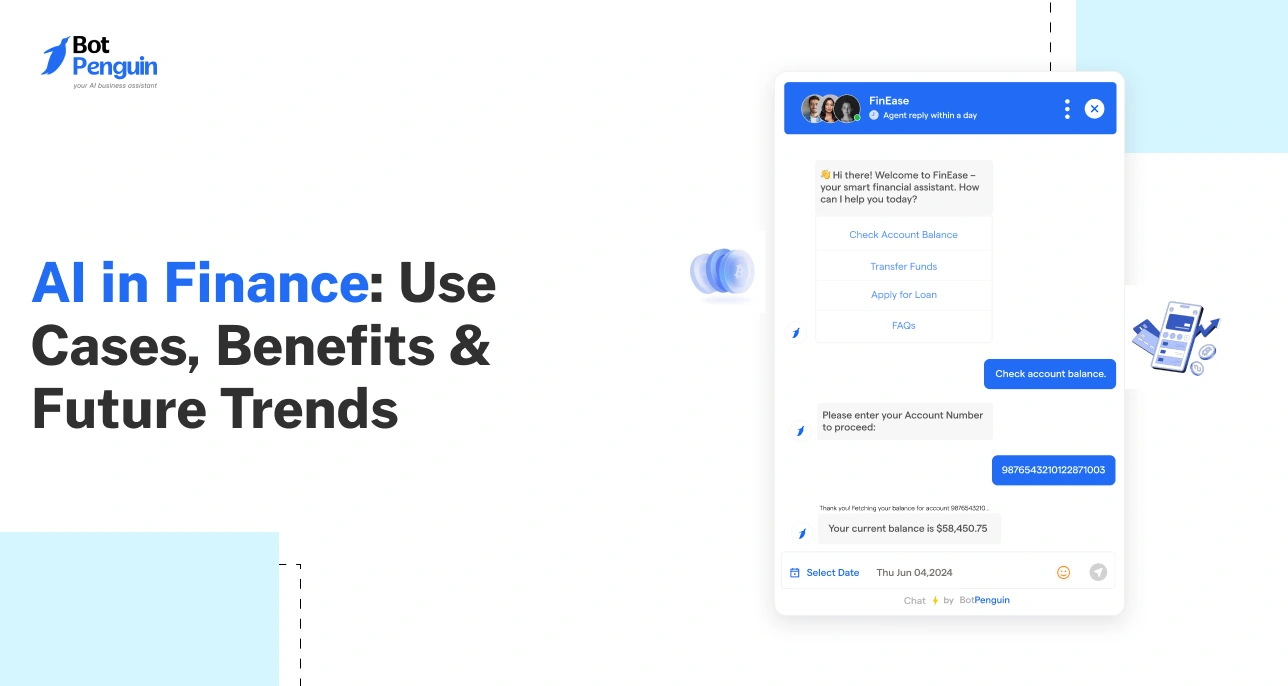
AI in finance is the use of machine learning and data analytics to automate and improve financial processes such as fraud detection, credit scoring, forecasting, reporting, and customer support. Banks, fintechs, and finance teams use it to cut costs, reduce errors, and make faster, data-driven decisions.
Finance is no longer run by humans alone.
Machines now analyze, predict, and even decide faster than most financial teams ever could.
From fraud detection to investment strategies, algorithms are quietly reshaping how money moves. Banks, insurers, and fintech companies are already relying on AI to reduce risk, cut costs, and improve decisions. Even routine tasks like reporting and customer support are becoming automated.
This shift isn’t coming; it’s already here.
In this guide, you’ll learn what AI in finance really means, how it works, where it’s used, and why it’s transforming the entire financial industry.
AI in finance refers to the use of artificial intelligence technologies, like machine learning and data analytics, to automate, improve, and optimize financial processes.
It helps institutions analyze large volumes of data, detect patterns, predict outcomes, and make faster, more accurate decisions across operations.
For example, JP Morgan’s COiN platform processes 12,000 commercial credit agreements in seconds, a task that once took lawyers 360,000 man-hours of legal work annually. (Source: Bloomberg)
The sheer volume, velocity, and complexity of financial data today prove why AI is gaining prominence in the finance sector.
Here's how it is reshaping the way financial institutions operate:
Traditional systems relied on rigid rules, manual inputs, and slow batch processing.
On the other hand, AI-driven systems learn continuously, adapt to new patterns, and deliver decisions at machine speed. Here’s a side-by-side look at how the two stack up:
These reasons suggest that AI has moved from buzzword to backbone in finance. In the next sections, we break down exactly how it’s used, where it’s applied, and what it means for the industry’s future.
Looking to bring AI into your own financial workflows? BotPenguin helps financial businesses deploy AI chatbots for customer support, loan queries, and more, without the heavy engineering lift.
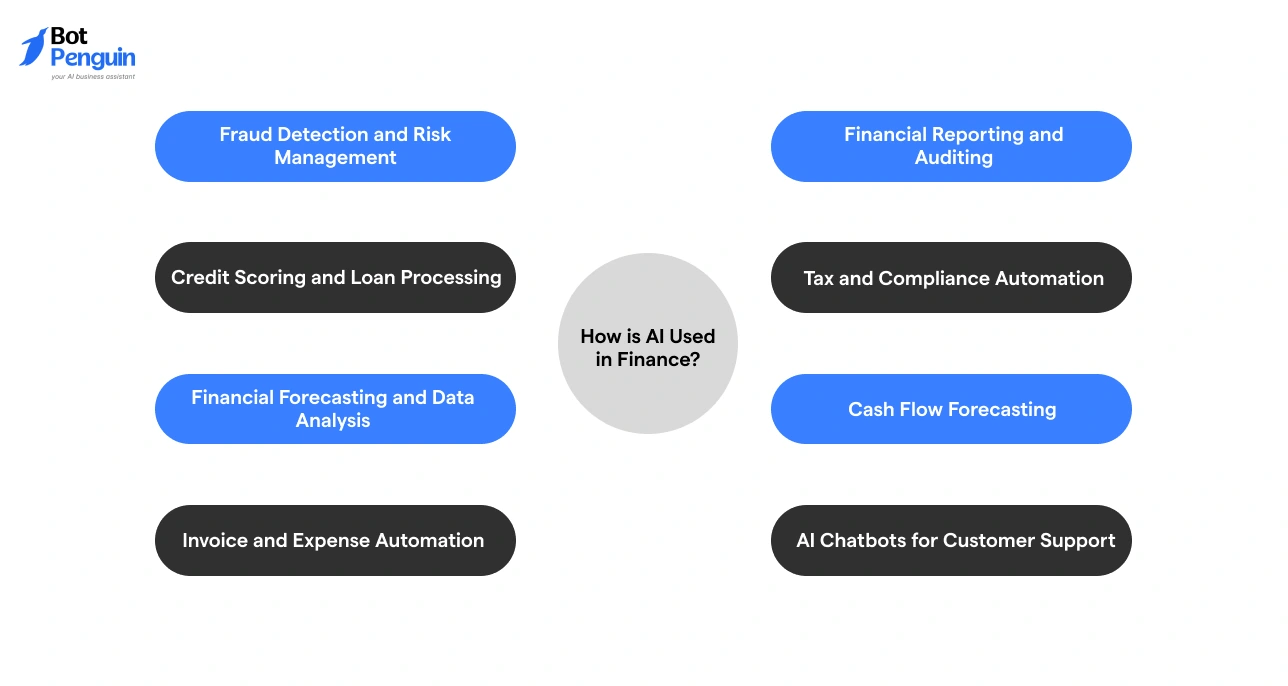
AI is already embedded across core financial workflows. It improves precision, speed, and decision-making in both customer-facing and back-office operations.
Let’s take a look at the key use cases of artificial intelligence in the finance industry:
AI monitors transactions in real time and flags unusual patterns instantly.
For example, if a card is used in two countries within minutes, AI can block it automatically and trigger alerts.
Lenders now use AI to assess borrowers beyond credit scores.
It analyzes spending behavior, income patterns, and digital footprints to approve loans faster, even for thin-credit users.
Upstart and Zest AI are leading examples. Both use machine learning to evaluate borrowers beyond traditional credit scores, enabling faster and more inclusive lending decisions.
AI processes historical and real-time data to predict revenue, demand, and market trends. Finance teams use it to plan budgets and adjust strategies proactively.
AI extracts data from invoices, categorizes expenses, and matches records automatically. A finance team can process thousands of invoices without manual entry.
Think: Automated expense categorization, smart invoice matching, and three-way reconciliation, all without manual data entry
AI scans financial records to detect anomalies and ensure compliance. Auditors use it to review large datasets quickly and identify risks early.
Tools like MindBridge AI and Workiva help auditors surface high-risk transactions and automate report generation, cutting audit cycles significantly.
AI tracks regulatory changes and applies rules automatically. It reduces errors in tax filings and ensures timely compliance.
This helps finance teams stay ahead of shifting regulations across jurisdictions, especially critical for multinational businesses dealing with VAT, GST, and cross-border tax rules.
AI predicts incoming and outgoing cash based on past trends. Businesses can avoid shortages and manage liquidity better.
AI chatbots handle balance checks, transaction queries, and routine customer requests 24/7, helping financial businesses reduce support workload and improve response times.
For a closer look at this use case, explore how a financial services chatbot supports customer interactions, or learn what a finance chatbot is in our glossary.
Together, these use cases show how AI is no longer a back-office experiment. It’s the engine running modern finance.
AI isn’t limited to one corner of the industry. From retail banking to algorithmic trading, it’s reshaping how every financial sector operates.
The table below showcases AI applications across the finance industry:
A few things stand out across all four sectors:
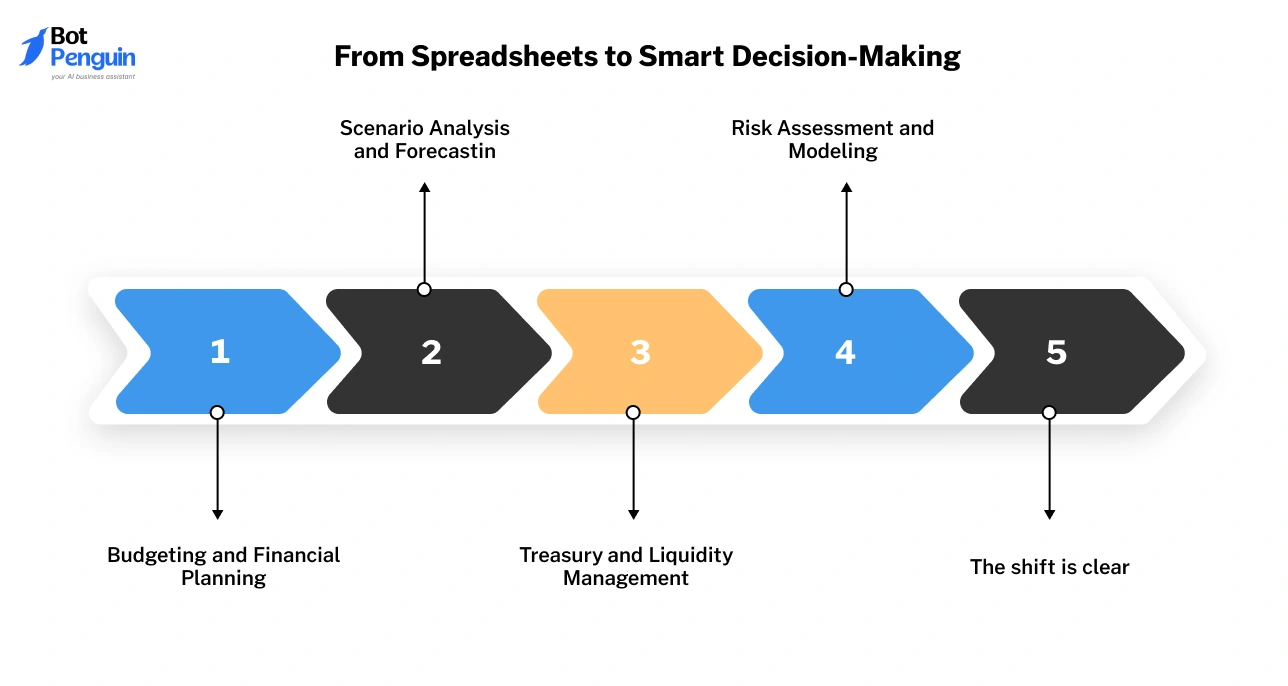
While AI in banking and fintech focuses on customers, AI in corporate finance works behind the scenes, optimizing how businesses plan, allocate, and protect their own capital.
In the context of corporate finance, AI is shifting the work from number-crunching to strategic thinking. Here’s where it’s making the biggest impact:
Now that you understand how AI in corporate finance helps optimize planning and forecasting, it’s time to look at generative AI and how it takes automation a step further.
Generative AI in finance refers to AI systems that can create content, insights, and recommendations instead of just analyzing data.
It uses models trained on large financial datasets to generate reports, summaries, forecasts, and even financial strategies in natural language.
Example: Bloomberg’s BloombergGPT is a large language model trained specifically on financial data, capable of answering market queries, summarizing earnings reports, and generating investment insights in seconds.
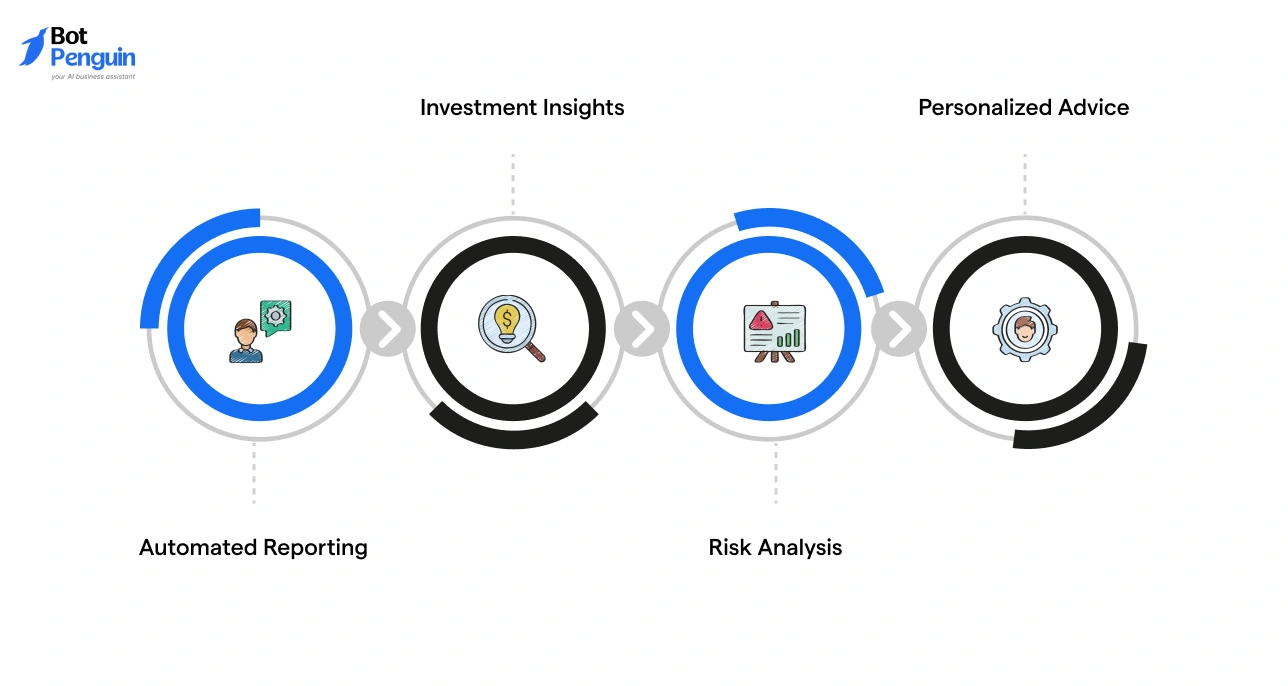
Generative AI is transforming how finance teams work day-to-day. It can:
For instance, instead of manually compiling a quarterly report, finance teams can use AI to generate a complete draft within seconds.
In accounting, generative AI simplifies complex workflows. It can explain financial statements, summarize audit findings, and generate compliance documentation automatically.
Accountants can also use it to answer queries like “Why did expenses increase this quarter?” with clear, data-backed explanations. This reduces manual effort while improving clarity and decision-making.
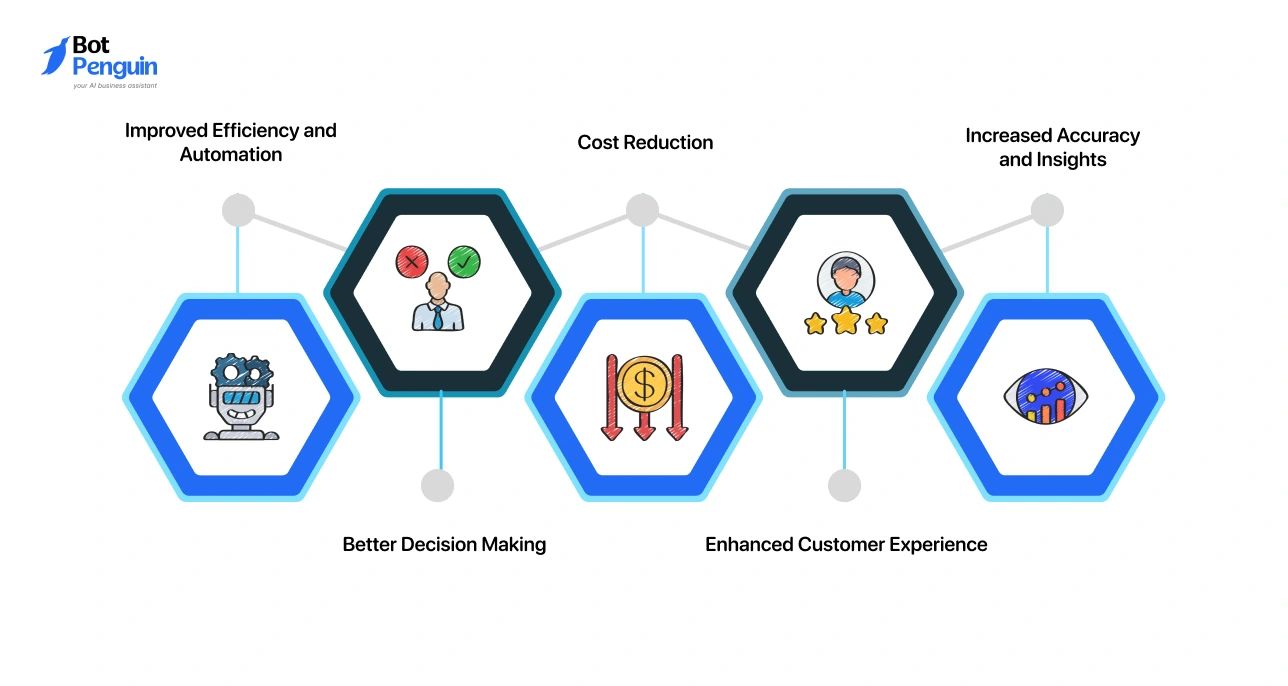
AI doesn’t just fasten things up. It fundamentally changes what finance teams can do, and how well they can do it.
Here are the top advantages of implementing AI in financial workflows:
The Bottom Line: AI gives finance teams fewer bottlenecks, better data, and more time for work that actually needs human judgment.
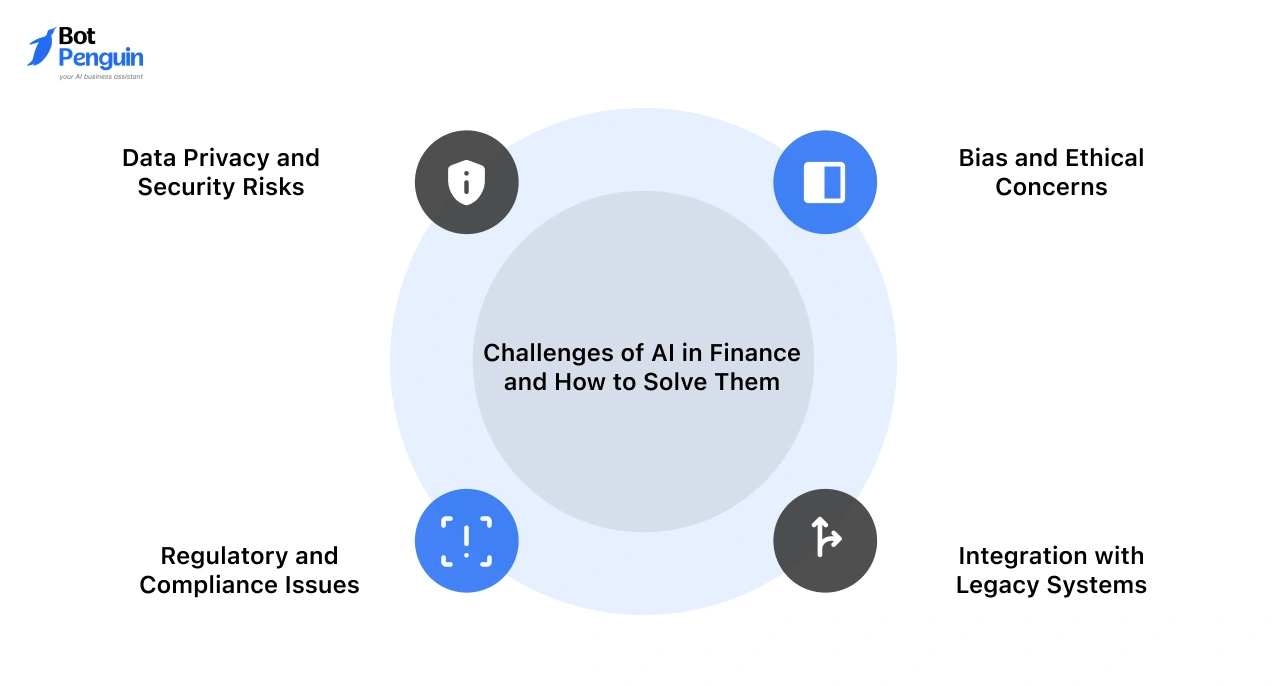
Most AI projects in finance fail because of what surrounds it: siloed data, rigid legacy systems, and compliance requirements that weren't accounted for from day one.
In that context, the top challenges that financial entities face while using AI include:
AI systems rely on large volumes of sensitive financial data, increasing the risk of breaches and misuse.
Solution: Implement strong data encryption, access controls, and compliance frameworks (like GDPR or local regulations). Regular audits and secure data pipelines are critical.
AI models can inherit bias from historical financial data, leading to unfair outcomes in lending or risk assessment.
Financial institutions must meet strict and evolving regulations, which AI systems may not always align with by default.
Many financial institutions still rely on outdated systems that are difficult to integrate with modern AI tools.
The institutions that get AI right aren't the ones with the biggest budgets. They're the ones that treat these challenges as implementation problems, not reasons to wait.
Not sure where to start? BotPenguin makes it easy to deploy AI in your financial workflows - with built-in compliance support and seamless integration.
The right AI tool depends on what you’re trying to solve. Here's a quick breakdown by function:
The best tool isn’t always the most popular one. It’s the one that fits your existing stack and compliance requirements.
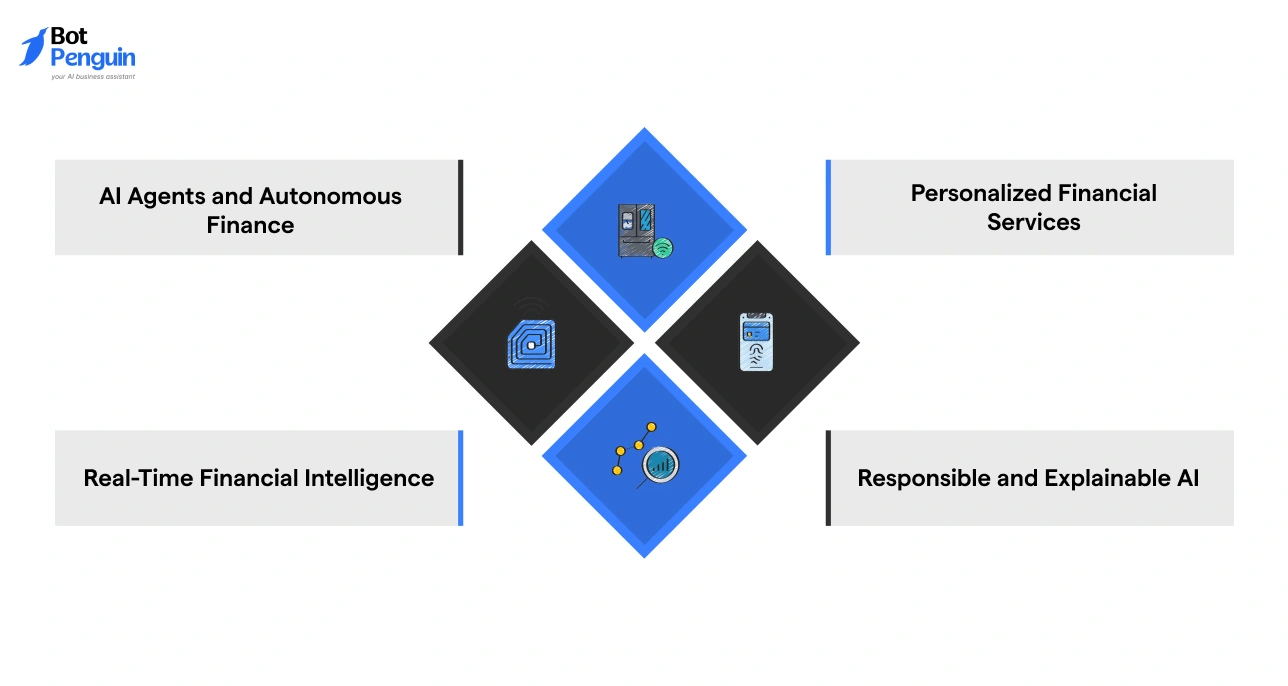
AI in finance has moved fast, but the next wave will be harder to ignore. We’re shifting from AI that assists to AI that acts, adapts, and explains itself.
AI agents will move from assisting to acting. They will execute trades, manage budgets, and optimize cash flow with minimal human input.
Finance teams will shift from doing tasks to supervising AI-driven operations.
Decisions will no longer rely on static reports. AI will provide real-time insights into revenue, risk, and market changes, allowing businesses to react instantly instead of retrospectively.
AI will enable hyper-personalized financial experiences. From tailored investment advice to customized loan offers, services will adapt to individual behavior, goals, and risk profiles.
As AI adoption grows, transparency will become critical. Financial institutions will focus on explainable AI models that justify decisions, reduce bias, and meet regulatory expectations while building trust with users.
The institutions building for these shifts today won't just keep up. They'll set the pace.
AI is changing how finance works at every level. It is faster, more accurate, and more scalable than traditional systems. From fraud detection to forecasting, it improves both speed and decision quality.
But it is not just about automation. It is about better insights, smarter planning, and more personalized services. Businesses that adopt AI early will have a clear advantage.
At the same time, challenges like data privacy, bias, and compliance cannot be ignored. These need careful handling.
The future of AI in finance is practical and already unfolding. The real question is not if you should adopt it, but how soon you can start.
AI in finance refers to using machine learning and data-driven algorithms to automate tasks, analyze financial data, improve decision-making, and enhance efficiency across financial services.
AI is used in finance for fraud detection, credit scoring, financial forecasting, customer support automation, compliance monitoring, and improving overall operational efficiency in financial processes.
AI improves accuracy, reduces costs, automates repetitive tasks, enhances fraud detection, enables faster decision-making, and helps financial institutions deliver better customer experiences at scale.
Common examples include fraud detection systems, robo-advisors, AI chatbots, automated accounting tools, credit risk models, and predictive analytics used for financial forecasting and decision-making.
Generative AI is used to create financial reports, summarize data, generate insights, assist with compliance documentation, and automate communication workflows across finance and accounting teams.
AI in finance can pose risks like data privacy issues, biased decision-making, lack of transparency, regulatory challenges, and over-reliance on automated systems without human oversight.
AI tools in finance include platforms for accounting automation, fraud detection, financial planning, chatbots for customer support, and analytics tools for forecasting and decision-making.
Smarter Financial Operations With AI Chatbots
Automate customer queries, lead qualification, and financial workflows. Reduce manual work, speed up responses, and improve user experience with AI-driven automation
Explore Now!Checkout our related blogs you will love.
Updated at Oct 6, 2026
9 min to read
Updated at Jun 30, 2026
11 min to read
Updated at Jun 8, 2026
11 min to read
Updated at Oct 9, 2026
10 min to read

Updated at Oct 9, 2026
12 min to read

Updated at Oct 7, 2026
12 min to read
Table of Contents