



Chatbots for Travel and Tourism: Use Cases, Benefits & How They Work
Updated at Oct 14, 2026
11 min to read
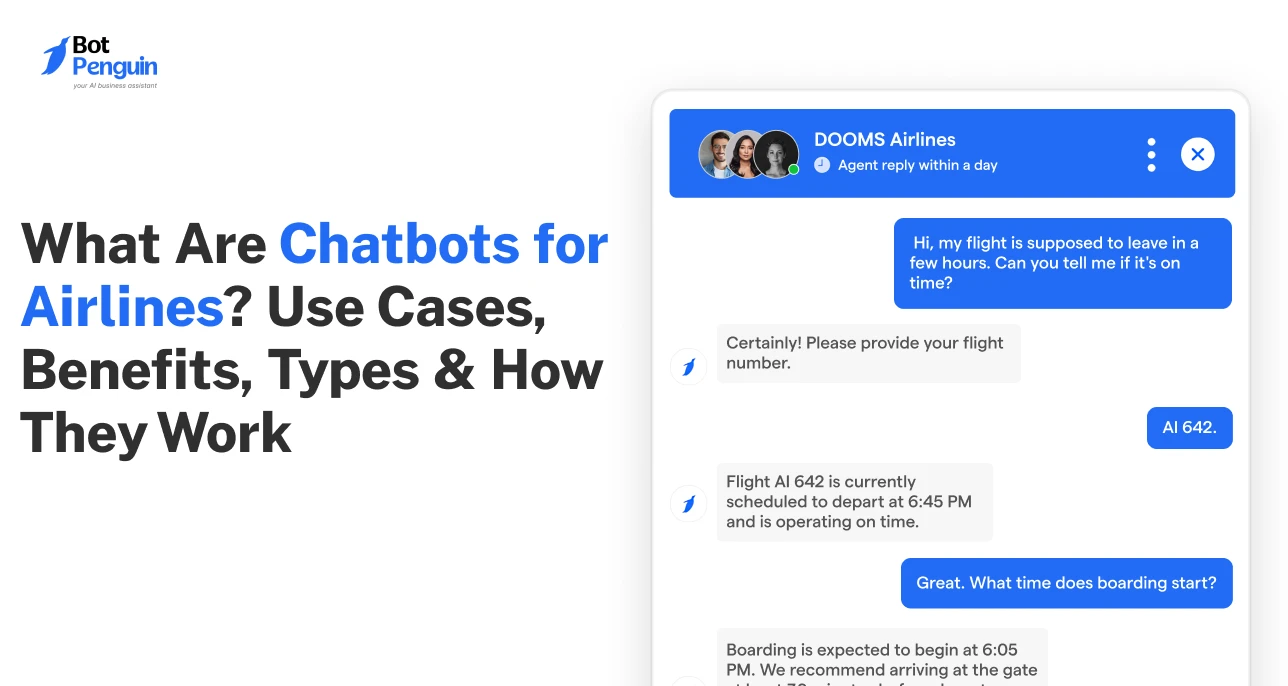
A flurryof systems work together for air travelers to reach their destinations.
Yet, behind the scenessits a vast network of airline operations, reservations, and real-time data, which must respond promptly and precisely.
This is where a chatbot for airlines steps in.
A delayed flight alone can trigger a chain of needs: missed connections, refund requests, baggage issues, or urgent rebooking. Modern airline chatbots handle this chaos across apps, websites, and messaging platforms, understanding passenger intent and delivering context-aware support.
In this guide, you’ll explore what airline chatbots are, how they work, where they are used across the passenger journey, and why they are becoming essential in modern airline operations.
An airline chatbot is a conversational assistant that helps passengers get answers or complete air travel tasks without waiting for a human agent.
In the airline industry, chatbots are commonly used for flight search, ticket booking, seat selection, check-in, boarding passes, flight status and gate alerts, baggage tracking, refunds, loyalty support, and escalation to human agents.
For airlines handling millions of queries daily, that shift isn’t coming; it’s already here.
The version that answers, “When does boarding close?” and the one that rebooks you on the next flight during a storm aren’t the same product.
Here’s how basic chatbots in the airline industry differ from advanced ones:
Where basic bots handle the predictable, advanced airline AI chatbots are built for the moments that actually test passenger loyalty.
Yet, building an advanced airline AI chatbot doesn't have to be complex. If you’re evaluating, platforms like BotPenguin give airlines a ready-to-deploy foundation that covers everything in that advanced column, without the months of custom development.
Airlines deal with rising passenger queries, disruption overload, and stretched support teams.
AI chatbots help manage these pressure points by managing high-volume, time-sensitive travel communication. Here’s why AI chatbots are gaining traction:
Basic status queries flood chat, app, and call centers, slowing down response times across all support channels and frustrating passengers.
Delays and cancellations create sudden surges in rebooking, refund, and update requests that teams can’t manually scale or manage effectively.
In a single year, nearly 1.7 million flights across the top 10 U.S. airlines were delayed or canceled, each one a potential support surge.
Baggage rules, check-in timing, and booking changes keep looping back to human agents, consuming valuable support bandwidth daily.
Flight changes, gate shifts, and boarding info often sit in disconnected systems, leading to inconsistent or delayed passenger communication.
Claims and refund statuses are hard to track, resulting in repeated follow-ups, confusion, and rising passenger frustration overall.
U.S. airline complaints rose 9% in a year, even as passenger volume grew by only 4%, a gap that signals a support system under strain.
Multiple languages, channels, and regions make it difficult for airlines to maintain uniform support quality across every touchpoint globally.
Thus, passenger expectations are outpacing what traditional support teams can deliver. AI chatbots for airlines don’t just fill that gap; they close it permanently, at scale, across every channel, timezone, and language.
Behind every instant reply is a chain of decisions happening in milliseconds. Here’s what actually happens when a passenger types in a query:
A passenger initiates a query through an airline’s digital channels, such as a website, mobile app, WhatsApp, or messaging platforms.
Requests typically include flight status, booking changes, check-in, baggage tracking, or refund-related questions, forming the entry point into the system.
The chatbot uses Natural Language Processing (NLP) and intent classification models to understand what the passenger is trying to achieve.
It separates queries into categories such as informational (flight updates), transactional (booking or modifications), or disruption-related (delay/cancellation handling), which determines the next workflow path.
At this stage, the chatbot operates through a two-layer architecture:
This separation ensures the chatbot can “understand” at scale while relying on secure system integrations for execution.
Once the correct system is identified, APIs fetch live operational data, including flight status, gate changes, seat availability, baggage movement, and booking records.
Since airline operations are highly dynamic, this layer ensures the chatbot always responds using up-to-date information.
Based on the request, the system either executes a transaction (check-in, seat selection, rebooking, or cancellation support) or generates a real-time response.
The output is delivered instantly within the same chat interface to maintain a seamless passenger experience.
If the request is complex, exception-heavy, or outside system capabilities, it is escalated to a live agent.
The chatbot passes complete conversation history, passenger context, and system data so the human agent can continue without delay.
The entire process happens in seconds. What makes it work isn’t just the AI, it’s how cleanly each layer hands off to the next, keeping the passenger in one seamless conversation from start to finish.
Even advanced airline chatbots are not built the same way. Airlines choose different architectures depending on how much control, intelligence, and automation they need across critical travel workflows.
Here’s a breakdown of the different types:
Closing Insight: Most airlines adopt hybrid or layered AI systems where generative or intent-based AI handles understanding, while structured workflows ensure safe execution of high-stakes airline operations.
Airline chatbots are used across the passenger journey to automate booking, check-in, flight updates, baggage tracking, refunds, rebooking, and post-flight support.
Below are the top use cases of airline chatbots for every stage of the travelers’ journey:
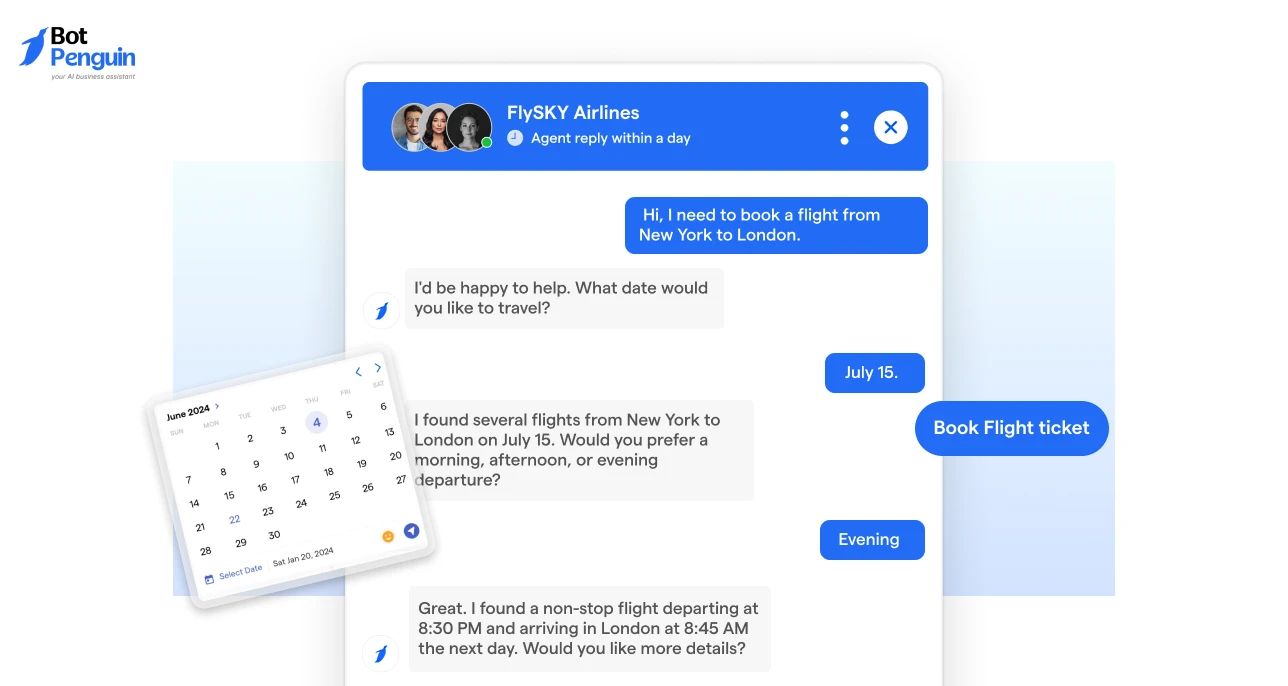
Airline chatbots help passengers search, compare, and book flights in a single chat flow. They handle route search, fare comparison, date selection, cabin choice, passenger details, and payment redirection.
Example: KLM's BlueBot (BB) lets passengers book tickets directly on Messenger in a conversational flow and is backed by a team of 250 human agents for complex cases.
Chatbots for airlines provide real-time updates on departures, arrivals, delays, cancellations, gate changes, and connection alerts, reducing the need for support calls and manual tracking.
They guide passengers through online check-in, seat confirmation, boarding pass access, baggage drop timing, and gate information, decreasing airport confusion and delays.
78% of travelers want one app to book, pay, and navigate the entire airport process, and chatbots sit right at the center of that experience. - IATA’s Global Passenger Survey
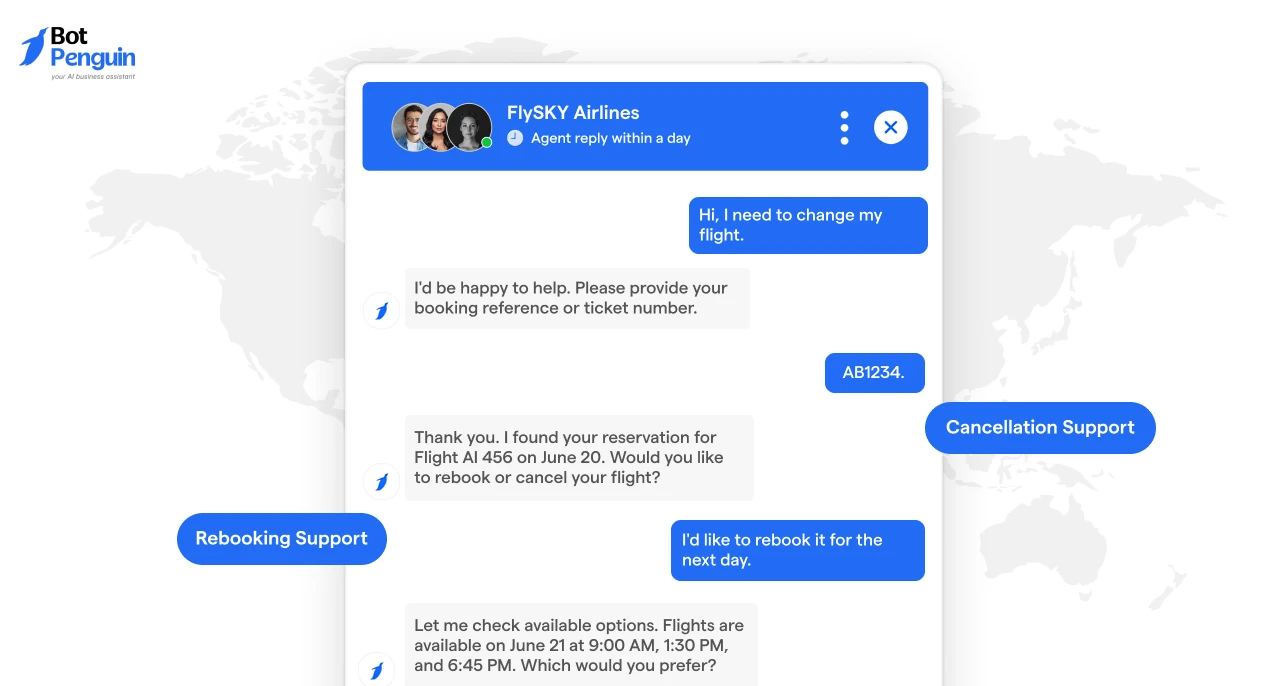
Airline chatbots also assist with checking rebooking eligibility, suggesting alternative flights, initiating cancellations, and guiding refund requests, especially during disruptions.
They allow passengers to track delayed baggage, report missing luggage, check claim status, understand allowances, and get guidance on extra baggage or damage claims.
Chatbots handle refund eligibility checks, cancellation workflows, reimbursement updates, payment failures, voucher details, and ancillary payments like seat upgrades or baggage fees.
They support requests for wheelchair assistance, medical support, infant travel, senior assistance, accessibility needs, and special meal preferences, with escalation where required.
This becomes particularly helpful when a passenger with mobility needs is connecting through multiple airports.
Airline chatbots manage loyalty queries such as miles balance, tier status, upgrades, lounge access, redemption options, and personalized travel offers.
They collect CSAT feedback, handle complaints, track refunds and baggage follow-ups, and support service recovery after travel is completed.
On the whole, airline chatbots cover every moment that matters to a passenger and every moment that used to cost airlines an agent, a call, and a wait time.
Airline chatbots improve the travel experience by giving passengers faster access to support while helping airlines manage high query volumes and operational pressure more efficiently.
We've divided the benefits into two sides of the same conversation: what airlines gain, and what passengers actually feel.
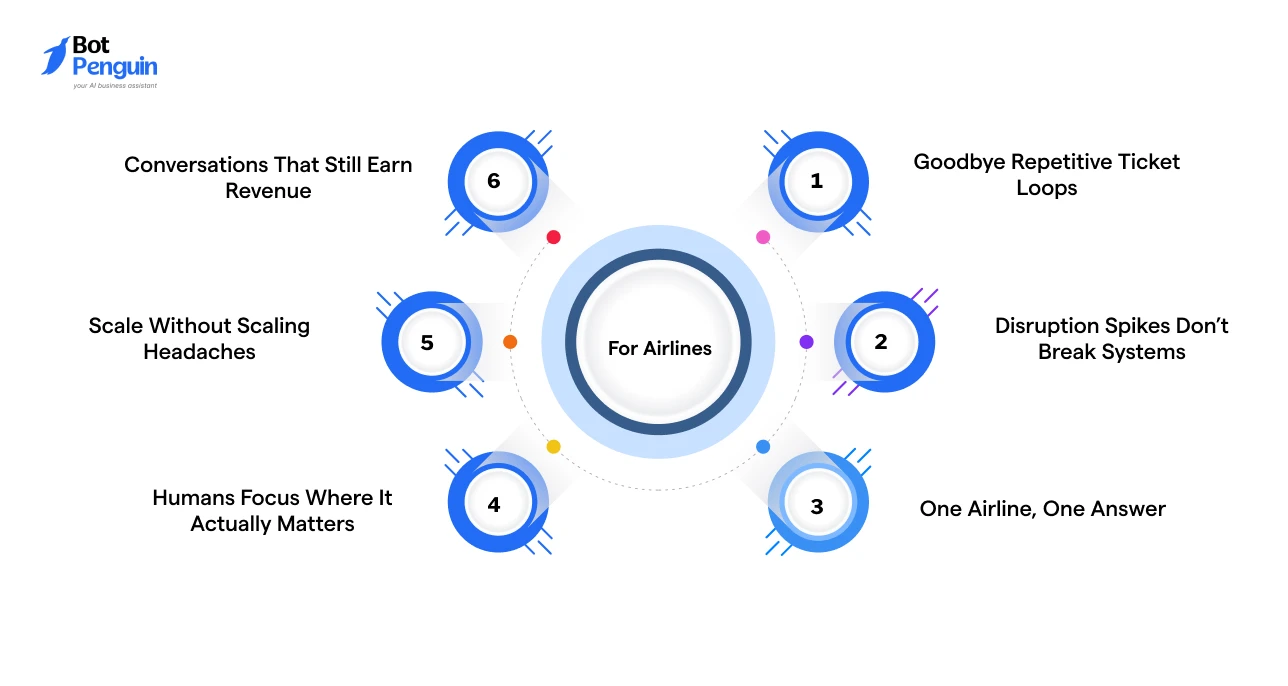
Now, let’s see how that translates into a better experience on the passenger side.
When both sides win, we get fewer frustrated passengers and fewer overwhelmed agents. That's not just good technology. That’s a better airline.
Airline chatbots are already live, named, and handling millions of passenger queries across the world’s biggest carriers. Here’s how some of them look in practice:
Points Worth Noting
At this stage, it’s also worthwhile to understand the various challenges that these chatbots face in real-world airline environments. Let’s explore that in the next section.
Airline chatbots improve efficiency, but they also introduce operational, compliance, and customer experience risks if not designed with accurate data, strong integrations, and proper escalation paths.
Here’s what to steer clear of when using airline chatbots:
Chatbots can sometimes give incorrect or outdated policy responses, especially around refunds, baggage compensation, fare rules, or passenger rights.
Solution: Use approved knowledge bases with strict policy controls so the chatbot only retrieves verified airline information instead of generating assumptions.
Poorly designed bots trap passengers in loops without resolving issues, especially when intent is unclear or frustration is high.
Solution: Build strong human handoff flows that trigger on emotion, complexity, or user request, and pass full conversation context to agents.
Without integration to PNR, booking, baggage, or loyalty systems, chatbots remain surface-level and cannot complete real tasks.
Solution: Connect chatbots securely with airline systems so users can modify bookings, track baggage, and complete transactions end-to-end.
Airline chat interactions often involve personal, payment, and travel data, making privacy and security critical.
Solution: Enforce strict access controls, encryption, audit logs, and data minimization to ensure compliance and safe handling of passenger information.
If chatbots are not easily accessible, passengers struggle to use them during high-stress moments like delays, gate changes, or missed connections.
Solution: Place chatbots across high-traffic touchpoints (app, web, messaging platforms) with a mobile-first design and quick entry access.
Airline chatbots depend heavily on live data feeds; if flight, baggage, or booking systems lag or go down, the chatbot can show outdated or inconsistent information.
Solution: Build fallback logic with cached data, system alerts, and graceful degradation so passengers still receive safe, accurate guidance during outages.
The risks aren't reasons to avoid airline chatbots, but are the reasons to build them right.
Now that you understand the limitations of AI chatbots in airlines, it’s time to look at the core considerations that ensure they are implemented safely at scale.
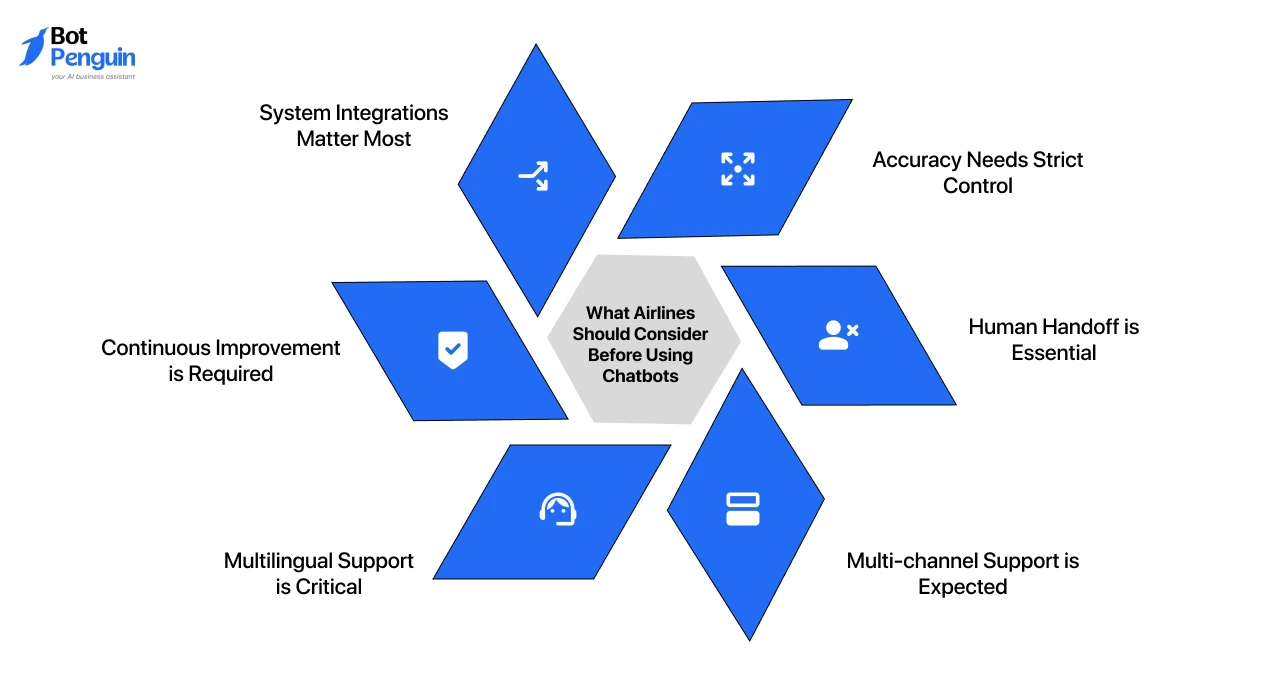
Airlines need to ensure chatbot systems are not just conversational tools, but fully integrated, accurate, and disruption-ready support layers that improve service without creating operational risk.
Here's what airlines should evaluate before and after going live with a chatbot:
A chatbot that checks all these boxes isn’t just a support tool; it’s a competitive advantage that compounds over time.
If you’re designing them for real airline operations, platforms like BotPenguin come with built-in escalation flows, system integration support, and compliance-ready architecture, so airlines aren’t starting from scratch on the hard parts.
Chatbots for airlines are now a key part of how airlines manage passenger support. They handle booking, check-in, flight updates, baggage, refunds, and disruptions in real time.
They lower the pressure on support teams and give passengers quicker answers without waiting in queues.
However, they only work well when they are built with the right systems behind them. Good integrations, accurate data, and clear escalation paths make a big difference.
Airlines that get this right can handle more passengers with less effort. The result is smoother journeys, fewer delays in support, and a better overall travel experience for everyone.
A chatbot for airlines is an AI assistant that helps passengers with booking, check-in, flight updates, baggage tracking, refunds, and travel support across channels.
Yes, airline chatbots can book flights when integrated with reservation systems. Basic bots may only redirect users to booking pages instead of completing bookings.
Yes, airline chatbots can guide refund eligibility, submit requests, and track status. Complex refund cases usually require human agent escalation for accuracy.
Airline chatbots are most useful during booking, check-in, flight delays, cancellations, baggage issues, and refund requests where passengers need fast, real-time support.
Airline AI chatbots are reliable when trained on verified data and connected to airline systems. Without proper controls, they may give incorrect policy information.
Airline chatbots work on websites, mobile apps, WhatsApp, Messenger, SMS, voice, and kiosks, with mobile apps being most useful during travel disruptions.
Airlines should evaluate integrations, data accuracy, privacy, multilingual support, escalation flows, analytics, and disruption handling before deploying a chatbot system.
Subscribe to Our Newsletter
Get the latest business insights straight into your inbox.
Checkout our related blogs you will love.
Updated at Oct 14, 2026
11 min to read
Updated at Oct 14, 2026
10 min to read

Updated at Sep 21, 2026
10 min to read
Updated at Oct 19, 2026
11 min to read
Updated at Oct 14, 2026
10 min to read

Updated at Oct 13, 2026
11 min to read
Table of Contents

