


How to Add a Chatbot to Your Website: A Complete Step-by-Step Guide
Updated at Oct 6, 2026
17 min to read
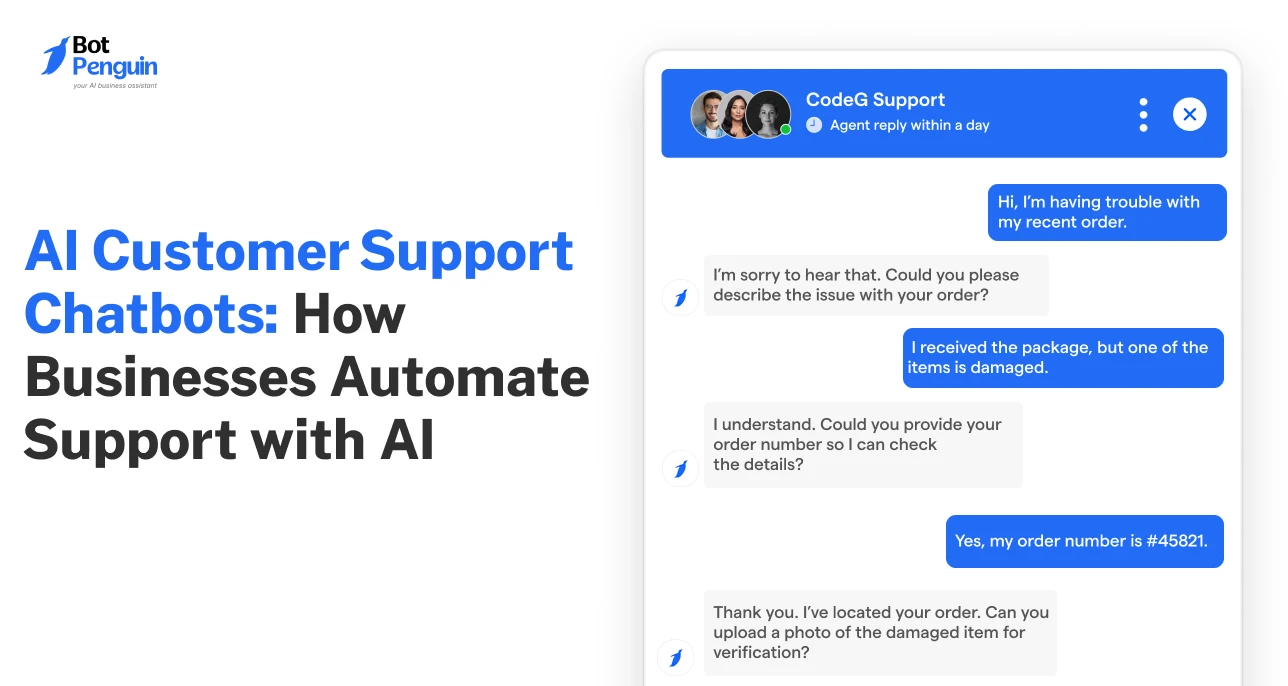
Customer support is the #1 use case of a chatbot. At least for most businesses!
What caused this shift is the growing gap between customer expectations and the ability of support teams to keep up.
Back in the day, humans were expected to meet rising ticket requirements and address the same query a thousand times. But the advent of chatbots helped change that.
Companies now use AI chatbots for customer support to automate responses, decrease wait times, improve customer experience, and scale support operations.
In this guide, we’ll explain what an AI customer chatbot is, how it works, its benefits, use cases, features, and implementation process.
An AI customer support chatbot is a software application that uses artificial intelligence to understand customer queries, reply automatically, and assist users across support channels.
Unlike basic bots, AI chatbots can understand intent, handle natural conversations, learn from interactions, and automate repetitive support. The Hans Hyundai case study shows how this kind of AI-powered automation can improve customer engagement and support efficiency in a real business setting.
Take Sephora, for instance. Its AI chatbot on Facebook Messenger handles recommendations, product queries, and bookings, which has driven a 30% increase in customer engagement.
Now that you understand what customer support chatbots are, it’s time to look at how they work. These AI-assisted tools typically follow this process:
The result? Customers get instant answers at any hour, agents focus on what actually needs a human touch, and your support operation runs around the clock.
Next, let's look at where AI-powered chatbots stand out & how they compare to the traditional ones.
Think of a rigid phone menu that forces you to “press 1 for billing”. Now think of a knowledgeable support rep who actually understands what you're asking. This is what customer support AI chatbots can do for you.
Here’s how to visualize that difference in practice:
If your business is still relying on traditional chatbots, you might not be just behind the curve; you're actively leaving customer satisfaction on the table.
Platforms like BotPenguin are built exactly for this upgrade, moving businesses from rigid, script-based bots to AI-powered conversations that actually understand customers.
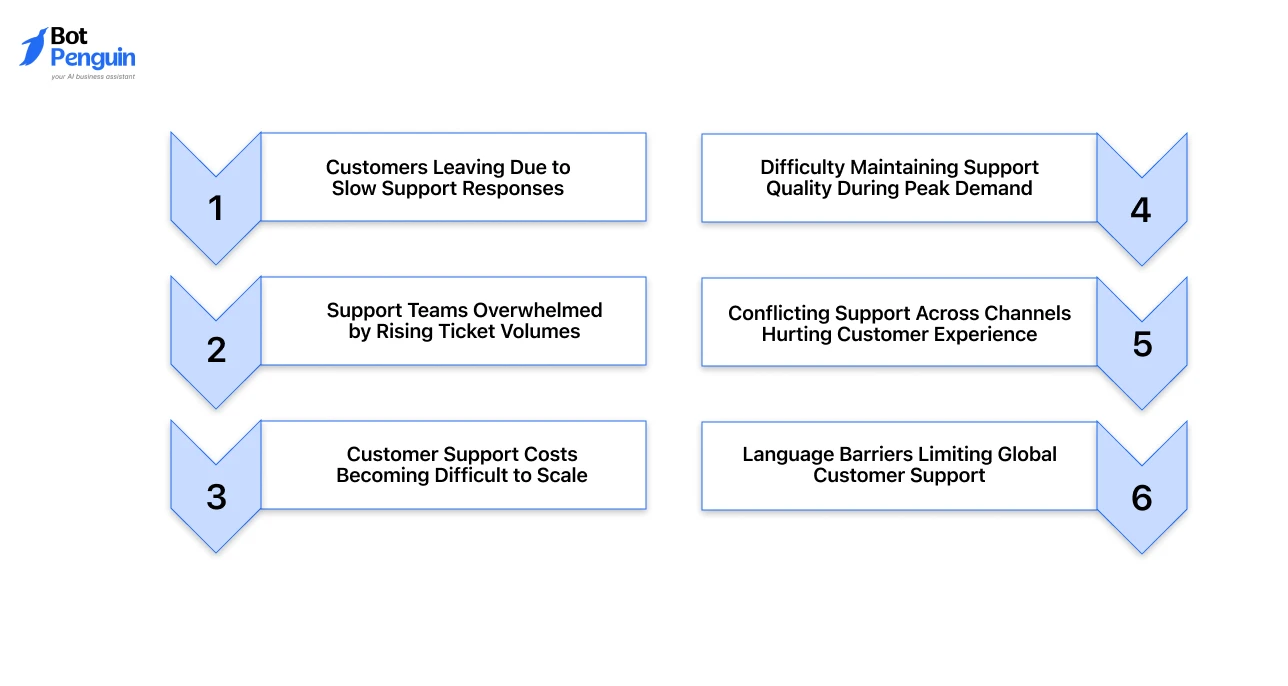
Businesses are adopting AI customer support chatbots because customer service expectations are rising faster than teams can manage in a never-seen-before competitive environment.
The businesses that recognize these gaps early and act on them are the ones that build strong customer support operations & lasting customer loyalty.
An AI-powered chatbot for customer support is no longer limited to answering FAQs.
Across the funnels, here’s how chatbots can help you maintain consistent communication and elevate client satisfaction:
Each of these use cases has been explained below:
AI chatbots help customers discover products, compare options, answer pricing questions, and guide buying decisions in real time.
Tools like H&M’s AI chatbot are known to keep potential customers engaged, acting as a personal stylist, suggesting outfits based on shopper preferences and turning browsers into buyers.
Chatbots assist users during checkout by resolving payment issues, applying discounts, sharing shipping details, and answering purchase-related questions instantly.
This includes resolving a failed payment in real time or automatically applying a discount code when a customer is about to abandon their cart.
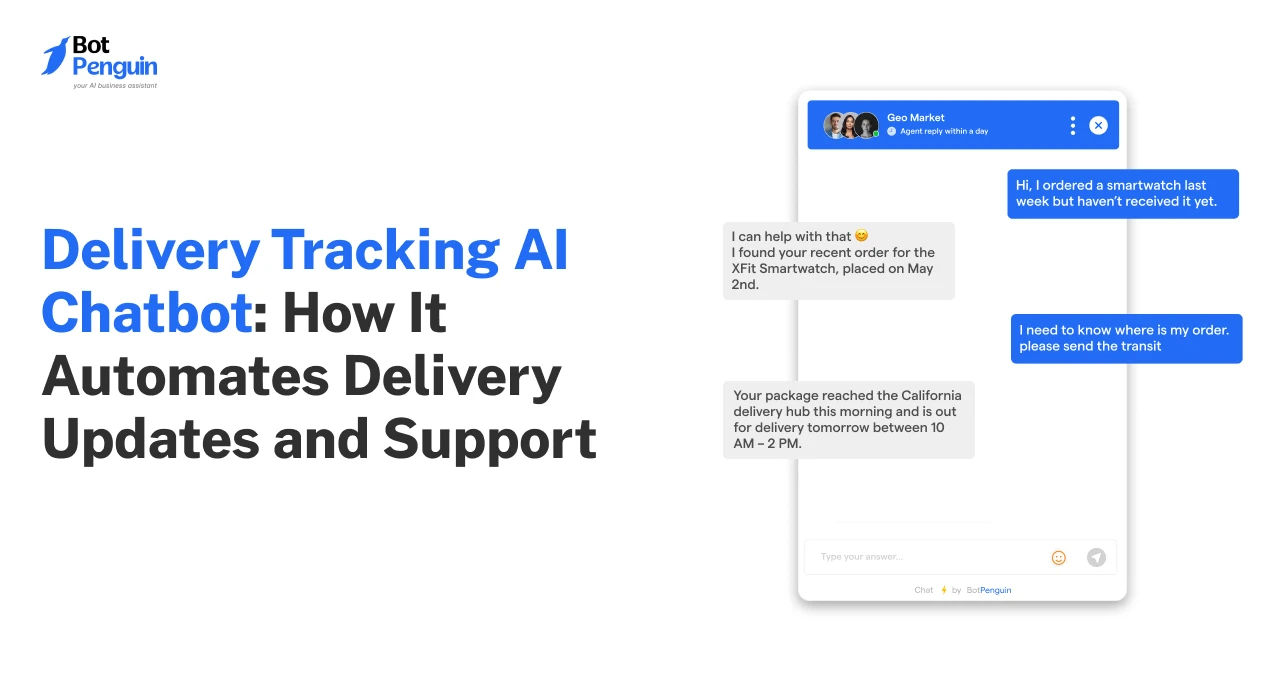
Businesses further use AI chatbots to provide delivery updates, return instructions, refund status, and post-purchase assistance.
Platforms like BotPenguin support businesses in automating delivery updates, return requests, and refund tracking, all within the customer's preferred channel, whether that's WhatsApp, website chat, or social media.
AI customer support chatbots can identify frustrated customers, collect issue details, create support tickets, and transfer complex cases to human agents quickly.
Vodafone's AI assistant TOBi handles millions of interactions per month with up to 60% first-time resolution rate, and when complaints exceed its scope, it summarizes the conversation and hands it off to a human agent instantly. (Source: Vodafone)
Businesses also use chatbots to send personalized follow-ups, collect feedback, share reminders, and reconnect with inactive customers across channels.
On the whole, these use cases depict how AI-powered chatbots are active participants in every stage of the customer journey, keeping conversations going, problems solved, and customers coming back.
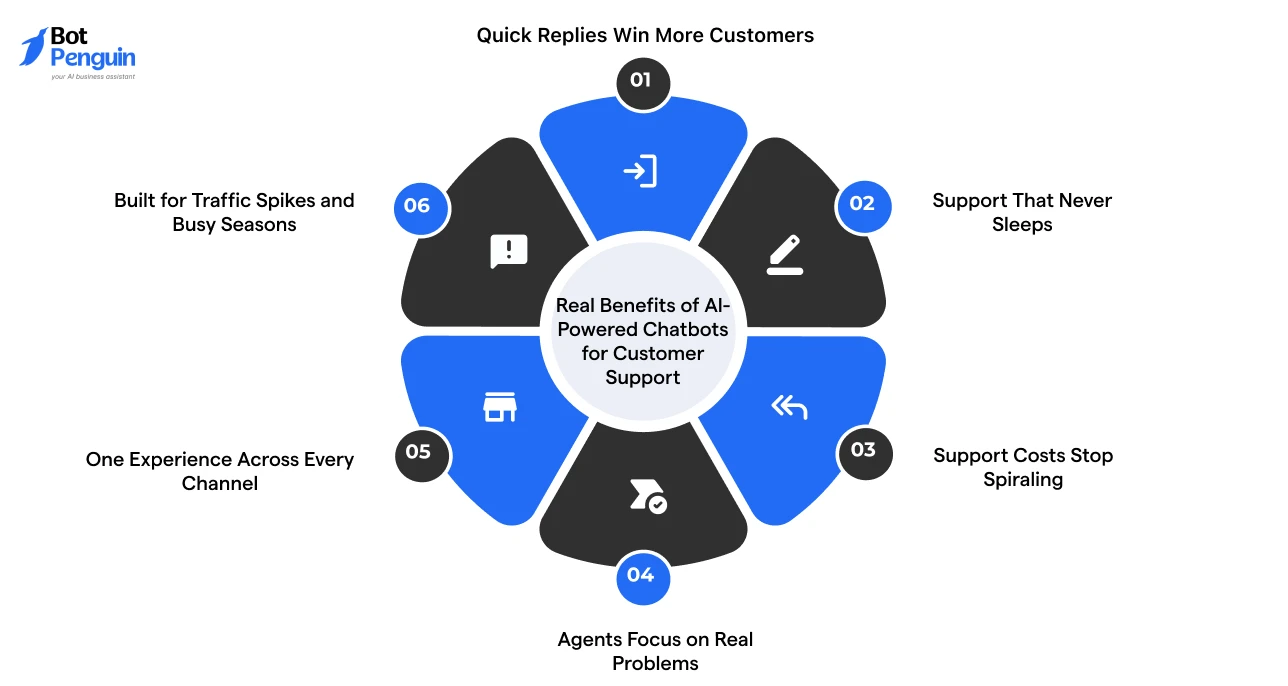
Businesses are investing in AI customer support chatbots because they improve both customer experience and support efficiency at scale.
Here are the top advantages that businesses stand to gain from AI chatbot solutions:
Individually, each of these benefits is compelling… But together, they compound. Faster responses build trust → trust reduces churn → reduced churn directly impacts revenue.
Implementing an AI customer support chatbot starts with understanding your customer support process first.
Here’s a step-by-step overview of the customer support chatbot deployment process:
Important Points to Remember
Implementation isn't a one-time project; it's an ongoing commitment. The businesses seeing the strongest results treat their AI chatbot like a team member: onboarded carefully, trained consistently, and improved continuously.
The right customer chatbot platform should help businesses handle conversations accurately, maintain support quality, and scale across channels.
Here’s a breakdown of the top features you should consider:
NLU helps chatbots understand customer intent, context, and conversational language instead of relying only on fixed keywords.
This helps chatbots handle the way customers actually type: incomplete sentences, slang, typos, and regional phrasing, without breaking the conversation flow.
Businesses should support customers consistently across websites, mobile apps, WhatsApp, email, and social media from a single platform.
Also, a unified inbox ensures that no customer query slips through the cracks, giving support teams full visibility across every channel from a single dashboard.
Chatbots should connect with CRM systems, ticketing platforms, and customer databases to access customer history and support workflows.
Complex or sensitive issues should transfer smoothly from AI chatbots to human support agents without losing conversation context.
This ensures the customer never has to repeat themselves. Agents pick up mid-conversation with full context, making the transition feel seamless.
AI-powered chatbots should communicate with customers in multiple languages to support global audiences more effectively.
Built-in analytics help businesses track response times, containment rates, customer satisfaction, and chatbot performance trends.
The best AI customer support chatbots, therefore, combine automation, integrations, and customer experience without making conversations feel robotic.
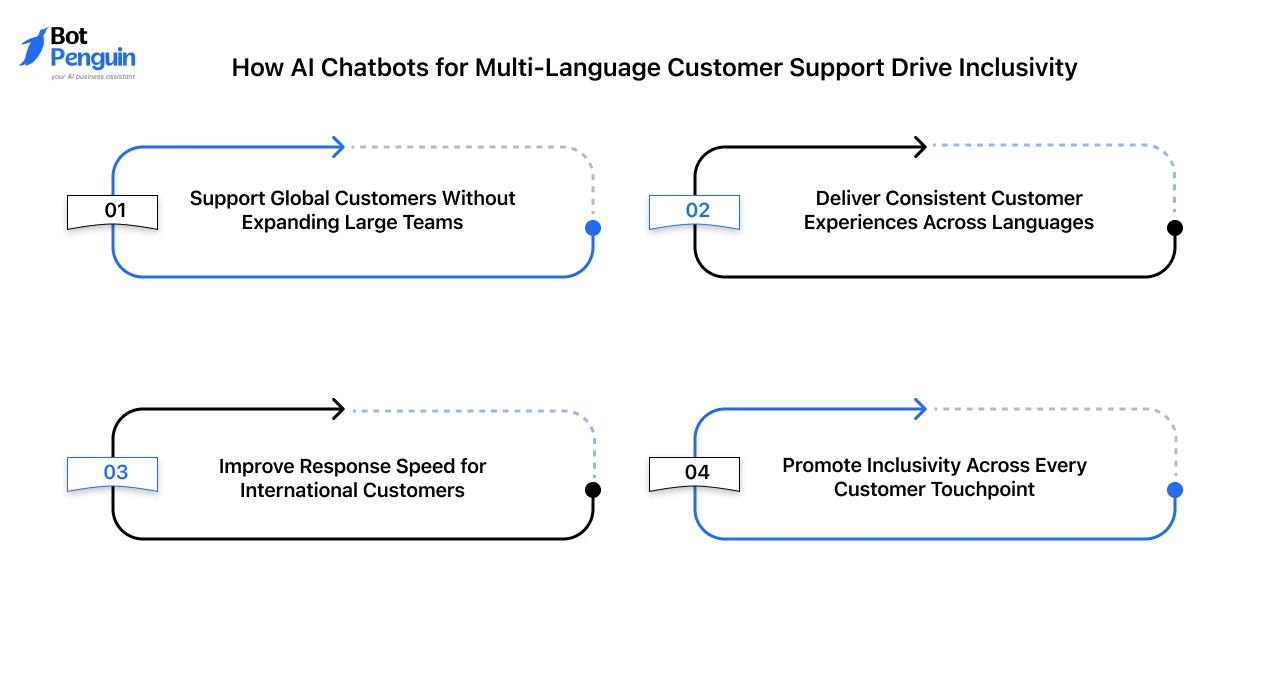
Customers expect support in their preferred language, regardless of location or channel.
AI chatbots for multi-language customer support help businesses handle conversations across regions with faster and more consistent communication. This not only breaks down language barriers but also promotes better inclusivity.
When customers feel understood in their own language, they don't just stay longer; they trust more.
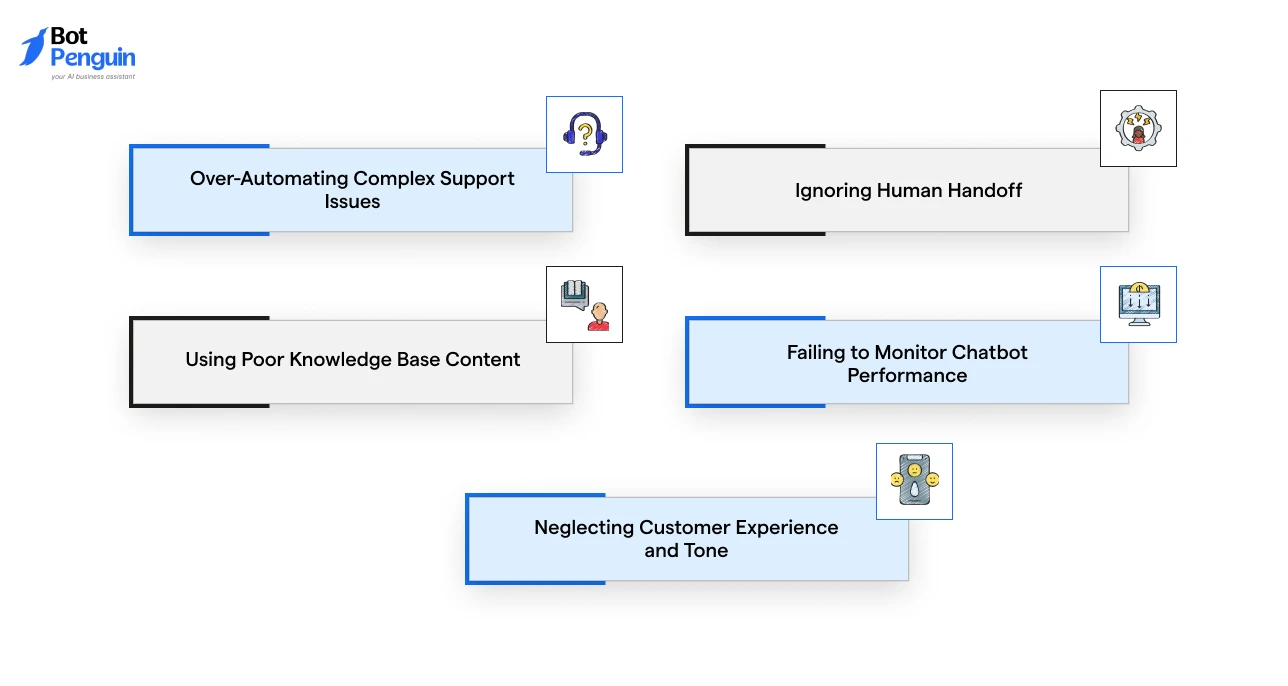
Many businesses implement AI customer support chatbots expecting immediate results. However, poor planning and weak customer experience strategies often limit chatbot performance.
Trying to automate every conversation can frustrate customers during sensitive or complicated situations.
Customers often get stuck when chatbots cannot solve their problems.
Outdated FAQs and incomplete support information lead to inaccurate chatbot responses.
Many businesses launch chatbots but rarely track performance afterward.
Robotic replies and poor conversation flow can damage customer trust.
A poorly implemented chatbot doesn't just underperform; it damages the very customer relationships you're trying to protect. Thoughtful implementation, on the other hand, is what separates a chatbot that frustrates from one that converts.
Tracking the right metrics helps businesses understand whether their AI customer support chatbot is actually improving support performance and customer experience.
Here’s a breakdown of the core metrics to monitor along with acceptable scores:
Businesses should track these metrics regularly to identify support gaps, improve chatbot accuracy, and optimize customer experience across channels.
Platforms like BotPenguin come with built-in analytics dashboards that track all of these metrics in one place, so you're never guessing where your chatbot needs improvement.
And if you're wondering how to put all of this into practice, the next section is exactly what you need.
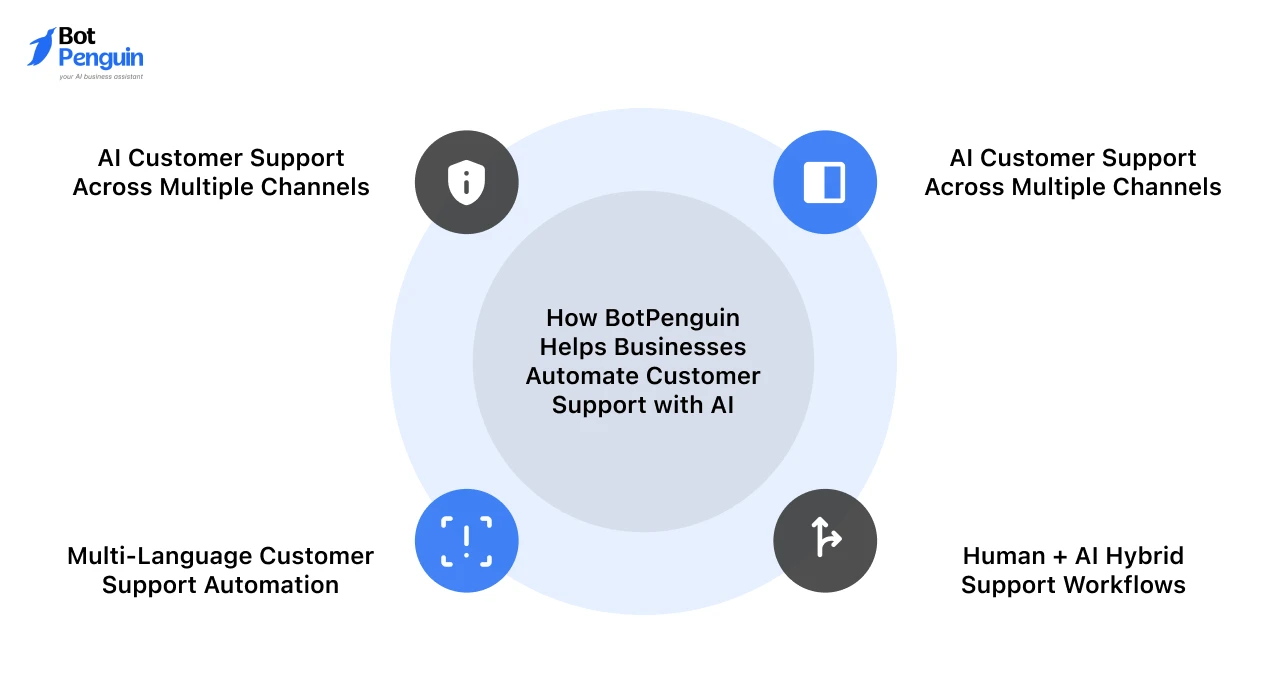
For businesses looking to put these practices into action, BotPenguin is one platform worth exploring.
Thus, BotPenguin doesn't replace your support team; it makes them significantly more effective, so every customer interaction counts.
Customers today want quick answers, support across channels, and help at any time. Most support teams struggle to keep up with those expectations manually.
AI chatbots for customer support help businesses manage repetitive queries, handle higher support volumes, and improve response times without compromising customer experience. They also make multilingual and omnichannel support easier to manage at scale.
But chatbots work best when paired with the right workflows, accurate knowledge bases, and smooth human handoff.
Businesses that balance AI with real customer needs are the ones delivering faster, more reliable, and more consistent support experiences today.
An AI customer support chatbot uses artificial intelligence to answer customer queries, automate support tasks, and assist users across multiple communication channels.
AI chatbots improve customer support by providing faster responses, 24/7 availability, consistent communication, and quicker resolution for repetitive customer queries.
Ecommerce, healthcare, banking, SaaS, education, travel, and retail businesses commonly use AI customer support chatbots to manage customer interactions efficiently.
AI chatbots handle repetitive and common queries, while human agents manage complex, sensitive, or high-value customer support conversations and escalations.
AI chatbots use natural language processing and AI models to understand and respond to customers in multiple languages across support channels.
AI chatbots help businesses improve response times, manage larger support volumes, lower operational costs, and maintain consistent customer experiences.
Businesses implement AI chatbots by identifying common support queries, building workflows, training the chatbot, integrating support tools, and optimizing performance regularly.
Subscribe to Our Newsletter
Get the latest business insights straight into your inbox.
Checkout our related blogs you will love.
Updated at Oct 6, 2026
17 min to read
Updated at Sep 28, 2026
15 min to read
Updated at Sep 28, 2026
19 min to read
Updated at Sep 25, 2026
9 min to read
Updated at Sep 1, 2026
10 min to read
Updated at Jun 24, 2026
10 min to read
Table of Contents