Best AI Virtual Assistants to Boost Office Productivity
Best AI Virtual Assistants for Businesses
Best AI Virtual Assistants for Developers
Best AI Virtual Assistants for Accessibility
Emerging AI Virtual Assistants to Watch in 2025
Best AI Virtual Assistants for Conversational AI and Large Language Models
Best AI Virtual Assistants for Smart Devices
Best AI Virtual Assistants for Enterprise Solutions
Best AI Assistants for Smart Homes and IoT
AI Assistants for Specialized Use Cases
How to Choose the Right Assistant
Conclusion
Frequently Asked Questions (FAQs)
Share
Introduction
In today's competitive world, AI assistants are playing a vital role by improving productivity, streamlining workflows, and offering personalized support across various industries, and in everyday life too.
From managing tasks to solving problems, these virtual helpers are becoming indispensable tools for both personal and professional use.
In 2025, the competition among AI assistants is fierce, with new features, smarter algorithms, and surprising innovations. Choosing the right one can make a huge difference, providing many benefits.
This guide dives into the 24 best AI virtual assistants of the year. Whether you need a digital concierge or a strategic partner, there is an option here for everyone. Let us get started.
Understanding AI Virtual Assistants
AI virtual assistants are intelligent software programs powered by artificial intelligence (AI). They respond to queries in human-like languages in text or voice format.
Using natural language processing (NLP), these assistants process and understand user intent, and then generate responses in a conversational manner.
In businesses, they can be used to execute tasks like scheduling appointments, answering customer queries, and providing general information. They integrate with apps, analyze data, and even learn user preferences over time to offer smarter, more personalized support.
The best AI virtual assistants go beyond basic automation; they enhance productivity, improve efficiency, and make life easier by handling repetitive tasks seamlessly.
Whether you need help organizing your work or streamlining business operations, these assistants are designed to simplify everyday tasks and boost overall efficiency.
Best AI Virtual Assistants for Work Productivity
Efficiency is the cornerstone of professional success, and the best AI virtual assistants are tailored to optimize work processes.
From managing schedules to generating content, these tools enhance productivity and streamline your daily workflow. Here are the top virtual assistants to boost your work efficiency.
1. Microsoft CoPilot
Microsoft Copilot is one of the best AI virtual assistants designed to enhance productivity within Microsoft’s ecosystem.
Unlike standalone AI assistants, Copilot works as an embedded AI tool across Microsoft 365 apps, helping users creating PowerPoint presentations with AI, with writing, data analysis, coding, and task management
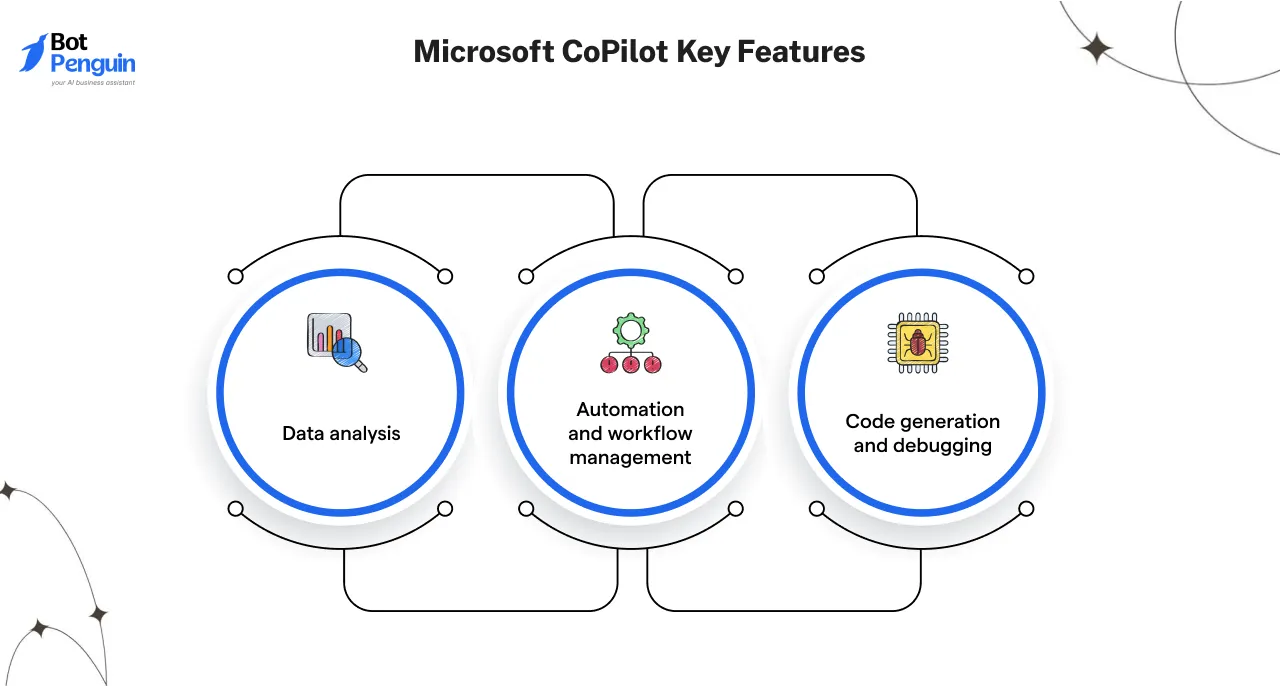
Key Features:
Data analysis: Uses AI to analyze data, create reports, and generate insights in Excel. Uses AI to analyze data, create reports, and generate insights in Excel. For advanced analytics, unified data platforms, and real-time reporting, businesses often rely on expert microsoft fabric consulting to make better use of Microsoft’s data tools.
Automation and workflow management: Boosts productivity by automating repetitive tasks in Teams, streamlining workflows with Power Automate, and assisting in content creation for PowerPoint presentations.
Code generation and debugging: Assists developers by generating code snippets and debugging issues in Visual Studio.
Ideal for:
Professionals who rely on the Microsoft ecosystem and want the best AI virtual assistants for seamless integration.
Users who need AI assistance for writing, data analysis, and workflow automation.
Developers seeking AI-driven coding support within Microsoft applications.
Pros:
Deep integration with Microsoft 365, Outlook, and Teams.
AI-driven automation boosts productivity across different tasks.
Works across multiple Microsoft applications, enhancing collaboration and efficiency.
Cons:
Limited functionality outside the Microsoft ecosystem, unlike some other best AI virtual assistants that support multiple platforms.
Requires a Microsoft 365 subscription for full features.
Requires an internet connection for AI-powered assistance.
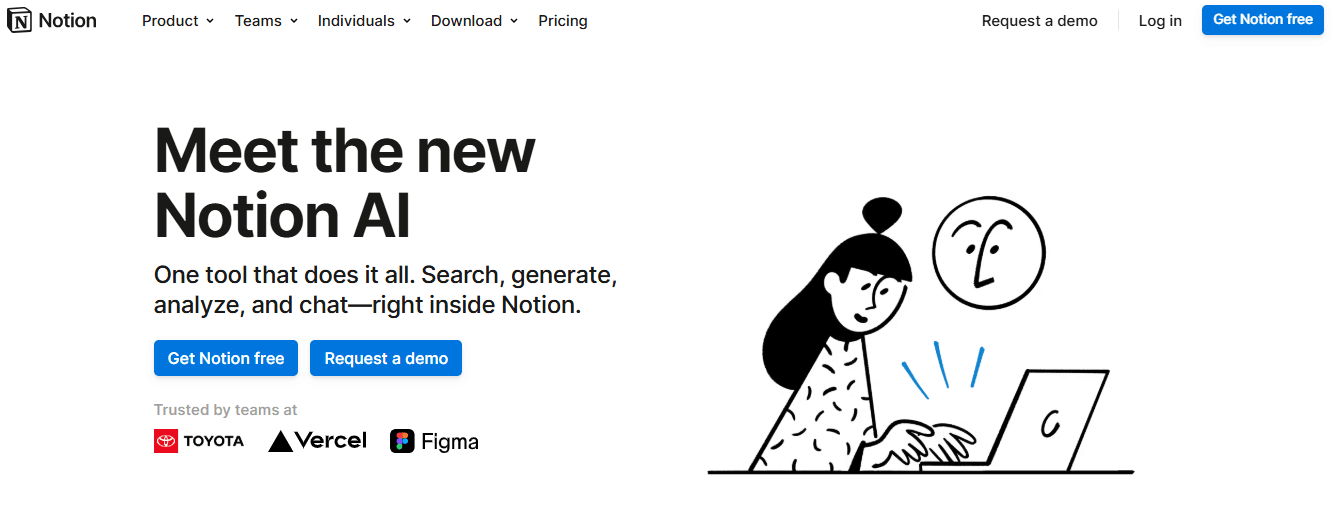
2. Notion AI
Source: Notion AI
Notion AI is considered one of thebest AI virtual assistants for project management and content creation.
Unlike full AI assistants like Siri or Alexa, it functions as an AI-powered productivity assistant, enhancing Notion’s workspace with smart automation, brainstorming support, and content generation.
Key Features:
Note organization: Categorizes and summarizes notes, ensuring quick access to information.
Content creation: Assists with writing tasks like drafting emails, reports, and meeting agendas.
Automatic summarization: Quickly condenses long documents, meeting notes, or project updates into concise, actionable insights.
Ideal for:
Teams managing intricate projects that require a structured organization with one of the best AI virtual assistants available.
Individuals juggling multiple tasks and deadlines.
Writers and researchers looking for AI-assisted content generation with one of the best AI virtual assistants for writing.
Pros:
Simplifies complex workflows with intelligent suggestions.
Customizable workspace to fit individual or team needs.
Efficient in generating content and summarizing lengthy notes.
Cons:
Requires a Notion subscription for full access to features, making it less accessible than some other best AI virtual assistants with free-tier options.
May not integrate seamlessly with non-Notion tools.
Can be slower for large databases and complex queries compared to other best AI virtual assistants optimized for speed.
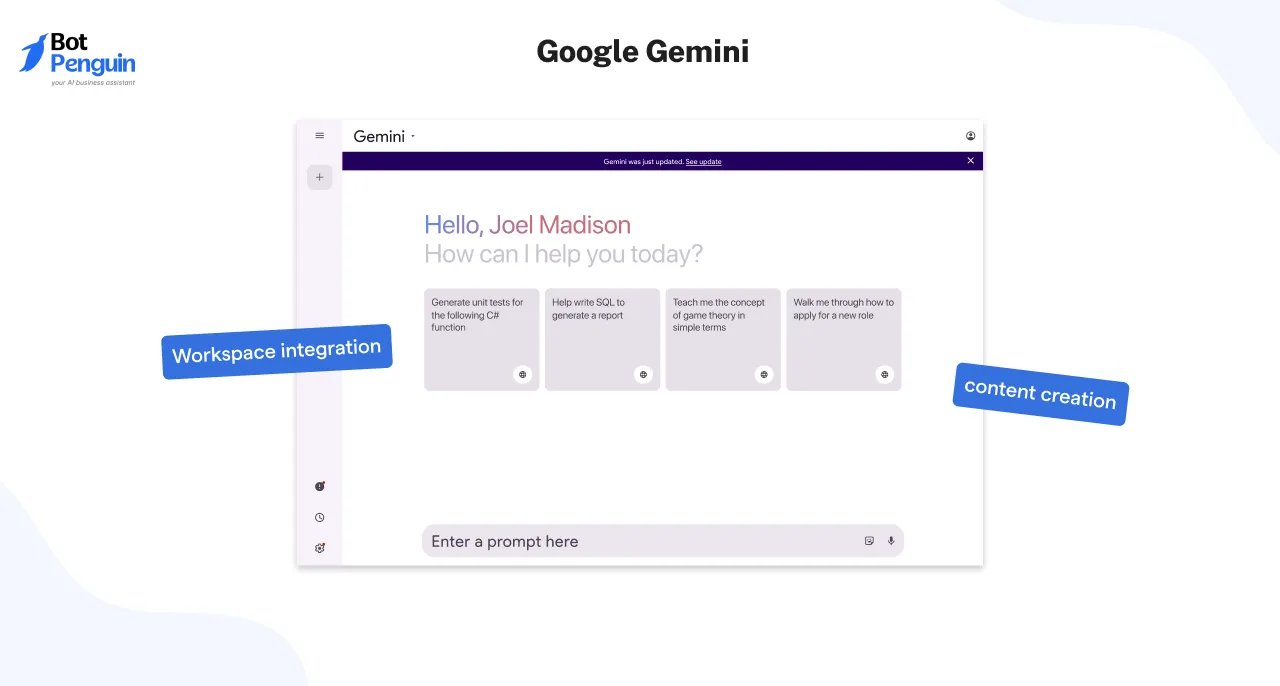
3. Google Gemini
Google Gemini AI for Workspace is one of the best AI virtual assistants, designed to help businesses enhance productivity and streamline workflows.
Designed specifically for Google Workspace, it seamlessly integrates with Google’s ecosystem to assist teams with automation, content creation, and data-driven insights.
Key Features:
Google Workspace integration: Ideal for businesses using Google’s ecosystem, making it one of the best AI virtual assistants for smooth collaboration.
Smart data analysis: Automates document and data analysis, delivering actionable insights.
Content generation: Helps create high-quality content quickly, from reports to marketing materials.
Ideal for:
Companies looking for the best AI virtual assistants to enhance Google Cloud integration.
Teams, needing AI-powered tools for content creation and data analysis.
Businesses, wanting to optimize workflows and boost team collaboration with AI assistance.
Pros:
Helps businesses efficiently generate high-quality content, positioning it as one of the best AI virtual assistants for content creation and marketing.
Automates routine tasks, freeing up time for strategic work.
Improves collaboration by automating scheduling and reminders.
Cons:
Limited integration with non-Google tools may restrict its use for some businesses.
May require extra customization for businesses with unique needs.
Initial setup complexity for those unfamiliar with Google Cloud.
Best AI Virtual Assistants to Boost Office Productivity
AI is transforming workplace efficiency by automating tasks, managing schedules, and streamlining communication. From handling emails to organizing meetings, the best AI virtual assistants help businesses improve productivity and reduce workload.
Whether you need an assistant for team collaboration, customer engagement, or task automation, here are the top picks designed for professional use.
4. Vizzy by Sintra AI
Vizzy is an AI virtual assistant that acts like an executive assistant in software form, improving images, planning trips, organizing events, compiling financial reports, and handling more than 10,000 types of tasks so you can stay focused on higher value work.
Key Features:
Handles a wide range of executive assistant tasks such as travel planning, event coordination, financial breakdowns, and day to day admin.
Connects to Brain AI so the ai virtual assistant can use your own websites, files, and snippets as a shared knowledge base across tasks.
Offers dedicated Power Ups including image generation, background remover, image quality improver, trip planner, birthday organizer, and financial reporter.
Ideal for:
Professionals who want an always available ai virtual assistant to take over recurring admin work, visual tasks, and trip or event planning.
Small teams and founders who need an executive style helper that can prepare reports, manage routine tasks, and stay on brand using Brain AI.
Non technical users who prefer a friendly, guided interface instead of manual prompting while still getting advanced automation.
Pros:
Highly versatile ai virtual assistant that can manage admin, visuals, travel, events, and financial summaries in one place.
Brain AI and integrations help Vizzy deliver more contextual, brand aware responses across all your Sintra helpers.
Supports work in more than 100 languages and is available 24/7, making it suitable for global and remote teams.
Cons:
Works best inside the Sintra ecosystem, so it may feel more like a separate hub than something embedded inside Microsoft 365 or Google Workspace.
To get the strongest results, users need to invest time feeding Brain AI with sites, files, and custom knowledge.
Advanced automation often depends on configuring and learning multiple Power Ups, which can add a layer of complexity for new users.
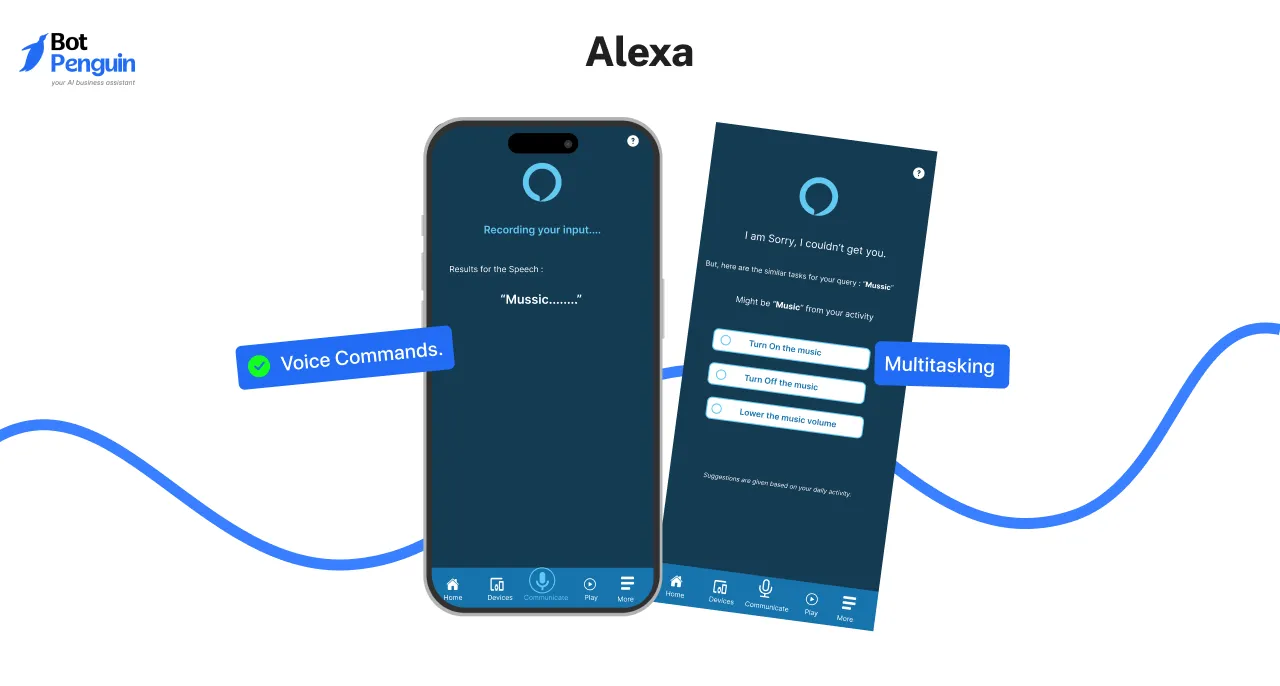
5. Alexa
Amazon Alexa is among thebest AI virtual assistants, designed to enhance workplace efficiency by automating administrative tasks, improving communication, and integrating with business applications.
Known for its seamless integration with business tools and smart office systems, Alexa simplifies task automation and enhances productivity.
Key Features:
Meeting & Conference Room Management: Start meetings hands-free, control video conferencing tools, and book rooms.
Task Automation: Set reminders, manage to-do lists, and schedule appointments via voice commands.
Business Integrations: Works with Microsoft 365, Google Workspace, and other productivity apps.
Ideal for:
Professionals who need voice-controlled efficiency.
Teams using Alexa-enabled conference rooms.
Businesses looking to automate tasks and streamline operations with voice commands.
Pros:
Hands-free workflow automation, positioning it as one of the best AI virtual assistants for multitasking professionals.
Integration with workplace tools, strengthening its role among the best AI virtual assistants for business environments.
Supports smart office functionalities, further proving why it is one of the best AI virtual assistants for modern workspaces.
Cons:
Limited third-party business app support compared to some of the best AI virtual assistants with broader integrations.
Best suited for Amazon ecosystem users.
Limited customization options for business-specific needs.
6. Google Assistant
Google Assistant is widely regarded as one of the best AI virtual assistants, offering powerful business productivity tools through automation, smart scheduling, and deep integration with Google’s ecosystem.
Key Features:
Smart Scheduling: Set up meetings, manage Google Calendar, and receive proactive reminders.
Email & Document Management: Search, draft, and manage emails in Gmail and Google Docs using voice commands.
Business Integrations: Works with Google Workspace, Slack, Zoom, and other third-party productivity apps.
Ideal for:
Businesses looking for an AI-driven assistant with broad app compatibility.
Apple’s Siri is recognized as one of the best AI virtual assistants, offering seamless productivity features for professionals and businesses within the Apple ecosystem.
It delivers a smooth user experience and performs well for quick, simple tasks.
Key Features:
Email & Messaging Support: Dictate emails, send messages, and manage business communications hands-free.
Voice-Powered Task Management: Create to-do lists, set alarms, and retrieve important business updates instantly.
Hands-Free Calling & Scheduling: Allows users to make calls, schedule meetings, and set reminders using just voice commands, enhancing efficiency.
Ideal for:
Professionals seeking a hands-free personal assistant.
Businesses using Apple’s enterprise solutions.
Organizations that rely on Apple’s ecosystem for workflow and communication.
Pros:
Seamless integration with Apple’s productivity tools.
Secure and privacy-focused.
Works across all Apple devices for a unified experience.
Cons:
Lacks the flexibility of other assistants for third-party integrations.
Limited functionality outside Apple devices.
Less advanced AI capabilities compared to competitors like Google Assistant.
Best AI Virtual Assistants for Businesses
Running a business requires juggling numerous tasks, from managing customers to coordinating teams.
The best AI virtual assistants for businesses are designed to streamline these processes, offering tools to optimize operations and enhance decision-making. Below are the top choices for businesses of different sizes.
8. Oracle Digital Assistant
Oracle Digital Assistant is one of the best AI virtual assistants designed specifically for businesses to automate processes and enhance customer engagement.
Unlike personal assistants such as Siri or Alexa, it functions as an AI-powered chatbot for Oracle applications, streamlining workflows and improving interactions across Oracle Cloud and third-party platforms.
Key Features:
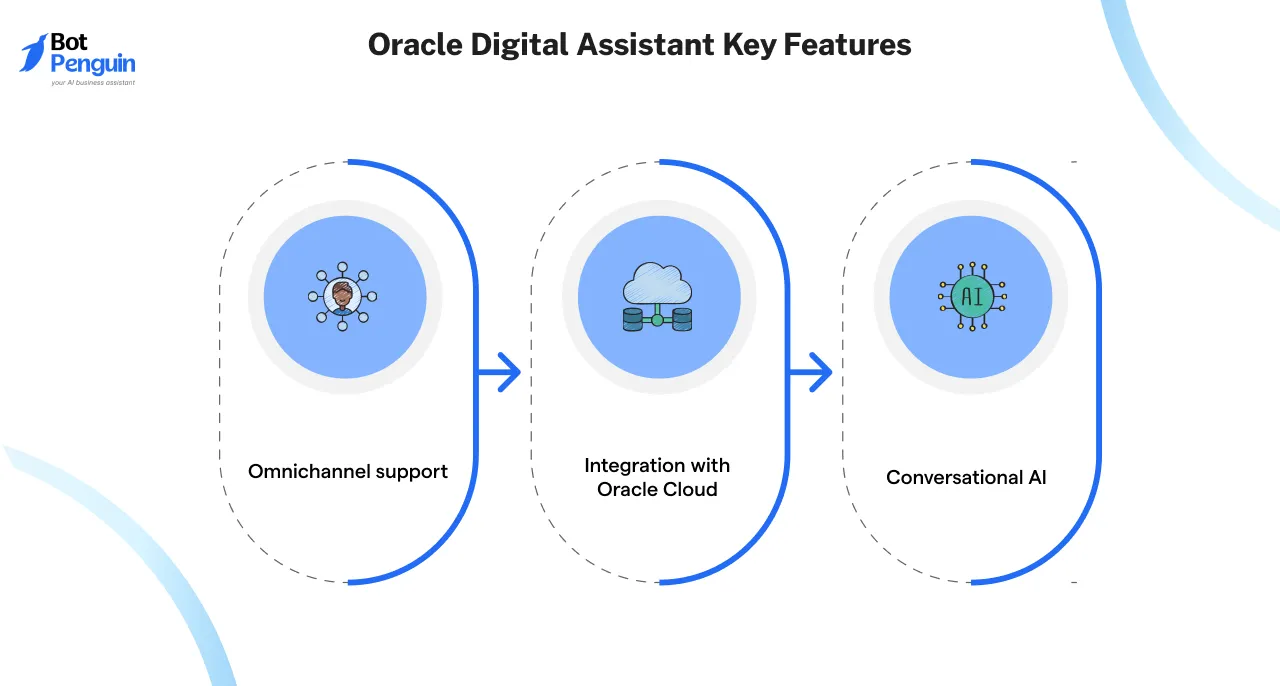
Omnichannel support: Available on various platforms, ensuring businesses can engage customers through multiple channels.
Integration with Oracle Cloud: Seamlessly integrates with Oracle applications, making it one of the best AI virtual assistants for businesses already using Oracle products.
Conversational AI: Enables natural, human-like conversations with customers, improving user experience.
Answer Your Customers like a Human Using an AI Chatbot!
Try BotPenguin
Ideal for:
Small businesses seeking to improve customer relationship management.
Companies looking for cost-effective automation tools.
Teams, needing AI-powered insights for sales, marketing, and customer support.
Pros:
Companies using Oracle applications that need an AI assistant for process automation.
Businesses seeking to enhance customer engagement through AI-driven interactions.
Teams needing to optimize workflows with an assistant that integrates seamlessly with existing systems.
Cons:
Limited third-party integration outside the Oracle ecosystem.
May require advanced setup for businesses not familiar with Oracle Cloud products.
Customization might be needed for complex business needs.
9. SAP Joule
SAP Joule is one of the best AI virtual assistants designed for enterprises to automate customer support, streamline internal processes, and improve business efficiency by integrating with SAP solutions.
Key Features:
SAP integration: Deep integration with SAP’s suite of applications, enhancing data-driven interactions.
Natural language understanding (NLU): Enables users to have intuitive, human-like conversations in multiple languages.
Chatbot builder: Provides tools to create custom AI chatbots tailored to specific business needs.
Ideal for:
Enterprises using SAP solutions that want to automate customer support and internal tasks.
Businesses seeking to deploy AI-driven chatbots to improve customer service.
Companies looking for seamless AI integration with SAP’s extensive ecosystem.
Pros:
Strong SAP integration makes it one of the best AI virtual assistants for SAP users.
Multichannel support ensures widespread customer engagement.
Cons:
Primarily SAP-focused, with limited integrations for non-SAP tools.
Complex setup may require technical expertise to fully implement.
Customizing advanced features can be time-consuming.
10. Clara
Source: Clara
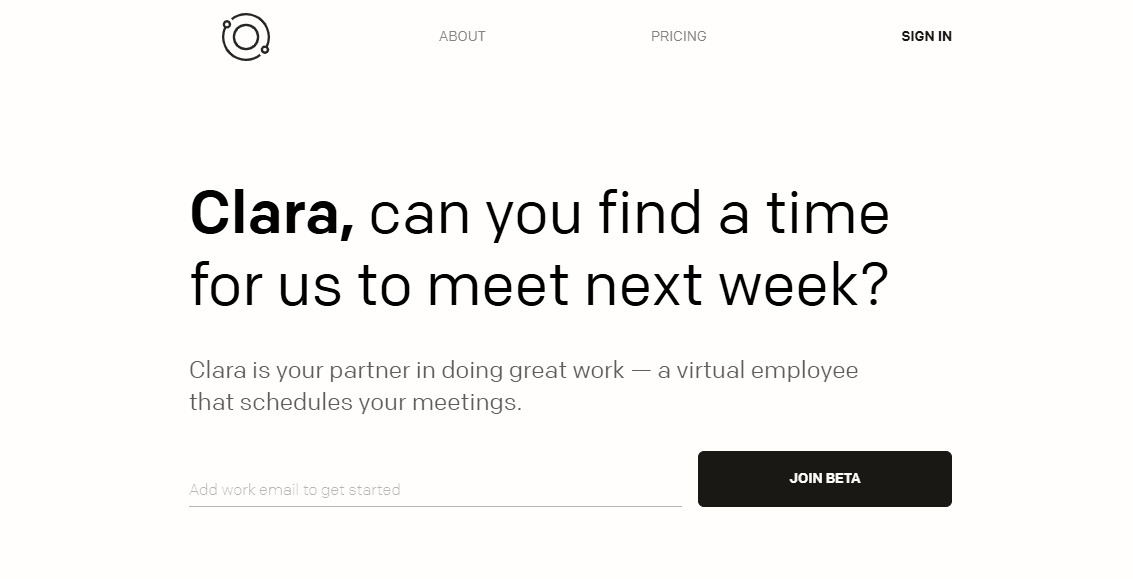
Clara is an AI assistant designed to simplify scheduling and email communication. Its intuitive interface and automation features make it a popular choice, and it is considered one of the best AI virtual assistants for small teams.
Key Features:
Automated scheduling: Coordinates meetings and appointments without human intervention.
Email replies: Handles routine email correspondence, freeing up time for critical tasks.
Calendar Integration: Syncs seamlessly with calendars to prevent scheduling conflicts and optimize meeting arrangements.
Ideal for:
Small teams seeking one of the best AI virtual assistants to minimize administrative workload.
Professionals managing packed schedules.
Executives and teams that frequently schedule meetings across multiple time zones.
Pros:
Simple to use and integrate into daily workflows.
Saves time by automating repetitive tasks.
Provides a human-like interaction experience, distinguishing itself from other best AI virtual assistants focused on business productivity.
Cons:
Limited functionality outside scheduling and email.
Requires subscription fees that may add up for larger teams.
Limited customization options for complex scheduling needs, unlike some of the best AI virtual assistants that offer advanced personalization.
Best AI Virtual Assistants for Developers
Developers require tools that go beyond everyday functionality to create tailored solutions.
The best AI virtual assistants for developers provide robust frameworks, natural language processing, and customization options. Here are the top picks for building smart and scalable applications.
11. Krisp AI
Krisp AI is an advanced noise-canceling assistant that enhances communication in virtual meetings, making it a valuable addition to any developer’s toolkit.
As one of the best AI virtual assistants for remote teams, it ensures crystal-clear conversations by eliminating background noise and improving voice quality.
Key Features:
Noise cancellation: Removes unwanted background noise during calls and virtual meetings.
Voice clarity enhancement: Enhances speech quality for seamless communication.
Real-time transcription: Converts spoken words into text for easy reference.
Ideal for:
Developers working in remote or shared spaces.
Teams conducting virtual meetings or stand-ups.
Customer support teams, needing clear, noise-free conversations with clients.
Pros:
Enhances communication for distributed development teams.
Helps maintain clear records of discussions with transcription.
Works across multiple conferencing platforms like Zoom, Microsoft Teams, and Google Meet.
Cons:
Limited to audio-related functionality.
The free version has usage restrictions on advanced features.
Can increase CPU usage, potentially affecting system performance.
12. Amazon Lex
Amazon Lex is a powerful service from AWS designed for building conversational interfaces, making it a top choice for chatbot development rather than general AI assistant use.
With its scalable architecture and robust natural language processing, it enables businesses to create intelligent, interactive chatbots for various applications.
Key Features:
AWS integration: Fully compatible with Amazon Web Services for easy deployment.
Natural language processing: Accurately interprets user intent to enhance interactions.
Machine Learning Adaptability: Continuously improves interactions by learning from user inputs over time.
Ideal for:
Developers working on scalable AI assistants.
Teams utilizing AWS for cloud infrastructure.
Enterprises developing multilingual chatbots with NLP capabilities.
Pros:
High scalability for growing applications.
Pre-built integrations with AWS tools like Lambda and DynamoDB.
The pay-as-you-go pricing model keeps costs manageable.
Cons:
Limited to AWS users for full functionality.
Requires familiarity with AWS services for efficient implementation.
Lacks built-in advanced analytics for conversation insights.
13. IBM Watson Assistant
Source: IBM Watson Assistant
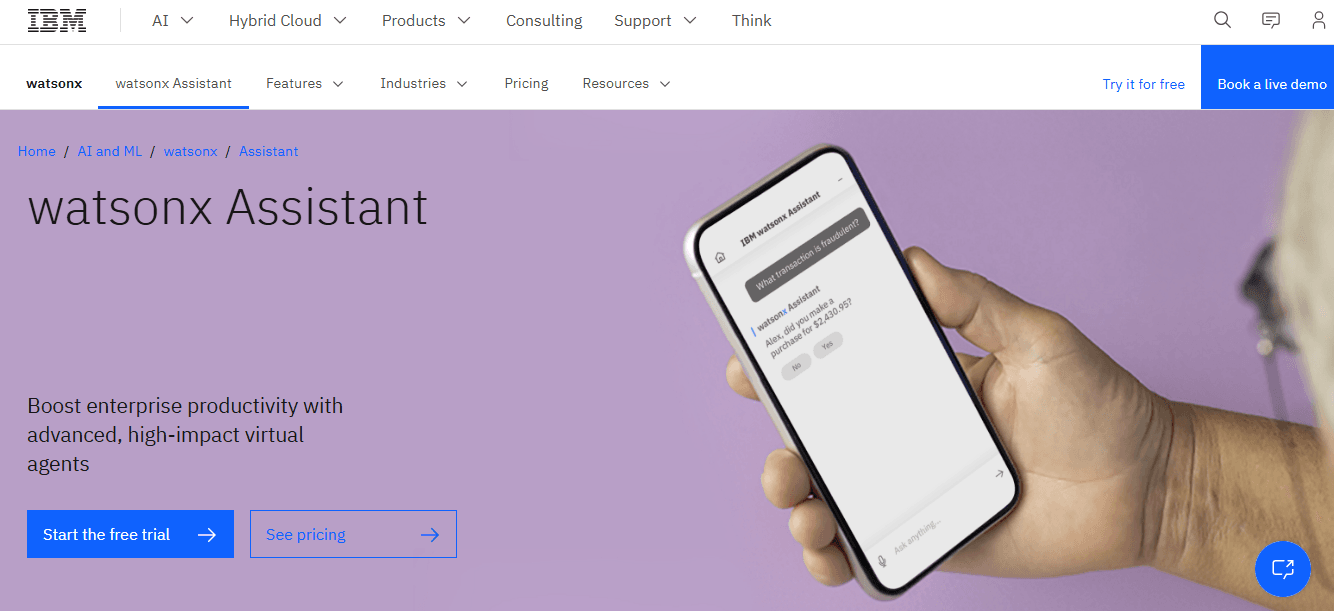
IBM Watson Assistant offers enterprise-grade solutions with a focus on customization, security, and seamless business integration.
Unlike personal assistants, it is built specifically for companies requiring precise control over their AI applications, making it one of the best AI virtual assistants for businesses seeking reliable, tailored solutions.
Key Features:
Customization: Tailored to meet the specific needs of various industries.
Data security: Ensures sensitive business data is protected during interactions.
Multi-Channel Support: Seamlessly integrates with websites, mobile apps, and messaging platforms to provide consistent user interactions.
Ideal for:
Enterprises building secure and sophisticated AI solutions.
Applications requiring high levels of customization.
Businesses, needing AI-driven customer support with advanced conversational capabilities.
Pros:
Offers industry-specific solutions for unique requirements.
Strong focus on privacy and compliance.
Integrates with existing enterprise systems seamlessly.
Cons:
Higher cost compared to other platforms.
May require additional resources for setup and maintenance.
Can have a steep learning curve for non-technical users.
Best AI Virtual Assistants for Accessibility
Technology plays a vital role in enhancing accessibility and breaking barriers for individuals with disabilities.
The best AI virtual assistants for accessibility empower users to interact with devices, navigate tasks, and communicate effortlessly. Here are the top tools designed for accessibility needs.
14. Ava
Ava is an AI-powered virtual assistant that focuses on enhancing accessibility in business environments, making it one of the best AI virtual assistants, particularly for individuals with hearing impairments.
It provides real-time speech-to-text transcription, helping users follow conversations and stay engaged in both personal and professional settings.
Key Features:
Speech-to-Text Transcription: Converts spoken words into text instantly, ideal for meetings, lectures, or casual conversations.
Language Support: Ava offers transcription services in multiple languages, broadening its accessibility globally.
Seamless Integration: Works across multiple platforms, including mobile and desktop, ensuring accessibility in various professional settings.
Ideal for:
Individuals with hearing impairments who need visual transcription of conversations.
Users in environments where real-time communication is essential, such as classrooms or work meetings.
Businesses and teams, needing real-time captions for inclusive communication in meetings.
Pros:
Instant transcription with minimal delay.
Available on a variety of devices and platforms.
Customizable settings to suit the user's preferences.
Cons:
Requires an internet connection for full functionality.
Some inaccuracies in transcriptions with heavy accents or background noise.
The free version has limited transcription minutes and features.
15. Be My Eyes
Source: Be My Eyes
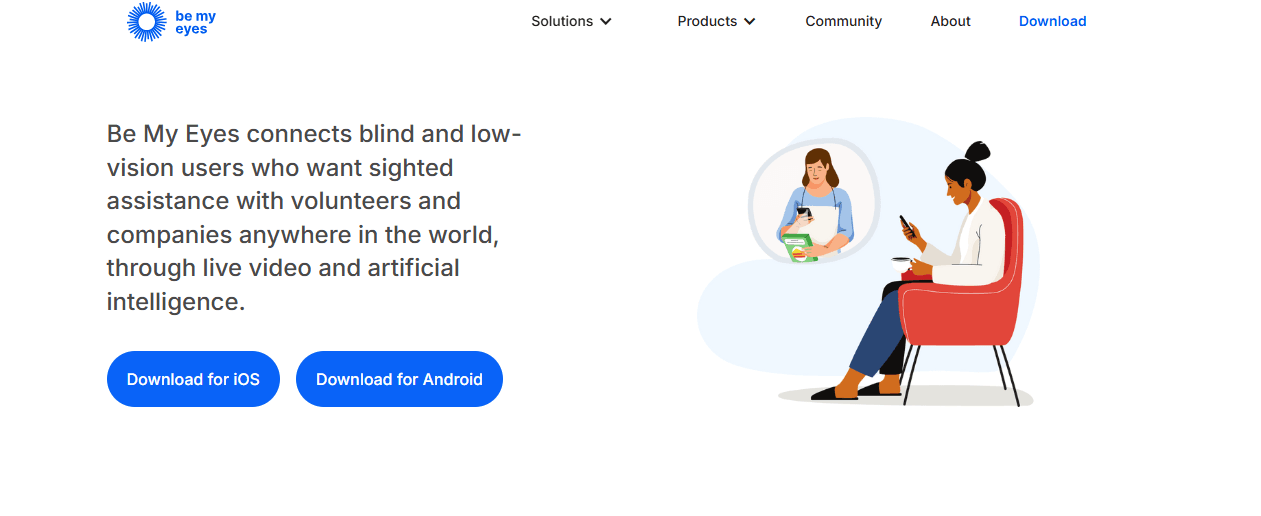
Be My Eyes is one of the best AI virtual assistants designed to assist visually impaired individuals by providing real-time assistance through a network of volunteers and AI technology.
This AI tool helps enhance accessibility, making it an excellent choice for businesses aiming to improve inclusivity in the workplace and customer interactions.
Key Features:
Real-time Object Recognition: Uses AI to recognize objects and describe them to users, enhancing business environments for visually impaired employees or customers.
Live Volunteer Assistance: Connects users with sighted volunteers for real-time assistance, ideal for customer service applications.
Navigation Assistance: Helps users navigate spaces like offices, retail stores, or outdoor environments, improving accessibility in workplaces.
Ideal for:
Retail businesses that want to offer inclusive services for visually impaired customers.
Companies integrating AI accessibility tools into their customer service workflows.
Organizations, committed to improving workplace inclusivity for employees with disabilities.
Pros:
Connects users with a volunteer network for immediate assistance, offering an effective support system.
Provides hands-free navigation and object identification, reducing barriers for employees with visual impairments.
Facilitates inclusive customer service experiences in retail and other customer-facing industries.
Cons:
Relies on volunteers for real-time assistance, which may not always be available for urgent business needs.
Limited in scope for large-scale business applications requiring more complex AI solutions.
Requires a stable internet connection for optimal functionality.
Send Personalized Messages According to Your Segmented Audience Using an AI Chatbot!
Get Started FREE
16. Aiva
Aiva Technologies is an AI virtual assistant designed to enhance accessibility for both customer service and enterprise applications, with a focus on voice interaction.
It enables businesses to provide seamless voice-based services, allowing users with visual or physical impairments to interact naturally and effectively.
Key Features:
Voice Interaction: Offers full voice interaction for users with visual or physical impairments, making it easier to access business services.
Multi-Language Support: Supports various languages, increasing accessibility for diverse customer bases.
Integration with Enterprise Systems: Integrates well with existing enterprise systems, streamlining workflows.
Ideal for:
Businesses looking to improve accessibility for customers with disabilities through voice-based interaction.
Enterprises, needing an AI assistant that integrates smoothly with existing systems.
Global businesses seeking multi-language support for accessibility.
Pros:
Voice-based interaction makes it a highly effective AI virtual assistant for businesses focusing on accessibility.
Supports integration with a wide range of enterprise systems.
Provides multi-language support, making it suitable for global businesses.
Cons:
May require additional setup and customization to align with specific business needs.
Can be complex to configure for non-technical users.
Limited to voice and text capabilities, with fewer features compared to some other AI assistants.
Emerging AI Virtual Assistants to Watch in 2025
As AI technology continues to evolve, new virtual assistants are pushing boundaries and exploring untapped areas.
These emerging tools aim to redefine how we interact with technology, offering innovative features and specialized applications. Here are three exciting names shaping the future of the best AI virtual assistants in 2025.
17. Perplexity AI
Perplexity AI is an AI-powered virtual assistant designed to enhance information retrieval and content generation.
Unlike traditional search engines, it uses natural language processing to provide precise, sourced answers to the queries of users, making it one of the best AI virtual assistants for research and knowledge acquisition.
Key Features:
Conversational Search: Interprets user queries in natural language, delivering concise and relevant answers.
Source Citation: Provides answers with inline citations, allowing users to verify information easily.
Multimodal Capabilities: Supports image generation and document uploads, enhancing the depth of information provided.
Ideal for:
Individuals seeking accurate and sourced information for academic projects.
Writers and marketers looking for factual content and idea generation.
Business professionals, needing concise answers to industry-specific questions.
Pros:
Delivers precise answers with references, ensuring credibility.
Offers an intuitive platform that simplifies complex information retrieval.
Continuously indexes the web, ensuring access to up-to-date information.
Cons:
Primarily focuses on providing information, lacking functionalities like task automation.
Needs a stable internet connection to fetch data.
Some features may require a subscription to access premium capabilities.
18. Cleo
Cleo is a financial AI assistant designed to help users manage personal finances and track spending patterns. Unlike general AI assistants, Cleo specializes in financial management, offering budgeting tools, expense tracking, and personalized financial insights.
It simplifies money management through an intuitive, conversation-based interface, making it one of the best AI virtual assistants for personal finance.
Key Features:
Expense Tracking: Automatically tracks and categorizes business expenses, helping businesses stay organized and compliant with tax regulations.
Budgeting Assistance: Helps set and track budgets for various business expenses, ensuring that financial goals are met.
Smart Financial Insights: Provides real-time spending analysis and personalized financial recommendations to help users make informed money decisions.
Ideal for:
Small businesses and startups, that need an easy-to-use solution for managing finances.
Entrepreneurs who want a quick, automated way to track expenses and stay on top of cash flow without hiring a full-time accountant.
Freelancers and self-employed professionals, who need a simple yet effective way to track income and expenses without complicated accounting software.
Pros:
Intuitive interface and easy-to-understand financial insights that don’t require accounting expertise.
Automates tedious tasks like categorizing expenses and managing invoices, freeing up time for other critical activities.
Provides live updates on the business’s cash flow, helping businesses make quick financial decisions.
Cons:
Cleo is not a full-fledged accounting solution, so businesses with complex financial needs may require additional tools.
Doesn’t provide direct tax filing services, so businesses would still need to handle that separately.
Limited integration with some business banking and accounting platforms, which may require manual data entry.
Best AI Virtual Assistants for Conversational AI and Large Language Models
AI chatbots and Large Language Model (LLM) assistants are changing how businesses interact with customers, automate workflows, and generate content.
The best AI virtual assistants in this category are designed to process complex queries, provide insightful responses, and assist teams with various tasks while keeping interactions natural and conversational.
19. Claude
Claude is one of the best AI virtual assistants for businesses, designed with a focus on safety, transparency, and ethical AI deployment.
Developed by Anthropic, it is ideal for businesses looking to enhance their operations through AI-driven automation while ensuring responsible AI practices.
Key Features:
Safety-first design: Prioritizes ethical AI and transparency in its deployment, making it one of the best AI virtual assistants for responsible business use.
Natural language processing: Helps businesses automate content creation, customer interactions, and data analysis through conversational AI.
Collaborative assistant: Works alongside teams to improve workflow efficiency without replacing human roles, making it an ideal choice among the best AI virtual assistants for businesses.
Ideal for:
Businesses seeking AI virtual assistants with a strong focus on ethical AI and transparency.
Organizations looking to automate tasks like customer service and content generation.
Teams that require a collaborative AI assistant to streamline workflows and improve productivity.
Pros:
Prioritizes safety and transparency, making it a trustworthy choice among the best AI virtual assistants for businesses.
Automates routine tasks, allowing employees to focus on strategic initiatives.
Highly customizable to align with the specific needs of businesses, offering tailored AI solutions.
Cons:
Limited cross-platform compatibility, which could limit its use with certain existing business tools.
Businesses with complex, industry-specific needs may find it lacking some advanced functionalities.
Requires businesses to have a solid understanding of how to configure and deploy Claude for optimal performance.
Best AI Virtual Assistants for Smart Devices
Smart devices are becoming essential in modern homes, and the best AI virtual assistants are the key to unlocking their full potential.
From controlling appliances to managing entire ecosystems, these AI tools enhance convenience and efficiency. Here are the top AI assistants designed for smart devices.
20. Samsung Bixby
Samsung Bixby is tailored to integrate seamlessly with Samsung devices, offering voice automation and advanced customization.
While it remains a core feature, Google Assistant has become the primary AI assistant on most Samsung devices, positioning Bixby as a secondary option.
Despite this shift, its device-specific capabilities make it an excellent choice for users within the Samsung ecosystem and one of the best AI virtual assistants for Samsung-powered workflows.
Key Features:
Device Integration: Seamlessly integrates with Samsung devices, including smartphones, tablets, and wearables, providing cross-device control.
Meeting and Schedule Management: Allows users to check schedules, book meetings, and send reminders directly through voice commands.
Deep Learning Adaptation: Learns user preferences over time to offer more personalized suggestions.
Ideal for:
Small to medium-sized businesses seeking to automate routine administrative tasks.
Teams requiring hands-free task management, particularly in industries like retail, hospitality, and tech.
Professionals who rely on Samsung's ecosystem for productivity, including smart office setups and mobile workflows.
Pros:
Optimized for Samsung devices, ensuring smooth operation.
Supports advanced voice commands for precise control.
Ideal for offices equipped with Samsung smart devices, allowing seamless control of IoT-enabled products like lights, security systems, and more.
Cons:
Limited compatibility outside Samsung devices.
Can feel less intuitive compared to other assistants.
Limited third-party app integration compared to other AI assistants like Google Assistant or Alexa.
Best AI Virtual Assistants for Enterprise Solutions
Businesses in industries like healthcare, finance, and customer service require AI solutions. They need AI that understands their customers, simplifies interactions, and makes support more efficient.
The best AI virtual assistants in this category help businesses manage inquiries, schedule tasks, and provide real-time support, ensuring seamless customer experiences while improving productivity.
21. Nina by Nuance
Nina by Nuance is an AI-powered virtual assistant built specifically for industries that require advanced customer interactions, such as healthcare and finance.
Unlike AI assistants designed for smart device management, Nina focuses on providing intelligent, conversational support to streamline customer service, schedule appointments, and deliver information.
This makes it one of the best AI virtual assistants for businesses in sectors with high customer engagement demands.
Key Features:
Speech Recognition: Offers advanced speech recognition capabilities to help users interact more naturally with the system.
Text-to-Speech and Voice Interaction: Supports both text and voice interaction, improving accessibility for users with visual or mobility impairments.
Multichannel Integration: Easily integrates across multiple channels (web, mobile, and phone), providing consistent service.
Ideal for:
Healthcare and financial services seeking AI assistants for customer support with accessibility features.
Businesses aiming to provide voice-based interaction for users with disabilities.
Enterprises needing a solution that works across various platforms and touchpoints.
Pros:
Offers advanced speech recognition and voice interaction, making it one of the best AI virtual assistants for businesses with accessibility needs.
Supports integration across multiple channels, including web and mobile.
Ideal for industries with complex customer interactions, such as healthcare and finance.
Cons:
Primarily focused on specific industries, such as healthcare and finance, limiting its use in other sectors.
Requires significant setup and customization to tailor for specific business needs.
Can be expensive for small businesses.
Best AI Assistants for Smart Homes and IoT
The rise of smart homes and IoT devices has made AI assistants an essential part of automation.
The best AI virtual assistants in this category help users control appliances, optimize energy consumption, and streamline daily tasks for greater efficiency.
22. LG ThinQ
Source: LG
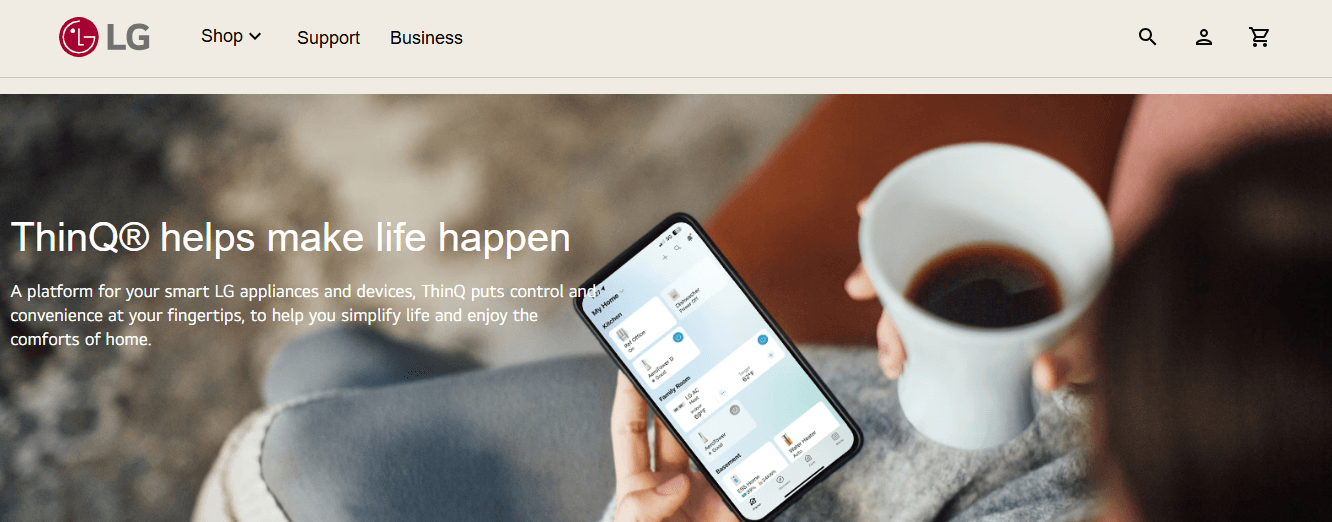
LG ThinQ specializes in managing smart appliances, making it a must-have for users with LG devices.
It is mainly designed for home automation but can be adapted for business purposes, especially in retail, hospitality, and offices where smart devices can streamline workflows, positioning it as one of the best AI virtual assistants for connected living.
Key Features:
Remote Monitoring: Enables remote monitoring and control of connected devices, making it suitable for businesses managing multiple locations.
Automation and Scheduling: Schedule tasks like turning off lights, adjusting temperatures, and other smart devices to optimize energy use and improve operational efficiency.
AI-Powered Energy Management: Optimizes energy usage in connected appliances for efficiency.
Ideal for:
Homeowners looking for an intelligent system to manage household devices remotely.
Smart home enthusiasts who want automation to enhance convenience and energy efficiency.
Hospitality businesses, such as hotels, needing to automate guest room temperatures and lighting for better comfort and cost savings.
Pros:
Helps reduce energy costs by monitoring and adjusting the use of devices.
Allows users to automate and remotely control their devices, optimizing operations, reducing human effort.
Enhances usability by integrating with popular voice assistants like Google Assistant and Alexa.
Cons:
LG ThinQ is more tailored for home automation, so businesses looking for advanced features in enterprise-level software may find it lacking in customization and functionality for professional use.
While useful for managing devices, it doesn't provide the depth of features needed for large-scale, data-driven business processes.
Limited compatibility with non-LG smart devices, which may restrict integration in mixed-brand environments.
AI Assistants for Specialized Use Cases
While general-purpose AI assistants dominate the market, some focus on niche applications to meet specific needs.
The best AI virtual assistants for specialized use cases provide precision, speed, and advanced capabilities. Here are two standout options for unique requirements.
23. Hound
Hound is best known for its advanced natural language processing (NLP), delivering lightning-fast responses with exceptional contextual understanding.
Unlike general AI assistants, Hound specializes in precise, instant conversational AI, making it one of the best AI virtual assistants for users who need instant, data-driven insights.
Key Features:
Fast responses: Processes complex queries almost instantly.
Contextual understanding: Maintains context during conversations, enabling more accurate replies.
Real-Time Business Insights: Quickly processes complex queries to provide instant, data-driven insights for professionals, making it ideal for fast-paced decision-making in business environments.
Ideal for:
Users who prioritize speed and precision in their AI assistant.
Professionals who need detailed, real-time information.
Businesses requiring a fast voice assistant for customer service, allowing employees to quickly retrieve information and respond to queries efficiently.
Pros:
Handles complex and layered questions with ease.
Supports voice commands that require immediate results.
Integrates with third-party apps for enhanced functionality.
Cons:
Limited ecosystem compared to larger AI platforms.
Hound’s voice recognition system may struggle with understanding accents or industry-specific jargon, leading to occasional misinterpretations in professional contexts.
Less widely adopted, meaning fewer integrations with major productivity tools compared to leading AI assistants.
24. Braina
Source: Braina
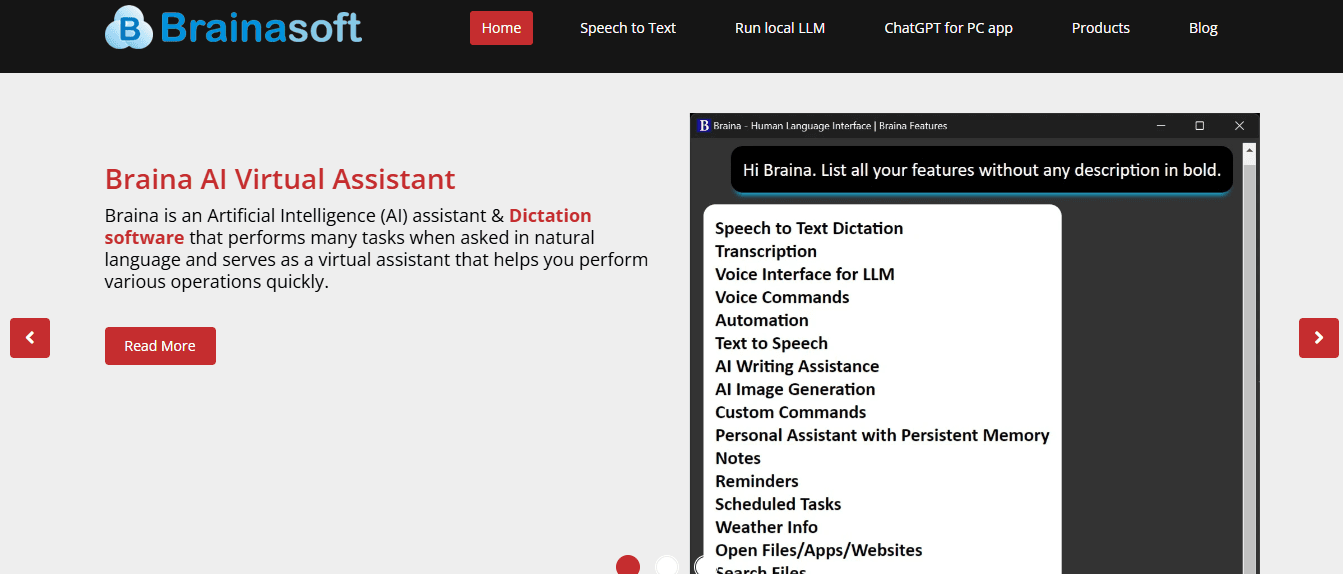
Braina (Brain Artificial) is one of the best AI virtual assistants designed to enhance productivity through voice recognition and automation.
Developed by Brainasoft, it allows users to interact with their computers using natural language commands, making it a powerful tool for professionals, businesses, and individuals who need hands-free control and workflow automation.
Key Features:
Speech Recognition: Supports over 100 languages, enabling users to dictate text and control applications through voice commands.
Automation and Custom Commands: Allows users to create personalized voice commands for tasks such as opening applications, managing files, and automating repetitive processes.
Remote Control: Provides a mobile app that lets users control their PC remotely via a smartphone or tablet.
Ideal for:
Individuals who require efficient dictation tools to convert speech into text accurately.
Organizations looking to automate routine tasks and improve workflow efficiency through AI-driven voice commands.
Individuals who require hands-free computing to navigate and control their PC.
Pros:
Delivers precise transcription, reducing the need for manual corrections.
Recognizes numerous languages and dialects, making it accessible to a global user base.
Users can define their own commands and automate complex tasks, enhancing functionality.
Cons:
Only available for Windows, excluding macOS and Linux users.
Users may need to train the software to recognize specialized vocabulary or accents accurately.
Advanced functionalities are available only in the paid version.
How to Choose the Right Assistant
With so many options available, selecting the best AI virtual assistants for your needs can feel overwhelming.
The right choice depends on how you plan to use the assistant and the features most important to you. Here’s a simple guide to help you decide.
Define Your Needs
Start by identifying what you want the assistant to do.
Are you looking for business process automation, such as managing workflows or streamlining customer service tasks?
Do you need help with work productivity, such as managing emails or schedules?
Or are you seeking a tool for specialized use cases, like accessibility?
Understanding your primary goal narrows down the options.
Consider the Ecosystem
The assistant’s ecosystem is critical.
If you use Google services, Google Assistant might integrate best.
Apple users should look at Siri for seamless compatibility.
For Samsung users, Bixby offers specific device commands.
Choose an assistant that works with the devices and platforms you already own.
Evaluate Key Features
Look at the features that stand out.
Some assistants, like Alexa, excel in smart home compatibility.
Others, like IBM Watson Assistant, offer customization and data security for businesses.
Compare features to see which assistant meets your priorities.
Test and Compare
Many of the best AI virtual assistants offer free versions or trial periods. Test them to see how well they perform. A quick trial can reveal if the assistant is user-friendly and fits your routine.
By carefully assessing your needs, compatibility, and key features, you can confidently select some of the best AI virtual assistants that enhance productivity, streamline tasks, and integrate seamlessly into your workflow.
Make Your Own AI Chatbot Without Any Coding!
Explore Now
Conclusion
AI virtual assistants have redefined convenience, productivity, and accessibility in both personal and professional spaces. From managing tasks to enhancing customer interactions, they simplify life in ways we couldn’t have imagined a decade ago.
For businesses aiming to adopt AI in a seamless and effective manner, tools like BotPenguin offer an approachable starting point. As an AI agent and a no-code platform, it enables businesses to create AI-powered chatbots effortlessly.
Whether it is improving customer support or automating workflows, BotPenguin helps businesses use AI without diving into complex coding.
While it may not function as a traditional AI virtual assistant, it plays a crucial role in harnessing the power of AI to enhance business operations without the need for complex coding.
It is a step towards smarter, more efficient operations in an increasingly digital world.
Frequently Asked Questions (FAQs)
What are some of the best AI virtual assistants for content creation?
Some of the best AI virtual assistants, like Jasper AI and ChatGPT, are designed to help with content creation. These tools can assist in generating blog posts, marketing copy, and even creative writing, enhancing content production workflows for businesses and individuals.
How do the best AI virtual assistants improve productivity?
The best AI virtual assistants enhance productivity by automating routine tasks, such as managing emails, setting reminders, and organizing schedules. This allows professionals to focus on more complex and strategic work, improving efficiency and reducing time spent on administrative tasks.
Are AI virtual assistants secure to use?
Most of the best AI virtual assistants prioritize data security, offering encryption and privacy controls. However, users should review the privacy policies and settings of each assistant to ensure personal information is protected.
Can AI virtual assistants integrate with multiple devices?
Yes, some of the best AI virtual assistants like Google Assistant and Alexa support extensive device integration across smartphones, and wearables, ensuring seamless functionality across different platforms.
What is BotPenguin, and how does it help businesses?
BotPenguin is an AI agent and a no-code chatbot platform. It allows businesses to create custom chatbots easily, streamlining customer service, automating workflows, and enhancing user engagement without requiring advanced technical skills.
Subscribe to Our Newsletter
Get the latest business insights straight into your inbox.





 (1).webp)