


Best Free AI Agent Builder (No-Code Tools to Build AI Agents)
Updated at Sep 30, 2026
18 min to read
The biggest threat to SaaS is software that no longer needs users, also known as AI agents.
For decades, SaaS platforms competed on better features, dashboards, and workflows. But AI agents are changing the rules. Instead of requiring users to navigate software step by step, agentic AI can understand goals, use tools, and complete tasks across applications with minimal human input.
The disruptive impact of AI agents on the SaaS industry was already visible in 2025, as businesses shifted from buying software features to seeking end results. But does that mean agentic AI is replacing SaaS, or simply redefining its future?
Businesses exploring branded agent-led software models can also evaluate White-Label AI Agents to launch scalable AI agent solutions under their own brand.
This article explores how AI agents are reshaping SaaS business models and what the future of software could look like.
The key difference between traditional SaaS and AI agents is simple: SaaS gives users tools to do work, while AI agents actually perform the work using those tools.
Instead of logging into dashboards, navigating workflows, and manually completing steps, users can now define a goal and let AI agents execute the process across systems in the background.
Here’s how to visualize this difference:
Key Shifts in How SaaS Works
Gartner predicts that 40% of enterprise apps will embed AI agents by the end of 2026, making it one of the fastest adoption curves in enterprise software history.
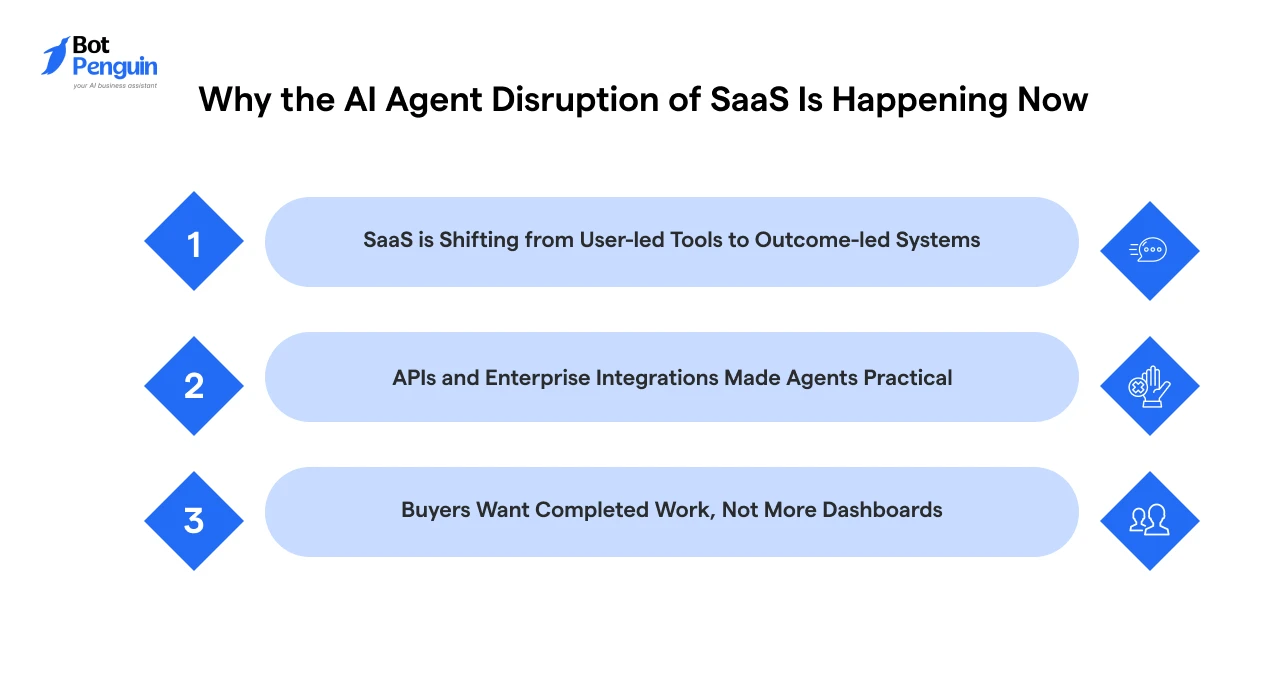
AI agents are disrupting SaaS now because they can do far more than answer questions.
Advances in Large Language Models (LLMs), APIs, cloud infrastructure, and enterprise workflow integrations have matured enough to automate real business processes, allowing AI agents to use tools, access data, and complete workflows that once required users to operate software manually.
Bain’s Technology Report confirms that agentic AI is already running live workflows across major SaaS platforms, from support tickets to financial entries to ad copy.
Here’s why AI agents’ disruptive impact on SaaS industry has become more prominent in 2026:
Traditional SaaS helps users complete tasks. AI agents take that a step further by completing parts of the work themselves.
Instead of guiding users through workflows, they use tools, interpret data, and perform actions to achieve a goal. Whether it's resolving support tickets, processing invoices, or handling employee requests, businesses are increasingly focused on outcomes rather than software features.
As a result, the value proposition is shifting from “use this software” to “get this work done”.
AI agents became practical as SaaS platforms exposed more APIs, webhooks, permissions, and workflow triggers.
Instead of only answering questions, agents can now interact with software, retrieve data, execute actions, and update records across systems.
This allows a single agent to work across CRM, helpdesk, billing, calendar, and analytics tools without requiring users to switch between multiple dashboards.
SaaS buyers are under pressure to reduce tool sprawl. They want fewer logins, less manual work, and clearer ROI.
This is shifting demand from feature-heavy software to systems that deliver completed work, not just dashboards and workflows.
On the whole, the infrastructure was always there. AI agents are what finally put it to work.
Future-conscious platforms likeBotPenguin are already meeting this change, offering AI agents built with native integrations, a unified inbox, and analytics dashboards that turn agent activity into business insight.
Not every SaaS workflow is equally exposed, but more are than most founders expect.
We divided them into 2 categories, viz., high-risk workflows ripe for agentic automation and lower-risk workflows that still require human judgment.
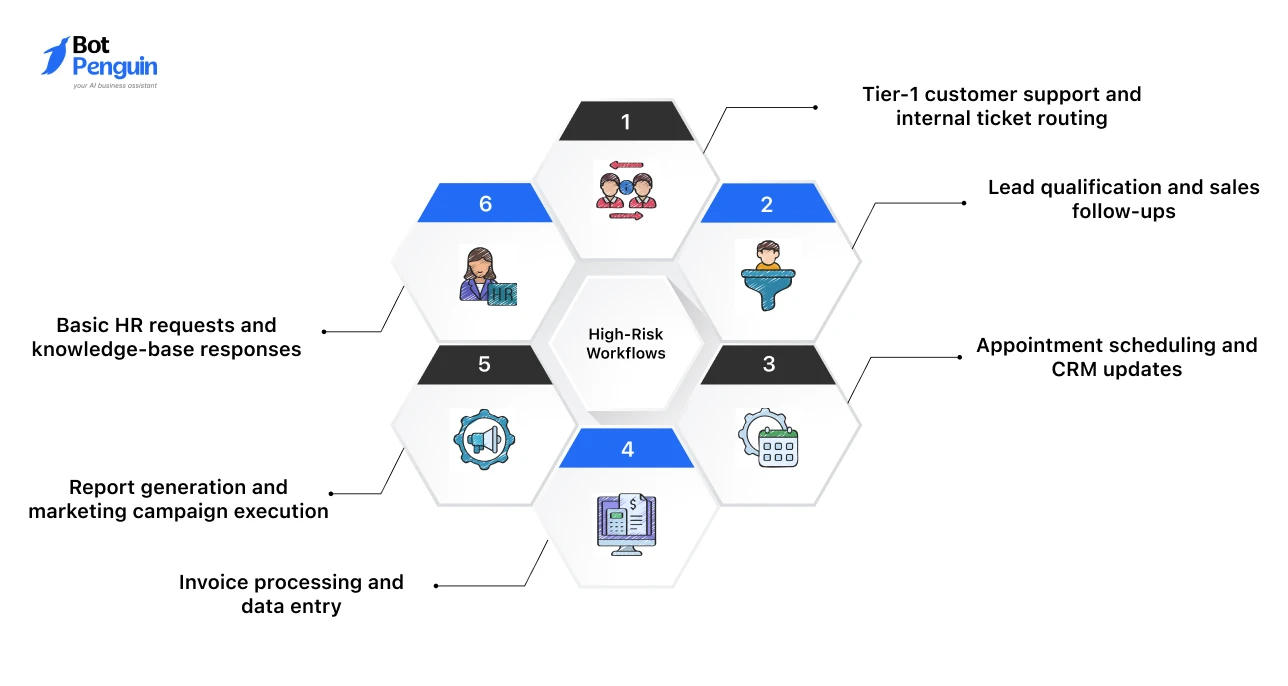
AI agents are most likely to impact workflows that are structured, repeating, and outcome-driven, where inputs and outputs are clearly defined.
These include:
Key Insight: These workflows make up a significant chunk of daily SaaS usage, and they're exactly where agentic AI delivers the fastest, most measurable ROI.
Tasks that involve context, accountability, regulatory oversight, or high-stakes decision-making still require human involvement.
These include:
While most SaaS products sit squarely in the high-risk column, that's not a reason to panic. Rather, it's a reason to move.
The founders who map their workflows honestly today will be the ones building the next generation of agentic AI SaaS tomorrow.
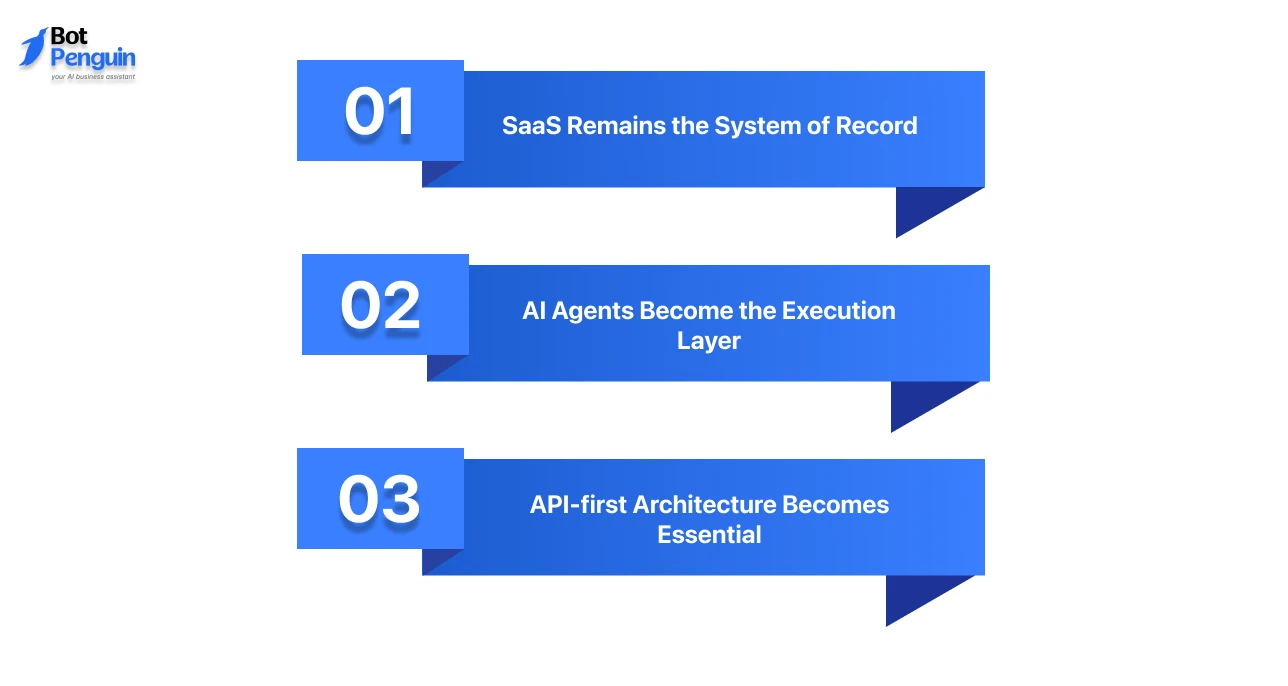
AI agents are pushing SaaS toward API-first systems, stronger permissioning, and real-time orchestration layers.
As this happens, the backend is becoming more important than the frontend because agents need structured, secure access to data, business logic, and workflows to operate effectively.
Core SaaS platforms like CRM, ERP, HRMS, finance, and helpdesk systems will continue to store critical business data.
However, their long-term value will depend less on UI features and more on data quality, governance, permissions, auditability, integration depth, and workflow rules.
Instead of users switching between multiple applications, AI agents can operate across systems and complete end-to-end workflows.
Example: An agent can read CRM data, analyze past interactions, score leads, draft follow-ups, schedule meetings, update pipelines, and notify stakeholders, all in a single automated flow.
To remain relevant in an agent-driven environment, SaaS platforms must be designed for machine access.
Closed systems risk losing workflow control to more open competitors. Agent-ready architecture typically includes secure APIs, webhooks, event streams, granular permissions, audit logs, approval workflows, and usage tracking.
This is where the AI agents’ disruptive impact on the SaaS industry becomes most visible at the technical level, shifting SaaS from user-operated software to machine-executed systems.
When AI agents start doing the work, two things break fast: how SaaS is priced and how it's used.
Here’s what’s changing and why it matters for every SaaS founder building for the next five years:
AI agents are transforming SaaS pricing by weakening seat-based models and forcing vendors to rethink what they're actually charging for.
Deloitte forecasts that seat-based SaaS licensing will give way to outcome- and usage-based models as applications become more autonomous and adaptive.
Seat-based pricing was built for a world where every user needed a login. That world is changing fast.
SaaS vendors are testing models that better match agentic output. Common pricing models include:
The model you choose signals how confident you are in your product’s output, and how ready you are to be held accountable for it.
Outcome pricing sounds clean because customers pay for value. It is harder to execute because attribution is rarely simple. Challenges include:
Key Insight: Outcome-based pricing is the highest-trust, highest-risk bet, but it's where the market is heading.
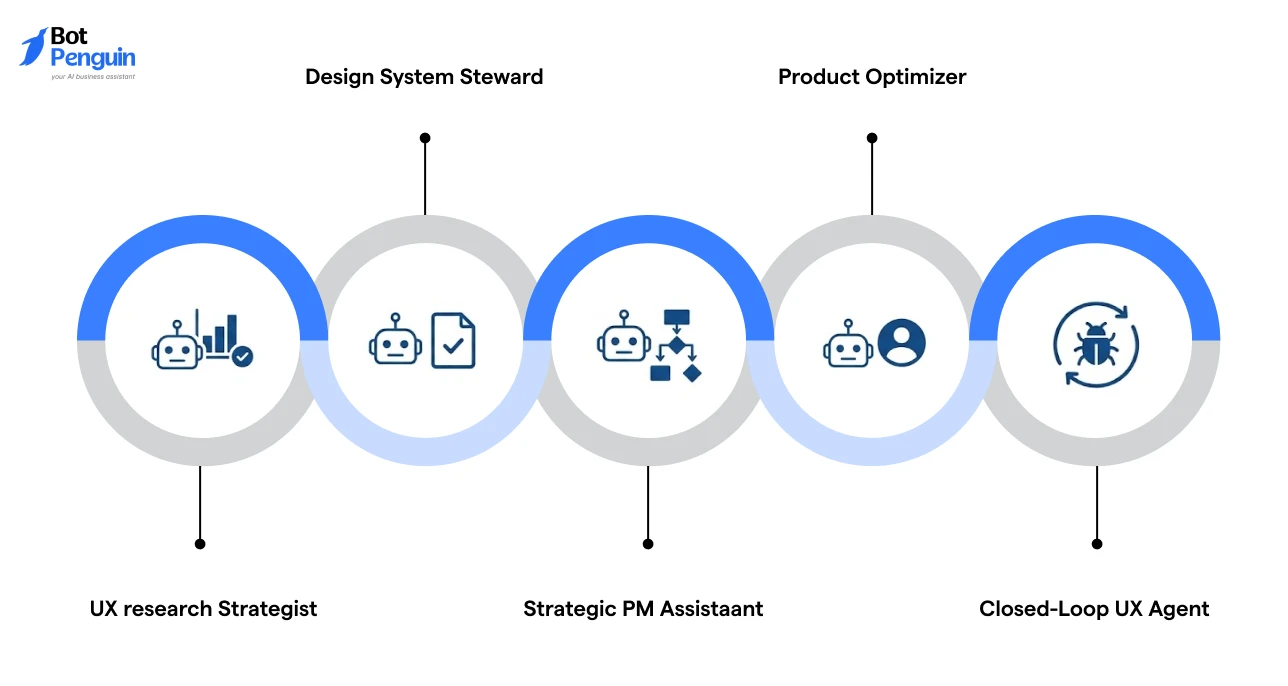
AI agents also change how it feels to use SaaS. The era of tab-switching, form-filling, and dashboard-hunting is giving way to something far more direct.
AI agents lower the need for users to move through many tabs, forms, and menus. The interface becomes more direct. Users may ask:
The SaaS UX becomesless about navigationandmore about supervision, approvals, and exception handling.
As agents take action, users need to know what happened. Logs, explanations, approvals, and rollback controls become part of the product experience.
Good agentic SaaS UX should show:
Pricing and UX aren't just product decisions anymore; they're trust signals. The SaaS products that win the agentic era won't just be the ones that automate the most. They'll be the ones that make it clearest what's happening, why it happened, and what it delivered.
No, agentic AI isn't replacing SaaS. Rather, it's absorbing it.
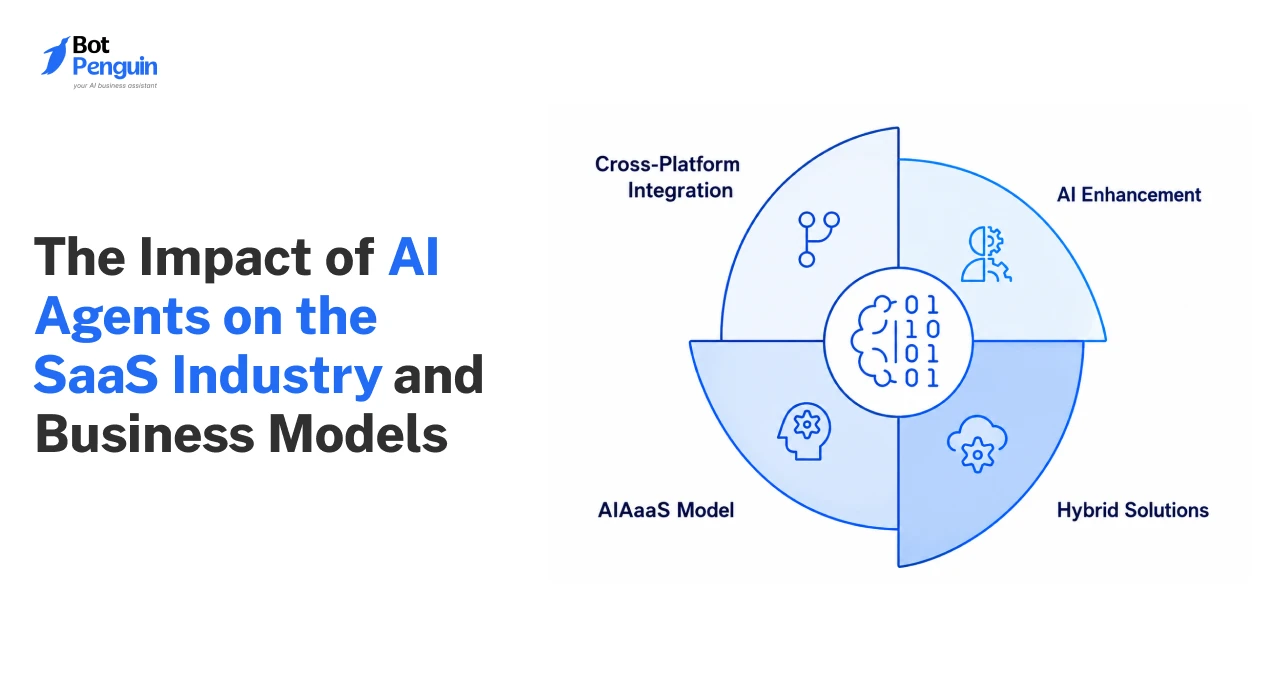
The future looks more like SaaS unbundling and rebundling, where agents replace some interfaces and workflows while SaaS remains the trusted data and execution layer, giving way to a new delivery model entirely, viz. Agents-as-a-Service (AaaS).
But before we understand that, let's see what we mean by agentic AI absorbing some parts of SaaS:
Now it's time to understand why AaaS is the logical next step, and what it actually means for your business.
AaaS is the emerging model where AI agents are delivered as a managed service (pre-built, deployable, and outcome-focused).
Instead of buying software to support a workflow, businesses subscribe to agents that run it.
Think of it as the next evolution:SaaS gave you the car. AaaS gives you the driver.
The line between “software company” and “AI agent provider” is already blurring. SaaS isn't dying. It's becoming the backbone of something bigger.
For businesses ready to make that leap, BotPenguin offers a straightforward entry point: purpose-built AI agents for support, lead generation, and customer engagement, deployable without rebuilding your existing SaaS stack.
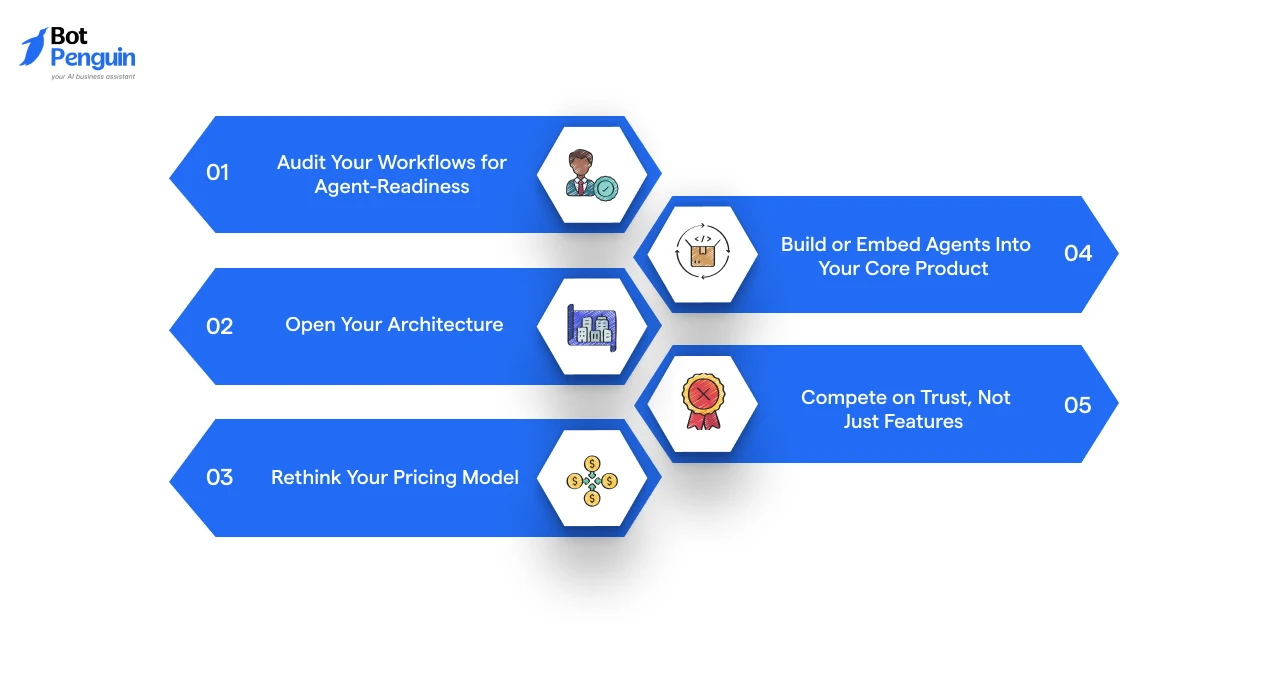
The agentic AI SaaS shift is already here. The question is whether you’re building and buying ahead of it or catching up to it.
Here's what you need to do on both sides of the table.
Map every core workflow and honestly assess which ones are repeating, rule-based, and result-measurable. Those are your highest-risk and highest-opportunity starting points.
Build for machine access. Secure APIs, webhooks, in-depth permissions, and audit logs aren't optional anymore. They're the foundation agents need to operate inside your platform.
Start experimenting with usage- or task-based pricing on at least one product line. Waiting until seat-based revenue visibly drops is waiting too long.
Don’t bolt AI on as a feature. Redesign key workflows around agent execution, with humans in the supervision and approval layer.
If you don't automate your own workflows first, an external agent platform will, and it'll own the customer relationship in the process.
Auditability, reliability, and explainability are your new moats. Make it easy for customers to see exactly what your agents did and why.
Don't adopt an AI-agent SaaS because the interface looks impressive. Evaluate whether the agent solves a real workflow safely. Before signing, ask:
A Word of Caution: Avoid agentic SaaS when data quality is poor, integration maturity is low, or the workflow carries significant legal or financial risk.
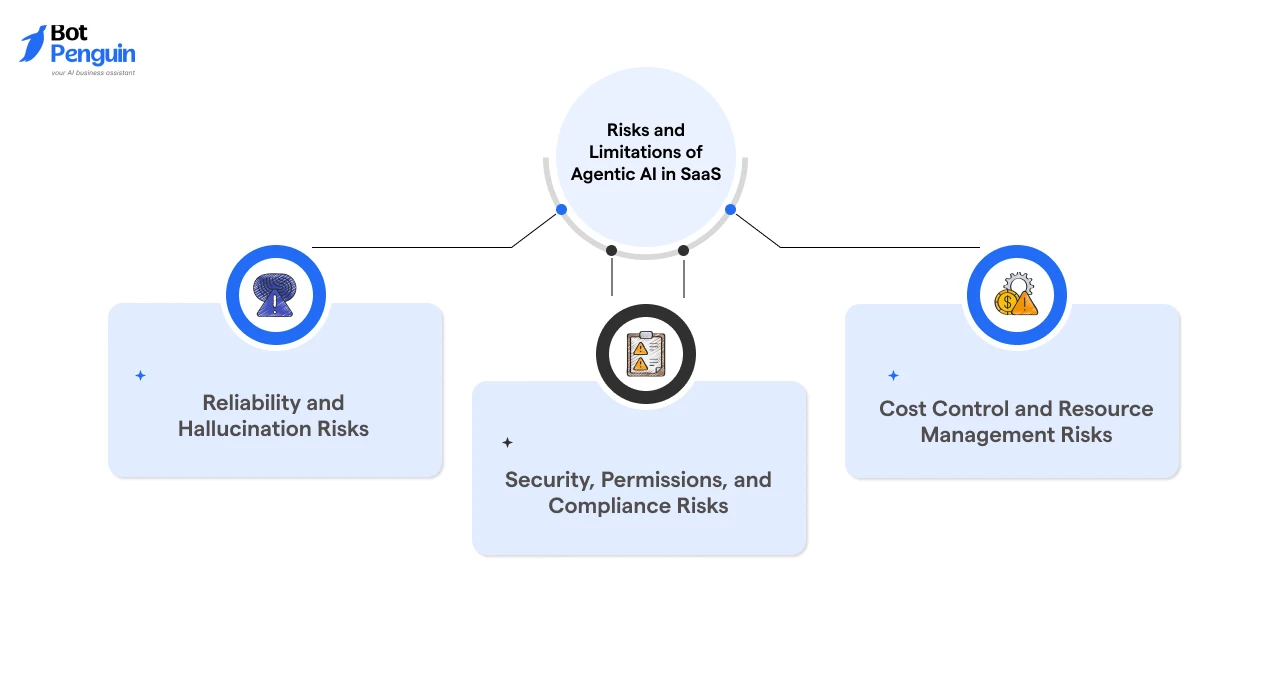
While AI agents can automate complex workflows, they still face limitations around reliability, security, governance, and cost control.
Understanding these risks is essential before committing to an agentic SaaS strategy:
SaaS AI agents can misinterpret context, choose incorrect actions, or generate inaccurate outputs, especially in multi-step workflows.
How to Address It: Use monitoring, validation checks, approval workflows, and human review for high-risk processes involving money movement, legal exposure, medical information, or irreversible system changes.
Agentic AI systems in SaaS often require broad access to tools and data, increasing the risk of prompt injection, sensitive information disclosure, excessive agency, and compliance violations.
How to Address It: Implement least-privilege access, tool-level permissions, prompt-injection safeguards, audit logs, data-loss prevention controls, sandboxed execution environments, and policy-based approval workflows.
AI agents introduce variable costs because they continuously consume model tokens, APIs, compute resources, and workflow executions.
How to Address It: Establish usage limits, cost forecasting, billing visibility, overrun alerts, admin controls, and transparent pricing metrics to maintain predictable spending as agent usage grows.
The goal isn’t to avoid agentic AI because of these risks; it's to deploy it with the guardrails that make automation trustworthy at scale.
AI agents are changing SaaS, but they are not making it obsolete.
Instead, they are changing how software creates value. Tasks that once required users to navigate dashboards and workflows can now be completed by agents working across multiple systems.
The biggest change is that businesses are starting to care less about software features and more about results. This is pushing companies to rethink their products, pricing models, architectures, and user experiences.
As agentic AI SaaS continues to grow, the winners will be the ones that combine trusted data, strong workflows, and reliable AI agents to help users get work done faster. The future of SaaS isn't disappearing; it’s being redesigned.
Traditional SaaS helps users complete tasks, while agentic AI can execute workflows, use tools, and take actions to achieve a defined goal.
No. AI agents are more likely to transform SaaS than replace it. SaaS remains the system of record, while agents handle execution and automation.
AI agents automate workflows, reduce manual work, change pricing models, and shift software from user-operated tools to outcome-driven systems.
Structured and recurring workflows such as customer support, lead qualification, scheduling, CRM updates, invoice processing, and report generation are most vulnerable.
AI agents are driving a shift away from seat-based pricing toward usage-based, task-based, outcome-based, and hybrid pricing models.
Agent-as-a-Service is a model where businesses subscribe to AI agents that perform specific tasks or workflows instead of purchasing software seats.
SaaS companies should audit workflows, build API-first architectures, strengthen governance, rethink pricing models, and embed AI agents into core products.
The biggest challenges include reliability, hallucinations, security risks, compliance requirements, cost control, and maintaining human oversight for high-stakes decisions.
Move Beyond Dashboards With AI Agents
Automate customer support, lead generation, and routine business workflows with AI agents that work across your existing software stack.
Get Started NowCheckout our related blogs you will love.
Updated at Sep 30, 2026
18 min to read
Updated at Sep 26, 2026
13 min to read
Updated at Sep 25, 2026
13 min to read

Updated at Sep 12, 2026
17 min to read
 (1).webp)
Updated at Sep 12, 2026
8 min to read
Table of Contents