



Best White-Label ChatGPT Platforms for Agencies in 2026
Updated at Oct 30, 2026
10 min to read

ChatGPT is a general-purpose AI assistant for writing, research, and everyday tasks. A ChatGPT clone is a custom conversational AI application designed for specific business needs. In the ChatGPT vs ChatGPT Clone comparison, ChatGPT suits general productivity. A custom solution offers greater control over branding, business knowledge, customer-facing conversations, and integrations with existing business systems.
Choosing the right AI solution impacts business operations and customer experiences. While ChatGPT offers immediate accessibility, businesses often need greater control over their AI interactions.
This makes the ChatGPT vs ChatGPT Clone decision important for organizations exploring conversational AI. The right choice depends on business goals, customer expectations, and required functionality.
Some businesses prioritize quick deployment and lower setup costs. Others need customized conversations, branded experiences, and integrations with existing systems.
Deployment flexibility, data management, and long-term costs also influence this decision.
This comparison examines capabilities, customization, integrations, costs, and practical business use cases to support informed decisions.
The main difference lies in their purpose, customization, and deployment. ChatGPT provides ready-to-use AI assistance, while a ChatGPT clone supports specific business requirements.
Both can deliver conversational AI experiences, but their capabilities depend on configuration.
ChatGPT is OpenAI's general-purpose AI assistant, designed for various tasks. Businesses use it for content creation, research, brainstorming, and data analysis.
It can understand questions, generate responses, and assist with everyday workflows.
ChatGPT also supports customization through custom instructions, GPTs, and available integrations. However, implementation options depend on the chosen product and plan.
A ChatGPT clone is an independently developed conversational AI application. It recreates ChatGPT-like interactions while supporting specific business requirements.
These applications may use OpenAI's GPT models or alternative large language models (LLMs). They do not necessarily replicate ChatGPT's underlying model or require independent model training.
Businesses can customize their interfaces, knowledge sources, branding, and supported workflows. Integration and deployment options depend on the platform and technical setup.
These differences become clearer when comparing their capabilities, customization options, costs, and business applications.
ChatGPT and custom clones differ in flexibility, deployment, and business applications. The following comparison highlights their capabilities and practical considerations for businesses.
ChatGPT works well when businesses prioritize accessibility and minimal technical setup. A custom clone may better support branded experiences and specialized workflows.
However, customization also introduces configuration and maintenance responsibilities. Neither option guarantees lower costs, stronger security, or better performance.
Understanding these trade-offs helps businesses evaluate each option's advantages and limitations.
ChatGPT offers businesses accessible AI capabilities without requiring extensive technical resources. However, its suitability depends on specific operational and customization needs.
ChatGPT provides several benefits for businesses seeking ready-to-use AI assistance.
Despite its flexibility, ChatGPT presents certain constraints for specialized business requirements.
These considerations make customization and operational control important when evaluating alternatives. A custom ChatGPT clone may address some limitations while introducing different responsibilities.
A ChatGPT clone offers businesses greater flexibility over conversational AI experiences. However, these benefits come with additional implementation and management responsibilities.
Custom ChatGPT clones can support specific operational and customer engagement requirements.
Building and maintaining a custom solution involves several practical considerations.
A clone is not automatically cheaper, safer, or more accurate. Its suitability becomes clearer when examining specific business use cases.
ChatGPT is suitable when businesses need accessible AI assistance without building applications. It works particularly well for general tasks and early AI adoption.
ChatGPT helps employees complete everyday tasks faster with minimal setup.
For example, a marketing team can brainstorm campaign ideas and draft newsletters.
ChatGPT supports research, information synthesis, and routine knowledge work.
Employees can analyze uploaded documents, summarize findings, and organize information. Available features and data controls depend on the chosen plan.
For example, an analyst can summarize market research before preparing a report.
Businesses can evaluate AI capabilities before investing in custom development.
Teams can test prompts, explore workflows, and assess potential applications.
For example, a support team can experiment with AI-generated FAQ responses.
These use cases prioritize convenience, while customer-facing applications may require greater customization.
A custom ChatGPT clone suits businesses requiring tailored customer interactions and workflows. It offers greater flexibility when standard AI interfaces cannot meet operational needs.
Businesses exploring custom chatbot development can build solutions around specific customer requirements.
Custom chatbots can answer customer questions using approved business information.
They help customers access product details, policies, and support guidance.
For example, an e-commerce chatbot can answer questions about return policies.
Custom clones can guide prospects through structured conversations and collect lead details.
Connected CRM systems can support lead tracking and follow-up workflows.
For example, a chatbot can qualify prospects before scheduling sales consultations.
Businesses can customize chatbot interfaces, communication styles, and brand messaging.
This creates a consistent experience across supported customer-facing channels.
For example, a retailer can deploy a branded chatbot on its website.
Custom clones can retrieve information from approved knowledge sources and connected systems.
Supported integrations also enable actions such as appointment scheduling and record updates.
For example, a service chatbot can check availability before booking appointments.
These applications highlight why deployment requirements, integrations, and operational costs matter when choosing between solutions.
The right choice depends on business requirements, available resources, and long-term goals. Before deciding, businesses should evaluate these six factors:
Choose ChatGPT when your priority is general productivity and quick implementation. It suits research, content creation, and internal assistance without extensive development.
Choose a custom ChatGPT clone when customer interactions require branded interfaces and specialized workflows. It becomes valuable when businesses need tailored integrations and greater deployment flexibility.
Neither option is universally better. The decision should reflect operational priorities rather than assumptions about cost or performance.
For businesses prioritizing customized customer experiences, purpose-built conversational AI platforms offer another implementation path.
BotPenguin helps businesses create conversational AI solutions without complex development processes. Its no-code platform supports chatbot customization, business knowledge integration, and multichannel communication.
Businesses can build a custom ChatGPT clone tailored to their operational needs.
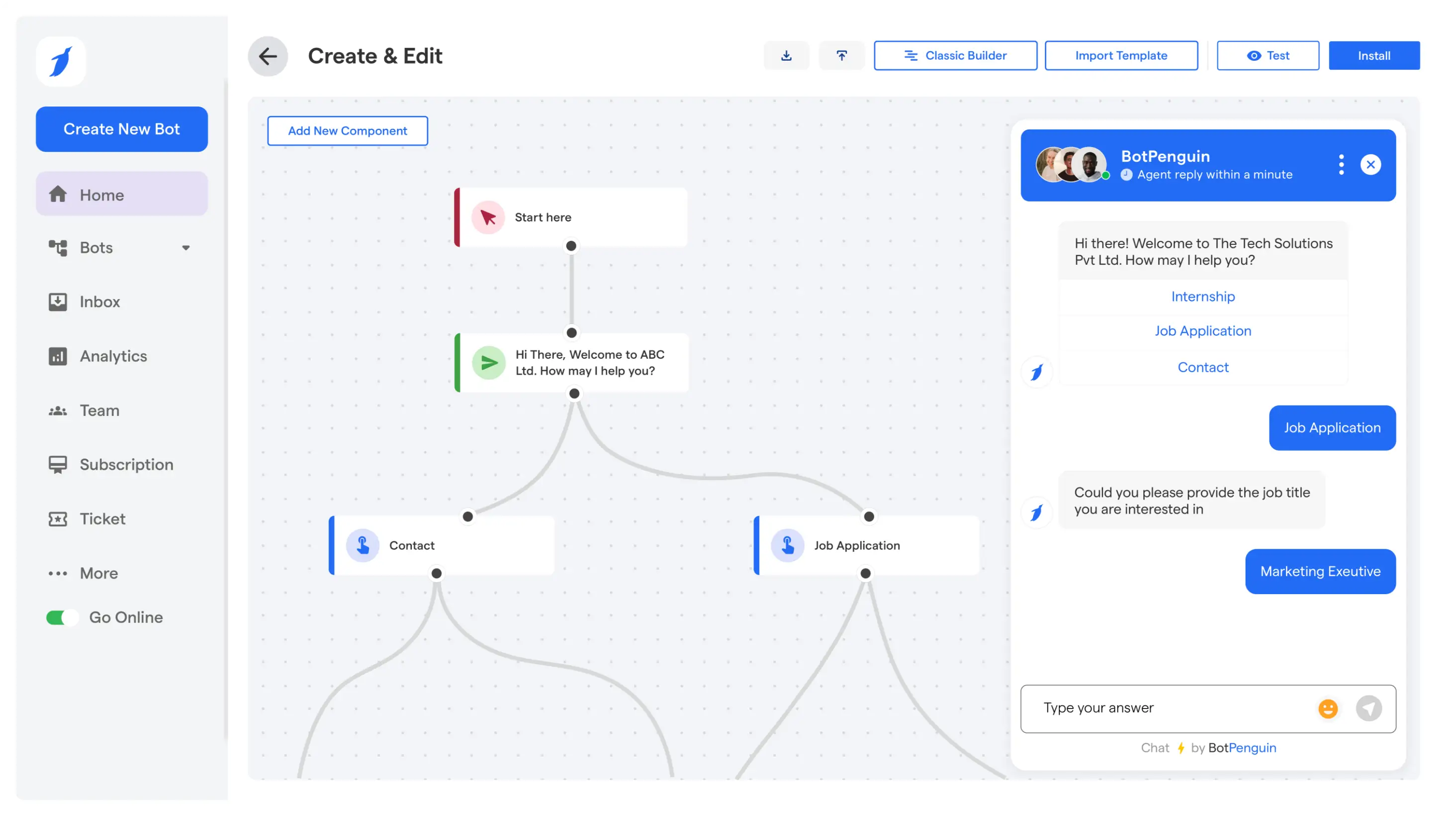
BotPenguin simplifies chatbot creation through its no-code builder.
Businesses can configure conversation flows, customize responses, and manage chatbot behavior. This reduces dependence on extensive coding for standard chatbot requirements.
BotPenguin supports AI-powered responses using business-specific information.
Businesses can deploy chatbots across websites, WhatsApp, Instagram, and other supported channels.
BotPenguin also supports integrations with business tools, including CRM and automation platforms. Integration availability depends on the selected plan and connected services.
These capabilities help businesses create tailored conversational experiences while simplifying chatbot management.
The ChatGPT vs ChatGPT Clone decision depends on your business goals and operational requirements. ChatGPT offers ready-to-use AI assistance for research, content creation, and everyday productivity.
Custom ChatGPT clones provide greater flexibility for branded customer interactions, specialized workflows, and business integrations. However, they also require careful planning, configuration, and ongoing management.
Businesses should evaluate customization needs, security requirements, technical resources, and long-term costs before choosing.
Ultimately, neither solution is universally better. The right choice balances functionality, operational efficiency, and customer expectations while supporting your business's long-term objectives.
ChatGPT is OpenAI's ready-to-use AI assistant for general tasks. A ChatGPT clone is a separately developed conversational application. It can offer customized interfaces, business knowledge, and workflows tailored to specific requirements.
A ChatGPT clone can offer similar conversational capabilities, depending on its underlying AI model. However, response quality, reasoning abilities, and available features may differ. Performance also depends on model configuration, connected data, and implementation quality.
Not necessarily. ChatGPT offers free and paid plans with defined usage limits. A custom clone may involve development, hosting, API, and maintenance expenses. The more economical option depends on usage volume, required features, and long-term operational costs.
Yes, custom ChatGPT clones can connect with CRMs, databases, helpdesk platforms, and other business applications. Integration capabilities depend on supported APIs, available connectors, and technical configuration. These connections can support data retrieval, workflow automation, and customer interactions.
ChatGPT can assist support teams with research, drafting, and internal knowledge tasks. A custom chatbot may better suit customer-facing support requiring branded conversations, business-specific information, and connected workflows. The choice depends on service requirements and available resources.
Build Your ChatGPT Clone
Create your own ChatGPT-like chatbot with BotPenguin, customize it with business knowledge, and deliver branded customer conversations effortlessly.
Start Building FreeCheckout our related blogs you will love.
Updated at Oct 30, 2026
10 min to read
Updated at Oct 30, 2026
11 min to read
Updated at Oct 22, 2026
10 min to read
Updated at Oct 16, 2026
9 min to read
Updated at Sep 26, 2026
10 min to read
Updated at Sep 26, 2026
7 min to read
Table of Contents