


Why Is a Chatbot Vital for Your E-commerce Business?
Updated at Oct 10, 2026
26 min to read
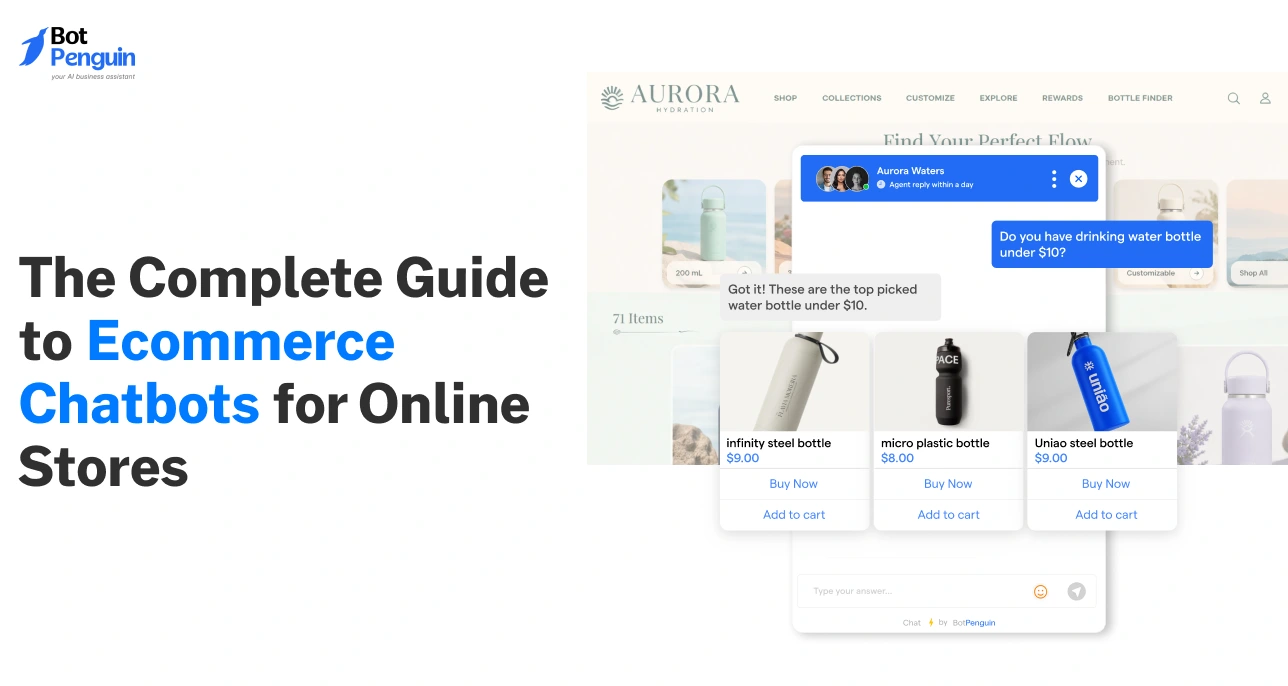
Online shoppers expect fast answers. They also expect relevant suggestions and smooth support during the buying process.
That matters because even small friction can hurt conversions. Baymard found the average cart abandonment rate is 70.19% (Source: Baymard Institute).
This is where ecommerce chatbots help. They can answer common questions, guide shoppers, and reduce hesitation during checkout.
In this guide, we will cover what they are, how they work, where they help, and how to choose the right solution for your store.
Ecommerce chatbots are automated assistants built for online stores. They interact with shoppers through text-based conversations. Their job is to answer questions, guide decisions, and make buying easier.
Unlike a basic chat widget, they do more than pass messages to a support team. They can respond instantly, follow set flows, or use AI to understand what a shopper wants. This makes them useful across both sales and support.
A chatbot for ecommerce helps customers at different stages of the buying journey. It can answer product questions, explain shipping or return policies, and help users track orders. It can also suggest products based on what someone is looking for.
In many stores, it works like a shopping assistant chatbot. It reduces the effort needed to find answers or complete a purchase. That makes the experience smoother for both customers and teams.
Ecommerce chatbots can appear across many customer touchpoints. Common examples include:
This helps brands stay available where shoppers already spend time. It also supports a more connected buying experience across platforms.
Online stores lose customers when support feels slow or unclear. Shoppers want quick help while they browse, compare, and decide.
This is where ecommerce chatbots add value. They speed up support, reduce friction, and help customers move forward with more confidence.
They also help teams handle more conversations without increasing manual workload. For growing stores, that means a better customer experience and greater operational efficiency.
Traditional chatbots can handle simple tasks. But online stores often need deeper support for products, orders, and customer journeys.
The difference becomes clearer when you compare what each type of chatbot can actually do.
If your store handles only a few repetitive questions, a simple bot may be enough. But when conversations involve product discovery, order help, and guided selling, an AI-powered option becomes the better fit.
An AI chatbot for ecommerce works by combining language understanding with store data. It reads what a shopper asks, connects that request to the right context, and returns a relevant response.
AI chatbots do not depend only on exact keyword matches. They use NLP to understand intent, phrasing, and context. This helps them respond even when shoppers ask the same thing in different ways.
What this helps with:
A chatbot becomes more useful when it connects with business systems. Common chatbot integrations include ecommerce platforms, product catalogs, CRM tools, helpdesks, and order systems. These connections help the bot do more than answer basic questions.
What integrations enable:
Before purchase, the bot can answer product questions and guide discovery. During checkout, it can reduce hesitation by clearing doubts around shipping, pricing, or returns. After the sale, it can help with updates, exchanges, and support requests.
Where it helps most:
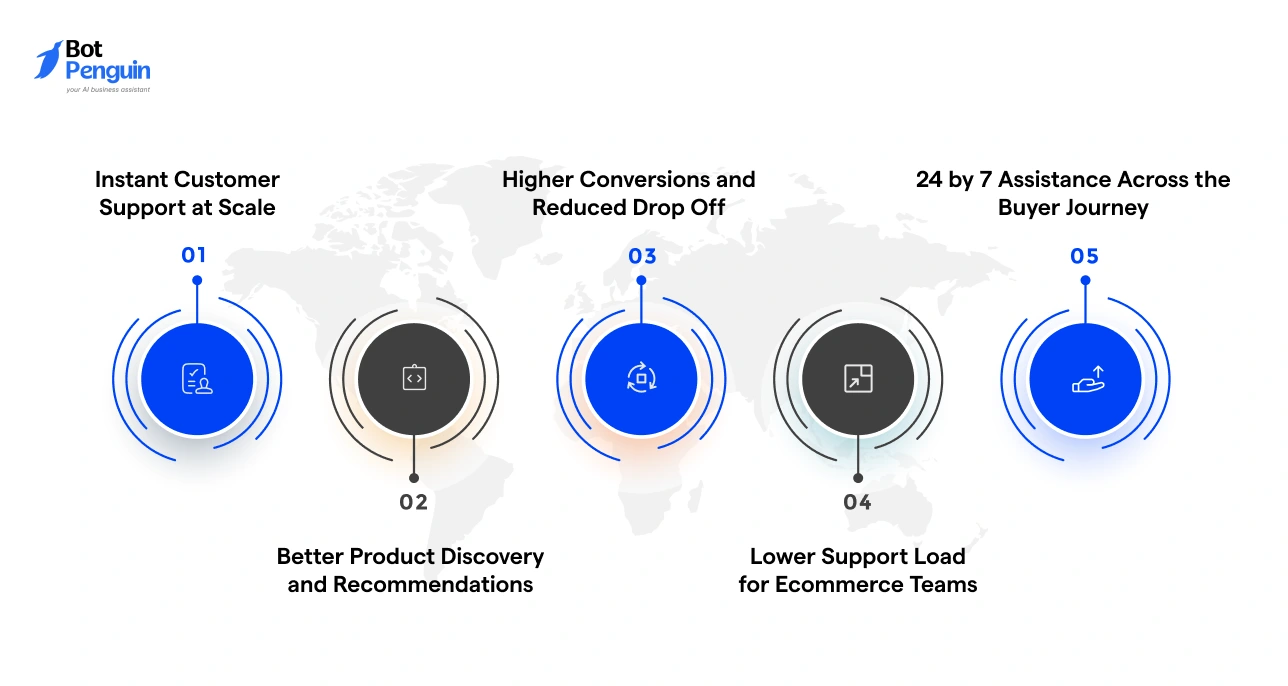
Chatbots for ecommerce do more than answer questions. They help stores respond faster, guide buyers better, and reduce pressure on support teams. When used well, they improve both customer experience and operational efficiency.
Customers do not want to wait for simple answers. They want quick help with shipping, returns, stock, pricing, or order updates. A chatbot can handle these questions instantly.
Zendesk reports that 88% of customers expect faster response times than they did a year ago (Source: Zendesk CX Trends 2026). That makes instant support a real business need, not just a nice feature.
Many shoppers do not arrive ready to buy. They compare options, ask questions, and look for guidance before choosing a product.
A chatbot can act like a personalized shopping assistant. It can narrow choices, surface relevant products, and make decision-making easier.
Small doubts can stop a purchase. Questions around delivery, returns, product fit, or pricing often create hesitation.
A chatbot helps in that moment. It quickly addresses objections and helps shoppers move toward checkout with more confidence.
Support teams spend a lot of time on repetitive questions. Chatbots can take over those routine conversations and reduce manual workload.
That gives human agents more room to handle complex cases, sensitive issues, and higher-value customer interactions.
Online stores stay active beyond support hours. Shoppers browse late, compare products on weekends, and place orders at any time.
Zendesk reports that 74% of consumers now expect customer service to be available 24/7 (Source: Zendesk CX Trends 2026). That is why round-the-clock support is becoming more important for online stores.
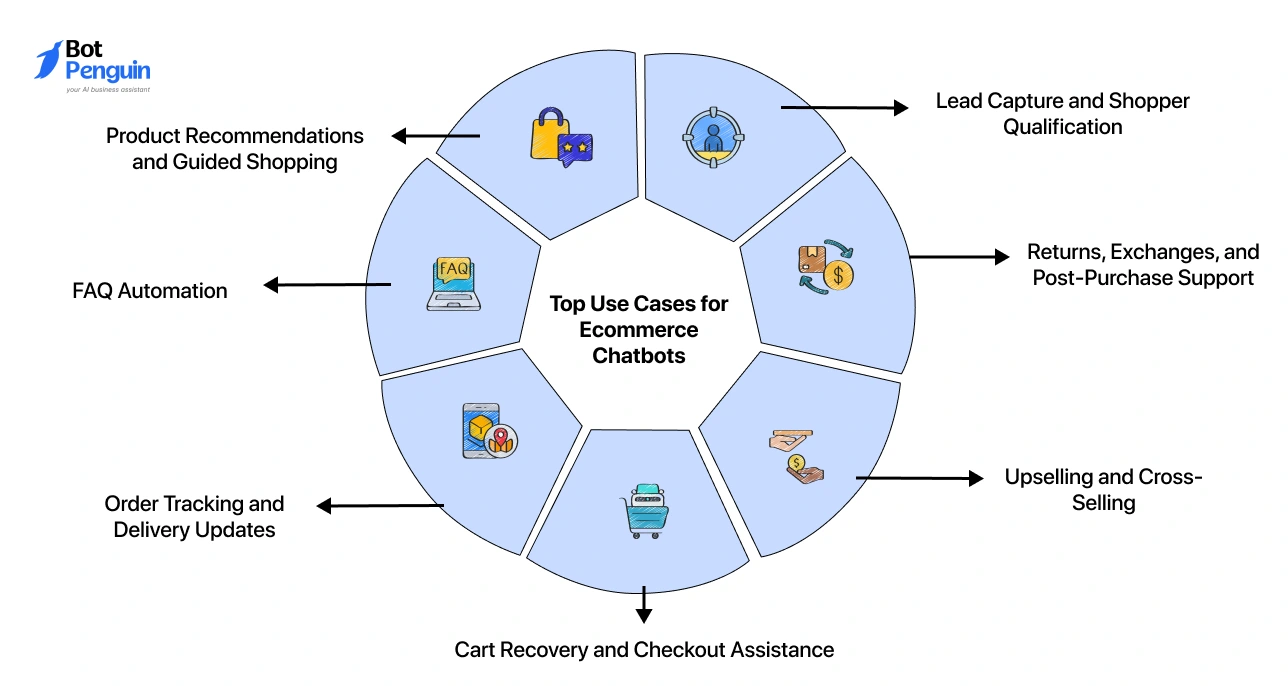
Online stores use chatbots across multiple stages of the customer journey. They can help shoppers discover products, complete purchases, and get support after the sale. That range is what makes them useful across sales, service, and retention.
Many shoppers do not know exactly what they want when they land in a store. They may need help choosing by budget, product type, size, use case, or personal preference.
A chatbot for ecommerce can guide that discovery through questions and suggestions. Instead of making the customer browse endlessly, it helps narrow choices faster.
Best use: stores with large catalogs or buyers who need help comparing options.
A large share of ecommerce support starts with repetitive questions. Customers often ask about delivery timelines, return rules, payment methods, stock availability, or store policies.
Ecommerce chatbots can answer these instantly. This improves response speed and reduces the number of repetitive conversations agents need to handle.
Best use: high-volume stores with recurring pre-purchase and support queries.
After placing an order, customers usually want one thing first: visibility. They want to know if the order is confirmed, shipped, delayed, or out for delivery.
A chatbot can surface that information instantly when connected to order systems. This saves customers time and cuts unnecessary support tickets.
Best use: stores handling frequent shipping status requests.
Many shoppers leave during checkout because of unanswered doubts. A question about shipping costs, delivery dates, return policy, or payment issues can be enough to stop the purchase.
An AI chatbot solution for ecommerce can step in at that point. It can answer concerns, provide reminders, and reduce friction before the customer drops off.
Best use: stores losing conversions during checkout or payment stages.
Chatbots can do more than support purchases. They can also increase order value by suggesting relevant add-ons, bundles, accessories, or better-fit alternatives during the conversation.
This works best when the recommendation feels helpful rather than pushy. Done well, it improves both the shopping experience and average cart value.
Best use: stores with complementary products, bundles, or tiered product options.
Post-purchase service often creates heavy support volume. Customers ask how to return an item, exchange a product, report an issue, or check refund status.
Chatbots can automate much of this flow. That makes after-sales support faster and more convenient while reducing manual workload.
Best use: brands dealing with frequent returns, exchanges, or after-sales questions.
Not every visitor is ready to buy immediately. Some need follow-up, reminders, or more information before making a decision.
Chatbots can collect contact details, preferences, and intent signals during the conversation. This helps brands qualify leads and support later remarketing or follow-up campaigns.
Best use: stores with higher consideration products or longer buying cycles.
Recent retail examples show how far ecommerce chatbots have evolved. They now help shoppers discover products, compare options, and move toward purchase with less friction.
The examples below show how major brands are using conversational shopping in more practical ways.
Ask Macy’s is Macy’s AI shopping assistant, introduced in March 2026. It helps shoppers discover brands, explore trends, and get personalized product recommendations.
Macy’s also connects it with virtual try-on, which makes the experience more interactive.
Its flow is discovery-led. A shopper starts with a need, style, or preference. The assistant then narrows options and suggests relevant products. This makes Ask Macy’s a strong example of guided shopping and personalization.
Sparky is Walmart’s GenAI shopping assistant, launched in June 2025. It appears through the Ask Sparky button in the Walmart app.
Walmart says it helps shoppers find products, compare options, summarize reviews, and build shopping lists. Its flow is built around active shopping tasks.
A user can ask what to buy, compare products, or plan for a specific occasion. Sparky then responds with more retail-specific guidance. This makes it a strong example of an AI-powered shopping assistant built for decision support.
Rufus is Amazon’s AI shopping assistant. It is available in the Amazon Shopping app and on the Amazon website. Amazon says Rufus helps shoppers get useful answers, tailored recommendations, and faster product discovery.
Amazon has also added features such as price history checks, deal-finding, and auto-buy actions based on target price.
Its flow is conversational and intent-led. A shopper can ask broad or specific questions, refine choices, and keep narrowing the path to purchase. That makes Rufus one of the clearest current examples of personalized shopping at scale.
For growing ecommerce brands, our platform, BotPenguin, helps bring similar shopping, support, and post-purchase experiences into a single chatbot setup.
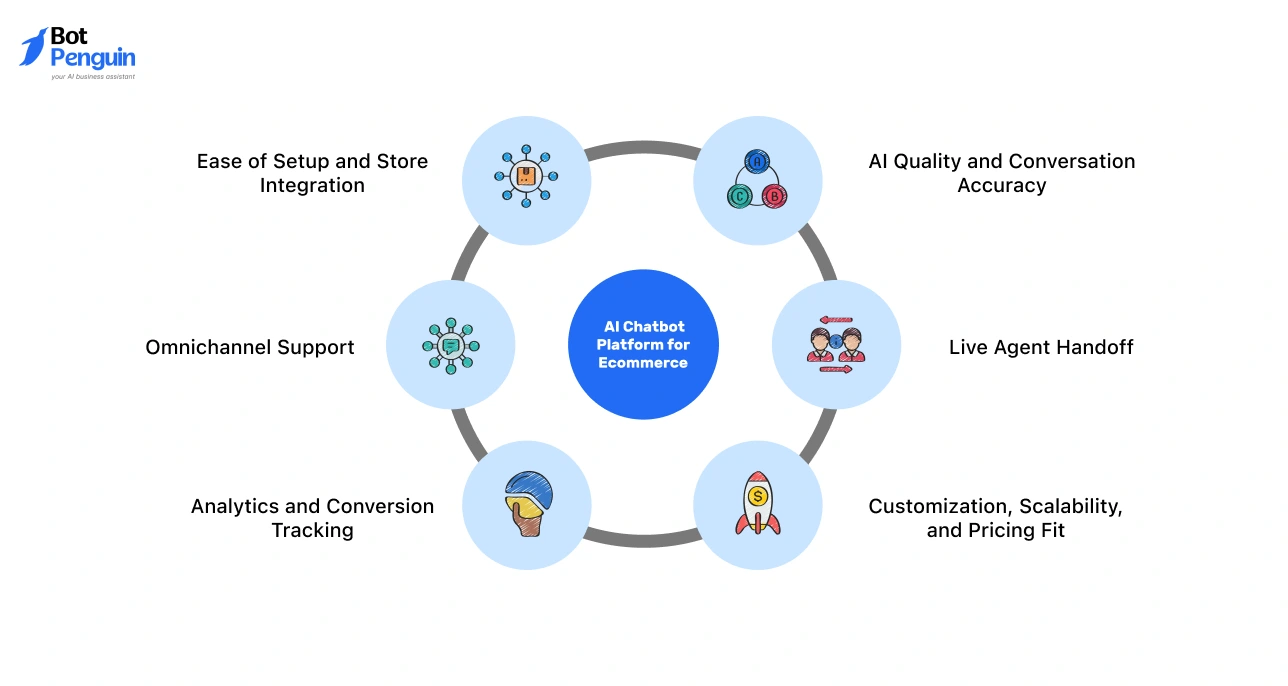
Choose an AI chatbot platform for ecommerce based on how well it supports shopping journeys, customer support, and business growth. The right platform should connect with your store, work across channels, deliver accurate responses, and scale with your team over time.
A platform should be easy to launch. It should also connect smoothly with your store, catalog, CRM, helpdesk, and order systems. Without these connections, the chatbot will stay limited.
Check whether it can:
The AI should understand intent, not just keywords. Shoppers ask questions in different ways, and the platform should still respond with relevant answers. Strong accuracy improves trust and keeps conversations useful.
Look for signs of strong AI:
Customers do not stay on one channel. They may discover a product on Instagram, ask a question on WhatsApp, and complete the purchase on your website. Your platform should support these journeys across channels.
Priority channels usually include:
No chatbot can handle every conversation alone. Some situations need a person, especially complaints, exceptions, or high-value purchase decisions. The handoff should feel smooth, not disruptive.
A good handoff should include:
A platform should show more than chat volume. You should be able to see engagement, support outcomes, assisted conversions, and where users drop off. That makes optimization easier and more meaningful.
The most useful reporting shows:
The platform should align with your brand tone, support your model, and align with your growth stage. What works for a small store may not suit a large catalog or multi-channel team. Pricing should also stay practical as your usage grows.
Compare platforms on:
Use this as a quick filter while comparing platforms. If a solution is weak in multiple areas, it will likely create friction later.
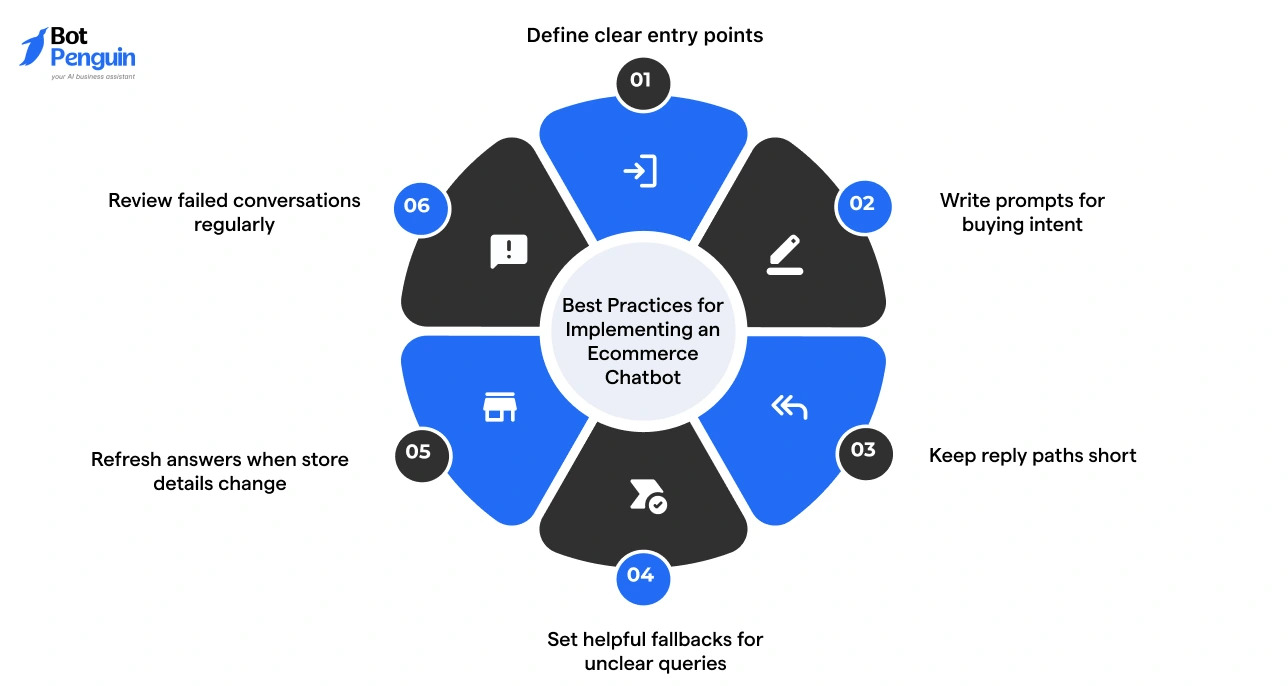
Implementing an ecommerce chatbot works best when you focus on small choices that improve real conversations. The goal is not just to launch the bot, but to make it more useful, accurate, and easier to interact with over time.
AI chatbot platforms like BotPenguin make this easier by letting teams train the chatbot on product data, policies, FAQs, and store-specific workflows.
Ecommerce chatbots usually do not fail because the technology is weak. They fail because the setup is too rigid, too disconnected, or never improved after launch.
For most online stores, ecommerce chatbots are worth it when they are built around real business needs. That means faster support, better product discovery, smoother checkout journeys, and stronger post-purchase service.
At BotPenguin, we help ecommerce businesses build AI chatbots that support these outcomes through features like:
This makes the chatbot more than a support layer. It becomes a practical tool for improving the customer experience, reducing repetitive workloads, and driving more conversions throughout the buying journey.
If you want to see how this works in practice, explore BotPenguin’s ecommerce chatbot platform and see how it can help your store automate support, guide shoppers, and drive better results.
An ecommerce chatbot is a virtual assistant for online stores. It helps shoppers with product questions, support, order updates, and buying decisions through automated conversations.
An AI chatbot understands shopper intent, leverages store data, and provides relevant answers. It can guide discovery, support checkout, and handle routine queries.
Ecommerce chatbots can help with product recommendations, FAQs, order tracking, checkout support, cart recovery, returns, and post purchase service across customer touchpoints.
No. Small and mid-sized stores can benefit too. Tools like BotPenguin AI ecommerce chatbot help growing brands automate support and improve shopping journeys without large teams.
Choose a platform based on integrations, AI accuracy, omnichannel support, analytics, scalability, and handoff options. For stores seeking these e-commerce-ready capabilities in one place, BotPenguin is worth exploring.
Recover Lost Ecommerce Sales
Automate FAQs, order updates, returns, and post-purchase queries across your ecommerce channels. Reduce friction in the entire customer journey and recover lost sales using BotPenguin’s AI chatbot.
Explore Complete Use CasesCheckout our related blogs you will love.
Updated at Oct 10, 2026
26 min to read
Updated at Jun 22, 2026
7 min to read
Updated at Jun 4, 2026
13 min to read
Updated at May 21, 2026
12 min to read
Updated at May 20, 2026
8 min to read
Updated at May 7, 2026
9 min to read
Table of Contents


