


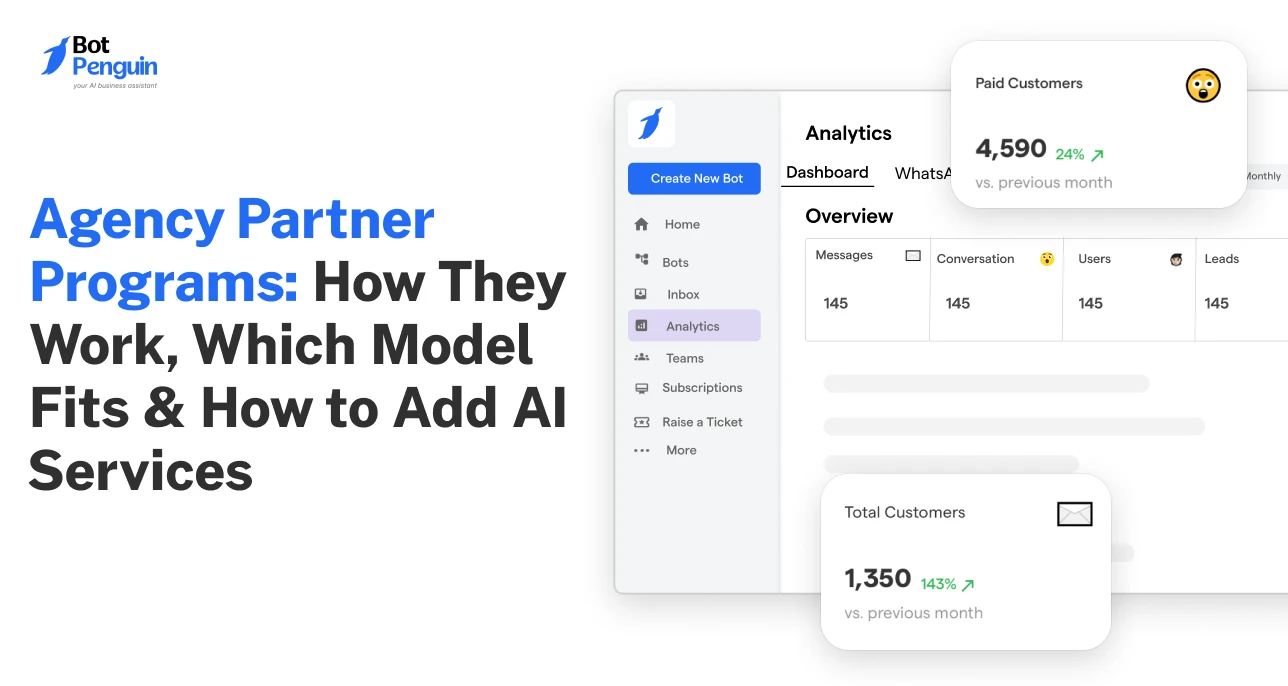
Agency Partner Programs: How They Work, Which Model Fits & How to Add AI Services
Updated at Sep 25, 2026
10 min to read
The best white label partner programs help agencies resell software under their own brand while managing pricing, clients, and margins. Options such as BotPenguin, Stammer.ai, WotNot, Engati, and others vary in branding depth, features, integrations, support, and overall partner flexibility.
AI has emerged as a highly lucrative space today. And the plus side? You don't need to know AI to sell it.
Agencies, consultants, MSPs, and entrepreneurs are building recurring revenue by reselling AI chatbots, agents, and automation solutions under their own brand. But success often depends on the partner program you choose.
A strong white label partnership gives agencies control over branding, pricing, and client relationships.
While most people compare white label AI platforms based on features, a truly rewarding white label partner program should be evaluated on factors like branding control, profit margins, pricing flexibility, support, and scalability.
In this guide, we review 7 of the best white label partner programs for agencies in 2026, covering what each offers, who it is best suited for, and the key factors to consider before choosing the right program for your growth goals.
Agencies are investing in AI because demand for AI solutions like chatbots, agents, and business automation is growing rapidly.
Businesses want solutions that improve customer support, generate leads, automate recurring tasks, and lower operational costs. This creates a major opportunity for agencies to expand their services and generate new revenue streams.
The global AI market is set to grow to $3,680.47 billion by 2034, reflecting one of the most sustained expansion runs in tech history.
As AI adoption continues to grow, many agencies see white label AI and chatbot reseller programs as a practical way to enter the market, differentiate their services, and build a scalable recurring revenue business.
Similarly, platforms like BotPenguin let agencies launch branded AI solutions, manage clients, and expand their offerings without developing the technology from scratch.
Next, we'll look at the key criteria we evaluated before shortlisting the best white label partner programs for agencies.
For this guide, we evaluated each white label partner program based on the factors that matter most for agencies: profitability, branding, scalability, and ease of launching.
We looked at how partners make money. Do you keep 100% of the revenue you generate, or does the vendor take a commission or percentage of every sale?
The difference between a revenue-share model and a full-margin model can define whether your business scales or stalls.
We reviewed the total cost of each program, including annual fees, monthly subscriptions, per-client charges, or usage-based pricing. The cost structure directly affects partner margins.
We also considered additional costs like API overage fees, onboarding charges, or per-seat pricing that may increase as the client base grows.
We evaluated how much control each program gives partners over their brand, including custom domains, logos, dashboards, and other customer-facing assets.
Looking to compare programs specifically in the chatbot category? Read our guide to the best white label chatbot partner programs.
We checked which channels each program supports, including websites, WhatsApp, Instagram, Facebook Messenger, and other platforms commonly used by clients.
Consistent engagement across channels like email, SMS, and web can drive up to 3x higher customer engagement.
Broader channel coverage can reduce the number of tools agencies need to manage while expanding the solutions they can offer clients.
We considered onboarding, technical support, training, and how quickly partners can start selling and deploying solutions.
Together, these five criteria helped us assess whether each white label reseller program can support a scalable, profitable business rather than simply provide access to an AI or chatbot platform.
Using this framework, we evaluated 7 white label partner programs to understand their strengths, limitations, and suitability for different agency and reseller models in 2026.
Different partner programs offer varying levels of control, flexibility, and earning potential.
Below, we've reviewed 7 leading options based on pricing, branding, channel availability, and partner benefits to help you identify the best fit for your business:
*Note: Pricing, features, partner benefits, and availability may vary by region and can change over time. Confirm the latest details directly with each provider before making a decision.
Now we’ll explore each of these programs in detail.
BotPenguin is built for businesses that want to sell AI solutions such as AI chatbots, agents, voicebots, and automations, under their own brand.
Partners keep 100% of the revenue they generate, get a fully branded experience with a custom domain, and can offer AI automation across multiple channels, including WhatsApp.
BotPenguin is GDPR, HIPAA, and CCPA compliant, ISO certified, SOC 2 attested, and VAPT-assessed by a CERT-In empanelled auditor. The platform also offers 80+ integrations, helping partners connect client systems.
With setup completed in as little as 12 hours, BotPenguin allows partners to launch their branded platform quickly.
Key Highlights
Best for: Agencies, consultants, MSPs, and AI automation businesses
Stammer.ai is a white-label AI platform built for agencies that want to sell AI chat and voice agents under their own brand.
Agencies can customize the platform with their own domain, logo, colors, signup pages, and client-facing dashboards. It also supports client sub-accounts and a white-label API for agencies that need greater control over their AI services.
Partners can set their own client pricing and generate revenue through subscriptions, setup fees, and usage markups while managing multiple client accounts from one platform.
Key Highlights
Best for: AI agencies, consultants, and resellers offering branded chat and voice AI solutions to multiple clients
Botpress is a developer-first, open-source-origin conversational AI platform. Its partner model is designed primarily for system integrators and technical teams building tailored AI solutions, rather than a traditional white label reseller program with fixed pricing or packaged offerings.
Pricing is enterprise-driven, with self-serve tiers available and custom enterprise contracts for larger deployments.
White-label usage is possible at the implementation level, but the platform is not structured as a plug-and-play reseller program.
Key Highlights
Best for: Technical agencies, developers, and enterprise teams
WotNot offers a white-label chatbot platform for businesses that want to launch and resell AI chatbot solutions under their own brand.
Partners can customize the platform with their own logo, domain, colors, and fonts while creating unlimited client accounts. WotNot also provides managed hosting and lets partners define their own pricing plans by packaging features around their business model.
The platform supports AI chatbots, voicebots, WhatsApp, live chat, and integrations. Partners can launch WotNot as a standalone branded platform, embed it through an iFrame, or integrate its capabilities through APIs.
Key Highlights
Best for: Agencies, SaaS businesses, and service providers selling branded AI chatbot solutions to multiple clients
ManyChat is a social automation platform with a partner program based on referrals and account management, not full white-label resale.
Agencies typically earn commissions by referring clients or managing accounts within the ManyChat ecosystem, rather than selling under their own brand.
It is widely used for Instagram, Facebook Messenger, WhatsApp, and TikTok automation, but does not offer a fully white-label experience.
Key Highlights
Best for: Social media marketing agencies & content creators focused on IG, FB, TikTok automation & lead generation
For agencies seeking a ManyChat alternative with full branding and revenue ownership, platforms like BotPenguin offer a more complete white-label partner model.
Crisp is an AI customer support and messaging platform for managing chat, email, WhatsApp, Instagram, Messenger, SMS, and Telegram in one workspace.
It offers Marketing and Technology partner programs for agencies, consultants, developers, and technology companies, covering referrals, enablement, integrations, and product partnerships.
White-label functionality is available on the Plus plan, allowing businesses to remove Crisp branding from customer-facing experiences.
Key Highlights
Best for: Agencies, consultants, and support-focused teams using multichannel customer messaging and AI automation
Engati is a conversational AI platform with a white-label partner program for businesses selling chatbot and automation solutions under their own brand.
White-label partners get a branded portal, unlimited customers, a master account, sales support, training, marketing collateral, and an account manager.
Engati supports WhatsApp, website chat, voice, and other customer engagement channels, with partner onboarding available for WhatsApp deployments.
Key Highlights
Best for: Agencies and businesses that want a fully branded conversational AI platform with flexible pricing and partner support
Overall, the best program is the one that aligns with your goals for control, branding, and revenue ownership.
If you’re exploring partnership models, you can also compare reseller vs affiliate vs agency models before choosing your revenue structure.
Choosing the wrong partner program can lead to poor margins, limited control, and slower growth. The key is identifying risks early and matching them with the right solution.
Many agencies choose programs without fully understanding who controls pricing and how revenue sharing works.
Solution: Prioritize programs that give you clear control over client billing, pricing, and margins.
Low entry pricing can hide usage fees or per-client costs that reduce profitability as you grow.
Solution: Look for transparent and predictable pricing structures that remain manageable as your client base expands.
Limited white-labeling can expose the underlying platform and weaken your brand credibility.
Solution: Choose programs that offer strong branding control, including custom domains and client-facing assets.
Some programs limit access to key channels like WhatsApp, reducing client value and upsell potential.
Solution: Ensure the program supports the channels most relevant to your target clients.
Delays in onboarding and limited partner support can slow go-to-market speed, leading to lost deals and frustrated clients.
Solution: Select programs with clear onboarding, reliable support, and reasonable deployment timelines.
The right partner program should minimize these risks so you can focus on growing the business instead of working around platform limitations.
Avoiding these mistakes is easier when you use the right comparison criteria. Explore more white label guides covering agency growth, platform selection, and partner models.
The right white-label partner program is defined less by features and more by control over revenue, branding, client relationships, and scalability.
Some programs operate through affiliate, commission, or platform-led models, while others provide deeper white-label control and allow partners to set their own client pricing.
For agencies building a long-term AI business, the right choice depends on your preferred revenue model, branding requirements, supported channels, costs, and level of partner support. Programs like BotPenguin suit teams that prioritize revenue ownership, fast deployment, and multichannel white-label capabilities, including WhatsApp.
Ultimately, the best program depends on whether you want to refer clients, resell an existing platform, or build a fully branded AI offering.
Ready to become a white label partner and launch your own branded AI offering? Explore BotPenguin’s partner program to compare reseller and white-label options.
Focus on revenue ownership, branding depth, pricing structure, supported channels, client management, onboarding, partner support, and scalability. The right program should fit how you plan to package, price, and deliver services.
The best option depends on your business model. Agencies should compare branding control, client ownership, pricing flexibility, supported channels, integrations, and partner support before choosing a platform.
No. Some programs offer custom domains, dashboards, logos, and client-facing branding, while others operate mainly through affiliate or partner models with more limited white-label control.
Costs vary by provider. Some use monthly subscriptions, others require annual plans or custom pricing, and additional usage, client, API, or onboarding fees may apply.
It depends on the provider. Some programs let partners set their own client pricing and keep the revenue, while others use commission, affiliate, or platform-controlled pricing models.
BotPenguin lets partners keep 100% of client revenue while offering custom branding, domain control, and multichannel AI automation. It also supports WhatsApp through its Official Meta Tech Provider status and offers white-label setup in as little as 12 hours.
Subscribe to Our Newsletter
Get the latest business insights straight into your inbox.
Checkout our related blogs you will love.
Updated at Sep 25, 2026
10 min to read
Updated at Jun 24, 2026
10 min to read
Updated at May 21, 2026
14 min to read
Updated at Oct 14, 2026
6 min to read
Updated at Oct 12, 2026
13 min to read
Table of Contents
