


7 Best White Label Partner Programs for Agencies in 2026
Updated at Sep 26, 2026
8 min to read
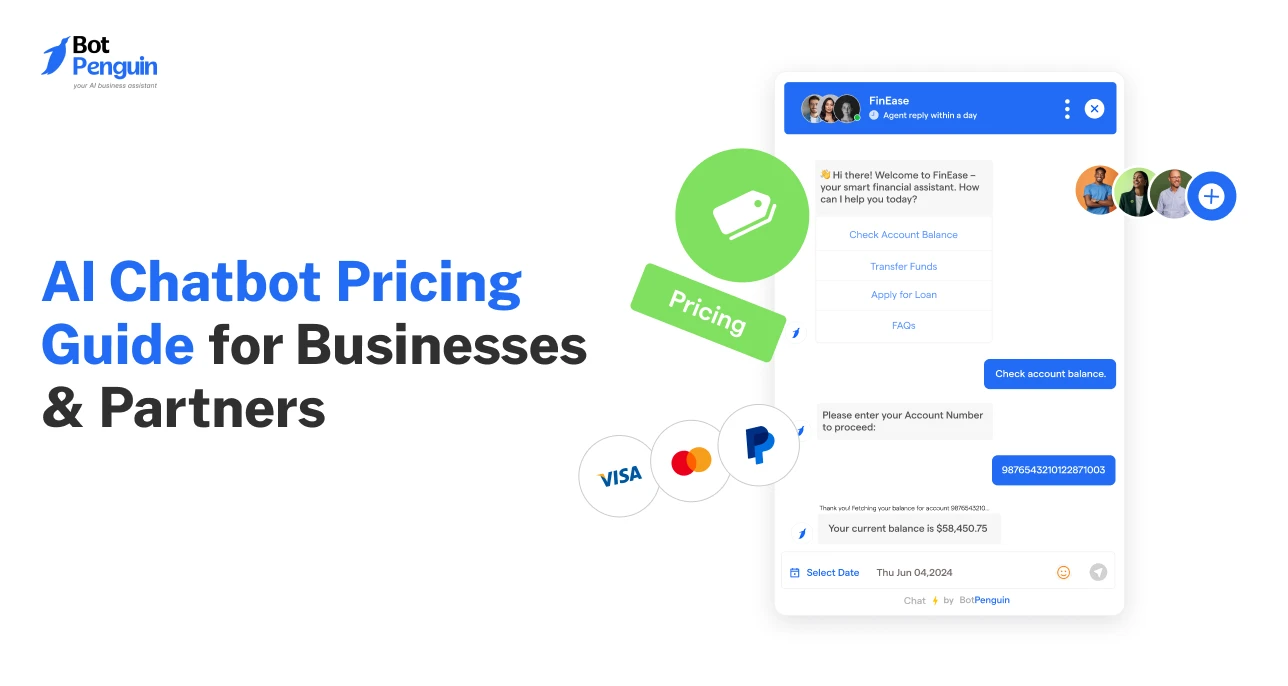
Chatbot pricing is not straightforward.
What seems like a simple tool often becomes a complex investment decision when features, integrations, and scale are involved.
If you are wondering how much it costs to build a chatbot, the answer goes beyond the tool alone. AI capabilities, channels, scalability, and long-term maintenance all impact the final cost.
For agencies and partners, pricing also affects delivery margins, client profitability, and long-term scalability.
This guide breaks down AI chatbot cost, pricing models, and real-world budget ranges to help businesses evaluate the right approach without overspending or underestimating their investment.
Chatbot costs vary because requirements differ across businesses, agencies, and reseller models. Pricing depends on how advanced the chatbot is, where it runs, and how much customization and support it requires.
Most chatbot pricing differences come down to the following factors.
For businesses, chatbot costs are primarily influenced by automation needs, scalability requirements, and long-term operational complexity.
The factors below explain the sources of most chatbot expenses.
Chatbot Type and Complexity
The type of chatbot has the biggest impact on cost. It directly affects both capability and scalability.
As complexity increases, both upfront and long-term costs rise.
Channels and Integrations
Cost increases as your chatbot expands across platforms and systems.
More channels and deeper integrations directly increase operational cost.
Customization and Maintenance
The initial build is only part of the investment. Long-term costs often have a larger impact.
This is why chatbot pricing should always be evaluated as a lifecycle investment.
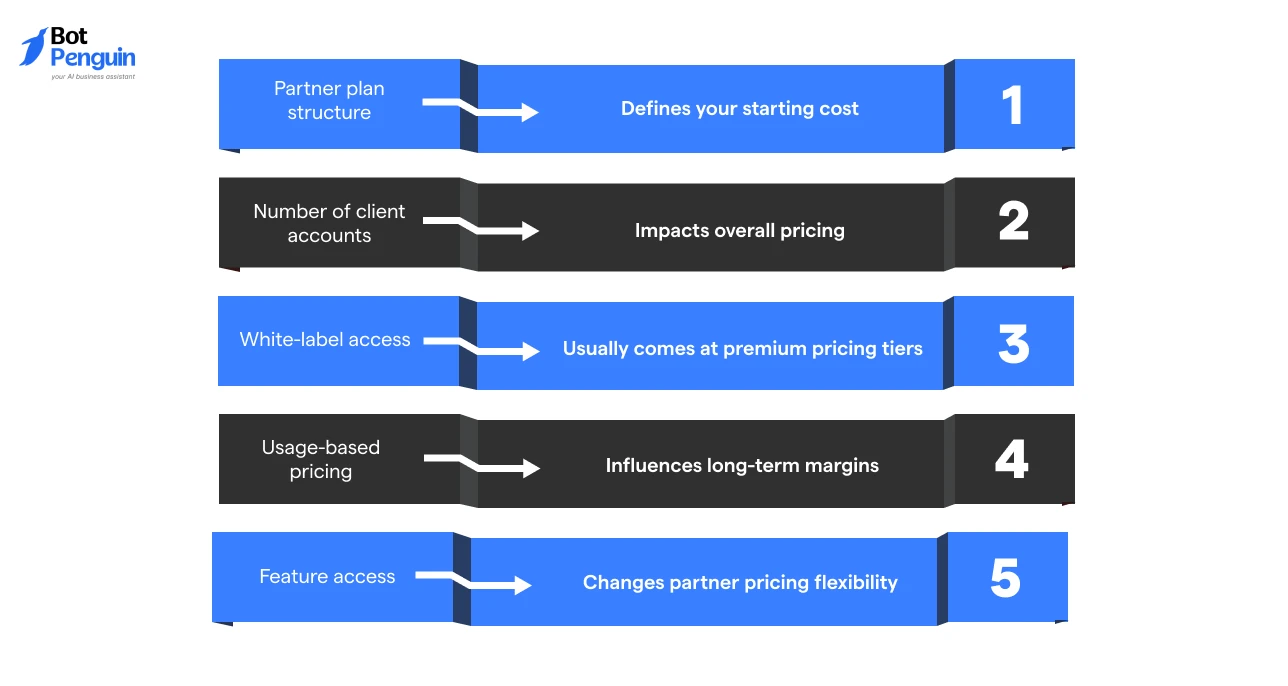
For resellers or white-label partners, chatbot pricing depends on more than the platform’s base cost. The real cost is shaped by how many clients you serve, how much control you need over pricing, and how easily you can manage delivery at scale.
The factors below determine how chatbot partner program costs usually work.
Some programs charge a fixed monthly partner fee, while others use reseller margins or revenue-sharing models. This determines upfront commitment and profitability potential.
Costs often increase as more client workspaces, chatbot deployments, or managed accounts are added to the platform.
Many platforms charge extra for white-label capabilities, custom branding, and branded client dashboards. These costs directly affect reseller pricing models.
AI conversations, automation workflows, integrations, and channel usage can increase operational costs as client activity grows.
Advanced integrations, API access, analytics, and automation capabilities are often restricted to higher-tier partner plans, impacting service packaging and pricing strategy.
For agencies and partners, the right chatbot pricing model should make it easier to package services, protect margins, and scale client delivery without increasing operational complexity.
Understanding these cost drivers helps businesses estimate realistic budgets and helps partners evaluate long-term profitability.
Next, let’s understand how these costs are structured. Different chatbot pricing models determine how you are charged and how predictable your costs will be.
Chatbot costs are not just about how much you pay; they also depend on how you are charged. Different chatbot pricing models define whether your costs stay predictable or increase with usage.
Most platforms follow three common models. Each comes with its own cost structure, scalability limits, and budgeting implications.
Each pricing model impacts how your costs behave over time. Subscription models offer predictability, usage-based models offer flexibility, and custom builds require long-term investment planning.
Next, it’s time to map these models to actual cost ranges. This will help you understand how businesses typically spend by chatbot type and complexity.
AI chatbot costs vary widely based on the level of automation you need. In practice, most businesses fall into three pricing tiers depending on complexity, scale, and use case.
The breakdown below shows what you can expect to pay at each level, helping you benchmark your budget against real-world implementations.
Basic chatbots are the most affordable option. They are designed for simple use cases like FAQs, lead capture, and basic support.
These bots are cost-effective but require upgrades as business needs grow.
AI chatbots and conversational AI bots are the most common choice for growing businesses. They support dynamic conversations, workflows, and customer engagement.
These bots provide the best balance between cost and functionality for most businesses.
Enterprise chatbots are built for complex workflows and large-scale operations. These are usually custom-built or heavily customized solutions.
These solutions are powerful but require significant investment and technical resources.
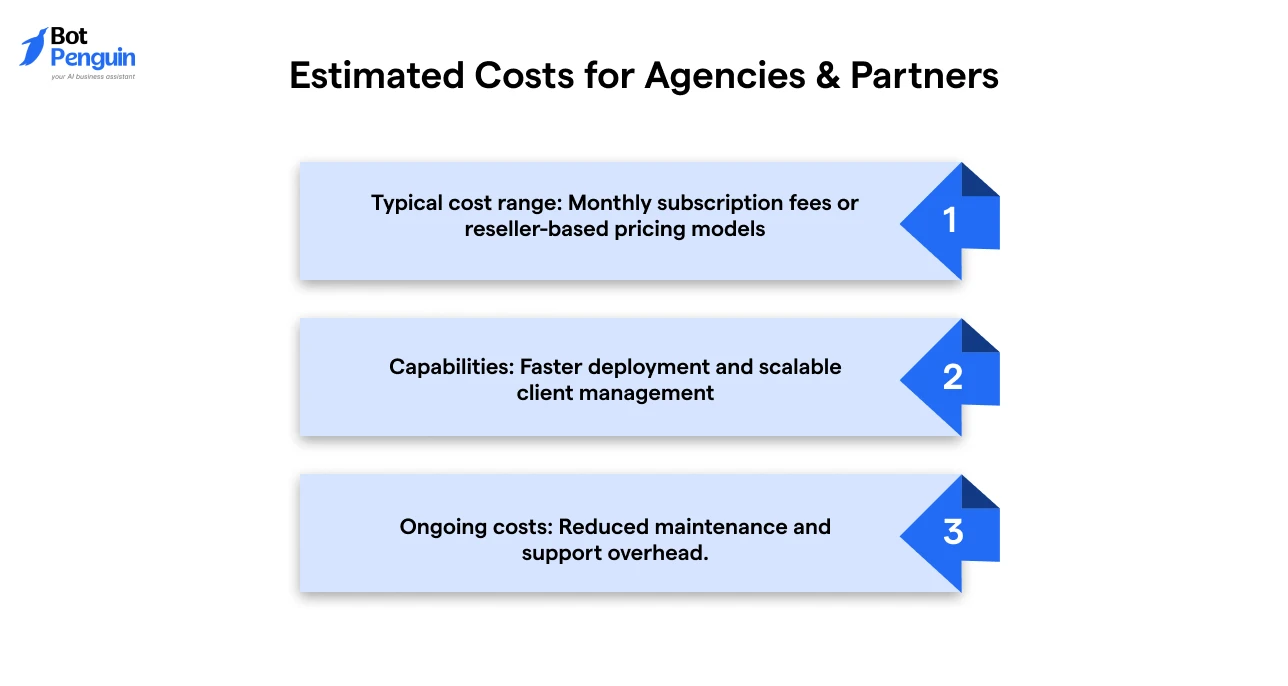
For agencies, consultants, and reseller partners, chatbot pricing is not just about development cost. Margins, scalability, and long-term support also affect profitability.
For many agencies and partners, SaaS chatbot platforms offer a more scalable, cost-efficient alternative to custom chatbot development.
Programs like the BotPenguin Partner Programs help simplify chatbot delivery with scalable pricing, easier client management, and white-label support.
But let’s compare SaaS vs. custom approaches in detail first.
Once you understand pricing tiers, it's time to implement your chatbot. Most businesses choose between SaaS platforms and custom development. The choice impacts cost, speed, scalability, and long-term ROI.
To make this decision easier, below are the key factors that compare SaaS and custom chatbots.
The biggest difference between SaaS and custom chatbots lies in how costs are structured over time.
SaaS platforms generally offer better cost efficiency, while custom solutions lead to higher overall AI chatbot costs over time.
Implementation speed and technical effort are equally important when evaluating options.
From a chatbot's pricing and operational standpoint, SaaS significantly reduces both time and resource burden.
For most businesses, SaaS chatbot platforms offer the best balance of cost, speed, and scalability. Use the checklist below to quickly assess if SaaS aligns with your requirements:
Choose SaaS if:
Platforms like BotPenguin follow this model by offering tiered pricing with flexible upgrades. You can begin with basic automation and progressively unlock advanced AI capabilities, integrations, and multi-channel support as your needs evolve.
This helps reduce AI chatbot cost while maintaining scalability.
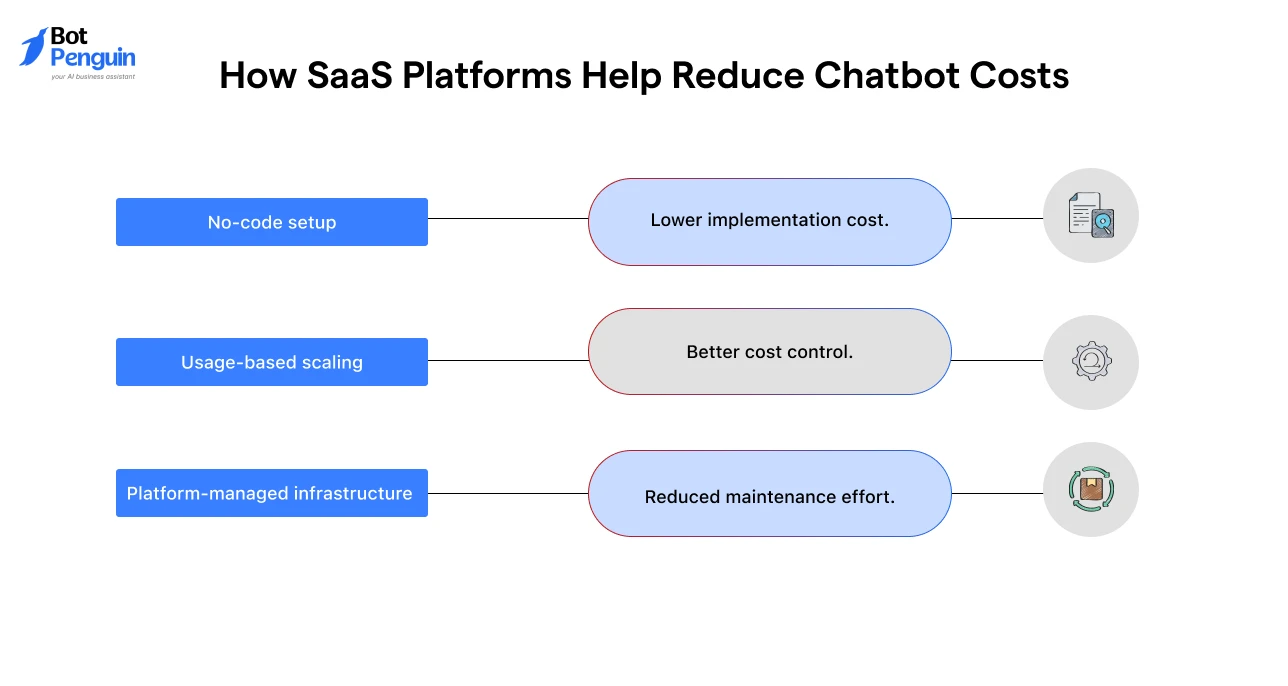
SaaS chatbot platforms reduce costs by lowering development overhead and allowing businesses to scale gradually based on actual usage.
This is why SaaS chatbot platforms are often the more cost-efficient option for businesses, agencies, and reseller partners looking to scale without a large upfront investment.
Understanding these cost differences makes it easier to evaluate which chatbot platforms best fit your budget and scalability requirements.
Next, let’s look at the best chatbot options across different pricing tiers and business stages.
Choosing the best chatbot depends on how much you are willing to spend and how your needs scale over time. Different budget levels require different types of tools, from basic SaaS platforms to enterprise-grade solutions.
The breakdown below maps your budget to the most suitable chatbot builder platforms, helping you choose a solution that fits both your current needs and future growth.
If you are starting out, focus on tools that are affordable and easy to deploy. These platforms help you validate use cases without a high upfront investment.
A few best-suited options are:
These tools offer free plans or low-cost entry tiers. They help control AI chatbot costs while enabling quick deployment.
As your business grows, your chatbot needs to handle more conversations, integrations, and channels. Scalability becomes the priority.
Here are the best tools for those tiers:
These platforms allow you to expand capabilities without switching systems. This keeps chatbot pricing aligned with growth.
Some of these platforms, such as BotPenguin, also offer partner or reseller programs that help agencies and consultants manage pricing, white-label delivery, and multi-client chatbot deployments more efficiently.
Enterprises require advanced capabilities, deep integrations, and high scalability. The focus shifts to flexibility and performance at scale.
The best-suited tools are:
*Disclaimer: Pricing mentioned above is indicative and may vary over time based on platform updates, feature availability, usage limits, integrations, and regional pricing structures.
These tools support complex workflows but come with higher costs and technical requirements under structured chatbot pricing models.
This breakdown helps you identify chatbot platforms that fit both your budget and scalability requirements. But for partner-led chatbot businesses, the right platform should also simplify client delivery, pricing management, and long-term scalability.
So, let’s look at how partner programs help optimize chatbot selling and service growth.
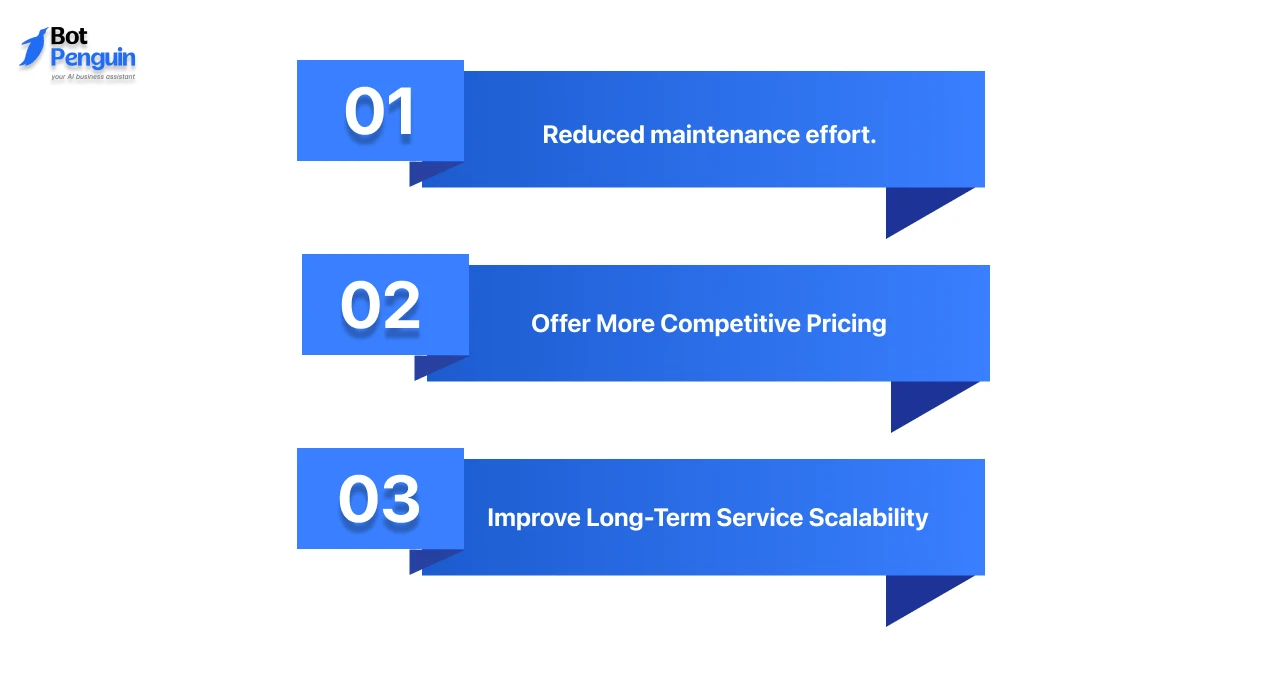
For chatbot businesses, profitability depends on more than just chatbot pricing. Faster deployment, scalable client management, and lower operational effort also influence long-term growth.
Here’s how dedicated partner programs like BotPenguin help improve operational efficiency and selling flexibility.
Partner programs help reduce implementation overhead through no-code tools, reusable workflows, and centralized management systems.
This allows teams to deploy chatbots faster without heavily increasing technical dependency.
Flexible partner pricing models make it easier to package chatbot services for clients of different sizes and industries.
This improves pricing flexibility while helping maintain healthier margins as projects scale.
Partner-focused platforms often include white-label support, multi-client management, and platform-managed infrastructure.
This reduces maintenance effort and helps streamline long-term chatbot operations.
For growing chatbot service businesses, these capabilities make scaling more operationally efficient and commercially sustainable.
Chatbot costs vary based on complexity, pricing models, and implementation approach. From basic bots to enterprise solutions, the investment can range widely depending on your requirements and scale.
For most businesses, chatbot platforms offer the most practical path.
Platforms like BotPenguin enable businesses to build AI chatbots without coding while keeping costs under control through flexible pricing. You can also try a free website chatbot to evaluate features, usability, and business fit before investing.
They also support partners with pricing flexibility and scalable reseller strategies, making it easier to offer competitive chatbot services across different client segments.
The right decision is not about choosing the most advanced solution. It is about selecting a chatbot that fits your current needs, delivers ROI, and evolves with your business over time.
AI chatbot pricing can range from under $100/month for basic automation to $1000+/month for advanced AI workflows, enterprise deployments, or multi-client partner operations.
Pricing varies based on AI capabilities, integrations, channels, usage limits, scalability, white-label features, and the level of automation required for businesses or partners.
Common hidden costs include AI usage limits, integrations, extra users, maintenance, premium support, scaling costs, and white-label or multi-client management features for partners.
For most businesses and partners, yes. SaaS platforms reduce upfront development costs and simplify long-term maintenance, infrastructure, and scalability management.
Subscription pricing works best for predictable usage, while usage-based pricing suits variable demand. The right model depends on growth, conversation volume, and client scalability.
Yes. Most chatbot platforms, including BotPenguin, allow gradual upgrades based on features, AI usage, integrations, channels, and client growth requirements.
Choose plans based on actual usage instead of future assumptions. Avoid paying for unnecessary features, excessive AI limits, or channels you are not actively using.
The biggest pricing factors include client account volume, white-label access, AI usage, feature tiers, automation scale, and long-term operational scalability.
Optimize Chatbot Pricing
Scale chatbot services profitably with BotPenguin’s Partner Program, flexible chatbot pricing, and white-label client management support.
View PricingCheckout our related blogs you will love.
Updated at Sep 26, 2026
8 min to read
Updated at Sep 25, 2026
10 min to read
Updated at May 21, 2026
14 min to read
Updated at Oct 21, 2026
11 min to read
Updated at Oct 19, 2026
10 min to read
Table of Contents
