


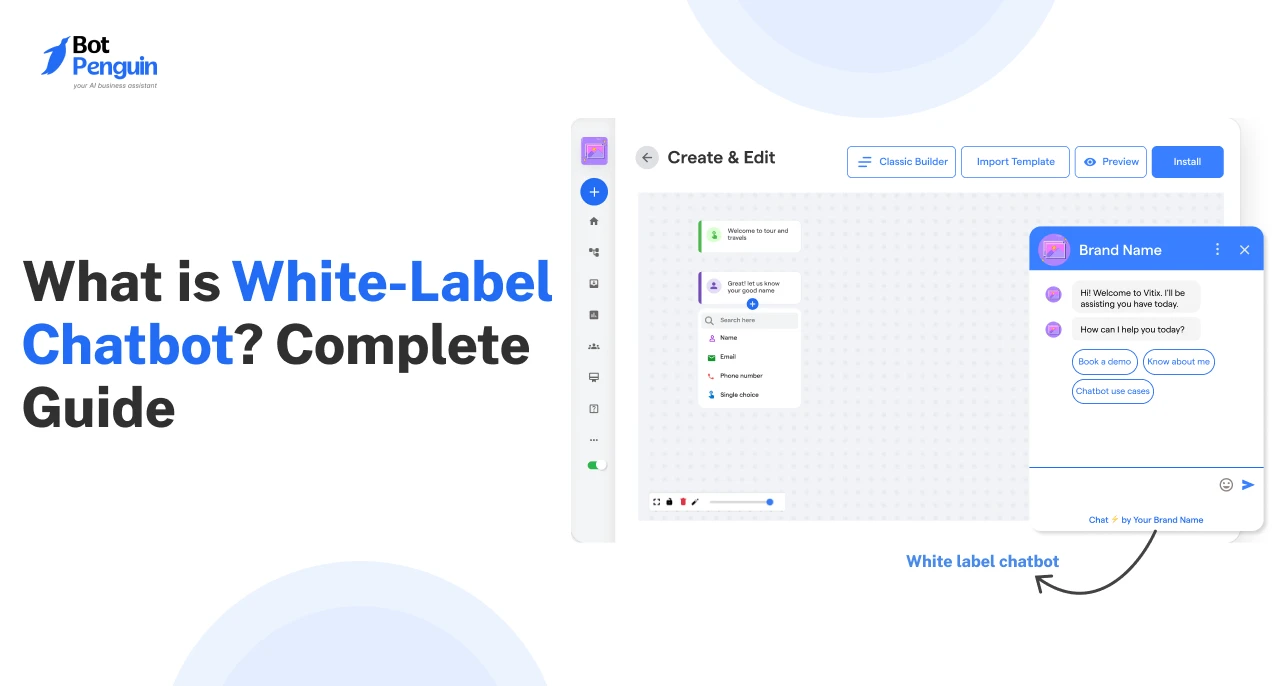
What is a White-Label Chatbot? Complete Guide For 2026
Updated at Oct 19, 2026
10 min to read
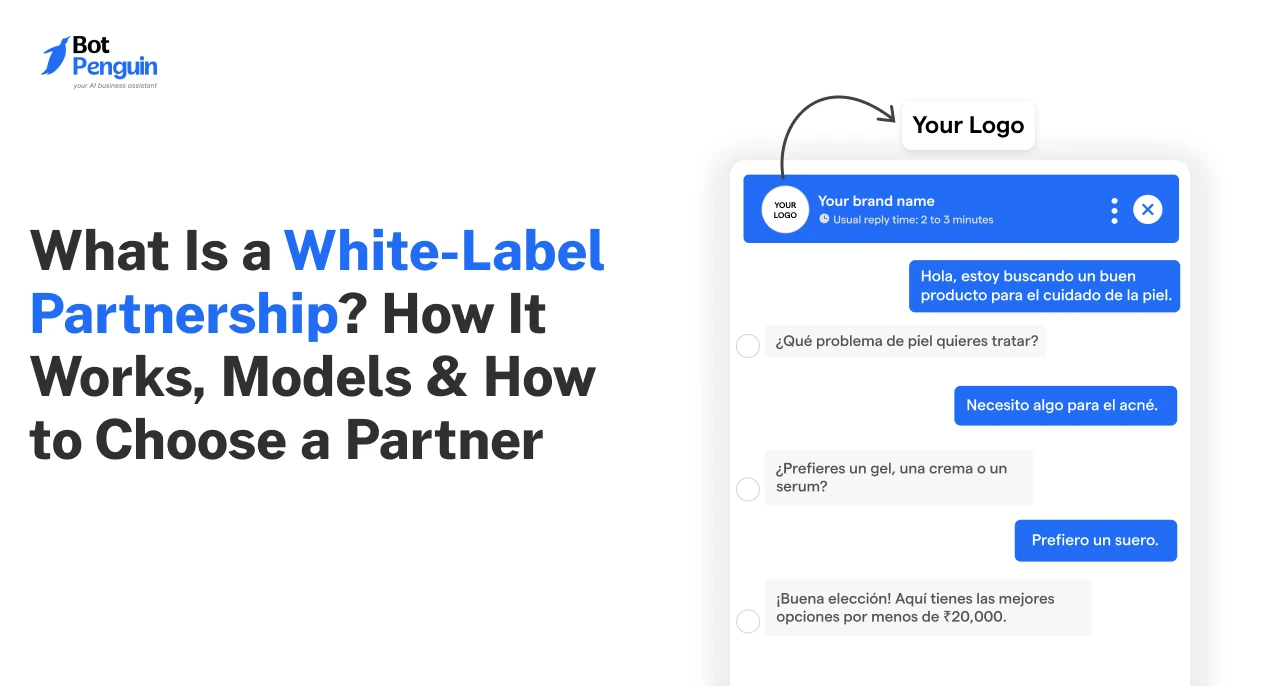
A white label partnership lets one company sell another company’s product or service under its own brand. In a white-label partner program, the vendor builds and maintains the product, while the partner controls branding, pricing, client relationships, and revenue margins without having to build from scratch.
Clients often ask for products your business does not offer. Building them from scratch takes time, money, and focus.
A white label partnership solves that gap.
Instead of building, you rebrand a finished product from a vendor. You sell it as your own. You keep the client relationship, pricing control, and recurring revenue share.
This model is common across agencies, SaaS firms, and consultancies. Many “branded” dashboards, chatbot tools, and service lines run this way.
When done well, white-label partnerships turn demand into margin. Done poorly, they create support issues, weak margins, and brand risk. This guide explains how white label partnerships work, their common models, benefits, risks, and business economics.
A white label partnership is a commercial agreement between two companies. One company builds the product or service. The other company rebrands it and sells it as its own.
The customer sees only the partner’s brand. The vendor stays behind the product. The vendor earns through licensing or wholesale pricing.
The partner keeps the margin and owns the customer relationship.
The term comes from white label. It refers to placing a blank label on a generic product. The reseller then prints its own brand on it.
In software, the product is not physical. The partner gets a rebrandable platform, logo, domain, and billing setup. Some partners also get branded apps, help docs, and client-facing dashboards.
A white-label partnership operates through a simple vendor-partner flow. The vendor builds the product. The partner brands it, sells it, and manages the client relationship.
The process usually works in four steps:
The customer buys from the partner and interacts with the partner’s brand, while the original vendor remains behind the product. The key point is client ownership.
In a true white label partnership, the client belongs to the partner. The vendor stays invisible. The partner owns the brand, pricing, support layer, and relationship.
A strong white label partner makes this feel seamless. Branded login, apps, invoices, and dashboards should all match the partner’s identity.
Now, let's understand how a formal white label partner program structures and supports this partnership.
A white label partner program is a structured system that helps businesses resell a vendor’s product under their own brand.
The partnership is the commercial arrangement between the vendor and the partner. The program is the framework that supports the partner in launching, selling, managing, and scaling the branded offer.
A strong program usually provides:
The vendor continues to manage product development, infrastructure, security, and updates. The partner controls the client-facing brand, packages, pricing, sales process, and customer relationship.
This makes a formal partner program more reliable than an informal resale agreement. It gives the partner the systems required to deliver a consistent branded experience and build recurring revenue without developing the underlying product.
To help you better understand how a white label partnership works, it is important to know how it differs from reseller, affiliate, and private label models. Each offers different levels of branding control, pricing flexibility, client ownership, and revenue potential.
The table below highlights these differences.
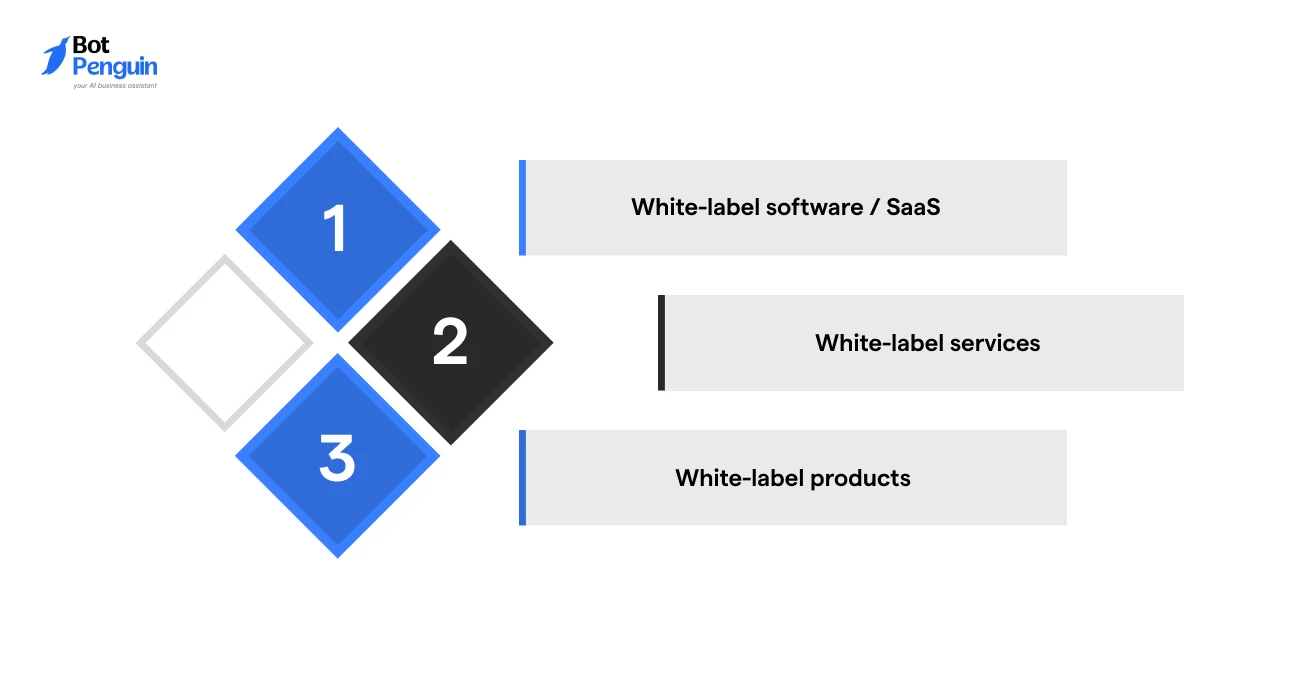
White label partnerships appear across software, services, and physical products. The basic model stays the same, but what the partner rebrands and delivers changes by industry.
The table below shows the main partnership types and how each works.
In B2B white-label software, SaaS is particularly scalable because there is no physical inventory and subscriptions generate recurring revenue. Agencies can offer a white label chatbot platform or a white label AI agent platform without developing the technology internally.
Different types of white label SaaS can support communication, automation, analytics, and other recurring software services.
Marketing agencies use a similar model to expand their service range. With white-label marketing, the agency keeps the client-facing brand, while a specialist provider handles fulfillment behind the scenes.
A single whitelabel partnership can therefore support an entirely new service or product line without requiring the partner to build the underlying capability itself.
White label partnerships help businesses launch new services, reach more clients, and generate revenue without developing their own software. Here are four examples of businesses that grew with BotPenguin:
Explore more success stories in our BotPenguin partner case studies.
Next, see why this model appeals to agencies and service businesses.
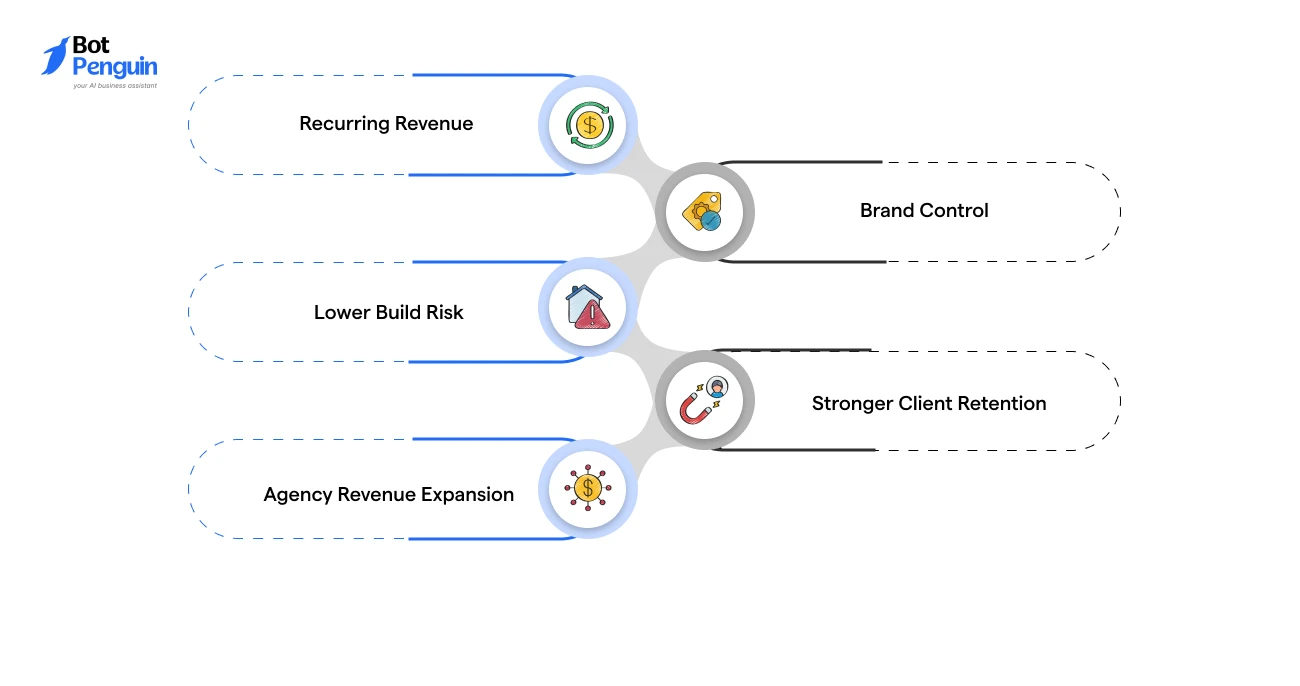
A white-label partnership helps partners increase revenue faster. The main benefit is speed with ownership. You sell under your brand without building the product yourself.
Key benefits include:
To know more about broader agency growth models, see our guide to the agency partner program.
Next, review the risks before choosing a partner.
White label partnerships can reduce build risk. But they still create brand, support, and margin risks.
The three risks below matter most before signing a vendor.
Your brand carries the vendor’s product. If it breaks, your client blames you.
Solution: Test the platform before committing. Check uptime, reliability, product depth, and roadmap clarity.
Slow vendor support becomes slow client support. This can damage client trust.
Solution: Choose a partner with dedicated onboarding and partner support. Avoid vendors that only offer end-user docs.
Hidden fees can reduce profit. Thin wholesale pricing can also limit growth.
Solution: Review pricing, usage limits, renewal terms, and upgrade costs before signing.
A white label agreement should clearly define client ownership, branding rights, support responsibilities, data handling, intellectual property, billing terms, and termination conditions.
It should also explain what happens to client accounts if the partnership ends. Partners should know how price changes will be handled and whether the vendor can contact their clients directly.
These terms matter because unclear ownership or communication boundaries can create disputes later. Review them before signing, especially when your own brand and customer relationships depend on the vendor.
Before entering a white label partnership, look beyond pricing and features. Watch for these warning signs that could affect your branding control, profit margins, and client relationships.
Review these terms before signing to protect your brand, maintain control over client relationships, and avoid unexpected costs.
Every risk comes back to partner selection. The wrong vendor can hurt your brand. The right vendor makes the risk manageable.
Next, see how the white label partnership business model generates revenue.
The white-label partnership business model is based on margins. The partner pays the vendor a wholesale or license fee. Then the partner sells the product at its own retail price.
The difference becomes the partner’s margin. If the client stays, that margin repeats every month.
This explains how whitelabel works as a business model: the vendor powers the product, while the partner owns the branded offer, pricing, and client relationship.
The table below shows how the basic economics work.
Example (illustrative): A partner pays $1,500 per year for a platform license and signs five clients at $300 per month each.
Annual revenue is $18,000. After deducting the $1,500 platform license, $16,500 remains before usage charges, client support, and other operating expenses.
Margins can improve as the partner adds more clients. Costs often stay predictable, while pricing remains under the partner’s control.
In B2B white label software, this model works well. Partners can manage subscriptions, local payments, flexible plans, and add-ons.
This makes white-label stronger than one-time commissions. You build a branded revenue asset, not just a referral stream.
Next, see how to start a partnership step by step.
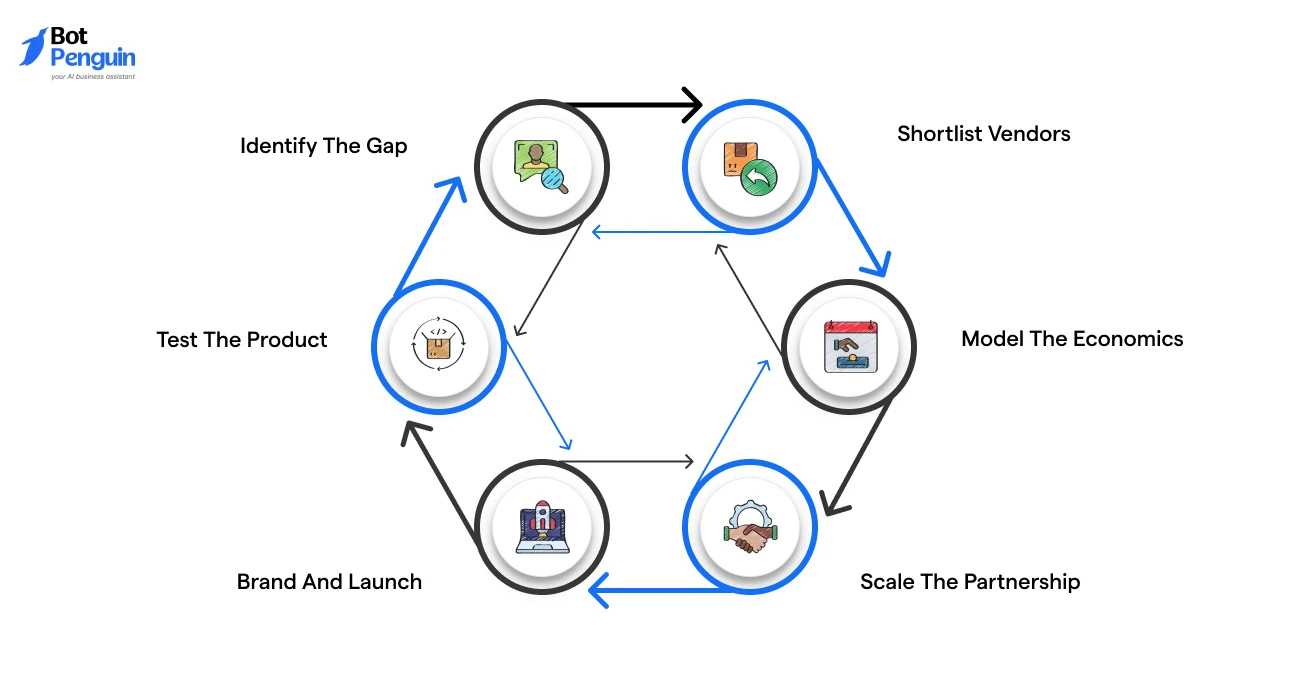
A white label partnership should start with client demand. Do not begin with the vendor. Begin with the gap your clients already mention.
The steps below show how to move from demand to launch.
1. Identify The Gap
List the services or products clients keep requesting. Choose the gap with clear demand and repeat revenue potential.
2. Shortlist Vendors
Compare vendors using branding depth, margin clarity, and partner support. A strong white label partner should make client delivery easier, not riskier.
3. Test The Product
Run a real pilot before selling it widely. Use the platform as a client would for 1-2 weeks before committing.
Check uptime, support response time, and whether the branding tools cover your client-facing needs.
4. Model The Economics
Compare wholesale cost, retail pricing, setup fees, and expected client volume. This helps you avoid weak margins.
5. Brand And Launch
Add your logo, domain, pricing, packages, and support process. Start with existing clients before targeting cold prospects.
6. Scale The Partnership
Once the offer works, expand into more clients or markets. You can also build sub-partners or resellers if the platform supports it.
Starting small keeps the launch controlled. Once the model proves profitable, scaling becomes easier.
AI services are well suited to white label partnerships because agencies can offer advanced solutions without developing the underlying technology themselves.
For example, BotPenguin’s white-label partner program lets agencies, consultancies, and software businesses launch branded AI services while BotPenguin manages the platform and infrastructure behind them.
Partners can build their offer around solutions such as a white-label chatbot platform or white-label AI agents, depending on the services they want to sell.
This approach helps partners move to market faster while keeping control over their brand, pricing, and customer relationships.
A white label partnership is when one company builds a product, and another sells it under its own brand. The vendor stays behind the scenes. The partner adds its name, logo, and pricing. The partner owns the client relationship and keeps the margin.
White-label partners make money from the pricing gap. They pay the vendor a wholesale or licensing fee, then charge clients their own retail price. The difference becomes recurring margin. Strong programs also support subscriptions, local billing, add-ons, and flexible client packages.
Usually, no. In a white label partnership, the vendor handles hosting, product development, security, and updates. The partner handles branding, sales, pricing, and client relationships. Some technical comfort helps during setup, but the partner does not need to build the product.
There is no fixed split. The partner usually pays a wholesale or license fee and charges clients a markup. That spread becomes recurring margin. Because the partner controls pricing, margins can grow through packaging, add-ons, higher-value plans, and larger client accounts.
Yes. White labeling is generally legal when the provider gives another business permission to rebrand and resell its product or service. The agreement should clearly define branding rights, intellectual property, customer responsibilities, and applicable compliance requirements.
Profit depends on provider costs, client pricing, operating expenses, and customer retention. There is no fixed earnings level because margins vary by offer and business model. See the revenue model of chatbot reselling partnerships for a deeper breakdown.
Costs can be based on an annual platform license, per-client pricing, usage-based charges, wholesale pricing, or a combination of these models. The exact structure depends on the provider. See the white-label pricing page for BotPenguin's region-specific options.
White label partners depend on another company for product quality, infrastructure, updates, and sometimes technical support. Because clients see the partner's brand, vendor problems can also affect the partner's reputation, margins, and customer relationships.
A white label partnership helps businesses add branded products or services without developing the underlying technology themselves. The model can support recurring revenue, faster market entry, and stronger ownership of customer relationships.
Its success depends on clear economics, reliable infrastructure, defined responsibilities, and a product that can be delivered consistently under the partner’s brand.
For businesses exploring AI as a white-label offering, BotPenguin’s partner program provides a way to launch branded AI services while BotPenguin manages the underlying platform.
Subscribe to Our Newsletter
Get the latest business insights straight into your inbox.
Checkout our related blogs you will love.
Updated at Oct 19, 2026
10 min to read

Updated at Oct 9, 2026
12 min to read
Updated at Oct 7, 2026
15 min to read
Updated at Oct 6, 2026
9 min to read
Updated at Oct 1, 2026
11 min to read
Updated at Sep 28, 2026
19 min to read
Table of Contents
