





10 Best Automotive Chatbot Platforms for Dealerships in 2026
Updated at Sep 24, 2026
8 min to read
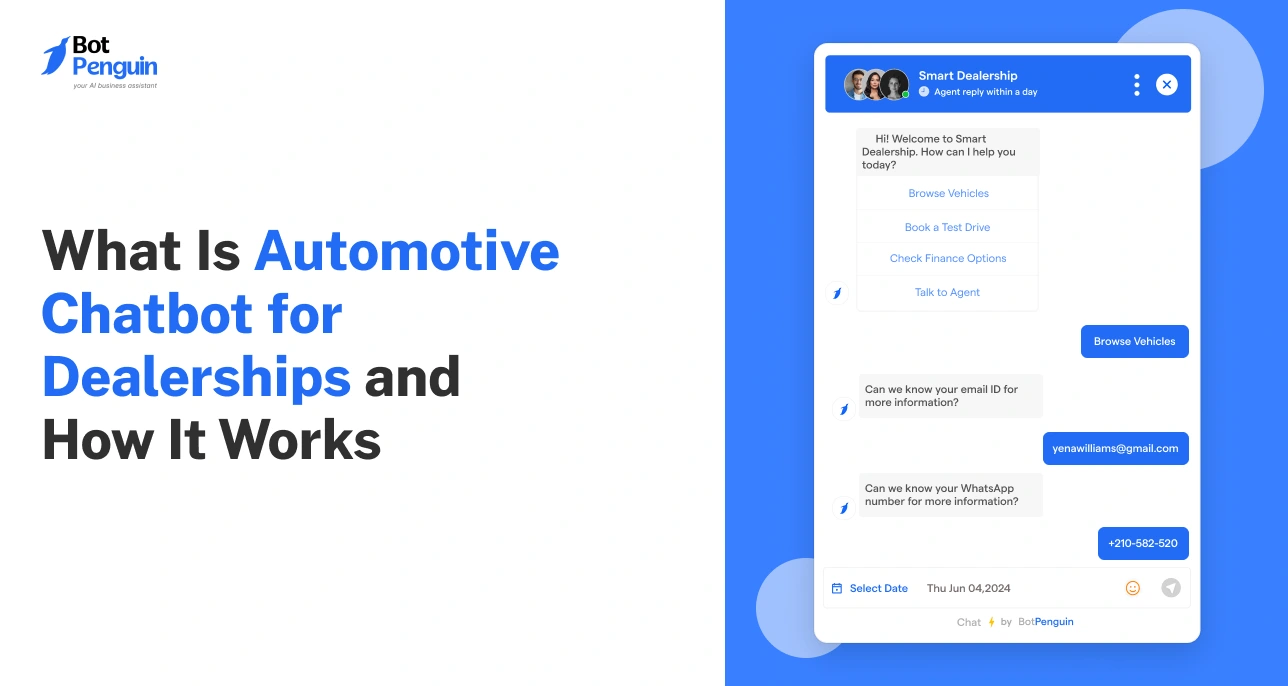
Automotive chatbots are AI-powered assistants that answer vehicle questions, qualify leads, book test drives, and schedule service across websites and messaging channels. They work by understanding customer intent, retrieving relevant data from connected systems, guiding each conversation toward the next step, and handing complex requests to dealership staff when needed.
Car buyers now research models, compare prices, check availability, and ask detailed questions online before visiting a showroom. That makes response speed and accurate information important across both sales and service conversations.
Brands such as Toyota already use AI chatbots to support vehicle consideration and customer engagement.
Dealerships can use similar workflows to answer recurring questions, capture buyer details, and keep conversations moving outside normal business hours.
In this guide, you’ll learn how automotive chatbots work, the technology behind them, common use cases, deployment mistakes, and real examples.
If you’re evaluating a solution for a dealership, see BotPenguin’s automotive chatbot for car dealerships for commercial capabilities and implementation options.
Car buyers rarely limit research to dealership hours. When inquiries sit unanswered overnight, buying intent cools and competitors get another chance.
A 2026 study of 200 dealerships found that 67% of leads submitted after 5 p.m. waited until the next business day for a live call, with an average delay of 14 hours and 22 minutes. (Source: Ringlead Dealer Response Index, 2026)
That response gap created a clear need for AI chatbots in automotive sales.
These gaps explain why dealerships began turning to AI chatbots to keep sales and service conversations moving beyond business hours.
If you are looking to keep dealership conversations moving after hours, BotPenguin can capture leads, answer buyer questions, qualify prospects, and book test drives across your key channels.
Next up, we’ll understand what an automotive chatbot actually is and how it works.
An automotive chatbot is an AI-powered tool on a dealership's website or app that answers vehicle questions, collects buyer details, and books test drives or service appointments without waiting for staff.
Brands like BMW and MINI already use AI-based assistants across their websites and apps to answer product, service, and vehicle-related customer questions around the clock.
How Do Automotive AI Chatbots Work Behind the Scenes?
Before we dive into specific automotive chatbot use cases, let’s look at how a typical chatbot works behind the scenes:
Understanding the mechanics behind that experience means looking at the technology stack that makes it possible.
Behind the everyday conversations on automotive chatbots is a connected technology stack that helps the chatbot understand buyers, retrieve dealership data, and take relevant actions.
Here’s the core tech stack powering these AI assistants:
Together, these technologies turn a simple chat interface into a dealership assistant that can answer questions, capture intent, and move buyers toward the next step.
The real value appears in moments that usually slow a buyer or service customer down. These examples show how chatbots for the automotive industry support qualification, scheduling, financing conversations, and service follow-up.
The chatbot asks about budget, preferred model, and purchase timeline early in the conversation.
It scores each buyer based on these answers. Sales reps get a ranked list of hot prospects. This means less time chasing browsers and more time closing serious buyers.
A real example is Galaxy Toyota, which used BotPenguin to generate 800+ qualified leads and automatically transfer captured buyer data into Bitrix CRM.
A buyer picks a vehicle, and the chatbot checks real-time slot availability at the nearest showroom.
It confirms the booking without a phone call. Reminders go out closer to the appointment. This keeps drop-off rates low and showroom calendars full.
Existing car owners describe their issue in plain language, and the chatbot suggests the right service type.
It checks bay availability and confirms a slot. Reminders reduce missed appointments. Service advisors walk in already knowing what the customer needs.
Buyers often stall because they don't know what their current car is worth. The chatbot asks for make, model, year, and mileage, then shares an estimated trade-in range.
This removes a major hesitation point early, keeping buyers engaged instead of comparing elsewhere.
Many buyers hesitate over financing before they ever mention it out loud.
The chatbot asks a few basic questions about financing preferences and down payment, then routes the buyer to the appropriate finance team or connected financing workflow.
This gives sales teams a financially ready buyer before the first showroom visit happens.
Cox Automotive found that 48% of buyers wanted to apply for credit online, while only 33% actually completed that step online. (Source: Cox Automotive, 2025)
Dealerships often lose service revenue simply because owners forget maintenance schedules. The chatbot tracks service history and sends reminders when a car is due, along with any active recall notices.
This keeps the service bay full without waiting for customers to remember on their own.
Together, these use cases turn a chatbot into a revenue driver, closing gaps that used to mean lost leads or empty service bays.
Automotive chatbot workflows can also extend beyond dealerships. Rental businesses can adapt similar availability and booking flows with a car rental chatbot template.
What Features Make Automotive Chatbots Work Reliably?
Beyond answering questions, the right solution should connect with existing systems, maintain buyer context, and give dealership teams control over conversations and customer data.
Here are the top features teams should look for:
A strong automotive chatbot should connect directly with the dealership’s DMS and CRM.
It should sync lead details, vehicle interests, appointments, and conversation history automatically, so sales and service teams receive complete context without manually copying information between disconnected systems.
Inventory-aware conversations let the chatbot answer questions using current vehicle data instead of static scripts.
It should recognize models, trims, pricing, availability, and relevant specifications, helping buyers narrow choices while reducing the risk of recommending vehicles that are no longer available.
Buyers may contact a dealership through its website, WhatsApp, Facebook, Instagram, or other messaging channels.
A capable chatbot should maintain consistent responses and context across those channels, so customers can continue conversations without restarting or repeating information each time they switch.
The chatbot should recognize when a buyer needs a salesperson or service advisor, then transfer the conversation with the collected history, vehicle interest, and intent intact.
This prevents customers from repeating everything after escalation.
Automotive chatbots collect names, phone numbers, financing interests, vehicle details, and other customer information.
Look for clear consent controls, role-based access, secure data handling, and configurable retention practices so the dealership can manage customer conversations without creating unnecessary privacy or compliance exposure.
A dealership should be able to see what happens after conversations begin.
Useful analytics should track lead sources, common questions, qualification outcomes, bookings, handoffs, and unresolved intents.
This helps teams identify where buyers drop off and where chatbot workflows need improvement.
These features determine whether a chatbot can support real dealership workflows reliably, rather than simply answering basic customer questions.
Want to compare available solutions? See the best automotive chatbot platforms and how their capabilities differ.
How Does BotPenguin Support Automotive Chatbot Workflows?
BotPenguin is one example of how an automotive chatbot platform can combine no-code building, omnichannel deployment, integrations, AI knowledge, analytics, and human handoff. The capabilities below map to the sales and service workflows explained earlier in this guide:
Explore more of BotPenguin’s chatbot features for building, training, and managing customer conversations.
These capabilities show how one platform can support lead capture, appointment booking, and follow-up while using the same workflow principles explained throughout this guide.
Still unsure if BotPenguin is right for your dealership? See what existing businesses say in BotPenguin reviews.
What Mistakes Should Dealerships Avoid With Automotive Chatbots?
Even a capable automotive chatbot can underperform when the deployment is poorly configured.
Most problems come from weak integrations, unclear handoff rules, or workflows that ignore how dealership buyers actually behave.
The chatbot quotes a model or trim that sold out days ago, and the buyer shows up for nothing.
Solution: Set a sync frequency tied to how fast stock actually turns, not a default daily refresh, since hot-selling trims need hourly checks while slow movers don't.
The chatbot passes every captured contact to sales as equally urgent, burying the buyers who are actually ready.
Solution: Route leads by a decay score that drops the longer a buyer stays inactive, so a hot lead from an hour ago always ranks above a warm one from three days back.
The chatbot keeps trying to answer complex trade-in or financing questions instead of looping in a rep.
Solution: Define handoff triggers around specific buyer signals, like mentioning a competitor's offer or asking for a discount, not just message count or wait time.
The chatbot confirms a test drive or service slot and the conversation just ends there.
Solution: Trigger a pre-visit checklist message, like documents to bring or a parking note, a few hours before the appointment to cut same-day no-shows.
The same chatbot flow runs on WhatsApp, website, and Instagram with no adjustment for how people behave on each.
Solution: Shorten response length and add more quick-reply buttons on WhatsApp and Instagram specifically, since typing feels more effortful there than on a desktop chat window.
The dealership tracks bookings made but never reviews where buyers abandon the chat before finishing.
Solution: Pull a weekly drop-off report by question step, not just by channel, since one confusing question, like an unclear budget range, often accounts for most of the loss.
Avoiding these mistakes helps dealerships turn chatbot automation into a more reliable part of the sales and service journey.
A buyer does not stop comparing cars when the dealership closes. That is why response speed, clear information, and simple next steps matter so much.
An automotive chatbot helps keep that journey moving. It can answer common questions, capture buying intent, connect with dealership systems, and guide customers toward a test drive or service booking.
But the real value comes from how well it fits the dealership. A strong car dealership chatbot should support real workflows, not just conversations.
The same applies to a test drive booking chatbot. Choose tools that lower friction where buyers are most likely to drop off.
An automotive chatbot is an AI-powered assistant that answers vehicle questions, qualifies leads, books test drives, schedules service appointments, and supports buyers across dealership websites and messaging channels, including outside normal business hours.
Yes. When connected to inventory data, an automotive chatbot can answer questions about available models, trims, pricing, and stock status, helping buyers get current information without waiting for a salesperson to respond.
Yes. An automotive chatbot can check available showroom slots, collect buyer details, and confirm a test drive inside the conversation, reducing the back-and-forth that often slows appointment booking for dealership teams.
Yes. Customers can describe their service need, share vehicle details, choose an available time, and receive confirmation through the chatbot, making routine service scheduling faster and easier outside dealership hours.
Yes. Automotive chatbots can connect with CRM and DMS systems to sync qualified leads, appointment details, vehicle interests, and conversation context, so sales and service teams can continue follow-up without re-entering information.
Yes. An automotive chatbot can collect vehicle details such as make, model, year, and mileage, then connect with valuation tools or dealership systems to provide an estimated trade-in range instantly.
Yes. Automotive chatbots can respond to inquiries after business hours, qualify buyers, capture contact details, and route high-intent leads for follow-up, helping dealerships avoid leaving active prospects unanswered overnight or until morning.
An automotive industry chatbot template should cover vehicle questions, lead qualification, test-drive booking, CRM or inventory connections, service scheduling, human handoff, and follow-up. Adapt the flow to the dealership, rental business, or automotive service use case instead of treating it as a fixed script.
Subscribe to Our Newsletter
Get the latest business insights straight into your inbox.
Checkout our related blogs you will love.
Updated at Sep 24, 2026
8 min to read
Updated at Oct 7, 2026
12 min to read
Updated at Oct 7, 2026
13 min to read
Updated at Oct 7, 2026
9 min to read
Updated at Oct 6, 2026
10 min to read
Updated at Oct 6, 2026
17 min to read
Table of Contents