


Top Real Estate AI Chatbot Platforms to Capture, Qualify, and Convert Property Leads Faster
Updated at Sep 25, 2026
12 min to read
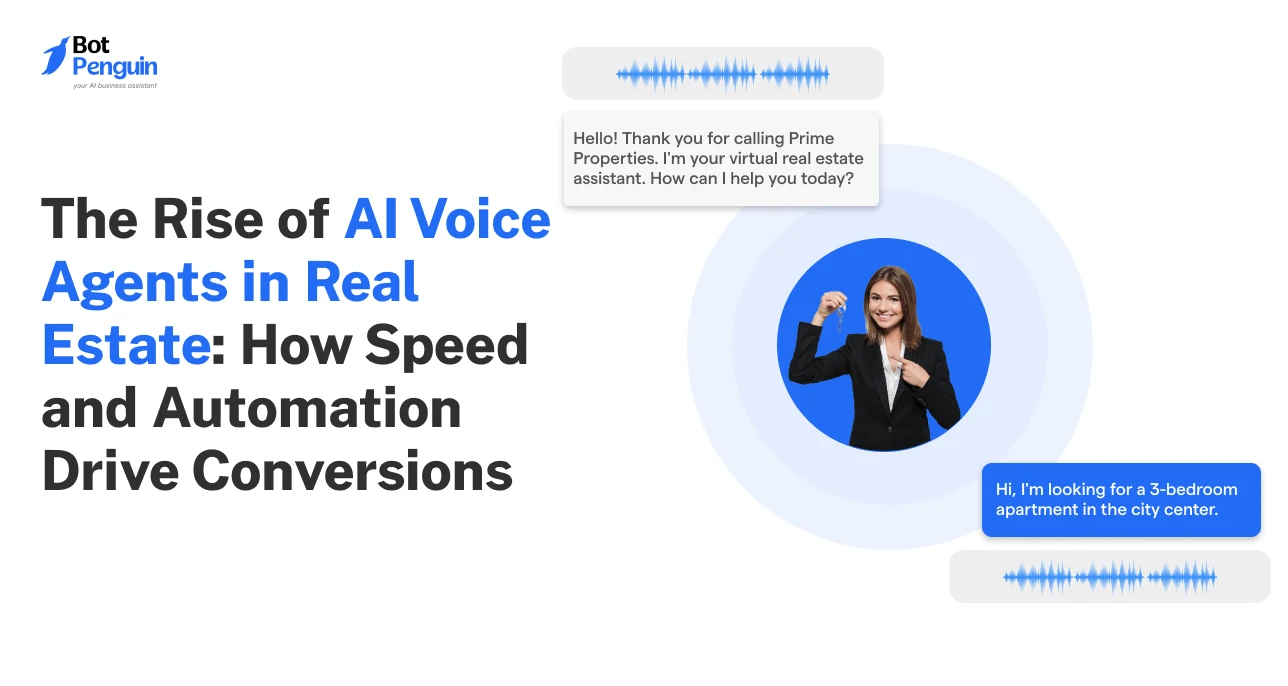
An AI voice agent for real estate handles property calls by answering questions, qualifying buyers or tenants, booking showings, and recording key details. It gives brokerages a way to manage phone inquiries even when agents are unavailable.
As AI voices sound more human, real estate is starting to sound different too.
Today's buyers and tenants want answers before they want a salesperson. They call with simple questions, ask about properties, check availability, and decide in seconds whether to stay on the line.
If nobody picks up, they move on to the next listing.
That's where voice AI for real estate gets interesting. Instead of a missed call or a hold queue, an AI voice agent picks up within seconds, understands what the caller wants, qualifies the lead, answers property questions, and books the next step.
In this guide, you'll learn how an AI voice agent for real estate works, where it fits into your buyer and tenant workflows, and what to consider before choosing one for your business.
An AI voice agent for real estate is software that answers property calls the way a trained agent would, understanding the caller's intent, answering questions about listings, qualifying the lead, and booking a viewing.
It runs around the clock, can handle concurrent calls depending on configured capacity, and hands off to a human only when the conversation needs one.
In 2026, CallRail found that real estate teams miss about 45% of inbound calls, showing how easily property inquiries become lost opportunities. (Source: CallRail, 2026)
Missed calls can create avoidable gaps across lead capture, follow-up, and booking opportunities.
Coverage Gaps: Calls often come in during showings, after hours, or on weekends when agents are unavailable.
Qualification Delays: Important details like budget, location, and timeline remain unknown until someone follows up manually.
Scheduling Friction: Interested buyers may need multiple callbacks before a viewing time is finally confirmed.
Lost Call Context: Without a clear call record, agents may follow up without knowing what the prospect already asked or needs.
Thus, for brokerages handling calls during showings, weekends, and peak hours, voice AI helps close those gaps before leads move elsewhere.
For broader lead capture, qualification, and viewing-booking workflows across channels, explore BotPenguin's real estate chatbot solution.
When you decide to adopt voice AI for your operations, the mechanics are simpler than they may seem.
The agent listens, understands, responds, and takes the right action based on the caller’s needs.
Here's exactly what happens between the first ring and the booked showing:
A buyer or tenant dials the number listed on a property ad, website, or portal.
There’s no hold music, no routing menu, no “please leave a message”. The call connects directly to the voice agent, including during after-hours periods.
The agent picks up within seconds and opens with a natural, conversational greeting, not a robotic script.
It sounds present and unhurried, setting the tone for a real conversation rather than an automated menu the caller has to fight through.
Using the caller's phone number, the ad source, or a quick spoken question, the agent pinpoints which property or listing prompted the call.
This context shapes everything that follows, so the conversation stays specific instead of generic.
The agent naturally works through budget, timeline, move-in date, financing status, or tenant requirements, whatever the brokerage defines as must-know fields.
It reads answers conversationally, not as a rigid checklist, so the call still feels human.
Once qualified, the agent pulls real-time availability from the connected calendar and offers open slots directly on the call.
No back-and-forth emails, no "let me check and get back to you", just immediate scheduling.
The caller picks a slot, and the agent confirms it on the spot, verbally and via a follow-up text or email.
The showing is locked in before the call even ends, with zero manual coordination required.
Every detail: qualification answers, showing time, caller intent, gets pushed into the CRM automatically.
Nothing sits in a notepad or gets forgotten between calls. Agents open their pipeline already knowing who's coming and why.
This covers the phone channel specifically. If most leads reach you through text, see our real estate AI chatbot guide for chat-based lead qualification, property discovery, and booking workflows.
If a caller asks something outside the agent's scope, negotiates price, or simply wants a person, the AI recognizes the cue and transfers smoothly to a human agent, with full context already passed along.
The conversation changes depending on who is calling, what they need, and how far they are from making a decision.
That is what makes voice AI useful in real estate: the same call flow can adapt without forcing every caller through the same script.
Every voice agent claims to "understand callers and book showings”.
Here are the features that actually separate a usable one from a gimmick:
The agent should answer within seconds, including during busy periods and after hours.
A slow pickup defeats the entire purpose of having an always-on front desk in the first place.
The underlying speech engine determines how naturally the agent understands callers and how human it sounds when responding.
This single layer often decides whether a caller trusts the agent or hangs up within seconds.
A good agent handles off-script questions and follow-ups mid-call, not just a fixed decision tree of scripted responses.
This is what allows it to sound like a knowledgeable agent instead of an automated phone tree.
Every call detail, qualification answers, showing time, and caller intent should sync to the CRM automatically and in real time.
This enables agents to walk into their pipeline already knowing exactly who called and what they need.
If your need extends beyond phone calls into autonomous multi-step work, see how an AI agent for real estate handles broader workflows.
The agent should switch naturally between languages mid-call based on caller preference, especially in diverse buyer markets where a single listing can attract callers from several different linguistic backgrounds.
The agent should recognize negotiation, complaints, or out-of-scope questions and transfer to a human with full context intact.
The caller never has to repeat information they already gave the agent minutes earlier.
The right voice agent should do more than answer calls. It should keep conversations moving while giving your team the context to take over when needed.
For teams focused specifically on outbound prospecting, see how AI cold calling for real estate can support first-touch outreach, lead qualification, and follow-up at scale.
Even a strong voice agent underperforms when it's set up wrong. Here are the pitfalls brokerages run into most, and how to avoid them.
Mistake: Many teams configure the agent with rigid, scripted paths. This makes it feel like the same frustrating phone tree it was meant to replace.
Solution: Configure it to handle open-ended questions and follow-ups. Let callers speak naturally instead of navigating fixed prompts.
Mistake: Some brokerages run the voice agent standalone, disconnected from the CRM. Qualified leads sit in a separate dashboard nobody checks.
Solution: Integrate the agent directly with your CRM from day one. Every call detail should land where your team already works.
Mistake: Teams often test the agent once, in a neutral accent, and assume it works everywhere. It rarely performs the same with real regional speech.
Solution: Test with real callers across every region and dialect you serve. Do this before going live, not after.
Mistake: Without clear rules for escalation, the agent either transfers too often or not enough. Both frustrate callers and mishandle sensitive conversations.
Solution: Set explicit handoff triggers for pricing, complaints, and legal questions. The agent should know exactly when to bring in a human.
Mistake: Some deployments collect financial and personal details without clear consent or retention policies. This creates real compliance exposure fast.
Solution: Confirm data storage, consent language, and retention policies meet local regulations. Do this before the agent goes live.
Mistake: Teams often deploy once and leave the agent untouched for months. Missed intents and awkward exchanges quietly pile up unnoticed.
Solution: Review call transcripts and outcomes regularly. Retrain the agent on gaps so it keeps improving over time.
A successful deployment depends as much on setup and ongoing review as the technology itself.
Avoiding these mistakes helps the voice agent stay useful, accurate, and connected to how your brokerage actually works.
For real estate teams, a voice agent has to do more than answer calls. It needs to qualify callers, support bookings, and keep every conversation connected to the existing sales workflow.
Here’s why BotPenguin’s Voice AI Agent fits real estate teams that need faster call handling without disrupting existing workflows.
BotPenguin Voice AI Agents can handle interruptions and changing topics during a call.
This helps buyer and tenant conversations feel less like a fixed phone menu.
BotPenguin supports voice AI integrations such as OpenAI, Deepgram, ElevenLabs, and Hume AI.
This gives teams flexibility across AI, transcription, and voice technologies.
The voice agent can connect with CRM and helpdesk tools to access or update records during calls.
Qualified lead details can therefore stay connected to the systems agents already use.
BotPenguin currently supports voice conversations across more than 30 languages.
This can help brokerages handle inquiries from buyers and tenants with different language preferences.
Teams can define when the voice agent should transfer a conversation to a person.
This is useful for negotiations, complex property questions, or situations requiring agent involvement.
Completed calls appear in the dashboard with call activity and outcomes, giving teams a clearer view of what happened before follow-up begins.
For brokerages, this means the voice layer can work alongside their existing sales process instead of becoming another disconnected calling tool.
Thus, with BotPenguin, brokerages can handle multilingual calls, connect voice agents with CRM systems, transfer complex inquiries to human agents, and track call outcomes.
You can also review BotPenguin’s Security and Trust framework before deployment. For real customer experiences, explore BotPenguin testimonials and case studies.
Real estate calls often come in when agents are busy, off-site, or unavailable. That is where an AI voice agent for real estate can make a practical difference.
It can answer calls, qualify leads, book showings, and record key details without adding more work for the team. It can also hand over complex conversations when human input is needed.
The goal is not to replace real estate agents. It is to make sure valuable calls do not get lost between showings, meetings, and after-hours inquiries.
If missed calls are affecting your pipeline, explore how BotPenguin Voice AI Agents can support your team.
An AI voice agent for real estate answers or places property calls, understands caller intent, qualifies buyers or tenants, books showings, and records conversation details without requiring a human to handle every call.
It answers incoming calls, identifies what the caller needs, asks qualifying questions, provides relevant information, schedules next steps when possible, and records the conversation for follow-up by the brokerage team.
Yes. When connected to the brokerage’s calendar, a voice agent can check available time slots, offer suitable options during the call, confirm the selected showing, and record the appointment automatically.
Yes, if the required CRM integration is configured. Call details, qualification answers, contact information, and next steps can be recorded in the CRM so agents have context before following up.
A voice agent handles spoken phone conversations, while a real estate chatbot handles text-based conversations on websites or messaging channels. Both can qualify leads, but they operate through different communication channels.
No. Voice agents are better suited to repetitive call handling, qualification, scheduling, and basic inquiries. Human agents remain important for negotiations, complex questions, relationship building, and decisions requiring professional judgment.
It depends on the system’s concurrency limits and configuration. Many voice AI platforms can manage multiple calls simultaneously, helping brokerages cover busy periods when human teams cannot answer every incoming call.
Capture More Real Estate Leads With AI Voice Agents
Answer buyer and tenant calls, qualify prospects, book property viewings, and route complex inquiries to your team with AI-powered voice conversations.
Start NowCheckout our related blogs you will love.
Updated at Sep 25, 2026
12 min to read
Updated at Sep 25, 2026
14 min to read

Updated at Sep 24, 2026
8 min to read
Updated at Sep 17, 2026
15 min to read
Updated at Sep 16, 2026
12 min to read
Updated at Oct 19, 2026
11 min to read
Table of Contents