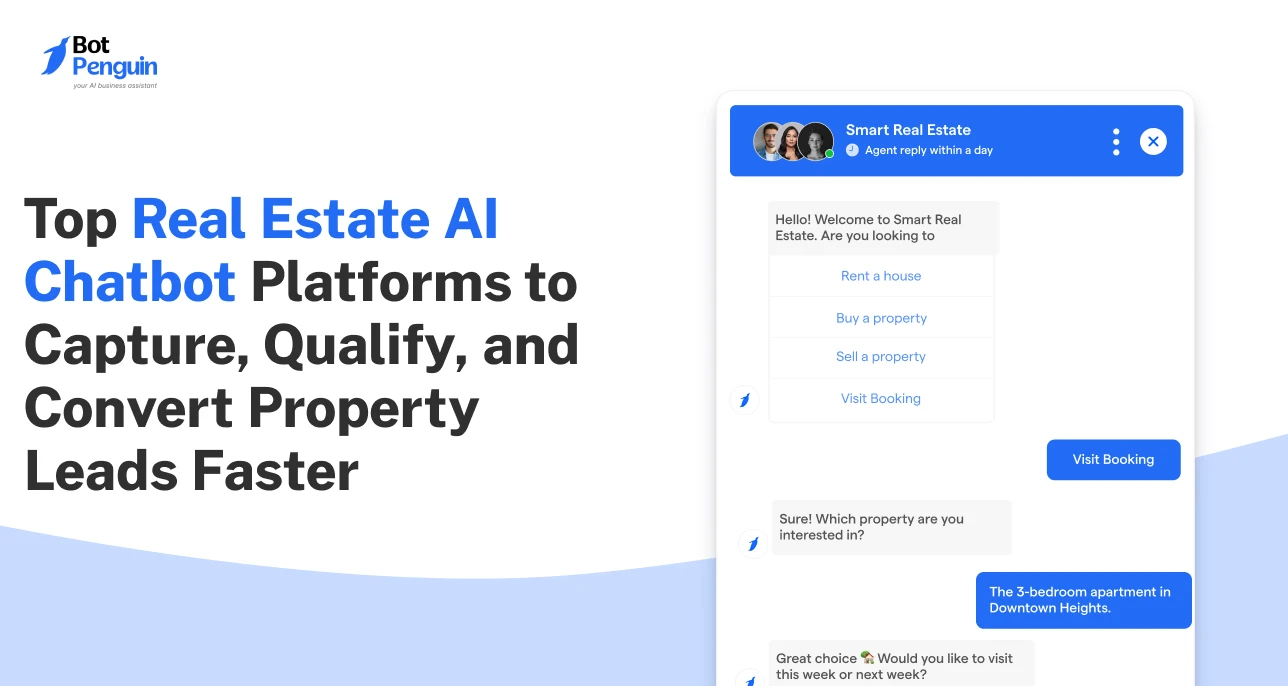
Top Real Estate AI Chatbot Platforms to Capture, Qualify, and Convert Property Leads Faster
Updated at Sep 25, 2026
12 min to read
An AI agent for real estate can handle connected tasks with limited human input. It can qualify leads, update CRM records, send follow-ups, schedule showings, and escalate complex cases. Unlike an AI real estate assistant or chatbot, it can continue across multiple steps instead of waiting for a new prompt or following only fixed conversation flows.
AI for real estate agents now covers far more than just writing support. It includes tools that draft content, answer questions, qualify leads, and automate connected workflows.
This guide focuses on AI agents that go beyond simple assistance. They can move work forward across multiple steps with defined guardrails.
The key question is simple: what changes when AI starts completing parts of the workflow?
In real estate, that can mean handling leads, updating CRM records, sending follow-ups, scheduling showings, and escalating complex cases. Understanding that shift helps brokerages decide where autonomous AI fits and where human judgment should remain essential.
An AI agent for real estate is software designed to pursue a defined goal across connected steps. It does more than answer a question or fulfill a single request.
The key difference is continuity. An AI agent can use available context, decide what should happen next, and take an appropriate action.
For example, a buyer may ask about a property. A basic tool might answer the question and stop there. An AI agent can continue working toward the broader goal without restarting the process each time.
This usually involves three core abilities:
Reasoning: Understanding the situation and deciding the next step.
Action: Carrying out approved tasks instead of only suggesting them.
Context: Using earlier information to keep later actions relevant.
AI agents also operate within defined guardrails. Those rules determine what the agent can handle independently and when it needs human involvement.
The following sections show how that works across real estate workflows.
An AI real estate assistant, chatbot, and AI agent serve different purposes. The main difference is how much work each can complete independently.
An assistant supports individual tasks when prompted. A real estate AI chatbot focuses mainly on conversations. An AI voice agent for real estate extends conversational automation to phone-based interactions.
An AI agent can continue working toward a defined outcome across connected steps.
The right choice depends on the job being automated.
An AI real estate assistant is best suited to tasks where the realtor remains in control. A chatbot suits structured interactions with prospects and clients. An AI agent is well-suited to situations where work must continue beyond a single response.
The distinction is simple: an assistant helps you work. A chatbot handles a conversation. An AI agent can continue the work after the conversation.
That difference becomes clearer when you look at how an AI agent decides, acts, and moves through a connected real estate workflow.
AI agents for realtors follow a simple cycle rather than acting randomly. They understand the goal, use available context, decide what should happen next, and take action within set limits.
The following steps show how that cycle works across connected real estate workflows.
Every workflow begins with a clear outcome. That could mean qualifying an inquiry or advancing a prospect.
The agent first identifies what needs to happen. It does not treat every message as an isolated request.
Next, the agent considers the information already available.
That context may include:
Property inquiry
Budget
Preferred location
Buying timeline
Previous responses
Existing CRM information
This helps the agent avoid unnecessary questions. It also keeps later actions relevant to the prospect.
The agent then determines what should happen next.
It may ask for missing information or continue the workflow. Other actions can include qualification, follow-up, scheduling, or escalation.
The choice depends on the goal, context, and configured rules.
An AI agent becomes more useful when it can take action. This often requires integrations with existing business systems.
These can include CRMs, calendars, websites, and messaging channels.
Not every decision should happen automatically. Guardrails define what the agent can handle on its own.
After each action, the agent checks whether it reached the goal. It can then continue, stop, or involve a realtor.
This operating cycle explains the mechanics behind AI for real estate agents. Its practical value becomes clearer when applied to specific tasks across a realtor’s daily workflow.
The practical value of AI for real estate agents becomes clearer through everyday workflows. A capable AI agent for real estate can coordinate several tasks rather than handling each one separately.
These nine use cases show where that connected approach can reduce repetitive work.
AI agents can collect the information needed to understand a new prospect.
That may include:
Budget range
Preferred location
Property type
Buying or selling timeline
Financing readiness
Buying or selling intent
The agent can use those answers to continue the qualification process. Realtors receive more context before entering the conversation.
Not every inquiry requires the same response or urgency.
Qualification data can help determine which leads need faster attention. A prospect ready to buy soon may require different follow-up than an early-stage researcher.
The agent can route or flag leads based on defined criteria. This helps teams focus human attention where it matters most.
Property inquiries often involve repeatable questions.
AI agents can help answer questions about:
Availability
Property details
Viewing information
Location
Basic listing information
Common process questions
If the request moves beyond approved information, the agent can involve a realtor.
Lead capture has limited value when follow-up stops afterward.
An AI agent can continue the conversation based on earlier context. It may request missing details, assess interest, or move the prospect to the next step.
This creates continuity between the first inquiry and later action.
Lead information often needs to move from conversations into a CRM.
An AI agent can pass captured details into connected workflows. These may include qualification context, lead status, preferences, and expected next steps.
This reduces repeated manual entry and keeps records closer to the conversation itself.
Scheduling often creates unnecessary back-and-forth.
An AI agent can work with connected availability to facilitate booking. It can also share appointment details and support rescheduling when circumstances change.
The realtor can then focus on the showing rather than coordinating every message.
Prospects often start with broad preferences rather than one property.
AI agents can collect requirements such as location, price range, property type, and desired features. That information can help narrow relevant options when connected property data is available.
The agent should work only with approved and accessible listing information.
A showing does not end the lead journey.
The agent can collect feedback and identify unanswered questions. It can also determine whether the prospect wants another viewing or needs realtor involvement.
This keeps the workflow moving while preserving context from earlier interactions.
Autonomy should have clear boundaries.
AI agents should escalate conversations involving:
Negotiation
Sensitive complaints
Unusual property requirements
Complex financing questions
Situations requiring professional judgment
The goal is not to automate every interaction. It lets AI handle routine steps while realtors remain responsible for higher-value decisions.
These use cases work best when they work together. A single lead can move through several of them before reaching a meaningful outcome.
A single, complete lead-to-showing workflow makes that connected journey easier to understand.
The difference between automation and an AI agent becomes clearer through a single connected journey. Consider a buyer who discovers a property and wants to schedule a viewing.
Instead of treating each task separately, the agent keeps working toward that outcome.
A buyer asks about a listed property through the brokerage website.
The agent responds using the available property information. It also recognizes that the buyer may be a new lead.
Rather than ending after the answer, the workflow continues.
The agent gathers information needed to understand the buyer’s situation.
That may include:
Budget range
Preferred location
Buying timeline
Financing status
Property requirements
Each answer adds context to the same conversation. The buyer does not need to restart the process at every step.
The agent evaluates the collected information against the brokerage’s qualification criteria.
A buyer with a defined budget and near-term timeline may be ready for a showing. Another prospect may need more information before moving forward.
The next action depends on the context.
Once you have enough information, you can update the lead record.
The CRM may receive the buyer’s preferences, qualification details, lead status, and expected next action.
The context moves with the lead rather than remaining within a single conversation.
The next message should reflect what the buyer has already shared.
A qualified buyer might receive available viewing options. Someone still researching may receive a different follow-up.
This is different from sending the same autoresponse to every inquiry.
When the buyer is ready, the workflow can move into scheduling.
The agent can use connected availability to offer suitable times. Once a slot is selected, the appointment can move forward without repeated coordination.
The realtor enters the process with the relevant information already available.
They can see what the buyer wants, how the lead was qualified, and what happened earlier. Human attention begins where professional judgment matters most.
This is where AI for real estate agents moves beyond isolated automation. The agent connects qualification, action, system updates, and handoff around one outcome.
Once those steps work together, the operational benefits become much easier to see.
The main value of AI for real estate agents is operational consistency. AI agents can reduce routine workload while keeping important decisions with the realtor.
Key benefits include:
Faster lead response: New inquiries can receive immediate attention, even outside working hours.
More consistent qualification: Every lead can move through the same approved qualification criteria.
Less repetitive administration: Routine data collection, status updates, and coordination require less manual effort.
Fewer disconnected handoffs: Context can follow the lead across workflow stages.
Better CRM data capture: Important lead details can be entered into connected records more closely tied to the original conversation.
More consistent follow-up: Prospects are less dependent on someone remembering every next step.
24/7 routine workflow handling: Common inquiries and approved actions can continue when the team is unavailable.
More time for valuable conversations: Realtors can focus on negotiations, client relationships, and complex decisions.
These benefits matter most when several steps work together. Faster responses alone matter less if qualification, follow-up, and CRM records remain disconnected.
AI agents are therefore most useful where repetitive work follows clear rules. Their value comes from keeping routine workflows moving consistently.
That does not mean every real estate decision should be automated. The next question is where autonomy should stop, and human judgment should take over.
The value of AI for real estate agents depends partly on knowing its limits. Some decisions require judgment, accountability, or expertise that should remain human-led.
AI can organize context and surface relevant information. However, offers, counteroffers, and difficult trade-offs require professional judgment.
A realtor should remain responsible for negotiation strategy and client decisions.
AI can support research and compare available data. Don't treat its output as unquestioned pricing advice.
Local conditions, property nuances, and professional experience still matter.
AI can help organize information or summarize documents. It should not replace qualified legal or professional review.
Contracts, disclosures, and legal obligations need careful human oversight.
Automated systems should never make discriminatory housing decisions.
The Fair Housing Act prohibits housing discrimination based on protected characteristics. AI-assisted processes still need appropriate oversight and compliance controls.
Mortgage eligibility, financing structures, and detailed financial advice require qualified expertise.
An AI agent can collect basic information. Escalate questions that require professional financial guidance.
Some conversations depend on empathy, trust, and situational judgment.
Complaints, failed negotiations, sensitive circumstances, or major client concerns often need direct human involvement.
Clear limits do not reduce the usefulness of AI agents. They make automation safer and more practical.
The next step is to clearly define that division: which responsibilities suit AI agents and which should stay with real estate professionals.
AI agents and realtors are strongest at different parts of the workflow. The goal is not to make one replace the other.
AI for real estate agents works best when repetitive tasks can follow clear rules. Human involvement matters more when judgment, trust, or accountability becomes central.
AI agents are useful when speed and consistency matter. They can keep routine work moving without requiring attention at every step.
Realtors bring qualities that automation cannot reliably reproduce. They interpret nuance, manage difficult conversations, negotiate trade-offs, and remain accountable to clients.
The strongest setup combines both roles. AI handles predictable tasks, while the realtor focuses on decisions that require expertise and personal judgment.
That division also makes technology selection easier. The right system should automate the tasks worth delegating without encroaching on areas that still require a professional.
BotPenguin fits into real estate workflows where conversations need to progress into connected actions. Its AI agents can support the journey from the first inquiry to a qualified opportunity and a realtor handoff.
For example, an agent can capture buyer or seller inquiries around the clock. It can collect details such as budget, location, property type, and timeline. That context can then support qualification and the next appropriate action.
Relevant real estate workflows include:
Property and listing assistance
Viewing and appointment booking
Follow-up and viewing reminders
Cold lead re-engagement
CRM updates with lead context
Human handoff with conversation history
Connected integrations can link these workflows with CRMs such as HubSpot and Salesforce, along with calendars and other business tools.
The full feature list provides broader product context. BotPenguin's security and trust measures help protect customer data across connected conversations and workflows.
Customer reviews provide firsthand perspectives on how businesses use BotPenguin in practice. For additional proof, the available case studies show how businesses use BotPenguin across real workflows.
BotPenguin's role is therefore specific. It helps connect lead conversations, qualification, follow-up, booking, CRM activity, and human handoff into a single workflow.
It refers to AI systems that support or automate real estate work. These can range from simple assistants to autonomous agents that handle lead qualification, follow-up, scheduling, CRM actions, and other related tasks.
A real estate AI agent works toward defined outcomes across several steps. It can gather information, determine the next action, update connected systems, continue follow-up, and involve a realtor when professional judgment is required.
A real estate AI assistant mainly supports individual tasks. It may help draft messages, summarize information, organize research, or answer prompts. Unlike an autonomous agent, it usually depends on the user to initiate and direct each task.
A chatbot primarily manages conversations through configured flows or responses. An AI agent can continue beyond the conversation by deciding and completing approved actions across connected systems while working toward a broader outcome.
Yes. AI agents for realtors can collect criteria such as budget, location, timeline, financing readiness, and property preferences. They can then use defined qualification rules to determine the appropriate next step or human handoff.
Yes, when the required CRM connection is configured. An agent can transfer captured lead details, qualification context, status changes, and relevant next steps into connected CRM workflows, reducing repetitive manual data entry.
Yes, when the agent is connected to an appropriate scheduling system. It can provide available times, facilitate booking, share appointment details, and support rescheduling in accordance with the brokerage's rules.
AI agents can reduce repetitive work, but they do not replace professional judgment. Negotiation, relationship building, sensitive conversations, local expertise, legal responsibilities, and complex client decisions still require qualified human involvement.
AI assistants help realtors complete individual tasks. AI agents go further by connecting those tasks into coordinated workflows.
For real estate teams, that journey can move from inquiry to qualification, CRM updates, follow-up, showing, and realtor handoff. The value comes from keeping routine work moving while preserving human judgment where it matters.
For brokerages exploring AI for real estate agents, the goal should not be maximum automation. It should be the right balance between autonomous action and professional oversight.
BotPenguin supports that approach by connecting lead conversations, qualification, booking, CRM activity, and human handoff into a single workflow.
Automate Real Estate Workflows
Use BotPenguin AI agents to qualify leads, update CRM records, follow up, schedule showings, and hand off when needed.
Build Your AI AgentCheckout our related blogs you will love.
Updated at Sep 25, 2026
12 min to read
Updated at Sep 25, 2026
14 min to read
Updated at Sep 24, 2026
14 min to read
Updated at Sep 24, 2026
8 min to read
Updated at Sep 17, 2026
15 min to read
Updated at Oct 19, 2026
11 min to read
Table of Contents