


Insurance AI Chatbots: Types, AI vs Rule-Based, and How to Choose
Updated at Oct 7, 2026
13 min to read
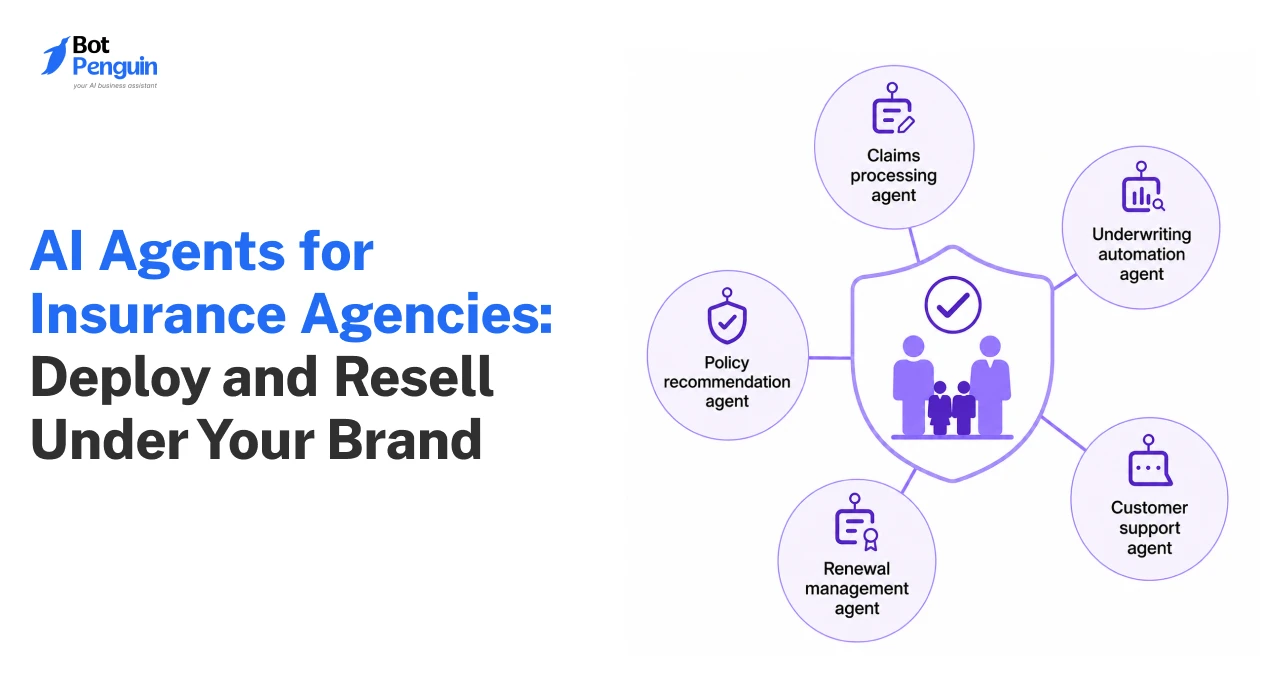
White label AI agents for insurance let agencies and IT consultancies offer branded AI automation to insurance clients without building the technology themselves. Partners can package lead qualification, policy FAQs, renewal reminders, and claims intake under their own brand, set client pricing, and build recurring revenue from insurance-focused AI services.
Insurance agencies deal with repetitive inquiries, high-value leads, and constant service demands. For digital agencies and IT consultancies, that creates a strong opportunity to resell AI agents to insurance agencies as a recurring service.
Instead of building the technology from scratch, agencies can offer branded AI agents for lead qualification, policy FAQs, renewal reminders, and first-level claims intake.
This guide explains how white label AI agents for insurance can be packaged, deployed, and managed for insurance clients while keeping compliance, human escalation, and recurring revenue in focus.
If you are an insurance business looking to use AI directly rather than resell it, explore our AI agents for insurance.
White label AI agents for insurance help agencies automate repeatable client workflows under their own brand. These include qualifying inbound leads, answering policy FAQs, sending renewal reminders, and collecting first-level claims information before human escalation.
The agents can work across WhatsApp and website chat while syncing conversation data with the insurance client’s CRM. This helps clients respond faster without changing how customers already reach them.
For digital agencies and IT consultancies, the value goes beyond automation. These workflows can be packaged into a recurring service that supports lead handling, customer support, renewals, and claims intake.
Because insurance workflows are structured, repetitive, and high-value, they are especially suitable for agencies looking to build repeatable AI service offerings.
The next section breaks down why insurance is especially attractive for agencies offering AI agent services.
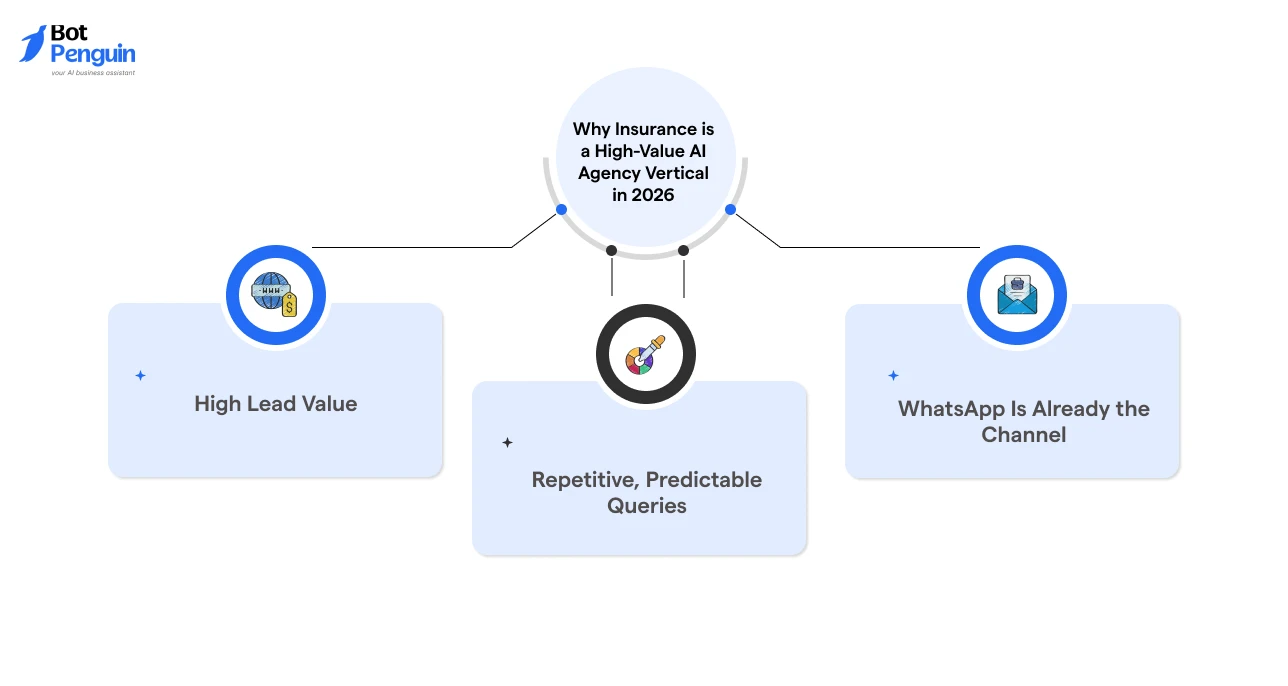
Insurance is a strong vertical for agencies building recurring AI services because its workflows are high-value, predictable, and easy to package across multiple clients.
For agencies exploring an insurance AI agent partner or reseller program, this creates a practical opportunity to combine repeatable deployments with ongoing optimization and client management.
The following explains the core characteristics that make the insurance industry particularly well-suited for AI agent services.
Because insurance leads can carry significant commercial value, improving qualification and response speed can make the service easier for clients to justify.
For agencies, that creates a clearer ROI story. The AI agent is not only reducing repetitive work but also helping insurance clients capture, qualify, and route more revenue opportunities.
AI agents trained on policy documents, FAQs, and approved knowledge sources can handle many repetitive customer questions before human involvement is needed.
For insurance clients, this can reduce routine support workload and improve response speed. For agencies, it creates an ongoing service that can be monitored, refined, and expanded over time.
For insurance businesses that already use WhatsApp for customer communication, it can be a practical channel for AI-assisted conversations.
Adding an AI agent to WhatsApp lets insurance clients handle lead qualification, routine questions, and follow-ups without introducing an entirely new customer touchpoint.
For agencies, this makes WhatsApp a useful channel to include when packaging white-label insurance AI services alongside website chat and CRM integrations.
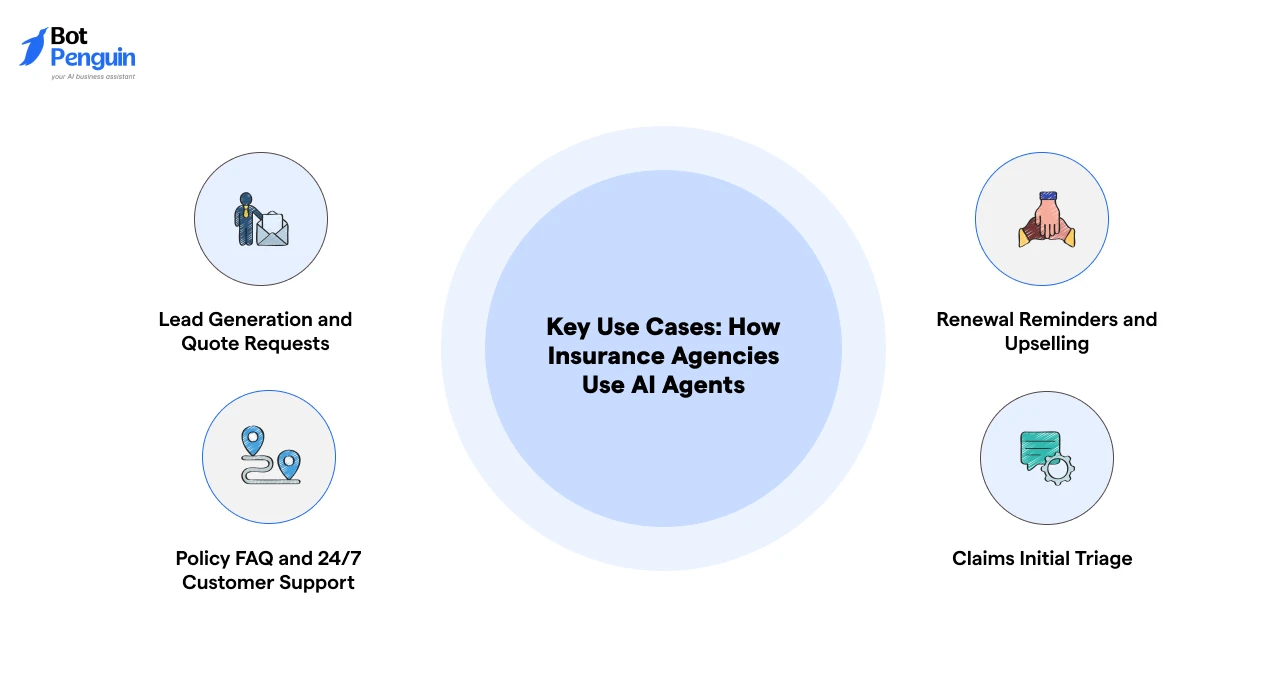
White label AI agents for insurance work best when agencies package them around clear, repeatable client workflows.
The strongest opportunities connect directly to lead capture, customer support, policy renewals, and claims intake. These workflows are easier to demonstrate, price, and manage as recurring services for insurance clients.
The following use cases show where agencies can create practical value while keeping sensitive decisions and complex cases with human teams.
The following sections break down how these workflows create practical operational and business value for insurance clients.
An AI agent on your insurance client’s website and WhatsApp engages inbound prospects the moment they arrive. It asks qualification questions about coverage type, current insurer, budget range, and timeline.
For qualified prospects, the AI agent can qualify prospects during the conversation and route suitable leads directly to the right insurance advisor. For prospects who do not qualify immediately, it automatically sets a follow-up schedule.
The agent can also respond outside normal business hours, helping insurance clients avoid leaving inbound prospects waiting for the next available team member.
For agencies focused on acquisition workflows, our guide to AI agents for lead generation explains how qualification, routing, and follow-ups work across client campaigns.
Customers of insurance agencies often ask the same policy questions: what a plan covers, how to make a claim, when renewal is due, how to add a family member, or how to update payment details.
Training the AI agent on approved policy documents, product information, and FAQs can reduce repetitive support conversations and give customers faster answers.
Insurance staff can then focus on complex queries, policy guidance, and cases that require human judgment.
This is where AI customer service agents for agencies become valuable. They help agencies offer insurance clients a structured support layer for repeated queries, instant replies, live-agent handoff, and consistent service across website chat and WhatsApp.
An AI agent connected to the insurance client’s CRM can trigger personalized renewal reminders before a policy expires.
These reminders can be delivered through supported channels such as WhatsApp, with links or instructions for the next renewal step. The same workflow can surface relevant coverage options based on approved client data and configured business rules.
Any recommendation requiring professional judgment should remain with the appropriate insurance advisor.
For insurance clients, automated reminders create a more consistent follow-up process around renewals. For agencies, this becomes another repeatable workflow that can be configured, monitored, and optimized as part of an ongoing AI service.
When an insurance customer initiates a claim, accurate initial data capture is important.
An AI agent can guide the customer through incident details, dates, locations, and involved parties before sending a structured intake summary to the claims team for human review.
Claims triage involves sensitive information and requires careful configuration. Complex, disputed, medical, or high-value claims should follow the insurance client’s approved human escalation rules.
These use cases show where AI agents create value, but insurance deployments also need strong compliance controls before agencies can confidently pitch them to clients.
The next section explains the compliance controls agencies need before deployment.
Compliance is often an important part of insurance technology evaluation, so agencies should address data handling, security credentials, and escalation rules early.
Insurance agencies handle regulated data, including personal financial information, sensitive claims details, and health records in the case of health insurance.
Insurance AI deployments may need to meet different privacy, security, and data-handling requirements depending on the client’s jurisdiction, business type, and data being processed.
Agencies serving regulated sectors can also compare this with white-label AI agents for healthcare clinics, where HIPAA-ready workflows and sensitive data handling are similarly important.
BotPenguin is GDPR, HIPAA, and CCPA compliant, ISO certified, SOC 2 attested, and VAPT-assessed by a CERT-In empanelled auditor. Data processing agreements are also available for clients who require formal documentation prior to deployment.
For agencies pitching AI services to insurance clients, clearly presenting relevant compliance credentials can help address security and data-handling questions early in the sales process. Include the relevant certification names in your proposal and ask BotPenguin for the required documentation to attach.
Compliance also affects how the AI agent is configured. Claims-related, disputed, medical, or high-value conversations should move to human teams immediately.
The AI agent can collect information, structure the query, and route it, but sensitive decisions should remain with licensed or authorized human staff.
Once compliance is clear, agencies can move from risk evaluation to deployment planning.
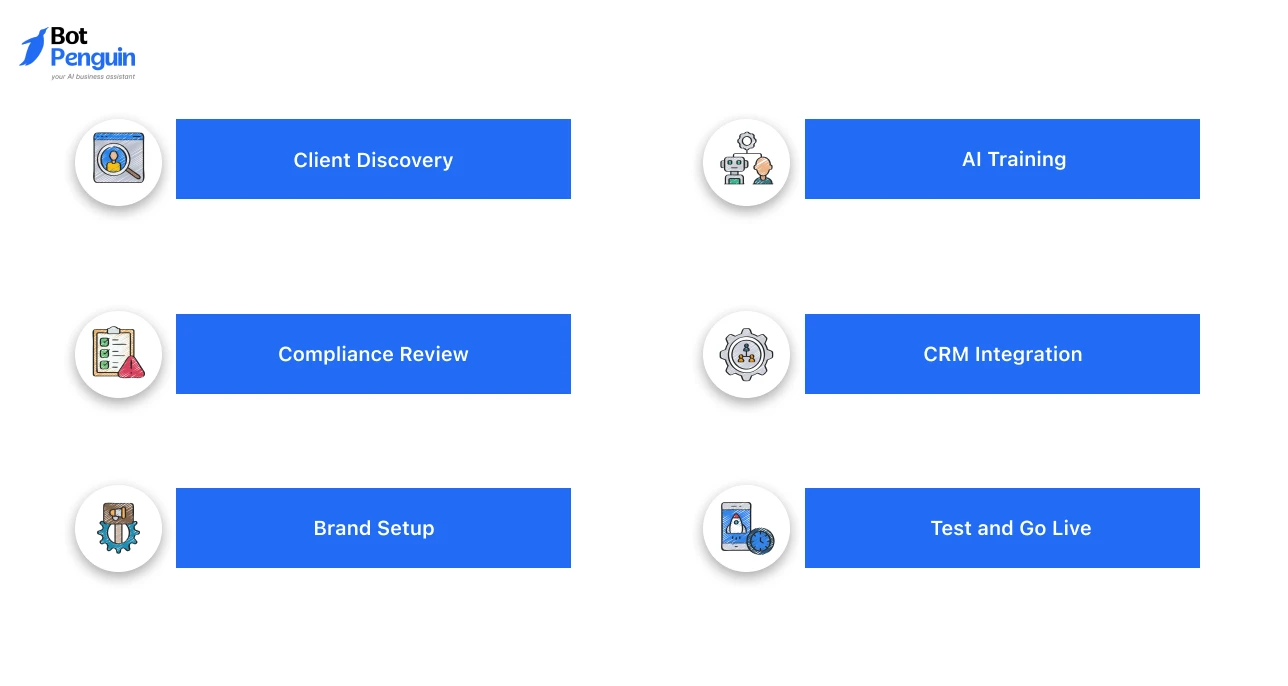
Agencies can turn white label AI agents for insurance into a repeatable client service by packaging discovery, compliance review, customization, integrations, testing, and ongoing optimization.
Each deployment can then be adapted to the insurance client’s workflows, branding, communication channels, and escalation requirements.
For agencies that want to package this as a recurring service, BotPenguin works as a white-label AI agent platform built for branded client deployments. Agencies can also explore the BotPenguin partner program to compare white-label, reseller, and affiliate models before choosing how to package their insurance AI services.
The steps below outline how agencies can move from client discovery to deploying a tested, branded insurance AI agent.
Start by mapping the client’s most frequent inbound queries, current lead qualification process, and renewal communication approach.
These inputs become the AI agent’s initial training set. They also help your agency identify which workflows to automate first, such as quote requests, policy FAQs, renewal reminders, or claims intake.
Confirm which regulations apply to the client’s business, such as GDPR, CCPA, or HIPAA. Then ensure the AI agent configuration meets those requirements.
Document the compliance setup in writing before go-live, especially for clients handling health insurance, financial data, or claims-related information.
Create a client workspace in BotPenguin’s partner dashboard with the client’s branding.
This includes connecting their WhatsApp Business number, embedding the website chat widget, and setting up the customer-facing experience so the deployment feels native to the insurance agency’s brand.
Upload product documentation, policy FAQs, lead qualification criteria, and renewal workflows.
Then configure escalation rules carefully. Any claims-related, disputed, medical, or sensitive query should route to a human immediately.
The AI agent should collect and structure information, not make sensitive insurance decisions.
Connect the client’s CRM, such as HubSpot, Zoho, or Salesforce.
This allows lead qualification data, policy queries, renewal prompts, and conversation records to sync automatically. It also helps the insurance client’s team follow up with full context instead of a scattered chat history.
Run a supervised testing period before full deployment.
During this stage, review conversation logs, test edge cases, refine training data, and adjust escalation rules. Move to full deployment only after the AI agent consistently handles approved workflows and routes sensitive conversations correctly.
The first insurance client deployment usually requires the most setup because your agency is creating the initial workflows, training structure, integrations, and escalation rules. Future client deployments can reuse that foundation, making the service easier to standardize and scale across multiple insurance accounts.
This makes white-label AI agents for insurance a repeatable service your agency can package, sell, and improve across multiple client accounts.
For a broader breakdown of platform ownership, pricing, and resale models, you can refer to our white-label AI agents guide.
Agencies can offer lead qualification, policy FAQs, renewal reminders, customer support, and first-level claims intake under their own brand. These white label AI agents can connect with client channels, business knowledge, CRM systems, and human escalation workflows securely for clients.
Yes. BotPenguin’s white-label partner program lets agencies offer AI agents to insurance clients under their own brand. Agencies can manage client workspaces, set their own pricing, keep the revenue they charge, and maintain full ownership of client relationships throughout independently.
Requirements depend on the client’s location, data, and workflows. Agencies should establish privacy controls, access permissions, data handling processes, and human escalation for sensitive claims, medical information, disputed cases, and regulated decisions before deploying AI solutions for insurance clients safely.
Agencies can use setup fees, recurring retainers, or bundled service packages. Pricing should reflect implementation, AI training, integrations, optimization, compliance support, and ongoing management. This gives partners flexibility to match pricing with client complexity and expected service scope accurately overall.
Website chat and WhatsApp are useful for lead qualification, policy questions, renewal reminders, and claims intake. Agencies should choose channels based on each insurance client’s customer behavior, existing communication processes, integration requirements, and compliance obligations across supported markets and workflows.
An insurance AI agent partner program lets agencies add AI services without building the underlying technology. Depending on the model, partners can white-label the platform, resell branded solutions, manage client accounts, set pricing, and create recurring revenue from deployments consistently.
Insurance is a strong vertical for agencies and IT consultancies offering recurring AI services. Their workflows include valuable leads, repetitive customer queries, renewals, and structured claims intake.
With white label AI agents for insurance, agencies can package these workflows under their own brand without building the underlying AI infrastructure.
BotPenguin’s white-label model lets partners manage client deployments, set their own pricing, and maintain control of the client relationship.
For agencies already serving insurance businesses, this creates a practical way to expand existing services with branded AI automation.
Subscribe to Our Newsletter
Get the latest business insights straight into your inbox.
Checkout our related blogs you will love.
Updated at Oct 7, 2026
13 min to read
Updated at Sep 21, 2026
11 min to read
Updated at Sep 21, 2026
15 min to read
Updated at Oct 14, 2026
11 min to read
Updated at Oct 14, 2026
10 min to read
Updated at Oct 14, 2026
10 min to read
Table of Contents