


What Is Zendesk and How Does It Work? A 2026 Guide
Updated at Oct 24, 2026
12 min to read

An HR helpdesk chatbot is an AI-powered employee support tool that answers routine HR questions, guides requests, and provides information about policies, leave, payroll, benefits, and onboarding. It gives employees faster self-service support, reduces repetitive helpdesk work, and escalates complex or sensitive issues to HR teams when needed.
HR teams handle a steady stream of employee questions about leave, payroll, benefits, policies, onboarding, and workplace processes. When every request requires manual attention, response times increase, and HR teams spend more time on repetitive support.
An HR helpdesk chatbot helps simplify this by giving employees instant access to routine information while routing complex or sensitive issues to the right HR team.
This guide explains what an HR helpdesk chatbot is, how it works, its key features and types, common use cases, major benefits, potential challenges, and what to consider when choosing one for your organization.
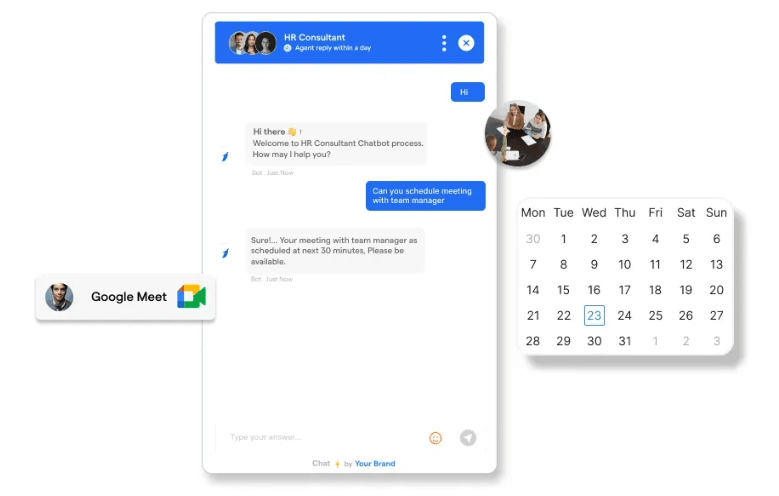
An HR helpdesk chatbot is an AI-powered tool that helps employees with HR-related queries and tasks. These chatbots can handle a wide range of functions, varying from answering FAQs to assisting with onboarding and payroll inquiries. Instead of waiting for a human representative, employees can get instant answers, improving satisfaction and efficiency.
HR helpdesk chatbots are one specialized type of HR chatbot, focused primarily on employee service and internal HR support.
The core role of an HR helpdesk chatbot is to enhance employee support. These bots can handle routine tasks like answering questions about benefits, company policies, or time-off requests.
Employees get faster answers, reducing the time spent waiting for human intervention. It’s a win-win for both HR departments and employees.
An HR helpdesk chatbot combines AI, automation, and natural language processing (NLP) to understand employee requests and provide relevant responses.
NLP helps interpret conversational language, while automation handles predefined actions. These can include retrieving policy information, guiding leave requests, or routing queries to the appropriate HR team.
The chatbot's performance can improve when HR teams review conversations, update its knowledge base, refine instructions, and adjust workflows. Escalate complex or sensitive requests to human HR staff.
An HR helpdesk chatbot is a boon for HR departments. It primarily addresses common problems HR departments face, creating a better experience for employees.
One of the best features of an HR helpdesk chatbot is its ability to provide round-the-clock support.
Consider Sarah, working late when her team is in another time zone. She needs access to her vacation days.
She doesn't want to wait till morning for the HR department to be online. The HR helpdesk chatbot makes this easily accessible at any time.
This constant access eliminates the need for employees to wait during office hours.
An HR helpdesk chatbot provides instant answers to common questions, from leave policies to benefits enrollment.
Imagine an employee, John, trying to determine whether his medical insurance covers a new treatment. Instead of waiting for an HR response, John can get the answer he needs right away through the chatbot, reducing frustration and downtime.
The more power the HR helpdesk chatbot has when it's connected to other HR systems, the better.
For example, if an employee wants to update personal details, a chatbot can retrieve the data from the HR system for verification and processing without errors or delays.
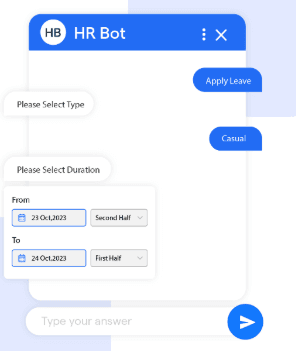
With an HR helpdesk chatbot, they can quickly handle tasks like submitting leave requests, viewing pay slips, or updating contact information without needing HR's direct involvement. This empowers employees and speeds up routine processes.
An HR helpdesk chatbot ensures that all employee data is treated with the utmost security.
Human resource systems store sensitive information, and the chatbot is designed to maintain confidentiality and comply with privacy regulations.
When an employee asks for salary details, the chatbot ensures only authorized personnel can access the information, keeping everything secure.
When selecting an HR helpdesk chatbot, it’s essential to understand the differences between the types available.
From simple, rule-based systems to more sophisticated AI-powered chatbots, the choice depends on your HR team’s needs and the complexity of the tasks at hand.
Simple doesn’t always mean better. While rule-based HR helpdesk chatbots are easy to set up and cost-effective, their lack of flexibility can be a major drawback.
These bots run on predefined scripts, making them efficient for basic questions but ineffective for anything outside the script.
An HR helpdesk chatbot with predefined scripts follows a flowchart: if the question fits, the bot responds, but if you ask something beyond its programming, the bot can’t help.
For example, it might answer questions like "How many sick days do I have?" but will struggle with custom benefit queries.
Pros:
Cons:
Rule-based bots are ideal for small businesses with straightforward HR needs. However, as questions get more complex, these bots quickly show their limits. Consider upgrading as your needs grow.
AI-powered HR helpdesk chatbots use NLP and AI models to understand varied employee questions and respond based on context and approved HR information.
Unlike rule-based chatbots, they can understand different ways of asking the same question without depending entirely on one predefined conversational path.
When an employee asks about vacation policies, expense claims, or workplace procedures, the chatbot identifies the intent behind the question and retrieves relevant information.
It can also guide employees toward forms, policies, or connected HR workflows when additional action is required.
Performance should be reviewed regularly. HR teams can analyze conversations, expand the knowledge base, refine instructions, and correct weak responses over time.
Pros:
Cons:
AI-powered HR helpdesk chatbots are useful for organizations with diverse or evolving employee support needs.
They work well when employees need conversational support across policies, benefits, payroll, onboarding, and other HR topics. However, they require ongoing review to keep responses accurate and reliable.
What if the simplest solution isn’t always the best? Hybrid HR helpdesk chatbots prove this by blending the straightforwardness of rule-based bots with the adaptability of AI to offer both efficiency and flexibility.
A hybrid HR helpdesk chatbot starts with the basics.
If an employee asks about vacation policies, the bot gives a standard response, like “You’re entitled to 20 days off per year.”
But it doesn’t stop there. When the same employee asks for more personalized details, such as extra holiday benefits based on their department, the chatbot uses AI to pull up tailored information. This mix of rule-based efficiency and AI flexibility makes hybrid bots effective for most workplaces.
Pros:
Cons:
Hybrid bots are ideal for businesses that need both speed and personalization.
They work well in medium-sized companies with varied HR needs—handling both simple questions and complex, customized requests without the high costs of fully AI-powered systems.
HR helpdesk chatbots can support recurring employee requests across onboarding, leave, payroll, engagement, knowledge access, and incident reporting.
Here are some common ways organizations can use them across HR operations.
New employees often need quick access to forms, policies, benefits information, training schedules, and other onboarding resources.
An HR helpdesk chatbot can guide new hires through these steps, answer common questions, and direct them to the right documents. This reduces repetitive HR follow-ups while helping employees complete onboarding tasks on time.
Employees can use an HR helpdesk chatbot to check leave balances, understand time-off policies, and submit leave requests.
When connected to the appropriate HR systems, the chatbot can guide the request through the configured approval process. This makes routine leave management easier for both employees and HR teams.
Employees frequently have questions about payslips, deductions, bonuses, benefits, or insurance information.
An HR helpdesk chatbot can provide approved information or retrieve relevant details from connected HR systems when authorized. More complex payroll or benefits issues can then be routed to the appropriate HR team.
HR teams can use helpdesk chatbots to collect feedback after internal events, policy updates, training programs, or other workplace initiatives.
These conversations can make it easier to gather recurring employee feedback at scale. HR teams can then review responses and identify areas that may require additional communication or action.
Employees often need quick answers about company policies, benefits, leave, workplace procedures, and other recurring HR topics.
An HR helpdesk chatbot can make approved HR information available through a conversational interface. This gives employees easier access to information while reducing repetitive questions for HR teams.
An HR helpdesk chatbot can guide employees through a structured incident-reporting process and collect the information required for further review.
It can then route the submission to authorized HR personnel according to the organization's configured workflow. Sensitive reports should use appropriate privacy controls, access restrictions, and clear human follow-up procedures.
HR helpdesk chatbots can improve everyday employee support by making routine HR information easier to access. They can also reduce repetitive administrative work when used alongside appropriate human support.
Employees often need quick answers about leave, benefits, policies, payroll, or workplace procedures.
An HR helpdesk chatbot can provide supported information immediately instead of requiring employees to wait for HR availability. This is particularly useful for distributed teams working across different schedules or locations.
HR teams regularly receive repetitive questions about policies, leave, employee records, benefits, and other routine matters.
A helpdesk chatbot can handle many of these recurring requests or guide employees toward the appropriate resources. HR professionals can then spend more time on complex cases and responsibilities that require human judgment.
Employees benefit when routine HR information is easy to access and does not require repeated follow-ups.
A helpdesk chatbot provides a self-service option for common questions while keeping human support available for complex or sensitive issues. This can create a more accessible and consistent employee support experience.
HR helpdesk chatbots can reduce the administrative effort required to handle high-volume, repetitive employee requests.
By automating suitable routine interactions, organizations can reduce the time HR teams spend answering the same questions and processing simple requests. This lets existing HR resources focus on work that requires expertise, judgment, or direct employee involvement.
Suggested Reading:
7 Inspiring Recruitment Chatbot Case Studies
Despite the numerous advantages, HR helpdesk chatbots do have challenges that companies must consider.
Implementing an HR helpdesk chatbot can be complex, especially when integrating it into organizational systems.
A large company may need extra effort to integrate the chatbot with existing HR software, such as payroll or performance management systems.
Installation takes time, resources, and expertise to ensure it operates smoothly.
It means that while a chatbot can handle repetitive tasks efficiently, it often lacks the emotional intelligence a sensitive issue may require.
An employee going through a personal crisis may need to discuss a leave of absence.
The HR helpdesk chatbot may not provide the emotional support or empathetic ear a human HR representative could, leaving the employee feeling out of touch.
HR helpdesk chatbots may handle sensitive employee information related to salary, benefits, leave, personal details, or other HR matters.
Organizations should use appropriate access controls, secure integrations, and clear data-handling policies. The chatbot should retrieve or display only the information the requesting employee is authorized to access.
Sensitive or high-risk requests should also have clear escalation paths to authorized HR personnel.
While HR helpdesk chatbots excel at routine tasks, they may struggle with more complex queries.
This might mean that an employee seeking clarification on tax deductions or benefits would receive an incorrect answer from the chatbot, which might confuse and frustrate them. In such cases, employees would still need human HR staff to resolve the issue.
Choosing the right HR helpdesk chatbot depends on your organization's specific needs and structure.
Here’s what to consider when deciding.
A local coffee shop or small business may need only a minimal HR helpdesk chatbot that can answer basic employee questions about vacation policies and company holidays.
A large company with complex HR requirements would need a more sophisticated chatbot that connects to payroll, performance reviews, and benefits management.
The HR helpdesk chatbot should work with the systems required for your intended employee-support workflows.
Depending on your use case, this may include an HRIS, payroll platform, benefits system, time-off management tool, or other HR software.
Before selecting a chatbot, identify which systems need to exchange information and confirm the required integrations are available and fit your workflows.
An HR helpdesk chatbot should be able to support changing requirements as the organization grows.
Consider whether it can accommodate additional employees, locations, languages, policies, and HR workflows without rebuilding the support system.
Customization is also important for aligning responses, workflows, and employee experiences with the organization's specific HR processes.
An HR helpdesk chatbot can make everyday employee support faster, more consistent, and easier to access. From onboarding and leave management to payroll questions, policy support, and incident routing, it can handle many repetitive HR interactions while reducing HR teams' workload.
However, successful implementation depends on more than automation alone.
Organizations need reliable HR information, secure integrations, appropriate access controls, scalability, and clear human handoff for sensitive or complex issues.
The right HR helpdesk chatbot should support employees without replacing the judgment and empathy of HR professionals. Together, they help organizations provide more efficient employee support while allowing HR teams to focus on higher-value responsibilities.
An HR helpdesk chatbot uses AI, automation, and natural language processing to understand and respond to employee queries, offering 24/7 support and handling routine tasks without human intervention.
HR helpdesk chatbots offer faster response times, reduce HR staff workload, improve employee satisfaction, and save costs by automating repetitive tasks and providing instant support.
There are three main types: rule-based chatbots, AI-powered chatbots, and hybrid chatbots that combine both approaches, offering varying levels of complexity and customization.
Yes, HR helpdesk chatbots can integrate with existing HR software, payroll systems, and time-off management tools, enhancing the overall HR workflow and providing seamless support.
HR helpdesk chatbots gather feedback, conduct surveys, and provide instant answers to HR-related questions, helping to enhance communication, increase transparency, and improve overall employee engagement.
Subscribe to Our Newsletter
Get the latest business insights straight into your inbox.
Checkout our related blogs you will love.
Updated at Oct 24, 2026
12 min to read
Updated at Oct 23, 2026
10 min to read
Updated at Oct 16, 2026
8 min to read
Updated at Oct 15, 2026
7 min to read
Updated at Oct 13, 2026
17 min to read

Updated at Oct 12, 2026
15 min to read
Table of Contents