Key Features to Look For in AI Phone Answering Systems
11 Best AI Phone Answering Systems for Restaurants in 2025
Comparison Table (At a Glance)
Calculating ROI with AI Restaurant Ordering
Conclusion
Frequently Asked Questions (FAQs)
Share
Half your restaurant calls never get answered.
That means thousands of dollars slip away every month without you even noticing.
Customers do not wait on hold anymore. They hang up, order somewhere else, and you lose them for good. Staffing shortages make it harder because your team cannot juggle phones, in-person guests, and online orders at the same time.
This is why restaurants in 2025 are turning to AI phone answering systems. These tools make sure every call is picked up, every order is taken, and every reservation is secured. In this guide, we’ll compare the 10 best options.
Why Restaurants are Adopting AI in 2025
Phones keep ringing even when your staff is already stretched thin. A busy shift often means calls go unanswered, and with every missed order or reservation, revenue quietly slips away.
Customers expect instant service, whether they are booking a table at midnight or calling during peak dinner hours.
This is where voice ordering for restaurants and ai restaurant ordering step in, giving restaurants a way to capture every call without adding to staff stress.
Missed calls hurt revenue: A family calling to order dinner hangs up after waiting too long. That meal goes to a competitor.
Staff shortages create gaps: With fewer people at the front, phones get ignored while staff handle walk-ins.
24/7 service is expected: Guests want to book a table late at night or place an order when the kitchen opens. AI never takes a break.
ROI is clear: Covering after-hours calls alone can recover thousands of dollars in lost sales each month.
By 2025, restaurants are adopting AI not as a luxury but as a necessity to stay competitive. The real difference lies in what these systems can do.
That’s why the next step is understanding the key features that make an AI phone answering system worth your investment.
Key Features to Look For in AI Phone Answering Systems
Knowing that restaurants are moving toward automation, the next step is choosing the right system. Not all tools work the same. Some are built for small diners, others for high-volume chains.
A good ai answering service for restaurants should not only answer calls but also fit smoothly into your daily operations. Think of it as hiring a reliable team member who understands your menu, speaks your customer’s language, and never misses a shift.
Evaluating the right features upfront can save you from wasted spend and ensure the system actually drives results.
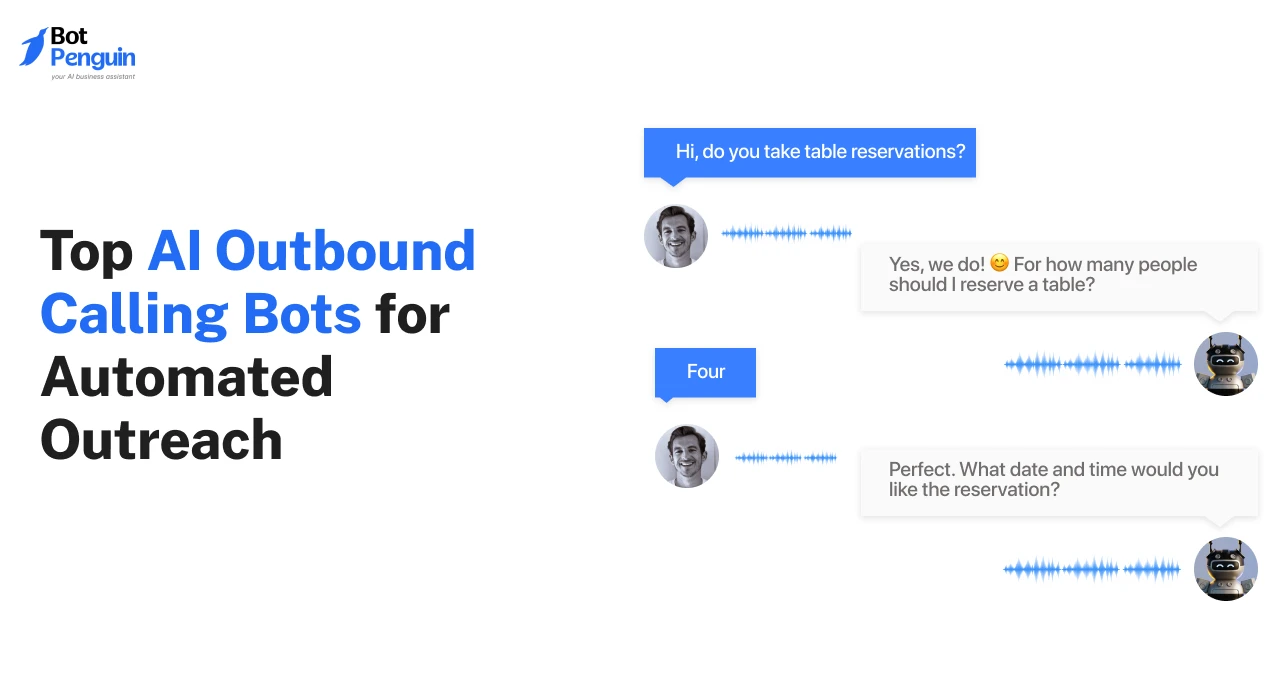
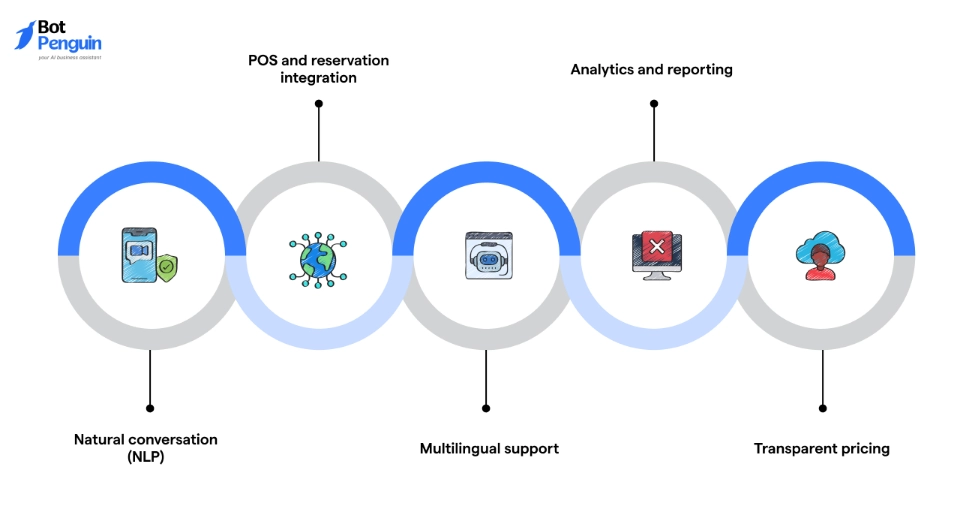
Natural conversation (NLP): The AI should understand everyday speech. For example, when a caller says, “Can I book a table for four tomorrow at 7?” the system should confirm the details without sounding robotic.
POS and reservation integration: Orders and bookings should go straight into your system. Imagine a customer calling for a pizza, and the AI directly pushes it into your POS, reducing errors and saving staff time.
Multilingual support: In areas with diverse guests, being able to answer in multiple languages is a must. It ensures no customer is turned away simply because of a language gap.
Analytics and reporting: Beyond answering calls, the system should provide insights. Knowing peak call hours or most common customer questions helps managers plan staffing and menu decisions.
Transparent pricing: Costs should be clear and predictable. Restaurants need to know whether the service is billed monthly, per call, or per conversation to avoid budget surprises.
These features separate a basic tool from a system that truly supports growth. With that in mind, it’s time to look at the top players shaping this space in 2025 and how they compare.
11 Best AI Phone Answering Systems for Restaurants in 2025
Once you know what features matter, the next step is comparing providers. Not every tool fits every restaurant. Some specialize in fast takeout orders, others in reservations and guest experience.
The right ai phone answering system for restaurants should match your size, call volume, and customer needs. Below are ten of the best platforms in 2025, structured so you can quickly scan what each offers.
1. BotPenguin Voice Agent
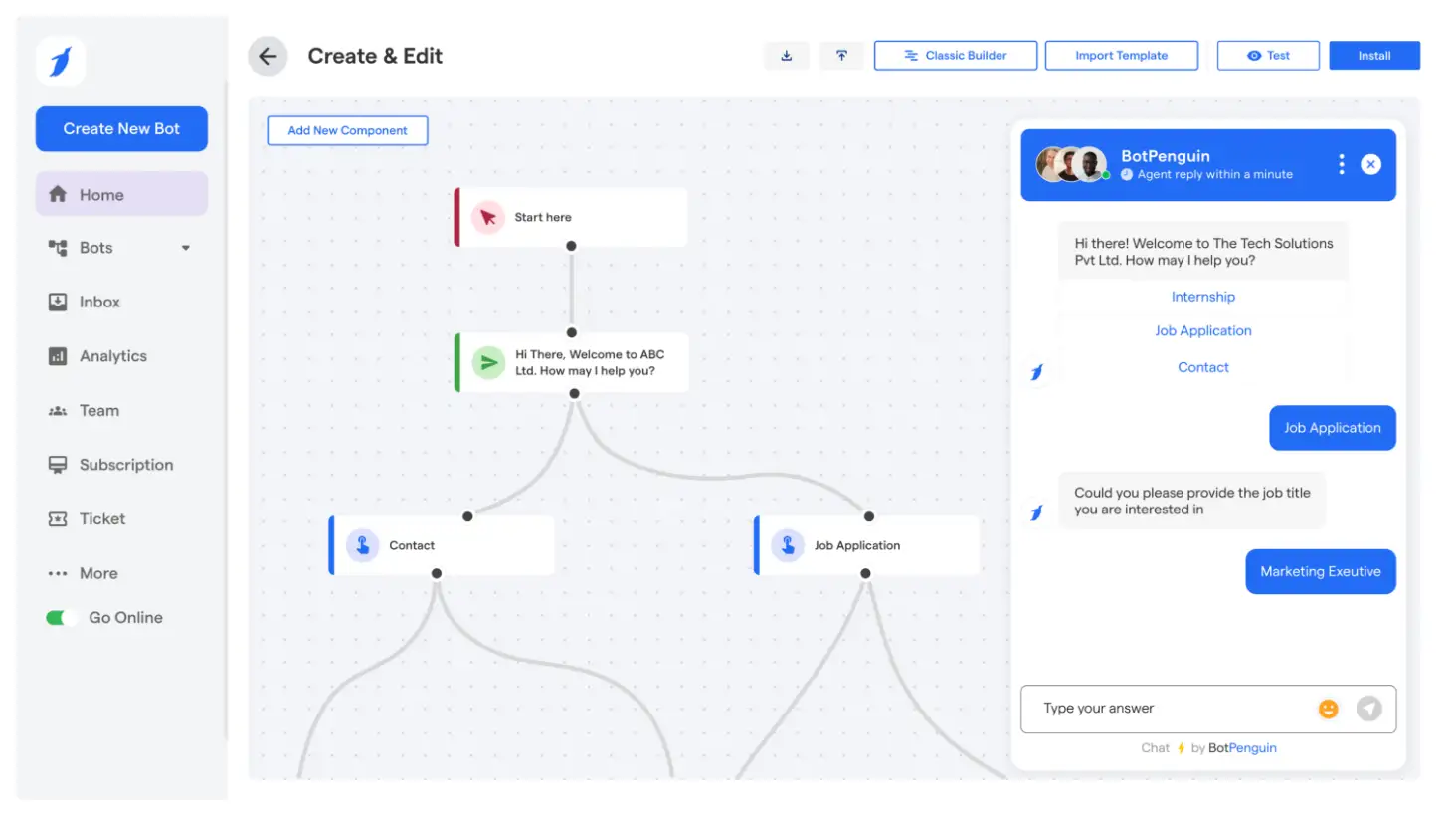
BotPenguin is an AI agent platform that combines chatbots, live agents, and voice agents into a single system. For restaurants, the Voice Agent functions as a 24/7 AI phone answering service.
It handles voice ordering, reservations, FAQs, and even escalates complex calls to human staff when needed. Unlike many US-focused competitors, BotPenguin is globally available, making it practical for restaurants across regions — from independent cafés to multi-location chains.
Standout Features
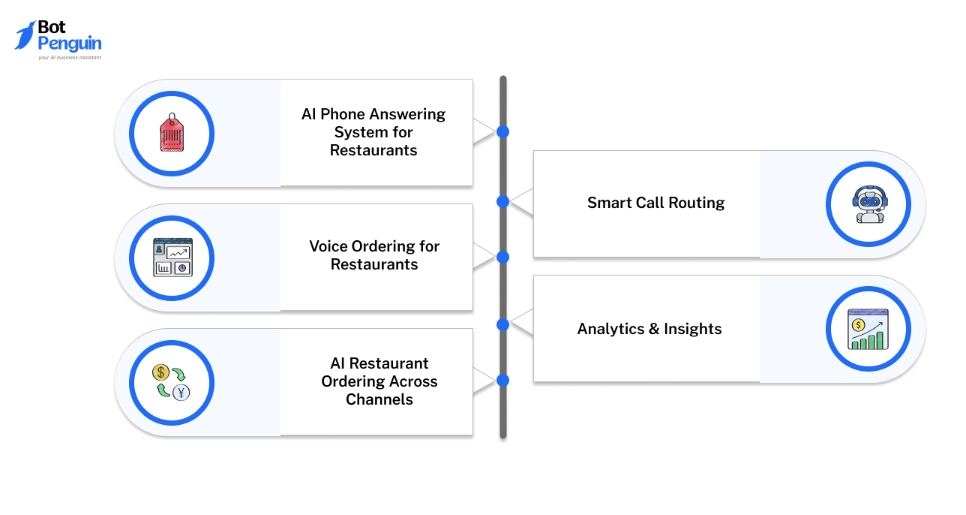
AI Phone Answering System for Restaurants: Answers calls instantly to reduce missed orders and reservations.
Voice Ordering for Restaurants: Enables customers to place takeout or delivery orders by speaking, with confirmations via SMS/email.
AI Restaurant Ordering Across Channels: Unified agent works on phone, WhatsApp, Messenger, Instagram, and web chat for consistent customer experiences.
Smart Call Routing: Escalates VIP or complex inquiries to managers while filtering routine calls.
Analytics & Insights: Provides transcripts, order summaries, and performance reports to measure ROI.
Integrations
Native support for Twilio (calls), SIP, WhatsApp API.
Connects with Shopify, WooCommerce, HubSpot, Zoho, and 80+ third-party apps.
POS order syncing possible via Zapier or custom API configuration.
Pricing
Free trial plan available for testing and small operations.
Details of paid plans are shared directly by the sales team.
Considerably more budget-friendly than most niche AI answering systems.
Pros
Global reach with VoIP/Twilio, ideal for restaurants outside the US.
All-in-one platform: Combines chatbot, live chat, and phone answering in one system.
Affordable: One of the lowest-cost AI answering options in the market.
Flexible integrations with popular CRMs and commerce platforms.
Cons
POS sync requires setup through Zapier/API (not native for all systems).
Not restaurant-exclusive; flows may need some customization for dining-specific use cases.
Best For
BotPenguin Voice Agent is best for global restaurants, independents, and budget-conscious operators who want AI phone answering plus multichannel support at a fraction of the usual cost.
It’s an especially strong fit for businesses outside the US market where most competitors don’t operate. For restaurants wanting to unify calls, chat, and messaging into a single AI-driven system without breaking the bank, BotPenguin delivers unmatched value.
Your Staff Can’t Answer Every Call But BotPenguin can — 24/7 Reservations, Orders, & Happy Customers
Try BotPenguin
2. Slang AI
Slang AI is a voice AI phone answering system for restaurants built specifically for the hospitality industry. It works as a virtual host, available 24/7 to handle reservations, menu questions, and even leads for private dining.
Unlike traditional phone menus, it lets callers speak naturally and responds in a warm, human-like tone that feels personal.
Standout Features
Reservation integration: Syncs directly with OpenTable, SevenRooms, and Tripleseat for real-time booking.
Cross-location booking: If one branch is full, it suggests an available table at another location.
VIP call routing: Identifies repeat or high-value customers and routes them to the right staff.
Smart alerts: Notifies staff about important calls like catering inquiries or complaints.
Customer satisfaction tracking: Maintains a 96%+ CSAT score from caller interactions, showing strong conversational quality.
Pricing
Starts at $199/month for basic coverage.
Mid-tier plans average $380/month.
Premium tier can go up to $599/month with added volume and features.
Custom add-ons available depending on needs.
Pros
Purpose-built for restaurants with deep industry integrations.
Highly conversational and context-aware.
Detailed analytics and transcripts.
Strong track record with full-service dining.
Cons
Higher price than some alternatives.
Primarily English support (Spanish available in select cases).
May be too advanced for very small restaurants with low call volume.
Best For
Slang AI is best for full-service restaurants, upscale dining, and multi-unit groups. It is especially effective for businesses that rely heavily on reservations and want to offer a concierge-like experience.
Restaurants using platforms like OpenTable or SevenRooms will see maximum value.
3. Kea AI
Kea AI is one of the pioneers of AI phone ordering for restaurants. It specializes in takeout and routine phone orders, making it especially valuable for quick-service and fast-casual restaurants.
Kea’s AI virtual assistant answers calls with high accuracy, handles order modifications, and integrates with delivery platforms, ensuring staff can focus on in-person guests rather than being tied to the phone.
Standout Features
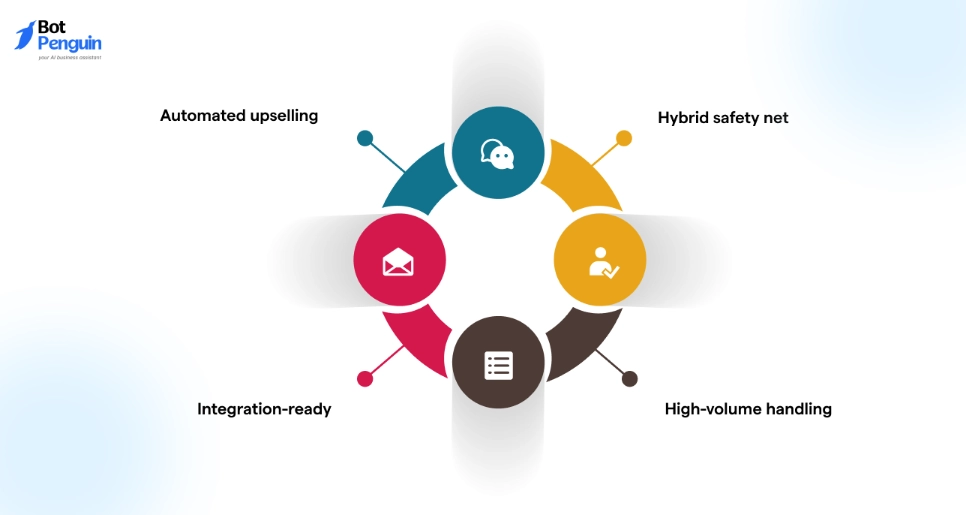
Automated upselling: Suggests add-ons like drinks or sides on every order, increasing average ticket size.
Hybrid safety net: A live service rep can monitor calls and step in if necessary, ensuring complex or VIP orders are never mishandled.
Integration-ready: Works with platforms such as Olo and various POS systems for seamless kitchen workflows.
High-volume handling: Manages multiple calls at once so customers never get a busy signal.
Pricing
Starts at around $199/month for the basic service.
Pricing scales based on order volume, number of locations, or enterprise needs.
Discounts and pilot programs are often available, with some reports noting up to 15% off annual plans for new sign-ups.
Pros
Proven to increase order revenue through consistent upselling.
Reliable in high-volume environments.
Integrates with common POS and delivery systems.
Human oversight option provides extra reliability.
Cons
Primarily focused on ordering, not reservations or general customer inquiries.
Best suited for multi-unit operations rather than very small independents.
Integration list is somewhat specific (e.g., best for those already using Olo).
Best For
Kea AI is ideal for quick-service restaurants, fast-casual chains, and busy takeout operations. Think pizza shops, burger joints, or franchise models that need consistent, error-free ordering across multiple locations.
For restaurants where phones are constantly tied up with food orders, Kea ensures every call is answered and every upsell opportunity is captured.
4. ConverseNow
ConverseNow is a conversational AI platform built for enterprise restaurants. Founded in 2018, it powers virtual ordering assistants that automate phone and drive-thru orders at scale.
Instead of relying on call centers or in-store staff, it manages limitless concurrent calls, eliminating hold times and busy signals.
Today, it is live in 1,800+ locations across the US, with brands like Wingstop, Domino’s, and Fazoli’s among its clients.
Standout Features
Enterprise scalability: Handles unlimited concurrent calls and drive-thru orders with no delays.
Menu-trained AI: Deeply trained on brand-specific menus (e.g., Wingstop) to improve accuracy.
Dynamic upselling: Consistently suggests add-ons, boosting average check size.
Bilingual conversations: Switches between English and Spanish seamlessly for diverse markets.
No new hardware needed: Integrates directly into existing phone and drive-thru systems.
Managed service: Includes reporting and a support team to optimize AI performance over time.
Pricing
Pricing is custom enterprise-based.
Contracts are negotiated by chain size, call volume, and locations.
Geared towards mid-to-large operators with 50+ stores.
Pros
Scales effortlessly for national chains.
Proven in real-world deployments with household QSR brands.
Supports both phone and drive-thru channels.
Bilingual capabilities broaden market coverage.
Increases order revenue through consistent upselling.
Cons
Not suited for single-location independents.
Requires enterprise-level investment.
More focused on orders than reservations or general inquiries.
Best For
ConverseNow is best for enterprise restaurant chains, QSRs, and franchises with high call and drive-thru volumes.
It’s especially valuable for pizza, burger, or fast-food brands that need consistency and scalability across hundreds of units. With Domino’s and Wingstop already on board, it stands out as a proven system for large-scale operators.
5. PolyAI
PolyAI is known for creating exceptionally lifelike conversational AI assistants. In the restaurant industry, it has gained prominence through its partnership with OpenTable, where it powers AI reservation agents for enterprise restaurants.
PolyAI acts like a virtual front-of-house receptionist, handling inbound calls, booking or modifying reservations, answering common guest questions, and ensuring no call goes unanswered.
Unlike menu-driven bots, it offers a “guest-led” experience, allowing customers to speak naturally while the AI manages the flow of the conversation gracefully.
Standout Features
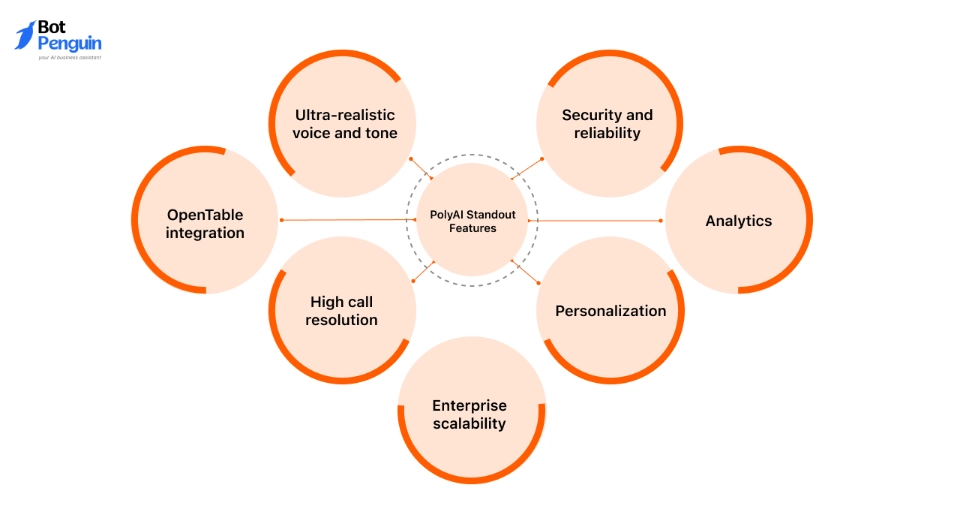
Ultra-realistic voice and tone: Conversations sound almost indistinguishable from a real person, building trust with guests.
OpenTable integration: Automates booking, cancellations, and modifications in real time, synced directly into OpenTable.
High call resolution: Can independently handle up to 70% of guest calls, reducing staff workload.
Enterprise scalability: Supports multi-location chains and allows variations for different concepts within the same group.
Personalization: Recognizes repeat callers and integrates with CRMs to recall loyalty members or preferences.
Analytics: Provides insights into caller trends, frequent questions, and service performance.
Security and reliability: Enterprise-grade uptime, compliance, and support.
Pricing
Operates on custom enterprise pricing based on locations, call volume, and feature needs.
Costs are aligned with or lower than hiring call center staff or in-house reservationists.
Smaller independent restaurants may find it less cost-effective.
Some OpenTable enterprise packages may include PolyAI access as part of the partnership.
Pros
Industry-leading human-like voice quality.
Strong reservation and hospitality focus, perfect for guest experience.
Seamless integration with major platforms like OpenTable.
High percentage of calls resolved without human involvement.
Multi-language support for global or diverse customer bases.
Cons
Enterprise-only: not accessible to single-location small businesses.
Requires setup and training for specific use cases.
Primarily built for reservations and hospitality rather than food ordering.
Best For
PolyAI is best suited for upscale dining groups, large restaurant enterprises, hotels, and hospitality brands where reservations and guest experience are critical. It is ideal for fine-dining groups or multi-unit chains that want to provide consistent, white-glove phone service.
Restaurants already using OpenTable at scale will benefit most, as PolyAI can modernize their phone answering and ensure every call leads to a booked reservation or satisfied guest.
6. SoundHound (Smart Ordering & Answering)
SoundHound is a well-established name in voice AI technology and has made a strong entry into the restaurant space with its Smart Ordering and Smart Answering solutions. Known for powering drive-thru bots at brands like White Castle, it also supports phone ordering and virtual assistance for restaurants of all sizes.
By combining years of speech recognition expertise with restaurant-specific training, SoundHound enables fast, accurate, and natural interactions that reduce friction for both customers and staff.
Standout Features
Speed and accuracy: Processes orders in just over 60 seconds on average in live deployments, often faster and more precise than human staff.
Noise cancellation: Optimized for noisy environments like drive-thrus, ensuring clarity even in challenging conditions.
Multi-channel support: The same AI can manage both phone calls and drive-thru intercoms.
Menu customization: Tailors the AI to a restaurant’s specific menu and FAQs.
POS integration: Orders flow directly into POS systems to reduce manual entry errors.
Multilingual capability: Handles multiple languages in one interaction, supporting diverse customer bases.
Employee-friendly design: Takes over repetitive tasks like answering phones, freeing staff to focus on in-person service.
Pricing
Custom enterprise pricing for large chains with high call volumes.
Packages available for small and mid-sized restaurants through SoundHound’s Smart Answering service.
Pricing typically includes an onboarding fee plus either monthly or per-call billing.
Exact costs depend on call volume and restaurant size.
Pros
Proven track record with well-known restaurant brands.
Exceptional order-taking speed and throughput.
Handles noisy environments and diverse accents effectively.
Applicable across multiple channels (phone + drive-thru).
Backed by decades of AI and voice recognition experience.
Cons
Primarily designed for ordering, less emphasis on reservations.
Custom integrations may require technical setup.
Smaller independents may find enterprise options costly unless using SMB plans.
Best For
SoundHound is best for quick-service and fast-casual brands, particularly those with drive-thru or heavy phone ordering operations. Busy burger chains, pizza delivery restaurants, or any concept where speed translates directly to revenue can benefit significantly.
For tech-forward operators wanting a battle-tested AI solution trusted by national brands like White Castle and Checkers, SoundHound is a reliable choice.
7. Loman AI
Loman AI is designed for small and mid-sized restaurants that want a 24/7 virtual receptionist without enterprise-level complexity. It manages inbound calls, takes orders, books reservations, and answers routine questions, all while staying affordable.
Unlike generic phone bots, Loman AI has been trained with real-world restaurant scenarios, making it particularly effective at handling catering inquiries and large bookings.
Standout Features
Simultaneous call handling: Ensures no caller gets a busy tone, even during peak rush.
POS and booking integrations: Works with popular POS systems and reservation platforms for automated order and calendar management.
Catering support: Collects details for large catering requests or routes them directly to the catering manager.
Flexible call routing: Urgent calls can be forwarded instantly to a manager’s cell phone.
Information handling: Provides hours, directions, and other FAQs without staff involvement.
Customization: Onboarding process fine-tunes the AI to match each restaurant’s menu, policies, and workflows.
Pricing
Starts around $199/month for the basic package.
Promotions occasionally offered (e.g., 10% off and waived onboarding fees for new sign-ups).
Pricing scales for multi-location operations or higher call volumes.
Positioned as an affordable alternative compared to larger AI providers.
Pros
Built with restaurants in mind, including catering and banquet reservations.
Strong POS and booking integrations streamline daily operations.
Accessible pricing for independents and small groups.
Handles multiple calls at once, preventing missed revenue opportunities.
Easy to forward complex calls to staff if needed.
Cons
Newer in the market compared to giants like SoundHound or ConverseNow.
Language support appears limited, primarily English.
Lacks advanced AI extras like emotion detection or deep sentiment analysis.
Requires careful setup for restaurants with very complex call flows.
Best For
Loman AI is a strong fit for independent restaurants, regional groups, and catering-focused businesses. It’s particularly useful for eateries that receive frequent calls about catering trays, banquet events, or large takeout orders.
For operators without a dedicated hostess or receptionist, Loman AI fills the gap at a manageable cost. In short, it’s a value-driven choice for small to mid-sized restaurants seeking reliability without overspending.
8. Hostie AI
Hostie AI is an AI-driven customer experience platform built for restaurants that covers calls, texts, reservations, and takeout orders in one solution.
Its AI persona “Jasmine” acts as a friendly virtual receptionist who ensures no customer inquiry slips through, whether it comes by phone or text.
Designed by restaurant operators, Hostie focuses on eliminating missed calls and providing a polished, guest-first interaction every time.
Standout Features
Omnichannel assistant: Handles phone calls, SMS, and reservations seamlessly.
20-language support (Premium+): One of the broadest options on the market.
POS & reservation integrations: Syncs bookings and orders in real time.
Team alerts & transcripts: Sends notifications and provides easy call records.
Event & takeout support: Premium plans include integrations for catering and takeout.
Mobile apps: Dedicated iPhone and iPad apps for on-the-go management.
Standard – $299/month: Everything in Basic + automated reservations, iOS app, reporting.
Premium – $399/month: Everything in Standard + takeout integration, event planning, AI texting, and 20-language support.
Enterprise (10+ locations): Custom pricing for multi-location groups with advanced needs.
Pros
Covers far more than just calls (text + reservations + takeout).
Competitive pricing tiers for independents and groups.
Built by restaurant operators, tuned for real-world needs.
20+ language support is a major plus for tourist-heavy or multicultural markets.
Easy-to-use apps and call transcripts for managers.
Cons
If you only need call answering, you may be paying for extra features.
Newer platform compared to giants like SoundHound or ConverseNow.
Setup requires connecting multiple systems (POS, reservations, events).
Best For
Hostie AI is ideal for small to mid-sized restaurants and growing groups that want a comprehensive AI concierge. It’s especially strong for operators with mixed communication needs — calls, catering, takeout, and SMS.
Restaurants in multilingual areas or those that want an all-in-one guest experience across channels will find Hostie’s Premium tier particularly valuable.
9. Whippy AI
Whippy AI is a modern AI-powered phone answering and communication platform built for restaurants and hospitality. Acting as a 24/7 virtual receptionist, it takes orders, books reservations, and answers guest questions with a natural, human-like tone.
Whippy is designed to preserve the human touch in automation, making conversations feel like they’re with your best host or hostess. Beyond calls, Whippy also unifies guest communication across SMS, email, WhatsApp, and VoIP into one platform.
Standout Features
Conversational NLP: Understands intent and asks natural follow-up questions instead of sticking to rigid scripts.
Emotion & sentiment detection: Spots caller frustration or urgency and escalates to staff immediately.
Multilingual support & custom greetings: Adapts to your brand and diverse customer base.
Integrations: Connects with reservation systems, POS, and CRMs to sync bookings and orders in real time.
Unified inbox: Consolidates all communications (voice, SMS, WhatsApp, email) into a single dashboard.
Manager tools: Mobile app and analytics dashboard for call monitoring, recordings, and live intervention.
Pricing
Lite – $150/month: Basic AI phone answering, Team Inbox, SMS campaigns, mobile app, 2,000 monthly credits.
Premium – $1,500/month: Everything in Growth + AI chatbots, translations (100+ languages), API/Webhooks, advanced reporting, 40,000 credits.
Professional – $3,000/month: Unlimited workflows and chatbots, job board integration, NPS feedback, dedicated support, 100,000 credits.
Custom Enterprise: Tailored pricing for large groups with SOC-2 and SSO support.
Pros
Hospitality-focused with polished, guest-like AI conversations.
Emotion detection and escalation prevent customer dissatisfaction.
Flexible pricing tiers — affordable for independents, scalable for large groups.
Omnichannel coverage ensures no communication is missed.
Strong manager visibility via app and dashboards.
Cons
Wide feature set may feel overwhelming for restaurants only needing phone coverage.
Advanced tiers can be costly for small independents.
Some integrations (like WhatsApp) depend on guest adoption.
Learning curve to fully utilize its omnichannel tools.
Best For
Whippy AI is best for restaurants of all sizes that want more than just call handling. Independents can start affordably with Lite, while multi-unit or hospitality groups can leverage its full omnichannel suite.
It’s especially valuable for owners who travel frequently or want remote visibility into guest interactions. If you’re looking for AI that blends human-like service with emotion-aware intelligence, Whippy stands out as one of the most advanced choices.
10. Maple Voice AI
Maple Voice AI is a transactional voice AI system designed specifically for restaurants that depend heavily on phone orders. Unlike receptionist-style AIs, Maple is optimized to complete entire orders end-to-end with speed and accuracy, making it ideal for QSRs and fast-casual brands.
It handles busy takeout and delivery environments where call volume is high, boasting under 2-second call pickup and 90%+ call completion rates. Maple emphasizes ultra-realistic voice quality and lightning-fast response times to keep customers engaged and reduce hang-ups.
Standout Features
Ultra-realistic voice quality: Human-like sound keeps callers comfortable and engaged.
Lightning-fast response: Replies within 0.5 seconds, nearly eliminating dead air.
POS & delivery integrations: Works with Toast, Square, Clover, and delivery platforms for seamless order entry.
Multi-location routing: Intelligently directs callers to the right branch or location.
Advanced analytics: Tracks AOV, completion rates, and caller patterns to provide actionable insights.
Data-driven insights: Turns phone orders into a measurable data source for operators.
Professional – $199/month(Most Popular): Adds support for 10 languages, advanced analytics, 10 voices, batch calling, appointment booking integration, warm call transfer, and priority support. Usage billed at $0.59/minute.
Premium – $299/month: Includes all major languages, 15 voices, SLA-backed advanced analytics, dedicated account manager, full integrations, and batch calling. Usage billed at $0.49/minute.
Enterprise Custom: Scales for multi-unit chains with volume discounts and tailored support.
Pros
Exceptional order automation with minimal staff intervention.
Highly accurate for complex menus with combos, variants, and add-ons.
Competitive entry-level pricing makes it accessible even for independents.
Provides detailed call analytics to improve operations.
Strongly order-focused — limited reservation or concierge functionality.
Multi-language support only fully available on higher tiers (in development for lower plans).
Newer player in the space, so long-term support and scale should be evaluated.
Best For
Maple Voice AI is ideal for QSRs, pizza shops, delivery restaurants, and high-volume takeout operations where speed and order accuracy drive revenue.
It’s particularly attractive to regional chains and independents doing $5K–$50K in monthly phone orders who want enterprise-level AI at a more affordable price. For restaurants that need fast, reliable, end-to-end phone ordering, Maple offers one of the best price-to-performance ratios on the market.
11. Maskd AI (Rhesto)
Maskd AI offers Rhesto, an AI receptionist platform built for restaurants and hotels. Designed in Washington state by a team with deep hospitality roots, Rhesto was created to directly solve the problem of missed calls in restaurants.
Acting as a 24/7 voice assistant, it takes orders, manages reservations, and handles guest inquiries, essentially working like a tireless front-desk employee.
What makes Rhesto stand out is its incredibly human-like sound and behavior, giving callers the feeling they’re speaking to a trusted staff member rather than a bot.
Standout Features
Human-like conversations: Mimics a natural receptionist’s tone and phrasing, making callers feel cared for.
Personalization: Remembers repeat customers by name and preferences, e.g., “Welcome back, would you like the same table as last time?”
After-hours booking: Can take 100% of orders and reservations even when the restaurant is closed.
System integrations: Connects with POS and reservation platforms to automate order and booking entries.
Unlimited call handling: No wait times, even during peak hours or rushes.
Hospitality-focused flows: Comes preloaded with conversational templates for common scenarios (lost items, dietary inquiries, etc.).
Proven ROI impact: Clients have reported up to 60% fewer abandoned calls and 25% more captured reservations after deploying Rhesto.
Pricing
Pricing details aren’t fully public, but Rhesto is offered as a monthly subscription service.
The Washington Hospitality Association noted a $50 discount for members, suggesting standardized plan tiers.
Likely ranges in the few hundred dollars per month per location, making it competitive with similar solutions.
Free demos are available, and pricing is positioned around the value of revenue recovery (e.g., saving even a few missed $25 orders can pay for the system).
Pros
Extremely natural and human-like voice experience.
Personalization sets it apart (few competitors advertise remembering guest names).
Direct focus on revenue recovery, not just answering calls.
Integrates seamlessly into existing POS and reservation workflows.
Endorsed and recognized by hospitality associations, adding credibility.
Cons
Newer entrant compared to bigger AI players.
Primarily English-focused (multi-language support not clearly stated).
Brand recognition is still developing beyond local and regional markets.
Highly unique call scenarios may require additional setup or training.
Best For
Rhesto is best for independent restaurants, regional eateries, and hospitality operators that want to maintain a personal touch on customer calls while gaining 24/7 coverage. It’s especially useful for businesses that lose revenue to voicemail or after-hours missed calls.
For example, a brunch cafe closed by mid-afternoon can still capture evening reservation calls for the next day, while a family restaurant slammed during dinner can rely on Rhesto to manage overflow.
If you’re a restaurant owner who says, “I want AI, but I don’t want it to feel like AI to my guests,” Rhesto is built for you.
Comparison Table (At a Glance)
Choosing the right system can feel overwhelming after reading about so many options. Busy restaurant owners often don’t have time to weigh every detail.
That’s why a quick side-by-side comparison of each ai phone answering system for restaurants is helpful. This table highlights the essentials: pricing tiers, standout features, best-fit scenarios, language support, integrations, and country availability.
For example, if you’re a café in Canada looking for a budget-friendly tool with WhatsApp integration, the table makes that clear. Or if you’re running a multi-location chain in the US and need enterprise-grade support, you’ll know which vendor is tailored for you.
Think of this as a shortcut to narrowing down your shortlist before diving into demos.
This comparison makes it clear that no two systems are the same. Some lean toward enterprise-scale ordering, while others focus on affordability and multilingual coverage.
With the shortlist in hand, the next step is to see how these platforms perform in the real world — and what kind of ROI restaurants are actually seeing after deployment.
Calculating ROI with AI Restaurant Ordering
Margins in restaurants are thin. Rising food costs, staff shortages, and demanding guests leave little room for error. That’s why calculating the return on investing in ai restaurant ordering is so important.
This isn’t about adding a shiny new tool. It’s about protecting revenue that’s already slipping through your fingers every time a call goes unanswered.
Think about what happens in a typical week:
Phones ring during the dinner rush, but no one can pick up.
A guest calls after hours to book a table, only to hear voicemail.
Staff forget to suggest a side or dessert that could have increased order value.
Your team spends hours on the phone instead of serving guests in front of them.
Each of these moments carries a cost. And when multiplied over weeks and months, the losses are larger than most owners realize.
Here’s how to put numbers to it:
Step 1: Track your missed calls per week
Use phone records or staff estimates. Even small cafés miss 10–15 calls, while busy takeout spots can miss 30 or more.
Step 2: Multiply by your average order or reservation value
At $25 per order × 15 missed calls = $375 lost weekly. A fine dining restaurant with $50 reservations could lose $750 for the same 15 missed calls.
Step 3: Annualize the number
$375 lost weekly adds up to $19,500 in a year. For higher-ticket businesses, it can be double or triple that.
Step 4: Compare against system costs
Most platforms charge $199–$399/month. If you’re losing nearly $20K annually, spending $4K to recover it is a clear return.
Step 5: Add upselling and efficiency gains
Unlike staff, AI never forgets to upsell. Suggesting drinks, sides, or desserts can raise average order values by 10–20%.
On top of that, staff freed from answering phones deliver better in-person service, which leads to happier guests and more repeat visits.
Scenarios to bring it home:
Café with walk-ins and takeout: 10 missed calls per week × $20 average order = $10,400 in lost revenue per year.
Pizzeria with heavy delivery volume: 25 missed calls per week × $30 order = $39,000 in losses annually.
Regional restaurant group: 100 missed calls per week across locations × $25 order = $130,000+ lost revenue.
Quick ROI Reference Table
Missed Calls/Week
Avg Order $20
Avg Order $30
Avg Order $40
10
$10,400
$15,600
$20,800
20
$20,800
$31,200
$41,600
30
$31,200
$46,800
$62,400
When you run the numbers, the case for ai restaurant ordering becomes clear. Even modest improvements in call handling quickly outweigh the cost of the system.
For many operators, this is the difference between flat growth and unlocking tens of thousands in recovered revenue each year.
Conclusion
For restaurants, phones remain one of the most important sales channels. Yet industry reports show that 30–40% of calls to restaurants go unanswered, often during peak hours.
That is revenue walking out the door. An ai phone answering system for restaurants solves this problem by ensuring every call is picked up, every reservation is logged, and every takeout order is confirmed.
The value is clear. Instead of losing thousands annually to missed calls, an ai answering service for restaurants recovers that revenue while freeing staff to focus on service. And when combined with cloud telephony, it ensures that calls aren’t just answered — they become opportunities to grow orders, boost guest satisfaction, and secure repeat visits.
BotPenguin brings this within reach for any restaurant — with 24/7 call handling, voice ordering, and multi-channel support at a fraction of typical costs.
Start your free trial today and turn every call into a guaranteed business opportunity.
How can an AI phone answering system for restaurants improve customer loyalty?
It guarantees quick responses, avoids missed calls, and creates consistent guest experiences, which makes customers feel valued and more likely to return.
What makes voice ordering for restaurants different from traditional phone ordering?
It automates call handling, processes multiple orders simultaneously, reduces hold times, and ensures accuracy without distracting staff from in-house service.
Can ai restaurant ordering handle special requests or dietary restrictions?
Yes. These systems recognize requests like gluten-free or extra toppings and pass details directly into the POS or kitchen workflow for accurate fulfillment.
How does an ai answering service for restaurants help during seasonal rushes?
It scales instantly, handling spikes in calls during holidays or weekends, ensuring every order and reservation is captured without overwhelming staff.
What security measures do providers of an ai phone answering system for restaurants usually follow?
They use encrypted communications, secure POS integrations, and compliance frameworks like GDPR or HIPAA to safeguard customer and payment data.
Why should restaurants consider BotPenguin as their ai answering service for restaurants?
BotPenguin offers 24/7 call handling, multi-channel ordering, and affordable plans, making it suitable for both small restaurants and multi-location groups worldwide.
Subscribe to Our Newsletter
Get the latest business insights straight into your inbox.


.webp)
.webp)



.webp)